Journal of Computing and Security
Multi-Constraint Optimal Path Finding for QoS-Enabled Smart
Grids: A Combination Approach of Neural Network and Fuzzy
System
Razieh Rastgoo
a, Vahid Sattari-Naeini
a,∗
,
aDepartment of Computer Engineering, Shahid Bahonar University of Kerman, 7616914111 Kerman, Iran.
A R T I C L E I N F O.
Article history:
Received:15 March 2017
Revised:24 June 2018
Accepted:17 July 2018
Published Online:02 December 2018
Keywords:
Smart Grid (SG), Routing Optimization, Neuro-Fuzzy (NF), Performance Improvement, Quality of Service (QoS).
A B S T R A C T
Smart Grid (SG) is an intelligent managed network including various data networks. Due to using the two-way data and electricity flows in SG, relations among the network elements are in an efficient way. Path finding optimization is one of the important challenges in SG. In this paper, we propose a routing protocol, namely Neuro-Fuzzy Stable Optimization Multi-Constrained Routing (NFSOMCR), to investigate the optimal path between two nodes in the SG. For this purpose, seven parameters and one cost function are used to meet the important QoS requirements of SG. Depending on the different initializations applied on the parameters, some routes with their constraints are found out by Dijkstra routing algorithm that form the inputs of the Neuro-Fuzzy system. The output of this system is the optimized cost function as well as the optimal paths between two nodes. Experimental results show that the proposed method outperforms existing works in terms of power cost and throughput.
c
2017 JComSec. All rights reserved.
1
Introduction
The Smart Grid (SG) is used to adapt technologically the future demand growth in electrical Grids [1–4]. SG collects various communication/networking technolo-gies into electrical power Grids to make them “smarter” [5]. Different communication networks in SG collect and transfer various information among different com-ponents of the network in order to support different requirements of SG applications [6]. Using the mutual flows of electricity and information in order to create an automated and widely distributed energy deliv-ery network is an important goal of the SG, which is redounded to have a more reliable, secure, efficient,
∗ Corresponding author.
Email addresses: [email protected](R. Rastgoo),
[email protected](V. Sattari-Naeini) https://dx.doi.org/10.22108/jcs.2018.106871.0
ISSN: 2322-4460 c2017 JComSec. All rights reserved.
and environmentally interpretable electrical Grid [7]. Automated and intelligent management is a critical component that determines the efficiency of the SG [8].
SG copes with different challenges that routing op-timization based on the Quality of Service (QoS) guar-antee is one of them [7–9]. QoS concept is much re-lated to the network performance in routing optimiza-tion of the communicaoptimiza-tion systems. Different network services require different QoS functionalities that can-not be supplied by the current QoS-unaware routing protocols [8]. Various QoS metrics and optimization techniques can be considered in QoS assessment of SG.
16]. We introduce some of the recent research works and protocols in the next section in order to have a suitable understanding of shortages and infects of the routing challenge in SG. Considering the defects and incompleteness of the existent routing protocols for SG, we propose a routing protocol, Neuro-Fuzzy Stable Optimization Multi-Constrained Routing (NF-SOMCR), by using seven parameters to show the QoS requirements in the SG. In addition, a cost function has been defined to collect the suggested parameters and optimize it by using the Neuro-Fuzzy technique. Sections 3 and 5 show the details of the NFSOMCR. The rest of this paper is arranged as follows. Sec-tion 2 reviews some literatures in routing optimizaSec-tion of SG. In Section 3, we introduce system model. A brief overview of neural network as well as fuzzy sys-tems has been expressed in the Section 4. We present our method for path finding, path selection based on the constraints in the paths, and details of the Neuro-fuzzy system used to optimize the routing protocol in Section 5. In Section 6, we provide the details of the experimental results of the proposed protocol and compare it by the recent research works. Eventually, with Section 7 we conclude the work.
2
Related Works
In this section, we review some literatures in routing optimization of the SG. In one of these literatures, Li and Zhang use the delay metric to verify the QoS rout-ing requirements in the SG. They use only two QoS requirements along with greedy routing algorithm in their Optimized Multi-Constrained Routing (OMCR) protocol [13]. OMCR uses a greedy routing algorithm, which is not suitable for some conditions that the SG may experience. In addition, OMCR doesn’t consider different situations and challenges in SG routing due to use only two parameters to show the QoS routing requirements. In another literature, Saputro et al., consider all of the QoS requirements of various appli-cations to support the QoS in the network that is too expensive and complicated [14]. A routing protocol, namely Genetic Algorithm with TBR Algorithm for Smart Grids (GATAS), is designed by Zaballos et al. GATAS is a combination of the Genetic algorithm (GA) and Ticket-Based Routing (TBR) [17]. However, GATAS protocol decreases the routing packets and minimizes the network communication delay of SG [17]; there are several limitations in the GATAS. First of all, the probe distribution is not optimized. Second, the variation of the delay between two nodes in the network cannot be approximated precisely. Third, the choosing of the final probes at the destination node does not take into account the load balancing. Jahromi and Rad, introduce an optimization model (PC/ISO) by using GA, which is focused on the topological
de-sign of a power communication network rather than the routing approach of the network [15]. Ebrahimi et al., propose a fuzzy-based adaptive routing algo-rithm to decrease congestion in the network, which in some cases their algorithm leads to non-optimal decisions [16]. Sahin et al., suggest a routing approach to prepare the service differentiation in reliability and timeliness domains in different SG environments [18]. However, they evaluate the network performance in single-path and multi-path environments; the power consumption of the network is not studied. Hou et al., present a multicast tree routing algorithm to minimize the transmission delay in Wide Area Control Systems (WACS) [19]. Since this routing algorithm is suggested to specific application, it cannot be used in general ap-plications. Lin et al., suggest two protocols, Local Op-timal Energy Routing Protocol (LOER) and Global Optimal Energy Routing Protocol (GOER), for SG. Due to high computational overhead of the GOER, it is not suitable for large-scale networks. LOER uses the layer optimal strategy to decrease the overhead of the network [20]. In other study, a Hybrid Wire-less Mesh Protocol (HWMP) based Neighbor Area Network (NAN) QoS-aware routing scheme, namely HWMP-NQ, is studied that uses an integrated rout-ing metric to route decision. To decrease the impact of routing oscillations of the HWMP-NQ, Deng et al., suggest a multi-gateway backup routing scheme along with a routing reliability correction factor [21].
Experimental results show that the proposed method outperforms existing works in terms of power cost and throughput. Appropriate training and learning of the neural network and fuzzy system, used in Neuro-fuzzy system, are very effective for convergence speed of the cost function. Our goal for using the Neuro-Fuzzy technique in NFSOMCR is comparing the power of the various Artificial Intelligence (AI) algorithms in our proposed routing protocols in order to select and use the best one of these protocols.
Contributions of this paper are listed as following:
• Proposing a routing protocol by considering the QoS guarantee,
• Using the Neuro-Fuzzy technique for optimizing the cost function of the protocol,
• Considering different initializations for parame-ters to have some paths with their constraints in order to form the inputs of the Fuzzy system. This step makes the network flexible to cope with the different situations and conditions for param-eters as well constraints of paths in SG.
Details of the proposed model and protocol are men-tioned in Section 3 and 5.
3
System Model
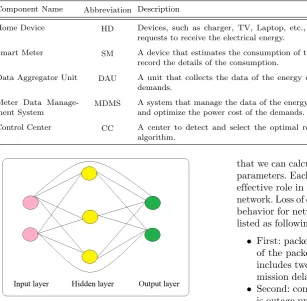
We propose a system model includes Home Device (HD), Smart Meter (SM), Data Aggregator Unit (DAU), Meter Data Management System (MDMS), and Control Center (CC) for SG. Description of the components of the proposed model is shown in Table 1. After sending a request from a user, the request for-wards from HD to CC in order to find the optimized routes. Founded routes are sent back to user based on the NFSOMCR. Figure 1 as well as Table 1 show the proposed model and details of the components. More details of the proposed model can be found in [11].
4
Overview of Artificial Neural
Net-work and Fuzzy System
In this section, a brief overview of artificial neural network and fuzzy system are mentioned.
4.1 Artificial Neural Network
The idea of artificial neural network is simulation of the neurons in the human brain. Neurons and their connections are defined as the neurons in the layers of the artificial neural network that connect to each other by using the weight vectors. Three types of the layers, input, hidden, and output layers, are used in these networks. Two artificial neural network topologies are as follows [22]:
• Feed forward artificial neural network: In this
Figure 1. Suggested Model of SG, Which Contains Home Device (HD), Smart Meter (SM), Data Aggregator Unit (DAU), Meter Management System (MDMS), Control Center (CC) [11].
Figure 2. A Feed Forward Artificial Neural Network Including Three Layers.
type of the network, the neurons of each layer is only connected to the neurons of the next layer. There is no feedback in this type of the network. Figure 2 shows a feed forward artificial neural network including three layers, two neurons in the input layer, three neurons in the hidden layer, and two neurons in the output layer.
Table 1. Details of the Considered Components in the Suggested Model of The SG.
Component Name Abbreviation Description
Home Device HD Devices, such as charger, TV, Laptop, etc., that users can use them for sending requests to receive the electrical energy.
Smart Meter SM A device that estimates the consumption of the electrical energy with the ability to record the details of the consumption.
Data Aggregator Unit DAU A unit that collects the data of the energy consumption of the other devices and demands.
Meter Data Manage-ment System
MDMS A system that manage the data of the energy consumption related to other devices and optimize the power cost of the demands.
Control Center CC A center to detect and select the optimal routes based on the suggested routing algorithm.
Figure 3. A Feed Back Artificial Neural Network Including Three Layers.
4.2 Fuzzy System
The idea of fuzzy system or fuzzy logic is converting the two-class outputs of the problems into multi-class outputs [23]. When we don’t use the fuzzy logic in a problem or network, we only have two logical out-put class, true or false. In contrast, when we use the fuzzy logic, we have multi-class in the output that are expressed in the form of probability of presence each of the output class in the system. Figure 4 shows these two types of logics. While in non-fuzzy system, Boolean logic, only one of the output classes are se-lected and assigned to 1, in fuzzy system, the labels of the output can be in the form of probability of presence of each output in the system.
5
Proposed Protocol
We describe the details of the path finding, path se-lecting, and proposed Neuro-Fuzzy approach used in NFSOMCR in the following sub-sections.
5.1 Proposed Method for Path Finding
After drawing the directed graph of the SG, we assign a weight to each edge in the graph. For each edge, we consider all of the suggested QoS parameters so
that we can calculate the cost function by using these parameters. Each of the suggested parameters has an effective role in the performance convergence of the network. Loss of each parameter can led to an unstable behavior for network. The suggested parameters are listed as following:
• First: packet transmission delay,d, is the delay of the packet transmission in the network that includes two types of delays: queuing and trans-mission delay.
• Second: connection outage probability,ζ, which is outage probability at each link of the network.
• Third: network criticality,τ, shows the network sensitivity to various changes in the network.
• Fourth: network unavailability, A, determines the delay of the components availability in the network.
• Fifth: effective throughput,ET, which is defined as the quantity of the data that is successfully transferred from the network link, divided by hop count. The number of the intermediate hops be-tween source and destination nodes is considered as the hop count.
• Sixth: path loss,ψ, is the difference between the transmitted and received power.
• Seventh: packet losspl, which is defined as the percentage of the total number of the transmitted packets that is lost in the network.
The overall network cost function of NFSOMCR, is defined as following:
Net-Cost(t, d, ζ, τ, A,ET, µ) =p(pl).L(t, ζ, τ, A, β) +p(1−pl).C(t, d, ET, ψ, α) where t is the time interval of the network evaluation,
Figure 4. Non-Fuzzy System Outputs Versus Fuzzy System Outputs.
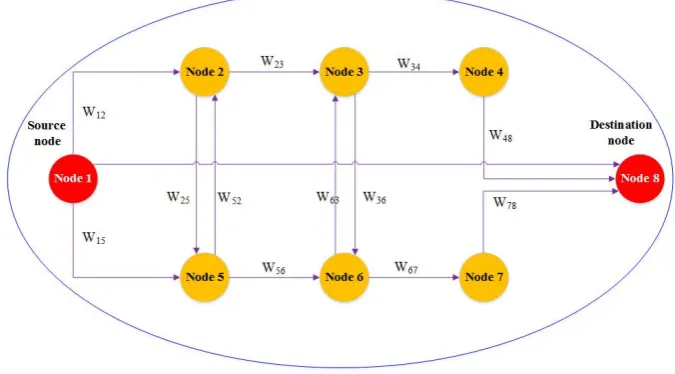
Figure 5. The Graph of the SG That Includes the Nodes, Edges, and Assigned Weights to Each Edge.
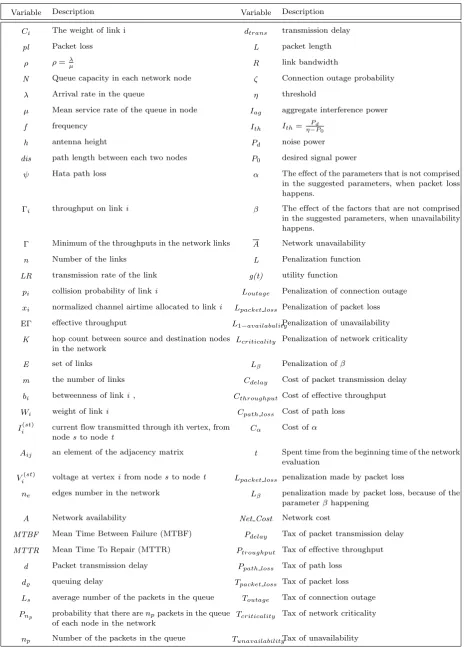
loss occurrence, L and C are the loss and cost of the parameters. All used parameters and functions in the proposed routing protocol are shown in Table. 6-14 in Appendix A. Seven parameters have been considered to define a cost function. While some of these parameters have a positive effect on the cost function, some others have a negative effect. We have defined two types of cost for these parameters:
• L defines for parameters with negative effect on the cost function. This means that when each of these parameters increases, the cost function decreases.
• C defines for parameters with positive effect on the cost function. This means that when each of these parameters increases, the cost function also increases.
Details of the parameters and functions used in the NFSOMCR can be found in [10]. Due to using the benefits of logarithm function, we used it in our cost function. The values of the parameters as well as the cost function have been scaled in the figures. All parameters are positive in order to avoid reaching to infinity. We optimize the cost function by having a trade-off among the parameters of the network cost function in the proposed Neuro-Fuzzy technique. Since we intend to use the Fuzzy system and Neural Network in Neuro-Fuzzy technique, we must have adequate training data to train the Fuzzy system and Neural
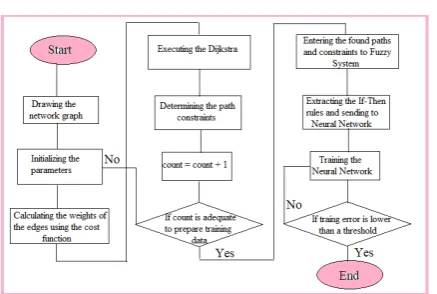
Network. In this regard, we execute the Dijkstra in a loop, which the iteration numbers of the loop are selected so that we can have adequate knowledge for Fuzzy system and training data for Neural Network. In each iteration, we have the below actions:
• Initializing the suggested QoS parameters by ran-dom values,
• Assigning the edges weight by using the cost function and QoS parameters,
• Executing the Dijkstra procedure that conduces to one found path, and
• Determining the constraint of the found path. After executing the above loop, all of the found paths of the Dijkstra algorithm are entered to the Fuzzy system to extract the If-Then rules. Then, the extracted rules are entered to Neural Network to train and find the optimal path and values of the parameters. The graph of SG, flowchart, and pseudo code of explained method are shown in Figures 5, 6 and Algorithm 1, respectively.
Wijin Figure 6 is the weight of the edge from node i
to node j.
5.2 Multiple Path Selection Based on Multi-Constraint QoS Requirements
tech-Algorithm 1Flowchart of NFSOMCR. Start
1: Draw thenetwork graph
2: Count = 0
3: Initialize the Threshold 1 and Threshold 2
4: Loop Until Count is lower than Threshold 1
5: Initialize the network parameters
6: Calculate the network weights
7: Dijkstra executing to find paths
8: Determine the constraints of the found paths
9: Count = Count + 1
10: End Loop
11: Enter found paths and constraints toFuzzy system
12: Extract theIf-Thenrules
13: Enter the extracted rules toNeural Network
14: Train the rules
15: If the train error is lower than Threshold 2go to14 otherwisego to12
16: Output theoptimal pathsandoptimal valuesof the parameters after enough training End
Figure 6. Flowchart of the Proposed Method for Path Find-ing and Optimization of the RoutFind-ing Protocol by UsFind-ing a Neuro-Fuzzy Technique
nique. In this regard, we find some paths by using Di-jkstra routing algorithm and consider a constraint for each found path in the network. Constraints are used to bind the values of the suggested parameters as well as the network cost. Indeed, each constraint shows the boundary value of each parameter in each found path. Note that, we determine the weight of the edge in the network graph by using the network cost function considered for SG. Each constraint is a column vector including some elements, which the numbers of the elements are equal to number of the suggested param-eters plus one. Latest element of the constraint vector has been used for weighting the path. For example, if we have a vector B as a constraint vector, then B includes eight elements in our work, which seven ele-ments are the seven suggested parameters and one is the network cost calculated by cost function based on the seven parameters proposed in [11]. Each element of the B shows the boundary value for each parameter
in each path of the SG. After finding the optimal path of the SG by Dijkstra, we determine the constraint of the found path. In this regard, we calculate each element of the constraint vector as Table 2.
After determining some constrains in the SG, we send these constraints along by found paths to Fuzzy system to extract the If-Then rules. Note that, the number of the constraints and found paths must be such that we can have adequate training data for proposed Fuzzy system and Neural Network.
5.3 Neuro-Fuzzy Approach to Find the Opti-mal Path
To optimize the network cost of the proposed routing protocol, NFSOMCR, we suggest a hybrid approach. Details of the proposed fuzzy inference system and Neural Network are similar to NFOMCR [10]. Un-doubtedly, the settings of the fuzzy system needs to be adjusted and specialized for the current situations. In fact, the used system in the NFOMCR is a scaled ver-sion of the system in the current model. In NFOMCR, we only had two parameters and much lower details in the cost function as well as the routing mechanism. In this regard, it is inevitable to have a system with much more settings and rules. Any appropriate membership function can be chosen in Fuzzy system. We apply the Sigmoid function due to its continuous and differen-tial property which is effective and suitable in back propagation learning and optimizing steps in our sys-tem. The inputs of the proposed Fuzzy system are the proposed parameters and the output is the network cost. Fuzzy linguistic expressions used for inputs are ’Low’, ’Medium’, and ’High’. Output of the Fuzzy
Table 2. Constraint of the Found Path in the NFSOMCR B1= ζ1 d1 ψ1 pl1 EΓ1
τ1 A1 C1 ,
ζ1 is a max outage among the outage of the graph edges in the found path.
d1 is a max delay among the delay of the graph edges in the found path.
ψ1is a max path loss among the path loss of the graph edges in the found path.
pl1 is a max packet loss among the packet loss of the graph edges in the found path.
EΓ1 is a min effective throughput among the packet loss of the graph edges in the found path. τ1 is a max criticality among the criticality of the graph edges in the found path.
A1 is a min availability among the availability of the graph edges in the found path.
C1 is the cost of the found path.
Figure 7. Fuzzy System Schematic as Well as Inputs and Output of the System.
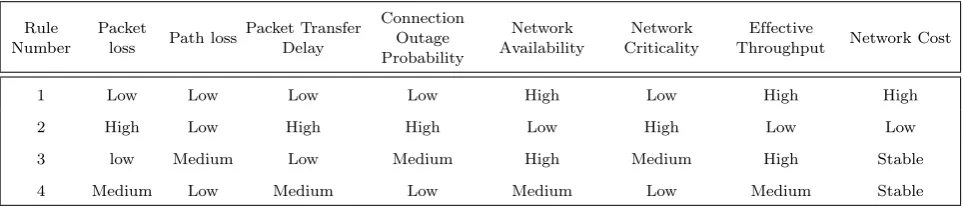
linguistic expressions. Some of the Fuzzy rules used in our Fuzzy system are shown in Table 3. We used the If-Then rules by using the AND operator in the rules. Since the network cost function is depend on the other parameters, we used the Sugeno fuzzy inference sys-tem in the proposed model. The output of this syssys-tem is a combination of the inputs. Table 4 shows some of these If-Then rules. Fuzzy system schematic as well as inputs and output of the system are shown in Figure 7.
We use a fuzzy inference system to extract the rules and send them to proposed Neural Network. The proposed Fuzzy system includes some parts, shown in the Figure 8, as the following:
• Membership function assigning: In this part, a suitable membership function is selected for in-puts of the Fuzzy system.
• If-Then rule extracting: Based on the inputs and output of the system, we extract the rules of the Fuzzy system.
• Fuzzyfication: To convert the crisp values of the input parameters to linguistic expressions, uzzyfi-cation is used. In this regard, we can extract the If-Then rules by using the linguistic expressions of the inputs.
• Decision making: In this step, we combine the extracted rules of the Fuzzy system which are suitable for proposed protocol and can optimize it. Combining some rules in order to have one
rule can be useful because we test some rules and collect the result of them in one rule by the form that each parameter in the combined rule can have some values or linguistics. For example, the connection outage probability parameter can be expressed either by ’Large’ or ’Medium’ in one rule.
• Defuzzyfication: Converting the linguistic expres-sions to the crisp values is essential for us to have a suitable explanation on the achieved results. The Centroid Defuzzyfication is used.
We use a feed forward neural network with three layers. The neurons and nodes number in the first and second layer are identical. The nodes number char-acterizes by selecting the found path of the Dijkstra routing algorithm, in first layer. Inputs of the first layer are the nodes of the selected path found by the routing algorithm. These inputs are shown by Node1, Node2, Node3, ... parameters in Figure 9. Third layer is the output layer and computes the optimal values of the suggested parameters as well as the network cost. Training the Neural Network, we can attain the optimal values of the suggested parameters, network cost value, and optimal found path in the SG. Learn-ing by usLearn-ing the back-propagation and decreasLearn-ing the error are in the procedure of the learning. The goal of the proposed neural network is learning the proposed parameters and functions. Seven outputs are seven parameters and the last one is the network cost. These eight parameters are the output of the network. The network perspective of the proposed Neural Network is shown in Figure 9.
6
Results and Discussions
Table 3. The Linguistic Expressions of the Inputs and Output Parameters of the Proposed Fuzzy System
Rule Number
Packet
loss Path loss
Packet Transfer Delay
Connection Outage Probability
Network Availability
Network Criticality
Effective
Throughput Network Cost
1 Low Low Low Low High Low High High
2 High Low High High Low High Low Low
3 low Medium Low Medium High Medium High Stable
4 Medium Low Medium Low Medium Low Medium Stable
Table 4. If-Then Expressions of the Extracted Rules of the Proposed Fuzzy System
Rule Number If-Then rules
1 If Packet loss=’Low’ and Path loss=’Low’and Packet Transfer Delay=’Low’ and Connection Out-age Probability=’Low’and Network Availability=’High’andNetwork Criticality=’Low’and Effective Throughput=’High’ThenNetwork Cost=’High’.
2 If Packet loss=’High’and Path loss=’Low’and Packet Transfer Delay=’High’and Connection Outage Probability=’High’ and Network Availability=’Low’ and Network Criticality=’High’ and Effective Throughput=’Low’ThenNetwork Cost=’Low’
3 If Packet loss=’Low’andPath loss=’Medium’andPacket Transfer Delay=’Low’andConnection Outage Probability=’Medium’andNetwork Availability=’High’andNetwork Criticality=’Medium’andEffective Throughput=’High’ThenNetwork Cost=’Stable’
4 If Packet loss=’Medium’andPath loss=’Low’andPacket Transfer Delay=’Medium’andConnection Outage Probability=’Low’ and Network Availability=’Medium’ and Network Criticality=’Low’ and
Effective Throughput=’Medium’ThenNetwork Cost=’Stable’
Figure 8. Parts of the Proposed Fuzzy Inference System Including Five Parts.
Figure 9. Network Perspective of the Proposed Neural Network Including Three Layers.
6.1 Evaluation of the Network Performance
The layer numbers are very significant in computing the network cost. In other words, we should properly
Figure 10. Network Cost Versus Layer Numbers.
the layer numbers to choose the appropriate value for it. Figure 10 shows the different layer numbers versus the network cost.
6.2 Training the Network
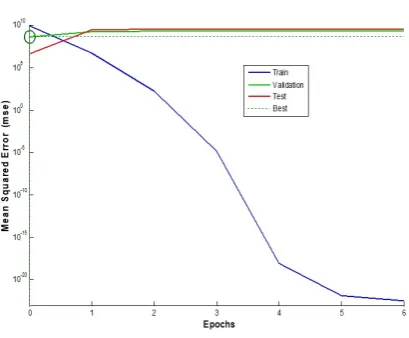
The train error of the proposed neural network is de-termined in Figure 11. According to Figure 11, the train error reduces in higher epochs, which is a suit-able behavior to make better the network performance. Mean Square Error (MSE) is chosen to evaluate the network performance. Figure 12 determines the MSE in different epochs for the train, test, validation, and best errors. According to Figure 12, the slop of the error curve in train error decreases, which shows that the network is near to the acceptable performance. Outputs of the proposed Neural Network are the opti-mal values of the proposed parameters, network cost, and path. Optimal values of the proposed parameters and network cost in training of the network are shown in Table 5. Values of the parameters are scaled in fig-ures, for simplicity. Based on the experimental results, the feed-forward NN is converging to the proper out-put by suitable adjusting the network parameters. We tested different parameters for network so that the network can converge to the suitable parameters.
6.3 Comparison With Other Protocols
In this sub-section, we compare the network cost of the proposed protocols with the other protocols. In the first step, we compare the network cost of the NFSOMCR, GASOMCR [11], NFOMCR [10], and OMCR [13]. The later one is a protocol defined for SG, which is a suitable candidate solution to Multi-Constrained problems. Figure 13 shows the compar-ison of NFSOMCR, GASOMCR, NFOMCR, and OMCR protocols. While NFSOMCR, GASOMCR, and OMCR protocols have a similar behavior between
Figure 11. Train Error in Different Epochs.
Figure 12. MSE in Different Epochs.
second and seventh iterations of the figure; NFSOMCR decreases after the seventh iteration, GASOMCR has a monotonically behavior after the second iteration, OMCR increases in the last iteration, and NFOMCR decreases in the last iterations after having an increas-ing behavior in the first iterations. Level of the net-work cost in OMCR is higher than the NFSOMCR, GASOMCR, and NFOMCR. Although GASOMCR has the lower level of the network cost than the NF-SOMCR protocol, NFNF-SOMCR can also use efficiently due to decreasing behavior in last iteration as well as GASOMCR.
Table 5. Optimized Value of the Proposed Parameters in Training of the Neural Network
Number Packet Loss
Path Loss (dB)
Packet Transmission
Delay (ms)
Connection Outage Probability
Network Availability
Network Criticality
(MW)
Effective Throughput
(bps)
Network Cost (MWh/ $)
1 0.2 3 2.7 0.21 0.8 3.2 9 18
2 0.18 2.8 3.2 0.3 0.87 2.81 8.7 16
3 0.8 2.3 8.3 0.84 0.2 9.1 3.4 8.03
4 0.85 3.1 8.9 0.81 0.16 8.9 2.4 8.03
5 0.23 4.1 2.6 0.41 0.81 4.5 8.1 8.03
6 0.85 3.1 8.9 0.91 0.33 8.3 2.84 8.02
7 0.26 4.3 2.8 0.41 0.85 5.2 9.2 8.01
8 0.31 3.9 3.1 0.52 0.89 5.6 8.4 8.01
9 0.47 2.9 4.6 0.21 0.51 2.1 4.5 8.01
10 0.52 2.3 5.1 0.18 0.46 3.1 5.2 8.01
Figure 13. Comparison the Cost of NFSOMCR, GASOMCR, NFOMCR, and OMCR.
MW, however all of the protocols and algorithms have an approximately fixed and stable behavior, level of the power cost is different in these protocols and algo-rithms. This comparison in load limitation between 5000-7500 MW is shown in the Figure 15.
In the third step, the network throughput of the Hybrid Wireless Mesh Protocol (HWMP) [21], Neighbor QoS-aware Hybrid Wireless Mesh Protocol (HWMP-NQ) [21], Multi-gateway Routing [19], and NFSOMCR are compared in different node numbers of the network. As we can see in Figure 16, increasing mode of the protocols continues so that they reach to node number equal to 36. While HWMP decreases in this point, the other protocols increase. In the point that the node number is equal to 49, throughput of the HWMP-NQ and Multi-gateway Routing protocols decrease while NFSOMCR continues the increasing behavior. Decreasing behavior of the protocols is the result of congestion in the network due to increasing
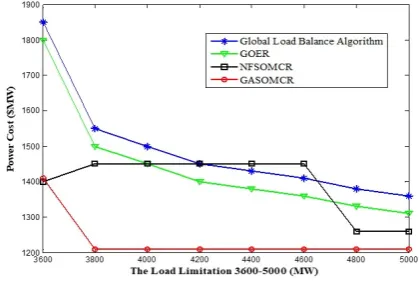
Figure 14. Comparison of the Power Cost of the NFSOMCR, GASOMCR, GOER, and Global Load Balance Algorithm in Load Limitation 3600-5000 MW.
Figure 15. Comparison of the Power Cost of the NFSOMCR, GASOMCR, GOER, and Global Load Balance Algorithm in Load Limitation 5000-7500 MW.
Figure 16. Comparison of the Throughput of the HWMP, HWMP-NQ, Multi-Gateway Routing, and NFSOMCR Proto-cols in Different Node Numbers of the Network.
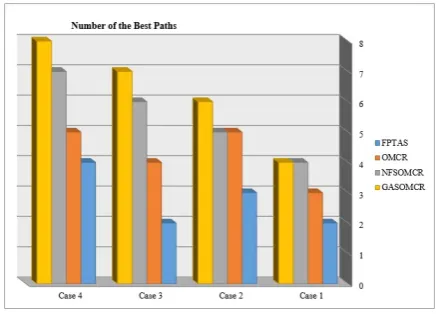
Figure 17. Comparison of the Number of the Best Paths Found by OMCR, GASOMCR, NFSOMCR, and FPTAS.
doesn’t decrease till the node number equal to 64. This shows that the congestion of the network with NFSOMCR occurs in higher node numbers that has a positive effect on the network performance.
Finally, we compare the number of the best paths found by OMCR, GASOMCR, NFSOMCR, and FP-TAS [24]. FPFP-TAS is the best estimate result of the OMCR problem [13]. Four test cases are used to com-pare the ability of the protocols in order to find the best paths in routing of the network. In these test cases, SG is simulated by randomly generated topol-ogy and some pairs of the source-destination nodes in the network. Different numbers of nodes (from thou-sands, dozens, and more) have been tested to evalu-ate the model. For evaluating the larger numbers of nodes, the powerful processors are needed in order to decrease the processing time and parallel executing. Figure 17 shows this comparison.
7
Conclusion and Future Works
SG is an intelligent managed network, which utilizes the two-way flows of the data and electricity to have the efficient relations among various components. In this work, we propose a QoS routing protocol,
NF-SOMCR, which uses the novelty of the Neuro-fuzzy technique to improve the network performance. Seven parameters are suggested to show the QoS require-ments in the SG. Trading-off among the proposed parameters leads to minimize the network cost. To improve the path selecting of the NFSOMCR, we consider a loop that including some actions, which are: initializing the parameters value, assigning the weights of the edges in the network graph, executing the Dijkstra routing algorithm, determining the op-timal path, determining the constraint of the found path. After execution of the loop, we have some paths along with their constraints. Fuzzy system extracts the If-Then rules from the found paths and constraints. Fuzzy rules are sent to Neural Network to train and extract++ the optimal values of the parameters, net-work cost, and optimal cost. Suitable designing and training of the Fuzzy system and Neural Network, uti-lized in the Neuro-Fuzzy system, have an important role in the convergence speed of the network perfor-mance to optimum value. Our comparison results of the proposed protocol with the other protocols shows the performance improvement in the network. We will continue our study on NFSOMCR protocol in order to optimize and decrease the network cost level more and more. Although having the seven parameters in our proposed protocol can be expensive; the network be-havior is sufficiently appropriate with these suggested parameters cost functions.
References
[1] D. Wollman, C. Greer, and d. prochaska. NIST framework and road map for smart grid interoperability standards. National In-stitute of Standards and Technology, 2014. doi:10.6028/NIST.SP.1108r3.
[2] Hamilton B. and Miller J. Understanding the benefits of smart grid. National Energy Technol-ogy Laboratory, pages 1 – 41, 2010.
[3] N. Saputro, K. Akkaya, and S. Uludag. A survey of routing protocols for smart grid communications. Computer Networks, 56 (11):2742–2771, 2012. ISSN 1389 - 1286. doi:10.1016/j.comnet.2012.03.027.
[4] M. Chakraborty, N. Deb, and N. Chaki. POM-Sec: Pseudo-Opportunistic, Multipath Secured Routing Protocol for Communications in Smart Grid. InIFIP International Conference on Com-puter Information Systems and Industrial Man-agement, CISIM, pages 264–276. Springer, 2017. ISBN 978-3-319-59104-9. doi:10.1007/978-3-319-59105-6 23.
doi:10.1016/j.future.2011.04.014.
[6] M. Kuzlu, M. Pipattanasomporn, and S. Rahman. Communication network requirements for major smart grid applications in HAN, NAN and WAN.
Computer Networks, 67:74 – 88, 2014. ISSN 1389-1286. doi:10.1016/j.comnet.2014.03.029.
[7] W. Wang, Y. Xu, and M. Khanna. A survey on the communication architectures in smart grid. Com-puter Networks, 55(15):3604 – 3629, 2011. ISSN 1389-1286. doi:10.1016/j.comnet.2011.07.010. [8] X.Masip-Bruina, M.Yannuzzi,
J.Domingo-Pascual, A.Fonte, M.Curado, E.Monteiro, F.Kuipers, P.Van Mieghem, S.Avallone, G.Ventre, P.Aranda-Guti´errez, M.Hollick, R.Steinmetz, L.Iannone, and K.Salamatian. Research challenges in QoS routing. Computer Communications, 29(5):563 – 581, 2006. ISSN 0140-3664. doi:10.1016/j.comcom.2005.06.008. [9] J. Barbancho, C. Le´on, F. J. Molina, and A.
Bar-bancho. Using AI in routing schemes for wire-less networks. Computer Communications, 30 (14-15):2802 – 2811, 2007. ISSN 0140-3664.
doi:10.1016/j.comcom.2007.05.023.
[10] R. Rastgoo and V. Sattari-Naeini. A Neuro-Fuzzy QoS-aware routing protocol for Smart Grids. In
2014 22nd Iranian Conference on Electrical En-gineering (ICEE), pages 2802–2811. IEEE, 2014. doi:10.1109/IranianCEE.2014.6999696.
[11] R. Rastgoo and V. Sattari-Naeini. Tuning Pa-rameters of the QoS-Aware Routing Protocol for Smart Grids Using Genetic Algorithm. Ap-plied Artificial Intelligence, 30(1):52 –76, 2016. doi:10.1080/08839514.2016.1138794.
[12] R. Rastgoo and V. Sattari-Naeini. GSOMCR: Multi-Constraint Genetic-Optimized QoS-Aware Routing Protocol for Smart Grids. Iranian Jour-nal of Science and Technology, Transactions of Electrical Engineering, 42(2):185 – 194, 2018. ISSN 2364-1827. doi:10.1007/s40998-018-0056-6. [13] H. Li and W. Zhang. QoS Routing in Smart Grid. In 2010 IEEE Global Telecommunications Conference GLOBECOM 2010. IEEE, 2010. ISBN 978-1-4244-5637-6. doi:10.1109/GLOCOM.2010.5683884.
[14] N. Saputro, K. Akkaya, and S. Uludag. A survey of routing protocols for smart grid communications. Computer Networks, 56 (11):2742 – 2771, 2012. ISSN 1389-1286.
doi:10.1016/j.comnet.2012.03.027.
[15] A. Eshraghniaye Jahromi and Z. Besharati Rad. Optimal topological design of power communica-tion networks using genetic algorithm. Sciatica Iranian, 20(3):945 – 957, 2013. ISSN 1026-3098. doi:10.1016/j.scient.2013.01.003.
[16] M. Ebrahimi, H. Tenhunen, and M. Dehyade-gari. Fuzzy-based Adaptive Routing Algorithm
for Networks-On-Chip. Journal of Systems Ar-chitecture, 59(7):516 – 527, 2013. ISSN 1383-7621. doi:10.1016/j.sysarc.2013.03.006.
[17] A. Zaballos, D. Vernet, and J.M. Selga. A ge-netic QoS-aware Routing Protocol for the Smart Electricity Networks. International Journal of Distributed Sensor Networks, 9(9), 2013. ISSN 1550-1477. doi:10.1155/2013/135056.
[18] D. Sahin, V. C. Gungor, T. Kocak, and G. Tuna. Quality-of-Service Differentiation in Single-Path and Multi-Path Routing for Wireless Sensor Network-Based Smart Grid Applications. Ad Hoc Networks, 22:43 –60, 2014. ISSN 1570-8705. doi:10.1016/j.adhoc.2014.05.005.
[19] R. Hou, C. Wang, Q. Zhu, and J. Li. Interference-aware QoS multi-cast routing for smart grid. Ad Hoc Networks, 22:13 –26, 2014. ISSN 1570-8705. doi:10.1016/j.adhoc.2014.05.008.
[20] J. Lin, W. Yu, D. Griffith, X. Yang, and G. X. Lu. On Distributed Energy Routing protocols in Smart Grid. InSoftware Engineering, Artificial Intelligence, Networking and Parallel/Distributed Computing, pages 143–159. Springer, Heidelberg, 2013. ISBN 978-3-319-00738-0. doi:10.1007/978-3-319-00738-0 11.
[21] X. Deng, L. He, X. Li, Q. Liu, L. Cai, and Z. Chen. A reliable QoS-aware routing scheme for neighbor area network in smart grid. Peer-to-Peer Net-working and Applications, 9(4):616 – 627, 2016. ISSN 1936-6450. doi:10.1007/s12083-015-0331-5. [22] Hive AI. tutorials point, 2017. URL https:
//www.tutorialspoint.com/artificial_ intelligence.
[23] J-Sh. Jang, Ch-Tsai. Sun, and E. Mizutani. Neuro-fuzzy and soft computing: a computational approach to learning and machine intelligence.
IEEE Transactions on Automatic Control, 42(10): 1482 – 1484, 1997. doi:10.1109/TAC.1997.633847. [24] G. Xue, W. Zhang, J. Tang, and K. Thulasira-man. Polynomial time approximation algorithms for multi-constrained QoS routing. IEEE/ACM Transactions on Networking (TON), 16(3):656 –
669, 2008. doi:10.1109/TNET.2007.900712.
Table A.1. First Part of the Parameters Used in the Proposed Routing Protocol.
Variable Description Variable Description
Ci The weight of link i dtrans transmission delay
pl Packet loss L packet length
ρ ρ=λµ R link bandwidth
N Queue capacity in each network node ζ Connection outage probability
λ Arrival rate in the queue η threshold
µ Mean service rate of the queue in node Iag aggregate interference power
f frequency Ith Ith=
Pd η−P0
h antenna height Pd noise power
dis path length between each two nodes P0 desired signal power
ψ Hata path loss α The effect of the parameters that is not comprised
in the suggested parameters, when packet loss happens.
Γi throughput on linki β The effect of the factors that are not comprised
in the suggested parameters, when unavailability happens.
Γ Minimum of the throughputs in the network links A Network unavailability
n Number of the links L Penalization function
LR transmission rate of the link g(t) utility function
pi collision probability of linki Loutage Penalization of connection outage
xi normalized channel airtime allocated to linki Lpacket loss Penalization of packet loss EΓ effective throughput L1−availabalityPenalization of unavailability
K hop count between source and destination nodes in the network
Lcriticality Penalization of network criticality
E set of links Lβ Penalization ofβ
m the number of links Cdelay Cost of packet transmission delay
bi betweenness of linki, Cthroughput Cost of effective throughput
Wi weight of linki Cpath loss Cost of path loss
I(ist) current flow transmitted through ith vertex, from nodesto nodet
Cα Cost ofα
Aij an element of the adjacency matrix t Spent time from the beginning time of the network evaluation
Vi(st) voltage at vertexi from nodes to nodet Lpacket loss penalization made by packet loss
ne edges number in the network Lβ penalization made by packet loss, because of the parameterβ happening
A Network availability Net Cost Network cost
MTBF Mean Time Between Failure (MTBF) Pdelay Tax of packet transmission delay
MTTR Mean Time To Repair (MTTR) Ptroughput Tax of effective throughput
d Packet transmission delay Ppath loss Tax of path loss
d% queuing delay Tpacket loss Tax of packet loss
Ls average number of the packets in the queue Toutage Tax of connection outage
Pnp probability that there arenppackets in the queue of each node in the network
Tcriticality Tax of network criticality
Table A.2. Second Part of the Parameters Used in the Proposed Routing Protocol.
Variable Description Variable Description
PN probability that there areN packets in the queue of each node in the network
C Cost function
λe effective arrival rate τ Network criticality
Count Counter of loop Train Error Error of the training in the proposed Neural
Network.
Neurons
number The number of the neurons in the proposed NeuralNetwork. Check Error Error of the proposed Neural Network in testdata.
Validation
Error Error of the e proposed Neural Network in vali-dation data. Best Error Minimum error of the proposed Neural Network.
Test Error Error of the proposed Neural Network in test data.
Epoch One iteration in evaluating the proposed Neural Network.
ζ∗ Optimal value of connection outage ψ∗ Optimal value of path loss
pl∗ Optimal value of packet loss A∗ Optimal value of network unavailability
τ∗ Optimal value of network criticality EΓ∗ Optimal value of effective throughput
d∗ Optimal value of packet transmission delay
Table A.3. Loss Functions Used in the NFSOMCR
Loutage (t,ζ) = kζk1 . g(t) Cdelay (t,d) = kdk1 . g(t)
Lpacket loss(t,pl) = kpl1k . g(t) , Cthroughput (t, EΓ) =kEΓk. g(t) ,
Lcriticality (t,τ) = kτk1 . g(t) , Cpath loss (t,ψ) = kψk1 . g(t) ,
L1−availability (t,A) = 1
kAk . g(t) , Cα (t,α) =kαk. g(t) ,
Lβ (t,β) = kβk1 . g(t) , g(t) = 1000 log(t)
Table A.4. Optimal Values of the Parameters Used in the NFSOMCR
ζ∗=arg min ζ
ζ.Loutage(t, ζ) +Toutage(ζ)
pl∗= arg min pl
pl.Lpacket loss(t, pl) +Tpacket loss(pl)
τ∗=arg min τ
τ.Lcriticality(t, τ) +Tcriticality(τ)
ψ∗=arg min ψ
Cpath loss(t, ψ) +Ppath loss(ψ)
A∗=arg min A
A.Lunavailability(t,A) +Tunavailability(A)
d∗=arg min d
C.Ldelay(t, d) +Pdelay(d)
EΓ∗=arg min EΓ
Cthroughput(t, EΓ) +Pthroughput(EΓ)
f =p (pl) . L + p (pl) . C
Table A.5. Functions Used for Parameters of the NFSOMCR
Parameter Defined Functions for Parameter
Packet loss
pl =ρN 1−ρ
1−ρN + 1
ρ=λµ
Path Loss
ψ= 69.55 + 26.16 log(f) - 13.82 log(h) -a(h)+ [ 44.9 - 6.55 log(h) ] log(dis)
a(h)= 3.2 [ log(11.75h)]2 - 4.97
Packet Transmission Delay
d=d%+dtrans
d%= Lλs e
Ls=
N
X
np=0
.Pnp ,Pnp =
(λ µ)np N
X
np=0
(λ
µ)
np
λe=λ[1−PN] ,dtrans= LR Connection Outage Probability Pout= Pr{SINR< η}= Pr{Iag>Ith} Network Availability A= M T BFM T BF+M T T R
Network Criticality
τ = 1
m−1
X
i∈E
∂bi
∂wi ,bi=
X
s≺t
Ii(st)
(12)ne(ne−1)
Ii(st)= 12X j
Aij|Vi(st)−V
(st)
j |
Aij=
1, if there is an edge between i and j
0, otherwise
Effective Throughput Γi=LR×(1 -pi)×xi , Γ = min
i=1,2,...,n
{Γi}, EΓ = Γκ
Network Cost
Next Cost (t,d,ζ,τ,A, EΓ,ψ,α,β) =p (pl) . L (t,ζ,τ, A,β) + p (pA). C (t,d, EΓ,ψ,α)
L (t,ζ,τ, A,β)=Lpacket loss (t,ζ,τ, A) +Lβ (t,β)
C (t, d, EΓ,ψ,α) =Cdelay (t, d) +Cthroughput (t, EΓ) +Cpath loss(t,ψ) +Cα(t,α)
p(pl)=p (pl|A|) .p (A) + p (pl|A|). p(A) )
Loutage(t,ζ) = kζk1 . g(t) ,
Lpacket loss(t, pl)= kplk1 . g(t),
L1−availability (t, A)= 1 kAk . g(t),
Lcriticality (t,τ) = kτ1k .g(t) ,
Lβ (t,β)= kβk1 . g(t) ,
Cdelay (t , d)= kdk1 . g(t),
Cthroughput (t, EΓ) =kEΓk. g(t) ,
Cpath loss(t,ψ) = kψk1 .g(t) ,
Cα(t,α) =kαk.g(t)
Razieh Rastgooreceived the B.Sc. Degree in Computer Engineering, Hardware, from Shiraz University of Iran. Also, she achieved her M.Sc. degree from Shahid Bahonar Uni-versity of Kerman, Iran. She currently is a Ph.D. student of Semnan University of Iran as well as the Ph.D. researcher at Barcelona University of Spain. Her interest areas are: Artificial Intelligence, Machine Learning, Deep Learning, Com-puter Vision, Smart Grids, Sign Language, Routing Protocols, Computer Networks.
![Figure 1. Suggested Model of SG, Which Contains HomeDevice (HD), Smart Meter (SM), Data Aggregator Unit (DAU),Meter Management System (MDMS), Control Center (CC)[11].](https://thumb-us.123doks.com/thumbv2/123dok_us/37976.2004328/3.595.319.532.76.259/figure-suggested-contains-homedevice-aggregator-management-control-center.webp)