587
NLP at SemEval-2019 Task 6: Detecting Offensive language using Neural
Networks
Prashant Kapil*, Asif Ekbal*and Dipankar Das+
*Department of Computer Science and Engineering
Indian Institute of Technology Patna, India
+Department of Computer Science and Engineering
Jadavpur University Kolkata, India
*{prashant.pcs17, asif}@iitp.ac.in +[email protected]
Abstract
In this paper we built several deep learning architectures to participate in shared task Of-fensEval: Identifying and categorizing Offen-sive language in Social media by semEval-2019(Zampieri et al.,2019b). The dataset was annotated with three level annotation schemes and task was to detect between offensive and not offensive, categorization and target iden-tification in offensive contents. Deep learn-ing models with POS information as feature were also leveraged for classification. The three best models that performed best on in-dividual sub tasks are stacking of CNN-Bi-LSTM with Attention, BiCNN-Bi-LSTM with POS in-formation added with word features and Bi-LSTM for third task. Our models achieved a Macro F1 score of 0.7594, 0.5378 and 0.4588 in Task(A,B,C) respectively with rank of33rd,
54thand52ndout of 103, 75 and 65 submis-sions.
1 Introduction
Due to the exponential rise in the usage of inter-net user generated content in the form of blogs, posts, comments etc. have been increased mani-fold. Some users also using this platform to tar-get any individual or any particular group on so-cial media on the basis of certain attributes, shar-ing different views. Many studies have been con-ducted on offensive language, hate speech, cyber-bullying, profanity, aggression detection. These contents are major concern for governments, so robust computational systems need to be devel-oped to tackle these posts to maintain social har-mony. This paper is organized as follows. Related work have been discussed in section2, Methodol-ogy have been described in Section3followed by data sets and other settings used to solve the tasks in Section 4. Results and analysis of the models is described in Section5with the limitation of the
models in Error Analysis in section6. Section 7 contains the conclusion and Future scope.
1.1 Problem Definition
The organizers proposed a hierarchical three level annotation model and divided into three sub tasks.
Task A:This task consist of classifying between offensiveandnot offensivecomments
Task B: The Offensive language was further needs to be classified into Targeted(TIN) and UnTargeted(UNT).
Task C:The targeted offensive needs to be further classified intoIndividual(IND),Group(GRP) and Other(OTH).
2 Related Work
(Nockleby,2000) defined hate speech as any com-munication that demean any person or any group on the basis of race, color, gender, ethnicity, sex-ual orientation, and nationality. (Kowalski et al.,
guidelines. (Sood et al., 2012) detected profan-ity by identifying offensive words using list based methods and incorporated edit distance to find similar obscene words. (Davidson et al.,2017) ob-served that seperating offensive and hate speech is very challenging task. nigga, hoe , bitch, fag are very offensive in nature but can be used in different manner. They reported Logistic Regres-sion as their best classifier in detecting approx. 25K Tweets by using N-grams weighted by TF-IDF, POS n-grams and using sentiment score as their features.(Samghabadi et al.,2017) used sur-face level features like word grams and char n-grams, LIWC and SentiWordNet to get the sen-timent score as well as some domain related fea-tures. (Malmasi and Zampieri, 2017) used char n-grams, word n-grams and word skip grams to get accuracy of 78% on Data set of 14509 tweets classified into 3 classes. (Waseem et al., 2017) tried to capture similarities between different sub tasks. They proposed a typology to differentiate language on the basis of individual or group attack or if the content is explicit or implicit. (Gamb¨ack and Sikdar,2017) used random vector, word vec-tors and also concatenated word based CNN and character based CNN to classify 6909 tweets into 4 classes. (Xu et al., 2012) used LDA to find out relevant and useful sentiment in bullying texts. (Zhang et al.,2018) proposed a CNN-GRU based structure which outperformed 6 out of 7 datasets by at most 13 F1 points. They have used sur-face level features, linguistic features, sentiment features as well as number of misspellings , per-centage of capitalisation for SVM. (Aroyehun and Gelbukh, 2018) implemented several neural net-works and also found that char n-grams is more superior than word n-grams in NBSVM. They also used data augmentation, pseudo labeling and sen-timent score as feature. (Kumar et al.,2018) dis-cuss the task of developing a classifier to discrimi-nateOvertly,CovertlyandNon Aggressivetext us-ing 15000 annotated social media data in both En-glish and Hindi(in Roman and Devanagri script) as part of TRAC-1. (Badjatiya et al., 2017) ex-perimented with several deep neural architecture and found that it outperformed state of the art word/char n-grams.(Djuric et al.,2015) proposed paragraph to vector for modelling of comments. (Gao and Huang, 2017) discusses the Bi-LSTM with attention mechanism with learning compo-nents context improved the classifier performance.
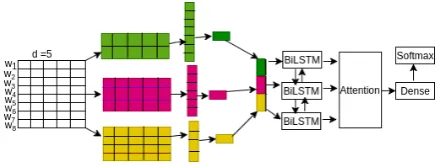
Figure 1:Sub Task A:CNN-BiLSTM-Attention
(Founta et al., 2018) studied different forms of abusive behaviour and made public annotated cor-pus of 80K Tweets categorized into 8 labels like Hate, aggressive, cyber bullying, normal , Spam.
3 Methodology
3.1 Task A:CNN-BiLSTM-Attention
In this model first we converted all the words to their unique index. Then all the unique in-dex in the sentences were mapped to their real valued vectors of Dimensions 100 using Glove by (Pennington et al., 2014) from Embedding Matrix. Convolution layers is used to extract useful information by convolving i words at a time using learnable kernel of size i*h where i = [2,3,4] and h is of size equal to the dimensions. The element wise dot product is performed to get the feature mapf1. N numbers of filters are used to get feature map = [f1,f2...fn]. Pooling reduces the size of representation by selecting max value from each feature map which is then passed to the BiLSTM layer with 100 hidden units. The sentence level representation is then passed to activation layers to capture the important key-words informations. This vector representation is then passed to softmax classification to get the probability values of each class.
Attention It tries to make RNN better by letting the network to know the weight of important keywords. It produces state of the art results on several NLP tasks. We used the approach followed by (Ding et al.,2018) for sentence level attention which follows the following equation.
et=tanh(W ht+b) (1)
αt=sof tmax(et) (2)
output=
t=n
X
t=1
Figure 2:Sub Task B:BiLSTM(Word+POS)
3.2 Task B:BiLSTM(Word+POS)
In this model two layers of BiLSTM were used with hidden nodes of 100 where the sentences were being represented by Glove embedding. BiLSTM uses 2 LSTM that is useful for keeping both the past and future information. The input sequence (i1,i2,...in) is converted to (h1i,h2i...hni) taking into account each words. Each word was tagged with its POS Tag and embedding for each Tag was calculated. Each sequence was then con-verted to their POS Tag real valued vector of Di-mensions of 20 using embedding matrix. The in-put sequence is then passed to BiLSTM layer with hidden nodes of 100. The outputs of both the chan-nels were concatenated and passed to the Fully connected layer followed by softmax Classifica-tion.
3.3 Task C: BiLSTM
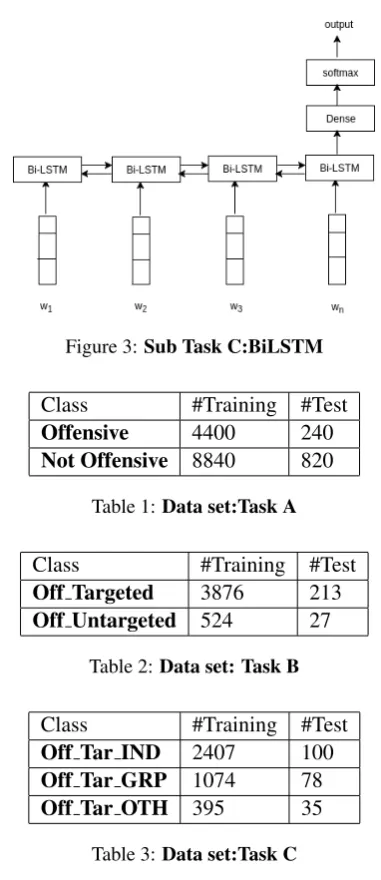
We used BiLSTM using 100 dimensions to repre-sent sequences by fixing the maximum length to 40 . Post padding with 0 was used for shorter se-quences as it helps in preserving the information at the borders. After getting desired hidden rep-resentation from 2 layers it is passed to the Fully Connected layers followed by softmax Classifier for getting probability distribution among classes.
4 Data Sets
[image:3.595.319.510.55.496.2]The Datasets provided by organisers (Zampieri et al., 2019a) were three level annotated social media text. The task was divided into three parts,description of their data sets is in Table1, Ta-ble2and Table3.
Figure 3:Sub Task C:BiLSTM
Class #Training #Test
Offensive 4400 240
Not Offensive 8840 820
Table 1:Data set:Task A
Class #Training #Test
Off Targeted 3876 213
Off Untargeted 524 27
Table 2:Data set: Task B
Class #Training #Test
Off Tar IND 2407 100
Off Tar GRP 1074 78
Off Tar OTH 395 35
Table 3:Data set:Task C
4.1 Parameter Tuning,Word embedding and evaluation Metrics
We use Keras with Tensorflow as backend,Scikit-learn library for implementation. For every dataset we use 80:20 for 80% to use in Training and using grid search to learn batch size and epochs. Ex-periments were performed using stratified 5-fold cross validation to train all the classes according to their proportion and 20% of remaining data were used as testing the model. We are reporting our results on Training data provided by orgainsers by standard Precision, Recall and F-score by averag-ing all the cross fold results. Categorical cross en-tropy loss function and Adam optimiser were used for training . In the experiment we use publicly available Glove embedding by (Pennington et al.,
[image:3.595.89.265.58.226.2]4.2 Preprocessing
As the datasets are collected from social media it contains lots of noise and inconsistencies in the form of urls, typos and abbreviations. So we start by applying light preprocessing by expanding all appostrophes containing words and then removing characters like : , & ! ? and also all the tokens were tranformed to lower case to avoid capitalized versions of same word being treated as different words. We also used dictionary to expand the mis-spelled words to its original form. The POS tags were obtained from NLTK.
Class OFF NOT F1 Acc.
OFF 2614 1786
74.96 78.95
[image:4.595.314.521.61.124.2]NOT 1006 7834
Table 4:Cross validation: Task A
Class TIN UNT F1 Acc.
TIN 3839 37
51.56 88.43
UNT 472 52
Table 5:Cross validation: Task B
Class IND GRP OTH F1 Acc.
IND 2103 303 1
47.69 71.18
GRP 423 649 2
OTH 208 182 5
Table 6:Cross validation: Task C
Class OFF NOT F1 Acc.
OFF 131 109
75.94 82.44
NOT 42 578
Table 7:Test Set: Task A
Class TIN UNT F1 Acc.
TIN 212 1
53.78 89.17
UNT 25 2
Table 8:Test Set: Task B
5 Results and Analysis
We have reported the cross validation split accu-racy and F-score in Table4, Table5 and Table6 for all the three subtasks. The results for test set is also included in Table7.Table8and Table9. For
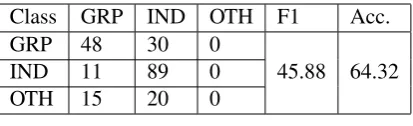
Class GRP IND OTH F1 Acc.
GRP 48 30 0
45.88 64.32
IND 11 89 0
OTH 15 20 0
Table 9:Test Set: Task C
our systems we got almost comparable results for both training and test datasets. We got F-score of 75.94%, 53.78% and 45.88% in sub task A, B, C respectively. Table10 shows the performance of our system compared with best systems.
Task Ours Best
A 75.94% 82.9%
B 53.78% 75.5%
C 45.88% 66%
Table 10:System Performance
6 Error analysis
Error analysis was carried out to analyze the errors that we encountered in our system by quantitative analysis using Confusion matrix of our best mod-els for each task.
6.1 Quantitative Analysis
From Table7it can be seen that false negative rate of offensive class is 45% where as for Not Offen-sive True Positive rate is 93.22% in Task 1. 42 in-stances of Not Offensive also got misclassified as Offensive showing evidence of challenges in clas-sification. For Task2 Table8shows that TIN True positive rate is almost 100% but system fails to classify UNT class with only 0.08% true positive rate. For Task3 Table9 shows that system com-pletely fails to detect OTH class with false nega-tive rate of 100%. However GRP and IND class obtained True positive rate of 61.5% and 89% re-spectively . The misconversion instances of GRP and IND to each other is 30 and 11.
7 Conclusion and Future Scope
[image:4.595.354.478.247.306.2]References
Segun Taofeek Aroyehun and Alexander Gelbukh. 2018. Aggression detection in social media: Us-ing deep neural networks, data augmentation, and pseudo labeling. InProceedings of the First Work-shop on Trolling, Aggression and Cyberbullying (TRAC-2018), pages 90–97.
Pinkesh Badjatiya, Shashank Gupta, Manish Gupta, and Vasudeva Varma. 2017. Deep learning for hate speech detection in tweets. In Proceedings of the 26th International Conference on World Wide Web Companion, pages 759–760. International World Wide Web Conferences Steering Committee.
Thomas Davidson, Dana Warmsley, Michael Macy, and Ingmar Weber. 2017. Automated Hate Speech Detection and the Problem of Offensive Language. InProceedings of ICWSM.
Zixiang Ding, Rui Xia, Jianfei Yu, Xiang Li, and Jian Yang. 2018. Densely connected bidirectional lstm with applications to sentence classification. arXiv preprint arXiv:1802.00889.
Nemanja Djuric, Jing Zhou, Robin Morris, Mihajlo Gr-bovic, Vladan Radosavljevic, and Narayan Bhamidi-pati. 2015. Hate speech detection with comment embeddings. In Proceedings of the 24th Interna-tional Conference on World Wide Web Companion, pages 29–30. International World Wide Web Con-ferences Steering Committee.
Antigoni-Maria Founta, Constantinos Djouvas, Despoina Chatzakou, Ilias Leontiadis, Jeremy Blackburn, Gianluca Stringhini, Athena Vakali, Michael Sirivianos, and Nicolas Kourtellis. 2018. Large Scale Crowdsourcing and Characterization of Twitter Abusive Behavior. arXiv preprint arXiv:1802.00393.
Bj¨orn Gamb¨ack and Utpal Kumar Sikdar. 2017. Using Convolutional Neural Networks to Classify Hate-speech. In Proceedings of the First Workshop on Abusive Language Online, pages 85–90.
Lei Gao and Ruihong Huang. 2017. Detecting on-line hate speech using context aware models. arXiv preprint arXiv:1710.07395.
Robin M Kowalski, Gary W Giumetti, Amber N Schroeder, and Micah R Lattanner. 2014. Bully-ing in the digital age: A critical review and meta-analysis of cyberbullying research among youth. Psychological bulletin, 140(4):1073.
Ritesh Kumar, Atul Kr Ojha, Shervin Malmasi, and Marcos Zampieri. 2018. Benchmarking aggression identification in social media. InProceedings of the First Workshop on Trolling, Aggression and Cyber-bullying (TRAC-2018), pages 1–11.
Shervin Malmasi and Marcos Zampieri. 2017. Detect-ing Hate Speech in Social Media. InProceedings of the International Conference Recent Advances in
Natural Language Processing (RANLP), pages 467– 472.
John T Nockleby. 2000. Hate speech. Encyclopedia of the American constitution, 3:1277–79.
Jeffrey Pennington, Richard Socher, and Christopher Manning. 2014. Glove: Global vectors for word representation. InProceedings of the 2014 confer-ence on empirical methods in natural language pro-cessing (EMNLP), pages 1532–1543.
Bj¨orn Ross, Michael Rist, Guillermo Carbonell, Ben-jamin Cabrera, Nils Kurowsky, and Michael Wo-jatzki. 2017. Measuring the reliability of hate speech annotations: The case of the european refugee crisis.arXiv preprint arXiv:1701.08118.
Niloofar Safi Samghabadi, Suraj Maharjan, Alan Sprague, Raquel Diaz-Sprague, and Thamar Solorio. 2017. Detecting nastiness in social media. In Proceedings of the First Workshop on Abusive Language Online, pages 63–72.
Anna Schmidt and Michael Wiegand. 2017. A Sur-vey on Hate Speech Detection Using Natural Lan-guage Processing. InProceedings of the Fifth Inter-national Workshop on Natural Language Process-ing for Social Media. Association for Computational Linguistics, pages 1–10, Valencia, Spain.
Leandro Silva, Mainack Mondal, Denzil Correa, Fabr´ıcio Benevenuto, and Ingmar Weber. 2016. An-alyzing the targets of hate in online social media. InTenth International AAAI Conference on Web and Social Media.
Sara Sood, Judd Antin, and Elizabeth Churchill. 2012. Profanity use in online communities. In Proceed-ings of the SIGCHI Conference on Human Factors in Computing Systems, pages 1481–1490. ACM.
Zeerak Waseem. 2016. Are you a racist or am i seeing things? annotator influence on hate speech detection on twitter. InProceedings of the first workshop on NLP and computational social science, pages 138– 142.
Zeerak Waseem, Thomas Davidson, Dana Warmsley, and Ingmar Weber. 2017. Understanding Abuse: A Typology of Abusive Language Detection Subtasks. In Proceedings of the First Workshop on Abusive Langauge Online.
Jun-Ming Xu, Kwang-Sung Jun, Xiaojin Zhu, and Amy Bellmore. 2012. Learning from bullying traces in social media. InProceedings of the 2012 confer-ence of the North American chapter of the associa-tion for computaassocia-tional linguistics: Human language technologies, pages 656–666. Association for Com-putational Linguistics.
Marcos Zampieri, Shervin Malmasi, Preslav Nakov, Sara Rosenthal, Noura Farra, and Ritesh Kumar. 2019b. Semeval-2019 task 6: Identifying and cat-egorizing offensive language in social media (offen-seval).arXiv preprint arXiv:1903.08983.