International Journal of Finance and Managerial Accounting, Vol.2, No.8, Winter 2017
63
With Cooperation of Islamic Azad University – UAE Branch
Internal Audit, Board of Directors and
Financial Reporting Quality
Sahar Sepasi
Assistant Professor of Accounting, Faculty of Management & Economics, Tarbiat Modares University, Tehran, Iran (Corresponding author)
Zahra Dianati Deilami
Associate Professor of Accounting, Faculty of Financial Sciences, Kharazmi University, Tehran, Iran
Salman Manzari Tavakoli
MSc Accounting, Kharazmi University, Tehran, Iran
ABSTRACT
High-quality internal audit is expected to lead to high-quality financial reporting. High-quality financial reporting expresses itself in earning quality. Earning quality has been playing a key role in capital market for a long time. Finance users pay special attention to earning quality because they make their decision based on it. On the other hand, the market economy will experience awful, irrecoverable losses if organization’s performance isn’t reflected in its earnings. Thus this research aims at investigating the relationship between internal audit quality, board of director quality and financial reporting. Research data, obtained from Tehran stock exchange’s official website, showed that 223 firms had internal audit department. Only 130 firms met involvement criteria, to which research questionnaires were sent. Finally 59 questionnaires were approved as acceptable, and were taken as research sample. Findings showed that high-quality internal audit will lead to high-quality financial reporting. Also, strong board of directors will reinforce this relation.
Keywords:
1. Introduction
While most researches have focused on the relationship between financial reporting quality and firm’s governance mechanisms like board of directors (Gramling, et al, 2004), other regulatory mechanisms including internal auditing have received less attention. Recently, internal audit has been focused on such that one of Tehran stock exchange’s Listing requirements (Internal Control Specification, 2012) is considering and presenting findings of internal audit in external audit’s report.
High-quality internal audit is expected to lead to high-quality financial reporting. High-quality financial reporting expresses itself in earning quality. Earning quality has been playing a key role in capital market for a long time. Finance users pay special attention to earning quality because they make their decision based on earning quality. On the other hand the market economy will experience awful, irrecoverable losses if organizational performance isn’t reflected in its earnings. Thus this research aims at investigating the relationship between internal audit quality, board of director quality and financial reporting.
Earnings have been claimed as one of fundamental tenants of capital market. Earnings reasonably ensure optimal resource allocation. Users of Financial reports are sensitive to earning quality because of the effect of which on their decisions (Schipper and Vincent, 2009). Inverters, employees, other firms and the economy, in general, will experience loss if firm’s real performance isn’t reflected in its profits (Perogla et al, 2009).
Obviously, insufficient information and low-quality earnings will lead to unfair distribution of wealth. Ensuring financial reporting quality or earning quality is among outstanding and fundamental roles of organization’s governance (Cohen et al, 2003).
However, related researchers have discovered a significant relationship among company governance’s various mechanisms and low-quality financial reporting, including earning management, income smoothing, fraudulent financial statements and inefficient internal controls (Dechow et al, 2000; Beasly et al, 2000; Krishnan, 2001; Klein, 2002; Carcello et al, 2011).
While previous researches have addressed the effect of board of director quality, audit and internal audit and management on quality of financial reports, the role of internal audits is ignored.
Thus given that the primary role of the audit is to validate financial reports, the quality of financial reports may be affected by the internal audit quality. This research tries to answer this question: had the quality of firms’ financial reporting improved after Mandatory Internal Audit Act? And is there any relationship between the internal audit quality and the quality of board of directors and financial reporting quality? given that Tehran stock exchange have mandated Internal audit procedure for firms to be listed in the Tehran exchange by 2012(amendment 2011); this act is mandatory for listed issuer of Tehran stock exchange too.
Today, many researches have addressed the role which internal audit plays in in relation to cross-organization financial reporting (e.g. Bou-Raad, 2000; Bame-Aldred, 2013). But rare researches have addressed the relationship between internal audit performance and financial reporting quality (Davidson et al, 2005; Prawitt et al, 2009). First of all this research reviews the internal audit quality. Next, contextual factors, including governance mechanisms, which affect internal audit, are survived. Finally the relationship between internal audit quality and the quality of board of directors and their effect on financial reporting quality are investigated.
On the other hand, some theoretical studies (Gramling et al, 2004) have assumed that the effect of internal audit quality on financial reporting quality
depends on availability of firm governance
mechanisms (including board of directors).
For example, a firm with solid board of directors may not need a stringent internal audit department. While potent members of the board of directors may
be interested in equipping themselves with
experienced internal auditors. This two-way effect led us to study the effect of the board of directors on the relationship between internal audit quality and financial reporting quality, simultaneously.
Recently many politicians are turning to internal audit performance, such that the internal procedure of
Tehran stock exchange for listing
2. Literature Review
Kley and Hogan (1981) asked: does the internal auditor decrease external audit cost? Their findings showed that most firms are interested in high quality internal auditors, and securing of which they are ready to pay higher premiums. Most of studied managers felt that internal audit department is independent from the organization. Thus lowering external audit costs requires that the external auditors employ the results of internal audit more than ever.
Gibenz and Wolf (1982) showed that internal audit department is one of important potential contextual factors which affect professional audits’ judgment. Interestingly, they found that while internal audit is fading away in terms of importance (because of recent auditing development), most external audits rely on internal auditors; they rely on internal auditors according to the results of evaluations they make of internal auditors’ performance.
Abdol-Khaligh, Snopal and Rog (1983) in their research titled “the effect of internal audit variables on external auditing planning” evaluated electronic processing of data and the effect two other organizational factors on auditing planning.
Their findings showed that the most important factor which affects auditing planning is the organization level on which the internal audits report. In other words, the more the auditor are neutral, the more they are reliable.
Heshy (1996), analytically, addressed this question: to what extent external auditors rely on internal controls of audited companies? They were motivated by this fact that auditing standards have accepted presence of internal control system as a foundation of later auditing operations. They wanted to know if internal controls are relied on, and if so, to what extent they are effective in terms of reducing content analyses? What are their operational advantages? Which barriers block their way?
Sadeghi (1997) studied the effect of internal audit endorsement by external auditors ****meeting informational demands is one of main objectives of any financial statement. Such information are relevant and reliable. Users of Financial statements always want to know that financial statements meet these criteria, and to what extent.
Klein (2002) addressed this question: is auditing committee and board of directors involvement is related to abnormal accrual items? S/he found that
there is a negative significant relationship between members of board of directors and independence of the auditing committee and abnormal accrual items.
Also, Gramling et al (2004) found that internal audit performance affects firm’s administration, financial reporting and performance.
Krishnan (2005) recognized that companies face less challenges and control problems while dealing with external auditing committee and a professional auditing committee which is specialized in financial affairs.
Farbar et al (2005) found that firms face fraudulent conducts when their regulative mechanisms have been weakly administrated through previous periods. Interestingly, their results showed that fraudulent firms were less experienced in terms of audit committee. They addressed this question too: does improving governance leads to higher market share? They concluded that firms which have administrated some criteria for governance improvement managed better performance in terms of market share.
Evaluating 218 listed public firm of US stock exchange between 2005 and 2008, Pravitt et al (2009), concluded that earning quality is limited to the performance of internal auditing.
Mosa-zade (2009) focused on auditors’ knowledge and skills in terms of accounting information system, and their effect on auditing process implementation and planning. The research aimed specifically at studying the role and the effect of auditors’ knowledge and skills in terms of information technology and accounting information systems’ basics and methods, and their effect on internal controls evaluation, audit risk approximation and audit implementation.
accounting firm and financial reporting quality wasn’t significant.
In their research, Etemadi and Dianati (2009) studied the relationship between financial manger’s ethical approach and the financial reporting quality. They measured manager’s ethical approach using Ethical Position Questionnaire, and financial reporting quality was quantized using observable variables. Finally the effect of managers’ ethical approach on information quality was investigated in 105 listed companies in the Tehran stock exchange. Structural modeling, based on partial least square, was used for data processing. Analysis results showed that managers’ ethical view affects the financial reporting quality, such that it explains 18% of variable variance. Besides, idealism affected the financial reporting quality in positive and significant way.
Lin (2011) showed that nature and amplitude of internal auditing activates are related to revealed important weaknesses more significantly, compared to internal audit criteria, mindset and investments.
Evaluating Spanish banks, Gross-Gill (2012) discovered that financial reporting; internal audit and external audit are in good relations and cooperation in the studied banks. Especially, they found that more internal audit’s extensive involvement in verification of financial reporting process brings about high quality financial reporting.
Moghadam et al (2012) conducted a research titled “the relation between the financial reporting quality and abnormal return dispersion in companies listed at Tehran stock exchange”. They aimed at studying the effect of financial reporting quality on abnormal return dispersion in listed companies in Tehran stock exchange. They collected and studied annual data of 2007-2009.
Determining the financial reporting quality, three criteria were measured: accrual quality, discretionary accruals, square root of discretionary accruals. Abnormal return dispersion was measured using monthly abnormal return variance. Findings indicated that profit smoothing using total accruals and discretionary accruals, is accepted by stock market, and will lead to abnormal return variance.
Moradzade-fard et al (2012) conducted a research titled “audit quality, earning quality and stockholder equity”. In sum, 301 companies were chosen from those were listed in Tehran stock exchange. Testing hypotheses and estimating coefficients, Panel Analysis
was conducted. Findings indicated that there is a reverse significant relationship between accruals’ quality and stockholder equity, in 59% confidence level.
Also, there is reverse, more significant relationship between accruals and stockholder equity in companies which has higher-quality auditing, compared against companies with lower-quality auditing.
Joulkifly* et al (2012) addressed and tested two dimensions of internal control quality and internal auditing involvement in auditing of financial statements and their relations with auditing services. They found that presence of internal audit in the organization, scheduling and previous experience of internal auditor in terms of auditing and accounting and their qualifications are related with lower audit fees; thus the relationship between internal audit quality and audit fee may be explained.
In a research titled “the effect of the internal audit quality on timely external audit report”, Hajiha and Rafiei (2014) used neutrality, tenure and audit department size for measuring the internal audit quality. Findings indicated that neutrality and tenure are related to late external auditing reversely and that there is no significant relationship between the size of internal audit department and late external auditing.
Ahmad-Shoaib and Shill (2015) studied the role of internal auditing in preserving current and future investors. They showed that most investors (62%) believe that internal auditors, financial managers and chief accounting officer aren’t independent in workplace. To their excitement, 89% of shareholders believed that shareholders are maintained only if internal auditing committee, financial executive managers and accounting managers do their jobs independently and effectively. In their research in 2015, so and benny studied the nature and degree of involvement of internal audit and reassuring in governmental, social and environmental context and consulting service in Australia. They discovered that is governmental accountability is the most important thing to internal auditors followed by social and
environmental issues. They predicted that
environmental issues will grow in importance through five next years, and will become one of most important demands of internal audit users. Thus in future, more specialties and skills will be need in these areas
Information Transparency and Earnings Quality: Evidence from Simultaneous Equation Models”. Their findings reported a significant relation between establishment of audit committee and information transparency and earnings quality. The results of simultaneous equations model suggest positive and interactive effects resulting from establishment of audit committee, information transparency and earnings quality.
Defining borders of internal auditing’s activity; Abbott et al (2017) argued that internal auditors can claim their right position in firms, only if they can reinforce their relation with board of directors in the light of Indian Company law 2013. Notwithstanding, such a understanding and such a goal require cooperation on board of directors’ side , such that the internal auditors can play their effective role in firm governance. Internal auditing, in such way, would be able to serve management and board of directors simultaneously.
Internal auditing: internal auditing is an independent evaluation department, which is created by organizations to check the internal controls; it also tests, evaluates and reports effectiveness of internal control department in terms of accurate, economic, effective and efficient use of resources. Internal audit is one of main components of effective management of any business, and helps management to do its job, through reinforcing the controls. Internal audit quality is consisted of four constructs: characteristics of internal auditing, presence of internal audit in organization chart, internal audit structure, internal audit plans and wise-spreading internal auditing. Board of directors is a group of people which has legal responsibilities in company governance. Besides shareholders and executive management, board of directors, as one of most important components of company governance, plays a significant role against the stakeholders.
Research has shown that some characteristics of the board of directors, including composition, independence, size and specialty, affect the financial reporting quality. Financial reporting quality, in many accounting and finance papers, has been defined as the level of integrity of managers when presenting fair and realistic information to decision makers. In other words, when managers present items of financial statements neutrally and objectively, one can claim that financial reporting is of high quality. One can say
that financial reporting is in flow and that it can reinforce advantages of financial information.
Thus research hypotheses were developed, according to the role of internal audits and other sovereign mechanisms including board of directors:
H1: there is a positive significant relationship between internal audit quality and financial reporting quality (abnormal accrual items).
H2: high-quality board of directors reinforces the positive relationship between internal audit quality and financial reporting quality.
3. Methodology
Reviewing financial statements and auditing reports of listed companies in Tehran stock exchange through Tadbir-Pardaz Database, research data were collected. Internal audit information was collected using questionnaire. Collecting necessary data regarding other variables, official websites of Tehran stock exchange (www.irbourse.com, www.rdis.ir) were consulted. Also Rahavard-Novin information system was used, gathering remaining data. In this research SPSS package was employed for analyzing data and testing hypotheses. Excel software was used to create required databases.
This is an applied research which uses descriptive methodology. This research uses correlation statistics. Correlation research refers to those studies and researches which aim at discovering or clarifying the assumed relations using correlation. One can say that this research is a post-event research, since it employs financial statements and audit reports of previous years (Sarmad et al, 2006).
In accordance to most Iranian researches, authors used objective (systematic) non-probability sampling. Thus only some members of statistical population were selected which met researcher-chosen criteria. Following were identified as sample selection criteria: 1) Companies should not be removed from the Tehran Stock Exchange during the research period
2) The financial information required for this research is fully available for the period 2012-2016.
companies because they have different pricing practices.
5) Companies have internal audit units during the years studied.
Accordingly, based on the information obtained from the Tehran stock exchange’s website, 223 companies had internal audit department. Applying aforementioned criteria, 130 companies met the criteria. Research questionnaires were sent to these companies. Eventually 59 companies completed and sent back the questionnaires. Thus they were selected as research sample.
In this research, “internal audit control” (IAQ) variable was considered as the independent variable, which itself is composed of four sub-constructs and features of extended internal audit. It was evaluated by a questionnaire. These four items were:
A. Presence of Internal audit in the organizational chart:
More specifically, we believe that the main indicator for presence of internal audit in the organization chart is a combination of weighted aggregation of the following variables:
1) Internal auditor in the organizational chart 2) Updating the organization chart
3) The existence of an audit committee in the organizational chart (alongside internal auditing(
4) Relative independence of the internal auditor (under the supervision of the Assembly(
B. The construct of internal auditing
The construct of internal auditing was broke down and weighted as follow:
1) Being member of professional bodes including registered accountants.
2) Continued training for internal auditors and attending new courses.
3) Choosing more experienced people with accounting and auditing background for internal auditing.
C) Internal Audit Programs:
Qualitative elements of Internal Audit emphasize on the performance aspects summarized in relation to the internal audit quality assessment for employees, and existence of a performance indicator for collecting feedback from the clients and senior management. In
particular, we believe that the internal audit program is graded as follows:
1) Using performance indicators in the internal auditor's program to measure the effectiveness of the units of the organization.
2) Using new techniques and procedures
(including the Caucus Cube) with regard to the structure and economic environment of the company in the internal auditor's program. 3) Using auditing standards through internal
auditors operations.
4) Selecting a unit to assess the quality of the internal auditor.
D) Internal audit activities:
In particular, we believe that internal audit activities are graded as follows:
1) Using accounting standards to conduct internal audit.
2) Preferring outsourcing of internal auditing for more effective performance.
The dependent variable is financial reporting quality (FRQ). We use Abnormal Accrual Items (AA) as a proxy for financial reporting quality, using the Jones Time-Division Model. Also Abnormal accruals are the result of a regression, which is estimated based on the year and the industry of companies listed at the stock exchange.
The moderator variable is the quality of the board (BODQ), which is argued to moderate the relationship between the internal audit quality and the financial reporting quality. The quality of the board members will be used in connection to independence of the members of the board of directors (number of non-members), financial expertise (number of members with accounting degree), size (number of board members) and composition of women (number of women in the structure of the board)
The control variables used in this model are 1) total Assets (LASSET), which is used to control the size of the company 2) Cash Flow Operations (CFO) 3) Rank A Audit Firm (BIG)*** 6.Age of the Company (LAGE)
specific controller variables which affect abnormal accruals.
FRQ =β1*IAQ + β2 *BODQ + β3*CFO +
β4*LASSET+ β5*BIG 4 + β6*LAGE + β7*FQR91+ e
FRQ = β1* IAQ*BODQ + β2*CFO + β3*LASSET+ β4* BIG 4 + β5*LAGE + β6*FQR91 + e
4. Results
Descriptive statistics of the findings
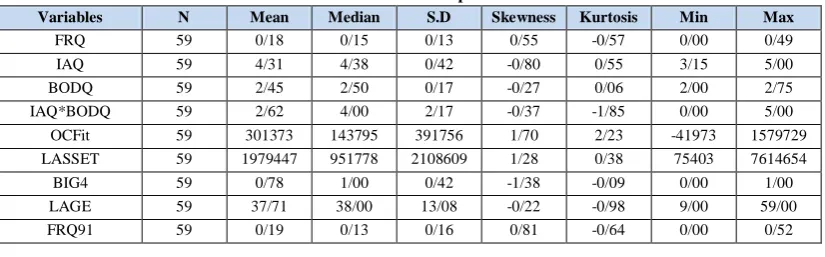
Calculated central indices such as mean, median and dispersion indices such as standard deviation, kurtosis, and skewness are presented in Table 1. As you can see the median is greater than mean, thus there are some outliners because the mean is affected by these values.
If variables’ means and medians are close, thus the distribution of variables is symmetric. This feature is of grave important because symmetry is one of the normal distribution features that will be addressed in the next section (Kurtosis and skewness of the normal distribution is zero). The skewness and kurtosis of the dependent variable of FRQ were 0.55 and -0.57 respectively, which indicate that its distribution is normal. The distribution of OCFit is skewed to right because their skewness number is different from zero.
The kurtosis coefficient is the index for measuring the dispersion of the sample relative to the normal distribution. In other words, it determines the
distribution height compared to the normal
distribution. In normal distributions, this coefficient equals 3, and less than 3 indicates that the concentration of the sample values around the mean is less than the normal distribution. The variables of this study tend to have less kurtosis than the normal distribution. In other words, these variables are dispersed more than the normal distribution, and that
the concentration of data around the mean is less compared against the normal distribution.
It should be explained that the normality of the remainders of the regression model is one of the regression assumptions which indicates the validity of regression tests. Then, the normal distribution of dependent variables was investigated, using the Kolmogorov-Smirnov test.
Co-ordination test between research variables
In this research, Pearson correlation coefficient was used to determine the correlation between independent variables. Pearson correlation coefficient: although the correlation analysis has a close relationship with regression, conceptually, they have significant differences. The primary goal of correlation analysis is to measure the degree or level of linear dependency between the two variables. The Pearson correlation coefficient analyzes the level of linear dependency (Shirin bakhsh, 2005(
Measuring linear dependence, the correlation
coefficient was determined. Determining the
significance level of correlation, the correlation coefficients were analyzed as per 95% confidence level, based on corresponding t statistic.
0 :
0 :
1 0
XY XY
H H
Pearson correlation matrix was developed, the most important results of which are presented.
The Pearson correlation results are as follows: FRQ and IAQ = 0.59(significant and positive), BODQ=0.05 (insignificant), IAQ * BODQ =0.33 (significant and positive), OCFit =0.004 (insignificant), LASSET = 0.05 (significant and positive), 4BIG =0.05 (insignificant), LAGE is -0.17 (insignificant) and FRQ91 =0.19 (insignificant).*****
Table 1. Research’s Descriptive statistics
Variables N Mean Median S.D Skewness Kurtosis Min Max
Table 2. Pearson Correlation
Investigating normality of dependent variable’s distribution:
Normality of regression model residuals is one of the regression assumptions which approves the validity of regression tests. Using Kolmogorov-Smirnov test, the normality of dependent variables distribution was tested. Since normality of dependent variable depends leads to normality of the model's remnants (the difference between the estimated values and the real values), Therefore, controlling the normality of the
dependent variable before the estimation of the parameters is necessary. If the above mentioned condition is not satisfied, then a suitable solution (e.g. transformation) should be found.
In this test, the null and alternative hypotheses were developed. Using Kolmogorov-Smirnov test (Table 3), FRQ’s probability was determined to be 0.467(which is greater than 0.05) Therefore, the zero hypothesis (variable normality) wasn’t rejected.
Table 3. Kolmogorov-Smirnov test results
N Normal Parameters
Maximum Difference K-S Value
Probability
Mean SD
AV Positive
Negative
59 0/19
0/13 0/11
0/11 -0/09
0/85 0/467
Model 1 was tested using regression analysis. The model is as follows:
FRQ =β1*IAQ + β2 *BODQ + β3*CFO +
β4*LASSET+ β5*BIG 4 + β6*LAGE + β7*FQR91+ e
The null and Alternative hypotheses:
6 , 4 ,... 2 , 1 0 :
0 ... :
1
6 2 1 0
i H
H
i
Correlations
1 .586** .046 .330* .004 .505** .049 -.171 .190 .000 .733 .011 .978 .000 .711 .196 .150 59 59 58 58 59 58 59 59 59 .586** 1 .037 .211 .142 .391** .063 -.229 .197 .000 .782 .112 .283 .002 .633 .081 .135 59 59 58 58 59 58 59 59 59 .046 .037 1 .714** -.138 .071 .164 .082 -.002 .733 .782 .000 .300 .597 .219 .543 .989 58 58 58 58 58 58 58 58 58 .330* .211 .714** 1 -.140 .106 .137 -.200 .191 .011 .112 .000 .294 .427 .306 .132 .152 58 58 58 58 58 58 58 58 58 .004 .142 -.138 -.140 1 .399** .174 -.032 -.052 .978 .283 .300 .294 .002 .187 .810 .694 59 59 58 58 59 58 59 59 59 .505** .391** .071 .106 .399** 1 .241 .012 -.130 .000 .002 .597 .427 .002 .068 .929 .330 58 58 58 58 58 58 58 58 58 .049 .063 .164 .137 .174 .241 1 -.024 -.026 .711 .633 .219 .306 .187 .068 .854 .843 59 59 58 58 59 58 59 59 59 -.171 -.229 .082 -.200 -.032 .012 -.024 1 -.404**
.196 .081 .543 .132 .810 .929 .854 .001 59 59 58 58 59 58 59 59 59 .190 .197 -.002 .191 -.052 -.130 -.026 -.404** 1 .150 .135 .989 .152 .694 .330 .843 .001
59 59 58 58 59 58 59 59 59 Pearson Correlation
Sig. (2-tailed) N
Pearson Correlation Sig. (2-tailed) N
Pearson Correlation Sig. (2-tailed) N
Pearson Correlation Sig. (2-tailed) N
Pearson Correlation Sig. (2-tailed) N
Pearson Correlation Sig. (2-tailed) N
Pearson Correlation Sig. (2-tailed) N
Pearson Correlation Sig. (2-tailed) N
Pearson Correlation Sig. (2-tailed) N FRQ
IAQ
BODQ
IAQ*BODQ
OCFit
LASSET
BIG4
LAGE
FRQ91
FRQ IAQ BODQ IAQ*BODQ OCFit LASSET BIG4 LAGE FRQ91
Correlation is significant at the 0.01 lev el (2-tailed). **.
Regression analysis results are shown in Table 4. As you can see the probability of significant F was 0.000 which is less than 0.05, so the null hypothesis is rejected at 95% confidence level, i.e. there is a significant model at 95% confidence level**. Determination coefficient was 0.51, which means almost 51% of dependent variable variation is explained by the independent and control variables.
The determination coefficient is very large, of which a strong correlation between independent variables and dependent variable is inferred.
Durbin-Watson statistic was 2.36. It should be mentioned that values close to 2 are indicating that the residuals aren’t autocorrelated (another assumption of regression. Therefore, there is no correlation between the residuals).
Table 4. Goodness of fit and estimation results; Model 1
Parameters Coefficient t value Probability Result VIF Constant -0/404 -2/58 0/013
Significant and positive -
IAQ 0/128
3/71 0/001
Significant and positive 1/31
OCFit 0/000
-2/04 0/047
Significant and negative 1/20
LASSET 0/00000003
3/75 0/000
Significant and positive 1/50 BIG4 -0/0013 -0/04 0/969 Insignificant 1/07 LAGE -0/0005 -0/43 0/668 Insignificant 1/23 FRQ91 0/125 1/33 0/188 Insignificant 1/26 value F 8/89 Probability F 0/000 Determination Coefficient 0/51 Durbin-Watson 2/36
Variance Inflation Factor (VIF) is an index which reveals multicollinearity. VIF>10 indicates that multicollinearity is probable; While the maximum VIF is 1.50.
Estimating coefficients using partial t-statistics, following hypotheses were developed. Null and Alternative hypotheses were developed as follows:
0 : 0 : 0 1 0 0 H H
Null and Alternative hypotheses of the independent and the control variables were developed as follows:
0 : 0 : 1 1 1 0 H H 0 : 0 : 2 1 2 0 H H . 0 : 0 : 6 1 6 0 H H
t-test statistic was calculated using:
6 ,..., 2 , 1 , 0 0 i S t i i i
t-test statistic’s distribution is normal in case of large samples, according to which rejection and non-rejection intervals were defined as follows:****
Which means that the null hypothesis is rejected if the t-statistic falls in the rejection interval.
Table** shows a positive and significant relationship between the independent and dependent variables, i.e. increasing the independent variable, the dependent variable also increases; while in case of negative significant relationship one would observe that increasing the independent variable leads to reduction of the dependent variable. Insignificant relationship means that there is no relation between the independent and dependent variables.
Variables’t-test values were as follows: IAQ =3.71 (significant and positive), OCFit = -2.04 (significant
and negative), LASSET=3.75 (significant and
positive), 4BIG=-0.04, (Insignificant), LAGE=-0.43 (nonsensical) and FRQ91=1.33 (nonsensical). Y-intercept’s t-values were -2.58, which is significant in 95% confidence level.
Conclusion: There is a positive significant relationship between the audit quality and financial reporting quality.
IAQ’s t-value was 3.71, therefore the relationship was positive and significant relationship and the hypothesis was confirmed.
Model 2:
Null and Alternative hypotheses: 8 ,..., 3 , 2 , 1 0 : 0 ... : 1 6 3 2 1 0 i H H i
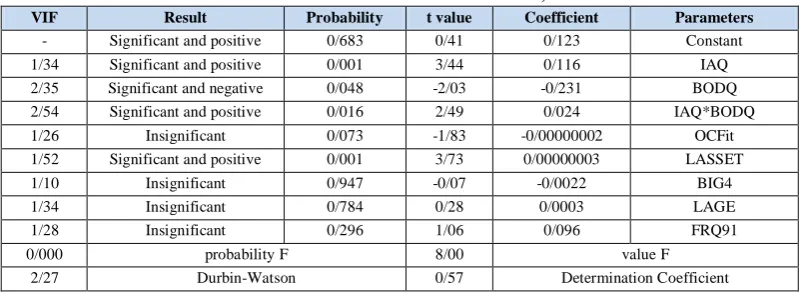
Table 5 shows the results of regression analysis. Results of Model 2 test are shown in Table 5. The probability value of significant F was 0.000which was less than 0.05, thus the null hypothesis was rejected at 95% confidence level, and i.e. the model is significant model at 95% confidence level. Determination coefficient was 0.77, i.e. about 57% of dependent variable variance was explained by the independent and control variables. The determination coefficient indicates that there is a strong relationship between the
independent and dependent variables. Watson-Durbin statistic was 2.27. The VIF was smaller than 2.54.
Variables’t-test values were as follows: IAQ =3.44 (significant and positive), BODQ =-2.03 (significant and negative), IAQ * BODQ=2.49 (significant and positive), OCFit =-1.83 (insignificant), LASSET =3.73 (significant and positive), BIG4 =-0.07 (insignificant),
LAGE=0.28 (insignificant) and FRQ91 =1.06
(insignificant). Y-intercept’s t-values were 0.41, which is insignificant in 95% confidence level.
Conclusion: the positive relationship between high-quality boards of directors reinforces and audit quality enhances the financial reporting quality.
(IAQ*BODQ)’s t-statistic was 2.49 i.e. the relationship is significant and positive, and the hypothesis was supported.
Table 5. Goodness of fit and estimation results; Model 2
Parameters Coefficient t value Probability Result VIF Constant 0/123 0/41 0/683
Significant and positive -
IAQ 0/116
3/44 0/001
Significant and positive 1/34
BODQ -0/231
-2/03 0/048
Significant and negative 2/35
IAQ*BODQ 0/024
2/49 0/016
Significant and positive 2/54 OCFit -0/00000002 -1/83 0/073 Insignificant 1/26 LASSET 0/00000003 3/73 0/001
Significant and positive 1/52 BIG4 -0/0022 -0/07 0/947 Insignificant 1/10 LAGE 0/0003 0/28 0/784 Insignificant 1/34 FRQ91 0/096 1/06 0/296 Insignificant 1/28 value F 8/00 probability F 0/000 Determination Coefficient 0/57 Durbin-Watson 2/27
5. Discussion and Conclusions
This paper investigated the relationship between the internal audit quality (and its components) and abnormal accrual items (which acts as a financial reporting quality index). Also, the board’s regulatory effect on this relation was tested.
Recently, Institute of Internal Auditors has defined Internal Auditing as follow: an advisory, independent and confidence making activity which enhances firm value and improves its operations. Based on this definition, we conclude that internal auditor play an important role in establishment of effective governance and control, and this is inevitable; since it has a significant impact on the reliability and credibility of financial reports.
Over the course of time, internal auditor’s role has grown such that it has been transformed from its
traditional form into ensuring an operation with essentially has higher added-value. Also, internal audit quality plays a significant role in terms of earnings management (one of the cornerstones of corporate governance ).
If the company has no internal audit department, the board should ensure its adequate and guaranteed approach, and regularly review ongoing internal control. According to Alder et al (2013), more investment in internal audit provides us with high-quality regulation through internal audit and enhanced ability to detect and prevent management bias or opportunistic behaviors.
This conclusion suggests that enhanced regulation through internal auditing (more intensive internal audit and higher costs), alleviates management bias and leads to more qualitative financial reporting.
According to the theoretical foundations and as it was expected, results showed that internal audit quality is positively correlated with financial reporting quality. The second hypothesis examined whether board quality affects the relationship between internal audit quality and abnormal accruals. Board quality (BODQ) was a variable, used for reviewing other aspects of corporate governance
According to Priyot et al. (2009), internal audit quality plays a significant role in earnings management. On the other hand, the desirable effects of internal auditing on financial reporting quality are
contingent on other government mechanisms,
including the quality of the board.
For example, if a company is already has powerful
internal (or external) sovereign governance
mechanisms such as a board of directors, then strong internal auditors may not of great value for the company; however, if the board of directors isn’t strong then a potent internal auditing department will be more valuable. On the other hand, strong board is looking intensively for potent internal auditors. Accordingly, we examined the effects of the internal auditor's performance financial reporting quality, assuming that the company has a strong board of directors.
Second hypothesis’s results showed that the higher the quality of the board of directors, the more strongly the relationship between internal auditor quality and financial reporting quality.
This study, as any research, faced some limitations. Limitations obscure the way to generalization of research results. One of the limitations of this research was difficulty in case of reaching internal auditors of studied companies. The other limitation was that some internal auditors avoided completing the research questionnaire. Also, part of the research data was based on the researcher-designed questionnaire which was sent to internal auditors.
In spite of validity and reliability of data measurement tool, one should cautious in case of issuing judgment regarding accuracy of the results (one of inherent limitations of questionnaires). Also since the research was conducted in 2016, at which
society’s conditions were tense from the political perspective and because of presidential elections and transfer of power, thus this research is limited from the contextual perspective since the majority of the members of the board of directors and corporate executives depended on the government, and could affect the financial reporting in a specific way. The first issue prevented us from reaching internal auditors of all listed companies at the securities exchange. It seems that the second limitation may have an impact on corporate performance, financial reporting quality, audit firm, and other factors.
According to the overall result of this research (the first hypothesis), it was confirmed that enhancing the internal audit quality will lead to high-quality financial reporting. And that internal auditing will enhance the value of the company and improve its operations. Also the internal auditor plays an important role in establishing effective governance and control, which is inevitable, and, at the same time, has a significant impact on the reliability and credibility of the financial statements.
Executives are recommended to establish internal audit departments, recruit experienced auditors, and use its report to improve the financial reports and to enhance company benefits. Also, given research results in terms of the second hypothesis, the quality of the board of directors will enhance the internal audit quality and financial reporting quality.
And if the company is has powerful board of directors, then strong internal auditors may not of great value for the company; however, if the board of directors isn’t strong then a potent internal auditing department will be more valuable. On the other hand, strong board is looking intensively for potent internal auditors. The companies are recommended to recruit people with financial background as independent (non-executive) members of board of directors, and to recruit them while meeting legal requirements of business law and company needs.
References
1) Abbott, L. J., Parker, S. and Peters, G. F. (2017), “Audit fee reductions from internal audit provided assistance: The incremental impact of internal audit characteristics”, Contemporary Accounting Research, Vol. 29(1), pp. 94 – 118.
“A Summary of Research on External Auditor Reliance on the Internal Audit Function.” Auditing: A Journal of Practice & Theory, Vol. 32(Supplement 1), pp. 251 – 286.
3) Beasley, M., Carcello, J., Hermanson, D. and Lapides, P. D. (2000), “Fraudulent financial reporting: Consideration of industry traits and co r po r a t e governance mechanisms”, Accounting Horizons, Vol. 14(4), pp. 441 – 454.
4) Bou-Raad. G. (2000), “Internal auditors and a value-added approach: the new business regime”, Managerial Auditing Journal, Vol. 15(4), pp. 182 – 187.
5) Carcello, J.V., Hermanson, D.R., Ye, Z. (2011), “Corporate governance research in accounting and auditing: insights, practice implications, and future research directions”, Auditing: A Journal of Practice & Theory, Vol. 30(3), pp. 1 – 31.
6) Cohen, J., Krishnamoorthy, G. and Wright A. (2004), “The corporate governance mosaic and financial reporting quality”, Journal of Accounting Literature, Vol. 23, pp. 87 – 152.
7) Cooper, B. J., Leung, P. and Wong, G. (2006), “The Asia Pacific literature review on internal auditing”, Managerial Auditing Journal, Vol. 21(8), pp. 822 – 834.
8) Davidson, R., Goodwin-Stewart, J. and Kent, P. (2005), “Internal governance structures and
earnings management”, Accounting and
Finance,Vo l . 45 (2), p p . 241 – 267.
9) Dechow, P. M., Sloan, R. G. and Sweeney, A.P. (1995), “Detecting Earnings Management”, The Accounting Review, Vol. 70(2), pp. 193 – 225. 10) Dechow, P.M. and Skinner, D. J. (2000),
“Earnings Management: Reconciling the Views of
Accounting Academics, Practitioners, and
Regulators”, Accounting Horizons, Vol. 14(2), pp. 235 – 250.
11) Etemadi, H., Dianati Dailami, Z.(2009) “The effect of financial manager’s ethical approach on the financial reporting quality”, Science and technology Ethics quarterly, V.10, w11.
12) Farber, D. (2005), “Restoring trust after fraud: Does corporate governance matter”, The Accounting Review, Vol. 80(2), pp. 539 – 561. 13) Gomez, E.T., and Jomo, K.S. (1997), Malaysia's
Political Economy: Politics, Patronage and Profits, First Edition, Cambridge University Press, Cambridge.
14) Gramling, A. A., Maletta, M.J. , Schneider, A. and Church, B.K. (2004), “The Role of the Internal Audit Function in Corporate Governance: A Synthesis of the Extant Internal Auditing Literature and Directions for Future Research”. Journal of Accounting Literature, Vol. 23, pp. 194 – 244.
15) Gras-Gil, E., Marin-Hernandez, S. and Garcia-Perez de Lema, D. (2012), “Internal audit and financial reporting in the Spanish banking industry”, Managerial Auditing Journal, Vol. 27(8), pp. 728 – 753.
16) Habibzade, Sh.(2010) “The effect of Internal auditing presence on external auditor planning”, Master’s Thesis, Tabatabie University.
17) Heshi, A.(1996) “to what extent external auditors rely on audit company’s internal audits?; A review”, Master’s thesis, Science college of Tehran University.
18) Jamshidi, H.(1999) “an investigation on
identification of internal controls of computerized accounting systems by Iranian external auditors, and its effect on auditor opinion”, Master’s thesis, Tehran University.
19) Klein, A. (2002), “Audit committee, board of
director characteristics, and earnings
management”, Journal of Accounting and Economics, Vol. 33, pp. 375 – 400.
20) Kothari, S.P., Leone, A.J. and Wasley, C. (2005), “Performance matched discretionary accrual measures”, Journal of Accounting and Economics, Vol. 39(1), pp. 163 – 197.
21) Krishnan, J. (2001), Corporate governance and internal control: An empirical analysis. American Accounting Association (AAA) Annual Meeting. Atlanta, GA: AAA
22) Krishnan, J. (2005), “Audit Committee Quality and Internal Control: An Empirical Analysis”, The Accounting Review, Vol. 80(2), pp. 649 – 675. 23) Lin, S., Pizzini, M. , Vargus, M. E. and Bardhan, I.
(2011). “The role of the internal audit function in the detection and disclosure of material weaknesses”, The Accounting Review, Vol. 86(1), pp. 287 – 323.
24) Pergola, T. and Verreault, D. A. (2009), “Motivations and potential monitoring effects of large shareholders”, Corporate Governance, Vol. 9(5), pp. 551 – 563.
(2009), “Internal audit function quality and earnings management”, The Accounting Review 84(4), pp.: 1255 – 1280.
26) Moghadam, AK., Ahmadi-nejad, M., and
Javanmardi, S.(2012) “the relation between the qualify of financial reporting and abnormal return dispersion in companies listed at Tehran stock exchange”, Experimental-Scientific Quarterly of Accounting, N.3, p.19.
27) Sadeghi, MR.(1397) “a study on the effect of confirmation letter of external auditor on internal control system assessed by Organization of Auditing ”, Master’s Thesis, Tehran University. 28) Sajjadi, SH., Zera-neghad, M., and Jafari,
AR.(2009) “Nonfinancial factors affecting
financial reporting quality of companies listed at Tehran stock exchange”, Accounting and Auditing periodical, No. 57, p.51.
29) Schipper, K. and Vincent, L. (2003), “ Earnings
quality”, Accounting H orizons, Vol.
17(Supplement), pp. 97 – 110.
30) Vafeas, N. (2005), “Audit committees, boards, and the quality of reported earnings”, Contemporary Accounting Research,. Vol. 22(4), pp. 1093 – 122. 31) Wang, M. C., Lee, M. H., & Chuang, J. J. (2016).
Relations among audit committee establishment, information transparency and earnings quality: Evidence from simultaneous equation models. Quality & Quantity, 50(6), 2417-2431.