An Efficient Method for DNA Extraction from Preserved
Stoneflies (Insecta, Plecoptera)
Maribet Gamboa Jazzmin Arrivillaga
Universidad Simón Bolívar, Departamento de Estudios Ambientales, Laboratorio de Genética de Poblaciones, Valle de Sartenejas, Caracas, VENEZUELA e-mail: [email protected], Corresponding author: Dr. Maribet Gamboa
ABSTRACT
Recent studies of ecology and taxonomy on stoneflies employed molecular sequences data based on DNA amplification used both field and museum alcohol-preserved specimens. In this study, we compared four different DNA extraction protocols based on preserved stoneflies specimens with SDS-Ethanol method, Phenol/Cloroform, Phenol/Chloroform/Isoamyl Alcohol method and modification of this last method to obtain best efficiency DNA extraction method. The absence of PCR inhibitors and the DNA quality were evaluated by PCR amplification of the mitochondrial 12S DNA gene using insects-specific primers. DNA extraction efficiency using method 4 is significantly higher with the highest quality >2.19 (260/280 nm) and quantity (>1370 ng/μl) and significantly difference (P< 0.05) than DNA extraction efficiency using other methods. This technique provides alternative DNA extraction methods for preserved stoneflies.
Key words: DNA extraction, 12S, molecular methods, Plecoptera, PCR
INTRODUCTION
Molecular methods have opened up a wide range of new approaches for invertebrate research, particularly with regard to phylogenetic and taxonomic studies (Schill, 2007). Several molecular fingerprint systems have been proposed and tested for a large number of invertebrates, including length polymorphism in polymerase chain reaction (PCR), amplified gene segments (Arrivillaga et al. 2003; Babcock & Heraty, 2000; Navarro & Weaver, 2004; Szalanski et al. 2000; Wiegmann et al. 2000), restriction fragment length polymorphisms (RFLP) (Szalanski et al. 1999; Torres et al. 2000), randomly amplified polymorphic DNA (RAPD) (Bidochka et al. 1994; Gawel & Bartlett, 1993; Winder et al. 2005), amplified fragment length polymorphisms (AFLP) (Van Der Wurff et al. 2003; Wang & Porter, 2004; Winder et al. 2005) and riboprinting (Clark et al. 1989-1995; Schill & Steinbrück, 2007).
GAMBOA, M., ARRIVILLAGA, J. In stoneflies (Plecoptera) research has mainly focused on enzymes studies (Fochetti, 1994; Fochetti & Nicolai, 1996; Fochetti et al. 1997; Hughes et al. 1999; Lees & Ward, 1987; Wright & White, 1992) with a few recent studies employing molecular sequences data (e.g. Steward & Beckenbach, 2006).
These molecular studies using tissue kits such as Quiagen (Thomas et al. 2006; Terry, 2003; Yasick & Wolin, 2004) and Puregene (Schultheis, 2000) for DNA extraction from a small portion of wing or leg muscle of preserved specimen.
The extraction and purification of intact DNA from stoneflies is often extremely difficult due to the small amount of total DNA available (Schultheis, 2000). Additional problems are encountered during preservation, when handling specimens in the field, laboratory or museum specimens, because a best way of preserved stoneflies species for field is 75%-80% alcohol, both adults and nymphs since the structures are better preserved for future morphological observation (e.g. Steward & Stark, 2002), and in the selection of the appropriate extraction protocol or commercial kit.
For molecular phylogenetic and taxonomic studies successful PCR amplification of DNA is dependent upon several factors, particularly the purity, quality and the quantity of the DNA template and therefore upon the original material, its preservation and the process of DNA isolation (Schill, 2007). In this study, we seek to evaluate which methods produce the highest -yield of quality DNA from preserved stoneflies.
MATERIALS AND METHODS Stoneflies species
Individuals of four Anacroneuria species (A. cacute, A. chorrera, A. tachira and
A. paleta) were used to investigate the best method of DNA extraction for successful amplification reactions.
Thespecimens were collected four years ago over a four month period from La Picón river (8º 37’ to 8º 39’ N and 71º 1’ to 71º 5’ O), Merida state, Venezuela with a D-net, preserved in 75% ethanol. Nymphs were identified using the keys in Maldonado
et al. (2002) and Maldonado (2002). DNA extraction methods
Sixty specimens of each species were used for DNA extraction from individual stoneflies following four different protocols:
Method 1: SDS-Ethanol (Arrivillaga et al. 2003).
Method 2: Phenol/Chloroform (Márquez et al. 2003).
Individual abdomens were homogenized with a manual grinder brand KONTEX in SE buffer (5M NaCl, 0,5M EDTA, 10% SDS and distilled water) and incubated overnight at 55°C. Equal volumes of phenol and chloroform were then added and vortexed vigorously to mix the phases before centrifuging at 14,000g for 5 min. The aqueous part was then removed and poured into a new tube, 100μl of 100% ethanol were added and the mixture was centrifuged at 14,000g for 15min. Samples were then stored at -20°C overnight. The mixture was then centrifuged again at 14,000g for 15 min and the supernatant removed. Refrigerated ethanol 70% was added and the mixture centrifuged at 14,000g for a further 15 min. The supernatant was poured off and the pellets allowed to air dry for 15min. DNA was resuspended in TE buffer (10mM tris-HCl, pH 8.0, 1mM EDTA).
Method 3: Phenol/Chloroform/Isoamyl Alcohol protocol (Halos et al. 2004). Individual abdomens were homogenized with a manual grinder brand KONTEX in Phosphate buffered saline (137mM NaCl, 2,7mM KCl, 10mM Na2HPO4, 2mM KH2PO4, distilled water), 1% SDS and 1μl proteinase K, and left at 50°C for five minutes. The sample was then left at 95°C for 15 min before adding an equal volume of phenol:chloroform:isoamyl alcohol and vortexing vigorously to mix the phases. The mixture was then centrifuged at 14,000g for 5 min, and the aqueous part removed and poured into a new tube. Twenty microliters of NaCl were then added, the supernatant was poured off and the pellets allowed to air dry for 15 min before dissolving in TE buffer (10mM tris-HCl, pH 8.0, 1mM EDTA).
Method 4: Modification of the Halos et al. (2004) Phenol/Chloroform/Isoamyl Alcohol protocol.
Individual abdomens were homogenized with a manual grinder brand KONTEX in Phosphate buffered saline (0,1M NaCl, 2,7mM KCl, 10mM Na2HPO4, 2mM KH2PO4, distilled water), 10% SDS and 1μl proteinase K and left overnight at 56°C. The sample was then left at 95°C for 15 min and an equal volume of phenol:chloroform:isoamyl alcohol added before vortexing vigorously to mix the phases and centrifuging at 14,000g for 5 min. The aqueous part was then removed, poured into a new tube and then added phenol: chloroform:isoamyl alcohol twice more, removing the aqueous part each time. Twenty microliters of NaCl and 100% ethanol were then added and the mixture left overnight at -20°C. It was then spun at 4°C for 15 min and the supernatant removed. Seventy percent cold ethanol was then added and the mixture centrifuged at 14,000g for 15 min (repeated twice). The supernatant was then poured off and the pellets allowed to air dry for 15 min, before dissolving in distilled water.
GAMBOA, M., ARRIVILLAGA, J. DNA amplification
PCR amplification (PTC100, M.J. Research Inc., Waltham MA 02451 USA) of the 12S region of mtDNA (Kambhampati & Smith, 1995) using primers: SR-N+ 5’ TAC TAT GT TAC GAC TTA T 3’ and SR-J- 5’ AAA CTA GGA TTA GAT ACC C 3’. Each reaction was carried out in 25μl volume containing 0,5μmol/ μl of each oligonucleotide primer, 0,5mM of each dNTP, 5μL of 10× PCR buffer, 1 U of Taq DNA polymerase, 4μL of the DNA extract, 4μL of MgCl2 and sterile water. The PCR thermal regime consisted of one cycle of 3 min at 95 °C; ten cycles of 30seg at 95 °C, 1 min at 40 °C and 1 min at 72 °C; 25 cycles of 30seg at 94 °C, 1 min at 50 °C and 1 min at 72 °C and a final cycle of 7 min at 72 °C. The DNA bands were visualized on a 1.2% agarose gel.
The signal intensity of the bands in the gel was quantified by a densitometric image analysis (Clouds Analyzer http://sm.ocando.googlepages.com/programacloudsana-lyzer, Venezuela, unpublished). The signal value of the strongest band was artificially set to 100% with the relative strength of a band from the ladder. Weaker signals were then calculated as a percentage of this value.
PCR product purification and sequencing
For purification and standard sequencing of 12S mtDNA primers, the sample was sent to the Macrogen Service Center (Korea) and identified using BLAST (Basic Local Alignment Search Tool).
RESULTS DNA extraction
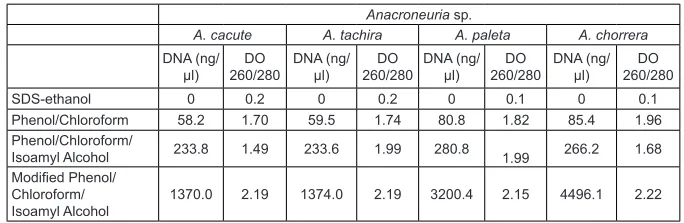
The fourth method (Modified Phenol/Chloroform/Isoamyl Alcohol protocol) yielded the highest quality and quantity of DNA (Table 1), with at least 1370 ng DNA/specimen and a purity of at least 2.15. A lower amount of DNA was extracted from methods two and three (Phenol/Chloroform and Phenol/Chloroform/Isoamyl Alcohol). The SDS-Ethanol extraction method (method 1) yielded DNA of a very low purity. Significant statistically difference, was found between methods (P<0.05).
Table 1. Concentrations of DNA extracted from Anacroneuria species using the different methods. Anacroneuria sp.
A. cacute A. tachira A. paleta A. chorrera
DNA (ng/
μl) 260/280DO DNA (ng/μl) 260/280DO DNA (ng/μl) 260/280DO DNA (ng/μl) 260/280DO
SDS-ethanol 0 0.2 0 0.2 0 0.1 0 0.1
Phenol/Chloroform 58.2 1.70 59.5 1.74 80.8 1.82 85.4 1.96
Phenol/Chloroform/
Isoamyl Alcohol 233.8 1.49 233.6 1.99 280.8 1.99 266.2 1.68
Modified Phenol/ Chloroform/
Isoamyl Alcohol 1370.0 2.19 1374.0 2.19 3200.4 2.15 4496.1 2.22
DNA amplification and PCR sequencing
from the Anacroneuria species studied, was evaluated. Clear bands of amplification products were produced for all methods although there were differences in the strength of the signals (Fig. 1).
Fig.1. Amplification products of the 12S region from preserved Anacroneuria species using four different DNA extraction methods. a) Marker, b) SDS-Ethanol, c) Phenol/Chloroform/Isoamyl Alcohol, d) Phenol/ Chloroform, e) Modified Phenol/Chloroform/Isoamyl Alcohol protocol.
The intensity of all the bands in relation to the ladder band was calculated (Fig. 2). The highest amount of PCR product (92%) was obtained using the Modified Phenol/ Chloroform/Isoamyl Alcohol protocol for DNA extraction. The Phenol/Chloroform/ Isoamyl Alcohol DNA extraction method also gave satisfying results, even though the signal was slightly weaker (57%). The Phenol/Chloroform extraction method produced weak band signals (7%), and null results were obtained with the SDS-Ethanol method.
Direct sequencing of the 12S region of the amplified PCR products gave sequences of around 260 bp.
GAMBOA, M., ARRIVILLAGA, J. DISCUSSION
Preserved tissue samples and museum specimens are a vast repository of genetic information of interest to biological researchers (Wandeler et al. 2007). DNA is known to degrade post-mortem as a function of heat and time molecular-based studies are largely limited to recently collected samples preserved specifically for molecular work (Gilbert et al. 2007). Many museum specimens, particularly insects, are stored pinned and are not subjected to any further preservation treatment (Zimmermann et al. 2008).
The aim of this study was to compare different procedures for nucleic acid isolation in order to test their efficiency and practicability for obtaining DNA suitable for PCR amplification from ethanol preserved aquatic insects. This is the first comparative approach for studying methods of DNA extraction from preserved-alcohol stoneflies.
The suitability of isolated DNA as analyze for a given technique is generally determined by three important factors: (i) amount or concentration, (ii) purity and (iii) integrity of the DNA. Each of these factors can be influenced by the extraction technique employed and, in turn, impacts upon the validity of techniques applied in subsequent analysis (Freeland, 2007; Saunders, 1999).
Method 4 is particularly well suited for extracting DNA from stoneflies preserved in ethanol, producing DNA of a high quality and purity despite the fact that ethanol-fixed specimen are most difficult to obtained DNA (Lindahl, 1993; Schill, 2007). This method is a modification of the Halos et al. (2004) method: samples were subjected to two overnight steps, two repeats of the phenol/chloroform:isoamyl alcohol step and were then resuspended in distilled water, and is probably a good choice for the DNA extraction to species of many small invertebrates fixed in ethanol or specimen from museum.
Alcohol preserved specimens are very common in stoneflies, due to the fact that major research is focused in ecology or taxonomic studies (e.g. Steward & Stark, 2002) seeking to preserve the morphological structures. In the past years, as molecular studies in stoneflies are increasing, many studies used alcohol stored at -20°C for DNA studies (Fochetti, 1994; Fochetti & Nicolai, 1996; Fochetti et al. 1997; Hughes et al. 1999; Lees & Ward, 1987; Thomas et al. 2006; Terry, 2003; Schultheis, 2000; Yasick & Wolin, 2004; Wright & White, 1992), which leads to the possible degradation of DNA and reduce the efficacy of PCR.
The amplification of a fragment of the mitochondrial 12S DNA gene of stoneflies is an important and necessary positive control to confirm the efficiency of DNA extraction and the quality of the DNA being amplified, as well as the absence of potentially inhibitory factors (Halos et al. 2004).
All of the methods used for the extraction of DNA from stoneflies (Schultheis, 2000; Thomas et al. 2006) have been developed for invertebrates (Giribet & Rivera, 2000; Hovmöller et al. 2002; Villa & Bjöklund, 2004), but parts of the protocols may be adapted for special applications. Steward & Beckenbach (2006) obtained high yields using proteinase K digestion followed by phenol/chloroform/isoamyl alcohol DNA extraction, a method modified from a previous protocol developed by the same authors (Steward & Beckenbach, 2005). Nevertheless, the addition of an extra overnight storage period, used in this study, improves the isolation of DNA still further.
Besides the different commercially available extraction kits mentioned above, which have been designed for the simple and rapid isolation of high quality PCR reproducible genomic DNA in as little as a few minutes up to a few hours, Pfenninger
et al. (2007) and Hughes et al. (2003) suggested another method for DNA extraction from aquatic insects, using CTAB and Chelex. These authors, however, did not give data for the quality or quantity of the DNA isolated.
Schill (2007) obtained between 20 and 30ng of DNA per specimen with fresh tissue using tissue kits (GenElute™ Mammalian Genomic DNA Miniprep Kit, the NucleoSpin® Tissue DNA extracting kit and E.Z.N.A.® Tissue DNA II Kit) and suggested that these kits are the best methods for DNA isolation. In this study, however, the modified phenol:chloroform:isoamyl alcohol protocol exhibits a better quality DNA yields of between 1370 and 4496ng per preserved specimen.
The condition of DNA is one of the determining factors for successful PCR and depends on two factors: the quality and quantity of the template DNA. If there is little DNA available, amplification of the whole genome from small samples will be poor (Schill, 2007).
There are many different protocols available from different suppliers and those used represent a random selection of those available for the region to be amplified. However, the amounts of PCR product obtained in this study were sufficient for direct sequencing and provide alternative methods for DNA extraction for molecular, taxonomic and ecological studies.
Molecular methods for species identification using short DNA sequences, known as DNA barcodes, signature sequences to identify molecular operational taxonomic units, have been proposed and developed to facilitate biodiversity surveys (e.g. Hajibabaei et al. 2007; Smith et al. 2008) and ecological studies (e.g. Smith et al.
2007; Valentini et al. 2007) and identify different life-stages (e.g. Pauls et al. 2009; Waringer et al. 2007-2008). Our study shows that obtaining high quality DNA from extraction protocols is a key factor for ensuring good results in PCR amplificiation. From the four methods we tested the best quality and quantity of DNA from stonefly tissues was obtained using the modified protocol of Halos et al. (2004).
ACKNOWLEDGMENTS
GAMBOA, M., ARRIVILLAGA, J. REFERENCES
Arrivillaga, J., Mutebi, J. P., Piñango, H., Norris D., Alexander B., Feliciangeli D., Lanzaro G., 2003, The Taxonomic Status of Genetically Divergent Populations of Lutzomyia longipalpis (Diptera: Psychodidae) Based on the Distribution of Mitochondrial and Isozyme Variation. Journal of Medical Entomology, 40: 615-627.
Babcock, C. S., Heraty, J. M., 2000, Molecular markers distinguishing Encarsia formosa and Encarsia luteola (Hymenoptera: Aphelinidae). Annual Entomology of Society of America, 93(49): 738-744. Bidochka, M. J., McDonald, M. A., St Leger, R. J., Roberts, D. W., 1994, Differentiation of species and
strains of entomopathogenic fungi by random amplification of polymorphic DNA (RAPD). Current Genetics, 25: 107-13.
Cameron, S. L., Beckenbach, A. T., Dowton, M., Whiting, M. F., 2006, Evidence from mitochondrial genomics on interordinal relationships in insects. Arthropod Systematics & Phylogeny, 64(1): 27-34. Clark, C. G., Diamond, L. S., 1997. Intraspecific variation and phylogenetic relationships in the genus
Entamoeba as revealed by riboprinting. The Journal of Eukaryotic Microbiology, 44: 142-154. Clark, C. G., Cross, G. A. M., De Jonckheere, J. F., 1989. Evaluation of evolutionary divergence in the
genus Naegleria by analysis of ribosomal DNA restriction enzyme patterns. Molecular Biochemical Parasitology, 34: 281-296.
Clark, C. G., Martin, D. S., Diamond, L. S., 1995, Phylogenetic relationships among anuran trypanosomes as revealed by riboprinting. The Journal of Eukaryotic Microbiology, 42: 92-96.
Fochetti, R., 1994, Biochemical systematic and biogeographical patters of the Italian and Corsican species of the Protoneumura Corsicana species group (Plecoptera: Nemouridae). Aquatic Insects, 16(1): 1-15.
Fochetti, R., Nicolai, P., 1996, The genus Taeniopteryx in Italy: biochemical and morphological data with the description of Taeniopteryx mercury n. sp. (Plecoptera: Taeniopterygidae). Bulletin de la Société Entomologique Suisse, 69: 95-106.
Fochetti, R., Cobolli, M., Matthaeis, E., Oliverio, M., 1997, Allozyme variation in the genus Isoperla (Plecoptera; perlodidae) from Mediterranean islands, with remarks on genetic data on stoneflies.
In: Landolt, P., Sartori, M. (Eds.). Ephemeroptera & Plecoptera: Biology-Ecology-Systematics. pp 476-483.
Freeland, J. R., 2007, Molecular ecology. John Wiley and Sons, Ltd. 388pp.
Fribourg, M. T. L., Gawel, N. J., Bartlett, A. C., 1993, Characterization of differences between whiteflies using RAPD-PCR. Insect Molecular Biology, 2: 33-38.
Gilbert, M. T., Moore, W., Melchior, L., Worobey, M., 2007, DNA extraction from Dry Museum Beetles without conferring external morphological damage, Plos ONE, 3(272): 1-4. Online access
Giribet, G., Rivera, C., 2000, A review of arthropod phylogeny: new data based on ribosomal DNA sequences and direct character optimization. Cladistics, 16: 204-231.
Hajibabaei, M., Singer, G. A. C., Clare, E. L., Hebert, P. D. N., 2007, Design and applicability of DNA arrays and DNA barcodes in biodiversity monitoring. Biomedcentral Biology, 5(24): 1-7.
Halos, L., Jamal, T., Vial, L., Mailard, R., Suau, A., Le Menach, A., Boulouis H., Vayssier-Taussat M., 2004, Determination of an efficient and reliable method for DNA extraction from ticks. Veterinary Research,
35: 709-713.
Hammer, O., Harper D. A. T., Ryan P. D., 2001, PAST: Paleontological Statistics Software Package for Education and Data Analysis. 1.42. Palaeontological Association, 4(1):1-9. http://palaeo-electronica. org/2001_1/past/issue1_01.htm.
Hebert, P. D., Cywinska, A., Ball, S. L., DeWaard, J. R., 2003, Biological identifications through DNA barcodes. Proceeding of The Royal Society of London, 279: 313-321.
Hogg, I. D., Willmann-Huerner, P., Stevens, M. I., 2002, Population genetic structures of two New Zealand stream insects: Archichauliodes diversus (Megaloptera) and Coloburiscus humeralis
Hovmöller, R., 2006, Molecular phylogenetics and taxonomy issues in dragonfly systematics (Insecta: Odonata). PhD thesis Stockholm University. Sweden. 67pp.
Hovmöller, R., Pape, T., Källersjö, M., 2002, The paleoptera problem: basal pterygote phylogeny inferred from 18S and 28S rDNA sequences. Cladistics, 18: 313-323.
Hughes, J. M., Mather, P. B., Sheldon, A. L., Allendorf, F. W., 1999, Genetic structure of the stonefly,
Yoraperla brevis, populations: the extent of gene flow among adjacent montane streams. Freshwater Biology, 41: 63-72.
Hughes, J. M., Mather, P. B., Hillyer, M. J., Cleary, C., Peckarsky, B., 2003, Genetic structure in a montane mayfly Baetis bicaudatus (Ephemeroptera: Baetidae), from the Rocky Mountains, Colorado.
Freshwater Biology, 48: 2149-2162.
Hunter, S. J., Goodall, T. I., Walsh, K. A., Owen, R., Day, J. C., 2008, Nondestructive DNA extraction from blackflies (Diptera: Simulidae): retaining voucher specimens for DNA barcoding projects. Molecuar Ecology Resources, 8: 56-61.
Jackson, J. K., Resh, V. H., 1992, Variation in genetic structure among populations of the caddisfly
Helicopsyche borealis from three streams in northern California, United States. Freshwater Biology, 27: 29-42.
Lindahl T., 1993, Instability and decay of the primary structure of DNA. Nature, 362: 709-715.
Lees, J. H., Ward, R. D., 1987, Genetic variation and biochemical systematic of British Nemouridae.
Biochemical Systematics and Ecology, 15(1): 117-125.
Kambhampati, S., Smith, P. T., 1995, PCR primers for the amplification of four insect mitochondrial gene fragments. Insect Molecular Biology, 4: 233-236.
Maldonado, V., 2002, Biodiversidad de Plecópteros (Insecta: Plecoptera:Perlidae) en Venezuela. PhD thesis Universidad Central de Venezuela. Caracas, Venezuela. 157pp.
Maldonado, V., Stark, B. P., Cressa, C., 2002, Descriptions and records of Anacroneuria from Venezuela (Plecoptera:Perlidae). Aquatic Insects, 24(3): 219-236.
Monaghan, M. T., Spaak, P., Robinson, C. T., Ward, J. V., 2001, Genetic differentiation of Baetis alpines
Pictet (Ephemeroptera: Baetidae) in fragmented alpine streams. Heredity, 86: 395-403.
Monaghan, M. T., Spaak, P., Robinson, C. T., Ward, J. V., 2002, Population genetic structure of 3 alpine stream insects: influences of gene flow, demographics, and habitat fragmentation. Journal of North American Benthology Society, 21(1): 114-131.
Márquez, L. M., Miller, D. J., MacKenzie, J. B., Van Oppen, M. J. H., 2003, Pseudogenes contribute to the extreme diversity of nuclear ribosomal DNA in the hard coral Acropora. Molecular Biology and Evolution, 20(7): 1077-1086.
Navarro, J. C., Weaver, S. C., 2004, Molecular phylogeny of the Vomerifer and Pedroi groups in the Spissipes section of the subgenus Culex (melanoconion). Journal of Medical Entomology, 41(4): 575-581.
Ogden, T. H., Whiting, M. F., 2005, Phylogeny of Ephemeroptera (mayflies) based on molecular evidence.
Molecular Phylogenetics and Evolution, 37: 625-643.
Pauls, S. U., Theissinger, K., Ujvarosi L., Balint, M., Haase P., 2009, Patterns of population structure in two closely related, partially sympatric caddisflies in Eastern Europe: historic introgression, limited dispersal, and cryptic diversity. Journal of North American Benthological Society, 28(3): 517-536. Page, R. D. M., 2000, Comparative analysis of secondary structure of insect mitochondrial small subunit
ribosomal RNA using maximum weight matching. Nucleic Acids Research, 28(20): 3839-3845. Pfenninger, M., Nowak, C., Kley, C., Steinke, D., Streit, B., 2007. Utility of DNA taxonomy and barcoding
for the inference of larval community structure in morphologically cryptic Chironomus (Diptera) species. Molecular Ecology, 12: 1957-1968.
Post, R. J., Flook, P. K., Millest, A. L., 1993, Methods for the preservation of insects for DNA studies.
Biochemical Systematics and Ecology, 21(1): 85-92.
GAMBOA, M., ARRIVILLAGA, J.
Schill, R. O., 2007, Comparation of different protocols for DNA preparation and PCR amplification of mitochondrial genes of tardigrades. In: Pilato, G., Rebecchi, L. (Eds.). Proceedings of the Tenth International Symposium on Tardigrada. Journal of Limnology 66(Suppl. 1): 164-170.
Schill, R. O., Steinbrück, G. H., 2007, Identification and differentiation of Heterotardigrada and Eutardigrada species by riboprinting. Journal of Zoology Systematics Evolutionary Research, 45(3): 184-190. Schultheis, A., 2000, Gene Flow and Dispersal among Populations of the Stonefly Peltoperla tarteri
(Plecoptera: Peltoperlidae) in the Southern Appalachians. PhD thesis Polytechnic Institute and State University. Blacksburg, Virginia. USA. 86pp.
Smith, M. A., Woody, D. M., Janzen, D. H., Hallwachs, W., Hebert, P. D. N., 2007, DNA Barcodes affirm that 16 species of apparently generalist tropical parasitoid flies (Diptera, Tachinidae) are not all generalists. Proceeding of the National Academy of Sciences of the United States of America,
104(12): 4967-4972.
Smith, M. A., Rodriguez, J. J., Whitfield, J. B., Deand, A. R., Janzen, D. H., Hallwachs, W., Hebert P. D. N., 2008, Extreme diversity of tropical parasitoid wasps exposed by iterative integration of natural history, DNA barcoding, morphology, and collections. Proceeding of the National Academy of Sciences of the United States of America, 105(34): 12359-12364.
Steward, J. B., Beckenbach, A. T., 2006, Insect mitochondrial genomics: the complete mitochondrial genome sequence of the meadow spittlebug Philaenus spurnarius (Hemiptera: Auchenorrhyncha: Cercopoidae). Genome, 48: 46-54.
Steward, J. B., Beckenbach, A. T., 2006, Insect mitochondrial genomics 2: the complete mithocondrial genome sequence of a giant stonefly, Pteronarcys princeps, asymmetric directional mutation bias, and conserved plecopteran A+T region elements. Genome, 49: 815-824.
Stewart, K.W., Stark, B.P., 2002, Nymphs of North American stonefly genera (Plecoptera). Second Edition. The Caddis press, Columbus, Ohio, 510 pp.
Szalanski, A. L., Sikes, D. S., Bischof, R., Fritz, M., 2000, Population genetics and phylogenetics of the Endangered American Burying Beetle, Nicrophorus americanus (Coleoptera: Silphidae). Annals of Entomology Society of America, 93(3): 589-564.
Szalanski, A. L., Roehrdanz, R. L., Taylor, D. B., Chandler, L., 1999, Genetic variation in geographical populations of western and Mexican corn rootworm. Insect Molecular Biology, 8: 519-525.
Thomas, M. A., Walsh, A. K., Wolf, M. R., McPheron, B. A., Marden, J. H., 2006, Molecular phylogenetics analysis of evolutionary trends in stoneflies wing structure and locomotor behavior. Proceedings of the National Academy of Science of the United Stated of America, 97(24): 13178-13183.
Terry, M., 2003, Phylogeny of the Polyneopterous insects with emphasis on Plecoptera: molecular and morphological evidence. Phd thesis Brigham Young University. USA. 125pp.
Torres, E. P., Foley, D. H., Saul, A., 2000, Ribosomal DNA sequence markers differentiate two species of the Anopheles maculatus (Diptera: Culicidae) complex in the Philippines. Journal Medical Entomology, 37: 933-937.
Valentini, A., Pompanon, F., Taberlet, P., 2008, DNA barcoding for ecologists. Tree. Open access: http:// www.bolinfonet.org/pdf/Valenti_et_al_2008_barcoding_for_ecologists.pdf.
Van Der Wurff, A. W., Isaaks, J. A., Ernsting, G., Van Straalen, N. M., 2003, Population substructures in the soil invertebrate Orchesella cincta, as revealed by microsatellite and TE-AFLP markers. Molecular Ecology, 12: 1349-1359.
Vila, M., Björklund, M., 2004, The utility of the neglected mitocondrial control region for evolutionary studies in Lepidoptera (Insecta). Journal Molecular Evolution, 58: 280-290
Wandeler, P., Hoeck, P. E., Keller, L. F., 2007, Back to the future: museum specimens in population genetics. Trends Ecology & Evolution, 22: 634-642.
Wang, B., Porter, A. H., 2004, An AFLP-based interspecific linkage map of sympatric, hybridizing Colias butterflies. Genetics, 168: 215-225.
Waringer, J., Wolfram, G., Pauls, S. U., Heinrich, V., Lubini V., 2008, DNA based association and descripcion of the larval stage of Drusus melanchaetes McLachlan, 1876 (Trichoptera: Limnephilidae: Drusinae) with notes on ecology and zoogeography. Limnologica, 38: 34-42.
Wiegmann, B. M., Tsaur, S., Webb, D. W., Yeates, D. K., Cassel, B. K., 2000, Monophyly and relationships of the Tabanomorpha (Diptera: Brachycera) based on 28S ribosomal gene sequences. Annals Entomology of Society American, 93(5): 1031-1038.
Winder, L. M., Phillips, C. B., Lenney-Williams, C., Cane, R. P., Paterson, K., Vink C. J., Goldson, S. L., 2005, Microsatellites and 16S sequences corroborate phenotypic evidence of trans-Andean variation in the parasitoid Microctonus hyperodae (Hymenoptera: Braconidae). Bulletin of Entomological Research, 95: 289-298.
Wright, M., White, M. M., 1992, Biochemical systematic of the North American Pteronarcys (Pteronarcyidae: Plecoptera). Biochemical Systematic and Ecology, 20(6): 515-521.
Yasick, A. L., Wolin, J. A., 2004, Population diversity and dispersal of two stonefly species (Order Plecoptera) in four watersheds of Northeast Ohio. Presented at the NABS Annual meeting, Vancouver, British Columbia.
Zimmermann, J., Hajibabaei, M., Blackburn, D. C., Hanken, J., Cantin, E., Posfai, J., Evans, T. C., 2008, DNA damage in preserved specimens and tissue samples: a molecular assessment. Frontiers in Zoology, 5(8):1-13.