Georgia State University Georgia State University
ScholarWorks @ Georgia State University
ScholarWorks @ Georgia State University
Business Administration Dissertations Programs in Business Administration
Spring 5-11-2012
Service Innovation in a Voluntary Organization: Creating Work
Service Innovation in a Voluntary Organization: Creating Work
Opportunities for Severely Developmentally Disabled Adults
Opportunities for Severely Developmentally Disabled Adults
Cathy Sue Neher Georgia State University
Follow this and additional works at: https://scholarworks.gsu.edu/bus_admin_diss
Recommended Citation Recommended Citation
Neher, Cathy Sue, "Service Innovation in a Voluntary Organization: Creating Work Opportunities for Severely Developmentally Disabled Adults." Dissertation, Georgia State University, 2012.
https://scholarworks.gsu.edu/bus_admin_diss/1
Cathy S. Neher Dissertation
PERMISSION TO BORROW
In presenting this dissertation as a partial fulfillment of the requirements for an advanced degree
from Georgia State University, I agree that the Library of the University shall make it available
for inspection and circulation in accordance with its regulations governing materials of this type.
I agree that permission to quote from, to copy from, or publish this dissertation may be granted
by the author or, in his/her absence, the professor under whose direction it was written or, in his
absence, by the Dean of the Robinson College of Business. Such quoting, copying, or publishing
must be solely for the scholarly purposes and does not involve potential financial gain. It is
understood that any copying from or publication of this dissertation which involves potential
gain will not be allowed without written permission of the author.
Cathy S. Neher Dissertation
NOTICE TO BORROWERS
All dissertations deposited in the Georgia State University Library must be used only in
accordance with the stipulations prescribed by the author in the preceding statement.
The author of this dissertation is:
Cathy S. Neher
4586 Latimer Pointe
Kennesaw, GA 30144
The director of this dissertation is:
Lars Mathiassen GRA Eminent Scholar
Professor, Computer Information Systems Center for Process Innovation
J. Mack Robinson College of Business Georgia State University
Cathy S. Neher Dissertation
Service Innovation in a Voluntary Organization: Creating Work Opportunities for Severely Developmentally Disabled Adults
BY
Cathy Sue Neher
A Dissertation Submitted in Partial Fulfillment of the Requirements for the Degree
Of
Executive Doctorate in Business
In the Robinson College of Business
Of
Georgia State University
GEORGIA STATE UNIVERSITY
ROBINSON COLLEGE OF BUSINESS
Cathy S. Neher Dissertation
Copyright by
Cathy Sue Neher
Cathy S. Neher Dissertation
ACCEPTANCE
This dissertation was prepared under the direction of the Cathy S. Neher Dissertation Committee.
It has been approved and accepted by all members of that committee, and it has been accepted in
partial fulfillment of the requirements for the degree of Executive Doctorate in Business from the
J. Mack Robinson College of Business of Georgia State University.
H. Fenwick Huss, Dean
DISSERTATION COMMITTEE
Dr. Lars Mathiassen (Advisor)
Dr. Richard Baskerville
Cathy S. Neher Dissertation
ACKNOWLEDGMENTS
This research was made possible by a generous grant Right In The Community received from
The Holly Lane Foundation and the enthusiastic participation of Right In The Community,
Georgia Community Support and Services, clients, parents and Georgia State University. I am
thankful for the efforts and support of my advisor, dissertation committee and research
stakeholders. Lastly, I am most thankful for the encouragement of my family and my son and all
of his friends at Marietta Enrichment Center who expressed the desire to be given the
opportunity to contribute by doing meaningful work.
Cathy S. Neher Dissertation
Contents
Tables and Figures ... 9
Tables ... 9
Figures ... 10
Abbreviations and Definitions ... 10
Abstract ... 13
1 Introduction ... 14
2 Problem Setting at RitC ... 18
2.1 About RitC ... 19
2.2 About Developmental Disabilities ... 21
2.3 Developmentally Disabled in the Workforce ... 25
2.4 Research Opportunity # 1 ... 27
3 Service Innovation in Voluntary Organizations ... 28
3.1 Voluntary Organizations ... 28
3.2 Service Innovation ... 30
3.3 Research Opportunity # 2 ... 32
4 Analytical Framework ... 32
4.1 Competing Values Framework... 33
4.2 Original Dimensions of Competing Values Framework ... 34
4.2.1 Organizational Focus ... 35
4.2.2 Structural Preference ... 36
4.2.3 Managerial Concerns ... 36
4.3 Extending the Competing Values Framework ... 37
4.3.1 Strategy Formulation ... 38
4.3.2 Motivational Trait ... 40
4.4 Research Opportunity # 3 ... 42
5 Research Methodology ... 42
Cathy S. Neher Dissertation
5.2 Action Research ... 45
5.2.1 Dual Cycles... 46
5.2.2 Action Research Principles ... 48
5.2.3 Managing Dilemmas... 49
5.3 Process Study ... 51
5.4 Data Collection and Analysis ... 53
6 Problem-Solving Cycle ... 57
6.1 Antecedent Conditions ... 60
6.2 Process Account ... 61
6.2.1 Initiation... 62
6.2.2 Emulation Strategy ... 63
6.2.3 Evolution Strategy ... 66
6.2.4 Formal Training ... 69
6.2.5 First Customer ... 72
6.2.6 New Initiative ... 76
6.3 Outcomes ... 76
6.4 Research Cycle Interactions ... 77
7 Results ... 78
7.1 Analysis Overview ... 78
7.2 Organizational Focus ... 83
7.3 Strategy Formulation ... 88
7.4 Motivational Trait ... 93
8 Discussion ... 99
8.1 Service Innovation at RitC ... 100
8.2 Service Innovation in Voluntary Organizations ... 103
8.3 Adapted CVF for Service Innovation in Voluntary Organization ... 108
Cathy S. Neher Dissertation
9. 2 Implications ... 115
9.3 Engaged Scholarship Reflections ... 116
Appendix ... 118
Appendix I – Definition of Developmental Disability ... 118
Appendix II - Principles of Canonical Action Research Applied to RitC ... 119
Appendix III - Shredding Project - Volunteer Expectations ... 122
Appendix IV – Glossary of Concepts ... 123
References ... 127
Vita ... 132
Tables and Figures
Tables
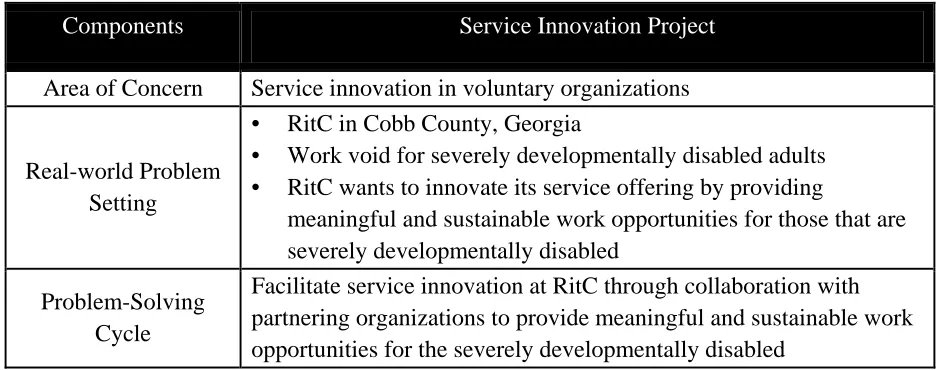
1.1 Engaged Scholarship Components of Service Innovation Project
2.1 Classification of Developmental Disabilities
2.2 Classification of MEC Clients by Developmental Disabilities
4.1 Maccoby’s Head and Heart Traits
5.1 Data Sources
5.2 Coding Framework
6.1 Process Model for Service Innovation at RitC
6.2 Timing of CVF Framework Adaption and Extension
7.1 RitC – Organizational Focus
7.2 RitC – Strategy Formation
Cathy S. Neher Dissertation
Figures
4.1 Quinn & Rohrbaugh’s Competing Values Framework
4.2 Effects of Means – Ends Focus on Innovation
4.3 Extended Competing Values Framework
4.4 Strategy Formation
5.1 Research Stakeholders
5.2 Dual Cycles of Action Research
7.1 RitC Service Innovation Coding Results – Dimensions
7.2 RitC Service Innovation Coding Results – Competing Values
8.1 Competing Values Framework Adapted for Service Innovation (CVFSI)
Abbreviations and Definitions
CCC: Comfort Community Center – Founded in 2009 and located in Marietta, Georgia, CCC is an Adult Day Services center that provides an array of services for Cobb County seniors, and adults who suffer from developmental disabilities and mental retardation.
CVF: Competing Values Framework – Framework for understanding organizational effectiveness consisting of three dimensions: organizational focus, structural preference and managerial concern.
CVFSI: Competing Values Framework Adapted for Service Innovation – Framework for
understanding service innovation in voluntary organization consisting of three dimensions: organizational focus, strategy formation and motivational trait.
Cathy S. Neher Dissertation
Developmental Disabilities Assistance and Bill of Rights Act (PL 106-442). The purpose of the DD Act is to help individuals with developmental disabilities achieve independence, productivity, integration and inclusion into the community.
GCSS: Georgia Community Support & Services - GCSS was created to provide community-based services and supports people with disabilities and their family. Founded in 1999, GCSS is a non-profit agency headquartered in Atlanta.
GSU: Georgia State University – GSU’s J. Mack Robinson College of Business provides the Executive Doctorate in Business (EDB) program.
MEC: Marietta Enrichment Center – MEC is a GCSS Community Life program that offers Adult Enrichment Programming and Youth ADL (Activities of Daily Living) programs.
NAID: National Association for Information Destruction – NAID is the international trade association for companies providing information destruction services. NAID's mission is to promote the information destruction industry while maintaining the standards and ethics of its member companies.
NISH: National Industries for the Severely Handicapped - Federally sanctioned national non-profit agency committed to creating employment opportunities for people with significant disabilities
PCPID: President’s Committee for People with Intellectual Disabilities - In 1966, President Lyndon B. Johnson established The President’s Committee for People with Intellectual Disabilities, formerly The President's Committee on Mental Retardation, to focus on this critical subject of national concern. Since that time, the President’s Committee has served in an advisory capacity to the President and the Secretary of Health and Human Services on matters relating to people with intellectual disabilities.
RitC: Right in the Community – For over 50 years RitC has been committed to finding, supporting, and creating services and programs for people with developmental disabilities in Cobb County, Georgia.
Cathy S. Neher Dissertation
THLF: The Holly Lane Foundation - The Holly Lane Foundation distributes funds to non-profits that focus on serving individuals with neuromuscular and severe developmental disabilities as well as acquired/traumatic brain injuries.
UCPB: United Cerebral Palsy of Greater Birmingham – Located in Alabama, UCPB provides quality programs and services for over 3,600 infants, children, and adults with disabilities in Birmingham and the surrounding ten counties.
Cathy S. Neher Dissertation
Abstract
Service Innovation in a Voluntary Organization: Creating Work Opportunities for Severely Developmentally Disabled Adults
By
Cathy Sue Neher
April 26, 2012
Committee Chair: Dr. Lars Mathiassen
Academic Unit: Center for Process Innovation
Current literature on the developmentally disabled indicates they represent a large untapped labor
pool that is significantly inhibited in its inclusion in the community. To address thisunnecessary
isolation, Right in the Community (RitC), a voluntary agency in Cobb County, Georgia, wanted
to innovate its service offering by providing meaningful and sustainable work opportunities for
those that are severely developmentally disabled. The Competing Values Framework (CVF)
offers a dynamic and robust theoretical framework that has been adapted to explain many
business factors in addition to organizational effectiveness. Based on a fourteen-month action
research engagement at RitC, I adapted the CVF to concentrate on the dimensions of
organizational focus, strategy formation and motivational traits to understand and guide service
innovation in a voluntary organization. My research aided RitC’s development of a program to
provide meaningful and sustainable work opportunities for those that are severely
developmentally disabled. From a theoretical standpoint, I have added new knowledge on
managing service innovation in voluntary organizations and adapted CVF for understanding and
Cathy S. Neher Dissertation
1 Introduction
Approximately seven to eight million Americans of all ages experience some level of
developmental disability. On a proportional basis, in Cobb County, Georgia, this equates to
16,296 - 18,623 citizens ("American FactFinder," 2009; Roach, 2011). Individuals with
developmental disabilities are classified as mild, moderate, severe or profound. Generally,
persons in the mild and moderate categories require less support than those classified as severe
or profound. The spectrum encompasses those with the ability to live independently and
participate in lifelong employment with the assistance of vocational and community socialization
training to those requiring intensive support as their mastery of daily living skills is quite limited
or non-existent. This wide spectrum for the developmentally disabled constitutes a vast array of
political, social, health and financial challenges that represent wicked problems. Initially
conceived by Rittel and Webber, all societal problems and nearly all public policy issues are
wicked problems in that they are never solved, merely re-solved repetitively (1973).
Through collaboration with Georgia Community Support & Services (GCSS), RitC has
addressed several wicked problems specifically faced by the developmentally disabled in Cobb
County. However, one particularly persistent wicked problem pertains to the incorporation of the
developmentally disabled into the workforce. Rather than seeking possible political, social or
welfare solutions to incorporating the developmentally disabled in the workforce, I constrained
Cathy S. Neher Dissertation
because of the urgency of the need and immediacy of possible solutions as opposed to the
potential political, social or welfare solutions which take much longer to germinate.
Currently only 31% of the developmentally disabled are working and this work void is
most severe in the lower functioning levels (Roach, 2011). As a result, the developmentally
disabled represents a large untapped labor pool (Freedman & Keller, 1981; Schilit, 1979)
inhibited from sustained community inclusiveness (Wolpert, 1976). However, current research
shows that this large untapped labor pool can perform meaningful work when given suitable
training, facilities and a supported environment (Bradley & Blumenthal, 1998; Friedman, 1974;
Goodyear & Stude, 1975; Hewitt & O'Nell, 1998; Leavitt, 2007; Unknown, 1977).
Hence, the practical problem solving in my research was driven by the question that
parents of children with severe developmental disabilities ask: “How can my child gain a sense
of accomplishment that comes from working when the day care program just provides arts and
craft activities?” The research was situated at Right in the Community (RitC), a voluntary
organization which provides services to the developmentally disabled and their families in Cobb
County, Georgia. To address this problem, I concentrated my research interests on service
innovation in voluntary organizations with a particular focus on providing meaningful and
sustainable work opportunities for those that are severely developmentally disabled.
To guide the investigation, I adopted action research (Van de Ven, 2007) and extended
the Competing Values Framework (CVF) (Quinn & Rohrbaugh, 1981). Action research was
Cathy S. Neher Dissertation
applied to explain many business factors in addition to organizational effectiveness. I used the
CVF as a robust theoretical framework to understand how RitC could innovate its service
offering. Based on insights from my fourteen-month action research engagement at RitC, I then
adapted CVF to focus on the dimensions of organizational focus, strategy formation and
motivational traits to understand and guide similar types of service innovation in other voluntary
organization. The specific engaged scholarship components of my service innovation project are
summarized in Table 1.1 (Mathiassen, Chaisson, & Germonprez, 2012).
The subsequent sections detail the arguments supporting my research as follows:
Section 2 provides an overview of RitC, developmental disabilities in the United States
and in the workforce, and discusses my first research opportunity – How does RitC create
meaningful and sustainable work opportunities for the severely developmentally
[image:17.612.71.545.527.712.2]disabled?
Table 1.1 Engaged Scholarship Components of Service Innovation Project
Components Service Innovation Project
Area of Concern Service innovation in voluntary organizations
Real-world Problem Setting
• RitC in Cobb County, Georgia
• Work void for severely developmentally disabled adults • RitC wants to innovate its service offering by providing
meaningful and sustainable work opportunities for those that are severely developmentally disabled
Problem-Solving Cycle
Cathy S. Neher Dissertation
Components Service Innovation Project
Framing of Argument
A multidimensional analysis based on the original dimensions of the CVF:
• Organizational focus: internal versus external • Structural preference: control versus flexibility • Managerial concern: means versus ends
The analysis was supplemented with two additional dimensions • Strategy formulation: deliberate versus emergent
• Motivational trait: head versus heart
Method
• Engaged scholarship
• Qualitative study based on action research • Process study based on punctuated equilibrium
Research Cycle
Data collection and analysis:
• Interviews, field observation, problem solving cycle documentation
• Data analysis using punctuated equilibrium to establish antecedent conditions, process timeline, and outcomes
• Data analysis of innovation based on the adapted framework of organizational focus, strategy formulation, and motivational traits
Contribution
• Practice: Developing sustainable model for providing meaningful work opportunities in Cobb County, Georgia for the severely developmentally disabled
• Theory:
1) Adding new knowledge on managing service innovation in the context of voluntary organizations
2) Adapting CVF for understanding and guiding service innovation in voluntary organizations
Section 3 provides an overview on voluntary organizations and service innovation and
then, drawing on the literature, addresses my second research opportunity - How does a
Cathy S. Neher Dissertation
Section 4 explains the CVF and its adaption as the analytical framework to study service
innovation in a voluntary organization and outlines my third research opportunity – How
can we adapt the CVF for understanding and managing service innovation in voluntary
organizations?
Section 5 discusses the overall research methodology to understand service innovation in
RitC, explains engaged scholarship, conveys how I adopted the principles of canonical
action research to address the dilemmas and ensure the rigor of my research, and outlines
my data collection and analysis efforts.
Section 6 deals with the problem solving cycle at RitC, outlines the process, and
discusses outcomes.
Section 7 summarizes the results based on analysis of the dimensions of organizational
focus, strategy formation and motivating traits.
Chapter 8 discusses my contributions to practice and theory.
Chapter 9 highlights limitations of the research, implications for theory and practice, and
provides and overall summary.
2 Problem Setting at RitC
In this section, I provide an overview of RitC, explain the situation of those with
developmental disabilities in the United States and focus on the current condition for the severely
Cathy S. Neher Dissertation
reports, I discuss my first research opportunity – How can RitC create meaningful and
sustainable work opportunities for the severely developmentally disabled?
2.1 About RitC
RitC, located in Atlanta, Georgia, is a 501(c) 3 non-profit organization serving families
who have children and adults with developmental disabilities. Originally known as the Cobb
Association for Retarded Citizens (Cobb ARC) and incorporated in 1956, RitC has served
families in Cobb and the outlying counties for over 50 years. Since its inception, RitC has been
committed to promoting opportunities for all people with developmental disabilities and, as a
result, has had many “firsts” … started the first sheltered workshop, first school for children with
mental retardation, first summer camp for disabled children, first respite home in Cobb County
and many more. In 2007, Cobb ARC decided to change its name to RitC – a name which
signified what they were truly doing – providing services right in the community where their
families live.
Currently, RitC has group homes (eighteen of which are occupied, two are built and
awaiting occupancy, one is in the process of construction, and two are pending funding
approval), owns and operates a respite care home, offers summer camp for children with severe
disabilities, assists families with information and referrals, and generally supports the special
needs population. With its mission “to promote opportunities for all people with developmental
disabilities to live full, productive, self-determined lives of the highest quality by fostering local
Cathy S. Neher Dissertation
whatever they need. RitC board members and staff sit on many other boards in the community
where they can speak for the rights and needs of individuals with developmental disabilities.
While having a history of innovation, RitC found itself on a plateau in 2010 when
changes in the funding and political climate derailed long-dreamed plans to develop a “one-stop”
center. Disassociation with the Association for Retarded Citizens created a blurred and confused
identity. In order to get a sense of new direction, RitC distributed a needs survey to those on its
mailing list. The survey captured demographics, needs for day, recreational, educational,
vocational, and transportation services, and care-giver specifics. Simultaneously, RitC became
involved with an action research project with Georgia State University (GSU). The researchers
(of which I was one) focused on how competing values (Quinn & Rohrbaugh, 1981) could
inform development of voluntary organizations and on how RitC could re-develop its identity,
organization, management practices and ability to plan for the future (Crim, Grabowski, Neher,
& Mathiassen, 2011). The resulting recommendations were developed in collaboration with RitC
management and adopted by the board in July, 2010. By August, 2010, RitC had moved off its
plateau and was moving forward to innovate its organization and services.
My affiliation with RitC is personal and spans many years. My severely developmentally
disabled son receives monthly respite services; I serve on the board; and, my family supports
them through financial contributions, donation of supplies for the respite home, and as-needed
maintenance on the group homes and respite house. My involvement with RitC has afforded
Cathy S. Neher Dissertation
RitC, provide a real-world glimpse into the lives of families with a developmentally disabled
member. While the challenges of researcher bias from this deep involvement will be discussed
later, it also helps to ensure my research is relevant and not sterile. Further, from a personal
level, I believe anything my research can do to help RitC will ultimately help my son and others
like him.
2.2 About Developmental Disabilities
According to the President’s Committee for People with Intellectual Disabilities
(PCPID), approximately seven to eight million Americans of all ages experience some level of
developmental disability (Roach, 2011). This equates to nearly 30 million, or one in ten families
in the United States, that are directly affected by a person with developmental disabilities
(Roach, 2011). By extrapolating data from PCPID and the U.S. Census Bureau, on a proportional
basis, there were 16,296 - 18,623 citizens in Cobb County, Georgia with developmental
disabilities in 2009 ("American FactFinder," 2009). Consequently, there are a great many
individuals locally that need the support offered by RitC.
With so many people affected, what is the definition of developmental disabilities?
Originally passed in 1963 as the Mental Retardation Facilities Construction Act of 1963 (Title I,
P.L. 88-164) and reauthorized by President Clinton on October 30, 2000, the Developmental
Disabilities Assistance and Bill of Rights Act (PL 106-442) (commonly known as the DD Act),
defines developmental disability in section 102(8) ("Developmental Disabilities Assistance and
Cathy S. Neher Dissertation
Helping individuals with developmental disabilities achieve independence, productivity,
integration, and inclusion into the community is the purpose of the DD Act, directly corresponds
with RitC’s mission, and constitutes a vast array of political, social, health and financial
challenges that represent wicked problems. Initially conceived by Rittel and Webber, wicked
problems are “poorly formulated, confusing, and permeated with conflicting values of many
decisions makers or other stakeholders” (Pries-Heje & Baskerville, 2008, p. 731). Consequently,
all societal problems and nearly all public policy issues are wicked problems in that they are
never solved, merely re-solved repetitively (Rittel & Webber, 1973).
First, to understand the wicked problems associated with the developmentally disabled,
one must have an idea for solving the issues based on an inventory of possible solutions (Ferlie,
Fitzgerald, McGivern, Dopson, & Bennett, 2011; Rittel & Webber, 1973; Weber & Khademian,
2008). The inventory of possible solutions spans the entire political, educational, social, and
business spectrum and represents a wide variety of individual perspectives. Consequently,
having such diverse participants in the wicked problem setting makes knowledge sharing a
challenge (Weber & Khademian, 2008). To overcome this challenge, Weber and Khademian
suggest developing a shared capacity for focusing on a wicked problem (2008). This is exactly
what RitC has done. Through collaboration with GCSS, RitC has been able to carve out solutions
for wicked problems specifically faced by the developmentally disabled in Cobb County.
However, one particularly persistent wicked problem pertains to the incorporation of the
Cathy S. Neher Dissertation
Second, to understand the challenges of including the developmentally disabled in the
workforce, one must first understand that developmental disabilities are classified as mild,
moderate, severe or profound in order to gauge an individual’s need for support. Generally,
persons in the mild and moderate categories require less support than those classified as severe
or profound; the spectrum spans those with the ability to live independently and participate in
lifelong employment with the assistance of vocational and community socialization training to
those requiring intensive supports where mastery of daily living skills is quite limited or
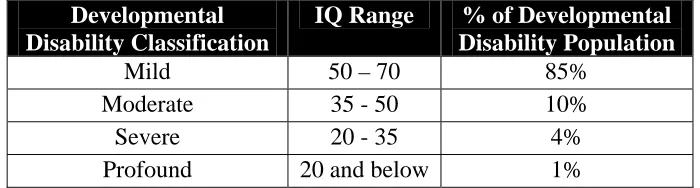
non-existent. Table 2.1 summarizes the IQ and population percentage by developmental disability
classification ("IQ Scores and Mental Retardation," 2011).
Hence, rather than seeking possible political, social or welfare solutions for incorporating
the developmentally disabled in the workforce, I constrained my solution space to creating
meaningful work opportunities for the severely developmentally disabled through a sustained
collaborative effort in Cobb County (Rittel & Webber, 1973; Weber & Khademian, 2008). This
solution space was chosen for three reasons: first, because of the urgency of the need, second,
because of the immediacy of possible solutions as opposed to the potential political, social or
welfare solutions which take much longer to germinate and third, 56% (Table 2.2) of Marietta
Enrichment Center’s (MEC) (one of GCSS’s day programs) clients fall in the severe and
Cathy S. Neher Dissertation
[image:25.612.131.481.170.264.2]
Table 2.1 Classification of Developmental Disabilities ("IQ Scores and Mental Retardation," 2011)
Developmental Disability Classification
IQ Range % of Developmental
Disability Population
Mild 50 – 70 85%
Moderate 35 - 50 10%
Severe 20 - 35 4%
Profound 20 and below 1%
Table 2.2 Classification of MEC Clients by Developmental Disabilities (Peterson, 2012)
Developmental Disability Classification
% of GCSS’s Clients at MEC
Mild 10% Moderate 34%
Severe 32% Profound 24%
Lips-Wiersma and Morris, define ‘meaningful work’ as having four components:
“developing and becoming self”, “unity with others”, “serving others”, and “expressing self”
(2009, p. 499). They cite the 2004 work of May et al. “the value of a work goal or purpose,
judged to the individual’s own ideals or standards” and the 1998 work of Korotkov
“meaningfulness refers to the degree to which life makes emotional sense and that the demands
confronted by them are perceived as being worth the energy investment and commitment” (2009,
p. 492). Consequently, RitC’s challenge is to create meaningful work which is defined as
sustainable tasks which are desirable and feasible, add value from a business context and are not
[image:25.612.113.494.314.420.2]Cathy S. Neher Dissertation
2.3 Developmentally Disabled in the Workforce
The PCPID reports that only 31% of developmentally disabled are working (Roach,
2011). This finding is supported on a local basis as well. In RitC’s 2010 survey, 71% of the
respondents indicated their special needs individual was not currently working and of those
currently not working but had the ability to do so, 90% had the desire to work in the community
(Crim, Grabowski, & Neher, 2010). The lack of work opportunities is most severe in the lower
functioning levels. Few training centers have special care units, while others refuse individuals
with multiple disabilities or profound developmental disabilities. Moreover, because of the rising
unemployment the mildly developmentally disabled who should find work in the community are
instead competing with the severely developmentally disabled for places in training centers and
supported employment opportunities (Unknown, 1977).
The developmentally disabled represents a large untapped labor pool (Freedman &
Keller, 1981; Schilit, 1979) that is inhibited in its community inclusiveness and sustained
inclusion (Wolpert, 1976). According to PCPID, this “unnecessary isolation is an unfortunate
reflection of the lack of value society at large sees in the lives of people with intellectual
disabilities. Because society often does not view people with intellectual disabilities as people
with intrinsic value, for many, their isolation continues and they remain invisible” (Leavitt,
2007, p. 16). However, current research shows that this large untapped labor pool can
successfully perform meaningful work when given suitable training, facilities and a supported
environment (Bradley & Blumenthal, 1998; Friedman, 1974; Goodyear & Stude, 1975; Hewitt &
Cathy S. Neher Dissertation
With no suitable occupation or training, many of the developmentally disabled adults
either end up staying at home all day or are confined to various day programs which primarily
offer day care; either option can be a source of stress for the family due to the excessive demands
on their energy and resources (Bubolz & Whiren, 1984; Unknown, 1977). GCSS is one such
provider, and among their service offerings they have two day programs: Art & Food trains
higher functioning individuals with developmental disabilities to work in the art and food
industries and MEC works with lower functioning individuals offering adult enrichment and
youth activities of daily living skills training. I am very familiar with MEC since my son has
attended the program since 2006 and I have been active on its Parent Advisory Board through the
years.
The primary activities of MEC’s current day program are arts and crafts related and
community outings. Instead of facilitating opportunities to perform meaningful work in a
sheltered setting, parents ask “how can my child with severe developmental disabilities gain the
sense of accomplishment that comes from working when the day care program just provides arts
and craft activities?” Unfortunately in our circumstances, parents have historically been told
their children cannot get jobs and are relegated to day programs. Consequently, parents are
concerned about the prospect of confining their children to a life-time of non-productive
activities when they whole heartedly believe they are capable of so much more. Once again this
points to the importance of RitC’s mission and the need for its services and support.
Cathy S. Neher Dissertation
creating meaningful work opportunities for the severely developmentally disabled, my goal was
to achieve what Ferlie et al. refers to as “cross cutting outcomes”, “complex outcomes that are
long term and dependent on intermediate processes such as building inter agency collaboration”
(2011, p. 308). Initially RitC focused its service innovation efforts on the development of a
shredding initiative, with the initial component being the establishment of a full-time training
program for severely developmentally disabled adults so that they can go out and work in a
professional office space doing the host company’s shredding. The longer-term objectives are to
give severely developmentally disabled adults the opportunity to break free from the
stereotypical jobs, work in the community with real office co-workers in a sustainable manner.
Initially conceived in 2000 from macroeconomics, sustainability has three primary components:
environmental integrity, economic prosperity and social equity (Hahn & Figge, 2011). In the
context of RitC’s service innovation and specifically its shredding initiative, environmental
integrity refers to recycling its shredded output, economic prosperity means that the effort needs
to be self-funding, and social equity refers to creating meaningful work in the community for the
severely developmentally disabled.
2.4 Research Opportunity # 1
Much has been written about how the developmentally disabled are excluded from the
mainstream of American life (Leavitt, 2007; Unknown, 1977; Wolpert, 1976), have a lack of
meaningful work (Lips-Wiersma & Morris, 2009) opportunities available even though they have
demonstrated the ability to make a contribution (Bradley & Blumenthal, 1998; Hewitt & O'Nell,
Cathy S. Neher Dissertation
meaningful work (Freedman & Keller, 1981; Friedman, 1974; Goodyear & Stude, 1975).
However, little has been written on how organizations can create meaningful work opportunities
for severely developmentally disabled adults. Accordingly, my first research question is:
RQ1 How does RitC create meaningful and sustainable work opportunities for the
severely developmentally disabled?
3 Service Innovation in Voluntary Organizations
In this section, I provide an overview of voluntary organizations and service innovation.
Then, drawing on the literature, I discuss my second research opportunity - How does a
voluntary organization innovate its service offering?
3.1 Voluntary Organizations
Several researchers have stated that volunteering is the essence of democracy and that it
is the social glue that holds societies together (Anheier & Salamon, 1999; Perotin, 2001;
Wandersman, Florin, Friedmann, & Meier, 1987). This is supported by the fact that between
October 2009 and September 2010, Americans volunteered a total of 62,790,000 hours, equating
to a median 52 hours per volunteer (Unknown, 2011) - clearly Americans view volunteering as
an emblem of good citizenship. With so many Americans volunteering, exactly what is it?
Simply stated, Wilson defines volunteering as “any activity in which time is given freely to
Cathy S. Neher Dissertation
Much of the literature on volunteering focuses on the demographics, motives and
organizational behavior of volunteers (Anheier & Salamon, 1999; Kreutzer & Jäger, 2011;
Wandersman, et al., 1987; D. C. Wilson & Butler, 1986; J. Wilson, 2000). Alternatively, not as
much literature focuses on the broader voluntary sector; those organizations benefiting from all
the volunteers. Often referred to as the “third sector” of the economy, the voluntary sector is also
referenced as the “independent sector”, “charities”, governmental organizations”,
“non-profits”, and “social economy” (Perotin, 2001). For my purposes, I will assume the terms are
used interchangeably and I use the particular term used by the researcher(s) being cited.
Within the literature definitions of the voluntary sector typically reference social service
and the use of volunteers. Dart’s definition of non-profit is fairly academic: “organized around
an interconnected nest of prosocial and voluntaristic values and goals with few references to the
means and structure by which these values are enacted” (2004, p. 294) whereas Wilson and
Butler offer a simpler definition for voluntary organizations which includes two key elements: “a
considerable proportion of the labor force is voluntary and, hence, unpaid”, and “such
organizations are engaged in the non-commercial provision of goods or services”(1986, pp. 521,
522). Perhaps the most comprehensive definition comes from Salamon and Anheier which
specifies five characteristics of non-profits: organized with some sort of permanent structure,
private (separate from government), self-governing, do not distribute any profits generated to
owners or directors and involve some degree of voluntary participation (1996). Using the five
characteristics as a foundation, Salamon and Anheier then classified all non-profit organizations
Cathy S. Neher Dissertation
Services, Environment, Law, Advocacy and Politics, Philanthropic Intermediaries and
Voluntarism Promotion, International, Religion, Business/Professional Association and Unions,
Not Elsewhere Classified (1996). Using Salamon and Anheier’s classification scheme, RitC falls
into the Social Services category.
With just four paid administrative staff, RitC is an organization that relies heavily on
getting things accomplished through volunteers. According to RitC’s Executive Director,
between October 2009 and September 2010 they amassed approximately 7,108 volunteer hours.
Consequently, with RitC’s mission to help the developmentally disabled and having to
accomplish the majority of its work through volunteers, RitC aligns with the definition of a
voluntary organization offered by Wilson and Butler (1986) referenced above. Refining the
definition of voluntary organization, Wilderom and Miner draw the distinction between
voluntary groups which operate only with volunteers versus voluntary agencies which operate
with some part of the membership being paid (1991). Based on this distinction, RitC falls into
the voluntary agency sub classification. Regardless of sub classification, RitC is an organization
whose ongoing operation is largely dependent on the volunteers who generally have a personal
connection with RitC through a developmentally disabled family member.
3.2 Service Innovation
According to Osborne and Flynn, definitions of innovation in the literature primarily
center around one of four themes: innovation represents newness to the organizations concerned,
Cathy S. Neher Dissertation
O’Connor define innovation as “a new technology or combination of technologies that offer
worthwhile benefits” and requires “new skills, levels of market understanding, leaps in new
processing abilities, and systems throughout the organization” (2002, p. 424). Thus, innovation
is the means by which organizations like RitC remain vibrant and respond to an ever changing
funding and political environment.
With innovation so important to the sustainability of a voluntary organization, one would
think that there would be a wealth of literature available. Unfortunately, as noted by Jaskyte, the
literature on innovation is primarily from the perspective of the individual, team or organization
within the business sector and focuses on types of innovation; i.e., radical versus incremental,
borrowed versus original, expansionary versus evolutionary development, product, process and
administrative (2011). Little appears to be written specifically about service innovation within
voluntary organizations.
Innovation within a voluntary organization is driven by the organization’s stakeholders
(Crim, et al., 2011; Jaskyte, 2011; Osborne & Flynn, 1997). The effectiveness with which
voluntary organizations innovate is also a function of stakeholder judgment (Herman & Renz,
1999, 2008). In the case of RitC, the stakeholders opted in 2010 to innovate its organization
(Crim, et al., 2011) and concluded that it needed the on-going collaboration of its principle
partner (GCSS) to perpetuate its success and sustainability. It is through collaboration of
interconnected organizations like RitC and GCSS that voluntary organizations innovate and
develop networks of support and influence at the local level (Diamond, 2010; Herman & Renz,
Cathy S. Neher Dissertation
3.3 Research Opportunity # 2
Much has been written about the nature of volunteering (Anheier & Salamon, 1999;
Perotin, 2001; Wandersman, et al., 1987), the individual volunteer (Anheier & Salamon, 1999;
Kreutzer & Jäger, 2011; Wandersman, et al., 1987; D. C. Wilson & Butler, 1986; J. Wilson,
2000), voluntary organizations (Dart, 2004; Perotin, 2001; Salamon & Anheier, 1996; D. C.
Wilson & Butler, 1986) and innovation in business (Jaskyte, 2011; McDermott & O'Connor,
2002). While some literature has been written on innovation in voluntary organizations (Crim, et
al., 2011; Osborne & Flynn, 1997), little appears to be written specifically about service
innovation within voluntary organizations. Accordingly, my second research question is:
RQ2 How does a voluntary organization innovate its service offering?
4 Analytical Framework
In this chapter, I introduce CVF with extensions as the analytical framework I used to study
service innovation at RitC. First, I will discuss the original framework and how it has been
adapted to explain business factors other than organizational effectiveness. Second, I discuss the
original dimensions of organizational focus, structural preference and managerial concerns and
how I have extended the CVF with the additional dimensions of strategy foundation and
motivational trait. Finally, I discuss a third research opportunity – How can we adapt the CVF to
Cathy S. Neher Dissertation
4.1 Competing Values Framework
To examine how competing forces shape service innovation in voluntary organizations, I
draw on Quinn and Rohrbaugh’s CVF (1981, 1983). In 1981, a widely shared definition of
effectiveness as it applied to the theory of organizational performance was elusive. In an effort to
generate such a theoretical framework, Quinn and Rohrbaugh built upon the contributions of
Steers and Campbell which independently recommended needing to identify the variables
pertaining to effectiveness, determined how the variables were related and eliminated overlap
(Campbell, 1977; Steers, 1975) to develop the sixteen effectiveness criteria across a
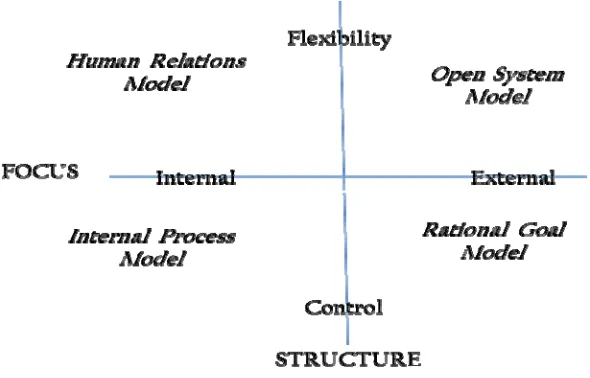
three-dimensional space and the four effectiveness models which formed the basis of their CVF
(Figure 4.1) (Quinn & Rohrbaugh, 1981). In addition, they offered the following definition of
organizational effectiveness: “a value-based judgment about the performance of an
organization” (1981, p. 138).
In 1983, Quinn subsequently published separately with Cameron and again with
Rohrbaugh enhancements to the CVF. First with Cameron, CVF was tied to organizational life
cycle development; a four-phased life cycle (1. entrepreneurial, 2. collectivity, 3. formalization
and control, and 4. structure elaboration and adaption stages) (1983). Second with Rohrbaugh,
CVF was expanded to recognize that while the four organizational effectiveness models are
comprised of criteria that are paradoxical in nature, the criteria need not be empirical opposites
or mutually exclusive in actual organizational environments (1983). The resulting collective
Cathy S. Neher Dissertation
organizational effectiveness regardless of life cycle stage and seeming contradictions in the
effectiveness construct.
Since its inception, CVF has been used to evaluate effectiveness in many business
settings. For example, CVF has been applied to management information systems (Cooper &
Quinn, 1993), the influence of organizational culture in higher education institutions (Obendhain
& Johnson, 2004), non-profits (Herman & Renz, 2008) and change in general (Poole & van de
Ven, 1989). More recently, the framework has been adapted to support development of voluntary
[image:35.612.179.474.407.596.2]organizations (Crim, et al., 2011).
Figure 4.1 Quinn & Rohrbaugh’s Competing Values Framework (1981)
4.2 Original Dimensions of Competing Values Framework
The original CVF dimensions (Quinn & Cameron, 1983; Quinn & Rohrbaugh, 1983)
Cathy S. Neher Dissertation
(demonstrated by control versus flexibility) and managerial concerns (demonstrated by means
and ends). The paradoxical nature of the criteria and the fact that the criteria need not be
opposites or mutually exclusive (Quinn & Rohrbaugh, 1983) made CVF especially applicable to
RitC since innovation and effectiveness within a voluntary organization are driven by the
organization’s stakeholders and their judgment (Crim, et al., 2011; Herman & Renz, 1999, 2008;
Jaskyte, 2011; Osborne & Flynn, 1997).
4.2.1 Organizational Focus
Organizational focus is the first dimension in CVF. According to Quinn and Rohrbaugh,
an external organizational focus is a macro emphasis on the functioning and development of the
organization as part of the larger environment and an internal organizational focus is a micro
emphasis on the functioning and development of people and their activities within the
organization (1981, 1983). As noted by the research of Crim et al., RitC has a history of being
externally focused; they depend on the external environment for volunteer resources and
financial donations and collaboration with other agencies in order to accomplish its mission.
Further, Crim et al., note that RitC’s internal focus primarily deals with its active 24-member
board and its respite and group home services (2011).
Over the years RitC has had to add, drop or modify services in order to survive and thrive
and align its organizational focus to accomplish its mission (Buenger, Daft, Conlon, & Austin,
1996). The simultaneous focus on both internal and external organization factors creates tension
and a complex environment (Meyers, 1993). However, according to Osborne and Flynn it is in
Cathy S. Neher Dissertation
threat that innovation typically occurs (1997). It is, therefore, the totality of RitC’s organizational
focus that ultimately determines who shall receive services and on what basis and how the
services will be funded (Buenger, et al., 1996; D. C. Wilson & Butler, 1986). CVF thus
illuminated RitC’s efforts to create synergy in its organizational focus as it strived to innovate its
service offering and provide meaningful work opportunities to the severely developmentally
disabled.
4.2.2 Structural Preference
Structural preference is the second dimension in CVF. According to Quinn and
Rohrbaugh, structural preference is the concern for control versus flexibility (1981, 1983).
Control has been described as an emphasis on high structure, predictability and stability whereas
flexibility has been defined as an emphasis on low structure, innovation and adaptability (Quinn
& Cameron, 1983; Quinn & Rohrbaugh, 1981, 1983).
The work of Quinn and Cameron did on organizational life cycles was particularly
relevant to service innovation at RitC. They found in their study that a high emphasis on control
resulted in a “considerable fall off in staff commitment, productivity, and flexibility” (Quinn &
Cameron, 1983, p. 48). Consequently, the need for flexibility was paramount in RitC’s quest to
innovate its service offering.
4.2.3 Managerial Concerns
Managerial concerns are the third dimension in CVF. Quinn and Rohrbaugh defined this
Cathy S. Neher Dissertation
setting) versus an emphasis on ends (i.e., outcomes, deliverables and productivity) (1981, 1983).
While infrequently linked in the same manner for both organizations and individuals, Lee and
Brower further clarify the definition by stating the ends are achieved by the means (2006).
When applying CVF to a voluntary organization like RitC, Woolley contends that
whether an organization is oriented towards means or ends will shape its innovative nature
(2009). She further states that there can be many preferred ends, each with multiple means of
attaining each desired end. This was particularly applicable to RitC since it is an organization
largely dependent on volunteers and where past innovations sprouted as a collaborate effort
between its management and volunteers. Consequently, I adapted Woolley’s model in Figure 4.2
to explain the innovation process at RitC that was driven by simultaneously emphasizing means
[image:38.612.117.495.487.581.2]and ends, with the ultimate actions taken affected by both orientations (2009, p. 503).
Figure 4.2 Effects of Means – Ends Focus on Innovation (Woolley, 2009, p. 503)
4.3 Extending the Competing Values Framework
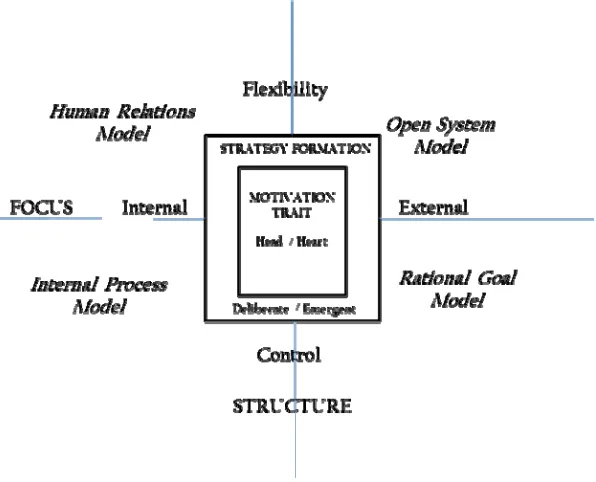
Building upon the work of Crim et al. (2011), I extended CVF by adding two additional
dimensions depicted below in Figure 4.3: strategy formation (demonstrated by deliberate versus
Cathy S. Neher Dissertation
4.3.1 Strategy Formulation
According to Boyne and Walker, strategy can be conceptualized from two perspectives:
first, by describing an organization’s position and how it interacts with its environment and
second, the specific steps that an organization takes to operationalize its stance (2004). It is the
second perspective of strategy formation, the operationalization of strategy that I emphasized in
my research because of its direct application to the service innovation process in a voluntary
[image:39.612.176.474.365.606.2]organization.
Figure 4.3 Extended Competing Values Framework
Mintzberg emphasizes the operationalizational aspects when he defines strategy as “a
pattern in a stream of decisions” (1978, p. 934). This definition implies that strategy is dynamic,
Cathy S. Neher Dissertation
concludes with a realized strategy directly ties to the iterative process of innovation. According
to Mintzberg, in individual collaborations with both McHugh and Waters, deliberate strategy
realized occurs when the actions taken pattern exactly as planned in the intended strategy and
emergent strategy realized occurs when the actions taken, despite intentions or in absence of
intentions, have an unintended order and are sequential in nature without a viable pattern or
consistency (Mintzberg & McHugh, 1985; Mintzberg & Waters, 1985). Their resulting strategy
[image:40.612.147.471.411.522.2]formation model is depicted in Figure 4.4 (1985, p. 162; 1985, p. 258).
Figure 4.4
Strategy Formation (Mintzberg & McHugh, 1985, p. 162; Mintzberg & Waters, 1985, p. 258)
The strategy formation model (Figure 4.4) was useful in understanding RitC’s efforts to
innovate its service offering by providing meaningful work opportunities to the severely
developmentally disabled. This was especially true since strategies need not be mutually
exclusive and can be mixed and combined (Boyne & Walker, 2004; Morrison & Salipante,
Cathy S. Neher Dissertation
advantage of their deliberate and emergent service innovation strategies throughout the course of
this research initiative.
4.3.2 Motivational Trait
The research of Crim et al. (2011) determined that while CVF captured the paradoxical
nature of the constructs involved in RitC’s organizational focus, structural preference and
managerial concerns, something was missing. The essence of the organization – its heart and
how they balanced the head and heart - was not being adequately addressed. Hence, they added a
fourth dimension to CVF (motivational trait) to help explain why RitC’s board members stay
involved for many, many years, why members respond to a survey favorably even when they are
not receiving services, why management and staff go the extra mile time after time, and why
RitC keeps helping those who cannot help themselves.
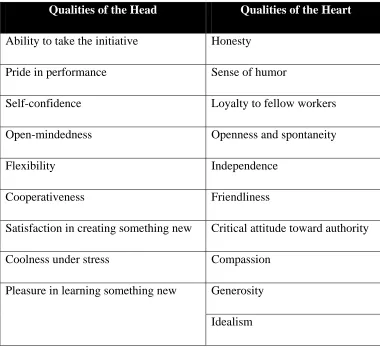
The above qualities are what Maccoby describes as “qualities of the heart”; attributes
which are essential for work (1976). Maccoby considers “the heart to be not only the home of
compassion; generosity, and idealism, but also the true seat of consciousness and courage” and
“it takes a well-developed heart to make difficult judgments in terms of the human values
involved” (1976, p. 100). According to Maccoby the head trait emphasizes behaviors rooted in
conceptualizations and is driven by problem-solving, collaboration, and competition while the
heart trait emphasizes behaviors rooted in consciousness and is driven by compassion,
Cathy S. Neher Dissertation
[image:42.612.113.493.152.500.2]
Table 4.1 – Maccoby’s Head and Heart Traits (Maccoby, 1976, 1978)
Qualities of the Head Qualities of the Heart
Ability to take the initiative Honesty
Pride in performance Sense of humor
Self-confidence Loyalty to fellow workers
Open-mindedness Openness and spontaneity
Flexibility Independence
Cooperativeness Friendliness
Satisfaction in creating something new Critical attitude toward authority
Coolness under stress Compassion
Pleasure in learning something new Generosity
Idealism
Researchers have applied head and heart traits to a variety of settings: business virtues
(Klein, 2002), perceptions of accountants (Patten, 1990), impact on decisions by younger and
older adults (Mikels, et al., 2010), ethical conduct (Kochunny & Hudson, 1994; Kochunny &
Rogers, 1992) and most recently, voluntary organizations (Crim, et al., 2011). However, my
review of the literature found little evidence of the application of the motivational trait to help
explain service innovation within a voluntary organization. The two fundamental questions asked
Cathy S. Neher Dissertation
accomplishment that comes from working when the Day Care program just provides arts and
craft activities?”, and “How can RitC create a sustainable model as follow-up to the success of
the initial shredding project completed by Medibase?” illustrated the tension within the
motivational trait dimension. Consequently, the motivational trait dimension added richly to the
discussion of service innovation in a voluntary organization.
4.4 Research Opportunity # 3
Much has been written about CVF, the paradoxical tensions encountered and its utility as
a general framework for organizational research (Poole & van de Ven, 1989; Quinn &
Rohrbaugh, 1983) and the specific dimensions of organizational focus (Meyers, 1993; Osborne
& Flynn, 1997), structural preference (Quinn & Cameron, 1983; Quinn & Rohrbaugh, 1981,
1983), and managerial concerns (D. Lee & Brower, 2006; Quinn & Rohrbaugh, 1981, 1983;
Woolley, 2009). In addition, a great deal has been written about the range of strategy formation
(Mintzberg & McHugh, 1985; Mintzberg & Waters, 1985) and motivation trait (Maccoby, 1976,
1978). However, little appears to be written specifically about adapting the CVF to inform
service innovation within voluntary organizations. Accordingly, my third research question is:
RQ3 How can the CVF be extended to better understand and manage service innovation
in voluntary organizations?
5 Research Methodology
Cathy S. Neher Dissertation
my research approach used engaged scholarship to focus on the stakeholders involved. Next, I
discuss action research – the specific research methodology used to support service innovation at
RitC. In doing so, I highlight the dual cycles, the characteristics and types of action research,
how I adopted the principles of canonical action research to address bias and dilemmas and
ensure the rigor of my action research with RitC and provide an overview of my process model. I
conclude with a discussion on which dimensions were most applicable to explaining service
innovation at RitC.
5.1 Engaged Scholarship
According to Van de Ven, engaged scholarship is a “participative form of research for
obtaining the different perspectives of key stakeholders (researchers, users, clients, sponsors,
and practitioners) in studying complex problems” (Van de Ven, 2007, p. 9). In the case of my
research, the key stakeholders are comprised of clients (adults with severe developmental
disabilities), parents of the clients, managers, staff and board members from RitC and GCSS, and
researchers from GSU. These stakeholders were actively involved in all facets of the research.
Each stakeholder group depicted in Figure 5.1 represents a different but complementary
perspective which facilitated the collaborative nature of the research. In addition, each group had
varying relationships with other stakeholders. For example, the clients are severely
developmentally disabled adults who participate in GCSS’s day program at MEC and are
members of RitC. The parents receive various services from GCSS and RitC and serve as RitC
board members. The clients and the majority of MEC program participants either live in group
Cathy S. Neher Dissertation
RitC’s group homes and the CEO and Board member have personal experience within their
immediate families with developmental disabilities. As a professor at GSU’s Center for Process
Innovation, my research colleague (and supervisor) had prior research involvement with RitC.
Lastly, I am the common thread among all stakeholders as I am part of the GSU research team,
client of RitC and GCSS, on the RitC board and a parent of a developmentally disabled son.
While each stakeholder brings a unique perspective, all had a vested interest in developing a
sustainable model for creating meaningful work opportunities for those that are severely
[image:45.612.176.434.384.577.2]developmentally disabled.
Figure 5.1 Research Stakeholders
I elected to do qualitative research because of my desire to answer “what”, “why” and
“how” questions and understand the context within which decisions and actions take place
(Golden-Biddle & Locke, 2007; Miles & Huberman, 1994; Myers, 2009). Unlike quantitative
Cathy S. Neher Dissertation
analysis of numerical data, I wanted to understand the ramifications of creating work
opportunities for the severely developmental disabled over a period of time from the perspective
of the key stakeholders and within the context of service innovation. Consequently, I conducted a
longitudinal action research study centered on service innovation within RitC.
5.2 Action Research
Of the four forms of engaged scholarship, I adopted action research which takes a clinical
intervention approach to diagnose and treat a problem of a specific client. Unlike informed basic
research which describes a social phenomenon, collaborative basic research which uses insiders
and outsiders to co-produce basic knowledge, and design and evaluation research which seeks to
obtain evidence-based knowledge of alternative solutions to applied problems, action research
focuses on understanding a social situation or business problem by changing it through deliberate
intervention and diagnosing the responses to the intervention (Van de Ven, 2007). The following
definition of action research from Rapoport is cited by numerous authors (Avison, Baskerville, &
Myers, 2001; Mathiassen, et al., 2012; Meyers, 1993; Susman & Evered, 1978): “Action
research aims to contribute both to the practical concerns of people in an immediate problematic
situation and to the goals of social science by joint collaboration within a mutually acceptable
ethical framework” (1970, p. 499).
As a pioneer of action research in 1946, Lewin posited that action research was “a spiral
of steps, each of which is composed of a circle of planning, action, and fact-finding about the
result of the action” (p. 206). Building upon Lewin and Rapoport, the efforts of Susman and
Cathy S. Neher Dissertation
method (1978). They defined the development of a client-system infrastructure and a five-phased
cyclical process consisting of diagnosing (identifying and defining a problem), action planning
(specifying the courses of the action to be taken), action taking (implementing the planned
actions), evaluating (analyzing the effects of the action) and specifying the learning (identifying
what was learned) (Susman & Evered, 1978, p. 588).
Building upon the framework from Susman and Evered, Checkland and Holwell
introduce the importance of “recoverability” to justify the generalization and transferability of
action research results (1998). Rather than settle for ‘plausibility’, they stress the need for
‘recoverability’ and argue that “action research should be to enact a process based on a
declared-in-advance methodology (encompassing a particular framework of ideas) in such a
way that the process is recoverable by anyone interested in subjecting the research to critical
scrutiny” (Checkland & Holwell, 1998, p. 18). The following discussion of my dual cycles,
action research principles adopted, and approach for managing the dilemmas outline my
epistemology so that research is ‘recoverable’ (Checkland & Holwell, 1998).
5.2.1 Dual Cycles
The cyclical process of action research is further enhanced by two interlinked
simultaneous cycles: one for the research cycle and one for the problem solving cycle (McKay &
Marshall, 2001). The problem solving cycle at RitC consisted of a service innovation and
culminated with an informal business plan and institutional commitment to provide meaningful
Cathy S. Neher Dissertation
in voluntary organizations. Collectively, the dual cycles in action research enabled me to develop
and elaborate on the CVF theory from each intervention introduced into practice (Eden &
Huxham, 1996).
Across these cycles, Baskerville and Wood-Harper explored three methodology
characteristics (1996). The first characteristic is that the researcher is actively involved with
expected benefit for both the researcher and the organization. In my case, my direct ongoing
involvement was personal and undertaken with the expectation that any benefit RitC receives
during the problem solving cycle would ultimately have a positive impact on my son and his
colleagues and their parents. Further, we advanced the knowledge base on service innovation in
voluntary organizations. Immediate application of the knowledge obtained is the second
characteristic. Throughout my research at RitC, as we progressed through both the problem
solving and research cycles we applied the knowledge learned previously to the next iteration of
activities. Finally, the third characteristic is a cyclical process linking theory and practice. In my
research, all of the stakeholders were actively involved to some capacity in all facets of the dual
Cathy S. Neher Dissertation
[image:49.612.106.508.156.499.2]
Figure 5.2 Dual Cycles of Action Research (McKay & Marshall, 2001)
5.2.2 Action Research Principles
To ensure the rigor of my action research, I followed the canonical principles of action
research (Davison, Martinsons, & Kock, 2004). According to Davison et al., action research is
iterative, rigorous and collaborative, involves a focus on both organizational development and
the generation of knowledge and is guided by five principles: researcher-client agreement,
cyclical process model, theory, change through action and learning through reflection (2004).