ScholarWorks @ Georgia State University
ScholarWorks @ Georgia State University
Political Science Theses Department of Political Science
Summer 8-7-2012
Mobile Phones and Gender Inequality: Can We Hear Her Now?
Mobile Phones and Gender Inequality: Can We Hear Her Now?
Kari An Mackey Georgia State University
Follow this and additional works at: https://scholarworks.gsu.edu/political_science_theses
Recommended Citation Recommended Citation
Mackey, Kari An, "Mobile Phones and Gender Inequality: Can We Hear Her Now?." Thesis, Georgia State University, 2012.
https://scholarworks.gsu.edu/political_science_theses/52
This Thesis is brought to you for free and open access by the Department of Political Science at ScholarWorks @ Georgia State University. It has been accepted for inclusion in Political Science Theses by an authorized
administrator of ScholarWorks @ Georgia State University. For more information, please contact
MOBILE PHONES AND GENDER INEQUALITY: CAN WE HEAR HER NOW?
by
KARI A. N. MACKEY
Under the Direction of Jelena Subotic
ABSTRACT
Are mobile phones the best vehicle for reducing gender inequality in the developing world? ICT
experts champion the use of mobile phones to improve women’s lives, and various stakeholders
have invested millions of dollars to launch mobile phone programs for women. Yet, given high
female illiteracy rates, patriarchal societies, and other structural and cultural barriers in
developing countries, many scholars contend that limited access to ICTs can perpetuate gender
inequality. Rooted in the theory that women’s empowerment and equality are inseparable and
necessary components for the realization of sustainable economic and social development, this
paper aims to determine if stakeholders are jumping on the mobile phone bandwagon too soon
by using a multivariate regression of cross national data to demonstrate whether or not mobile
phones fall short of advancing women at the same rate that men develop.
MOBILE PHONES AND GENDER INEQUALITY: CAN WE HEAR HER NOW?
by
KARI A. N. MACKEY
A Thesis Submitted in Partial Fulfillment of the Requirements for the Degree of
Master of Arts
in the College of Arts and Sciences
Georgia State University
Copyright by
MOBILE PHONES AND GENDER INEQUALITY: CAN WE HEAR HER NOW?
by
KARI A. N. MACKEY
Committee Chair: Jelena Subotic
Committee: Charles Hankla
Carrie Manning
Electronic Version Approved:
Office of Graduate Studies
College of Arts and Sciences
Georgia State University
ACKOWLEDGEMETS
First and foremost I would like to thank Dr. Jelena Subotic for serving as my committee chair
and for providing much needed guidance and support. Additionally, I am grateful for the sound
advice and direction of Dr. Charles Hankla and Dr. Carrie Manning, both of whom also served
on my thesis committee.
I am honored to call Laura Neuman my mentor and friend, and I wish to thank her for believing
in me and introducing me to the right access to information (ATI). Although the end product of
this thesis did not concentrate on ATI in the way that I initially hoped it would, it is undoubtedly
my passion for ATI that has led me to explore other, connected means for empowering
vulnerable and marginalized populations such as information and communication technologies.
Of course, I am thankful for my parents, brother, family, and dear friends for loving me and
never doubting me. But it is to my husband and best friend, Carlton Mackey, to whom I am truly
indebted. Without him none of this would be possible. For the countless hours of care he
provided to our son while I typed away in a coffee shop, for the financial support he lent to
sustain my grad school habit, and for the prodding and pushing he did when I had absolutely no
TABLE OF COTETS
ACKOWLEDGEMETS iv
LIST OF TABLES vi
LIST OF FIGURES vii
1 ITRODUCTIO 1
2 LITERATURE REVIEW 2
2.1 Why Gender Inequality? 2
2.2 The Role of ICTs and Mobile Phones 7
3 HYPOTHESIS 15
4 METHODS AD DATA COLLECTIO 16
4.1 Data Sources 17
4.1.1 Mobile Phone Subscriptions (M) 17
4.1.2 Gender Inequality (G) 18
4.1.3 Country Income Level (I) 21
4.1.4 Religious Favoritism (R) 21
4.1.5 Level of Democracy (D) 22
4.1.6 Education (E) 23
4.1.7 Health/Life Expectancy (H) 23
4.1.8 Literacy (L) 24
4.1.9 Income Inequality (1) 24
4.1.10 Agricultural Labor Force (A) 25
5 FIDIGS AD AALYSIS 25
6 DISCUSSIO AD RECOMMEDATIOS 34
7 COCLUSIO 39
LIST OF TABLES
Table 4.1 Structure of the Global Gender Gap Index 20
Table 5.1 Data Summary 26
Table 5.2 Linear Regression of Mobile Phone Subscriptions on Global Gender Gap 27
Table 5.3 Multivariate Linear Regression of All Variables on Global Gender Gap 28
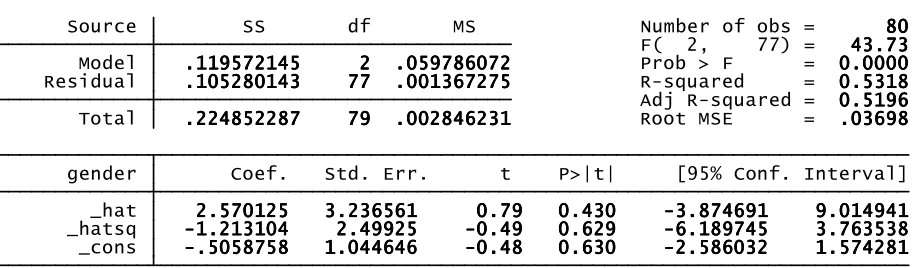
Table 5.4 Linktest on Second Model 29
LIST OF FIGURES
Figure 5.1 Lowess Smoother Graph Regressing Mobile on Gender 27
Figure 5.2 Lowess Smoother Graph Regressing Religion on Gender 32
Figure 5.3 Lowess Smoother Graph Regressing Literacy on Gender 33
1 ITRODUCTIO
Are mobile phones the best vehicle for reducing gender inequality in the developing
world? For years, scholars within the Information and Communication Technologies (ICT)
community have suggested the adoption of new technologies as a means to advance the status of
women in developing countries. It has been argued that ICTs can deliver more than just
information to women and may also contribute to women’s empowerment and development, in
addition to serving as a means for poverty eradication (Maier and Nair-Reichert, 2008). More
recently, ICT experts have championed the use of mobile phones in particular as a way to
improve the lives of women. Various stakeholders, including donors, non-profits, governments,
and private firms have invested millions of dollars to launch mobile phone programs for women
around the world. The United States Agency for International Development (USAID) alone, in
the midst of a recovering economy that still suffers from historically high unemployment rates,
will invest close to US$4 million of tax payer dollars over the next four years to help reduce the
mobile phone gender gap by 50 percent, placing mobile phones in the hands of an additional 150
million women in developing countries (Kiplinger, 2011; Trading Economics, 2011; GSMA,
2011).
Given the high illiteracy rates that women in developing countries face, as well as
patriarchal societies and other structural and cultural barriers, many scholars contend that
women’s access to ICTs is limited, thereby perpetuating inequalities and “have-not situations”
(Spence, 2010). However, focusing mainly on development and empowerment in general, extant
literature often fails to shed light on the impact that mobile phones specifically have on gender
inequality. Furthermore, much of the literature is anecdotal in nature, rather than scientific.
picture. Do mobile phones help to reduce gender inequality? While they may indeed advance
women’s development, if this progress is not relative to that of men’s progress, then women will
continue to suffer from the plight of unequal access to healthcare, education, capital, voice,
political participation, information, land, etc., as well as general inferiority. Rooted in the theory
that women’s empowerment and equality are inseparable and necessary components for the
realization of sustainable economic and social development, this paper aims to determine if
stakeholders are jumping on the mobile phone bandwagon too soon by using a multivariate
regression of cross national data to demonstrate whether or not mobile phones fall short of
advancing women at the same rate that men develop. While mobile phones might help women
progress, if they are not serving to decrease gender inequality as well, they may be contributing
to a vicious cycle of inequity. In addition to examining the relationship between mobile phones
and gender inequality, this paper provides stakeholders with recommendations for advancing the
status of women commensurate to men, creating a more enabling environment for the use of
mobile phones in development projects targeted to women, and increasing scholarship on the
issue of gender inequality.
2 LITERATURE REVIEW
2.1 Why Gender Inequality?
According to the literature, scholars and popular women’s movements have advocated for
the empowerment of women prior to the introduction of this term as a key strategy for women’s
development by the Beijing Declaration and Platform for Action in 1985 (Charlier and Caubergs,
2007). The Beijing Declaration was unanimously adopted by 189 countries attending the Fourth
major obstacles to gender equality and women’s empowerment” (United Nations Economic and
Social Commisison for Asia [UNESCAP], 2012). According to section 13 of the document:
Women’s empowerment and their full participation on the basis of equality in all
spheres of society, including decision-making process and access to power, are
fundamental for the achievement of equality, development and peace. (Beijing
Declaration, 1985)
Scholars have noted that empowerment is tied to “the seizing of power” as self-esteem
and self-confidence is improved, and to “the collective power to change gender relations in the
economic, political, legal and socio-cultural spheres” (Charlier and Caubergs, 2007). Another
expert indicates that empowered women can “bloom from their hidden potentialities;” exhibit
power of thought, word, and organization; and are able to “participate in the socioeconomic
development for their emancipation from less human conditions to more human condition”
(Haider and Atkar, 1999; Islam and Sultana, 2005). Some suggest that “women empowerment is
the development of mental and physical capacity, power or skills in women for them to operate
meaningfully in their social milieu, thereby experiencing a more favorable level of social
recognition and subsequently enhance their economic status (Akomolafe, 2006; Danjuma,
Malami, Gatawa, 2011).
While much of today’s international development literature related to women’s
advancement continues to highlight the importance of empowering women, it often focuses more
on the economic empowerment of women. Because women lack equal access to basic services,
resources, and opportunities including support mechanisms, raw materials, credit, transportation,
health care, market information, education, etc., women represent the majority of people living in
are affected by poverty, susceptible to disease, and prone to environmental degradation,”
development is compromised and economic empowerment of women becomes “imperative”
(Danjuma, Malami, Gatawa, 2011). Economic empowerment entails equipping women with the
skills, education, and training necessary for entering the market and embarking on economic
ventures to emancipate them from poverty (Danjuma, Malami, Gatawa, 2011). Scholars believe
that “if individual women gain economic independence, they would have more decisional power
over their lives and create change from within” (Salime, 2010). When economically empowered,
women are also better able to participate in decision making within their families and externally
in society.
In addition to impacting the progress of individuals, the empowerment of women is said
to help advance whole societies. Women are known to be the main providers of care for their
children, families, and communities. In this vein, studies have shown that “when women have
increased income or greater control over resources, more resources are allocated to children’s
well-being including food and education” thereby transforming whole communities (Onyishi and
Agbo, 2010). And because “working women contribute to household income and
expenditure…empowering women to become entrepreneurs” can impact “the economy of
developing nations” as well as the “quality of family life” (Onyishi and Agbo, 2010).
The empowerment of women, while essential to the advancement of individual women
and important to society writ large, does not necessarily equate to gender equality. When
women are empowered, but advance at a rate unequal to that of men’s progress, as has been the
case for women throughout much, if not all, of history, gender inequality persists. Furthermore,
the empowerment of women in one particular area does not necessarily ensure the empowerment
terms “women empowerment” and “gender equality” are often used synonymously throughout
the literature with no regard to the fact that these two concepts are quite different. Even the third
Millennium Development Goal sandwiches them together as “Promote gender equality and
empower women” (United Nations Development Program [UNDP], 2012). While gender
equality may entail the empowerment of women, the former is not a promised result of the latter.
It seems to be a vicious cycle, and the consequence may be a continuation of limited or a
complete lack of access to a host of life-altering resources such as:
…women’s access to position of influence and power is limited, their
occupational choices are narrower, and their earnings are lower than men that
they must struggle to reconcile activities outsider their home with their traditional
roles and they are constrained by the norms, beliefs, customs and values.
(Nikkah, Redzuan, and Abu-Samah, 2012)
Just as the empowerment of women can have positive implications for society, the same
holds true for reducing gender inequality. Gender inequality has also been shown to affect not
only individual women, but societies as a whole (Kayode, 2009). In a study by Olaoye Ismail
Kayode, it is noted that “areas with large and persistent gender inequalities pay the price of more
poverty, illness, malnutrition, and other deprivations, even death” (2009). Another study
indicates that “societies that discriminate on the basis of gender pay the cost of greater poverty,
slower economic growth, weaker governance, and a lower living standard of their people”
(Nikkah, Redzuan, and Abu-Sama, 2012). Josefa S. Francisco, in her paper on “Gender
Inequality, Poverty and Human Development in South East Asia,” explains the impact of gender
Gender-based disparities are bad for growth, wealth creation, and poverty
reduction. By limiting women’s capacity ‘to do’ and ‘to be,’ the productive
capacity and potential of women are also concomitantly limited, restricting their
contributions in the economy and stunting the capacity of the economy to become
more dynamic. Persistent inequities on account of gender affect the distribution of
costs and benefits from economic arrangements, including regional economic
integration and trade agreements…Gender inequality not only erodes human
security, but also deepens festering structural conflicts, vulnerabilities, and
exclusions in society. Inequality slows down human development. (2007)
While it is important to note that women empowerment and gender inequality are
different concepts, it does seem irresponsible to decouple the two given the positive attributes of
empowering women and the negative impact that gender inequality can have on whole societies.
According to one economic scholar, “gender equality…and women’s empowerment are now
widely recognized as integral and inseparable parts of any sustainable strategy for economic
growth and pro-poor development” (Mayoux, 2010). Yet in practice, this does not always seem
to be the case. Far too often various stakeholders engage in development projects targeted at
women that ignore one part of the equation. Most likely due to a lack of research, limited funds,
and/or scarce resources, many projects focus on the advancement of women, but fail to address
the fact that this advancement is taking place at a rate unequal to that of men’s progress. Granted
the task is tall, but if we wish to eject ourselves from this vicious cycle, it is worth ensuring that
development efforts, like placing mobile phones in the hands of millions of women, both
2.2 The Role of ICTs and Mobile Phones
Given the gross inequalities between women and men in the developing world as
referenced above, various stakeholders have spent countless hours and contributed tremendous
effort to determine the best routes toward reducing gender inequality and improving the status of
women globally. Among the various actors taking up these issues is the Information
Communication Technologies for Development (ICT4D) community which focuses on using
ICTs for furthering political and social development in developing countries. The Millennium
Development Goals (MDGs)—or poverty and hunger eradication, provision of primary
education and basic healthcare, and the elimination of gender inequality —are often the focus of
ICT4D efforts (Toyama and Dias, 2008).
Literature on the role of ICTs in the global advancement of women is surprisingly scant
but growing at an impressive rate. In general, advocates for ICTs stress the pertinence of
technology to the advancement of women in developing countries, while others, though not
denying the ability of new technologies to improve the quality of women’s lives, argue that their
limited access to ICTs perpetuate gender inequalities and ensure their marginal status in society.
Before examining the literature on ICTs as they relate to the advancement of women and gender
inequality, it is worthwhile to reflect on the roots of information communication technologies for
development (ICT4D) more broadly.
Early academic and policy writings on the use of ICTs in development projects often
focused on poverty alleviation. In the late 1990s, one of the leading communication institutes,
Panos, noted that several stakeholders, including governments, donors, and development
organizations were “rushing to realize the benefits that Internet access promises in the fight
that ICTs offer a lot to the poor through the provision of information on health, education, and
agriculture (1999). In the introductory paragraph of Charles Kenny’s paper on the costs and
benefits of employing ICTs for poverty alleviation, the following summary of ICT contributions
is offered:
Radio and the telephone have a long history demonstrating their utility in
developing countries. The Internet has also already proved itself useful in these
countries, increasing both the incomes and quality of services received by
citizens. Using Internet-based systems to make phone calls has reduced the cost
of international communication; the Internet is being used to ease the export and
import of goods; and countries such as India are earning billions of dollars a year
exporting IT services and software. (2002)
Other scholars contend that ICTs can alleviate poverty by placing economies “on a higher
income trajectory over time” and enabling developing countries to “’leapfrog’ stages of
development and be at par with the level of development in the West” (Maier & Nair-Reichert,
2007; Alampay, 2005). One scholar notes that ICTS have “proven to be increasingly
fundamental for social and economic development” because “access to basic ICT infrastructure
is a key to increasing the flow of information and improving communications and by extension
increasing the possibilities and opportunities” (Kayode, 2009). In turn, ICTs have “proven to be
a great leveler between the developed and the developing countries of the world” (Kayode,
2009). Sylvia Maier and Usha Nair-Reichert offer a list of ways in which ICTs “can foster
greater market integration,” including:
• They allow firms and individuals in developing countries to participate more
economies and reduce uncertainty in doing business;
• Information regarding prices enables producers to plan their product mix and
input purchases in an efficient manner;
• Access to ICTs allows producers to sell their products in the most profitable
markets and determine the optimum timing of sale;
• Availability of price information shrinks the informational asymmetry between
the rural producers and middlemen;
• ICTs reduce the exploitation of rural producers by e-middlemen;
• Increased information facilitates technology diffusion, adoption and innovation
at a much faster pace;
• Increased information about the availability of jobs could result in better and
faster matching between landless laborers and available jobs, ultimately leading
to increased productivity;
• ICTs provide greater access to weather-related information and credit
opportunities. (2007)
In addition to contributing to poverty alleviation and economic progress broadly, ICTs
have been hailed as a tool for development through empowerment, especially of women.
Women are empowered when they enjoy an increased ability to take control over decision
making processes regarding life-changing issues (Kayode, 2009). According to Kayode, “this
includes having full access to complete information and to self-discern the quality and credibility
of such information in making these decisions” (2009). By bringing the internet to rural,
poverty-stricken areas, women within these communities can “become more autonomous” and
gathering, flexing their voices, becoming activists, and resisting the status quo” (Wheeler, 2007).
Other scholars contend that new technologies can increase women’s participation in democratic
processes, ensure better access to information, and expand “business, employment, social, and
education opportunities” (Phillips, 2003).
Mobile phones in particular have recently been hailed as the answer for promoting
women’s empowerment (Lloyd, 2010). While otherwise isolated, immobile, impoverished, or
illiterate, mobile phones have enabled women to communicate with their husbands while they
work far from home, obtain medical care for their children, run a small enterprise, and report
violence (Lloyd, 2010). As compared to other ICTs, such as computers, mobile phones are
easier to learn and more accessible (Lloyd, 2010). And for those implementing development
projects for women, such as mWomen program director Trina DasGupta, “mobile technology
also scales up for large populations in ways that social programs rarely achieve” (Lloyd, 2010).
Vikas Nath offers a particularly convincing argument on the impact that ICTs can have
on women and societies (2001). Linking ICTs with their ability to deliver information and thus
increase knowledge, Nath explains that “knowledge is empowering, while the lack of knowledge
is debilitating” (2001). For women in particular, “knowledge and its widespread dissemination
in an absorbable and usable form is therefore quintessence to initiate the change process for
women’s development” (Nath, 2001). Because women have historically been distanced from
“the global pool of information and knowledge” due to “societal, cultural, and market
constraints,” women are less empowered than men—a potentially damaging fact when one
considers the role of women in society (Nath, 2001). As women’s traditional roles in society
aware than men of their communities’ needs (Nath, 2001). Therefore, sharing knowledge not
only empowers individual women, but advances whole communities.
Although many scholars promote the use of ICTs for women’s empowerment and overall
development, several do so cautiously because of their ability to inadvertently maintain or
worsen gender inequality. While new technologies have the ability to help women transcend
their limited access to education, information, transportation, markets, etc., unequal access to
ICTs in and of themselves can serve to perpetuate or exacerbate these inequalities. Insufficient
training, high equipment and connection costs, severe poverty, and “highly patriarchal social
structures” can hinder women’s access to information and communication technologies (Maier &
Nair-Reichart, 2007). Furthermore, women’s gross underrepresentation in the development and
implementation of new technologies are believed to adversely affect their ability to equally enjoy
the benefits of ICTs (Maier & Nair Reichert, 2007).
Maier and Nair-Reichert, in their article regarding the empowerment of women through
ICT-based business initiatives, break down the root causes of women’s unequal access to new
technologies (2007). For women entrepreneurs in the developed world, the inability to easily
obtain seed funding and a general resistance by male government officials to women’s
empowerment has barred some women from accessing ICTs (Maier & Nair-Reichert, 2007).
Additionally, illiteracy and unfamiliarity with new technologies at the village level triggers
distrust in conducting business transactions via computers (Maier & Nair-Reichert, 2007).
Finally, societal challenges often limit women’s access to ICTs. Fear of shifting power
structures, uncertainty about professional opportunities following marriage, and the overburden
of juggling family and work obligations “may result in women opting out of ICT-driven
Egypt, Deborah Wheeler echoes Maier and Nair-Reicherts’ sentiments, suggesting that women
in the Arab world face several obstacles in accessing ICTs, including “illiteracy, lack of access,
prohibitive costs, IT knowledge, and lack of technical training,” as well as “powerful
authoritarian states that curb the flow of online information (i.e., censorship) and restrict freedom
of use (i.e., state cyberpolicing and persecution of individuals who use the Web in ways it finds
threatening)” (Wheeler, 2007).
Referred to as “the darker side” of distributing mobile phones to women, Melissa
Ulbricht of MobileActive.org indicates that “changes in gender relations and power dynamic, a
potential increase in violence,…invasion of privacy, and increased control by a male partner” are
possible outcomes of such programming. Ulbricht refers to a thesis study by Aramanzan
Madanda regarding gender relations and the adoption of ICTs in Uganda which found that
despite an increase in the use of women using mobile phones, underlying gender structures
largely remained and that “a strong intersection between use of especially mobile phones and
escalation of gender based violence” exists (Madanda, 2011; Ulbricht, 2011). Citing an Inter
Press Service article regarding the Uganda study, Ulbricht writes:
“Traditionally, in Busoga (one of the study sites), a woman must seek her
spouse’s consent to go anywhere, whether to visit a relative or go to the market,”
Madanda explained. “But now women can be directly in touch with relatives and
other people without their husband’s consent and since men have lost that power
to control the women some turn to violence.” (Kagumire, 2010; Ulbricht, 2011)
Drawing from a paper by Geeta Shroff and Matthew Kam on the empowerment of
impoverished Indian women, Ulbricht notes that “if a women is given too much power via a
actually hurt the woman in some way’” (Shroff & Kam, 2011; Ulbricht, 2011). In another article
Simon Clark shares the story of Maryam—a 24 year Afghani woman whose “husband was so
outraged when he discovered the [mobile phone] she had smuggled into their Kabul home that
he beat her with his fists and a whip” (2011).
Inability to easily access ICTs is not the sole impediment to women’s empowerment
through new technologies. Even when women can own or use mobile phones and other
technologies with ease and the support of their communities, because women are often excluded
from the production of ICTs, their needs are not represented in the end products, thereby
resulting in services and software that may not serve to advance women. Nancy Spence posits
that “one of the greatest challenges in harnessing ICTs for the social transformation of women is
to see women as ICT producers, developers, and decision makers, not simply as consumers, to
ensure further equal participation of women in the information society (2010). Anita
Gurumurthy echoes this sentiment and explains:
What will contribute to transformation, particularly the transformation of gender
relations, is whether or not women and men are involved in community-based
processes to determine what is useful, and whether or not women’s indigenous
knowledge and their concerns, interests, and rights are factored into the
production and dissemination of content. (2006)
Most scholars suggest that ICTs are not an end, but rather a means to an end that is
insufficient when not paired with other development measures. Many articles championing the
use of new technologies for development also cautioned stakeholders from placing all of their
eggs in the ICT basket. In an interview with Jenny Aker, co-author of the article, "Mobile
bullet…they can’t replace certain things like investment in public goods, in health and
education” (MacDonald, 2011). In the June 2008 edition of Computer, in which “authors pay
increased attention to the innovations involving wireless technology, mobile phones, and digital
video,” the introduction provides a sort of disclaimer, if you will:
The articles in this special issue share a cautious, self-reflective tone. The
authors, speaking from hard-won experiences, rarely make extravagant claims for
themselves or their technology. Technology provides one piece of the larger
puzzle of development, but rarely a total solution. Channels for information and
communication might be lacking, but so too are a physical infrastructure,
individual education, and social structure—all of which are typically required to
accomplish meaningful change. (Toyama and Dias, 2008)
The literature regarding the impact that mobile phones have specifically on gender
inequality, as opposed to just women empowerment, is insufficient and largely reflects a barrage
of anecdotes often found in policy papers and non-profit blogs. Scientific field studies, such as
the one conducted in Uganda by Mandanda, are few and far between and mostly limited to a
particular country or region. In order to help provide a more holistic picture and contribute much
needed scholarship on the relationship between mobile phones and gender inequality, this thesis
draws on information from around the globe, comparing data from countries across different
regions and that exhibit varying levels of development via a multivariate statistical regression
analysis. Ultimately, this study reflects that mobile phones lack any statistically significant
3 HYPOTHESIS
Given the importance of gender equality to development, it is worthwhile to determine if
mobile phones are really the best vehicle for reducing gender inequality in the developing world.
Many scholars believe that mobile phones empower women and therefore help them to progress
both economically and socially. On the other hand, extant literature also tells us that in
developing countries, cultural and structural barriers often restrict women’s access to ICTs or
exclude them from playing a role in the production of ICTs, thereby exacerbating, or at least
maintaining gender inequality. Even when mobile phones are placed directly in the hands of
women, patriarchal cultures can bar them from the full enjoyment of the benefits that mobile
phones promise. And as noted above, scholars have drawn a strong link between countries
exhibiting more gender inequality and higher rates of poverty, illness, malnutrition, and even
death among their citizens (Kayode, 2009). If mobile phones are not helping to reduce gender
inequality, then in order to ensure that mobile phone programs for women are having the greatest
positive impact possible, key stakeholders should take the necessary steps to ensure that these
projects address inequities and help to advance women at a rate commensurate to men’s
progress.
In order to determine if there is a causal link between mobile phones and gender
inequality, I have explored both hypotheses in support of and skeptical of mobile phones.
Because gender disaggregated data regarding the use of mobile phones is not as readily available
as is the number of mobile phone subscriptions per one hundred inhabitants in each county, I
have used the latter for this model. The selection of this data will be explained in greater detail
below. Additionally, to measure gender inequality, I rely on the Global Gender Gap score also
mobile phone advocates are right in believing that mobile phones reduce inequality, then we can
expect the following hypothesis to be supported:
As the number of mobile phones subscriptions in a country increases, the Global
Gender Gap score increases as well, other things equal
If on the other hand skeptics have rightly argued that mobile phones perpetuate or increase
gender inequality, then the following hypothesis should be upheld:
As the number of mobile phones subscriptions in a country increases, the Global
Gender Gap score remains constant or decreases, other things equal
With mobile phone subscriptions (M) as the independent variable, Global Gender Gap
score (G) as the dependent variable, and controls for country income level (I), religious
favoritism (R), level of democracy (D), average years of education (E), average life expectancy
(H), literacy rate (L), measure for income inequality (N), and percent of agricultural labor force
(A) all further detailed below, the mathematical expression for the model that I seek to test is:
G = αααα + β1M + β2I + β3R + β4D + β5E + β6H + β7L + β8 + β9A + µ
4 METHODS AD DATA COLLECTIO
In order to test the influence of mobile phone access on gender inequality, this study
employs a straightforward multivariate regression analysis on 80 cases using Stata statistical
analysis software. Despite high hopes to use a cross-sectional time-series model, scarce data
availability severely limited the scope of this study and further highlights the need for more and
better datasets for use in statistical analysis within the social sciences. This small n study
consists of those countries1 for which information is fully available from the datasets discussed
1
below, and even then, data was not available for one particular year across all variables. While
most data was generated in 2008, values for some of the variables were drawn from other years
as noted2. Fortunately, given the number of countries included in this study, the sample does
retain rather strong diversity in region, income, religion, political structure, population size,
geographic area, etc. Of the 80 countries included in this study, 25 percent represent Latin
America and the Caribbean, 30 percent are located in Africa or are neighboring islands, just over
21 percent are in Asia, and about 22 percent hail from Europe.
4.1 Data Sources
4.1.1 Mobile Phone Subscriptions (M)
Every year, the International Telecommunication Union (ITU) publishes a “Yearbook of
Statistics” including data “about the evolution of the telecommunication sector, the availability
of ICTs in households and the usage of ICTs by individuals” as collected and processed through
“questionnaires sent to telecommunication/ICT ministries, telecommunication regulatory
authorities and national statistics offices (International Telecommunication Union [ITU], 2011).
The most ideal dataset for this study is mobile phone use, access, and/or subscriptions
disaggregated by gender as this information would better reflect who is using the mobile
phones—be it men or women; however, I was disappointed to learn that this information is not
easily accessible, free of charge, and in some instances, does not exist. To circumvent the issue
of data inaccessibility, aggregated data that highlights the number of mobile cellular
subscriptions per 100 inhabitants in 2008 is used. It is assumed that as the number of mobile Croatia, Cyprus, Dominican Republic, Ecuador, Egypt, El Salvador, Estonia, Ethiopia, Gambia, Georgia, Ghana, Greece, Guatemala, Honduras, Hungary, India, Indonesia, Iran, Italy, Jamaica, Jordan, Kazakhstan, Kenya, Kyrgyzstan, Latvia, Lesotho, Lithuania, Macedonia, Madagascar, Malawi, Malaysia, Mali, Mauritania, Mauritius, Mexico, Nicaragua, Nigeria, Pakistan, Panama, Paraguay, Peru, Philippines, Poland, Portugal, Romania, Russia, Singapore, Slovenia, South Africa, Spain, Sri Lanka, Tanzania, Thailand, Trinidad and Tobago, Tunisia, Turkey, Uganda, Ukraine, Uruguay, Venezuela, Yemen, and Zambia.
2
phone subscriptions in a given country increases, especially to over 50 percent of the population
since on average women represent more than 50 percent of the global population, that more
women will have access to mobile phones or enjoy mobile phone subscriptions. While I agree
that future studies should be conducted using gender disaggregated data, given the idea that
aggregated data can still capture an increase in the number of women accessing mobile phones, I
believe that the findings of this study still provide much needed insight into the impact that
mobile phones have on gender inequality.
4.1.2 Gender Inequality (G)
Several indices that measure gender inequality exist, such as the Organization for
Economic Cooperation and Development (OECD) 2009 Social Institutions and Gender Index
(SIGI) and the United Nations Development Program (UNDP) Gender Inequality Index (GII);
however, these indices do not cover as many countries as the World Economic Forum Global
Gender Gap Index. Therefore, the latter was used in this study.
According to the 2011 Global Gender Gap Report, the Global Gender Gap Index is “a
framework for capturing the magnitude and scope of gender-based disparities and tracking their
progress…the Index benchmarks national gender gaps on economic, political, education, and
health-based criteria” (Hausmann, Tyson, and Zahidi, 2011). The Index “focuses on measuring
gaps rather than levels,” and more specifically, “it captures gaps in outcome variables rather than
gaps in mean or input variables” (Hausmann, Tyson, and Zahidi, 2011). The Global Gender Gap
Report provides the following example for why measuring gaps is important:
…rich countries have more education and health opportunities for all members of
society and measures of education levels thus mainly reflect this well-known fact,
at its own level of income. The Global Gender Gap Index, however, rewards
countries for smaller gaps in access to these resources, regardless of the overall
level of resources. Thus the Index penalizes or rewards countries based on the size
of the gap between male and female enrollment rates, but not for the overall levels
of education in the country. (Hausmann, Tyson, and Zahidi, 2011)
With regard to outcomes versus means, the Index aims to “provide a snapshot of where
men and women stand with regard to some fundamental outcome variables related to basic rights
such as health, education, economic participation and political empowerment” (Hausmann,
Tyson, and Zahidi, 2011). In this way “variables related to country-specific policies, culture or
customs” are excluded (Hausmann, Tyson, and Zahidi, 2011). The example provided by the
report is the variable included in the Index which compares the gender gap in “high-skilled jobs
such as legislators, senior officials and managers (an outcome variable), whereas “data on length
of maternity leave,” a policy or input variable, is not used (Hausmann, Tyson, and Zahidi, 2011).
Perhaps most important, the Global Gender Gap Index “ranks countries according to their
proximity to gender equality rather than women’s empowerment” (Hausmann, Tyson, and
Zahidi, 2011). In other words, the index focuses on a decrease or increase in the gap between
men and women with regard to economic participation and opportunity, educational attainment,
health and survival, and political empowerment. It does not highlight whether women have
advanced beyond men and are therefore “’winning’ the ‘battle of the sexes’” (Hausmann, Tyson,
and Zahidi, 2011). Rather, countries are only rewarded when “outcomes for women equal those
for men” (Hausmann, Tyson, and Zahidi, 2011).
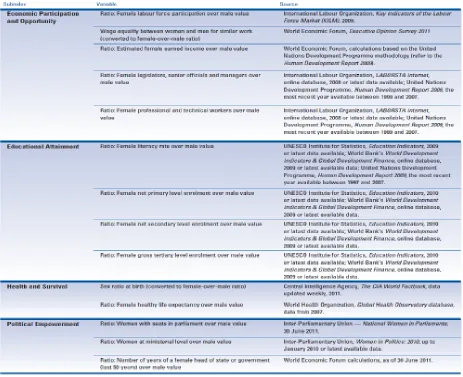
As previously mentioned, the four pillars captured by the Global Gender Gap Index
political empowerment. The following table (Table 4.1) excerpted from the Global Gender Gap
[image:29.612.76.539.156.533.2]Report 2011 provides a breakdown of the structure of the index:
Table 4.1 Structure of the Global Gender Gap Index
In order to construct the Index, the data is converted to female/male ratios in order to
capture gaps. Next the “ratios are truncated at the ‘equality benchmark,’” which is “1” for most
variables and translates to “equal numbers of women and men” (Hausmann, Tyson, and Zahidi,
2011). Only two variables, sex ratio at birth and health life expectancy are slightly higher or
lower than “1.” In this way, countries are not rewarded for achieving higher ratios of women to
Weighted averages are then calculated to create a subindex score (Hausmann, Tyson, and Zahidi,
2011). Lastly, final scores are calculated by taking “an un-weighted average of each subindex
score” (Hausmann, Tyson, and Zahidi, 2011). “The highest possible score is 1 (equality) and the
lowest possible score is 0 (inequality)” (Hausmann, Tyson, and Zahidi, 2011). For the purpose
of this paper, the Global Gender Gap Index scoring mechanism has not been altered.
4.1.3 Country Income Level (I)
It is well know that gender inequality is usually lower in higher income countries (Dollar
and Gatti, 1999). As higher income countries invest more resources in education and healthcare
for girls, whole societies are improved, and gender gaps often decrease. In order to account for
country income level, a control variable has been included in this model using the World
Economic Outlook Database Purchasing-Power Parity (P) rates, which “convert economic
statistics into a common currency before comparing them” (Relly and Sabharwal, 2009). Each
value is presented in current international dollar units (billions) and represents the “gross
domestic product based on purchasing-power parity valuation of country gross domestic
product” (International Monetary Fund [IMF], 2011).
4.1.4 Religious Favoritism (R)
Some scholars have noted a relation between religious preference and gender inequality
(Dollar and Gatti, 1999). Also, those religions known to be more pervasive in politics, such as
Islam and Shari’a Law are thought to have a greater impact on gender relations and equality.
Although using religion as an indicator for gender inequality has generated heated and
controversial findings and debate, it is worth including the variable as a control in this study.
in my model. Religion is also serving as a control for culture, since culture and religion are often
closely linked.
Rather than use a group of dummy variables to identify whether or not the majority of
citizens in a particular country claim a specific religion (i.e. Indonesia would receive a “1” for
the Muslim indicator and a “0” for Roman Catholic, Other Christian, Shinto, and so on), this
study employs the 2008 Government Favoritism of Religion Index accessed through the
Association of Religion Data Archives. Religious favoritism is defined as “subsidies, privileges,
support, or favorable sanctions provided by the state to a select religion or a small group of
religions” (Grim and Finke, 2006). On a scale of 0-10, a higher score on the Government
Favoritism of Religion Index indicates a higher level of favoritism. As previously noted,
countries with higher levels of religious favoritism, such as Islamic countries with Shari’a law,
exhibit greater levels of gender inequality.
4.1.5 Level of Democracy (D)
In addition to income and religion, political factors have been linked to varying levels of
gender inequality (Kenworthy and Malami, 1999). The literature on the issue of democracy as it
relates to gender inequality varies, with some scholars noting that more democratic countries
exhibit lower levels of inequality, while others do not see a strong link. In the event that there is
a causal link, it seemed important to include the variable as a control in this study. In order to
prevent issues of multicollinearity, “thick” democracy scores that often encompass
measurements of general freedom, including gender equality were not used. Instead, data has
been obtained from the Polity IV Project scores, which capture regime authority on an 11-point
4.1.6 Education (E)
According to the literature, education has been emphasized as a means for shaping both
men’s and women’s beliefs, thereby “encouraging non-traditional attitudes” and decreasing
gender inequality (Kane, 1995). To control for education, a variable representing the mean years
of schooling as provided by the United Nations Educational, Scientific and Cultural Organization
(UNESCO) Institute for Statistics (UIS) via the UNDP International Human Development
Indicators (HDI) has been included. The variable specifically accounts for the “average number
of years of education received by peoples ages 25 and older, converted from education
attainment levels using official durations of each level” (United Nations Educational, Scientific
and Cultural Organization Institute for Statistics [UIS], 2011).
4.1.7 Health/Life Expectancy (H)
According to Amartya Sen, mortality—commonly measured by life expectancy--can
serve as an indicator of economic success and failure as well as social inequalities, like gender
bias (2001). Countries that exhibit higher levels of life expectancy often have higher levels of
national income and lower levels of gender inequality. While this phenomenon would suggest
that the health and education variables are closely correlated, the Pearson Correlation Coefficient
for these two controls is only 0.6369, as discussed in greater detail below and shown in Table
5.5. Therefore, my model does account for the overall health of each country and includes a
control variable for life expectancy at birth. As with the education data employed in this study,
the health data was sourced through the HDI as referenced above and is “expressed as an index
using a minimum value of 20 years and an observed maximum value over 1980-2010” (HDI,
4.1.8 Literacy (L)
Literacy has long been recognized as an important tool for the exercise of socioeconomic
rights (Acharya, 2004). When illiterate, citizens are less able to participate in public and political
life. Furthermore, given the link between literacy and education3 and the aforementioned impact
that the latter is noted to have on gender inequality, it would seem that the same holds true for
the former—that increased levels of literacy result in decreased gender inequality. To control for
literacy, national literacy rates for adults aged 15 years and older were obtained from the UIS
2008 and 2009 data. According to UNESCO, a person is considered to be literate when they
“can both read and write with understanding, a short, simple statement on his or her everyday
life” (2011).
4.1.9 Income Inequality (1)
While the literature review did not directly point to a link between income inequality and
gender inequality, given the suggested relationship between national income and gender
inequality, I was compelled to include a control variable for income inequality. Data for this
variable was taken from The Standardized World Income Inequality Database (SWIID). The
SWIIDD “standardizes the United Nations University’s World Income Inequality Database and
other inequality data while minimizing reliance on problematic assumptions by using as much
information as possible from proximate years within the same country” (Solt, 2009). The
SWIIDD employs the Gini Index which has “a theoretical range from zero, which indicates that
each reference unit receives an equal share of income, to one hundred, indicating that a single
3
reference unit receives all income and all others receive nothing” (Solt, 2009). The most recent
data for each sample country was used, but sadly ranged from 2001-2009.
4.1.10 Agricultural Labor Force (A)
Rural women make up the majority of the agricultural labor force in most developing
countries, and yet “female farmers are often underestimated and overlooked” (Danida, 2008).
Because gender inequality is pervasive in the agricultural sector, I wondered if the presence of
agriculture-based economies impact and therefore act as an indicator for higher levels of gender
inequality. To control for this, I used data from the World Resource Institute’s Earth Trends
Environmental Information Portal. More specifically, a variable representing the agricultural
labor force as a percent of the total labor force was employed. Unfortunately, the most recent
data available is from 2004.
5 FIDIGS AD AALYSIS
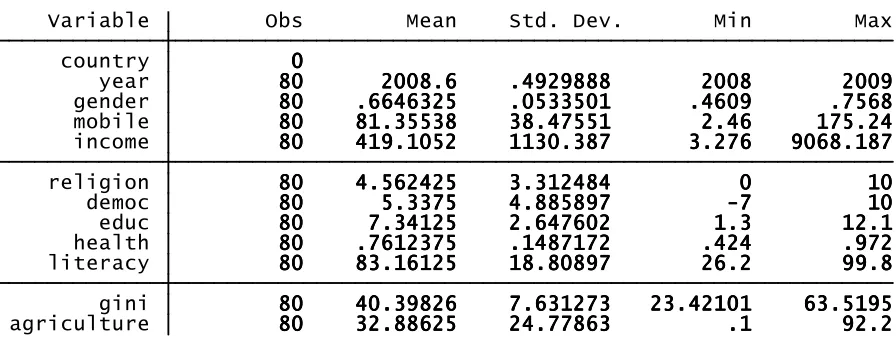
An initial peek at the data through a summary table (Table 5.1) reveals that the sample
mean for the 2008 Global Gender Gap score is approximately 0.67, which nicely corresponds to
the population average that is also 0.67 when rounded to the nearest tenth. This score signifies
that about 67 percent of the global gender gap had been closed in 2008, up slightly from 66
percent in 2006 when the index was initiated. The summary table also indicates that an
astonishing 81 percent of sample country inhabitants had mobile phone subscriptions in 2008.
Also interesting are the mean values for adult literacy at 83 percent, life expectancy at 76 years,
education at 7 years, and percent of the labor force in agriculture at 33 percent. As these
numbers are higher than I expected them to be, I am amazed by the income inequality that exists
in Table 5.1 below as “gini”), literacy rates, life expectancy, education, and industry in
[image:35.612.83.531.149.324.2]developed countries are really driving up global averages.
Table 5.1 Data Summary
agriculture 888080 00 3333222.2.8..8888886866622522555 222244.44..7.777777788688666333 3 ...1.111 99992222....2222
gini 888080 00 4444000.0...33933998988822262666 7777....66636333112112227777333 3 2232233.3...44442221210110010111 666633.33..5.555111199995555
literacy 888080 00 8888333.3.1..11616616111222525 55 11118888..8..88080008888999977 77 222626.66..2.222 99999999....8888
health 88088000 ....7767766161112223233377577555 ....114114484888777711711777222 2 ..4..44422242444 ....999977772222
educ 88808000 77.77..3.3334441411122522555 2222..6..6466444777766660020022 2 11.11..3.333 11112222....1111
democ 88808000 5555....3333337337757555 44.44...88888888558558889999777 7 ---7-777 11110000
religion 888080 00 4444..5..55566662224242442252555 33.33...33313111224224448888444 4 0000 11110000
income 88088000 4444111919.99...11101000555252 22 11111111333030.00...33338888777 7 3333...2.22277677666 999090006686688.8...118118887777
mobile 88088000 8888111.1.3..33355555555333838 88 33338888...4.44477775555555511 11 222.2...4464466 6 111177577555....22224444
gender 88088000 ....66666646644466636333222525 55 ....00005553533333335555000011 11 ....4446460660900999 ..7..777555566668888
year 88808000 2202200000080888...6.6 66 ....44449929922929998888888888 88 2220200000080888 2222000000009999
country 0000
Variable Obs Mean Std. Dev. Min Max
To begin examining the relationship between mobile phone subscriptions and gender
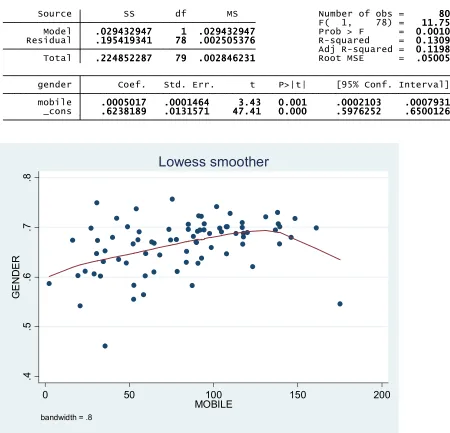
inequality, I first ran a very simple linear regression (Table 5.2) of the independent variable,
mobile phone subscriptions (M), on the dependent variable, gender inequality (G). While the
overall model is significant with a p-value of 0.0010 and the independent variable proved
significant with a p-value of 0.001 and a t-score of 3.43, the adjusted R-squared for this model is
only 0.1198. It is worth noting, however, that the root mean squared error is very small at
0.05005, indicating that the model is rather accurate. However, graphical representation (Figure
5.1) of this model indicates issues with linearity.
The coefficient for mobile phone subscriptions is positive and supports the pro-mobile
phone hypothesis; as more of the population has access to mobile phones, the Global Gender
Gap score increases, signifying a decrease in gender inequality. However, while positive, the
coefficient is seemingly small at 0.0005017. Yet, according to this model, the overall impact is
Table 5.2 Linear Regression of Mobile Phone Subscriptions on Global Gender Gap
_cons ...6.666222233383888118118889999 ....000011131333111515755777111 1 44744777..4..4441111 00.00...00000000000 0 ....555959979777666262522525522 2 ...6.666550550000000111212226666 mobile ...0.000000000050555001001117777 ....000000000000111414644666444 4 3333...4.4443333 000.0...00000010011 1 ....000000000000222121011030033 3 ...0.000000000007777999393331111 gender Coef. Std. Err. t P>|t| [95% Conf. Interval] Total ....22222222448448858555222222822888777 7 77977999 ....000000200228288844446662623223313111 Root MSE = ...0.0500555000000005555 Adj R-squared = 000.0...1111111919998888 Residual ....11191999554554414111999393433444111 1 77877888 ....000000200225255500005553537337767666 R-squared = 000.0.1..111333030009999 Model ....00020292299494434333222929499447477 7 11 11 ....000202922994944433332229294994474777 Prob > F = 000.0.0..000000101110000 F( 1, 78) = 111111.11..7.7775555 Source SS df MS Number of obs = 88880000
.4 .5 .6 .7 .8 G E N D E R
0 50 100 150 200
MOBILE
bandwidth = .8
Lowess smoother
Figure 5.1 Lowess Smoother Graph Regressing Mobile on Gender
the Global Gender Gap score by 0.02 or 40 percent of its standard deviation of 0.0533501 and 7
percent of its full range from 0.4609 to 0.7568.
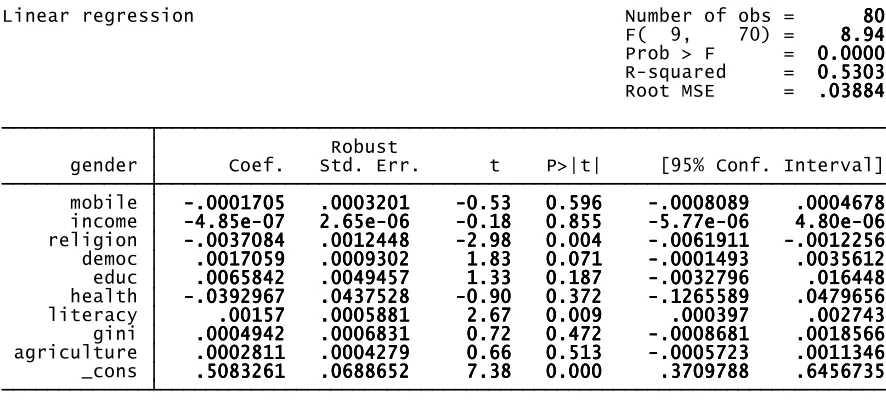
Because we know that individuals do not live in a vacuum where only mobile phones
regression was ran (Table 5.3). This time a multivariate regression was used including the
following control variables: country income level (I), religious favoritism (R), democracy (D),
education (E), health (H), literacy (L), income inequality (N), and agricultural labor force (A).
To control for heteroskedasticity, the multivariate regression was run using robust standard
[image:37.612.79.522.234.437.2]errors.
Table 5.3 Multivariate Linear Regression of All Variables on Global Gender Gap
_cons ...5.555008008883332326226661111 ....000066866888888866566555222 2 777.7.3..3383888 0000...0.00000000000 ....3337370770009999777878888888 ....6666445445556666777733335555 agriculture ...0.000000000002228281881111111 ....000000000040044422272777999 9 000.0...66666666 00.00.5..55151131333 --.--...0000000000005555777272223333 ....0000001001111111333344446666 gini ...0.000000000004449494994442222 ....000000000060066688838333111 1 000.0...77727222 00.00.4..44747727222 --.--...0000000000008888666868881111 ....0000001001118888555566666666 literacy ....00000001011155755777 ..0..00000000050055588888888111 1 222.2...66676777 0000...0.00000090999 ...0.00000000000333939997777 ....000000002222774774443333 health --.--..0.000339339992229296996667777 ....000044344337377755255222888 8 ----000.0.9..9909000 0000...3.37337727222 ---.-...11211222666655555558588899 99 ....0040044477779969966655556666 educ ...0.000006006665558584884442222 ....000000400494499944544555777 7 111.1.3..3333333 0000...1.18118878777 ---.-...0000000033332272277979996666 ..0..00011116646644444448888 democ ...0.000000011117770705005559999 ....000000000090099933303000222 2 111.1...88838333 00.00.0..00707717111 --.--...0000000000001111444949993333 ....0000003003335555666611112222 religion --.--..0.000003003337770708008884444 ....000000100112122244444444888 8 ----222.2.9..9989888 0000...0.00000400444 --.--...0000006006661111999191111111 --.--...0000001001112222222255556666 income --4--44.4...88588555eee-e-0--0007777 2222....6656655e5eee--0--000666 6 ----000.0.1..1181888 0000...8.85885555555 ---5-555..7..7777777ee-ee--0-00066 66 4444..8..8880000ee-ee---00006666 mobile --.--..0.000000000001117170770005555 ....000000000003033322022000111 1 ----000.0.5..5535333 0000...5.59559969666 ---.-...00000000000088088008088899 99 ....0000000000004464466677778888 gender Coef. Std. Err. t P>|t| [95% Conf. Interval] Robust
Root MSE = ..0..0003333888888884444 R-squared = 00.00...5555333300003333 Prob > F = 00.00...0000000000000000 F( 9, 70) = 8888..9..9994444 Linear regression Number of obs = 88880000
This second model retains overall significance as well, but with an even better p-value of
0.0000. Furthermore, this model provides for a more complete picture of what variables are
impacting gender inequality with an R-squared of 0.5304. Additionally, the root mean squared
value remains small at 0.03884. To test the model specification, I ran a linktest in Stata (Table
5.4). Unable to reject the null hypothesis that there is no specification error in my model with an
Table 5.4 Linktest on Second Model
_cons --.--..5.550505005558888775775585888 111.1...004004444446464664446666 ---0-000..4..4448888 000.0..6.63663330000 ---2-22.2.5..555888866066000333322 22 111.1.5..55757774442428228818111 _hatsq ---1-111..2..221211133133111000404 44 2222..4..4494999992992225555 ---0-000..4..4449999 000.0..6.66622922999 --6--66.6...118118889997974774544555 333.3..7.76776663335355353383888 _hat 2222...5.55757770000112112252555 333.3...223223633665655566661111 0000....77797999 00.00.4..44433330000 --3--33.3...888877774446469669199111 999.9..0.01001114449499494414111 gender Coef. Std. Err. t P>|t| [95% Conf. Interval] Total ....222222242484488855552222228228887777 7797799 9 ....000000200228288844446662623223331111 Root MSE = ....00300336366969989888 Adj R-squared = 0000....5515511919969666 Residual ....111100050525522288880000114114443333 7777777 7 ....000000100113133366667772727227775555 R-squared = 0000..5..553533131181888 Model ....111111191959955577772222114114454555 22 22 ....000055595997977788886660607007772222 Prob > F = 0000..0..000000000000000 F( 2, 77) = 444433.33..7.7737333 Source SS df MS Number of obs = 88808000
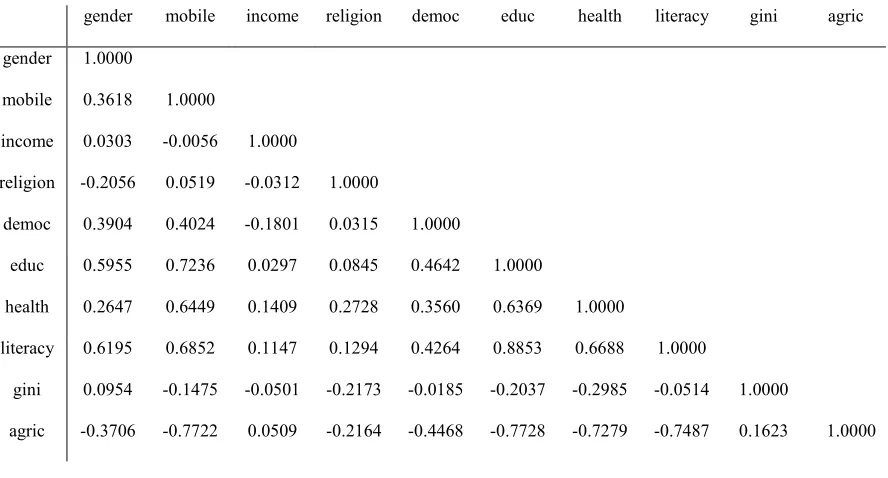
To ensure that none of the variables are too closely correlated, I reviewed a correlation
matrix (Table 5.5) and did not find anything alarming. The most closely correlated variables, as
expected, are literacy and education with a Pearson Correlation Coefficient of 0.8853. I was
initially concerned that literacy and gender inequality would correlate too closely given that the
Global Gender Gap score accounts for female literacy rates. It seemed to make sense that as a
given country’s literacy rate increased, more of the female population would be accounted for
within that literacy rate; however, the Pearson correlation coefficient for literacy and gender
inequality is only 0.6195 and it was not necessary to collapse the two variables into a single
index.
A look at the actual covariates in this second model reveals that mobile phone
subscriptions are no longer significant with a p-value of 0.596 and a t-score of -0.53; I am left to
reject both hypotheses and conclude that mobile phones have no significant impact on gender
inequality. According to this model, few variables impact gender inequality. Country income,
education, health, income inequality, and agricultural labor force are all insignificant with
respective p-values of 0.855, 0.187, 0.372, 0.472, and 0.513. In fact, mobile phone subscriptions
Table 5.5 Correlation Matrix of All Variables
gender mobile income religion democ educ health literacy gini agric
gender 1.0000
mobile 0.3618 1.0000
income 0.0303 -0.0056 1.0000
religion -0.2056 0.0519 -0.0312 1.0000
democ 0.3904 0.4024 -0.1801 0.0315 1.0000
educ 0.5955 0.7236 0.0297 0.0845 0.4642 1.0000
health 0.2647 0.6449 0.1409 0.2728 0.3560 0.6369 1.0000
literacy 0.6195 0.6852 0.1147 0.1294 0.4264 0.8853 0.6688 1.0000
gini 0.0954 -0.1475 -0.0501 -0.2173 -0.0185 -0.2037 -0.2985 -0.0514 1.0000
agric -0.3706 -0.7722 0.0509 -0.2164 -0.4468 -0.7728 -0.7279 -0.7487 0.1623 1.0000
As many mobile phone advocates argue that “mobile technology has great potential for
placing women in low-income countries on a higher income trajectory” thereby bringing “great
benefits to businesses and...the wider economy” it is enlightening to note the insignificance of
both the mobile phone and income variables (ExxonMobil, 2011). Granted, most advocates fail
to consider the relationship between mobile phones and gender inequality, focusing merely on
women’s development instead. But if we recall what the literature says about the impact of
gender inequality on income as previously summarized in Kayode’s study--“areas with large and
persistent gender inequalities pay the price of more poverty”—then we have a conundrum that
needs to be addressed (2009). Increasing women’s access to mobile phones without
simultaneously addressing the root causes of gender inequality may result in a wash, or in other
words, the negation of the benefits attributed to mobile phone programs for women.
So which variables do impact gender inequality? The statistical analysis points toward
p-value at 0.004 and literacy second at 0.009. The coefficients for the significant variables differ
greatly with one being positive and the other negative indicating that religion and literacy impact
gender inequality differently. Religion, with a coefficient of -.0037084 negatively impacts
gender inequality. The more a given country demonstrates favoritism for a particular religion,
the gender gap score decreases, indicating that less of that country’s gender gap is closed and
that gender inequality is actually higher. Graphical representation (Figure 5.2) of the
relationship between religion and gender inequality demonstrates this negative relationship. That
the model suggests religion impacts gender inequality is disconcerting given that religious
culture is difficult to change or influence. This finding also corroborates with anecdotal studies
that suggest handing mobile phones to women may have dire consequences in some religiously
conservative cultures; recall the story of Maryam whose husband beat her when he discovered
the mobile phone that she had been hiding from him.
While religion has a negative coefficient and impact on the Global Gender Gap score,
literacy, on the other hand, has a coefficient of 0.00157 illustrating a positive impact on gender
equality. As the rate of adult literacy in a particular country increases, the Global Gender Gap
score increases and signifies that more of the gender gap is closed and that gender inequality is
actually lower in that country. The Lowess smoother graph below (Figure 5.3) demonstrates the
positive relationship between literacy and the Global Gender Gap score.
Lowering the confidence interval to 90 percent makes democracy significant as well,
with a p-value of 0.071 and a t-score of 1.83. The coefficient for democracy is positive
.4
.5
.6
.7
.8
G
E
N
D
E
R
0 2 4 6 8 10
RELIGION bandwidth = .8
[image:41.612.77.455.75.351.2]Lowess smoother
Figure 5.2 Lowess Smoother Graph Regressing Religion on Gender
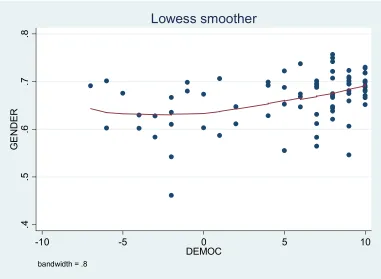
increases as well and gender inequality is reduced. The positive relationship between democracy
and the Global Gender Gap score is reflected in the Figure 5.4 Lowess smoother graph.
Lowering the confidence interval to 90 percent makes democracy significant as well,
with a p-value of 0.071 and a t-score of 1.83. The coefficient for democracy is positive
0.0017059 indicating that as levels of democracy increase, the Global Gender Gap score
increases as well and gender inequality is reduced. The positive relationship between democracy
and the Global Gender Gap score is reflected in the Figure 5.4 Lowess smoother graph.
While the findings of this study reflect significant values for religion, literacy, and
democracy, the religion variable proves to have the greatest impact on the Global Gender Gap
score. According to this model, a one point increase in the religion value moves the Global
.4 .5 .6 .7 .8 G E N D E R
20 40 60 80 100
LITERACY bandwidth = .8
[image:42.612.77.456.76.351.2]Lowess smoother
Figure 5.3 Lowess Smoother Graph Regressing Literacy on Gender
.4 .5 .6 .7 .8 G E N D E R
-10 -5 0 5 10
DEMOC bandwidth = .8