OPTIMIZATION OF PRESSURE VESSEL DESIGN USING PYOPT
Dereje Engida Woldemichael1 and Abraham Debebe Woldeyohannes2
1Universiti Teknologi Petronas, Mechanical Engineering Department, Bandar Seri Iskandar, Perak, Malaysia 2Caledonian College of Engineering, Department of Mechanical and Industrial Engineering, Muscat, Sultanate of Oman
E-Mail: [email protected]
ABSTRACT
pyOpt is an open source python based object oriented framework for nonlinear constrained optimization problems. In this study, we used pyOpt to solve pressure vessel design problem. Among the available optimizers in pyOpt, SLSQP (Sequential least squares programming), COBYLA (Constrained Optimization by Linear Approximation), ALPSO (Augmented Lagrangian Particle Swarm Optimizer), NSGAII (Non Sorting Genetic Algorithm II), MIDACO (Mixed Integer Distributed Ant Colony Optimization), and ALGENCAN (Augmented Lagrangian with GENCAN) were used. The effect of initial design variables on convergence was investigated for six different regions. The initial design variables for MIDACO and SLSQP should be within the design variable bound while COBYLA and ALPSO provide good result when the initial point is greater than the upper bound. On the other hand, NSGAII and ALGENCAN converge to the optimum value regardless of the initial value. The optimum results from all optimizers were compared with published literatures. Except for ALPSO with mixed discrete variables, the results are in good agreement with maximum percentage error of less than 5%. Therefore, pyOpt can be considered as an alternative option to solve engineering design optimization problems.
Keywords: pyOpt, pressure vessel design, constrained optimization, nonlinear optimization.
INTRODUCTION
Design optimization is the process of finding optimal parameters that leads to obtaining minimum or maximum value of the cost (objective) function subjected to a set of constraints. This type of optimization is known us constrained optimization and can be further classified as linear or nonlinear optimization depending on the type of objective function and constraints. There are a number of algorithms and methodologies to solve such problems with varying ease of use and degree of success. The choice and selection of these algorithms depends on the type and complexity of the design problem (linear/nonlinear, constrained/unconstrained), types of design variables (continuous, discrete, integer), availability of solver (commercial/ open source), and ease of use among others. In this paper, we investigate the use of pyOpt, an open source optimization framework, for optimal design of pressure vessel design. pyOpt is a python based object oriented framework for nonlinear constrained optimization problems[1]. Python is an open source high-level programming language which can be used to write standalone application models. It can also be interfaced with application models written in low-level programming languages such as C, C++, and Fortran. pyOpt is also an easy-to-use optimization framework where problem formulation and solution by different solvers are defined independently using object oriented constructs. The main capabilities of pyOpt include flexible optimizer integration, operating on multiple platforms, parallelization, and warm-restart for automatic result refinement.
In general, pyOpt can be used to find solution for general constrained nonlinear optimization problems of the form:
) ( min f x
x (1)
Subjected to:
me equality constraints e
j x j m
h ( )0 1,..., (2) m inequality constraints
m m
j x
gj( )0 e1,..., (3) n bounds
n i x x
xiL 0 iU 1,..., (4)
The objective function f(x) is assumed to be nonlinear function, and the equality and inequality constraints can be either linear or nonlinear functions of the design variables x. Three different variable types namely: continuous, integer, and discrete can be used in pyOpt. However, the use of variable types depends on the optimizers. There are various optimization algorithms integrated with pyOpt for nonlinear constrained optimization. Some of the algorithms require commercial license while most are freely available with Creative Commons (CC) license. We will use the CC licensed algorithms to study their effectiveness in solving pressure vessel design and compare their result with previous studies. Pressure vessel design is one of the most widely used structural design benchmarking problem used by a number of researchers to validate their algorithms [2-8].
the variables are more than 4. The derivative estimation for SLSQP and ALGENCAN with finite difference (FD) and complex-step (CS) methods has been investigated. Table 1 lists the optimizers used in this study with supported variable types.
Table-1. Optimizers and variable types used in this study.
PROBLEM FORMULATION
[image:2.612.310.539.375.624.2]The pressure vessel design problem has been formulated to minimize the total cost which includes the cost of material and cost of fabrication (forming and welding). The pressure vessel is made from a cylindrical vessel caped at both ends with hemispherical heads as shown in Figure-1.There are four design variables namely: thickness of the cylindrical vessel, Ts, thickness of the hemispherical heads, Th, inner radius of the vessel, R, and the length of the vessel excluding the heads, L. Ts and Th are considered as discrete variables with values of integer multiples of 0.0625 whereas R and L are considered to be continuous variables.
Figure-1. Pressure vessel with design parameters.
According to [8], the optimization problem for pressure vessel design is modeled as
Minimize:
R T L T R
T RL
T
f 0.6224 s 1.7781h 23.1661s2 19.84 s2 (5)
Subjected to:
0 0193 . 0
1T R
g s (6)
0 00954 . 0
2T R
g h (7)
0 1296000 3
4 3
2
3 R L R
g (8)
200 , 10 ; 0625 . 0 * 99 , 0625 .
0 TsTh RL (10)
There are two upper bounds used in the literature for L; [2, 6, 8, 9] used L200 while [5, 6, 10, 11] usedL240.
SIMULATION MODEL
The numerical model was defined in pyOpt programming environment. The initial values (starting points) for simulation were varied as
iU iU
iU iL
iL
iL x x x x x x x x x
x
x0 ; 0 ; 0 ; 0 ; 0 using randomly generated values for each variable. Here, xiL and xiU are the lower and upper bounds of design variable i respectively. The simulation was carried out for bothL200 andL240.
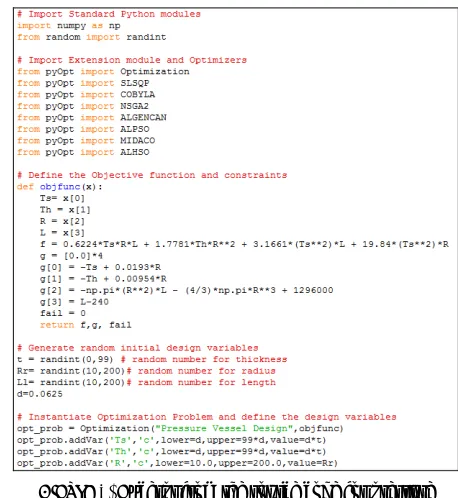
As indicated in the problem description, Ts and Th are discrete variables. Due to the limitation in SLSQP, COBYLA and ALGENCAN, these variables were considered as continuous for those solvers. Similar assumption were taken by [6] in obtaining the optimal values of the design variables. For ALEPSO, ALHASO and MIDACO we considered both continuous and discrete variable options. An excerpt from the source code for continuous variable definition is shown in Figure-2.
Figure-2. Excerpt from the source code for pressure vessel design.
RESULT AND DISCUSSION
Effect of initial value
[image:2.612.73.295.443.544.2]region we repeated the simulation ten times to see the consistency of the result and effect of initial values on the optimal values. Based on the numerical result, NSGAII and ALGENCAN converge to the same numerical result regardless of the initial value. MIDACO requires initial design variables to be set within the bounds (xiLx0xiU). For initial values with values less than the lower bound or greater than the upper bound, MIDACO terminates prematurely. For initial design variables within the bound, MIDACO converges to the same optimal value for all attempts similar to NSGAII and ALGENCAN regardless of the initial value. On the other hand, the results from SLSQP, ALPSO and ALHASO vary with the initial value. Thus, the results from these solvers require statistical analysis such as mean, median and standard deviation. SLSQP gives reasonable values when the initial values are within the bound. COBYLA and ALPSO converge to the optimum value when the initial starting values are in the upper region (x0xiU ). For all the regions, the results obtained using ALHASO did not converge to optimum value and we could not find any statistical correlation. For instance for twenty randomly generated initial variables within the boundxiLx0xiU with L< 200 for the fourth design variable, the optimum value for the objective function, f was (best = 6706.89, worst = 9427.99, mean = 855056, median = 9066.30 and standard deviation = 1003.43). Similar trends were observed for the other regions as starting value. Thus, we omit the result from ALHASO from further analysis.
Comparative study with published results
Pressure vessel design optimization problem has been solved by a number of authors in the literature. Kennan and Kramer [8] used augmented lagrange multiplier approach, [9] used self-adaptive penalty approach with genetic algorithm, [5] used Firefly algorithm (FA), [10] used filtered simulated annealing (FSA), and [6] used penalty guided artificial bee colony (ABC) algorithm. A variety of particle swarm optimization such as simple particle swarm optimization (SiC-PSO) algorithm for constrained optimization problem [2], Co-evolutionary particle swarm optimization (CPSO) approach [12] were also used. [13] used hybrid method combining PSO and AC called heuristic particle swarm ant colony optimization (HPSACO). [11] used four algorithms namely Simple Genetic Algorithm(SGA), Struggle Genetic Algorithm (StrGA), Particle Swarm Optimization Algorithm (PSOA), and Particle Swarm Optimization Algorithm with Struggle Selection (PSOStr). The results from these literatures were compared with the results obtained in this paper using PyOpt.
A number of numerical studies were conducted for both conditions (L ≤ 200 and L≤ 240). We classified the study in to two categories. The first category includes NSAGAII, ALGENCAN and MIDACO (both continues [c] and discrete[d] values). These algorithms converge to the same optimal value regardless of the initial set of design variables. The results are shown together with previously published results. Table-2 shows the results of the optimization using pyOpt simulation packages for the design parameters, constraints and the optimal functions in comparison with previously published results.
For L ≤ 200, [7] used mathematical analysis and Lagrange multiplier method in an attempt to find the true global optimality of the pressure vessel design as 6059.714 which agrees with a number of other publications. For L ≤ 200, the percentage error in comparison with [7] are 3% for ALGENCAN, MIDACO[c] and MIDACO[d] and 5% for NSGAII. Similar trends were observed for L ≤ 240. Note that the results from [5] and [6] are better than the true global optimal reported in [7] as the reported values are the best rather than the mean as shown Table-3.
In the second category, the results from SLSQP, COBYLA, ALPSO[c] and ALPSO[d] were considered. These algorithms give slightly different optimal values for each initial set of design variables. Thus, the comparison requires statistical analysis such as mean, median, and standard deviations. Table-3 shows the minimized
objective function using pyOpt simulation packages (SLSQP, COBYLA, ALPSO[c] and ALPSO[d]), in comparison with published results.
As shown in Table-3, the mean objective function value obtained from pyOpt packages (SLSQP, COBYLA, ALPSO[c]) for L ≤ 200 are in good agreement with the true optimal value reported in [7] with maximum of percentage error of 4%. These solvers also give comparable result with those reported in [9, 12, 13] with better standard deviation value. For L ≤ 240, SLSQP, gives the best result compared to [10, 11]. The mean optimal value obtained from COBYLA and ALPSO[c] is close to the result reported in [10, 11] with better standard deviation. On the other hand, for both L ≤ 200 and L ≤
240, ALPSO[d] gives the worst result among the ones reported in the literature.
Table-3. Comparison of results for category II optimizers with other results presented in literature.
CONCLUSIONS
There have been many attempts on the methodology of solving the optimization problem in engineering design with various degree of success. In this paper we presented the application of an open source package pyOpt to optimal design of pressure vessel. Among the optimizers in pyOpt, we investigated seven solvers namely: SLSQP, COBYLA, NSGAII, ALGENCAN, MIDACO, ALPSO and ALHASO. Since MIDACO, ALPSO and ALHASO can handle both
convergence of the optimization problem has been identified. The results from these optimizers have been compared with published results. In general, the results were in good agreement with less than 5% error with other optimizers except ALHASO (both continuous and discrete variables) and ALPSO[d] with discrete variable.
REFERENCES
[1] R. Perez, P. Jansen, and J. R. A. Martins, "pyOpt: a Python-based object-oriented framework for nonlinear constrained optimization," Structural and Multidisciplinary Optimization, vol. 45, pp. 101-118, 2012.
[2] L. C. Cagnina, S. C. Esquivel, and C. A. C. Coello, "Solving engineering optimization problems with the simple constrained particle swarm optimizer," Informatica, vol. 32, 2008.
[3] L. d. S. Coelho, "Gaussian quantum-behaved particle swarm optimization approaches for constrained engineering design problems," Expert Systems with Applications, vol. 37, pp. 1676-1683, 2010.
[4] A. H. Gandomi, X.-S. Yang, and A. H. Alavi, "Cuckoo search algorithm: a metaheuristic approach to solve structural optimization problems," Engineering with computers, vol. 29, pp. 17-35, 2013.
[5] H. Gandomi, X.-S. Yang, and A. H. Alavi, "Mixed variable structural optimization using Firefly Algorithm," Computers & Structures, vol. 89, pp. 2325-2336, 2011.
[6] H. Garg, "Solving structural engineering design optimization problems using an artificial bee colony algorithm," Journal of Industrial and Management Optimization, vol. 10, pp. 777-794, 2014.
[7] X. S. Yang, C. Huyck, M. Karamanoglu, and N. Khan, "True global optimality of the pressure vessel design problem: A benchmark for bio-inspired optimisation algorithms," International Journal of Bio-Inspired Computation, vol. 5, pp. 329-335, 2013.
[8] K. Kannan and S. N. Kramer, "An Augmented Lagrange Multiplier Based Method for Mixed Integer Discrete Continuous Optimization and Its Applications to Mechanical Design," Journal of Mechanical Design, vol. 116, pp. 405-411, 1994.
[9] A. Coello Coello, "Use of a self-adaptive penalty approach for engineering optimization problems," Computers in Industry, vol. 41, pp. 113-127, 2000.
[10] A.-R. Hedar and M. Fukushima, "Derivative-Free Filter Simulated Annealing Method for Constrained Continuous Global Optimization," Journal of Global Optimization, vol. 35, pp. 521-549, 2006.
[11] G. G. Dimopoulos, "Mixed-variable engineering optimization based on evolutionary and social
metaphors," Computer Methods in Applied Mechanics and Engineering, vol. 196, pp. 803-817, 2007.
[12] Q. He and L. Wang, "An effective co-evolutionary particle swarm optimization for constrained engineering design problems," Engineering Applications of Artificial Intelligence, vol. 20, pp. 89-99, 2007.