in the population sciences published by the Max Planck Institute for Demographic Research Konrad-Zuse Str. 1, D-18057 Rostock·GERMANY www.demographic-research.org
DEMOGRAPHIC RESEARCH
VOLUME 19, ARTICLE 54, PAGES 1831-1850
PUBLISHED 14 OCTOBER 2008
http://www.demographic-research.org/Volumes/Vol19/54/ DOI: 10.4054/DemRes.2008.19.54
Research Article
How can economic schemes curtail the
increasing sex ratio at birth in China?
Debarun Bhattacharjya
Anant Sudarshan
Shripad Tuljapurkar
Ross Shachter
Marcus Feldman
c
°2008 Bhattacharjya et al.
1 Introduction 1832
2 Sex ratio at birth, son preference and the one-child policy 1833
3 Causes of son preference 1834
4 Son preference, marriage and old-age support 1835
5 Implications of the increasing sex ratio at birth 1837
6 Sex ratio at birth, fertility decline and sex-selective potency 1837
7 A quantitative model 1839
7.1 Perceived present values and son preference 1839
7.2 The efficient optimal potency 1840
7.3 The equilibrium optimal potency 1841
8 Perceived present value ratios: An application in China 1843
9 The implications of policy interventions 1843
10 Conclusion and discussion 1844
11 Acknowledgements 1845
References 1846
Appendix A 1848
How can economic schemes curtail
the increasing sex ratio at birth in China?
Debarun Bhattacharjya1
Anant Sudarshan2
Shripad Tuljapurkar3
Ross Shachter4
Marcus Feldman5
Abstract
Fertility decline, driven by the one-child policy, and son preference have contributed to an alarming difference in the number of live male and female births in China. We present a quantitative model where people choose to sex-select because they perceive that married sons are more valuable than married daughters. Due to the predominant patrilocal kin-ship system in China, daughters-in-law provide valuable emotional and financial support, enhancing theperceived present valueof married sons. We argue that inter-generational transfer data will help ascertain the extent to which economic schemes (such as pension plans for families with no sons) can curtail the increasing sex ratio at birth.
1Direct all correspondence to Debarun Bhattacharjya, Management Science and Engineering, Stanford
Uni-versity, CA 94305, USA. E-mail: [email protected]
1. Introduction
China is currently experiencing rapid demographic changes. A rapid decline in fertility, driven by the one-child policy, has produced a rapidly aging population and been followed by a large increase in the sex ratio at birth (SRB). The latter is primarily due to son pref-erence (Coale 1991; Johansson and Nygren 1991; Li et al 2000a), which is widespread in China and derives in part from Confucian principles and a rigid patrilineal culture. Fertil-ity decline, a strong parental desire to have at least one son, and the increasing availabilFertil-ity of sex-selection technology have led to a far greater number of male live births than fe-male live births as compared to the numbers expected in most human populations (Coale 1991; Sen 1990). Continued growth in the SRB will likely have serious implications for China’s marriage market and its future stability (Tuljapurkar et al. 1995).
In this paper we focus on understanding how policy interventions by the Chinese government, particularly economic programs, could affect the sex ratio at birth. Previous research has shown that the kinship system and nature of marriage strongly affect son preference in China, Northern India and South Korea (Das Gupta et al. 2003). In the long run there is likely to be feedback from the marriage squeeze created by a large number of excess males, which may force people to rethink sex-selection, at least to some extent (Tuljapurkar et al. 1995). To capture the relationship between son preference, marriage and the value of children, we introduce the notion ofperceived present valuesof married and unmarried sons and daughters (Appendix A contains a glossary of terms).
2. Sex ratio at birth, son preference and the one-child policy
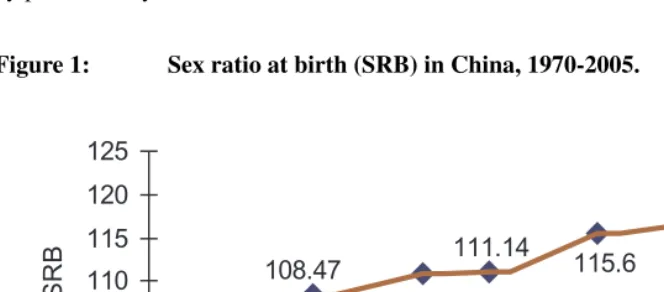
The sex ratio at birth (SRB) is the ratio of number of boys to girls born in a certain time period. The SRB is usually stated as the number of boys born for every hundred girls born. An SRB of 105 is generally accepted to be naturally occurring, and does not change much with parity, i.e. the birth order of the child (Johansson and Nygren 1991). The increasing SRB in China (figure 1) and in other Asian countries like India, South Korea and Taiwan indicate a growing deviation from this normal value. Increases in the SRB are attributed to an increase in the rate of sex-selection, using such methods as abortion, infanticide or abandonment, to ensure having at least one son. Thus,son-preference, the cultural trait of desiring sons, is prevalent in these countries. Note that there is great regional variation in the SRB in China. Appendix B lists the SRB along with certain socio-economic factors by province in year 2000.
Figure 1: Sex ratio at birth (SRB) in China, 1970-2005.
Source: For 1982, 1990 and 2000, tabulation on the population census in 1982, 1990 and 2000; for other years, 1% Population Sampling Survey, National Bureau of Statistics of China.
children are being born, couples have a much lower chance of having a son and people are motivated to intervene to select the sex of their children. Ultrasound technology enabling the pre-natal determination of sex has been widely available since the 1980s, leading to large-scale selective abortion of females (Zeng et al. 1993). Even though sex-selection is illegal in China, as Graham, Larsen and Xu (1998) write, “many couples find ways through the ‘back door’ to learn the sex of their unborn child, and abortion is an accepted form of birth control in China.”
Fertility has declined dramatically in China ever since the implementation of the one-child policy in the late 1970s. Technically, the policy is not really a ‘one-one-child’ policy. The Chinese government recognised that ethnic differences across regions had to be ac-commodated, and although the policy is a national one headed by the State Population and Family Planning Commission, administration and monitoring are decentralized to the provincial governments. Local administrators are responsive to regional needs and there are significant regional differences among the specific family planning regulations. The one-child policy includes rewards for people who agree to follow the policy, exceptions allowing some parents (e.g., in rural farming communities) to have a second (or higher order) child, and punishments for those who sign an agreement but break the rules. Con-ditions that may allow parents to have a second child include: 1) the first child is a girl; 2) the first child is disabled; 3) the parents are only children; 4) the parents have certain special occupations (Hung 2004).
However, while the one-child policy would seem to make sex-selection more attrac-tive, it is not necessarily the only cause of China’s sex ratio imbalance. Comparisons are often made with other countries where the SRB has increased despite the lack of co-ercive family planning regulations (Banister 2004; Wang 2003; Li et al 2000b). These discussions suggest that the SRB may not be significantly different in China even if the one-child policy were revoked or modified.
3. Causes of son preference
Even though socio-economic factors are very different in India, China and Korea, the common factor driving son preference in all three countries is believed to be a rigid patri-lineal kinship system (Das Gupta et al. 2003; Feldman et al 2006) in which the lineage of the family is continued solely by males, and productive assets are typically inherited only by males. Patrilocality, or cohabitation of a married couple with the husband’s parents, is typical of such a kinship system. Patrilocal marriage weakens ties between a daughter and her parents, and she may be neither obligated nor encouraged to support her parents after her marriage. Even though there has been a surge in economic opportunities for women in recent times, the value of a daughter is believed to remain low because she provides support (in money, time, and care) only to her in-laws.
4. Son preference, marriage and old-age support
The nature of marriage is a central theme in our discussion of son preference and the sex ratio at birth. Most traditional marriages in China are virilocal, with the married couple residing with the husband’s parents. Uxorilocal marriages are the opposite kind in which a married couple resides with the wife’s parents. The fraction of marriages that is uxorilocal has slowly increased in recent times due to the increase in the number of no-son families following sustained low fertility. Li et al. (2006) consider this a good sign because uxorilocal marriage helps to stabilize low fertility, alleviate son preference, decrease male bias in the sex ratio at birth, and improve female child survival and women’s social status. However uxorilocal marriage is still infrequent and has had little effect on the trend towards increasing the SRB in China.
results in Songzi also showed no significant difference between the amounts of financial support received by parents in their old age from sons and daughters (Li et al. 2004).
Jin, Li and Feldman (2006) conducted a survey in Shenzhen of rural-urban migrants. One of the purposes of their study was to explore the relationship between gender of mar-ried migrants and the financial support provided to their non-co-residing parents before and after migration. We use results from their survey to compare the mean annual finan-cial support provided by sons and daughters to their parents before migration, i.e. in the rural area. Table 1 shows the mean net financial transfers from sons, daughters and their respective spouses to parents. The numbers suggest that the key driver of value for the parents is the daughter-in-law! There is no significant difference between the financial support provided by sons and daughters to their biological parents, but the daughter-in-law provides more support than any of the other children. For a country where virilocal marriages are common we also expect that the daughter-in-law will provide a fair amount of emotional and instrumental support.
Table 1: Net financial support from children and their spouses to parents;
survey results from Shenzhen, before migration to urban areas.
Mean Annual Financial Support (Yuan)
Son 459
Daughter-in-law 879
Daughter 453
Son-in-law 720
Source: (Jin et al. 2006)
5. Implications of the increasing sex ratio at birth
The fertility and mortality declines in China and the growth of the SRB increase the uncertainty about China’s demographic future. Several researchers have shown that there will be a significant number of excess males born in the future, at the expense of ‘missing women’, and these excess males will be unable to find brides. These males are known as the ‘guang gun’, meaning ‘bare branches’ or ‘bare sticks’. The first-marriage market will be highly imbalanced in the future (Tuljapurkar et al. 1995) - it is estimated that there were more than 23 million unmarried boys born between 1980 and 2001 in China, and a similar number of excess males is expected in the next 20 years (Poston and Glover 2005). What will this population of unmarried males do? Only time will answer this ques-tion, but several gloomy scenarios have been proposed. There may be an increase in violence as there is extensive sociological evidence that if men do not marry, they are more likely to spread disease and commit crimes (Poston and Glover 2005). There has already been a steady rise in the number of kidnappings and forced marriages reported around China. The surplus men are also likely to have a profound impact on the future of HIV spread in China. They may become a significant new HIV risk group, and there-fore future interventions to curb the HIV epidemic in China will need to consider their potential effects (Tucker et al 2005). The Chinese government has recognised the need to address the problem of sex-selection both for the long term and also to counter the unethical and illegal behaviour of sex-selection in China. As Poston and Morrison (2005) point out, “the surplus of boys and shortage of girls ‘made in China’ could soon become not just a concern for China, but for the world.”
6. Sex ratio at birth, fertility decline and sex-selective potency
China’s SRB has been increasing steadily as the total fertility rate (TFR, or the average number of children borne to a woman) has declined from over 6 in the 1950s to close to 2 in the 1990s (figure 2). The one-child policy has played a role in this decrease as fertility has declined much quicker than under a voluntary family planning programme. However, there is reason to believe that the one-child policy has aggravated the trend to increasing SRBs and not created it. Fertility decline plus inherent cultural son preference may lead some couples to take action to ensure that they have a son. When technology to detect the sex of unborn children is readily available as it is in most places in China, some of these couples resort to abortion, abandonment or infanticide of daughters and these actions result in a higher than normal SRB.
Figure 2: Total fertility rate (TFR) in China, 1949-1991.
Source: National Bureau of Statistics, P.R. China, China Statistical Yearbook 2000. Available at: http://www.cpirc.org.cn/en/year.htm
Zeng et al. 1993). There is some evidence that indicates that almost all sex-selection is by couples who have no previous sons and are able to have at most one more child. Keeping this notion in mind, it is useful to decompose the effects of fertility decline and son preference on the increasing SRB. Li, Feldman and Tuljapurkar (2000) introduce the following terminology to define and measure separately the impact of the demographic issue of fertility decline and that of the cultural/behavioural issue of son preference on SRB. They define the phrase ‘a woman being in the sex-selection situation’ as the random event Y in the life of a woman such that this woman is able to have only one more child and that she has no sons borne to her previously. Thesex-selection pressure, y, is the probability that she is in this situation. Thesex-selective potency( which we just call
potencyfor brevity) is the probability that a woman will have a son through sex-selection given that she is in the sex-selective situation. The termsex-selectionrefers to any activity that ensures that the last child is a boy, including infanticide, sex-determination followed by abortion, etc. Now we summarize some mathematical relationships derived in Li, Feldman and Tuljapurkar (2000) that will be useful for subsequent sections:
during her life, ands0be the normal sex ratio at birth, i.e. sex ratio without sex-selection. If there arenwomen and each woman has a probabilityy of being in the sex-selective situation and a sex-selective potency ofp, then the expected number of sex-selective boys isnpy. The total expected number of children isnT, therefore the expected number of children born without sex-selection isn(T −py). These children are born without sex-selection and thus we expect their numbers to have the normal sex ratio at birth. There are n(T−py)s0/(1 +s0)boys who are born without sex-selection andn(T−py)/(1 +s0) girls, on average. The total number of boys is the sum of the boys who are born as a result of sex-selection and those who are not.
The total expected number of boys=n
·
py+ (T −py) s0 1 +s0
¸
(1)
The prevalent sex ratio at birth after sex-selection, s, is the ratio of the total expected number of boys divided by the total expected number of girls,
s=T s0+py
T−py (2)
Rearranging the terms, we can also express the potency in terms ofT,sandy.
p= T(s−s0)
y(1 +s) (3)
The advantage of using potencyp(as opposed tos) as an indicator of the level of son preference in a community is thatpexpresses a decision variable, the probability that a woman will undertake sex-selection. In current modern-day populations and particularly in China, the TFR and the sex-selection pressureyhave stabilized or is expected to sta-bilize soon, so changes in the realized sex ratiosare driven by changes in the potencyp. Potency is a useful index for comparing populations that have similar fertility rates but different realized sex ratios (like provinces across China). In subsequent sections, we use potency as the measure of son preference, i.e. a population with a higher potency is one where son preference is more prevalent.
7. A quantitative model
7.1 Perceived present values and son preference
there are too few women in the marriage market. This is precisely what is being observed in China today - the ‘guang gun’ are the excess males that may not be able to find mates in China.
How do people in the sex-selective situation behave if they are trying to do the best they can for themselves? To answer this question we introduce the notion ofperceived present value(PPV). We define the perceived present value of a child to be the worth of a child to its parents throughout their lives, discounted back to the child’s birthday. We argue that people in China and other countries who practice sex-selection perceive that a son has a higher PPV than a daughter. The PPV is the sum of the present value (PV) of the financial aid that a child might provide for old-age support, plus the value of cultural benefits that are more difficult to quantify but which we assume can be expressed in money equivalents. For instance, sons may have a higher PPV because they help in ancestor-related rituals, continue the family lineage, or improve parents’ social status. We label the PPV as ‘perceived’ to include cultural values of the latter sort that are not necessarily financial and ‘present’ values to sum over the long term benefits over the life of a newborn child.
We now present a simple theoretical model that relates the potency, as discussed in the previous section, and the perceived present values. Let the expected PPV for a married son, an unmarried son and a daughter in a population bevm,vuandvdrespectively. We
assume for simplicity that all women marry once, and that if there are excess males born each year, they will never marry. Also, we presume thatvm > vd > vu > 0, i.e. the
married son has the highest expected PPV and the unmarried son has the lowest expected PPV.
7.2 The efficient optimal potency
Expected number of excess boys=n
·
py+ (T−py) s0
1 +s0 −(T−py) 1 1 +s0
¸
=n
·
2py+T(s0−1) 1 +s0
¸
(4)
We know the expected number of married boys, married girls, unmarried boys and also the PPV for each. Hence the total expected valueVsfor all people is:
Vs=n ½·
2py+T(s0−1) 1 +s0
¸
vu+ ·
T−py 1 +s0
¸
(vm+vd) ¾
=
µ
n 1 +s0

{T[vm+vd+vu(s0−1)] +py[2vu−(vm+vd)]} (5)
Recall thatvm> vd> vu, and the values are assumed to be positive. Thus,vm+vd>
2vu. The total expected value is a decreasing linear function inp, and therefore the
maximum value ofVsis attained whenp= 0. We can see this intuitively as well: if there
are 10 children to be born, it is socially optimal if there are 5 boys and 5 girls so that they can pair up. If exactly one of the women giving birth to a girl had sex-selected, there would be 4 pairs of married boys and girls and 2 unmarried boys, resulting in a lower value overall. According to this simple model, it is efficient for society if people do not sex-select.
7.3 The equilibrium optimal potency
In most Chinese provinces, the efficient optimal potency value of 0 is not observed in practice, suggesting that there is an incentive for people to sex-select to try to increase their individual expected PPV. A woman in the sex-selective situation may believe that the chance that her son will find a mate is high enough for her to prefer the sex-selection option. There is a trade-off involved - when the potency is high, there are fewer girls born and the chance for boys to find a partner decreases. We suppose that theith couple chooses whether to sex-select knowing what the population’s potency will be. In other words, the couple chooses their own potency pi, their probability of bearing a son, in
order to maximize their own expected PPV. Since we assume that everybody has the same expected PPV values, by symmetry, everybody has the same optimal potencyp∗ at the
Nash equilibrium. In this sub-section we use a simple game theoretic model to understand the behaviour of couples regarding sex-selection, under equilibrium conditions. To obtain the equilibrium potencyp∗we analyze the perspective of a particular couple in the
potency, and ask whether the couple can maximize its PPV by choosing an individual potencypi>0.
For then−1other couples, and usings0 = 1as an approximation, the number of excess boys is given by replacingnbyn−1ands0by 1 in equation (4), which equals (n−1)p∗y.
For any boy in the population, the probabilityq∗ that he will marry, is the number
of girls (which is the number of married boys) divided by the total number of boys. We assume that mortality rates are the same for both girls and boys from birth till marriageable age, hence mortality can be ignored. Also, assuming n is a large number, theith couple’s decision does not affectq∗. Note that in the symmetric equilibrium, the othern−1women
all choose the (identical) optimal potencyp∗. Thus,q∗is given as,
q∗= (n−1)(T−p∗y)/2
(n−1)p∗y+ [(n−1)(T −p∗y)/2] =
T−p∗y
T+p∗y (6)
Notice that q∗ is a decreasing function ofp∗. The couple under consideration will
have a son if they sex-select with probabilitypi, or if they don’t sex-select and happen to
have a boy. As mentioned earlier, we uses0= 1as a simplifying approximation, so it is equally likely that a couple will have either a son or a daughter, if they do not sex-select.
The probability they have a son=pi1−pi
2 =
1 +pi
2 (7)
They will either have a son who marries, a son who doesn’t marry, or a daughter. If they have a son, the son will marry with a probabilityq∗, or will remain unmarried with
probability1−q∗. The mathematical expression forq∗ was obtained in equation (6).
Therefore, the expected PPV for the couple,Ve, is given by:
Ve= ½µ
1 +pi
2

[q∗v
m+ (1−q∗)vu] + µ
1−pi
2

vd ¾
(8)
The couple chooses a value ofpi that maximizes Ve, given that the other couples
choosep∗. Now V
e in the equation above is either an increasing or decreasing linear
function ofpi, unless the coefficient ofpiequals 0. The coefficient ofpiin this expression
isq∗(v
m−vu)−(vd−vu)where both terms in parentheses are positive. Butq∗ is
a decreasing function ofp∗, so there may be a value ofp∗ between 0 and 1 at which
this coefficient is zero, and hence at which the couple’s PPV is maximized. This value yields the only possible symmetric equilibrium solution, where theith woman’s optimal pi equalsp∗. Using (6) and setting the coefficient ofpi to 0 yields the unique value for
p∗:
p∗= T(vm−vd)
Note that the equilibrium potency is 0 when the PPV for a married son is the same as that of a married daughter. This simple model can easily be extended to incorporate mortality rates of children and marriage among people born in different years. A demo-graphic model similar to the cultural transmission model of Li, Feldman and Li (2000) can be used to project the actual SRB as a function of the PPVs. This will provide a forecast for the SRB and one can perform a sensitivity analysis on the parameters to see the effects of different potency or perceived value trajectories on the SRB.
8. Perceived present value ratios: An application in China
It may be difficult to quantify the PPVs for a population, but if we assume that people behave optimally and the system is in equilibrium, then we can estimate some relation-ships between the PPVs: vm,vu andvd. Let the ratiosvm/vu andvd/vu bemandd
respectively (wherem > d >1). We will refer to these ratios as thevalue ratios. In 1989 the TFR in China was 2.25 (close to the replacement level) and the SRB was 1.14 (which is above the normal SRB of 1.05). Li, Feldman and Li (2000) estimated the sex-selective pressurey to be 0.58 and potencypto be 0.17 using the quantitative model they devel-oped. Assuming that the equilibrium potency was attained in 1989, we can use equation (9) to find the relationship between value ratiosmanddin China in 1989. Re-arranging terms in equation (9), we obtain:
m= d(T +py)−2py
T−py (10)
We see thatmis a linear function ofd. Replacing the 1989 values in equation (10),
m= 1.09d−0.09 (11)
Equation (11) shows the relationship betweenmanddaccording to the model, assum-ing that the potency was at equilibrium in 1989. For instance, if we assume that married daughters were perceived to be twice as valuable as unmarried sons, then married sons were perceived as 2.1 times as valuable as unmarried sons in 1989. We discuss these issues in more detail in the following section.
9. The implications of policy interventions
relevant messages from the mass media, efforts by the government to introduce flexibility into the kinship system, educating women and involving men in family planning.
The lack of adequate social security for the rural population appears to be an important factor in people’s use of sex-selective abortion. Can economic support help in controlling son preference? Policies such as the provision of adequate pensions to families with no sons can bridge the gap between the PPVs by increasing the value of a daughter for people in a sex-selective situation. How much financial support in the form of pensions should the government provide to families with no sons? We can answer this question using our model. Suppose that the government wishes to decrease the equilibrium potencypto another equilibrium at a lower valuep0by spending an amountxto increase the PPV of a
daughter fromvdtov0d.
Equation (10) can be written as:
m=K1(p)d+K2(p), whereK1andK2are functions ofp,
K1(p) = T+py
T−py and K2(p) =− 2py
T−py (12)
Since bothpandp0are equilibrium values, equation (10) must hold for both. Therefore,
m=K1(p)d+K2(p) and m=K1(p0)d0+K2(p0) (13)
The required pension for each family with no sons can be calculated by manipulating equation (13):
x=v0
d−vd =vu(d0−d) =vm µ
1 K1(p0)−
1 K1(p)

+vu µ
K2(p) K1(p)−
K2(p0)
K1(p0)

(14)
To findx, we would require estimates ofvmandvu, i.e. the perceived present values
of married and unmarried sons. It may be difficult to quantify these values, but we can base estimates around intergenerational transfers from children and their spouses. Thus our model provides a framework to quantify interventions that can reduce the SRB.
10. Conclusion and discussion
values for children. The model is applicable not only to China, but in all countries where the SRB has been rising. Several papers have previously discussed the issues regarding policy and son preference, but there has been little effort to quantify the role of policy interventions. Son preference is related to several complicated factors, and this paper is an attempt to quantify its relationship with marriage. Future research should estimate the perceived value of children through survey information, so that the Chinese government can develop appropriate incentives to control the sex ratio at birth.
11. Acknowledgements
References
Banister, J. (2004). Shortage of girls in China today. Journal of Population Research
21(1): 19–45.
Coale, A. J. (1991). Excess female mortality and the balance of the sexes in the popu-lation: An estimate of the number of ‘missing females’. Population and Development Review17(3): 517–523.
Coale, A. J. and Banister, J. (1996). Five decades of missing females in China. Proceed-ings of the American Philosophical Society140(4): 421–450.
Das Gupta, M., Zhenghua, J., Bohua, L., Zhenming, X., Chung, W., and Bae, H. (2003). Why is son preference so persistent in East and South Asia? A cross-country study of China, India and the Republic of Korea. The Journal of Development Studies40(2): 153–187.
Feldman, M. W., Tuljapurkar, S., Li, S., Jin, X., and Li, N. (2006). Son preference, marriage, and intergenerational transfer in rural China. In: Gauthier, A. H., Chu, C. Y. C., and Tuljapurkar, S. (eds.)Population, resources and development, volume 2: Allocating public and private resources across generations: Riding the age waves, pp. 139–162. Dordrecht: Springer. (International studies in population; 3).
Graham, M. J., Larsen, U., and Xu, X. (1998). Son preference in Anhui province, China.
International Family Planning Perspectives24(2): 72–77.
Hung, Y. (2004). China’s one-child policy: Regional regulation variation and the sex ratio at birth. Bachelor’s honors thesis, Stanford University, Department of Economics, Stanford.
Jin, X., Li, S., and Feldman, M. W. (2006). The effects of rural-urban migration on inter-generational financial transfer in China: A gender-based perspective. Paper presented at the 71st Annual Meeting of the Population Association of America, Los Angeles, USA.
Johansson, S. and Nygren, O. (1991). The missing girls of China: A new demographic account.Population and Development Review17(1): 35–51.
Li, N., Feldman, M. W., and Li, S. (2000a). Cultural transmission in a demographic study of sex ratio at birth in China’s future.Theoretical Population Biology58(2): 161–172.
Li, N., Feldman, M. W., and Tuljapurkar, S. (2000b). Sex ratio at birth and son preference.
Li, S., Feldman, M. W., and Jin, X. (2004). Children, marriage form and family support for the elderly in contemporary rural China.Research on Aging26(3): 352–384.
Li, S., Jin, X., Feldman, M. W., Li, N., and Zhu, C. (2006). Uxorilocal marriage in con-temporary rural china: A research summary. In:Uxorilocal marriage in contemporary rural China. Beijing: Social Sciences Academic Press.
Poston, D. L. and Glover, K. S. (2005). Too many males: Marriage market implications of gender imbalances in China. GenusLXI(2): 119–140.
Poston, D. L., Gu, B., Liu, P., and McDaniel, S. (1997). Son preference and the sex ratio at birth in China: A provincial level analysis.Social Biology44(1-2): 55–76.
Poston, D. L. and Morrison, P. A. (2005). China: Bachelor bomb. International Herald Tribune September 14, 2005.
Sen, A. (1990). More than 100 million women are missing. New York Review of Books
37(20): 61–66.
Tucker, J. D., Henderson, G. E., Wang, T. F., Huang, Y. Y., Parish, W., Pan, X. S., S. M. an Chen, and Cohen, M. S. (2005). Surplus men, sex work, and the spread of HIV in China. AIDS19(6): 539–547.
Tuljapurkar, S., Li, N., and W., F. M. (1995). High sex ratios in China’s future. Science
267(5199): 874–876.
Wang, Y. (2003). What should china do about its gender imbalance problem? e-merge: A graduate journal of international affairs. [Electronic Journal] 4, May 2003. http://ssrn.com/abstract=547982.
Appendix A
Glossary of terms:
Parity - The birth order of a child. For example, the first born child has parity 1, the second child has parity 2, and so on.
Perceived present value (PPV) - the worth of a child to a couple, throughout their lives and discounted back to the child’s birthday. It includes not only the financial support that a child might provide for old-age support, but also cultural benefits that are more difficult to quantify.
Potency (same as sex-selective potency) - The probability that a woman will give birth to a son through sex-selection, given that she is in the sex-selective situation.
Sex ratio at birth (SRB) - The ratio of live male births to live female births in a certain time period, usually expressed in terms of live male births per hundred live female births. The natural SRB has been observed to be around 105.
Sex-selective situation - A general phrase indicating a preference for sons over daughters in a population.
Total fertility rate (TFR) - The average number of children borne to a woman in a popula-tion, calculated as the ratio of number of live births to number of women in a certain time period.
Uxorilocal marriage - A marital living arrangement where the married couple resides with the wife’s parents after marriage.
Appendix B
SRB and socio-economic factors by province in China, 2000. Source: (Hung 2004).