SUBJECT
LEVEL 68
STANDARDS
SYSTEM DESIGNERS' NOTEBOOK
Description of the Standards, Conventions, and Guidelines Used in the Software and Documentation of the Multics Operating System
SOFTWARE SUPPORTED
PREFACE
Multics System Designers' Notebooks (SDNs) are intended for use by Multics system maintenance personnel, development personnel, and others who are thoroughly familiar with Multics internal system operation, and also can be used by application programmers or subsystem writers.
Since internal interfaces are added, deleted, and modified as design improvements are introduced, Honeywell does not ensure that the internal functions and internal module interfaces will remain compatible with previous versions.
This SDN describes the standards, conventions, and guidelines used in the development of all Multics software and documentation.
Throughout this manual, the term Multics refers to the Multics Operating System.
It is important that the standards in this manual be followed to consistently maintain and support the development of the Multics Operating System. If you are a system programmer, permission should be obtained from your Technical advisor to deviate from the standards; if you are not werking for Multics System Development, you can deviate from the standards.
~Honeywe11 Information Systems Inc., 1980 File No.: 1L13
Section
Section 2
Section 3
Section
4-Section 5
Section 6
CONTENTS
Introduction.
How to Use This Document . Volatility of Contents General Issues .
Registered Names . . . . Topics . . . . .
Interface Standards . . . . Command Interfaces . . . .
Storage System Conventions . . . . Command Arguments . . . . . . . . . . Pathname Conventions. . . . . . Control Argument Conventions . . . . Output Conventions . . . .
User Interaction Conventions . .
Subroutine Interface Standards . . . • . Subroutine Names. . . .
Argument Standards . . . . General Programming Standards . .
Command Standards . . . . Naming Standards . . . . Storage System Conventions
Output Conventions.
Use of On Units for the Cleanup Condition Coding Conventions.
Modularity . . . . Program Structure . . Compilable Unit Size
Generality of Mechanism . .
External Availability of Mechanism . . . . . Binding and Bindfiles . . . .
Contents of Bound Segments.. . . . . Names of Bound Segments .
Bindfile Contents . . . Bindfile Formatting
Env ironment Independence.. . . . . Reentrancy . . . . . . . . . Transparency . . . .
Interruptibility . . . . Condition Handling .
Access Assumptions
Use of Standard Mechanisms
Pathnames and Search Rules . . . • .
Program Format. . . . • . Comments in Programs " . . . .
Section 7
Section 8
Section 9
CONTENTS (cont)
Page
Include File Format and Constraints . . . . 7-1 Include File Format. . . 7-1 Use of Include Files . . . 7-1 Naming Include Files . . . 7-2 PL/I and ALM Include Files . . 7-2 PL/I Language Conventions . .
Constraints . . . . Efficient PL/I Constructs . .
The Alignment Attributes . . . .
Attributes with Arithmetic and Pointer Variables .
Use of the Alignment Attributes with Short Strings . . . . Use of the Alignment Attribute with
Long Strings . . . . Use of Unaligned Short Variables in
Arrays and Structures . . . . . . Use of the Precision Attribute in Offset
and Length Expressions . . . . The Use of Internal Static to Simulate
Named Constants . . . .
Use of the Initial Attribute . . . . . The Assignment Operation. . . . The Multiple Assignment Statement. Conversions. . .
Pictures . . . . . Arithmetic Operations . .
Binary Operations . . Decimal Operations .
String Operations . . . • . . Special Case of Concatenation • . Operations on Long Strings . Aggregate Operations . . . Use of the Builtin Functions.
Arithmetic Builtins . . String Builtins . . . . Mathematical Builtins . . . The Call Statement and Function
References . . . . Determining the 'Quickness' of a Block Using Constant Argument Lists • . Using If Statements . . . . . . Optimization of Comparisons . . . . Other Constructs That Are Costly or Dangerous. . . . . • . . . Storage Management . .
Use of the Storage System. Pathnames • . . . . • . Naming Conventions . . . Working Directory Use .
Access Control List Management . . . . Making Segments Known and Unknown
Pathnames vs. Segment Pointers . • Multisegment Files. . . . . . Use of the Bit Count.. . . . . . Storage Allocation • . .
Internal Static Storage . PL/I Areas . . . . Temporary Segments. . . .
Section 10 Section 11
Section 12
Appendix Appendix
Appendix
Appendix
Index
Table A-1 Table A-2
A B
C
D
CONTENTS (cont)
Documentation Standards • . Location of Documents . •
Page
. 10-1
. 10-1 Info Segments. . . 11-1 Style. . . 11-1 Physical Appearance. . . . . . 11-1
Naming Conventions . . . 11-2
Syntax of Info Segments. . . 11-2
Title. . . . . . . . 11-2
Paragraphs. . . 11-2
Sections. . . • . . . . . . . 11-2 Command Descriptions. • . . . 11-3 Subroutine Descriptions . . . 11-3 Other Info Segments . . . 11-4 Rules for Translator Writers. . . • . . 12-1
The Command Program. . . . • . . 12-1 The Object Segment Created. . . . . . . 12-1 Listing Output . . . 12-2 Miscellaneous Requirements. . . . . . 12-2 Registered Control Arguments.
.
Registered Suffixes
List of Suffixes
.
.
Registered 1/0 Switch NamesList of 1/0 Switch Names Registered Condition Names.
.
List of Condition Names.
.
TABLES
Approved Standard Control Arguments Approved Special Control Arguments . .
SECTION 1
INTRODUCTION
HOW TO USE THIS DOCUMENT
This document should be read in its entirety in order to understand its contents. It should then be used as a reference document whenever relevant to the work being done.
VOLATILITY OF CONTENTS
The information in this document will be updated. Because the standards change as the system evolves, much of the system will not completely conform to the standards. As part of the development effort, software should be upgraded to meet the requirements of the new or changed standards whenever this is possible.
GENERAL ISSUES
To expound upon the general issues that comprise the design goals of the Multics Operating System is beyond the scope of this document. However, it is useful to remind the reader of some of the most important issues. Multics interfaces are designed with the average user in mind. As a result the needs of the very inexperienced or the very sophisticated user may be slighted. Consistency among all parts of the system is stressed in order to make this very complicated system possible to use and to allow different subsystems to be combined in ways not originally planned.
REGISTERED NAMES
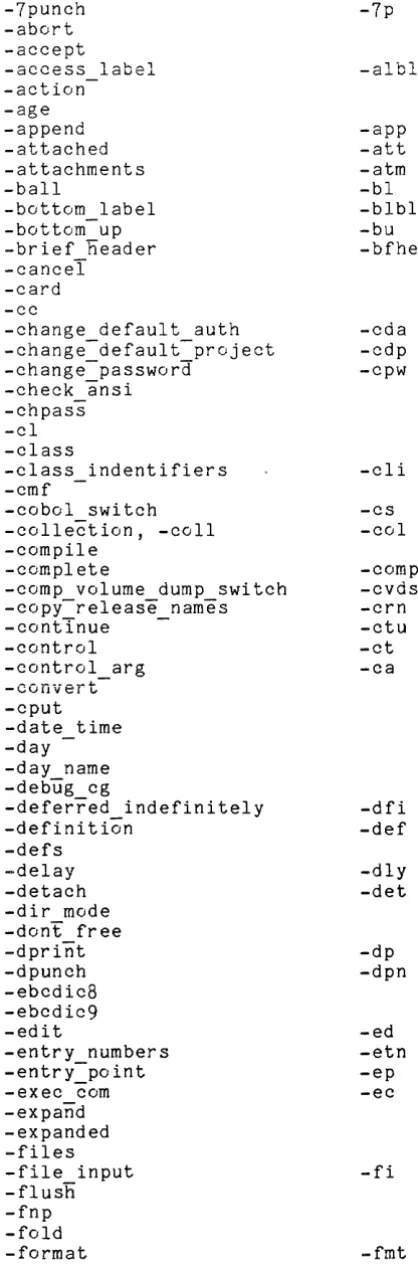
One of the most important parts of the user interface that must be kept consistent is that of the several classes of names used by commands and subroutines. This manual contains a number of appendices that register these names. Only those names registered here may be used; if new names are required they must be registered.
Appendix A lists control arguments. Appendix B lists suffixes.
Appendix C lists 1/0 switch names. Appendix D lists condition names.
TOPICS
Main topics included in this manual are interface standards (including both commands and subroutines), programming standards, modularity, environment independence, program format, include file format, PL/I language conventions, storage management, use of the storage system, documentation standards, info segments, and rules for translator writers.
SECTION 2 INTERFACE STANDARDS
COMMAND INTERFACES
Comman~s are a special class of programs designed with the terminal user in
mind.-TheYserve as the principal interface between the system and all of its users. Since many commands are used by both naive and sophisticated users, they must be designed with a two-fold purpose. The naive user should not be burdened with information he doesn't understand; the sophisticated user must not be denied the facilities that he needs.
Commands should not be too powerful. The result of a typing error should not be a disaster for the user.
Commands should be recursive, i.e., they should be able to be interrupted in midstream and invoked again. If it is inappropriate for a particular command to be used in this way, protection should be built into the command to query or inform the user.
Commands should not retain information from one invocation to the next in such a way that behavior of the second invocation
implication of the first. For example, the use of in one invocation should not make all future output other hand, a metering command that accumulates data to reset the accumulated values.
Storage System Conventions
is affected by some hidden the -brief control argument be in -brief form. On the should have a -reset option
In general, commands should deal with multisegment files as well as segments, unless inappropriate.
Commands should not perform write operations on the components of archive segments, except for the archive, archive sort, and reorder arch.ive commands. Commands should have no knowledge of the structure of archive segments, except for the commands mentioned above and the bind command.
lowercase letters and the underscore character. The pl1 command is an obvious exception, but doesn't invalidate the rule. Its name was chosen by another guideline for constructing names.
A command name should be short enough so that it may be conveniently typed. A two to four letter abbreviation should be selected using the first letter of the words or syllables of the name. If the command is in the tools library, it should not be supplied with an abbreviation. The system libraries should be checked to ensure that there are no conflicts with other installed command names and abbreviations.
New command names should be chosen with the following distinction in mind. Commands whose names start with print should have no knowledge of the structure of the input and deal with ASCII data. Commands whose names start with display should know about the data structure of the input and produce highly structured output. Commands whose names start with dump should have little knowledge of the contents of the data, may produce octal output, and may format the output in blocks.
Commands that are part of a subsystem should have the subsystem name or an abbreviation as a leading name.
In general, the suffix command should be the principal command that processes a segment whose name ends in .suffix. This is particularly true for language translators, for example, the pl1 command.
Command Arguments
Commands should check carefully for argument validity and warn users of possible misunderstandings. They should be consistent in behavior and interface with other commands.
Commands that always require arguments should print a usage line when invoked with no arguments. Commands that require no arguments should print a usage line if arguments were given.
Command arguments should be order independent unless the order dependency serves a useful purpose (e.g., -update of the bind command).
Commands whose interface is simple (such as the add name command) should accept multiple arguments if appropriate.
Commands that deal with segments whose names have a fixed suffix should not force the user to type the suffix; however, they should permit the user to include the suffix as part of the name. The expand pathname $add suffix subroutine performs suffix handling for such commands. -
-A series of related commands should have a similar or parallel syntax and control arguments.
Arguments for which sensible omitted, i.e., the last access name default pathname to many commands.
defaults exist should be allowed to be to set acl and the working directory as a
It is desirable to check the validity of all arguments before beginning its execution or before terminating the command.
Command arguments should be used, whenever appropriate, to inform the command what to do. The user should not have to type additional lines of input to control the behavior of the command. For cases where there is a great deal of input it should be possible to put the input in a control segment and to specify the pathname of the control segment as an argument to the command.
The use of octal numbers is discouraged. An exception is the use of octal numbers to represent a segment number or segment offset, and in such cases it may be more appropriate/to use a virtual pointer (as interpreted by the cv ptr subroutine) or a virtual entry (as interpret,ed by the cv_entry_ subroutine):
-Pathname Conventions
Commands that accept pathnames pathnames or absolute pathnames expand_pathname_ and absolute_pathname_.
as as
arguments interpreted
should by
accept relative the procedures
Commands that accept pathnames should honor the star convention whenever appropriate. Careful consideration of the interaction between the star convention and links must be given. Links are not chased by default when given a starname as an input argument. A control argument (-chase) should cause links to be chased when doing star processing (e.g., the copy command).
Commands that accept pairs of pathnames should honor the equal convention, for example, the compare_ascii command.
Commands that take segment names as arguments should accept pathnames and not reference names unless the command is dealing with reference names explicitly, such as the where command.
The -name control argument should be used by commands that normally take a segment number as an argument to indicate that the argument looks like a segment number but really is a pathname. The -pathname control argument should be used by commands that normally take a pathname to distinguish pathnames beginning with a minus (-) from control arguments.
Control Argument Conventions
Invalid or inappropriate control arguments should be diagnosed and the operation of the command terminated.
Entry names beginning with minus signs should be considered invalid by most commands. Any unrecognized string beginning with a minus sign should be diagnosed as an invalid control argument, rather than being treated as an entry name (even by commands that do not take control arguments). If there is a need to accept entry names with a leading minus sign, the -pathname control argument may be used.
New control arguments should not be invented when there that serve the purpose. All control arguments should be
are existing ones registered. (See Appendix A for a list of registered control arguments.)
Control arguments that are used only by commands in the tools library should not have abbreviations.
Control arguments that take arguments should do so uniformly (from one command to another) and should always take the same type of argument.
Output Conventions
Unless the purpose of a command is to produce output, it should not produce terminal output during its normal operation. The success of a command doing its job is indicated by the absence of output. However, a command that takes a long time to execute should print a short message to reassure the user that it has started, for example, the pl1 command.
Normal output from a command should be written to the 1/0 switch user output.
Error output by a command should be printed by the com err subroutine. The long name of the command should be included in the com err message. The com err message should give additional information to- resolve possible ambiguity about the source of the error. The user's argument that is in error should always be included in the call to com err. Calls to com err should include the appropriate nonzero status code. The subroutine actTve fnc err should be used in a similar fashion for error reporting by active-function procedures.
Error messages about storage system entries should include the absolute pathname of the entry in error. Those messages concerning input arguments should include the argument as given by the user.
Frivolous use of com err should be avoided. It should not be used unless an error has actually occurred, as the condition command error is signalled.
Other output should be done by means of iox $put_chars or ioa . Red
properly.
shift should not be used, since few terminals-handle Messages with underlining should be avoided.
this mode
Commands that produce a large amount of output (e.g., the PL/I compiler issuing diagnostics) should write all the messages on user_output and write a single error message with com err indicating that there were errors.
Commands should not write terminal-directed output to 1/0 switches other than user_output except when specified by control arguments.
Commands that produce only one line of output should not emit blank lines.
User Interaction Conventions
When a command that interacts with the typist produces an error message that the typist does not expect, it should perform a resetread operation on user input so that the user can modify his subsequent input.
Commands normally should not handle the quit condition.
Commands that interact with the typist should be prepared to handle the program interrupt condition signalled by the program interrupt command. This is particularly important for commands that produce a large amount of output that the user might want to abort.
Commands that ask questions should do so by means of the subroutine command_query_ so that the command question condition is signalled.
SUBROUTINE INTERFACE STANDARDS
Subroutine Names
Names of subroutines or data bases should be descriptive of the function they perform. The name should not be so long as to be inconvenient to use.
Names of segments created by system programs that are to remain as segment names in a directory should end in underscore, to avoid naming conflicts with user-defined names.
Names should consist only of lowercase letters, the underscore character, and the dollar sign. Subroutine names which will appear as names on segments in the system libraries should end in an underscore to avoid conflicts with user program names.
Total characters;
underscore.
length of subroutine names the entry point portion
of the form a$b of such a name
should not exceed 32 should not end in an
Argument Standards
Standard status codes should always be returned if an error code. Either codes in the system data registered subsystem error table should be used.
the subroutine returns base error table or a
The status code should be the last argument to a subroutine. Arguments
Output, Output. in a Arguments that are both input and output should be avoided. calling sequence should be grouped: Input, Input, ... ,
Arguments that are used for many subroutines should be declared in the same way for all such uses.
Subroutines that return more than one argument or that have side effects should not be called as functions.
The type of each argument should be chosen with the use and meaning of the argument in mind.
Subroutines should not check the number or type of input arguments, but assume they have been called correctly. Subroutines should not validate the correctness of their input arguments, unless it is part of their intended operation. However, subroutines which accept structure arguments should check the input structure version number for validity.
Character string arguments should be passed instead of a ptr to a string and its length. They should be declared unaligned and usually declared char(*) unless the length is fixed.
SECTION 3
GENERAL PROGRAMMING STANDARDS
This section documents conventions (to be used by system programs) that are of a general nature and do not fall within the province of the other sections of this document.
COMMAND STANDARDS
Commands should not call other commands.
Commands that perform general purpose service functions used by other commands or subsystems should be modularized into a command and a subroutine interface that implement the service function. The subroutine usually should not print messages but should return a standard status code to indicate an error condition.
Commands 'that accept arguments should accept a Variable number of arguments and should not explicitly declare a fixed number of arguments. The subroutine cu $arg ptr should be used to obtain each argument and the subroutine cu=$arg=count should be used to obtain the number of arguments.
Commands should invoke standard approved general purpose subroutines and internal interfaces developed specifically for the command or subsystem. They should not call internal interfaces of other commands or subsystems.
Commands that are also active functions should print the results that would be returned by the active function.
Active functions that would be meaningful commands should also be invokable as commands.
NAMING STANDARDS
Programs that produce output in a file should name the output sensible fashion. Listing output from the processing of segment should be placed in xxx.list.
file in a xxx.suffix
STORAGE SYSTEM CONVENTIONS
Programs that require temporary segments should use the subroutines get temp segment and get temp segments to obtain them and should call release_temp_segment_ or reTease=temp_segments_ when they are finished.
Programs should terminate any reference names that they associate with a segment. Programs generally should initiate a segment with a null reference name.
System programs should not allocate storage in the user free storage area. Storage is allocated in the user free area unless an <in option> is given in the PL/I <allocate statement> and <free statement>. Therefore, <in option>s must be
used. Such programs should use the area obtained by calling
Programs should have a cleanup condition handler to free allocated storage and temporary segments.
The duplicate name convention implemented by the subroutine nd handler should be honored by user ring programs.
Programs should use the subroutine delete for deleting storage system entries. If a nonzero error code is returned, the subroutine dl handler should be used to resolve the error. Programs should use the subroutine term for terminating segments that may have nonnull reference names associated with-them or that may have links snapped to them.
Output Conventions
Programs other than commands generally should not produce output or print error messages except for those subroutines whose explicit purpose is to perform these functions. The exact nature of the output should be documented in the interface description.
If a subroutine prints an error message, it should use the com err subroutine (if printing a fatal error on the caller's behalf where the caller has too little information to print a meaningful message), or the sub err subroutine (if printing a nonfatal error which can be restarted selectively under control of the caller or the user). The name of the command invoking the subroutine should be given in such error messages, implying that this name must be an input argument to the subroutine.
Use of On Units for the Cleanup Condition
The on unit for the cleanup condition must not be a goto statement, and the on unit (or any procedure or block invoked from the on unit) must not contain a nonlocal goto statement, as this will interfere with the nonlocal transfer that originally signalled the condition.
Cleanup tasks include freeing allocated storage and releasing temporary segments.
Cleanup handlers should never print anything.
Coding Conventions
Programs should only be written in the PL/I language, except with explicit permission. Exceptions usually are made when performance is an issue.
All variables should be declared.
All parameter lists for external entries should be fully declared, except for those entries accepting a variable number of arguments. These should be declared as options (variable).
Declarations should be grouped in a readable fashion.
All pad fields in data structures should be explicitly declared, i.e., there should be no gaps.
All pad fields that are documented to be zero should be set to zero explicitly. This operation allows for future expansion of a data item. A name such as mbz1 should be used to declare pad fields to make it clear that the caller must zero such fields.
Whenever possible, avoid including system parameters as constants in a program. For example, if the maximum number of words for a segment is required, the external variable sys_info$max_seg_size should be referenced.
SECTION 4
MODULARITY
The Multics Operating System is modularized to simplify debugging and modification and to increase reliability. In the following section, the issues and modularity which are important to designers and implementors are discussed.
PROGRAM STRUCTURE
Overall structure of each program component is to be designed with the newest techniques. Small parts of programs are to be as understandable as the total program. Using PL/I internal procedures is encouraged because they are almost as efficient as in-line code.
COMPILABLE UNIT SIZE
Programs are recommended to be no longer than a few hundred lines of executable code. Try not to combine small components into one very large program, unless performance is affected.
GENERALITY OF MECHANISM
Much of the uniformity of mechanism and function in the Multics system has been attained by attempting to generalize mechanisms so that they can be shared. This eliminates the need for similar facilities in distinct parts of the system that are likely to produce incompatible effects or later require unwieldy simultaneous extension. Do not generalize a mechanism if it is not justifiable, however.
EXTERNAL AVAILABILITY OF MECHANISM
BINDING AND BINDFILES
The individual program components of the Multics system are usually bound together by the Multics binder. This is done to reduce the number of separate components visible in the system, to make internal interfaces unavailable, to conserve segment numbers, and to minimize the number of linkage faults.
Contents of Bound Segments
Programs that are logically related should be bound together and placed in an order chosen to minimize the number of page faults taken when various subsets and usage patterns of the components within are used.
Names of Bound Segments
Every bound segment is named with a functionally related name starting with the string "bound" and terminating with an underscore. The bindfile is named bound segment name .bind. The bindfile and all of its components are stored in a single archIve segment whose name is bound_segment name_.archive.
Bindfile Contents
The contents of the bindfile should abide by the following conventions: 1. The order statement is required to specify binding order.
2. An objectname statement is required to state the name of the bound segment.
3. A global: delete; statement is required to ensure that extraneous definitions are deleted.
4. An addname statement is required to specify all names that are to be known externally.
5. Statements used only for debugging purposes are not to be used (e.g., No_link, Force_Order).
6. An objectname statement should be included for each component that has other attributes specified. Components with no attributes specified should not have a corresponding objectname statement since they will already have been named in the Order statement.
7.
The retain statement is to be used only for those definitions that must be retained because they are externally available interfaces. 8. The synonym keyword is to be used to specify all synonyms for eachcomponent.
Bindfile Formatting
The following formatting rules are to be used for ease of reading of the bindfile:
1. Tabs should be used to separate keywords from their arguments. 2. Each objectname statement should be preceded by one blank line.
3. Synonym, delete, retain, and global statements should be indented one space with arguments lined up under the arguments of the objectname statement.
4. Comments should be included at the beginning of the bindfile that give the logical relationship of bound components, and that state the date, author and reason for each change.
SECTION 5
ENVIRONMENT INDEPENDENCE
Subsystems, commands, and subroutines should be implemented so that they may be used in a variety of environments without other portions of the environment affecting them and without their affecting other components of the environment. This is referred to as the principle of surroundability. Surroundability is important because it makes it possible for users and subsystem designers to integrate many portions of the Multics system to compose a new subsystem without having to change any of the components they are integrating.
REENTRANCY
Components of the Multics Operating System should be reentrant. This is accomplished by proper use of pure procedures, the recursive nature of the PL/I language and its implementation, and careful use of static storage. If making a subsystem reentrant results in performance degradation or implemention problems, it is permissible for the subsystem to not be reentrant. In this case, checks are to be implemented to detect possible misuses of the subsystem and are to either prevent the misuse or warn the user of the possible conflict.
TRANSPARENCY
The operation of a program should be transparent to the environment. This is accomplished by correct storage management techniques, programs cleaning up any temporary environment changes, naming conventions, 1/0 attachments, and avoiding other static effects on the environment. For example, if a program changed the working directory without that being a specified property of that program, then subsequent programs would behave differently than expected.
INTERRUPTIBILITY
CONDITION HANDLING
Programs should handle conditions that may be signalled because of their operation and pass on all other conditions that they cannot handle better than the default handler.
ACCESS ASSUMPTIONS
Programs should execute properly under a wide range of access conditions. Access checking and condition handlers can achieve this. Programs using privileged entry points for some functions, but that are also usable by the general user, should be prepared to handle a call by a user with insufficient access.
USE OF STANDARD MECHANISMS
Programs ought to use the standard mechanisms that are available in the system, not their own. This is important since these mechanisms are provided to permit surroundability and modularity. For example, if a subsystem needs to use a number of temporary segments, it should use the system-provided temporary segment manager, not any other.
PATHNAHES AND QC'IIDru
I.",)LnH\J1J DrlT C'Q HU.L."L."L..J
Programs should not have pathnames built into them. The standard search rule mechanism should be used to find other programs and data bases, found through the linker. Commands or subsystems for data segments should use the standard search path facility. The default search paths for a subsystem should be chosen with the general user in mind and for a specific application.
SECTION 6 PROGRAM FORMAT
This section gives guidelines and requirements for the format of programs. Recommendations mostly apply to any source language, but a few are specific to the indicated language.
COMMENTS IN PROGRAMS
All programs installed in the Multics system must have a set of comments. These comments include a copyright notice to protect the rights of the owners and sponsors of the Multics system, a journalization notice for each installation to record changes, a set of comments describing the interfaces of the program, and comments that help the reader understand the program itself.
Copyright Notice
Each separately compilable program must have a copyright notice. The copyright notices should be created and modified by th~ add copyright.command to
ensure that all requirements are met. \ ... ,~ .... _~ ---/
Journalization Notice
Each time a program is submitted for installation to the system it must have a comment added that summarizes the reason for the change. The minimal information required is the date, name of submitter, and a one-line summary of the change, including all relevant MCR numbers. These journalization notices are to be placed after the copyright notice with the latest notice at the end. If a program is completely rewritten, a note should be made and all previous journalization notices deleted. Similarly, very old notices that no longer serve a useful purpose can be deleted.
Interface Descriptions
Program Comments
Each major block of the program has to contain comments describing its function. Comments describing important variables, particularly those whose value have a significant effect on the flow of control through the program, but whose names do not indicate the meaning, should be included. Statement-by-statement comments are discouraged if they give little or no additional information. For example,
len
=
0; 1* set len to zero *1gives no additional information, whereas,
len
=
0; 1* for this case we have a null string *1offers extra information that may aid the reader.
Good choice of variable names eliminates the need for excessive commenting. However, if the names chosen are too long, they might not be able to fit on one line and may be hard to read.
GENERAL LAYOUT OF A PL/I PROGRAM
White space in the form of new pages, tabs and blank lines should separate independent sections of code. A new page should follow:
1 • journalization notices
2. local declarations
3.
include filesAlthough the following formatted as follows:
is not a strict rule, a readable program might be
1. the copyright notice,
2. a general description of the program followed by the journalization notice,
3.
a new page,4. the main procedure statement,
5. declarations for variables not in include files, 6. a new page,
7. an optional set of include files,
7a. a new page if include files were included,
8. the executable code for the main body of the program,
9. a new page,
10. internal procedures for the program, and
11. another optional set of include files.
Declaration statements are to be grouped by storage class or function, and should rarely take up more than one line of code except for structure declarations. Comments should accompany variables whose use may not be obvious. Factoring of attributes should not be done to more than one attribute at a time.
Standard Format
All PL/I programs must be formatted with the standard formatting command. Programs should be structured so that subsequent invocations of the standard formatting command, such as by installation procedures, do not destroy the format.
ALM PROGRAM CONSIDERATIONS
There are conventions which ALM programs should follow. These are: 1. all entry's and segdef's should be at the beginning of the program,
2. use blank lines to separate logical statements,
3.
always use include files for references to variables in structured data bases,4. segref should not be used (use <seg>: [offset])
5. avoid VFD pseudo-ops if ALM has a cleaner way to define the data,
6. use new pages for subroutines,
7.
"declarations" (equ's, temp's etc.) should be at the beginning, 8. the "push" pseudo-op should not be used with an argument, and9. no IC references should be made when the value is greater than 2. For example,
*+3
3,icSECTION
7
INCLUDE FILE FORMAT AND CONSTRAINTS
INCLUDE FILE FORMAT
The include files used in the Multics Operating System should be in the following form:
1. Header lines (in comments) gIvIng the date the include file was created, dates when it was modified, as well as why, how, and by whom. The header should begin with:
BEGIN INCLUDE FILE xxx.incl.lang where xxx and lang are filled in appropriately.
2. The body of the include file giving declarations (or whatever). All declared variables must be commented. Any strange constructs should be clearly described.
3. The last line of an include file should be of the form: END INCLUDE FILE xxx.incl.lang
commented appropriately.
The following constraints apply to the variables and structure of include files:
1. Structures in include files should be based.
2. If a structure in an include file is based on a particular pointer, that pointer should be declared (without explicit storage class) in the include file.
3. Include files should not contain partial PL/I statements.
4. Include files should be formatted in a manner consistent with the system standards for the language in which they are written.
USE OF INCLUDE FILES
NAMING INCLUDE FILES
The name of an include file is simply: xxxxx,incl.lang
where xxxxx is the name used in the "include" statement and lang is the name of the language for which the include file applies. The primary name of the include file (xxxxx) should end in an underscore for externally advertised include files.
Include files used by (or supporting use of) a particular subsystem should have names beginning with a prefix which identifies the subsystem. For example:
.; ""V """"rio", ; nr>1 1"'\1 1 ~vr.. _ l U . V ... """~ • ..L """'''''''' • t" ... I
pI 1 s t a c k f ram e . inc 1 . pI 1 mrds_users.incl.p11
PL/I AND ALM INCLUDE FILES
When a structure or data base is described in both PL/I and ALM include files, the include files are to make reference to each other. Also, the variable names should correspond exactly.
SECTION 8
PL/I LANGUAGE CONVENTIONS
This section highlights the coding rules for system programs that are to be written in the PL/I language. Recommendations for generating efficient code are included. The rules are to be taken as guidelines; there will be rare programs that follow every rule. Refer to "Efficient PL/I Constructs" below.
PL/I is the Multics Operating System programming language. However, there are several features in the language which should be avoided either because they are inefficient, they are not implemented well by our compiler, or they lead to complex coding constructs. The following language features should be avoided by subsystem programs:
1. use of PL/I inp~t/output statements
2. aggregate expressions (except for assignment) 3. condition prefixes
4. use of "returns (char
(*»"
5. use of the built-in function decat
CONSTRAINTS
The following list describes some general restrictions and requirements;
1. all variable names have to be declared in a declare statement
2. each reference to a member of a structure must be qualified by the name of the level-one containing structure
3. no compilation warning messages or error messages are allowed
4. implicit conversions should not be used
5. multiple block closures by an end statement should not be used 6. the default statement should not be used
EFFICIENT PL/I CONSTRUCTS
This subsection is an informal guide to efficient use of the Multics PL/I compiler. It provides advice on how to take advantage of the good features of the compiler while avoiding its weaknesses. Emphasis is placed on constructs which produce more efficient code than others. The reader is assumed to be familiar with PL/I.
For a semiformal definition of the language supported by the Multics PL/I compiler, see the Multics PL/I Language Specification, Order No. AG94.
The Alignment Attributes
The use of the aligned attribute and the unaligned attribute can have a great effect on the speed of a program and the size of its data base. Unaligned items can start on a bit boundary (character boundary for character strings, pictures, and decimal variables), aligned items must start on at least a fullword boundary and occupy an integral number of fullwords. If a value requires 72 bits or less of storage to represent it, access of the value will be faster if its generation of storage is aligned because it can be directly loaded into the aq registers.
ATTRIBUTES WITH ARITHMETIC AND POINTER VARIABLES
Access of aligned binary and pointer variables is usually faster than that of unaligned variables. The only exception to the above is that unaligned pOinters that the compiler recognizes as aligned are accessed at speeds comparable to that of aligned pointers, but the former cannot be indi~ected
through. You should use aligned binary and pointer variables for local scalar variables, and only use unaligned binary and pointer variables in large data structures where size is important, but speed of access is not.
The alignment attribute has no effect on the access time of decimal variables or varying strings.
USE OF THE ALIGNMENT ATTRIBUTES WITH SHORT STRINGS
A short string is defined to be a nonvarying string with constant extents whose length is less than or equal to 72 bits (eight characters). Access of aligned short strings is usually much faster than that of unaligned short strings. Thus, it is recommended that one use aligned short strings for local scalar variables, and restrict the use of unaligned short strings to large data structures where space is important.
USE OF THE ALIGNMENT ATTRIBUTE WITH LONG STRINGS
All nonvarying strings that are Because these strings are too long to
not short are considered to be long. fit into the aq registers or their length
is not known at compile time, the use of the
their access. It is recommended that attribute--unaligned.
8-2
",1icrno" ",ttl"'ihlltO "'-'0'" n,-,t ",noo" I1n
'-""""""' . . 0.&..1 ... 1o.AVV.l. . . _\,Au ... _ _ ... ~ ~ .. ....,v LJp ... ""'''''' V I p
one use the default alignment
USE OF UNALIGNED SHORT VARIABLES IN ARRAYS AND STRUCTURES
For the purposes of this discussion, short variables are those variables which occupy no more than 72 bits (eight characters) of storage and are declared with constant extents.
When accessing an element of an array of short unaligned variables, the access code is quicker if a constant subscript is used, because the compiler uses an EIS (Extended Instruction Set) instruction, when the subscript is not constant, in accessing the variable. If an unaligned short variable is contained in an array of structures, and the variable is accessed with a nonconstant subscript, access code is faster if the array is declared aligned, because the use of an EIS instruction is avoided.
Use of the Precision Attribute in Offset and Length Expressions
Because the Multics CPU's index registers can only hold 18 bits of information, while up to 24 bits may be needed to express the offset or length of a string for use in an EIS instruction, the compiler must make use of the preclslon attribute in deciding which register to use. If a subscript expression, the second or third argument of the substr builtin, or the declared length of a string has a precision of 18 or less, it can be kept in an index register, whereas if the precision is more than 18, it must be kept in the a or q register. This means, for example, that if a user knows that he wants a substring that may be more than 262,143 items long, then the precision of the third argument of substr should reflect that fact (otherwise the high-order bits of the length may be lost). Conversely, if the user knows that a string is less than 262,144 items long, he should reflect that knowledge in the precision used for subscripts and arguments to substr. (Besides looking at the precision of the length and offset expressions, the compiler also makes use of the declared string size in cases of constant extents to determine where the offset or length may be kept.)
The general guideline is to always declare variables with the correct preclslon. The following precisions are guidelines when a user is not sure a smaller precision will suffice. A word offset into a segment should be declared fixed bin(18). A number of words on a segment should be declared fixed bin(19). Character string indexes and lengths should be declared fixed bin(21). Bit string indexes and lengths should be declared fixed bin(24).
The Use of Internal Static to Simulate Named Constants
When "options(constant)" is added to the declaration of an internal static initialed variable, the variable is allocated in the text section whether or not it is set or passed as an argument. The user is responsible for ensuring that the variable is not actually set, however, as this would cause faults or other errors.
Use of the Initial Attribute
The compiler's implementation of the initial attribute for automatic, based, and controlled arrays is inefficient compared with the code the user can get from explicit assignment statements. Therefore, using the initial attribute in the above cases is discouraged. Since the use of the initial attribute does not generate code for static variables, the above statement does not apply in that case. Users are warned, however, that use of the initial attribute can make a program more difficult to read in some cases, and that initialization of large external static arrays this way can cause creation of a larger object segment than intended.
The Assignment Operation
THE MULTIPLE ASSIGNMENT STATEMENT
In deciding whether or not to use a multiple assignment statement rather than separate assignment statements, it is useful to know under which circumstances multiple assignment statements produce inefficient code. A multiple assignment statement of the form:
T1, T2, Tn
=
E;where E is not a constant, is semantically equivalent to the separate statements:
v
=
E; T1=
V; T2=
V;Tn
=
V;If the temporary represented by V can be kept in a machine register throughout the assignment, then the multiple assignment statement is efficient. Clearly, this implies that if E is longer than two words, the multiple assignment statement will not be efficient, since E cannot fit in a register. Thus, multiple assignment statements are not efficient when the right hand side is a long string, a varying string, an entry value, a label value, a file value, a
format value, an area, a decimal value, a complex value, Or an aggregate.
CONVERSIONS
All of the PL/I conversions are efficient, many of them producing inline code, while the others produce calls to any to any. Inline code is produced for all cases where neither the source nor- target are complex, decimal, character string, or picture (see the discussion of pictures below). Of the other cases, the following produces inline code:
complex float binary (precision~27)
=
real binary;real binary = complex float binary (precision~27);
-real decimal :: real decimal;
complex decimal = compl ex decimal; real binary integer = real decimal;
real decimal = real binary integer;
character = real fixed decimal;
character = real binary integer;
All other cases produce calls to any_to_any_o
The convert builtin function can be used to effect conversion between character and binary and to avoid intermediate conversions that other builtins might cause.
PICTURES
The use of pictures provides a convenient way to get efficient controlled conversion between arithmetic and character. When using pictures, the user can avoid PL/I's inconvenient conversion rules by specifying the desired format.
While picture unpacking (going from character to arithmetic form) is done by p11 operators, the most common cases of picture editing (going from arithmetic to character form) are done inline. Inline code is generated for the majority of cases of editing into real fixed pictures. The cases of editing into real fixed pictures that is done by p11 operators are any of the
following: -
-• the absolute value of the number's scale is greater than 31
• a "y" picture character appears in a drifting field picture (e.g.,
$$$y99)
• a zero suppression character or drifting character appears to the right of the "v" picture character
ARITHMETIC OPERATIONS
Most arithmetic operations are implemented with fast inline code. The one general exception is the power operator (e.g.
**)
which is sometimes implemented by p11 operators or subroutine calls. Users are cautioned against using the"I"
oper~tor with 1ixed point operands as the PLII precision rules may cause unexpected results. Use the divide builtin function instead.BINARY OPERATIONS
Most binary arithmetic operations produce inline code. Multiplication of fixed binary (precision>36) numbers utilizes p11 operators references, all fixed binary division invoked by the "/" operator-causes references to slow p11_operators_ routines.
The
"**"
operation generates p11 operators calls for real operands and full subroutine calls for complex operands. If the operands are both real, and the second operand is a positive integer constant that could be represented as a fixed bin(35) value, inline code will be generated to do the power operation as repeated multiplications.DECIMAL OPERATIONS
efficient inline code to be one or both of the operands This case will often cause Most decimal arithmetic operations cause
generated. The major exception is the case of having a scale greater than 32 or less than -31. additional assignments or multiplications to be
hardware only handles scales within the range -31 to 32. generated since the 6180
If the power operator has decimal operands, a conversion to and from binary
andlor a subroutine call will be generated.
String Operations
All string operations (as opposed to builtins) cause inline code to be generated. In addition, some special cases cause better than usual code to be generated.
SPECIAL CASE OF CONCATENATION
Concatenation is often used in constructing varying strings. A normal concatenation of the form:
a
=
b :: c;results in three (3) moves -- band c are moved into a temporary, and the result is moved into a. However, a concatenation of the form:
vs
=
vs :: c;where vs is a varying string, results in just one move -- c is moved to the end of vs. The latter special case can be used to great advantage in building varying strings. Consider the following example:
vs
=
a :: b :: c;results in four moves and perhaps some instructions to allocate temporaries, while:
vs
=
a;vs
=
vs :: b; vs = vs : Ie;results in three moves with no temporaries allocated.
OPERATIONS ON LONG STRINGS
Most statements of the form: a
=
b <bool_op> c;a
=
translate (b, ... ); a=
bool (b,c,<bolr»;where a, b, and c are long nonvarying strings, cause code to be generated that performs the operation in a temporary and then moves the result into a. However, if a is the same length as the temporary would be, and if the compiler believes that a could not possibly overlap with b or c, then the operation will be performed directly in a and no temporary will be allocated.
In a statement of the form: if a <op> b ...
or
if bool (a, b, <bolr» ...
where a and b are long strings, the compiler will attempt to do the operation without allocating a temporary, by using an SZTL instruction if the value is not needed elsewhere.
AGGREGATE OPERATIONS
Most aggregate operations, other than simple assignment and the use of the string and unspec builtins and pseudovariables, are relatively inefficient in the present Multics PLII implementation and should be avoided. By simple, assignment, we mean assignment statements of the form:
P -> aggregate
=
q -> aggregate;ARITHMETIC BUILTINS
With the exception of the divide builtin, all the arithmetic builtins cause efficient code to be generated. The divide builtin is inefficient only for some cases in which a fixed binary result is produced. If a fixed binary result is produced, a reference to a very slow p11 operators divide routine is generated unless the result and both operands are unscaled wIth a precision less than or equal to 35.
STRING BUILTINS
Efficient inline or out-of-line code is generated for all but one string
builtin~ decat. Execution of the decat builtin is about 50 times slower than
might be expected.
There are special cases of some of the other string built ins that cause more efficient code to be generated than is normally generated for the general case. These are:
index «char str>, <char1» index «char str>, <char2»
index (reverse«char str», <char1» index (reverse«char_str», <char2»
index (reverse«char str», reverse«char2») search «char1>, <char str»
verify «char2>, <char str» search C<char_str>, <constant» verify «char str>, <constant»
search (reverse«char_str», <constant» verify (reverse«char_str», <constant»
translate «char str>, <constant> [,<constant>]) before «char str>, <char1»
-before «char _str>, <char2» after «char _str>, <char1» after «char str>, <char2»
-Itrim «char _str>, <constant» rtrim «char str>, <constant»
-copy «char1 constant>, expression)
MATHEMATICAL BUILTINS
References to the mathematical builtin functions are compiled either into fast references to p11 operators or into slower subroutine calls. The following math built ins are implemented in p11_operators_ if they have real arguments:
atan exp sin tand
atand log sind
cos log10 sqrt
cosd log2 tan
All other cases produce subroutine calls.
The Call Statement and Function References
When a call statement or function reference is executed, in the general case, an argument list must be constructed which takes 3 + 2*number_of_arguments words. When the new procedure block is entered, a new stack frame is established by a p11 operators routine that takes around 30 instructions. This is a high overhead -to have when using an important feature of PL/I that is necessary for good programming practice. The Multics system PL/I compiler has two optimizations which can greatly reduce this overhead. First, it can decide that an internal procedure or begin block may share the stack frame of another block rather than obtaining its own. A block that does not obtain its own stack frame is called a "quick" block or procedure. Second, the compiler can build argument lists to quick procedures at compile time, if the arguments have constant addresses known at compile time. These two optimizations greatly reduce the cost of call statements and function references.
DETERlviINING THE OF A DT(")("V
i..JJ..."VVl'\,
The Mul tics PL/I compiler goes through a two stage process to determine which (procedure or begin) blocks can be quick, that is, which ones need not obtain stack frames. The first stage excludes blocks from being quick because of their properties. The following properties can make a block non-quick.
•
it is the external procedure block•
it is an ON-unit•
it has 110 statements•
it has format statements•
it has ON, or revert statements•
it has automatic variables with expression extents• it has an entry that is assigned to an entry variable or passed as an argument
• it has an entry that is referenced in the argument list of such a call after the aforementioned argument
In the second stage, the compiler uses a graph of the calls between blocks, to determine which of the remaining eligible blocks can be quick. The algorithm used in this stage is an iterative one based on the constraint that a quick block may use the stack frame of one and only one non-quick block and thus may effectively be invoked from only one non-quick block. In fact, the algorithm states that a quick block may be invoked from only one stack frame, and an invocation from a quick block is considered an invocation from its owner's stack frame.
A user can determine which blocks have been made quick by examining the symbol s 1 i st ing prod uc ed by the compil er . In the sec t ion marked, "STORAGE REQUIREMENTS FOR THIS PROGRAM" is a list of all the blocks in the program. If the line for a particular block contains the words, "shares stack frame of", that block is quick.
USING CONSTANT ARGUMENT LISTS
In generating a quick procedure call, the Multics PL/I compiler can often generate a constant argument list if the addresses of the arguments are known at compile time. This saves the cost of executing instructions to set up the argument list at runtime. At this time the following constraints must be satisfied for the compiler to generate a constant argument list:
• the quick procedure must contain no non-quick blocks
• the stack frame of the caller must be smaller than 16,384 words
• the arguments must be constants, expressions with operators, builtin references, function references, or automatic variables
• all automatic arguments must be allocated in the stack frame of the caller
• all automatic arguments must have constant extents • all subscripted arguments must have constant subscripts
Using If Statements
In handling if statements containing logical operators, such as: if x = 0 : p "'= null : x + 3<z
then call a;
if z>3 & q
=
null & loaded then call b;the Multics system PL/I compiler (as of MR4.0) attempts to generate code that uses the minimum number of operations to decide the result. This is a change from previous releases of the compiler that always evaluated the complete expression in the if statement. In order for this optimization to take place, the user must specify the -optimize control argument for the compilation, there must be no irreducible function references in the expression, and the expression must evaluate to a bite 1) value. Thus a user should feel free to use logical operators in if statements without worrying about their efficiency.
NOTE: no program may depend on the order of evaluation of operands in the expression of an if statement. Thus, the statement:
if P "'= null
& p
-->
q=
0 then ... is illegalAny program that depends on complete or incomplete evaluation of expression is in error, unless the expression contains irreducible references, in which case complete evaluation takes place.
Optimization of Comparisons
such an function
The Multics system PL/I compiler (as of MR4.0) remembers in its abstract machine state model the most recent comparison or indicator setting operation at any particular point in time in generating object code. This enables it to remove redundant comparisons in constructs such as the following:
if a<b
then call foo; else if a
=
bthen
Other Constructs That Are Costly or Dangerous
• default statements
• multidimensional arrays with star bounds • arrays of elements of star extents
SECTION 9
STORAGE MANAGEMENT
USE OF THE STORAGE SYSTEM
System programs often request the storage system to perform certain actions on "objects" in the storage system hierarchy. These objects are directories, segments, and links. Multiie~ment files (MSFs) are implemented as a collection of specially named segments (components) in a directory whose bit count (not otherwise used for directories) reflects the number of components. Although multisegment files are not part of the storage system, some of the rules governing their use are similar to those of segments.
Functions performed by the storage system are: listing an ACL, setting a bit count, and making a segment known. These requests are made through the hcs gate. Sometimes less primitive interfaces are used to perform the functions: These are preferred because of the "side effects" they provide.
The hcs interfaces accept either a pathname (consisting of a directory pathname and an entry name) or a segment pointer. System subroutines should not use relative pathnames or reference names to identify an object in the storage system.
?athnames
All storage system interfaces that accept pathnames also expect descriptors for the pathnames. The argument description in the declare statement for the entry should be "char (*)". (Some programs written with previous compilers in mind use "char (*) aligned".) The programmer is advised to make reference to the interface description.
Naming Conventions
Programs do not change the name of an eXisting storage system object. Objects are created with only one name. System programs should preserve all the names of existing entries which are manipulated. System programs should be aware of the command system's conventions concerning entry names and not violate them. Nonprinting characters, for example, are to be avoided.