Georgia State University Georgia State University
ScholarWorks @ Georgia State University
ScholarWorks @ Georgia State University
Political Science Theses Department of Political Science
Summer 7-14-2010
Opportunity to Rebel: The Effects of Unemployment Coupled with
Opportunity to Rebel: The Effects of Unemployment Coupled with
Ethnic Divided on the Onset of Civil Conflict
Ethnic Divided on the Onset of Civil Conflict
David R. Hamilton Georgia State University
Follow this and additional works at: https://scholarworks.gsu.edu/political_science_theses
Part of the Political Science Commons
Recommended Citation Recommended Citation
Hamilton, David R., "Opportunity to Rebel: The Effects of Unemployment Coupled with Ethnic Divided on the Onset of Civil Conflict." Thesis, Georgia State University, 2010.
https://scholarworks.gsu.edu/political_science_theses/32
This Thesis is brought to you for free and open access by the Department of Political Science at ScholarWorks @ Georgia State University. It has been accepted for inclusion in Political Science Theses by an authorized
OPPORTUNITY TO REBEL: THE EFFECTS OF UNEMPLOYMENT COUPLED WITH ETHNIC
DIVIDED ON THE ONSET OF CIVIL CONFLICT
by
DAVID R. HAMILTON
Under the Direction of Carrie Manning
ABSTRACT
The effects of unemployment on the genesis of civil conflict are examined as both a social and
economic factor, with particular emphasis on civil conflict in ethnically heterogeneous nations. A
logit statistical analysis of a data set indicates that increased unemployment rates do contribute
to the onset of civil conflict.
OPPORTUNITY TO REBEL: THE EFFECTS OF UNEMPLOYMENT COUPLED WITH ETHNIC
DIVIDED ON THE ONSET OF CIVIL CONFLICT
by
DAVID R. HAMILTON
A Thesis Submitted in Partial Fulfillment of the Requirements for the Degree of
Master of Science
in the College of Arts & Sciences
Georgia State University
Copyright by
David R. Hamilton
OPPORTUNITY TO REBEL: THE EFFECTS OF UNEMPLOYMENT COUPLED WITH ETHNIC
DIVIDED ON THE ONSET OF CIVIL CONFLICT
by
DAVID R. HAMILTON
Committee Chair: Carrie Manning
Committee: Denise Donnelly
Charles Hankla
Electronic Version Approved:
Office of Graduate Studies
College of Arts & Sciences
Georgia State University
iv
DEDICATION
I would like to dedicate this work to my parents who have lent me support in this endeavor as
v
ACKNOWLEDGMENTS
I would like to acknowledge my committee members, Dr. Carrie Manning, Dr. Denise Donnelly,
and Dr. Charles Hankla for their support and patience in helping keep me focused and in
helping me achieve the project I set out to produce. I would also like to acknowledge my close
vi
TABLE OF CONTENTS
ACKNOWLEDGEMENTS
LIST OF TABLES
Chapter 1 – Introduction
v
vii
1
Chapter 2 – Literature Review
1.1 Foundation Works: Revolution
Theory
1.2 Rebellion Theory: Resource
Mobilization
1.3 Rebellion Theory: Greed vs.
Grievance
1.4 Rebellion Theory: Greed &
Grievance
Chapter 3 – Theory
Chapter 4 – Methodology
4.1 Primary Variables
4.2 Control Variables
Chapter 5 – Statistical Analysis
Chapter 6 – Conclusion
vii
LIST OF TABLES
Table 4.1 – Variable Descriptions
Table 5.1 – Logit Regression Models
17
1 Chapter 1 - Introduction
Numerous civil conflicts exist in today’s global environment. In addition to these current
conflicts, the after effects of numerous prior conflicts are still felt socially and economically. Civil
conflicts, averaging roughly seven years in length, carry tremendous social and economic costs1
which can take years, even decades, to overcome. Billions of dollars of investment and donation
are required to facilitate recovery. With these ever increasing social and economic costs, two
factors become increasingly imperative: (1) understanding what factors affect the onset of civil
conflict, and (2) how they can be addressed given enough forewarning to prevent the outbreak
of conflict. Issues such as levels of economic development, population size & density,
government type & strength, and ethnic fractionalization are all linked to the onset of civil
conflict.
In this paper I focus on the onset of civil conflict and draw on a large body of economic
and social literature discussing the onset of civil conflict in order to generate testable
hypotheses regarding the effect of unemployment on civil conflict onset. Unemployment is both
a social and an economic factor. While much of the prior literature has tried to separate the two
issues, looking for predominantly social or economic reasons for the onset of civil conflict, it is
only in some of the most recent literature that a link between the two areas has been studied. I
test these hypotheses empirically using a data set I have compiled2.
One might observe now, at the peak of a global economic crisis, as well as throughout
history, a pillar in most political campaigns and policy agendas has been the creation of jobs
and the reduction of levels in unemployment. Political and social tensions rise in conjunction
with rising unemployment, as increasing numbers of citizens lose their jobs and turn to their
government for aid. Correspondingly, increasing stress gets placed on the government as it
1
Collier (Collier & Hoeffler, 2004b) reports the average length of civil wars at seven years and the rough economic cost for each at $54 Billion in damages over time on the intrastate and international levels.
2
attempts to address the issue. If levels of unemployment get too high or are sustained for too
long, conflict can occur as people resort to violence and other desperate measures. Conflict
may occur between non-governmental groups or against the state as groups lash out in
frustration.
In many states or societies unemployment is likely to be an economic factor that can be
manipulated by politicians to sway individuals and groups along the conservative/liberal
spectrum and pit upper classes versus the lower and working classes. However, in states with
ethnically3 divided populations it has the ability to become an identity based factor. In some
states, i.e. Northern Ireland, society and government are divided along lines of ethnic
orientation. With the parties controlling government divided by ethnic or religious classification
and the population itself divided closely between ethnic groups, unemployment becomes an ‘us
versus them’ issue, rather than a class issue or a conservative/liberal issue which could cut
across ethnic groups. In cases such as this, as unemployment levels rise, politicians and social
elites may manipulate the issue, turning groups against each other for political gain. While all
ethnic groups may be suffering to roughly the same extent, framing of the issue by politicians
may create the perception that one group is suffering at the benefit of an alternative group, or
that one group is suffering more. This can increase tensions between groups and potentially
lead to conflict if unemployment levels get too high. Therefore I argue that unemployment
becomes an even more critical factor in areas of ethnic dominance4.
3
In referencing ethnicity, I defer to Horowitz’s definition of ethnicity: Ethnic groups are defined by ascriptive differences, whether the indicum is color, appearance, language, religion, some other indicator of common origin, or some combination thereof… This is an inclusive concept of ethnicity [that facilitates] comparison (1985, 17‐18).
4
3
In the next chapter I review the prior literature on the occurrence of civil war. In chapter
3, I present a theoretical argument regarding the effects that unemployment and ethnic
fractionalization have on the onset of civil conflict. In chapter 4 I describe the data set and
discuss the statistical methods utilized in this study. In chapter 5 I present the empirical results,
discussing the effects of unemployment on civil conflict, and conclude in chapter 6 with
suggestions for the future direction of this research.
Chapter 2 - Literature Review
Foundation Works: Revolution Theory
Contemporary analyses of the factors leading to the onset and duration of civil war trace
their roots to early social revolution literature which focused on social and economic inequalities
as the root causes of political violence and revolution. De Tocqueville’s classic hypothesis
stated: “Almost all of the revolutions which have changed the aspect of nations have been made
to consolidate or to destroy inequality. Remove the secondary causes which have produced the
great convulsions of the world and you will almost always find the principle of inequality at the
bottom,” ([1835] 1961, p. 302). Later works followed the effects social inequality had on
revolution and incidents of political violence. Russett (1964) and Nagel (1974) found minor
support for the link between political violence and inequality tied to the distribution of land. Nagel
(1974) identified the level of economic well being within a state as the most important variable
linking the two rather than the distribution of land. Skocpol (1979) evaluated the effects of class
inequalities and suppression of the lower classes by the landowning elites and wealthy
merchant classes. Despite Nagel’s (1974) claim that economic well being was the key link
between political violence and inequality, later studies (Sigelman & Simpson, 1977; Hardy,
1979; and Weede, 1981) found that once controlled for, economic development has little affect
4
Huntington (1968) focused primarily on the process of modernization within states, but
he also drew a link between the rates at which states developed (or modernized) and how
stable they remained. He observed that as states experienced increased rates of modernization,
they experienced greater likelihoods of destabilization as social institutions were unable to
evolve rapidly enough to adequately cope with social demands. He speculated that as social
demands failed to be met, groups would lose faith in the state and attempt to remove the
government. Most prominent among these groups would be state militaries who took over via
coup. While Huntington’s focus was primarily on the structure of the state, Gurr (1970) focused
on the distribution of income and equality among society within the state. Gurr hypothesized that
as the level of inequality of income between groups rose within the state, the potential for
political violence would increase. Gurr expanded upon this hypothesis theoretically and
historically but did little in the way of quantitative analysis to test his hypothesis, possibly due to
the lack of available data on the observed cases.
Rebellion Theory: Resource Mobilization
Shifting away from the focus of economic inequality and its link to revolution and the use
of political violence, another body of literature focused on the ability of dissident groups to
mobilize through their ability to acquire necessary resources in order to finance and support
themselves. Called by some the “resource mobilization school”, this body of literature (Gamson,
1975; Jenkins & Perrow, 1977; Tilly, 1975, 1978) casts doubts on the idea of a strong direct
relationship between discontent and political violence. Scholars in this school argued that the
central explanatory variable was the opportunity of discontent to organize people into effective
dissident groups. This argument focused on the ability of dissident groups to acquire and control
5
the political environment in which dissident groups formed, i.e. weak vs. strong governments
and autocratic vs. democratic regimes.
Eisinger (1973) argued that the more oppressive or closed a political system, the less
opportunity there was for dissident groups to engage in collective action of any type.
Alternatively, the more open a political system, the lower the likelihood of political violence as
dissident groups are able to pursue collective action issues through more peaceful and
democratic measures. Political systems falling within the middle range of the
autocratic-democratic spectrum, moderately autocratic to moderately autocratic-democratic, are seen as the most
likely to experience civil conflict, primarily as a result of weaknesses in state capacity (ie. weak
militaries, inability to enforce laws, and corrupt institutions). Weak autocratic and democratic
regimes lack strength to suppress rebellion groups and protests. The nature of the governments
are often such that the people view their options as limited only to extreme, often violent,
measures in order to change the political climate. While the style of government has social
implications, this body of literature viewed it only as an enabler/inhibitor for conflict and focused
the basis of the argument on the ability of groups to receive adequate economic backing to
mount a rebellion.
This argument received additional statistical backing in more contemporary discussions
on the outbreak of civil war (Collier& Hoeffler 2001, 2002a, Sambanis 2001, and Fearon &
Laitin, 2003). These researchers showed that, with all other factors controlled for, highly
democratic and autocratic governments are unlikely to experience civil conflict, while weak
autocratic or democratic governments are more susceptible to civil conflict. Measurement of
government strengths and types are taken primarily from the Freedom House5 and Polity6
5
www.freedomhouse.org/
6
indexes. A significant failure in this literature is its lack of discussion on the varying effects that
government style can have on identity (ethnic) based civil wars. Primarily, are highly autocratic
governments less likely to experience conflict in general or could they be just as susceptible in
ethnically dominant states where one ethnic group controls the government and suppresses or
oppresses another ethnic group?
Building on the theory of resource mobilization, the focus shifted to the use of
econometric models to forecast or predict the onset of civil war in states. Early work on the
modeling of the onset of civil war was developed by Grossman (1991, 1999) who derived much
of his work from economic theory literature. Grossman, utilizing econometric models, cast
rebellion as an industry that generates profit from the looting of local resources. He argued that
rebellions are motivated by greed. Thus, so long as there is ample opportunity for profits to be
extracted, the likelihood of rebellion formation will be strong. Simply put, merely the presence of
lootable resources is necessary for the formation of rebel groups. This argument again suffers
the same fault as the earlier research: it only observes rebellion through an economic lens and
fails to apply a social filter to the analysis.
Rebellion Theory: Greed vs. Grievance
In contrast, much of the political science literature explains rebellion in terms of motive.
Hirshleifer (1995, 2000) presents the argument that the presence of grievances, actual and
imagined (or misperceived), present the primary motives for rebellion. These grievances are
collectively referred to as identity based issues and can come from ethnic and social divisions
within society that generate(sometimes incorrectly) identity based perceptions of inequality,
leading to rebellion by groups with the perceived grievance.While Hirshleifer sheds important
7
link with previously identified economic factors, or, more explicitly, the importance of opportunity
for rebellion, or of factors that make it more feasible.
Stemming from this divide in the argument over the causes of civil war, Collier & Hoeffler
(2000, 2001, 2002a, 2002b, and Collier, Hoeffler & Sambanis 2005) attempt to settle the debate
through what they present as the “Greed7 vs. Grievance8” model. Utilizing a number of proxies
for both greed oriented motivations and grievance oriented motivations, Collier and Hoeffler
constructed a series of models to test the competing arguments. In their first model, the greed
or opportunity model, they tested the argument for the effects of greed motivated factors in
relation to the onset of civil war. In this model they presented a basket of proxy variables for
economic opportunity, measuring the cost/benefit ratio of rebel involvement and weighing the
potential opportunity cost individuals face in the participation of rebel activities. They briefly
mentioned unemployment as a possible economic factor but brushed it under the table with little
explanation and instead utilized male secondary schooling as their proxy for measuring
opportunity cost to participate in rebel activities.
In the second model they tested for the effects of grievance motivated factors in relation
to the onset of civil war such as ethnic fractionalization and openness of government. Following
these two models, Collier & Hoeffler tested a series of models combining proxies from the first
two models. They found that while the greed model holds only marginally better explanatory
power over the grievance model for the onset of civil war, certain elements of the “Grievance”
model have significant relationships to the onset of civil war. Opportunity proxies associated
with a significant relationship to the onset of civil war are: Primary Commodity exports, Male
7 The Greed model focuses on economic incentives and entitlements that would motivate individuals and groups
to undertake rebel actions.
8
8
Secondary schooling9, GDP per capita, and GPD Growth in the prior five year period. Proxies
from the grievance model associated with a significant relationship are: Ethnic Fractionalization,
and Regime type. Proxies in both models associated with a significant relationship that are
classed as neither greed nor grievance are: Peace duration, Population Size, and Geographic
dispersion of the population. While still leaving more questions unanswered than answered,
these works provide the basis for the emergence of the combined social and economic body of
literature.
Shifting away from the greed focus, other branches of the contemporary literature have
attempted to disaggregate the types of civil war into classes of ethnic civil wars and
economic/opportunity based civil wars or identity and non-identity based wars (Sambanis, 2001;
Collier & Sambanis, 2002; Fearon & Laitin, 2003; and Fearon, 2005). This group of literature
separates civil wars between those fought over control of local resources (i.e. drugs, diamonds,
lumber, oil, and other minerals) and those fought between ethnic and cultural groups for political
control of a state or region. Sambanis (2001)10 notes that ethnic/religious, or identity based, civil
wars are significantly and positively correlated with ethnic heterogeneity. Additional support for
these findings are presented through various statistical models that analyze the effects of ethnic
and cultural fractionalization in relationship to civil war onset in areas with little economic
motivation for profit-seeking or greed-based civil wars11.
Rebellion Theory: Greed & Grievance
While much of the Rebellion Theory literature developing out of Revolution Theory has
focused specifically on either economic or social causes for conflict, a small body of literature
9
This paper challenges the assumption that Male secondary schooling is a proxy for opportunity for rebellion. I argue here that education is not a necessary deterrent for conflict but instead the presence of employment opportunities that are a necessary deterrent for conflict.
10
Also seeDoyle & Sambanis (2000)
9
has focused on the combined interactions of both. Edward Muller (1985) examined the effects of
income inequality and regime repressiveness on the occurrence of political violence. Drawing
primarily on Gurr (1970) and Eisinger’s (1973) early works, Muller theorized that as income
inequality grows within a society the likelihood for conflict increases. Drawing on Eisinger
(1973), he added that conflict would be most likely under regimes that fell in the middle of the
autocratic-democratic spectrum; highly repressive regimes are able to more effectively manage
discontent and highly democratic regimes offer means for discontent to be voiced through
means other than violence. Muller found support for his hypothesis, but found diminishing
support for the effect of income inequality on political violence in his later time-series data.
The issue of the interplay and influence of social and economic factors on conflict was
later examined by Christopher Cramer (2003), who looked at the issue of inequality between
groups and how social institutions reinforce these inequalities. Drawing on sociological and
economic literature, Cramer theorized that ‘categorical inequality’ (inequality that is specific to
defined groups within society) is a primary cause of conflict. He emphasized that the institutional
setup of states and their societies reinforces these inequalities and further increases the
likelihood for conflict by leaving social groups little alternative beyond violent conflict in order to
improve their situation. Cramer tested this theory through two case studies on Angola and
Rwanda. While providing an interesting argument for the link between economic and social
factors, Cramer did little but suggest that these factors were linked.
Despite this limitation, Cramer provided a theoretical basis for the work of Bendikt Korf
(2005). Korf approached the Greed vs. Grievance nexus and attempted to link the two by
focusing on the institutional mechanisms that preserve ethnic entitlements. Korf theorized that in
highly divided or heterogeneous societies, ethnic groups which “gain political control will then
10
2005). As this enrichment occurs, horizontal inequalities between groups in political, economic,
and social dimensions will widen, providing the basis for intergroup animosity and conflict. Korf,
like Cramer, used case study analysis but presented little beyond anecdotal evidence to support
the theory. In addition, Korf only explored the inequality of land rights within a state or region.
Land rights are important in lesser developed or undeveloped states where agriculture
and other commodities make up a majority of the economy, but I argue that they are less
significant to the majority of individuals in states that are more developed and industrialized. In
these states, larger portions of the population are concentrated in urban areas where it is less
important whether an individual owns land or property. Instead, the focus is on whether they are
able to provide basic necessities for themselves: i.e. food, shelter, and healthcare. In developed
societies, the issue of employment, or more specifically unemployment, is a significant factor for
the onset of civil conflict. It is a tool which can be politicized and used to mobilize large numbers
of individuals with a limited amount of resources. While much analysis has been done in regards
to inequality and its effects on civil conflict, only passing attention has been given to
unemployment and its effects on civil conflict. Collier, Hoeffler & Sambanis (2005) make
mention of unemployment as a contributing factor in the onset of civil conflict but do not
operationalize it in any of their greed or grievance models. Beyond their discussion of
unemployment, the issue has received no more than a single sentence discussion in any of the
other literature. I aim to address this omission.
Chapter 3 - Theory
As noted earlier, I use the case of Northern Ireland to develop a theoretical argument for
the effects of unemployment on conflict onset and then test it using a sample of 184 countries.
11
groups: the Catholics and the Protestants12. In each of the six counties comprising the region,
Protestants constituted a majority of the population and the government was held in the hands
of protestant controlled Great Britain. Under Protestant rule, the Protestant community
experienced favorable economic and employment opportunity. The Troubles developed out of a
civil rights movement by the Catholic community that the British Government responded to with
violence. One of the driving elements behind the civil rights movement was the demand for fair
employment opportunities and access to jobs. Rising levels of unemployment during the late
1960’s made these demands more urgent on the part of the Catholic community, but also made
the Protestant community more resistant as they attempted to protect their own well being.
While a peaceful civil rights movement was initially undertaken by the Catholic community in
order to seek changes from the government, the government’s response to protest marches
quickly devolved the movement into a violent conflict with groups aligning along ethnic lines.
With levels of unemployment high within both the Catholic and Protestant communities, the
ranks of paramilitary groups on both sides quickly swelled as individuals had little deterring them
from joining. These groups had long been in existence, the IRA predominantly within the
Catholic community seeking political change through any means necessary, and Ulster Unionist
groups within the Protestant community seeking to protect the six counties of Northern Ireland’s
union with Britain. It can be claimed that it was the rising levels of unemployment in the late
1960’s that gave the paramilitaries on both sides the resource pool they needed to recruit
individuals to their cause.
12
12
Drawing on the theoretical foundations of Collier & Hoeffler’s (2001; 2002a; Collier,
Hoeffler & Sambanis 2005) opportunity model, coupled with Muller’s (1985), Cramer’s (2003),
and Korf’s (2005) models of inequality, I theorize that:
H1: As the net level of unemployment increases (decreases) within a state, the probability for the outbreak of civil conflict will increase (decrease).
Building from the works of Gurr (1970) and Grossman (1991, 1999), and pulling from Mancur
Olson’s (1965) theory of collective action, I theorize that as the levels of unemployment rise, the
opportunity cost of joining a rebellion decreases. In joining a rebellion, individuals often are
faced with the decision to forgo incomes they might receive from alternative endeavors. As
discussed by Kalyvas (2006), inclusion in rebel groups often takes or forces individuals from the
areas in which they and their families are located. For many individuals the perceived benefits
(short- & long-term) of joining a rebel group must be greater than what they might receive
otherwise through employment and careers. In cases where employment rates are high,
individuals are unlikely to see much financial benefit over alternative, non-violent options in
addressing social grievances. In addition, in cases where individuals have families to support,
the cost of abandoning current employment and guaranteed income is even greater. However,
as unemployment levels rise, increasing numbers of individuals are faced with lower opportunity
costs when presented with the opportunity of joining a rebel group. As more and more
individuals become unemployed and the prospects for future employment appear non-existent,
participation in rebel movements will increase, leading to increased probabilities for the outbreak
of civil war.
Collier & Hoeffler (2005) noted that most countries are governed by ethnically dominant
majority groups (groups comprising between 45%-90% of the population). In autocratic states
13
by the ethnically dominant group, giving little or no opportunity for voice and representation to
other ethnic groups. Only highly democratic states are less likely to experience civil conflict as
they have political institutions in place to ensure that all groups receive fair representation and
have the ability to voice and address grievances in a just and effective manner.
Moreover, I theorize that there is an interactive effect between rising unemployment,
ethnic dominance, and the onset of civil conflict. In states with ethnically dominant populations,
increases in unemployment will increase horizontal inequality, or increase the perception that
one group is suffering while other groups benefit. While preexisting divides may have been
present between ethnic groups, these issues are likely to get repressed or overshadowed in
times of economic prosperity. As economic shocks occur and unemployment levels rise,
underlying cleavages between ethnic communities are likely to become strained. Drawing on
Cramer (2003), Korf (2005), and Kalyvas (2006), I present the following hypothesis:
H2: States with ethnically dominant populations will have a lower
threshold for unemployment before conflict onset occurs than states without ethnically dominant populations.
As unemployment rises, neighboring groups identifying with different ethnic backgrounds are
likely to place blame for their misfortune on each other13. While these “grievances” may in some
cases be misperceived, the resulting tensions between groups are likely to rise as
unemployment rises, and the outbreak of civil conflict becomes imminent. In the next section I
examine the effects of changing levels of unemployment on civil conflict in ethnically dominant
states. I will present an empirical model designed to conduct a large N, cross-national time
series utilizing the data set I have constructed.
13 While there is concern as to how the distribution of unemployment between groups may affect the onset of
14 Chapter 4 - Methodology
In order to test the above theories, I will employ a cross-sectional time series14 utilizing a
logit regression model in order to determine the probability for the outbreak of civil conflict. A
logit model is most applicable in this situation as the dependent variable, the onset of conflict,
will be a binary variable. The data set being used for this analysis is a brand new dataset that I
have assembled from a variety of already existing datasets. The study will look at 184 countries
with data from each year across the time period of 1960-2007. This provides for an initial 8,832
case years of observation before any case drop occurs due to insufficient data or taking into
account that not all countries included in the model existed for the entirety of the period
observed.
Primary Variables
The dependent variable for all models to be run will be the onset of civil war within a
country, coded (0) if no conflict occurred for the country in the observed year, (1) if conflict broke
out in the observed year, and (-) if a conflict was observed within a country for a given year but
the origin of the conflict occurred in a prior year. Occurrences for the outbreak of civil war are
taken directly from the State Failures Project15. In some exceptional cases, occurrences of
conflict are taken from prior studies conducted by Collier & Hoeffler (2001; 2002a; Collier,
Hoeffler & Sambanis 2005). The occurrence of a civil war is defined as an armed conflict
between the government and local rebels with the ability to mount some resistance. The
violence must kill more than 1,000 individuals between both sides in a year to be classified as a
civil war (Sambanis, 2004). In all, there are 171 observations of civil war onset, 7,695
observations of non-occurrence, and 966 dropped observations due to ongoing conflict. These
14
See Harris, Richard, and Robert Sollis, Applied Time Series Modelling and Forecasting (2003) for information on cross sectional time series analysis.
15
dropped observations are removed from the regression analysis as this study is concerned with
factors affecting the onset of civil conflict and not its duration or termination.
In my model designed to test H1, unemployment will be the primary independent
variable. Unemployment is measured as the percentage of the adult population reported as
unemployed for each country year available from 1960-1999. Unemployment is lagged one time
period in order to avoid any endogeneity issues. This measure is coded from (0) to (100). This
data is taken from the World Development Indicators (WDI)16 and International Labor
Organization’s (ILO)17 data sets. The theoretical expectation is for the coefficient for
unemployment to have a positive sign following regression analysis. The unemployment data
utilized is the best available for each observation. In some cases, as reported by the WDI and
the ILO, unemployment figures are for only the male portion of the population and in other cases
it contains male and female unemployment for persons aged 15-64.
To test H2 I will rerun the model forH1 but will include a new variable: Ethnic Dominance.
This variable will measure whether a country is comprised of an ethnically dominant majority
group (groups comprising between 45%-90% of the population). If a country contains an
ethnically dominant group, it receives a (1) for the observed year; all other observations receive
a (0). In addition, this model will include an interacted variable generated by multiplying
unemployment by ethnic dominance to test the interactive effect between the two variables. This
model will contain all of the same control variables included in the first model. The theoretical
expectation is for the coefficients for both ethnic dominance and unemployment is to have a
positive sign following regression analysis. The coefficient for the interacted variable should also
be positive to lend support for H2.
16
www.worldbank.org/
16
Control Variables
Natural Log of GDP per Capita (lngdppc): The natural log of GDP per capita is taken
for each country year in the observation. GDP per capita values (measured in constant 2005
US$’s) are taken from the Penn World Tables, v. 6.318. GDP per capita is used as a measure of
state capacity with the understanding being that as GDP per capita levels increase, state
capacity to prevent civil war onset increases thus decreasing the probability for civil war
outbreak. These values are logged with the theoretical understanding that increases in GDP per
capita produce a diminishing overall increase in state capacity at higher levels than it does at
lower levels. The coefficient is expected to have a negative sign following regression analysis.
GDP per Capita Growtht-1 (gdppcgrwth_l): The percent increase of GDP per capita,
measured from -.63% to 1.67% across all observations, is lagged one time period to observe
the affect of growth in the prior year on the occurrence of civil war outbreak in the observed
year. This data is taken from the Penn World Tables, v. 6.3. The coefficient is expected to have
a negative sign following regression analysis.
Natural Log of Population (lnpop): Population values are taken from the World
Development Indicators and from the Penn World Tables, v. 6.3 for each country year and
logged. The coefficient is expected to have a positive sign following regression analysis.
Population Dispersion (popdisp): This is an index measure of the dispersion of the
population within each country in the observation. This data is taken from Collier & Hoeffler’s
(2002; 2005) data set. The measure of this index ranges from (0), indicating even distribution of
the population across the country, to (1) indicating complete concentration of the population in
one area. The coefficient is expected to have a negative sign following regression analysis.
17
Post Cold War (postcw): This is a dummy variable indicating if the observed country
year occurred during the cold war or after the fall of the Soviet Union. Country years 1960
through 1989 receive a zero while years 1990 through 1999 receive a (1). The coefficient is
expected to have a negative sign following regression analysis.
Prior Conflict (priorc): This is a dummy variable carried over from use in prior studies
by Collier & Hoeffler (2001; 2002a; Collier, Hoeffler & Sambanis 2005), Sambanis 2001, and
Fearon & Laitin, 2003. This variable looks at each individual country year and lists a (0) if a
conflict has not occurred within the previous ten years and a (1) if a conflict has occurred. This
variable is used to account for legacy effects still present following the previous conflict such as
inflated unemployment and faltering economies. The above research has found that on average
it takes ten years for a country to fully overcome the effects of prior conflict. The coefficient is
[image:26.612.68.546.381.646.2]expected to have a positive sign following regression analysis.
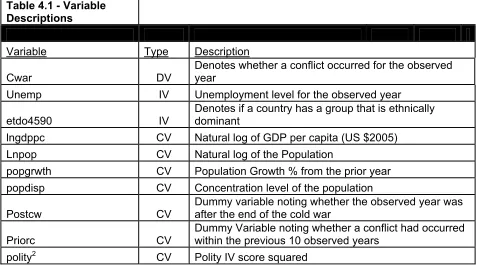
Table 4.1 - Variable Descriptions
Variable Type Description
Cwar DV
Denotes whether a conflict occurred for the observed year
Unemp IV Unemployment level for the observed year
etdo4590 IV Denotes if a country has a group that is ethnically dominant lngdppc CV Natural log of GDP per capita (US $2005)
Lnpop CV Natural log of the Population
popgrwth CV Population Growth % from the prior year popdisp CV Concentration level of the population
Postcw CV
Dummy variable noting whether the observed year was after the end of the cold war
Priorc CV
Dummy Variable noting whether a conflict had occurred within the previous 10 observed years
18
Regime Score2 (polity2): This variable comes from the Polity IV19 data set which
measures a state’s government on a scale from (-10) (completely autocratic) to (+10)
(completely democratic). Due to the variable’s expectation to produce a parabolic effect, the
variable is squared, giving a range from (0) to (100) in order to measure the linear effect of
regime type. The coefficient is expected to have a negative sign following regression analysis.
Chapter 5 -Statistical Analysis
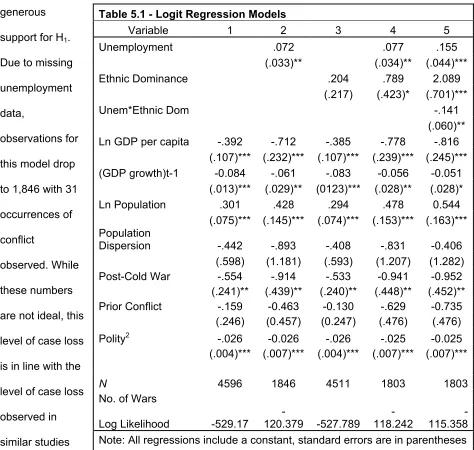
Following regression analysis, we are presented with the results in Table 5.1 below. In
the first regression model (column 1) we see the results from running a logit analysis against
only the control variables as a test to see if the coefficients hold to their predicted directions. It is
observed that the Ln of GDPpc, GDP Growtht-1, Population Dispersion, Post-Cold war, and the
Polity2 coefficients all show a negative effect as predicted and all of them except Population
dispersion come out as statistically significant. In addition, the coefficient for the Ln of
Population comes out positive as predicted and is statistically significant. The surprise of the
group is that the coefficient for Prior Conflict, which was predicted as having a positive sign,
comes out as having a negative sign but is shown as not being statistically significant. This is
possibly due to the fact that in all other prior studies, the time series analysis was done in 5 year
blocks whereas this study analyzes on an annual basis, giving considerably more observations
of the effect of prior conflict on conflict onset. The variables in this group allow for an initial 4,596
observations with 139 occurrences of conflict onset present.
In the second regression model (column 2) we see the results for the model designed to
test H1. Unemployment is added to the initial model run in column 1. The coefficients for the
control variables all hold to their same directional effects and Population Dispersion and Prior
Conflict continue to be statistically insignificant. The only variable which drops in its level of
19
significance is GDP growth in the prior period which drops from the 1% level to the 5% level
following the addition
of unemployment to the model. The coefficient for Unemployment, the variable of concern in
the model, shows a positive sign as predicted and is shown to be statistically significant at the
5% level, giving
generous
support for H1.
Due to missing
unemployment
data,
observations for
this model drop
to 1,846 with 31
occurrences of
conflict
observed. While
these numbers
are not ideal, this
level of case loss
is in line with the
level of case loss
observed in
similar studies
[image:28.612.72.546.193.643.2]discussed above
Table 5.1 - Logit Regression Models
Variable 1 2 3 4 5
Unemployment .072 .077 .155
(.033)** (.034)** (.044)***
Ethnic Dominance .204 .789 2.089
(.217) (.423)* (.701)***
Unem*Ethnic Dom -.141
(.060)**
Ln GDP per capita -.392 -.712 -.385 -.778 -.816 (.107)*** (.232)*** (.107)*** (.239)*** (.245)*** (GDP growth)t-1 -0.084 -.061 -.083 -0.056 -0.051
(.013)*** (.029)** (0123)*** (.028)** (.028)*
Ln Population .301 .428 .294 .478 0.544
(.075)*** (.145)*** (.074)*** (.153)*** (.163)*** Population
Dispersion -.442 -.893 -.408 -.831 -0.406
(.598) (1.181) (.593) (1.207) (1.282) Post-Cold War -.554 -.914 -.533 -0.941 -0.952
(.241)** (.439)** (.240)** (.448)** (.452)** Prior Conflict -.159 -0.463 -0.130 -.629 -0.735
(.246) (0.457) (0.247) (.476) (.476)
Polity2 -.026 -0.026 -.026 -.025 -0.025
(.004)*** (.007)*** (.004)*** (.007)*** (.007)***
N 4596 1846 4511 1803 1803
No. of Wars
20
and is still able to produce results that give an understanding of how unemployment is affecting
conflict onset.
In the final three models, the variable for
Ethnic Dominance is added to the logit regression. The third regression model (column 3)
displays the results for a model that drops unemployment and adds the variable for ethnic
dominance. Once again, the coefficients for the control variables carry the same signs as they
have in the prior two models and the significance for each remains the same as they did in the
first model. However, while the coefficient for ethnic dominance carries the predicted positive
sign, it does not show as statistically significant in this model. The variables in this model allow
for 4,511 observations with 139 occurrences of conflict onset. In the fourth regression model
(column 4) both Unemployment and Ethnic Dominance variables are added to the logit
regression in order to begin testing H2. Once again, the signs for the coefficients of the control
variables remain as they have for the prior three models and the significance levels for the
coefficients remain the same as they were in the second model. The coefficient for
Unemployment again shows a positive sign and remains statistically significant at the 5% level.
The coefficient for ethnic dominance is again positive and for the first time shows statistical
significance, for this model at the 10% level, indicating that any observed effect of ethnic
dominance on conflict onset is more than just random. This also lends positive support for H2.
Data limitations again drop the number of observations for this model to 1,803 with 31
occurrences of civil conflict onset present.
The final model combines all of the discussed variables in order to fully test H2, adding
the interacted variable of Unemployment & Ethnic Dominance to the fourth model. Once again,
the signs for the coefficients of the control variables remain as they have for the prior three
21
second model with the exception of GDP growth in the prior period. In this model, the
significance level drops to the 10% level. The coefficients for both Unemployment and Ethnic
Dominance once again show the predicted signs and both show significance at the 1% level.
However, while the coefficient for the interacted variable shows significance at the 5% level; its
sign is opposite that predicted by H2. This result is troubling as it indicates that while
unemployment is a significant explanatory variable for conflict onset when an ethnically
dominant population is not present, it has no affect when an ethnically dominant population is
present. The logit results indicate that when an ethnically dominant population is present, any
increase in unemployment is nullified by the interactive affect between unemployment and
ethnic dominance; ethnic dominance becomes the primary explanatory factor for conflict onset.
Despite limitations in the number of observations, statistical support is provided for H1
but support is not shown for H2. While the coefficient for Unemployment is shown as having the
predicted effect in models 2 & 5 and was statistically significant in both, the negative coefficient
for the interacted variable invalidates H2. However, the negative coefficient for the interacted
variable indicates the opposite for what is predicted in H2. The results of the final model indicate
that unemployment is still a highly significant factor for the onset of civil conflict, but in areas that
contain an ethnically dominant population its effect is nullified. In addition, the traditional
variables from past research of Ln GDP per capita, GDP per Capita growtht-1, Ln Population,
Post-Cold War, and Regime type all remained highly statistically significant and operated in the
directions previously predicted. One key point of interest is that Population Dispersion was not
statistically significant in any of the models whereas in prior studies20 it had shown statistical
significance up to the 1% level. A probable reason for this change from prior studies could be
due in part to the use of annual observations rather than observing five year blocks. On an
22
annual basis, Population dispersion levels change very little. This lack of change from year to
year is likely to have diminished the statistical effect of Population Dispersion on conflict onset.
In addition, by observing in five year blocks, if conflict occurs during a period, it is unclear
whether the change in population concentrations occurred prior to the conflict or after the onset
of the conflict.
Chapter 6 – Conclusion
This study focuses on the issue of civil conflict onset, asking what the effects of
unemployment are on the occurrence of civil conflict. It uses a similar research design to the
one employed by Collier & Hoeffler (2001; 2002a; Collier, Hoeffler & Sambanis 2005),
Sambanis 2001, and Fearon & Laitin, 2003. I challenge the theoretical assumptions proposed in
prior studies that attempt to separate the social and economic factors regarding the opportunity
for rebellion to occur. This study improves on previous research by applying a new variable,
unemployment. My results show that an increase in overall unemployment has a statistically
significant effect on the increase in the probability of civil conflict so long as an ethnically
dominant population is not present. In addition, this study expands on prior studies by analyzing
individual countries on an annual basis rather than looking at averaged data in five year blocks
as prior studies have21. By observing data in five year averaged blocks, it becomes questionable
as to what is driving the data. If the occurrence of conflict onset occurs within the first years of
the observed block, any changes in the data that are driving significance levels could be due to
the conflict itself. By observing annually, you are able to avoid issues of endogeneity and
instead observe the direct effects of the independent variables on the onset of civil conflict. The
only true downside to observing on an annual basis is that the data becomes more susceptible
23
to case loss due to missing data. This was a perceivable issue in this study as numerous
individual cases were dropped that would have remained in the analysis of a study utilizing five
year averaged blocks.
This study also shows that while unemployment remained a statistically significant factor
for conflict onset when coupled with ethnic dominance, it had a slightly diminished effect in
cases where an ethnically dominant population was present. This went counter to the theory
proposed by this paper that the presence of an ethnically dominant population should
compound the effect that unemployment has in increasing the likelihood for conflict onset. This
finding advances the study of the causes of ethnic and non-ethnic wars by suggesting that both
conflicts may have different causes; however, it indicates that the ethnic and non-ethnic conflicts
are intertwined.
Where does this leave us? This paper should only be the beginning of the focus on the
effects of unemployment on conflict onset. The data here provides a spring board for future
research regarding the effect of unemployment on civil conflict but needs to be expanded on
drastically. Holes in the data need to be filled and additional variables need to be added to the
regression models. A more complete set of data can considerably strengthen my findings. In
addition, in-depth case studies evaluating the issue of unemployment in cases of civil conflict
are necessary to expand our understanding at the micro-level. As is often the case with large-N
studies, macro level data may not always pan out when observed on a case by case basis.
Underlying and intervening factors may be causing the effects witnessed at the macro-level and
through the utilization of case studies, these factors can be uncovered. With this project I lay
24
References
Collier, Paul, and Anke Hoeffler. 2000. “Greed and Grievance in Civil War.” Mimeo, DECRG, World Bank, Washington, DC.
---. 2001. “Greed and Grievance in Civil War.” Policy Research Working Paper 2355, World Bank, Washington, DC.
---. 2002a. “Greed and Grievance in Civil War.” CSAE Working Papers, WPS 2002-01. http://www.economics.ox.ac.uk/CSAEadmin/workingpapers/pdfs/2002-01text.pdf.
---. 2002b. “On the Incidence of Civil War in Africa.” Journal of Conflict Resolution 46 (1): 13-28.
---. 2004a. “Greed and Grievance in Civil War.” Oxford Economic Papers 56: 563-595.
---. 2004b. “The Challenge of Reducing the Global Incidence of Civil War.” Copenhagen Consensus Challenge Paper, Oxford University.
Collier, Paul, Anke Hoeffler, and Nicholas Sambanis. 2005. “The Collier-Hoeffler Model of Civil War Onset and the Case Study Project Research Design.” In Understanding Civil War: Volume I & II. World Bank, Washington, DC.
Collier, Paul and Nicholas Sambanis. 2002. “Understanding Civil War.” Journal of Conflict Resolution 46 (1): 3-12.
Cramer, Christopher. 2003. “Does Inequality Cause Conflict?” Journal of International Development 15: 397-412.
Doyle, Michael and Nicholas Sambanis. 2000. “International Peace Building: A Theoretical and Quantitative Analysis.” American Political Science Review 94: 4.
Eisinger, Peter K. 1973. “The Conditions of Protest Behavior in American Cities.” American Political Science Review 67: 11-28.
Fearon, James D. 2005. “Civil War Since 1945: Some Facts and a Theory.” Working Paper. Stanford University.
Fearon, James D., and David D. Laitin. 2003. “Ethnicitiy, Insurgency, and Civil War.” American Political Science Review 97 (1): 75-90.
Gamson, William A. 1975. The Strategy of Social Protest. Homewood, IL: Dorsey.
25
---. 1999. “Kleptocracy and Revolutions.” Oxford Economic Papers 51: 267-83.
Gurr, Ted Robert. 1970. Why Men Rebel. Princeton: Princeton University Press.
Hardy, Melissa A. 1979. “Economic Growth, Distributional Inequality, and Political Conflict in Industrial Societies.” Journal of Political and Military Sociology 5: 209-27.
Harris, Richard and Robert Sollis. 2003. Applied Time Series Modelling and Forecasting. West Sussex, England: John Wiley & Sons.
Heston, Alan, Robert Summers and Bettina Aten, Penn World Table Version 6.3, Center for International Comparisons of Production, Income and Prices at the University of Pennsylvania, August 2009.
Hirshleifer, J. 1995. “Theorizing about Conflict.” In Handbook of Defense Economics, ed. K. Hartley and T. Sandler, Pg. 165-89. Volume I, Amsterdam: Elsevier Science.
---. 2001. The Dark Side of the Force: Economic Foundations of Conflict Theory. Cambridge, UK: Cambridge University Press.
Huntington, Samuel P. 1968. Political Order in Changing Societies. New Haven, CT: Yale University Press.
Jenkins, Joseph Craig and Charles Perrow. 1977. “Insurgency of the Powerless: Farm Worker Movements (1946-1972).” American Sociological Review 42: 249-268.
Kalyvas, Stathis N. 2006. The Logic of Violence in Civil War. Cambridge, New York: Cambridge University Press.
Korf, Benedikt. 2005. “Rethinking the Greed-Grievance Nexus: Property Rights and the Political Economy of War in Sri Lanka.” Journal of Peace Research 42 (2): 201-217.
Muller, Edward N. 1985. “Income Inequality, Regime Repressiveness, and Political Violence.” American Sociological Review 50: 47-61.
Nagel, Jack. 1974. “Inequality and Discontent: A Non-linear Hypothesis.” World Politics 26: 453-72.
Olson, Mancur. The Logic of Collective Action: Public Goods and the Theory of Groups. Harvard University Press.
Reynal-Querol, Marta. 2002. “Ethnicity, Political Systems, and Civil Wars.” Journal of Conflict Resolution 46: 29-54.
26
Sambanis, Nicholas. 2001. “Do Ethnic and Nonethnic Civil Wars Have the Same Causes?.” Journal of Conflict Resolution 45 (3): 259-282.
---. 2002. “A Review of Recent Advances and Future Directions in the Literature on Civil War.” Defense and Peace Economics 13 (2): 215-43.
---. 2004. “What is Civil War? Conceptual and Empirical Complexities of an Operational Definition.” Journal of Conflict Resolution 48 (6): 814-58.
Sigelman, Lee and Miles Simpson. 1977. “A Cross National Test of the Linkage Between Economic Inequality and Political Violence.” Journal of Conflict Resolution 21: 105-28.
Skocpol, Theda. 1979. States & Social Revolutions: A Comparative Analysis of France, Russia, and China. Cambridge, UK: Cambridge University Press.
Tilly, Charles. 1975. “Revolutions and Collective Violence.” Pg 483-555 in Fred I. Greenstein and Nelson W. Polsby (eds), Handbook of Political Science, Volume III. Reading, MA: Addison-Wesley.
---. 1978. From Mobilization to Revolution. Reading, MA: Addison-Wesley.
Tocqueville, Alexis de. [1835] 1961. Democracy in America, Volume II. New York: Schocken Books.