Open Access
Research article
Validation of a questionnaire measuring the regulation of
autonomic function
M Kröz
1, G Feder*
2, HB von Laue
3, R Zerm
1, M Reif
4, M Girke
1, H Matthes
1,
C Gutenbrunner
5and C Heckmann
6Address: 1Research Institute Havelhöhe (FIH) at the Havelhöhe Community Hospital, Berlin, Germany, 2Unit of academic primary health care,
Bristol University, Bristol, UK, 3Oncology Practice, Öschelbronn, Germany, 4Institute for Clinical Research, Berlin, Germany, 5Institute of
Balneology and Medical Climatology, Medical University Hannover, Hannover, Germany and 6Faculty of Human Medicine, University of Witten/
Herdecke, Witten, Germany
Email: M Kröz - [email protected]; G Feder* - [email protected]; HB von Laue - [email protected]; R Zerm - [email protected]; M Reif - [email protected]; M Girke - [email protected]; H Matthes - [email protected]; C Gutenbrunner - [email protected]; C Heckmann - [email protected]
* Corresponding author
Abstract
Background: To broaden the range of outcomes that we can measure for patients undergoing treatment for oncological and other chronic conditions, we aimed to validate a questionnaire measuring self-reported autonomic regulation (aR), i.e. to characterise a subject's autonomic functioning by questions on sleeping and waking, vertigo, morningness-eveningness, thermoregulation, perspiration, bowel movements and digestion.
Methods: We administered the questionnaire to 440 participants (♀: N = 316, ♂: N = 124): 95 patients with breast cancer, 49 with colorectal cancer, 60 with diabetes mellitus, 39 with coronary heart disease, 28 with rheumatological conditions, 32 with Hashimoto's disease, 22 with multiple morbidities and 115 healthy people. We administered the questionnaire a second time to 50.2% of the participants. External convergence criteria included the German version of the Hospital Anxiety and Depression Scale (HADS-D), a short questionnaire on morningness-eveningness, the Herdecke Quality of Life Questionnaire (HLQ) and a short version questionnaire on self-regulation.
Results: A principal component analysis yielded a three dimensional 18-item inventory of aR. The subscales orthostatic-circulatory, rest/activity and digestive regulation had internal consistency (Cronbach-α: rα = 0.65 – 0.75) and test-retest reliability (rrt = 0.70 – 85). AR was negatively associated with anxiety, depression, and dysmenorrhoea but positively correlated to HLQ, self-regulation and in part to morningness (except digestive aR) (0.49 – 0.13, all p < 0.05).
Conclusion: An internal validation of the long-version scale of aR yielded consistent relationships with health versus illness, quality of life and personality. Further studies are required to clarify the issues of external validity, clinical and physiological relevance.
Published: 5 June 2008
BMC Complementary and Alternative Medicine 2008, 8:26 doi:10.1186/1472-6882-8-26
Received: 12 November 2007 Accepted: 5 June 2008
This article is available from: http://www.biomedcentral.com/1472-6882/8/26
© 2008 Kröz et al; licensee BioMed Central Ltd.
Background
The importance of quality of life research in relation to health care evaluation is now well established. General inventories of health-related quality of life (HRQL) have established that patients with psychosomatic symptoms can have greater impairments of HRQL and daily func-tioning, than severely ill patients suffering from chronic physical conditions [1,2]. Smith and colleagues' meta-analysis of 12 studies [3] measuring the relationship of physical, mental and social factors and global quality of life found that HRQL was more strongly associated with mental than with physical health status. Therefore general HRQL scales potentially underestimate physical func-tional loss in chronically ill people [3]. Disease specific HRQL-questionnaires are more sensitive instruments for specific condition, but outcomes cannot be compared across conditions. We aimed to develop a questionnaire that measures physical symptoms related to autonomic function across a range of chronic conditions and that was sensitive enough to capture both somatic functions and somatic functional loss [4]. Physiologically measured cir-cadian rhythm markers have been shown to be relevant for recording health [5] and illness [6]. In the case of hypertension in diabetic patients, nocturnal non-dipping correlated with increased mortality rates [7]. Reduced heart rate variability (HRV) is a risk factor for increased mortality in various chronic conditions illnesses includ-ing diabetes and coronary heart disease [8]. A loss of noc-turnal cardio-respiratory coordination was seen in patients with diabetes mellitus (types 1 and 2) and with breast cancer, where the grade of loss was dependent on the severity of the illness [9]. It was also shown that the rest/activity rhythm was relevant in the prognosis for metastasised colorectal cancer [10]. Affective and auto-nomic disorders have been reported in manifest and latent hypothyroidism [11].
To establish a systematic method of measuring chrono-biological and autonomic function, we have developed an inventory of self reported measures of autonomic regula-tion. It includes questions pertaining to autonomic func-tions such as rest/activity rhythms, vertigo, orthostatic regulation, heat regulation, metabolism and digestion; additional questions on activity aim to record self-reported sleep duration and quality, as well as day-time functioning which could reflect the rest/activity rhythm [12]. We define autonomic regulation (aR) as the state of regulation of different autonomic functions in the rhyth-mic change of rest and activity. aR is influenced by consti-tution, gender, age and disease and in healthy people, aR is a relatively stable trait. Acute illness and chronic condi-tions can lead to reduced aR, this is called loss of regula-tion [13]. The potential relevance of these autonomic functions as determinants of health and illness was first articulated by Rudolf Steiner in the 1920s [14]. He
formu-lated questions about autonomic functions reflecting his concept of strong or weak regulation of physical and func-tional systems through spiritual strength, the so-called ego-organization [14].
The relation between aR and health and personality mark-ers can also be demonstrated, which supported Steiner's idea that a strong regulation has an impact on health and on personality markers [14,15]. High aR reflects an equil-ibrated functioning of autonomic nervous system and with low aR indicating the converse situation [12]. In a cross-sectional study conducted from 2000 to 2001 with the short version questionnaire, we have shown that peo-ple with a range of chronic physical condition have a poor aR [13].
The variation between individuals in autonomic tone (from predominant vagotonia to sympathicotonia) is one of the most elaborated and physiologically applicable modern approaches to constitution [16]. Psychometri-cally measured autonomic regulation shows clear concep-tual convergence to and correlation with physiological measurements of autonomic tone [17]. Moreover, consti-tution is an important component in some complemen-tary medicine treatment models. In the context of anthroposophical medicine or homeopathy, constitution is central to diagnostic and treatment decisions [15,18,19]. For example calcium carbonicum can be used in the treatment of night-sweats but it also represents a constitutional type [19]. Yet we do not know if the remedy reduces night-sweats more effectively in patients with the calcium carbonicum constitution type. This type of empir-ical question requires valid and reliable measures of auto-nomic function.
Initial versions of the questionnaires testing autonomic regulation did not perform well psychometrically [18,20]. We then developed a 12 item autonomic regulation (aR) short version which had satisfactory reliability and valid-ity [12] This version was then tested in a new sample of 408 patients with a range of medical conditions. [13] We now report the further development and re-validation of a longer (18-item) version of the aR scale which includes questions of digestive regulation with the responses of the same 408 patients in the previous analysis and an addi-tional 32 patients with treated hypothyroidism. We aimed to validate the German version of this longer aR question-naire and test it further with a principal component anal-ysis.
Methods
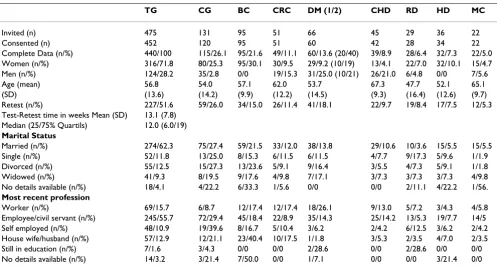
the Wuppertal Endocrinology Practice. The participants of the study consisted of healthy volunteers and seven groups of patients. The latter were recruited consecutively among inpatients (Havelhöhe) and among outpatient consultations in the other two study centres. The condi-tions were: (1) histologically proven breast cancer and (2) colorectal cancer; (3) diabetes mellitus (types 1 and 2); (4) angiographically confirmed coronary artery disease (CAD); (5) clinically and immunologically confirmed rheumatological conditions (12 connective tissue disease, 11 rheumatoid arthritis, three spondylarthrosis, one pol-yarteritis nodosa, one polymyalgia rheumatica); (6) sono-graphically and immunologically confirmed (positive TPO-Ak) Hashimoto's Disease (26 (substituted) with euthyreosis and 6 with subclinical hypothyreosis) (table 1); and (7) patients with multiple conditions either with two of the study conditions (1 to 6) or one of the chronic study conditions with an additional cancer. We included these conditions to test construct validity based on hypotheses concerning aR for each condition: lowest aR was hypothesised for patients with multiple conditions, reduced aR was hypothesised in breast cancer, diabetes, and the two auto-immune diseases and no reduction in aR was hypothesised for CAD and colorectal cancer. For a detailed socio-demographic description of the sample see table 1. If a patient with an initial diagnosis of diabetes mellitus had a coronary event or new diagnosis of CAD,
they were still analysed in the diabetes group. For all other cases of new co-morbidity, the patients were analysed in the multiple conditions group. The control group was recruited from the Havelhöhe Hospital staff and their rel-atives. 131 persons have been asked consecutively, 11 refused participation, after excluding relevant diseases the questionnaire was filled out by 115 persons. Exclusion cri-teria were: other severe organic conditions (with the exception of the multiple conditions group), manifest psychosis (because of potential insufficient compliance), severe immobilisation or a Karnofsky index <50%, uncon-trolled pain, recent operations (<1 week prior to study recruitment) or recent chemotherapy or radiotherapy (<3 weeks prior to recruitment) to avoid the potential con-founding of adverse effects of treatment and for a more robust test-retest analysis. All participants gave their writ-ten informed consent. We were not required to seek for-mal ethics approval for this study by our institution, although it fulfilled contemporary ethical standards for psychometric studies.
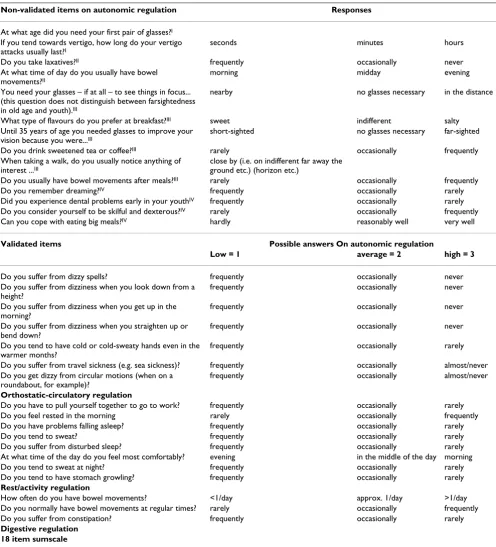
[image:3.612.57.554.98.367.2]The study we report here includes recapitulation of the development process in order to integrate questions about gastrointestinal function. We included 32 questions at the start of the process including the 12 in the shorter aR ver-sion [12] and 20 articulated (table 2) by a panel of seven experts: 5 doctors (a gastroenterologist, two internists, a Table 1: Sociodemographic data of the study groups including participation refusion and exclusion rate
TG CG BC CRC DM (1/2) CHD RD HD MC
Invited (n) 475 131 95 51 66 45 29 36 22
Consented (n) 452 120 95 51 60 42 28 34 22
Complete Data (n/%) 440/100 115/26.1 95/21.6 49/11.1 60/13.6 (20/40) 39/8.9 28/6.4 32/7.3 22/5.0
Women (n/%) 316/71.8 80/25.3 95/30.1 30/9.5 29/9.2 (10/19) 13/4.1 22/7.0 32/10.1 15/4.7
Men (n/%) 124/28.2 35/2.8 0/0 19/15.3 31/25.0 (10/21) 26/21.0 6/4.8 0/0 7/5.6
Age (mean) 56.8 54.0 57.1 62.0 53.7 67.3 47.7 52.1 65.1
(SD) (13.6) (14.2) (9.9) (12.2) (14.5) (9.3) (16.4) (12.6) (9.7)
Retest (n/%) 227/51.6 59/26.0 34/15.0 26/11.4 41/18.1 22/9.7 19/8.4 17/7.5 12/5.3
Test-Retest time in weeks Mean (SD) 13.1 (7.8)
Median (25/75% Quartils) 12.0 (6.0/19)
Marital Status
Married (n/%) 274/62.3 75/27.4 59/21.5 33/12.0 38/13.8 29/10.6 10/3.6 15/5.5 15/5.5
Single (n/%) 52/11.8 13/25.0 8/15.3 6/11.5 6/11.5 4/7.7 9/17.3 5/9.6 1/1.9
Divorced (n/%) 55/12.5 15/27.3 13/23.6 5/9.1 9/16.4 3/5.5 4/7.3 5/9.1 1/1.8
Widowed (n/%) 41/9.3 8/19.5 9/17.6 4/9.8 7/17.1 3/7.3 3/7.3 3/7.3 4/9.8
No details available (n/%) 18/4.1 4/22.2 6/33.3 1/5.6 0/0 0/0 2/11.1 4/22.2 1/56.
Most recent profession
Worker (n/%) 69/15.7 6/8.7 12/17.4 12/17.4 18/26.1 9/13.0 5/7.2 3/4.3 4/5.8
Employee/civil servant (n/%) 245/55.7 72/29.4 45/18.4 22/8.9 35/14.3 25/14.2 13/5.3 19/7.7 14/5
Self employed (n/%) 48/10.9 19/39.6 8/16.7 5/10.4 3/6.2 2/4.2 6/12.5 3/6.2 2/4.2
House wife/husband (n/%) 57/12.9 12/21.1 23/40.4 10/17.5 1/1.8 3/5.3 2/3.5 4/7.0 2/3.5
Still in education (n/%) 7/1.6 3/4.3 0/0 0/0 2/28.6 0/0 2/28.6 0/0 0/0
No details available (n/%) 14/3.2 3/21.4 7/50.0 0/0 1/7.1 0/0 0/0 3/21.4 0/0
Table 2: Diagram of the 32 items of the analysis process with symbols (I-IV) indicating the point of exclusion
Non-validated items on autonomic regulation Responses
At what age did you need your first pair of glasses?I
If you tend towards vertigo, how long do your vertigo attacks usually last?I
seconds minutes hours
Do you take laxatives?II frequently occasionally never
At what time of day do you usually have bowel
movements?II
morning midday evening
You need your glasses – if at all – to see things in focus... (this question does not distinguish between farsightedness in old age and youth).III
nearby no glasses necessary in the distance
What type of flavours do you prefer at breakfast?III sweet indifferent salty
Until 35 years of age you needed glasses to improve your vision because you were...III
short-sighted no glasses necessary far-sighted
Do you drink sweetened tea or coffee?III rarely occasionally frequently
When taking a walk, do you usually notice anything of interest ...III
close by (i.e. on indifferent far away the ground etc.) (horizon etc.)
Do you usually have bowel movements after meals?III rarely occasionally frequently
Do you remember dreaming?IV frequently occasionally rarely
Did you experience dental problems early in your youthIV frequently occasionally rarely
Do you consider yourself to be skilful and dexterous?IV rarely occasionally frequently
Can you cope with eating big meals?IV hardly reasonably well very well
Validated items Possible answers On autonomic regulation
Low = 1 average = 2 high = 3
Do you suffer from dizzy spells? frequently occasionally never
Do you suffer from dizziness when you look down from a height?
frequently occasionally never
Do you suffer from dizziness when you get up in the morning?
frequently occasionally never
Do you suffer from dizziness when you straighten up or bend down?
frequently occasionally never
Do you tend to have cold or cold-sweaty hands even in the warmer months?
frequently occasionally rarely
Do you suffer from travel sickness (e.g. sea sickness)? frequently occasionally almost/never
Do you get dizzy from circular motions (when on a roundabout, for example)?
frequently occasionally almost/never
Orthostatic-circulatory regulation
Do you have to pull yourself together to go to work? frequently occasionally rarely
Do you feel rested in the morning rarely occasionally frequently
Do you have problems falling asleep? frequently occasionally rarely
Do you tend to sweat? frequently occasionally rarely
Do you suffer from disturbed sleep? frequently occasionally rarely
At what time of the day do you feel most comfortably? evening in the middle of the day morning
Do you tend to sweat at night? frequently occasionally rarely
Do you tend to have stomach growling? frequently occasionally rarely
Rest/activity regulation
How often do you have bowel movements? <1/day approx. 1/day >1/day
Do you normally have bowel movements at regular times? rarely occasionally frequently
Do you suffer from constipation? frequently occasionally rarely
Digestive regulation 18 item sumscale
(I plausibility items, II answer boxes below 5% or more than 75%, III insufficient item-total/Cronbach-α, IV insufficient factor loading). 18 validated
diabetologist, an endocrinologist and a specialist in oncology), a statistician and a psychometrician. We then performed reliability and factor analyses. (table 2).
Convergence criteria
1) Marburg short questionnaire on chronotypology (MQC) (table 3 I) consists of 5 items relating to morning-ness/eveningness and is an extraction of the Horne-Ösberg Questionnaire [21] with a four or five Likert scale and a range of 4 – 24. High rating means morningness and low rating points out eveningness. It's reliability and validity are adequate: Cronbach-alpha = 0.73, test-retest reliability = 0.78) [22,23] and it is a pragmatic, short measure for characterising an individual's chronotypol-ogy.
2) The German version of the Hospital Anxiety and Depression Scale (HADS-D) consists of 14 items (7 for anxiety and 7 for depression) on which people rate on a four-point Likert scale (0–21 both). Higher scoring indi-cate more symptoms, ≥ 11 points anxiety or depression are probable, ≥ 8 – 10 possible cases, <7 no cases. The HADS is highly reliable and valid and is an extensively used scale in family medicine and internal medicine research and audit [24,25].
3) The Grossarth-Maticek short questionnaire on self-reg-ulation is a scale with 16 items for measuring self-regula-tion and health-building activity with a six-point-Likert scale. The 16 items are summed and divided by 16 to obtain a total score. A higher score indicates better self-regulation. The validity and reliability of the question-naire are good: Cronbach-alpha = 0.80 and test-retest reli-ability = 0.82). We used this scale because of it's conceptual congruence with aspects of autonomic regula-tion. [26].
[image:5.612.58.559.569.728.2]4) The Herdecke Quality of Life Questionnaire (HLQ) is a HRQL questionnaire with 35 items in 6 subscales (physi-cal problems, digestive wellbeing, motility, mental bal-ance, social interaction) showing good validity and reliability in large German samples. Answers are struc-tured in a five-point-Likert scale which are transformed to percent values between 0 and 100% (best possible HRQL) [27]. We administered it as one would expect convergence between aR and HQRL. Questions on autonomic state, heat sensitivity, general constitution, current and past ill-nesses, medication were collected by questionnaire (table 3 II) and semi-standardised interviews [12].
Table 3: Marburg short questionnaire on chronotypology and items on the autonomic nervous system
(I) Marburg short questionnaire on chronotypology Possible answers
At what time would you like to get up in the morning? before 6.20 hrs, 6.20 hrs – 7.45 hrs, 7.45 hrs – 9.50 hrs, 9.50 hrs – 10.50 hrs, after
10.50 hrs
How difficult is it for you to get up in the morning? not difficult rarely difficult not easy very difficult
In the last 14 days, how often did you go to bed late without reason and ended up feeling that you hadn't really slept long enough?
never once 2–3 times frequently
At what time in the evening do you usually feel tired and find it necessary to go to bed?
before 20.50 hrs, 20.50 hrs – 22.10 hrs, 22.10 hrs – 0.50 hrs, 0.50 hrs – 2.00 hrs, after 2.00 hrs
You will have heard of the so called "morning people", who feel at their best in the morning and „evening people", who feel at their best in the evening- which of these groups would you consider yourself to belong to?
definitely a morning person, more a morning than an evening person, more an evening person than a morning person, definitely an evening person
(II) Questions on autonomic function, heat sensitivity, general constitution, illnesses and symptoms
Possible answers
Do you tend to sweat through your head and extremities even in the colder months?
frequently occasionally rarely
Do you tend to feel cold and to shiver? frequently occasionally rarely
In the last few years, have you reacted to common colds with a temperature over 38°?
frequently occasionally rarely
Do you generally tend to feel quite low? frequently occasionally rarely
Do you have any allergies? yes no
Which childhood illnesses did you have? measles, scarlet fever, whooping cough, rubella, mumps, chicken-pox
How many days was your average menstrual cycle? a) between the ages of 21–30 : b) at present:
over 28 days ca. 28 days under 28 days
How strong are/were your period pains? a) between the ages of 21–30: b) at present:
little pain average pain strong pain with hours spent in bed
Acceptability criteria
Our criterion for acceptability of a questionnaire item was that 95% or more of participants had to complete it. Items were also dropped if less than 5% or more than 75% of participants scored one. Finally, all items with item-total-correlations less than 0.10 and greater than 0.70 were excluded.
Principal component analysis
A principal component analysis (rotation: varimax with Kaiser normalisation) was conducted with data from all participants on the acceptable items, with an optimality assessment of the two-, three-, four- and five-factor model, respectively, at a minimum factor load of r = 0.35. Only items that loaded on a factor remained in the scale.
Internal consistency, reliability and convergence validity analyses
For both the total score and the resulting subscales, inter-nal consistency was assessed with the Cronbach-α coeffi-cient [28]; test-retest-reliability and pair-wise correlations between the subscales were assessed with Spearman rank correlations. We measured convergence validity (instru-ments measuring aspects hypothetically influencing aR) with Spearman rank correlations [29].
Discriminant validity
We based analysis of discriminant validity on differences between each of the chronic condition groups and the healthy group with gender as a fixed factor and age as a continuous covariate, estimating each parameter's influ-ence on the total aR-score and each of its subscales. We adjusted the p-values and confidence intervals of the seven resulting pair-wise comparisons, controlling for the aR-score, for multiple-testing with the Dunnett adjust-ment in order to keep the aR-scale-wise alpha error on a global level of 5%.
All analyses were performed with SPSS 13.0 and SAS 9.1.3 statistical packages.
Results
We invited 475 people to participate in our study; 452 consented (95%) and we had complete data on 440 par-ticipants (93%). Parpar-ticipants consisted of a healthy con-trol group (n = 115) and seven patient groups (n = 325) (table 1). The average age of participants was 56.8 years (SD = 13.6), with ages ranging from 18–85 years. 227 par-ticipants (51.6%) were re-tested when they re-attended an outpatients clinic or were re-admitted two weeks to six months after the initial questionnaire administration (table 1). The second test was carried out after a median of 12.0 weeks (table 1).
Item acceptance and selection
The item acceptance was ≥ 95% for all items with the exception of "length of vertigo attack" (27.4%). From the initial 32 items (table 2) two items (having glasses and length of vertigo attack) were used as plausibility items and not as items for reliability analysis (table 2: I), two items in the completed answer boxes were below 5% and were consequently excluded (table 2: II): "laxative taken" (frequency = 3.1%) and "when do you have bowel move-ment?" (evening = 4.4%). Due to insufficient item-total correlation and because of an improved Cronbach-α when the item was excluded six items (table 2: III) were dropped from the questionnaire. In this first step 22 items were pre-selected.
Principal component analysis
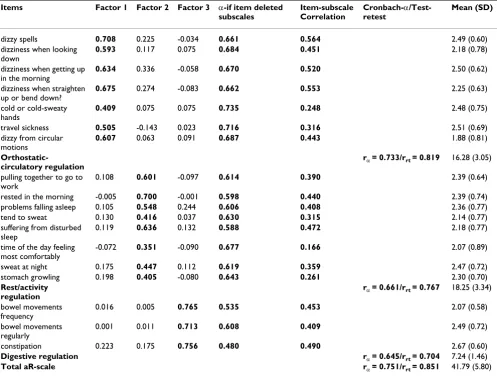
On the basis of these 22 items, we performed a principal component analysis. A four-principal-component model (seven, four, three and three items, respectively) fulfilled the Kaiser criterion [30] and showed an unambiguous model of an orthostatic-circulatory, digestive and a split component of sleep and daily regulation. The most con-vincing model was the one with three unambiguous com-ponents (table 4) as this model represented the most combination of items with highest face validity, and because only the eigenvalues of these three factors were larger than those of equivalent null models (with only random associations) which were generated for compari-son by a Monte-Carlo simulation. The last four eliminated items see table 2: IV. Therefore, we chose an 18-item total score with three subscales as the most appropriate repre-sentation of the data Factor 1 (orthostatic-circulatory reg-ulation) explains 10.2%, factor 2 (rest/activity regreg-ulation) explains 8.2% and factor 3 (digestive regulation) explains 5.9% of total variance.
Reliability
All 18 items were checked for total score, seven items for the subscales orthostatic-circulatory, eight items for rest/ activity- and three items for digestive regulation: The Cronbach-α coefficients varied between 0.75 – 0.65, item-subscales correlation rtr = 0.57 – 0.17 and test-retest relia-bility rrt = 0.85 – 0.70 (table 4)
Convergence validity
morningness (with the exception of no correlation between the digestive aR-scale and MQC (r = 0.41 – 0.13, all other p < 0.05). High aR-scores were associated with thermoregulation, with the exception of the digestive reg-ulation subscale: less perspiration and less feelings of cold (r = 0.33 – 0.15) (both p < 0.05). (all convergence corre-lations see in table 5)
Discriminant validity
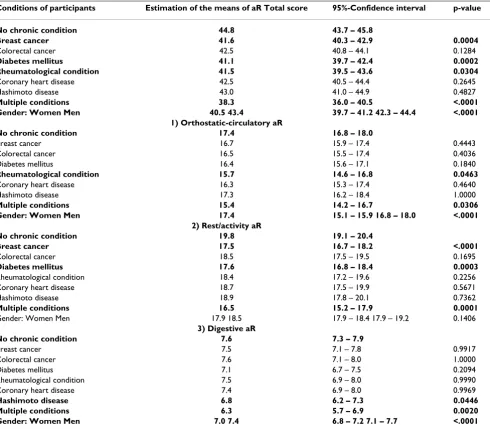
Participants in the healthy control group consistently had the highest aR-score; participants with breast cancer, dia-betes (both in sum- and subscale 2), rheumatological con-ditions (sum- and subscale 1) and Hashimoto disease (subscale 3) had a reduced aR-score and the multiple con-ditions group the lowest aR-score in all scales. Men showed a higher aR-score than women (table 6, 7). Over-all 92.2% of participants with chronic conditions show a
loss of autonomic regulation and 30.2% of the healthy group, which may be a constitutional problem.
Discussion
[image:7.612.58.555.120.496.2]We developed a reliable and valid instrument for charac-terising autonomic regulation with 18 items [29]. As the questions on the various autonomic functions are heter-ogenous, we conducted a factor analysis and detected the underlying subscales with satisfactory internal consist-ency: sleep rhythm and daily functioning (rest/activity), orthostatic-circulatory and digestive regulation. In this re-analysis we integrated in the scale items with a clear rela-tionship to the autonomic nervous system and that showed a clear loading pattern. Items such as dental health, dreaming, being skilful, and flavour preference did not load. To highlight the relationship of the items to underlying physiological function, we changed the name Table 4: List of the 18 items on autonomic regulation with the relevant factor loading (r>0.35 in bold and minor co-loading in standard letters), α-if item deleted, item-subscale correlation, internal consistency (Cronbachs-α) and test-retest reliability, mean of items and subscales with standard deviation (SD)
Items Factor 1 Factor 2 Factor 3 α-if item deleted
subscales
Item-subscale Correlation
Cronbach-α /Test-retest
Mean (SD)
dizzy spells 0.708 0.225 -0.034 0.661 0.564 2.49 (0.60)
dizziness when looking down
0.593 0.117 0.075 0.684 0.451 2.18 (0.78)
dizziness when getting up in the morning
0.634 0.336 -0.058 0.670 0.520 2.50 (0.62)
dizziness when straighten up or bend down?
0.675 0.274 -0.083 0.662 0.553 2.25 (0.63)
cold or cold-sweaty hands
0.409 0.075 0.075 0.735 0.248 2.48 (0.75)
travel sickness 0.505 -0.143 0.023 0.716 0.316 2.51 (0.69)
dizzy from circular motions
0.607 0.063 0.091 0.687 0.443 1.88 (0.81)
Orthostatic-circulatory regulation
rα= 0.733/rrt = 0.819 16.28 (3.05)
pulling together to go to work
0.108 0.601 -0.097 0.614 0.390 2.39 (0.64)
rested in the morning -0.005 0.700 -0.001 0.598 0.440 2.39 (0.74)
problems falling asleep 0.105 0.548 0.244 0.606 0.408 2.36 (0.77)
tend to sweat 0.130 0.416 0.037 0.630 0.315 2.14 (0.77)
suffering from disturbed sleep
0.119 0.636 0.132 0.588 0.472 2.18 (0.77)
time of the day feeling most comfortably
-0.072 0.351 -0.090 0.677 0.166 2.07 (0.89)
sweat at night 0.175 0.447 0.112 0.619 0.359 2.47 (0.72)
stomach growling 0.198 0.405 -0.080 0.643 0.261 2.30 (0.70)
Rest/activity regulation
rα= 0.661/rrt = 0.767 18.25 (3.34)
bowel movements frequency
0.016 0.005 0.765 0.535 0.453 2.07 (0.58)
bowel movements regularly
0.001 0.011 0.713 0.608 0.409 2.49 (0.72)
constipation 0.223 0.175 0.756 0.480 0.490 2.67 (0.60)
Digestive regulation rα= 0.645/rrt = 0.704 7.24 (1.46)
Total aR-scale rα= 0.751/rrt = 0.851 41.79 (5.80)
of the inventory from "endogenous" to autonomic regula-tion.
All items show an unambiguous factor loading pattern in the whole sample (table 4) and in patients with chronic conditions. In the healthy group the factor model is more ambiguous. This could be related to the smaller number of symptoms in people without chronic conditions and the potential greater effect of factors operating as traits. The digestive regulation subscale has low correlation with the other both subscales, which reflects the relative heter-ogeneity of the different autonomic functions that are integrated in the whole inventory. This does not invali-date the total score and potentially increases the utility of the subscales in different clinical conditions. Most HRQL scales report the global scores and the scores for sub-scales.
Overall, we can conclude that the long version aR scale not only has increased content and face validity but improved reliability (table 4). The test-retest reliability is satisfactory to good, in spite of the heterogeneity and long test-retest interval (13.1 weeks). The test-retest reliability is consistent with the concept of character traits, although this would need to be confirmed with a repeated measures analysis over a longer period of time. Discriminant valid-ity show significant differences (3.2 to 6.5 in total- and subscales) between healthy people and those with chronic conditions. These absolute differences correspond to 9 – 18% relative differences, which is likely to be meaningful clinically [31]. The utility of a scale cannot be based on its psychometric properties alone. We agree with Hyland that
although a "scale should satisfy certain minimum criteria (satisfying Cronbach-α and test-retest-reliability and vali-dating criteria), they do not form an essential part of choosing between scales. The best way to select...is exam-ine the items of the scale carefully, and judge to what extent the set of items...matches the requirements of the research" [32]. Below we discuss the sub-scales of the questionnaire.
1) Orthostatic-circulatory regulation
[image:8.612.56.551.100.327.2]Previous research has shown that "dizziness on rising", "dizziness on bending over" and "dizziness on looking down," (classed as orthostatic vertigo) are correlated [12] to "dizzy from circular motions" and to low levels of aR [12] in patients with physical illnesses. We confirmed this interaction in this analysis and can also apply this range of symptoms to travel sickness and "dizzy from circular motions" (table 4). Orthostatic intolerance has been observed in young women with high sympathetic drive and relative instability of their autonomic nervous system [33], but also in people with diabetes mellitus, breast can-cer and coronary artery disease [34], auto-immune disor-ders (including rheumatological conditions) and chronic fatigue syndrome [35]. The correlation between "cold extremities" (stimulated α-adrenoreceptors) with high sympathetic drive [12,36] and questions on vertigo and dizziness are weak and could be regarded as signs of malaise or loss of regulation in illness. People with multi-ple and rheumatological conditions have the lowest score on this subscale. Tolerance of cold is moderately associ-ated with and less perspiration is weakly associassoci-ated with high-level orthostatic-circulatory regulation, which could Table 5: List of Spearman correlations between the aR sum- and subscales and the convergence criteria
AR- sumscale orthostatic-circulatory regulation rest/activity regulation digestive regulation
AR -sumscale
orthostatic- circulatory regulation 0.781
rest/activity regulation 0.810 0.373
digestive regulation 0.375 0.150 0.120
A-HADS 0.495 0.341 0.486 0.133
D-HADS 0.349 0.212 0.368 0.127
Self- regulation 0.346 0.236 0.332 0.142
MQC 0.306 0.132 0.403 0.020
HLQ-Physical Complaint 0.399 0.244 0.368 0.204
HLQ-Digestive Wellbeing 0.356 0.267 0.315 0.191
HLQ-Motility 0.400 0.250 0.379 0.187
HLQ-Mental Balance 0.518 0.316 0.527 0.180
HLQ-Social Interaction 0.391 0.279 0.383 0.146
HLQ-Initiative Power 0.373 0.227 0.366 0.192
General feeling 0.358 0.239 0.367 0.140
Less Allergies 0.184 0.159 0.151 -0.012
Less Dysmenorrhoea 0.325 0.280 0.262 0.195
Less Perspiration 0.277 0.156 0.330 0.010
Less Feeling Cold 0.247 0.307 0.153 0.013
be linked with the thermo-regulatory threshold level between perspiration and vasoconstriction. These func-tions are dependent on circadian rhythm and also on vig-ilance, personality and gender [37].
2) Rest/activity regulation
The variables "difficulties falling asleep", "disturbed sleep", "having had a good sleep" and "having to pull oneself together to do something" had a wide range of inter-item-correlation (r = 0.16 to 0.56) and item-total-correlation, consistent with variation found in other stud-ies of psychometric measures and sleep monitoring [38,39]. The interaction between physical activity, ability, "having to pull oneself together" and sleep quality ("being rested") and its relationship to circadian well-being ("morningness") has also been reported by other investigators [40,41] as has its relationship with perspira-tion [12,36]. The physiological mechanism of the interac-tion of "stomach growling" to rest/activity is unclear, but a raised low frequency (LF) power when awake and low-ered high frequency (HF) power during non-REM-sleep have been observed and point towards complex auto-nomic dysfunction in functional digestive disorders [42]. The reduced aR total score of the breast cancer group is partly determined by reduced rest/activity regulation and could therefore reflect the patients' cancer related fatigue (CRF) which affects more than 70% of these patients dur-ing chemotherapy and 34% of the patients up to ten years after remission [43]. With different CRF inventories mod-erate to high correlation with aR has been documented and the association between poor rest/activity regulation to CRF has face validity [44]. The reason why the aR scale did not have discriminant validity for colorectal cancer patients may be because the conventional chemotherapy regimes for colorectal cancer in 2000–2001 (5-Fluoru-racil/leucovorine) had fewer adverse effects than for breast cancer, with a CRF-prevalence range from 5 to 20% [45]. In the diabetes group the reduced rest/activity regulation could be related to sleep apnoea and restless legs syn-dromes (RLS) which occur in about 36% and 27% respec-tively in type 2 diabetes [46,47]; sleep disturbances are also elevated in diabetes mellitus type 1 [48].
3) Digestive regulation
Our study is the first to integrate questions on gastrointes-tinal symptoms into a measure of aR. Migrating motor-complexes are determinants of gastrointestinal function-ing. They are dependent on circadian rhythms, with a postprandial pattern maximum at breakfast time [49] with variation between individuals. [50]. This may account for the unreliability of questions about bowel movements at specific times of day. The association between functional bowel disorders and reduced heart rate variability [42] and the influence of light on gut elec-trophysiological function [51] is a potential area for fur-ther investigation of digestive disorders. Reduced digestive regulation in the multiple conditions group is related to the global loss of regulation in these patients. The loss of digestive aR in those patients with Hashim-oto's disease could be due to 6 patients with sub-clinical (untreated) hypothyroidism.
Patients with cancer have high levels of anxiety and depression and these may have an adverse effect on HRQL and survival [52]. Depression and anxiety is also more prevalent in people with diabetes mellitus [53,54] and heart disease, and can worsen prognosis in the latter con-dition [55,56]. Higher self regulation in patients with can-cer or coronary heart disease is associated with improved prognosis [26,55]. It is possible that improved autonomic regulation is a potential mediator through its association with reduced anxiety, depression and self-regulation.
[image:9.612.54.553.103.190.2]The moderate correlation of aR to all HRQL dimensions of the HLQ is consistent with a recent study by Mormont & Waterhouse [56] who reported a correlation between a disturbed circadian rhythm with fatigue during the day (r = 0.37) and global HRQL (r = 0.34). We consider that the strong correlation between aR and mental balance, physi-cal complaints and gastrointestinal motility supports our conceptualisation of aR and strengthens the case for meas-uring it. The relationship between high level aR and morningness seen in earlier studies was confirmed [12]. Otsuka has shown that an earlier acrophase of systolic and diastolic blood pressure is accompanied by positive mood and more balanced diet [57]. This in turn concurs with our concept that morningness can be viewed as a marker Table 6: Raw-data means and SD separated for gender and age classes with sum-scale and subscales.
Gender Age classes N aR 18 Mean/SD Orthostatic-circulatory
regulation Mean/SD
rest/activity regulation Mean/SD
Digestive regulation Mean/SD
Women 316 41.0/5.8 15.7/3.1 17.9/3.3 7.1/1.5
Men 124 43.8/5.2 17.4/2.9 18.7/3.4 7.3/1.4
lower third (18–40) 59 41.3/4.6 15.9/3.0 18.3/2.8 7.1/1.3
middle third (41–62) 230 41.5/6.1 16.1/3.1 17.8/3.5 7.3/1.4
of health and well-being [12] and excessive eveningness (phase delay syndrome) is associated with breast cancer [58] and shows higher prevalence in sleep and psychiatric disorders such as seasonal affective disorder, depression and alcoholic consumption [59-61].
High aR scores are correlated with cardio-respiratory coor-dination [12] and a loss of aR has been shown in patients with chronic medical conditions in the short-version questionnaire [13].
A limitation of our study was that validation of the scale was confined to other inventories of self-reported symp-toms. Polysomnography and actimeter-based studies are
[image:10.612.63.553.110.539.2]required to investigate the physiological correlates of the aR-scale. Another limitation was our choice of a low threshold of 0.10 in the reliability analysis, necessitated by the heterogeneous construct of autonomic regulation, before conducting a principal component analysis. A lim-itation that is intrinsic to the current version of the aR scale is the measuring of a combination of trait status. This may explain why the scale has a high sensitivity (92%) for detecting loss of regulation in patients with chronic con-ditions but a low specificity, ascribing low aR to 30% of healthy controls, probably detecting a constitutional (trait) deficit. This hybrid nature of the scale, detecting both aR trait and loss of regulation may also explain as well why the 3 factors have a cumulative variance of only Table 7: Test of discriminant validity between controls and patient groups and gender with estimation of the means of aR with a linear model with the discrete factors diagnosis and gender and the steady covariate age
Conditions of participants Estimation of the means of aR Total score 95%-Confidence interval p-value
No chronic condition 44.8 43.7 – 45.8
Breast cancer 41.6 40.3 – 42.9 0.0004
Colorectal cancer 42.5 40.8 – 44.1 0.1284
Diabetes mellitus 41.1 39.7 – 42.4 0.0002
Rheumatological condition 41.5 39.5 – 43.6 0.0304
Coronary heart disease 42.5 40.5 – 44.4 0.2645
Hashimoto disease 43.0 41.0 – 44.9 0.4827
Multiple conditions 38.3 36.0 – 40.5 <.0001
Gender: Women Men 40.5 43.4 39.7 – 41.2 42.3 – 44.4 <.0001
1) Orthostatic-circulatory aR
No chronic condition 17.4 16.8 – 18.0
Breast cancer 16.7 15.9 – 17.4 0.4443
Colorectal cancer 16.5 15.5 – 17.4 0.4036
Diabetes mellitus 16.4 15.6 – 17.1 0.1840
Rheumatological condition 15.7 14.6 – 16.8 0.0463
Coronary heart disease 16.3 15.3 – 17.4 0.4640
Hashimoto disease 17.3 16.2 – 18.4 1.0000
Multiple conditions 15.4 14.2 – 16.7 0.0306
Gender: Women Men 17.4 15.1 – 15.9 16.8 – 18.0 <.0001
2) Rest/activity aR
No chronic condition 19.8 19.1 – 20.4
Breast cancer 17.5 16.7 – 18.2 <.0001
Colorectal cancer 18.5 17.5 – 19.5 0.1695
Diabetes mellitus 17.6 16.8 – 18.4 0.0003
Rheumatological condition 18.4 17.2 – 19.6 0.2256
Coronary heart disease 18.7 17.5 – 19.9 0.5671
Hashimoto disease 18.9 17.8 – 20.1 0.7362
Multiple conditions 16.5 15.2 – 17.9 0.0001
Gender: Women Men 17.9 18.5 17.9 – 18.4 17.9 – 19.2 0.1406
3) Digestive aR
No chronic condition 7.6 7.3 – 7.9
Breast cancer 7.5 7.1 – 7.8 0.9917
Colorectal cancer 7.6 7.1 – 8.0 1.0000
Diabetes mellitus 7.1 6.7 – 7.5 0.2094
Rheumatological condition 7.5 6.9 – 8.0 0.9990
Coronary heart disease 7.4 6.9 – 8.0 0.9969
Hashimoto disease 6.8 6.2 – 7.3 0.0446
Multiple conditions 6.3 5.7 – 6.9 0.0020
Gender: Women Men 7.0 7.4 6.8 – 7.2 7.1 – 7.7 <.0001
25%. Therefore the current version of the aR scale is unlikely to be sensitive to change and therefore not useful for prospective measurement of aR in patients undergoing treatment. We are currently undertaking a validation study for the development of a state questionnaire for the assessment of aR.
There is evidence that actimetrically measured rest-activity rhythms are correlated with outcomes in metastatic color-ectal cancer [10]. This supports a longstanding concept that circadian rhythms and coordination of autonomic functions are relevant to health status and in people with chronic medical conditions, is associated with prognosis [62]. Autonomic imbalance or loss of aR can be seen not only as an early sign, but also as a underlying reaction to various somatic diseases [63] and could be associated with a loss of cardio-respiratory coordination. Therefore there is a compelling reason to measure autonomic func-tion and symptomatology and to assess rest/activity rhythms and coordination with a psychometric clinical instrument especially in multimodal CAM concepts. The aR-scale has the potential to measure constitutional pat-tern at the three different functional levels, which could be important for detecting the response to multimodal anthroposophical and CAM treatment. In our own prac-tice we have applied it clinically. For example we use it to screen for potential reduced heart rate variability (HRV) in patients with diabetes, in whom low aR is associated with reduced HRV [17]. We have also used the aR inventory as a screen for sleep disorders: sleep apnoea, RLS and RLS-treatment with Zincum valerianicum [64,65]. In breast cancer in addition to its use as a screening instrument for sleep disorders and cancer related fatigue [66] we employ it for a constitutional assessment in patients receiving mis-tletoe therapy [67].
Further studies of the clinical application of the aR inven-tory are required before its potential role in clinical prac-tice is realised.
Conclusion
Our evaluation of a long version of the aR inventory found satisfactory to good reliability and convergent validity and reasonable discriminant validity of the sub-scales between different chronic conditions and healthy volunteers. The physiological and clinical relevance of aR needs to be evaluated in future studies, including investi-gation of loss of autonomic functioning in different con-ditions and its potential role as a measure of prognosis in chronic conditions. Further studies will indicate if the aR inventory has the potential to detect the subtle effects of conventional and complementary therapies on a range of symptoms experienced by patients that are not captured by current measures.
Abbreviations
AR: autonomic regulation; CAM: Complementary and Alternative Medicine; CHD: Coronary Heart Disease; CRF: Cancer Related Fatigue, HADS: Hospital Anxiety and Depression Scale, HRQL: Health related Quality of Life; HF: High Frequency of Heart Rate Variability; HLQ: Herdecke Quality of Life Questionnaire; HRV: Heart Rate Variability; LF: Low Frequency of Heart Rate Variability; MQC: Marburger Short Questionaire on Circadian Phase Position; RLS: Restless Legs Syndrome.
Competing interests
The authors declare that they have no competing interests.
Authors' contributions
MK participated in the study design, carried out the study, participated in statistical analysis, interpretation of results and writing the paper and submitting it for publication. GF participated in interpretation of results, writing and submitting the paper, MR participated in statistical analy-sis, interpretation of results and writing the paper, HBvL participated in the study design and in data collection, RZ participated in the study design and in data collection, MG participated in the study design and data collection, HM participated in the study design and writing the paper, CG participated in writing the paper, CH partici-pated in the study design, data collection. All authors have read and approved the final manuscript.
Acknowledgements
Thanks to Dagmar Brauer for data base management and formatting and editing of the manuscript and to Franz Halberg for critical advice.
This study was made possible through the sponsorship of the Humanus-Institut e.V., Kandern Germany, joint society for age research and teaching.
References
1. Juenger J, Schellberg D, Kraemer S, Haunstetter A, Zugck C, Herzog W, Haass M: Health related quality of life in patients with con-gestive heart failure: comparison with other chronic diseases and relation to functional variables. Heart 2002, 87(3):235-241.
2. Rose M: Messung der Lebensqualität bei chronischen
Erkrankungen. Habilitationsschrift für das Fach Innere Medizin. Berlin: Humboldt-Universität zu Berlin; 2003.
3. Smith KW, Avis NE, Assmann SF: Distinguishing between quality of life and health status in quality of life research: a meta-analysis. Qual Life Res 1999, 8(5):447-459.
4. Hildebrandt G: Die Kur – Kurverlauf, Kureffekt und Kurdauer.
In Handbuch der Balneologie und medizinischen Klimatologie Volume 1. Edited by: Gutenbrunner C, Hildebrandt G. Berlin, Heidelberg, New York: Springer; 1998:85-184.
5. Kristal-Boneh E, Raifel M, Froom P, Ribak J: Heart rate variability in health and disease. Scand J Work Environ Health 1995,
21(2):85-95.
6. Touitou Y, Levi F, Bogdan A, Benavides M, Bailleul F, Misset JL:
Rhythm alteration in patients with metatstatic breast cancer and poor prognosis factors. Cancer Res Clin Oncol 1995,
121:181-188.
7. Sturrock ND, George E, Pound N, Stevenson J, Peck GM, Sowter H:
Non-dipping circadian blood pressure and renal impairment are associated with increased mortality in diabetes mellitus.
8. Burger AJ, Charlamb M, Sherman HB: Circadian patterns of heart rate variability in normals, chronic stable angina and diabe-tes mellitus. Int J Cardiol 1999, 71(1):41-48.
9. Bettermann H, Kröz M, Girke M, Heckmann C: Heart rate dynam-ics and cardiorespiratory coordination in diabetic and breast cancer patients. Clinical Physiology 2001, 21(4):411-420.
10. Mormont M, Langouet A, Claustrat B, Bogdan A, Marion S, Water-house J, Touitou Y, Levi F: Marker rhythms of circadian system function: A study of patients with metastatic colorectal can-cer and good performance status. Chronobiology international 2002, 19(1):141-155.
11. Nowotny B, Teuber J, an der Heiden W, Schlote B, Kleinböhl D, Schmidt R, Usadel K: Die Rolle des TSH für psychische Veränderungen und Befindlichkeitsstörungen bei Schild-drüsenfunktionsstörungen. Klin Wochenschr 1990, 68:964-970. 12. Kröz M, Laue von H, Zerm R, Girke M: [Development of a
Ques-tionnaire for Endogenous Regulation – a Contribution for Salutogenesis Research]. Forsch Komplementär Med Klass
Natur-heilkd 2003, 10:70-77.
13. Kröz M, von Laue H, Zerm R, Brauer D, Reif M, Girke M, Matthes H, Heckmann C: [Reduction of endogenous regulation in internal medicine patients]. Forsch Komplementarmed Klass Naturheilkd 2005, 12(6):333-341.
14. Steiner R: 5.Vortrag vom 25.3.1920. In Geisteswissenschaft und Medizin Bibl.Nr. 312. Auflage Volume 6. Dornach: Rudolf Steiner Verlag; 1990:96-116.
15. Schrauth M: Histrionisch-dissoziative Symptome bei psychia-trischen Patienten und ihre Behandlung im Rahmen eines naturkundlich-anthroposophischen Ansatzes mit einem Extrakt aus Citrus limon und Cydonia oblonga (Gencydo). In Inaug Dissertation Freiburg: Albert-Ludwigs-Universität; 2005. 16. Hildebrandt G: Therapeutische Physiologie. Berlin, Heidelberg,
New York: Springer; 1998.
17. Zerm R, Kröz M, Cysarz D, Frühwirth M, Moser M, Jecht M, Heck-mann C, Girke M: Cardiovascular risk in diabetic patients determined by a newly developed questionaire of autonomic regulation (aR). 7th International Congress on Coronary Artery Disease (ICCAD): Venedig 2007. 7.-10.10.07
18. Hoffmann C, Rosenberger A, Troeger W, Stange R, Buehring M: Val-idation of Questionnaires from Several Medical Fields regarding the Constitution of Patients. Forsch
Komplemen-tarmed Klass Naturheilkd 2002, 9(1):37-44.
19. van Haselen RA, Cinar S, Fisher P, Davidson J: The Constitutional Type Questionnaire: validation in the patient population of the Royal London Homoeopathic Hospital. Br Homeopath J 2001, 90(3):131-137.
20. Weckenmann M, Kitschmann M, Rauch E, Trageser K, Möllenbruck G, Wormsbecher M: Pilotstudie über die Anamnesefragen R. Steiners und ihre Beziehung zu klinischen Bildern (2.Teil).
Merkurstab 1995, 48(2):161-176.
21. Horne JA, Östberg O: A self assessment questionaire to deter-mine morningness- eveningness in human circadian rhythms. Int J Chronobiol 1976, 4(2):97-110.
22. Giesen M: Untersuchungen über die Beziehungen zwischen circadianem Phasentyp und vegetativen Kenngrößen bei berufstätigen Frauen. Marburg/Lahn: Philipps-Universität; 1982. 23. Kröz M, von Laue HB, Ebeling A, Brauer D, Matthes B, Heckmann C,
Girke M: Ergebnisse der Prävalidierungsstudie des Havel-höher Konstitutionsfragebogens (HKF), Version 1.0.
Merkur-stab 2000, 53(2):99-111.
24. Herrmann C, Buss U: HADS-D, Hospital Anxiety and Depres-sion Scale- Deutsche VerDepres-sion. Testdokumentation und Handanweisung. Bern, Göttingen, Toronto, Seattle: Verlag Hans Huber; 1995.
25. Zigmond AS, Snaith RP: The Hospital Anxiety and Depression Scale. Acta Psychiatr Scand 1983, 67:361-370.
26. Grossarth-Maticek R: Systemische Epidemiologie und präven-tive Verhaltensmedizin chronischer Erkrankungen. Berlin, New York: Walter de Gruyter; 1999.
27. Ostermann T, Bussing A, Beer AM, Matthiessen PF: The Herdecke Questionnaire on Quality of Life (HLQ): validation of facto-rial structure and development of a short form within a naturopathy treated in-patient collective. Health Qual Life
Out-comes 2005, 3(1):40.
28. Cronbach L: Coefficient alpha and the internal structure of the tests. Psychometrika 1951, 16(3):297-334.
29. Lienert G, Raatz U: Testaufbau und Testanalyse. Weinheim: Beltz Psychologie Verlags Union; 1998.
30. Fahrmeir L, Hammerle A, Tutz G: Multivariate statistische Ver-fahren. Berlin, New York: de Gruyter; 1996.
31. Schunemann HJ, Akl EA, Guyatt GH: Interpreting the results of patient reported outcome measures in clinical trials: the cli-nician's perspective. Health Qual Life Outcomes 2006, 4:62. 32. Hyland M: A brief guide to the selection of quality of life
instrument. Health and Quality of Life Outcomes 2003, 1:24. 33. Weckenmann M: Der Puls-Atem-Quotient der orthostatisch
Stabilen und Labilen im Stehen. Basic Res Cardiol 1975,
70:339-349.
34. Klingenbeben T: Autonome Dysfunktion und orthostatische Intoleranz. Internist 2002, 43(9):1055-1064.
35. Ali Y, Daamen N, Jacob G, Jordan J, Shannon JR, Biaggioni I, Robertson D: Orthostatic Intolerance: A Disorder of Young Women.
Obstet Gynecol Surv 2000, 55(4):251-259.
36. Weckenmann M, Kitschmann M, Rauch E, Trageser K, Möllenbruck G, Wormsbecher M: Pilotstudie über die Anamnesefragen R. Steiners und ihre Beziehung zu klinischen Bildern (4.Teil).
Merkurstab 1995, 48(4):323-333.
37. Tayefeh F, Plattner O, Sessler D, Ikeda T, Marder D: Circadian changes in the sweating-to-vasoconstriction interthreshold range. Eur J Physiol 1998, 435:402-406.
38. Becker-Carus C: Subjektive versus objektive Einschätzung der Schlafqualität. In Kompendium Schlafmedizin Edited by: Schulz H, Becker-Carus, C et al. Landsberg: ecomed; 1998. II-1.1.-1-3 39. Bakeland F, Hoy P: Reported vs. recorded sleep characteristics.
Arch Gen Psychiatry 1971, 24:548-551.
40. Monk TH, Buysse DJ, Potts JM, DeGrazia JM, Kupfer DJ: Morning-ness-eveningness and lifestyle regularity. Chronobiol Int 2004,
21(3):435-443.
41. Van Reeth O, Weibel L, Spiegel K, Leproult R, Dugovic C, Maccari S:
Interactions between stress and sleep: from basic research to clinical situations. Sleep Med Rev 2000, 4:201-219.
42. Orr WC, Elsenbruch S, Harnish MJ: Autonomic regulation of car-diac function during sleep in patients with irritable bowel syndrome. Am J Gastroenterol 2000, 95(10):2865-2871.
43. Bower JE, Ganz PA, Desmond KA, Bernaards C, Rowland JH, Meye-rowitz BE, Belin TR: Fatigue in long-term breast carcinoma survivors: a longitudinal investigation. Cancer 2006,
106(4):751-758.
44. Kröz M, Zerm R, Reif M, von Laue H, Schad F, Büssing A, Bartsch C, Feder G, Girke M: Validation of a German version of the Can-cer Fatigue Scale (CFS-D). European Journal of Cancer Care 2008,
17:33-41.
45. Iop A, Manfredi AM, Bonura S: Fatigue in cancer patients receiv-ing chemotherapy: an analysis of published studies. Ann Oncol 2004, 15(5):712-720.
46. Resnick HE, Redline S, Shahar E, Gilpin A, Newman A, Walter R, Ewy GA, Howard BV, Punjabi NM: Diabetes and sleep disturbances: findings from the Sleep Heart Health Study. Diabetes Care 2003, 26(3):702-709.
47. Lopes LA, Lins Cde M, Adeodato VG, Quental DP, de Bruin PF, Mon-tenegro RM Jr, de Bruin VM: Restless legs syndrome and quality of sleep in type 2 diabetes. Diabetes Care 2005,
28(11):2633-2636.
48. Happe S, Treptau N, Ziegler R, Harms E: Restless legs syndrome and sleep problems in children and adolescents with insulin-dependent diabetes mellitus type 1. Neuropediatrics 2005,
36(2):98-103.
49. Auwerda JJ, Bac DJ, Schouten WR: Circadian rhythm of rectal motor complexes. Dis Colon Rectum 2001, 44(9):1328-1332. 50. Kunze WA, Furness JB: The enteric nervous system and
regula-tion of intestinal motility. Annu Rev Physiol 1999, 61:117-142. 51. Sone Y, Hyun KJ, Nishimura S, Lee YA, Tokura H: Effects of dim or
bright-light exposure during the daytime on human gas-trointestinal activity. Chronobiol Int 2003, 20(1):123-133. 52. Watson M, Haviland JS, Greer S, Davidson J, Bliss JM: Influence of
psychological response on survival in breast cancer: a. Lancet 1999, 354(9187):1331-1336.
Publish with BioMed Central and every scientist can read your work free of charge "BioMed Central will be the most significant development for disseminating the results of biomedical researc h in our lifetime."
Sir Paul Nurse, Cancer Research UK
Your research papers will be:
available free of charge to the entire biomedical community
peer reviewed and published immediately upon acceptance
cited in PubMed and archived on PubMed Central
yours — you keep the copyright
Submit your manuscript here:
http://www.biomedcentral.com/info/publishing_adv.asp
BioMedcentral
54. Peyrot M, Rubin RR: Levels and risk of depression an anxiety symptomatology among diabetic adults. Diabetes care 1997,
20(4):585-590.
55. Grossarth-Maticek R, Kiene H, Baumgartner SM, Ziegler R: Use of Iscador, an extract of European mistletoe (Viscum album), in cancer treatment: prospective nonrandomized and rand-omized matched-pair studies nested within a cohort study.
Altern Ther Health Med 2001, 7(3):57-66. 68–72, 74–56 passim
56. Mormont M, Waterhouse J: Contribution of the rest-activity cir-cadian rhythm to quality of life in cancer patients. Chronobiol
Internat 2002, 19(1):313-323.
57. Otsuka K, Mitsutake G, Yano S: Depression, quality of life and lifestyle: Chronooecology health watch in a community.
Biomed Pharmacother 2002, 56:231s-242s.
58. Kröz M, Heckmann C, Weckenmann M: [Development of body weight, vegetative autonomous system, and breast cancer].
Forsch Komplementarmed Klass Naturheilkd 2000, 7(3):132-138.
59. Hidalgo MP, Caumo W: Sleep disturbances associated with minor psychiatric disorders in medical students. Neurol Sci 2002, 23(1):35-39.
60. Murray G, Allen NB, Trinder J: Seasonality and circadian phase delay: prospective evidence that winter lowering of mood is associated with a shift towards Eveningness. J Affect Disord 2003, 76(1–3):15-22.
61. Chelminski I, Ferraro FR, Petros TV, Plaud JJ: An analysis of the "eveningness-morningness" dimension in "depressive" col-lege students. J Affect Disord 1999, 52(1–3):19-29.
62. Hildebrandt G: Leistung und Ordnung. Med Welt 1966,
17:2732-2740.
63. Heckmann C: Chronobiologische Bausteine zur
patholo-gischen und therapeutischen Physiologie. Habilitationsschrift. Witten/Herdecke 1994.
64. Zerm R, Cysarz D, Kröz M, Frühwirth M, Müller-Pawlowlski H, Hecht K, Petitjean T, Moser M, Heckmann C, Girke M: Reduzierte kar-dio-respiratorische Koordination und Herzfrequenzvariabil-ität bei Diabetes mellitus Typ 2 mit V.a. schlafbezogene Atmungsstörung. Somnologie 2006, 10(Suppl 1):61.
65. Kröz M, Brauer D, Girke M: Zum pathologischen Verständnis und zur Behandlung des Restless legs Syndrom mit Zincum valerianicum und Calcium Quercus Inject 10. Merkurstab 2007, 60(4):302-308.
66. Linke J, Kröz M, Zerm R, Brauer D, von Laue H, Hecht K, Girke M:
Cancer Fatigue und gestörte Ruhe/Aktivitätsregulation bei Mammakarzinom Patientinnen. Med Klin 2007. 102(Abstract-Band)
67. Kröz M, Brauer D, Matthes B, Girke M: Eine multidimensionale Erfassung von Tumorverlauf, immunologischen Parame-tern, vegetativen und konstitutionellen Merkmalen und Leb-ensqualität bei einer Mammakarzinom-Patientin unter ABNOBAviscum. In Die Mistel in der Tumortherapie Edited by: Scheer R, Becker H, Berg PA, Fintelmann V. Essen: KVC Verlag; 2001:389-402.
Pre-publication history
The pre-publication history for this paper can be accessed here: