
Identity-based encryption with (almost) tight security in the
multi-instance, multi-ciphertext setting
Dennis Hofheinz∗, Jessica Koch†, and Christoph Striecks‡ Karlsruhe Institute of Technology, Germany,
{Dennis.Hofheinz,Jessica.Koch,Christoph.Striecks}@kit.edu
Abstract
We construct an identity-based encryption (IBE) scheme that is tightly secure in a very strong sense. Specifically, we consider a setting with many instances of the scheme and many encryptions per instance. In this setting, we reduce the security of our scheme to a variant of a simple assumption used for a similar purpose by Chen and Wee (Crypto 2013). The security loss of our reduction isO(k) (wherekis the security parameter). Our scheme is the first IBE scheme to achieve this strong flavor of tightness under a simple assumption. Technically, our scheme is a variation of the IBE scheme by Chen and Wee. However, in order to “lift” their results to the multi-instance, multi-ciphertext case, we need to develop new ideas. In particular, while we build on (and extend) their high-level proof strategy, we deviate significantly in the low-level proof steps.
1
Introduction
Tight security. For many cryptographic primitives, we currently cannot prove security di-rectly. Hence, we typically reduce the security of a given scheme to the hardness of a compu-tational problem, in the sense that every successful attack on the scheme yields a successful problem solver. Now it is both a theoretically and practically interesting question to look at the
loss of such a reduction. Informally, the loss of a reduction quantifies the difference between the success of a hypothetical attacker on the cryptographic scheme, and the success of the derived problem solver. From a theoretical perspective, for instance, the loss of a reduction can also be viewed as a quantitative measure of (an upper bound for) the “distance” between primitive and assumption. But “tight” (or, “loss-free”) reductions are also desirable from a practical perspective: the tighter a reduction, the better are the security guarantees we can give for a specific instance of the scheme. Hence, we can recommend smaller keylengths (which lead to more efficiency) for schemes with tighter security reduction.
However, in most practical usage scenarios, a cryptographic primitive is used multiple times. (For instance, in a typical multi-user encryption scenario, many instances of the encryption scheme are used to produce even more ciphertexts.) Hence, tight security reductions become particularly meaningful when they reduce an attacker on the whole system (with many instances of the cryptographic scheme) to a problem solver. In fact, while for many primitives (such as secret-key [2] or public-key [3] encryption), one-instance security is known to imply multi-instance security, the corresponding security guarantees for concrete schemes may indeed vanish in the number of instances [2].
Existing tightly secure schemes. The loss of security reductions has been considered explicitly by Bellare et al. [2] for the case of encryption schemes. The first “somewhat tight”
∗
Dennis Hofheinz was supported by DFG grants GZ HO 4534/2-2 and GZ HO 4534/4-1. †
Jessica Koch was supported by BMBF project “KASTEL”. ‡
reductions (whose loss is independent of the number of instances of the scheme, but not of the number of ciphertexts) for public-key encryption (PKE) schemes could be given in [4]. In the following years, more tight (or somewhat tight) reductions for encryption schemes were constructed in the random oracle model [14, 10, 7], or from “q-type” assumptions [15, 16].1
However, only recently, the first PKE schemes emerged [18, 1, 20] whose tight security (in the multi-instance, multi-ciphertext setting) can be proved under simple assumptions in the standard model.2 Even more recently,identity-based encryption (IBE) schemes with “somewhat tight” security (under simple assumptions) have been constructed [11, 6]. (This required new techniques, since it is not clear how to extend the techniques of [18, 1, 20] to the IBE setting.) In this case, “somewhat tight” means that their security reduction loses only a small multiplicative factor, but still considers the standard IBE security experiment [9] with one encryption and one instance of the scheme. Nonetheless, while the IBE schemes from [11, 6] are not proved tightly secure in a multi-user, multi-ciphertext setting, these schemes imply tightly secure PKE schemes (even in the multi-user, multi-ciphertext setting) when plugged into the transformations of [9, 18, 20].3
Our contribution. In this work, we construct the first IBE scheme with an almost tight security reduction in the multi-instance, multi-ciphertext scenario. Our reduction is only almost tight, since it loses a factor ofO(k), wherekis the security parameter. However, we stress that this loss is independent of the number of ciphertexts, revealed user secret keys, or instances of the scheme. In our security reduction, we rely on a computational assumption in composite-order pairing-friendly groups; this assumption is a variant of an assumption used by Chen and Wee [11] for their IBE scheme, and in particular simple in the above sense. We note that a conversion to the prime-order setting using the techniques from [17, 21, 13, 19] (see also [5]) seems plausible—specifically since Chen and Wee [11] already describe such a conversion for their assumption—, but we leave such a conversion as an open problem.
Our approach. Our scheme is a variant of the IBE scheme by Chen and Wee [11] (which is almost tightly secure in the one-instance, one-ciphertext setting), and our proof strategy draws heavily from theirs. Hence, to describe our techniques, let us first briefly sketch their strategy. In a nutshell, Chen and Wee start with a real security game, in which an adversaryAreceives a master public key mpk of the scheme, as well as access to arbitrarily many user secret keys
uskid for adversarially chosen identities id. At some point, A selects a fresh challenge identity
id∗ and two messages M0∗, M1∗, and then receives the encryption Cid∗∗ ← Enc(mpk,id∗, Mb)
(under identityid∗) of one of these messages. After potentially querying more user secret keys (for identities id 6= id∗), A eventually outputs a guess b∗ for b. If b∗ = b, we say that A
wins. Chen and Wee then show security by gradually changing this game (being careful not to significantly decrease A’s success), until Atrivially cannot win (except by guessing).
As a first preparatory change, Chen and Wee use the user secret key uskid∗ to construct the challenge ciphertext Cid∗∗. (This way, the encryption random coins for Cid∗∗ do not have to
be known to the security game.) Additionally Cid∗∗ is now of a special, “pseudo-normal” form
that will later enable a gradual randomization of the encrypted message. The core of the proof then consists of a number of hybrid steps, in which the distribution of all generated user secret keys (including the user secret keyuskid∗ used to generateC∗
id∗) is modified. Concretely, in the
1A “q-type” assumption may depend on the size of the investigated cryptographic system. (That is, larger
cryptographic systems may only be secure under a stronger instance of the assumption.) Hence, a tight reduction
(even in a multi-instance scenario) to aq-type assumption may not yield security guarantees that are independent
of the number of users.
2
A “simple” assumption is defined through a security game in which an adversary first gets a challenge whose size only depends on the security parameter, and must then output a unique solution without further interaction.
Examples of simple assumptions are DLOG, DDH, or RSA, but not Strong Diffie-Hellman [8] orq-ABDHE [15].
3More specifically, Boneh and Franklin [9] mention (and attribute this observation to Naor) that every IBE
i-th hybrid game, each useduskid contains an additional “blinding term” of the form R(id|i),
where id|i is the i-bit prefix of id, and R is a truly random function. Eventually, each user secret keyuskid will be fully randomized by a truly random valueR(id). In particular, at this point, the key uskid∗ used to prepare Cid∗∗ is blinded by a fresh random valueR(id∗). By the
special “pseudo-normal” form of Cid∗∗, this means that the corresponding encrypted message is
also blinded, andA’s view is finally independent of the challenge bitb.
We keep this high-level proof structure, extending it of course to multiple ciphertexts and multiple instances of the scheme. However, as we will explain below, the way Chen and Wee gradually introduce the blinding termsR(id|i) does not immediately extend to many ciphertexts
or instances; hence, we need to deviate from their proof strategy here.
The problem. Specifically, Chen and Wee move from the (i−1)-th to thei-th hybrid through a single reduction as follows: first, they guess the i-th bit id∗i of the challenge identity id∗. Then, they set up things such that
(a) all user secret keys for identities id with idi = id∗i (i.e., that coincide in the i-th bit with
id∗) behave as in the previous hybrid (i.e., carry a blinding term R(id|i−1)),
(b) all user secret keys for identities id with idi = 1−id∗i carry a blinding term ofR(id|i−1)·
R0(id|i−1)). Depending on the input of the reduction, we have either thatR0= 1 (such that
the overall blinding term isR(id|i−1)), or thatR0 is an independently random function. (In particular, all uskid withidi = 1−id∗i contain an embedded computational challengeR0.)
Depending on whether or not R0 = 1, this setup simulates the (i−1)-th or the i-th hybrid. However, we remark that the setup of Chen and Wee only allows to generate “pseudo-normal” challenge ciphertexts Cid∗∗ for identities id∗ with the initially guessed i-th bitid∗i. (Intuitively,
any pseudo-normal ciphertext for an identity id withidi= 1−id∗i would “react with” an
addi-tional blinding termR0(id|i−1) inuskid, allowing to trivially solve the computational challenge.) Hence, in their i-th game hop, only challenge ciphertexts for identities with the samei-th bit can be generated. Thus, their approach cannot in any obvious way be extended to multiple challenge ciphertexts for different identities. (For similar reasons, a generalization to multiple instances of the scheme fails.)
Our solution. In order to move from the (i−1)-th to thei-th hybrid, we thus follow a different strategy that involves three reductions. The main technical ingredient in our case is the ability to distribute the blinding terms R(id|i) in user secret keys into two different “compartments”
(i.e., subgroups) of the composite-order group we are working in. (In particular, a termR(id|i) in one compartment can be changed independently of terms in the other compartment.)
More specifically, recall that in the (i−1)-th hybrid, all user secret keys carry an additional
R(id|i−1) blinding term, and all challenge ciphertexts are pseudo-normal (in the sense that they “react with” the blinding terms in user secret keys). In our first step, we move all blinding termsR(id|i−1) in theuskid into the two compartments, depending on thei-th bit ofid. (That is, if idi = 0, then the corresponding blinding term R(id|i−1) goes into the first compartment, and if idi = 1, then it goes into the second.)
In our second step, we can now treat the embedded blinding terms for idi = 0 andidi = 1
separately. In particular, since these cases are now “decoupled” by being in different compart-ments, we can completely re-randomize the underlying random function R in exactly one of those compartments. (This does not lead to trivial distinctions of the computational challenge since we do not introduce new blinding terms that would “react with” pseudo-normal cipher-texts and thus become easily detectable. Instead, we simply decouple existing blinding terms in different subgroups.) Note however that since now different random functions, say,Rb andRe,
determine the blinding terms used for identities withidi = 0 andidi= 1, we essentially obtain
blinding terms that depend on the firsti(and not onlyi−1) bits of id.
of Chen and Wee again, this yields a sequence ofO(k) reductions that show the security of our IBE scheme. (From a conceptual perspective, it might also be interesting to note that none of our reductions needs toguess, e.g., an identity bit.)
Outline of the paper. After introducing some preliminary definitions in Section 2, we explain the necessary algebraic structure (mentioned in the “compartment discussion” above) of “extended nested dual system groups” (ENDSGs) in Section 3. (This structure extends a similar structure of Chen and Wee [11].) In Section 4, we present our IBE scheme from ENDSGs, and in Section 5, we show how to instantiate ENDSGs in composite-order pairing-friendly groups.
2
Preliminaries
Notation. For n∈ N, let [n] := {1, . . . , n}, and let k∈N be the security parameter. For a finite setS, we denote bys← S the process of samplingsuniformly fromS. For an algorithm
A, let y ←A(k, x) be the process of running A on input k, xwith access to uniformly random coins and assigning the result toy. (We may omit to mention thek-input explicitly and assume that all algorithms takek as input.) To make the random coinsr explicit, we write A(k, x;r). We say an algorithm A is probabilistic polynomial time (PPT) if the running time of A is polynomial ink. A functionf :N→Ris negligible if it vanishes faster than the inverse of any polynomial (i.e., if ∀c∃k0∀k≥k0 :|f(k)| ≤1/kc). Further, we write vectors in bold font, e.g.,
v = (v1, . . . , vn) for a vectors of lengthn ∈N and with componentsv1, . . . , vn. (We may also
write v = (vi)i∈[n] or even v = (vi)i in this case.) In the following, we use a component-wise
multiplication of vectors, i.e.,v·v0 = (v1, . . . , vn)·(v10, . . . , v0n) = (v1·v10, . . . , vn·vn0). Further,
we write vj := (vj1, . . . , vnj), for j ∈ N, and v−i := (v1, . . . , vi−1, vi+1, . . . , vn), for i ∈ [n], and
sv:= (sv1, . . . , svn). For two random variablesX, Y, we denote withSD(X;Y) is the statistical distance ofX andY. We might also say thatX and Y areε-close ifSD(X;Y)≤ε.
Identity-based encryption. An identity-based encryption (IBE) scheme IBE with identity space ID and message space M consists of the five PPT algorithms Par,Gen,Ext,Enc,Dec. Parameter sampling Par(k, n), on input a security parameterk and an identity length param-eter n ∈ N, outputs public parameters pp and secret parameters sp. (We assume that Ext,
Enc, andDec have implicitly access to pp.) Key generation Gen(pp,sp), on input pp and sp, outputs a master public key mpk and a master secret key msk. User secret key extraction
Ext(msk,id), given msk and an identity id ∈ ID, outputs a user secret key uskid associated withid. EncryptionEnc(mpk,id, M), givenmpk, an identityid ∈ ID, and a messageM ∈ M, outputs an id-associated ciphertext Cid. Decryption Dec(uskid, Cid), given uskid for an iden-tity id, and ciphertext Cid, outputs M ∈ M ∪ {⊥}. For correctness, we require that for any
k, n ∈ N, for all (pp,sp) ← Par(k, n), for all (mpk,msk) ← Gen(pp,sp), for all id ∈ ID, for all uskid ← Ext(msk,id), for all M ∈ M, and for all Cid ← Enc(mpk,id, M), Dec satisfies
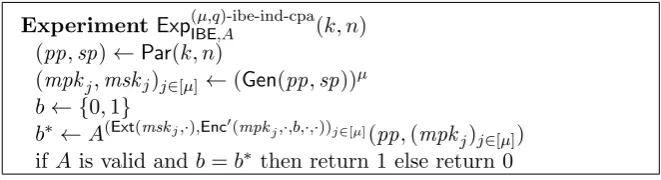
Dec(uskid, Cid) = M. For security, we define multi-instance, multi-ciphertext IBE security, dubbed (µ, q)-IBE-IND-CPA security, for (µ, q)∈N2, as follows.
(Weak) (µ, q)-IBE-IND-CPA security. An IBE scheme IBE defined as above is (µ, q )-IBE-IND-CPA-secure if and only if any PPT adversary A succeeds in the following experi-ment only with probability at most negligibly larger than 1/2. Let Enc0(mpk,id, b, M0, M1) be a PPT auxiliary encryption oracle that, given a master public key mpk, a challenge iden-tity id ∈ ID, a bit b ∈ {0,1}, and two messages M0, M1 ∈ M, outputs a challenge ci-phertext Cid ← Enc(mpk,id, Mb). First, A gets honestly generated public parameter pp
and master public keys (mpk1, . . . ,mpkµ). During the experiment, A may adaptively query
Ext(mskj,·)-oracles and Enc0(mpkj,·, b,·,·)-oracles, for corresponding mpkj,mskj and a
(uni-form) bit b ← {0,1}, for all j ∈ [µ]. Eventually, A outputs a guess b∗. We say that A
Experiment Exp(IBEµ,q,A)-ibe-ind-cpa(k, n) (pp,sp)←Par(k, n)
(mpkj,mskj)j∈[µ]←(Gen(pp,sp))µ
b← {0,1}
b∗ ←A(Ext(mskj,·),Enc0(mpkj,·,b,·,·))j∈[µ](pp,(mpk
j)j∈[µ]) ifA is valid and b=b∗ then return 1 else return 0
Figure 1: The (µ, q)-IBE-IND-CPA security experiment.
has already queried the corresponding Enc0(mpkj,·, b,·,·) oracle (and vice versa); each mes-sage pair A selected as input to Enc0 contained only equal-length messages; and A has only queried its Enc0-oracles at most q times per j-instance. We say that A succeeds if and only if A is valid and b = b∗. Concretely, the previous described experiment is given in Figure 1 and denoted Exp(IBEµ,q,A)-ibe-ind-cpa. Further, we define the advantage function for any PPT A as
Adv(IBEµ,q,A)-ibe-ind-cpa(k, n) :=|Pr
h
Exp(IBEµ,q,A)-ibe-ind-cpa(k, n) = 1
i
−1/2|.
Furthermore, we callIBE weakly(µ, q)-IBE-IND-CPA secure if and only ifAdv(IBEµ,q,A)-ibe-ind-cpa
is negligible for all weak PPT adversaries A. Here, A is weak if it never requests chal-lenge ciphertexts for the same scheme instance and identity twice (i.e., if it never queries any
Enc0(mpkj,·, b,·,·) oracle twice with the same identity id).
Finally, we remark that the one-instance, one-ciphertext notion (1,1)-IBE-IND-CPA is the standard notion of IBE security considered in, e.g., [9, 11, 6].
Pairings. Let G, H, GT be cyclic groups of order N. A pairing e : G×H → GT is a map
that is bilinear (i.e., for all g, g0 ∈ G and h, h0 ∈H, we have e(g·g0, h) =e(g, h)·e(g0, h) and
e(g, h·h0) =e(g, h)·e(g, h0)), non-degenerate (i.e., for generators g ∈G, h∈H, we have that
e(g, h)∈GT is a generator), andefficiently computable.
3
Extended nested dual system groups
(Nested) dual system groups. Nested dual system groups (NDSG) [11] can be seen as a variant of dual system groups (DSG) [12] which itself are based on the dual system framework introduced by Waters [21]. NDSGs were recently defined by Chen and Wee and enabled to prove the first IBE (almost) tightly and fully secure under simple assumptions. In the following, based on NDSGs, we construct a new notion we call extended nested dual system groups.
A variant of nested dual system groups. We introduce a variant of Chen and Wee’s nested dual system groups (NDSG) [11], dubbed extended NDSG (ENDSG). (Mainly, we re-use and extend the notions from [11].) Further, let G(k, n0) be a group generator that, given integers
k and n0, generates the tuple (G, H, GT, N,(gp1, . . . , gpn0),(hp1, . . . , hpn0), g, h, e), for a pairing
e:G×H →GT, for composite-order groupsG, H, GT, all of known group orderN =p1· · ·pn0,
for k-bit primes (pi)i and integer n0 ∈ O(1). Further, g and h are generators of G and H,
and (gpi)i and (hpi)i are generators of the (proper) subgroups Gpi ⊂G and Hpi ⊂H of order
|Gpi| = |Hpi| = pi, respectively. In this setting, an ENDSG ENDSG consists of algorithms
SampP,SampG,SampH,SampG\,SampG^ :
Parameter sampling. SampP(k, n), given security parameter k and parameter n∈ N, sam-ples (G, H, GT, N,(gp1, . . . , gpn0),(hp1, . . . , hpn0), g, h, e)← G(k, n
0), for a constant integer
n0 determined bySampP, and outputs public parameterspp = (G, H, GT, N, g, h, e, m, n,
pars) and secret parameters sp = (bh,eh,parsd,parsg), where m :H → GT is a linear map, b
h,eh are nontrivial H-elements, and pars,parsd,parsg may contain arbitrary additional
G-group sampling. SampG(pp), given parameterpp, outputsg= (g0, . . . , gn)∈Gn+1.
H-group sampling. SampH(pp), given parameterpp, outputsh= (h0, . . . , hn)∈Hn+1.
Semi-functional G-group sampling 1. SampG\ (pp,sp), given parametersppandsp, outputs
b
g= (bg0, . . . ,bgn)∈G
n+1.
Semi-functional G-group sampling 2. SampG^ (pp,sp), given parametersppandsp, outputs
e
g= (eg0, . . . ,egn)∈G
n+1.
Correctness of ENDSG. For correctness, for all k∈N, for all integersn=n(k) >1, for all
pp, wherepp is the first ouput of SampP(k, n), we require:
Associativity. For all (g0, . . . , gn) ← SampG(pp) and for all (h0, . . . , hn) ← SampH(pp), we
have e(g0, hi) =e(gi, h0), for alli.
Projective. For alls←Z∗N, for allg0 which is the first output ofSampG(pp;s), for allh∈H, we have m(h)s=e(g0, h).
Security of ENDSG. For security, for all k ∈ N, for all integers n = n(k) > 1, for all (pp,sp)←SampP(k, n), we require:
Orthogonality. Formspecified in pp, forbh,eh specified in sp, we havem(bh) =m(eh) = 1. For g0,bg0, andeg0that are the first outputs ofSampG(pp),SampG\(pp,sp), andSampG^ (pp,sp),
respectively, we have that e(g0,bh) = 1, e(g0,eh) = 1,e(gb0,eh) = 1, ande(eg0,bh) = 1.
G- and H-subgroups. The outputs ofSampG,SampG\, and SampG^ are distributed uniformly over the generators of different nontrivial subgroups ofGn+1 (that only depend onpp) of coprime order, respectively, while the output of SampHis uniformly distributed over the generators of a nontrivial subgroup of Hn+1 (that only depends on pp).
Non-degeneracy. Forbh specified insp and for bg0 which is the first output ofSampG\ (pp,sp),
it holds thate(bg0,bh) is uniformly distributed over the generators of a nontrivial subgroup
of GT (that only depends on pp). Similarly, e(eg0,eh) is uniformly distributed over the
generators of a nontrivial subgroup ofGT (that only depends onpp), whereehis specified
insp andeg0 is the first output ofSampG^ (pp,sp).
Left-subgroup indistinguishability 1 (LS1). For any PPT adversary D, we have that the function
Advls1ENDSG,G,D(k, n) := |Pr [D(pp,g) = 1]−Pr [D(pp,gbg) = 1]|
is negligible ink, where g←SampG(pp),gb←SampG\ (pp,sp).
Left-subgroup indistinguishability 2 (LS2). For any PPT adversary D, we have that the function
Advls2ENDSG,G,D(k, n) :=|Pr
h
D(pp,bheh,g0bg0,gbg) = 1 i
−Pr
h
D(pp,bheh,g0bg0,geg) = 1 i
|
is negligible in k, whereg,g0 ←SampG(pp),gb,gb
0 ←SampG\(pp,sp), e
Nested-hiding indistinguishability (NH). For any PPT adversary D, for all integers q0 =
q0(k), the function
AdvnhENDSG,G,D(k, n, q0) := max
i∈[bn
2c]
|PrhD(pp,bh,eh,bg−(2i−1),eg−2i,(h1, . . . ,hq0)) = 1
i
−PrhD(pp,bh,eh, b
g−(2i−1),eg−2i,(h 0
1, . . . ,h0q0)) = 1
i
|,
is negligible ink, where bg←SampG\ (pp,sp), eg←SampG^(pp,sp), and
hi0 := (hi0,0, . . . , hi0,n)←SampH(pp),
h0i0 := (hi0,0, . . . , hi0,2i−1·(bh)γbi0, h
i0,2i·(eh)γei0, . . . , h
i0,n),
forbh,eh specified insp, forbγi0,eγi0 ←Z∗ord(H), and for all i0 ∈[q0].
(Informal) comparison of NDSGs and ENDSGs. Loosely speaking, in contrast to the NDSGs from [11], ENDSGs have a second semi-functional G-group sampling algorithm SampG^
as well as a second nontrivialH-element insp(i.e.,eh). Further, we omit theSampGT-algorithm.
Concerning the ENDSG properties, we extend the NDSG properties and assumptions appro-priately and introduce one additional assumption (i.e., LS2).
4
An (almost) tightly
(µ, q)
-IBE-IND-CPA-secure IBE
A variant of the IBE of Chen and Wee [11]. We are now ready to present our variant of Chen and Wee’s IBE scheme [11]. As a basic building block we use an ENDSG
ENDSG = (SampP,SampG,SampH,SampG\ ,SampG^ ) from Section 3. Besides, for groups GT
(defined below), let U H be a family of universal hash functions H : GT → {0,1}k such that
for any nontrivial subgroup G0T ⊂ GT, and for H ← U H, X ← G0T, and U ← {0,1}k, we
have SD((H,H(X)) ; (H, U)) =O(2−k). Let IBE= (Par,Gen,Ext,Enc,Dec) with identity space
ID={0,1}n, for n=n(k), and message space M={0,1}k be defined as follows:
Parameter generation. Par(k, n) samples (pp0,sp0)←SampP(k,2n), forpp0 = (G, H, GT, N,
g, h, e, m,2n,pars) andsp0 = (bh,eh,parsd,parsg)), andH← U H, and then outputs the public
and secret parameters (pp,sp), where pp= (pp0,H) and sp=sp0.
Key generation. Gen(pp,sp), given parameterspp andsp, samples msk ←H, and outputs a master public keympk := (pp, m(msk)) and a master secret key msk.
Secret-key extraction. Ext(msk,id), givenmsk ∈H and an identityid = (id1. . .idn)∈ ID,
samples (h0, . . . , h2n)←SampH(pp) and outputs a user secret key
uskid := (h0,msk·
n
Y
i=1
h2i−idi).
Encryption. Enc(mpk,id, M), givenmpk = (pp, m(msk)), an identityid = (id1. . .idn)∈ ID,
and a messageM ∈ M, computes (g0, . . . , g2n) :=SampG(pp;s), for s← Z∗N, and gT :=
m(msk)s (=e(g0,msk)), and outputs a ciphertext
Cid := (g0,
n
Y
i=1
Decryption. Dec(uskid, Cid0), given a user secret key uskid =: (K0, K1) and a ciphertext
Cid0 =: (C0, C1, C2), outputs
M :=H
e(C0, K1)
e(C1, K0)
⊕C2.
Correctness of IBE. We have
H
e(C0, K1)
e(C1, K0)
⊕C2= H
e(g0,msk·Qni=1h2i−idi)
e(Qn
i=1g2i−id0i, h0)
!
⊕H(gT)⊕M
(∗)
= H(gT)⊕H(gT)⊕M,
forid =id0. (∗) holds due toENDSG’s associativity and projective properties.
(µ, q)-IBE-IND-CPA security of IBE. We base our high-level proof strategy on the IBE-IND-CPA proof strategy of Chen and Wee [11], but deviate on the low level. First, we define auxiliary secret-key extractionExtand auxiliary encryptionEnc, random functionsbRj,iandRej,i,
pseudo-normal ciphertexts, semi-functional type-(·, i) ciphertexts, and semi-functional type-i
user secret keys similarly to [11]:
Auxiliary secret-key extraction. Ext(pp,msk,id;h), given parameterpp, master secret key
msk, an identity id =id1. . .idn ∈ ID, and h= (h0, . . . , h2n)∈(H)2n+1, outputs a user
secret key
uskid := (h0,msk·
n
Y
i=1
h2i−idi).
Auxiliary encryption function. Enc(pp,id, M;msk,g), given parameter pp, identity id =
id1. . .idn ∈ ID, message M ∈ M, master secret key msk, and g = (g0, . . . , g2n) ∈
(G)2n+1, outputs a ciphertext
Cid := (g0,
n
Y
i=1
g2i−idi,H(e(g0,msk))⊕M).
Random function families. Let id|i := id1. . .idi be the i-bit prefix of an identity id, and
let ID|i := {0,1}i. For an instancej and i∈ [n]∪ {0}, consider functions Rbj,i :ID|i → H, id|i 7→ (bh)bγj,i(id|i) and Rej,i : ID|i → H, id|i 7→ (eh)eγj,i(id|i), where
b
γj,i : ID|i →
Z∗
ord(H),id|i 7→bγj,id|i and eγj,i:ID|i → Z
∗
ord(H),id|i 7→ eγj,id|i are independently and truly random.
Pseudo-normal ciphertexts. Pseudo-normal ciphertexts are generated as
Cid := Enc(pp,id, M;msk,gbg)
= (g0bg0,
n
Y
i=1
g2i−idibg2i−idi,H(e(g0bg0,msk))⊕M),
for uniform g = (g0, . . . , g2n) ← SampG(pp) and bg = (bg0, . . . ,bg2n) ← SampG\ (pp,sp).
(Hence, pseudo-normal ciphertexts have G-components sampled fromSampG\ .)
Semi-functional type-(∧, i) and type-(∼, i) ciphertexts. LetRbj,iandRej,ibe random
func-tions as defined above. Semi-functional ciphertexts of type (∧, i) are generated as
b
Cid := Enc(pp,id, M;msk·Rbj,i(id|i)·Rej,i(id|i),gbg)
(1) = (g0bg0,
n
Y
i=1
while semi-functional ciphertexts of type (∼, i) are generated as
e
Cid :=Enc(pp,id, M;msk·bRj,i(id|i)·Rej,i(id|i),geg)
(2) = (g0eg0,
n
Y
i=1
g2i−idieg2i−idi,H(e(g0eg0,msk·Rej,i(id|i)))⊕M),
where g = (g0, . . . , g2n) ← SampG(pp), gb = (bg0, . . . ,gb2n) ← SampG\ (pp), and eg =
(eg0, . . . ,eg2n)←SampG^(pp), while (1) and (2) hold due to ENDSG’s properties.
Semi-functional type-i user secret keys. Let Rbj,i and Rej,i be defined as above. For h =
(h0, . . . , h2n)←SampH(pp), semi-functional type-iuser secret keys are generated as
uskid := Ext(pp,msk·Rbj,i(id|i)·Rej,i(id|i),id;h)
= (h0,msk·Rbj,i(id|i)·Rej,i(id|i)·
n
Y
i=1
h2i−idi).
Theorem 4.1. IfENDSGis an ENDSG system as defined in Section 3 andHis a universal hash function, then IBE defined as above is weakly (µ, q)-IBE-IND-CPA-secure. Concretely, for any weak PPT adversary A with at mostq0=q0(k) key extraction queries per instance and running time t in the (µ, q)-IBE-IND-CPA security experiment with IBE, there are distinguishers D1
on LS1, D2 on LS2, and D3 on NH with running times t01 ≈ t02 ≈ t03 ≈ t+O(µnkc(q+q0)),
respectively, for some constant c∈N, with
Adv(IBEµ,q,A)-ibe-ind-cpa(k, n)≤Advls1ENDSG,G,D1(k,2n) + 2n·Advls2ENDSG,G,D2(k,2n)
+n·AdvnhENDSG,G,D3(k,2n, µq0) +µq·O(2−k), (1)
for group generator G defined as above.
Proof. We show the (µ, q)-IBE-IND-CPA security of IBE for any weak PPT adversary A in a sequence of games where we successively change the games until we arrive at a game where A
has only negligible advantage (i.e., success probability of 1/2) in the sense of (µ, q )-IBE-IND-CPA. LetSA,j be the event thatAsucceeds in Gamej. We give an overview how the challenge
ciphertexts and user secret keys are generated in Table 1.
Game 0. Game 0 is the (µ, q)-IBE-IND-CPA experiment as defined above.
Game 1. Game 1 is defined as Game 0 apart from the fact that all challenge ciphertexts are pseudo-normal.
Game 2.i.0. Game 2.i.0 is defined as Game 1 except that all user secret keys are semi-functional of type (i−1) and all challenge ciphertexts are semi-functional of type-(∧, i−1), for all i∈[n].
Game 2.i.1. Game 2.i.1 is defined as Game 2.i.0 except that if and only if the i-th bit of a challenge identity is 1, then the corresponding challenge ciphertext is semi-functional of type (∼, i−1). (Otherwise, if and only if thei-th bit of a challenge identity is 0, then the corresponding challenge ciphertext is semi-functional of type (∧, i−1).)
Game 2.i.2. Game 2.i.2 is defined as Game 2.i.1 except that the challenge ciphertexts are semi-functional of type (·, i) (where· can be ∧ or ∼as defined in Game 2.i.1, i.e., depending on the i-th challenge identity bit) and the user secret keys are semi-functional of type i.
Game Challenge ciphertexts forid∗j,i0 User secret keys forid
G. 0 Enc(mpkj,id∗j,i0, Mj,i∗0,b) Ext(mskj,id)
G. 1 Enc(pp,id∗j,i0, Mj,i∗0,b;mskj,gbg) Ext(pp,mskj,id;h)
G. 2.i.0 Enc(pp,id∗j,i0, Mj,i∗0,b;mskj·Rbj,i−1(id∗j,i0|i−1),ggb) Ext(pp,mskj·Rbj,i−1(id|i−1)·eRj,i−1(id|i−1),id;h)
G. 2.i.1 ifid∗j,i0,i= 0 : Ext(pp,mskj·Rbj,i−1(id|i−1)·eRj,i−1(id|i−1),id;h)
Enc(pp,id∗j,i0, Mj,i∗0,b;mskj·bRj,i−1(id∗j,i0|i−1),gbg)
ifid∗j,i0,i= 1 :
Enc(pp,id∗j,i0, Mj,i∗0,b;mskj·eRj,i−1(id∗j,i0|i−1),geg)
G. 2.i.2 ifid∗j,i0,i= 0 : Ext(pp,mskj·Rbj,i(id|i)·Rej,i(id|i),id;h)
Enc(pp,id∗j,i0, Mj,i∗0,b;mskj·bRj,i(id∗
j,i0|i),ggb)
ifid∗j,i0,i= 1 :
Enc(pp,id∗j,i0, Mj,i∗0,b;mskj·eRj,i(id∗j,i0|i),gge)
G. 3 Enc(pp,id∗j,i0, Mj,i∗0,b;mskj·Rbj,n(id∗
j,i0),ggb) Ext(pp,mskj·Rbj,n(id)·Rej,n(id),id;h)
G. 4 Enc(pp,id∗j,i0, Rj,i0;mskj·Rbj,n(id∗
j,i0),ggb) Ext(pp,mskj·Rbj,n(id)·Rej,n(id),id;h)
Table 1: Instance-j challenge ciphertexts for challenge identity id∗j,i0, for g ← SampG(pp), for gb ←
\
SampG(pp,sp), for eg ← SampG^(pp,sp), for Rj,i0 ← {0,1}k, and for instance-j user secret keys for
identityid, forh←SampH(pp), for all (j, i0, i)∈[µ]×[q]×[n]. The differences between games are given by underlining.
Game 4. Game 4 is defined as Game 3 except that the challenge ciphertext messages are uniformk-length bitstrings.
Lemma 4.2 (Game 0 to Game 1). If the G- and H-subgroups property and LS1 of ENDSG
hold, Game 0 and Game 1 are computationally indistinguishable. Concretely, for any PPT adversary A with at most q0 = q0(k) extraction queries per instance and running time t in the (µ, q)-IBE-IND-CPA security experiment with IBE there is a distinguisher D on LS1 with running time t0 ≈t+O(µnkc(q+q0)), for some constant c∈N, such that
|Pr [SA,0]−Pr [SA,1]| ≤Advls1ENDSG,G,D(k,2n). (2)
Proof. In Game 0, all challenge ciphertexts are normal in the sense of IBEwhile in Game 1, all challenge ciphertexts are pseudo-normal. In the following, we give a description and its analysis of a LS1 distinguisher that uses any efficientIBE-attacker in the (µ, q)-IBE-IND-CPA sense.
Description. The challenge input is provided as (pp,T), where T is either g or gbg, for pp = (G, H, GT, N, g, h, e, m,2n,pars), g ← SampG(pp), and bg ← SampG\ (pp,sp). First, D
samples (mskj)j ← (H)µ, sets mpkj := (pp,H, m(mskj)), for all j, for H ← U H, and sends
(mpkj)j to A. During the experiment, D answers instance-j secret key extraction queries to
oracleExt(mskj,·), forid ∈ ID, as
Ext(pp,mskj,id;SampH(pp)),
for all j. (We assume thatA queries at most q0 user secret keys per instance.) Then, D fixes a bit b ← {0,1}. A may adaptively query its Enc0-oracle; for A-chosen instance-j challenge identityid∗j,i∈ ID and equal-length messages (Mj,i,∗ 0, Mj,i,∗ 1). Dreturns
Enc(pp,id∗j,i, Mj,i,b∗ ;mskj,Tsj,i)
to A, for sj,i ← Z∗N, for all (j, i) ∈ [µ]×[q]. (We assume that A queries at most q challenge
Analysis. The provided master public keys and the A-requested user secret keys yield the correct distribution and are consistent in the sense of Game 0 and Game 1. Due to ENDSG’s
G- and H-subgroups property, we have that T is uniformly distributed over the generators of a nontrivial subgroup of G2n+1. Hence, Ts, for s ← Z∗
N, is distributed uniformly over the
generators of a nontrivial subgroup ofG2n+1and, thus, all challenge ciphertexts yield the correct distribution in the sense of Game 0 and Game 1. If T=g, then the challenge ciphertexts are distributed identically as in Game 0. Otherwise, i.e., if T=ggb, then the challenge ciphertexts
are distributed identically as in Game 1. Hence, (2) follows.
Lemma 4.3(Game 1 to Game 2.1.0). If the orthogonality property ofENDSGholds, the out-put distributions of Game 1 and Game 2.1.0 are the same. Concretely, for any PPT adversary A in the (µ, q)-IBE-IND-CPA security experiment with IBE, it holds that
Pr [SA,1] = Pr [SA,2.1.0]. (3)
Proof. In this bridging step, we argue that each instance-jmaster secret keymskj, withmskj ←
H, generated as in Game 1 and the (implicit) instance-j master secret keysmsk0j, withmsk0j :=
msk00j·Rbj,0(ε)·eRj,0(ε), formsk00j ←HandRbj,0,Rej,0 defined as above, generated as in Game 2.1.0,
are identically distributed, for allj. Note that the master public keys forAcontain (m(mskj))j;
but since ((m(msk0j))j = (m(msk00j))j, which is due to the orthogonality property ofENDSG, no
b
Rj,0-information and no Rej,0-information is given out in the master public keys. Further, since
(mskj)j and (msk00j)j are identically distributed, it follows that (3) holds.
Lemma 4.4 (Game 2.i.0 to Game 2.i.1). If the G- and H-subgroups property and LS2 of
ENDSG hold, Game 2.i.0 and Game 2.i.1 are computationally indistinguishable. Concretely, for any PPT adversary A with at most q0 =q0(k) extraction queries per instance and running time t in the(µ, q)-IBE-IND-CPA security experiment with IBE, there is a distinguisher D on LS2 with running time t0 ≈t+O(µnkc(q+q0)), for some constant c∈N, such that
|Pr [S2.i.0]−Pr [S2.i.1]| ≤Advls2ENDSG,G,D(k,2n), (4)
for all i∈[n].
Proof. In Game 2.i.0, we have semi-functional type-(∧, i−1) challenge ciphertexts while in Game 2.i.1, challenge ciphertexts are semi-functional of type (∼, i−1) if and only if the i-th challenge identity bit is 1.
Description. The challenge input is provided as (pp,bheh,g0gb0,T), where T is either gbg or geg, for pp as before, for bh,eh specified in sp, for g,g0 ← SampG(pp), bg,bg0 ← SampG\ (pp,sp),
and eg ← SampG^(pp,sp). First, D samples (mskj)j ← (H)µ, sets mpkj := (pp,H, m(mskj)),
for all j, for H ← U H, for m specified in pp, and sends (mpkj)j to A. Further, D defines a
truly random functionR: [µ]× {0,1}i−1→ h
bhehi. During the experiment,Danswers instance-j
secret key extraction queries to oracleExt(mskj,·) as
Ext(pp,mskj·R(j,id|i−1),id;SampH(pp)),
forid ∈ IDand allj. (Again, we assume thatAqueries at mostq0user secret keys per instance and we setid|0 ={0,1}0 =:ε.) Amay adaptively query itsEnc0-oracle; for instance-j challenge identityid∗j,i0 =idj,i∗ 0,1. . . ,id∗j,i0,n∈ ID and equal-length messages (Mj,i∗0,0, Mj,i∗ 0,1), Dreturns
Enc(pp,id∗j,i0, Mj,i∗0,b;mskj ·R(j,id∗j,i0|i−1),(g0gb
0)sj,i0) ifid∗
j,i0,i= 0,
toA, forb ← {0,1}, for sj,i0 ← Z∗
N, for all (j, i0)∈[µ]×[q]. Eventually, A outputs a guess b0.
Doutputs 1 if b0 =b and Ais valid in the sense of (µ, q)-IBE-IND-CPA, else outputs 0.
Analysis. The master public keys yield the correct distribution as well as the requested user secret keys (which is due to ENDSG’s G- and H-subgroups property, i.e., the output of
SampH is uniformly distributed over the generators of a nontrivial subgroup of H2n+1). For the challenge ciphertexts, note that g0bg0 and T are uniformly distributed over the generators of their respective nontrivial subgroup of G2n+1 and, hence, (g0bg
0)s and Ts, for s ← Z∗
N, are
distributed uniformly over the generators of their respective nontrivialG2n+1-subgroup as well. IfT=ggb, then the challenge ciphertexts are distributed identically as in Game 2.i.0. Otherwise, if T= geg, then the challenge ciphertexts are distributed identically as in Game 2.i.1 (where, in both cases,ENDSG’s orthogonality and non-degeneracy properties hold; thus,bh and eh must
contain coprime nontrivial elements and the challenge ciphertexts yield the correct distribution). Hence, (4) follows.
Lemma 4.5 (Game 2.i.1 to Game 2.i.2). If the G- and H-subgroups property and NH of
ENDSG hold, Game 2.i.1 and Game 2.i.2 are computationally indistinguishable. Concretely, for any PPT adversary A with at most q0 =q0(k) extraction queries per instance and running time t in the(µ, q)-IBE-IND-CPA security experiment with IBE, there is a distinguisher D on NH with running time t0≈t+O(µnkc(q+q0)), for some constant c∈N, such that
|Pr [S2.i.1]−Pr [S2.i.2]| ≤AdvnhENDSG,G,D(k,2n, µq
0), (5)
for all i∈[n].
Proof. In Game 2.i.1, the challenge ciphertexts are semi-functional of type (∧, i−1) if thei-th bit of the challenge identity is 0 and semi-functional of type (∼, i−1) if the i-th bit of the challenge identity is 1, while in Game 2.i.2, all challenge ciphertexts are of type (·, i).
Description. The challenge input is (pp,bh,eh,gb−(2i−1),ge−2i,(T1,1, . . . ,Tµ,q0)), where Tj,i0
equals either
(hj,i0,0, . . . , hj,i0,2n) or (hj,i0,0, . . . , hj,i0,2i−1·(bh)bγj,i0, hj,i0,2i·(eh)eγj,i0, . . . , hj,i0,2n),
for pp as before, bh,eh specified as in sp, for bg ← SampG\ (pp,sp), for ge ← SampG^ (pp,sp), for
(hj,i0,0, . . . , hj,i0,2n)←SampH(pp), and for uniform
b γj,i0,
e
γj,i0 ←Z∗
ord(H), for all (j, i
0)∈[µ]×[q0].
D samples (mskj)j ← (H)µ, sets mpkj := (pp,H, m(mskj)), for all j, for H ← U H, for m
specified in pp, and sends (mpkj)j toA. Further, D defines random functionsRbj,i−1,Rej,i−1 as above. In addition, for identity id =id1. . .idn∈ ID, we will define
b
Rj,i(id|i) :=Rbj,i−1(id|i−1) and (implicitly) eRj,i(id|i) :=eRj,i−1(id|i−1)·(eh)eγj,i0 ifidi = 0,
e
Rj,i(id|i) :=Rej,i−1(id|i−1) and (implicitly) bRj,i(id|i) :=bRj,i−1(id|i−1)·(bh)bγj,i0 ifid
i = 1,
for suitable (j, i0) ∈ [µ]×[q0] as shown below. Further, during the experiment, D returns the
i0-th secret key extraction query in instancej for an identity id, with prefix id|i not a prefix of
an already queried identity in instance j, as
Ext(pp,mskj·Rbj,i(id|i)·Rej,i−1(id|i−1),id;Tj,i0) ifidi = 0,
Ext(pp,mskj·Rbj,i−1(id|i−1)·Rej,i(id|i),id;Tj,i0) ifidi = 1,
for all (j, i0). (Note thatid|i could be a valid prefix in any other instance different toj. Further,
that is a prefix of an already queried identity in instance j, let (j, i00)∈[µ]×[q0] be the index of that query. In that case, Dreturns
Ext(pp,mskj·bRj,i(id|i)·Rej,i−1(id|i−1),id;Tj,i00·SampH(pp)) ifidi = 0,
Ext(pp,mskj·bRj,i−1(id|i−1)·Rej,i(id|i),id;Tj,i00·SampH(pp)) ifidi = 1,
for all j. (Note that we use SampH to rerandomize the H2n+1-subgroup element of Tj,i00.)
Further, A may adaptively query its Enc0-oracle; for A-chosen instance-j challenge identity
id∗j,i000 =id∗j,i000,1. . . ,id∗j,i000,n∈ ID and equal-length messages (Mj,i∗000,0, Mj,i∗000,1) and returns
Enc(pp,id∗j,i000, Mj,i∗000,b;mskj·Rbj,i(id∗j,i000|i),(g−(2i−1)bg−(2i−1))sj,i000) if id∗j,i000,i= 0,
Enc(pp,id∗j,i000, Mj,i∗000,b;mskj·Rej,i(id∗j,i000|i),(g−2ieg−2i)sj,i000) ifid∗j,i000,i= 1,
to A, for sj,i000 ← Z∗
N, for g ← SampG(pp), for fixed b ← {0,1}, for all (j, i
000). (Note that
a modified Enc-input is provided with only 4n instead of 4n+ 2 elements. Nevertheless, the omitted elements are not needed to generate a valid ciphertext (since it is consistent with the challenge identities (id∗j,i000)j,i000). Hence, we assume that Enc works as desired.) Eventually, A
outputs a guess b0. D outputs 1 if b0 = b and A is valid in the sense of (µ, q)-IBE-IND-CPA, else outputs 0.
Analysis. Note that the provided master public keys yield the correct distribution. For the A-requested user secret keys, we have that since bh and eh have nontrivial H-elements of
coprime order (again, this is due to ENDSG’s orthogonality and non-degeneracy properties), the random functions Rbj,i−1,Rbj,i and Rej,i−1,Rej,i yield the correct distributions in the sense of
Game 2.i.1 and Game 2.i.2, respectively. Due to theG- and H-subgroups property ofENDSG,
g−(2i−1) and gb−(2i−1) as well asg−2i and eg−2i are uniformly distributed over the generators of
their respective nontrivial subgroups ofG2n and, thus, (g−(2i−1)gb−(2i−1))
s and (g
−2ieg−2i)
s, for
s←Z∗N, are distributed uniformly over the generators of their respective nontrivial subgroup of
G2n. Further, ifid∗j,i000,i= 0, then it holds thatbRj,i(id∗j,i000|i) =Rbj,i−1(id∗j,i000|i−1) and all required componentsgb−(2i−1) to create the challenge ciphertexts are given. Analogously, ifid∗j,i000,i= 1,
then we have Rej,i(id∗j,i000|i) =eRj,i−1(id∗j,i000|i−1) and all necessary componentseg−2i are provided
as needed. Hence, the challenge ciphertexts and user secret keys yield the correct distribution. If (Tj,i0)j,i0 = (hj,i0,0, . . . , hj,i0,2n)i0, then the user secret keys are distributed identically as in
Game 2.i.1. If (Tj,i0)j,i0 = (hj,i0,0, . . . , hj,i0,2i−1 ·(bh)bγj,i0, h
j,i0,2i·(eh)eγj,i0, . . . , h
j,i0,2n)j,i0, then the
user secret keys are distributed identically as in Game 2.i.2. Thus, (5) follows.
Lemma 4.6 (Game 2.i-1.2 to Game 2.i.0). If theG- andH-subgroups property and LS2 of
ENDSG hold, Game 2.i-1.1 and Game 2.i.0 are computationally indistinguishable. Concretely, for any PPT adversary A with at most q0 =q0(k) extraction queries per instance and running time tin the(µ, q)-IBE-IND-CPA security experiment withIBE, there is a distinguisherDwith running time t0 ≈t+O(µnkc(q+q0)), for some constant c∈N, such that
|Pr [S2.i−1.2]−Pr [S2.i.0]| ≤Advls2ENDSG,G,D(k,2n), (6)
for all i∈[n]\ {1}.
Lemma 4.7 (Game 2.n.2 to Game 3). If the G- and H-subgroups property and LS2 of
ENDSG hold, Game 2.n.2 and Game 3 are computationally indistinguishable. Concretely, for any PPT adversary A with at most q0 = q0(k) extraction queries per instance and running time tin the(µ, q)-IBE-IND-CPA security experiment withIBE, there is a distinguisherDwith running time t0 ≈t+O(µnkc(q+q0)), for some constant c∈N, such that
|Pr [SA,2.n.2]−Pr [SA,3]| ≤Advls2ENDSG,G,D(k,2n). (7)
Proof. It is easy to see that Game 3 and a potential Game 2.n+1.0 would be identical. Hence, we can reassemble the proof of Lemma 4.6 withi:=n+ 1 and (7) directly follows.
Lemma 4.8 (Game 3 to Game 4, weak adversaries). Game 3 and Game 4 are statisti-cally indistinguishable. Concretely, for any PPT weak adversaryA on the(µ, q)-IBE-IND-CPA security of IBE, it holds that
|Pr [SA,3]−Pr [SA,4]| ≤µq·O(2−k). (8)
Proof. In Game 4, we replace each challenge message Mj,i0,b, for challenge bit b∈ {0,1}, with
a (fresh) uniformly random k-length bitstring Rj,i0 ← {0,1}k. We argue with ENDSG’s
non-degeneracy property and the universality ofHfor this change. Concretely, for instance-jGame-3 challenge ciphertexts
Enc(pp,id∗j,i0, Mj,i∗0,b;mskj·Rbj,n(id∗j,i0),(ggb)sj,i0)
= ((g0bg0)
sj,i0,(
n
Y
i=1
g2i−id∗j,i0,igb2i−id∗j,i0,i)
sj,i0,H(e((g 0bg0)
sj,i0,msk
j·Rbj,n(id∗j,i0)))⊕Mj,i∗0,b),
for g ← SampG(pp), for bg ← SampG\ (pp,sp), for sj,i0 ← Z∗
N, for all i0 ∈ [q], note that
e((bg0)sj,i0,Rbj,n(id∗
j,i0)) = e((
b
g0)sj,i0,bh)bγj,i0, for uniform
b
γj,i0 ∈ Z∗
ord(H), is uniformly distributed in a nontrivial subgroup G0T ⊂ GT due to the non-degeneracy property of ENDSG.
Further-more, since A is a weak adversary, all the Rbj,n are for different preimages and thus
indepen-dently random. Hence, since H is a (randomly chosen) universal hash function, we have that
SD((H,H(X)) ; (H, U)) =O(2−k), forX←G0T andU ← {0,1}k. A union bound yields (8).
Lemma 4.9 (Game 4). For any PPT adversary A in the (µ, q)-IBE-IND-CPA security ex-periment with IBE, it holds that
Pr [SA,4] = 1/2. (9)
Proof. In Game 4, for (uniform) challenge bitb∈ {0,1}, we provideAwith challenge ciphertexts that include a uniform k-length bitstring instead of a A-chosen b-dependent message, for each instance and challenge. Hence, bis completely hidden fromA and (9) follows.
Taking (2), (3), (4), (5), (6), (7), (8), and (9) together, shows (1).
From weak to full (µ, q)-IBE-IND-CPA security. The analysis above shows only weak security: we must assume that the adversary A never asks for encryptions under the same challenge identity and for the same scheme instance twice. We do not know how to remove this restriction assuming only the abstract properties of ENDSGs. However, at the cost of one tight additional reduction to (a slight variant of) the Bilinear Decisional Diffie-Hellman (BDDH) assumption, we can show full (µ, q)-IBE-IND-CPA security.
Concretely, in Game 3, challenge ciphertexts for A are prepared using (the hash value of) e(bgs0,bhγ) as a mask to hide the plaintext behind. Here, gb0s and bh are public (as part
encryption, andγ is a random exponent that however only depends on the scheme instance and identity. (Thus, γ will be reused for different encryptions under the same identity). Hence, if we show that many tuples (bg
si, e(
b gsi
0 ,bhγ)) (for different si but the sameγ) are computationally
indistinguishable from random tuples, we obtain that even multiple encryptions under the same identity hide the plaintexts, and we obtain full security.
Of course, the corresponding reduction should be tight, in the sense that it should not degrade in the number of tuples, or in the number of consideredγ.
A (subgroup) variant of the BDDH assumption (s-BDDH). For any PPT adversary
D, we have that the function
Advs-bddhENDSG,G,D(k, n) := |PrhD(pp,g,ga,gb,bga,bgb0,bh,bhb,bhc, e( b
g0,bh)abc) = 1 i
−Pr
h
D(pp,g,ga,gb,gb
a,
b
gb0,bh,bhb,bhc, e(gb0,bh)z) = 1 i
|
is negligible in k, for (pp,sp) ← SampP(k, n), for g ← SampG(pp), for bg = (bg0, . . . ,bgn) ← \
SampG(pp,sp), forbh specified insp, forespecified inpp, and for (uniform)a, b, c, z ←Z∗N. Rerandomization. Given N ∈ N, g,bg,ga,gba ∈ Gn+1, bgb0 ∈ G, bh,hbb,bhc ∈ H, and T = e(bg0,bh)z ∈GT, fora, b, c, z ∈Z∗N.
Reranda(N,g,ga,bg,bg
a,
b
gb0,bh,bhb,bhc,T) samples r1, t1 ←Z∗N and outputs
(ga¯,bg¯a,bg0b,bhb,bhc,Ta),
where
g¯a= (g0¯a, . . . , gn¯a), for
g0¯a= (g0a)r1 ·gt1
0 =g
a·r1+t1
0 and g
¯
a
i = (gia)r1 ·gti1 =g a·r1+t1
i , for alli∈[n],
b
g¯a= (bg0¯a, . . . ,bgn¯a), for
b
g0¯a= (gb0a)r1 · b gt1
0 =bg
a·r1+t1
0 and bg
¯
a i = (bg
a i)r1 ·bg
t1
i =g a·r1+t1
i , for alli∈[n],
Ta =Tr1 ·e(bg
b
0,bhc)t1 =Tr1 ·e(bg0,bh)b·c·t1
If z = abc, then ¯a is uniformly distributed in ZN and Ta = Tabc¯ . If z 6= abc, then ¯a
is uniformly distributed in ZN and Ta = e(gb0,bh)
zr1+bct1, where zr
1+bct1 is uniformly distributed in ZN.
Rerandb(N,g,ga,gb,gb
a,
b
gb0,bh,bhb,bhc,T) samplesr2, t2 ←Z∗N and outputs
(ga,bga,bg¯b0,bh
¯b
,bhc,Tb),
where
b g¯b0= (bg
b
0)r2 ·bg
t2
0 =bg
b·r2+t2
0 ,
b
h¯b= (bhb)r2·bht2 =bhb·r2+t2, Tb=Tr2 ·e(bg
a
0,bhc)t2 =Tr2 ·e(bg0,bh)a·c·t2.
If z = abc, then ¯b is uniformly distributed in ZN and Tb = Ta
¯bc
. If z 6= abc, then ¯b
is uniformly distributed in ZN and Tb = e(bg0,bh)
zr2+act2, where zr
Rerandc(N,g,ga,gb,gb
a,
b
gb0,bh,bhb,bhc,T) samplesr3, t3 ←Z∗N and outputs
(ga,gb
a,
b
gb0,bhb,bhc¯,Tc),
where
b
hc0¯= (bhc0)r3·bh0t3 =bhc0·r3+t3, Tc=Tr3 ·e(
b
ga0,bhb)t3 =Tr3 ·e(bg0,bh)a·b·t3.
If z = abc, then ¯c is uniformly distributed in ZN and Tc = Tab¯c. If z 6= abc, then ¯c
is uniformly distributed in ZN and Tc =e(gb0,bh)
zr3+abt3, where zr
3+abt3 is uniformly distributed in ZN.
Rerandabc(N,g,ga,bg,bg
a,
b
gb0,bh,bhb,bhc,T) outputs
(g¯a,bg
¯
a,
b g¯0b,bh
¯b
,bh¯c,Tabc)
by running Reranda(N,g,ga,bg,bg
a,
b gb
0,bh,bhb,bhc,T) → (g¯a,bg¯a,bgb0,hbb,bhc,Ta) and take this
output as new input (N,g,g¯a,
b g,gb¯a,
b gb
0,bh,bhb,bhc,Ta) for Rerandb. Then take this output
(g¯a,
b ga¯,
b g¯b
0,bh
¯b
,bhc,Tab) as appropriate input for Rerandc to get (ga¯,bg¯a,bg
¯b 0,bh
¯
b,
bh¯c,Tabc).
The input exponentsa, b, candzfor all algorithms are required to be uniformly distributed inZ∗N, but if we reuse the outputs ofRerandaandRerandb, then ¯aand ¯bare uniformly
dis-tributed inZN. However, the uniform distribution inZN is statistically indistinguishable
from the uniform distribution in Z∗N, since for a ← Z∗N,¯a← ZN the statistical distance
SD(a; ¯a) = 12P
x∈ZN|Pr [a=x]−Pr [¯a=x]| =
N−ϕ(N)
N is negligible in k, because for
N =p1·. . .·pn0, wheren0 ∈O(1) andps denotes the smallestk-bit prime factor ofN, we
have N−Nϕ(N) (∗)
≤ N
N− N N+
Pn0
l=1 n0 l 1 pl s
≤c(n0)· 1
ps ∈O(2
−k), for a constantc(n0) depending
on n0. (Note that (∗) holds due to ϕ(NN) ≥ N N +
Pn0
l=1
n0 l
1
pl
s.) So, if z =abc, then ¯a, ¯b,¯c
are uniformly distributed in ZN and Tabc =T¯a
¯
b¯c. If z 6=abc, then ¯a,¯b,¯c are uniformly
distributed inZN and, for za:=zr1+bct1, zab :=zar2+ ¯act2 and zabc:=zabr3+ ¯a¯bt3, we have Tabc=e(gb0,bh)
zabc, wherez
a, zab and zabc are all uniformly distributed inZN.
Lemma 4.10(Game 3 to Game 4, full security). LetGbe a group generator andRerandabc,
Reranda rerandomization algorithms, all as defined above. If ENDSG is an ENDSG system,
s-BDDH holds, and H is a universal hash function, Game 3 and Game 4 are computationally indistinguishable. Concretely, for any PPT adversary A with at most q0 = q0(k) extraction queries per instance and running time t in the (µ, q)-IBE-IND-CPA security experiment with
IBE, there is a distinguisher D with running time t0 ≈t+O(µnkc(q+q0)), for some constant c∈N, such that
|Pr [SA,3]−Pr [SA,4]| ≤AdvENDSGs-bddh,G,D(k,2n) +µq·O(2
−k). (10)
Proof. In Game 3, each challenge ciphertext carries a b-dependent A-chosen message, for b ← {0,1}, while in Game 4, each challenge ciphertext message is replace by uniform k-length b -independent bitstring.
Description. D is provided with challenge input (pp,g,ga,
b g,bga,
b gb
0,bh,bhb,bhc,T), where T
is either e(bg0,bh)abc or e(gb0,bh)z, for (pp,sp) ← SampP(k,2n), for g ← SampG(pp), for bg =
(bg0, . . . ,bgn)←SampG\ (pp,sp), forbhspecified insp, forespecified inpp, and fora, b, c, z ←Z ∗
N.
First, D samples (mskj)j ← (H)µ, sets mpkj := (pp,H, m(mskj)), for all j, for H ← U H,
for m specified in pp, and sends (mpkj)j to A. Further, D defines a truly random function
b
R : [µ]× {0,1}n → h
b
hi. During the experiment, D answers instance-j extraction queries for
id ∈ ID as
for all j. Further, A may adaptively query its Enc0-oracle; for A-chosen instance-j challenge identity id∗j,i0 = id∗j,i0,1. . . ,id∗j,i0,n ∈ ID and equal-length messages (Mj,i∗ 0,0, Mj,i∗0,1) ∈ (M)2,
for all (j, i0) ∈ [µ]×[q]. For each fresh instance-j challenge identity id∗j,i0 (i.e., id∗j,i0 was
not queried before by A in instance j), D computes (gaj,i0,
b gaj,i0,
b gbj,i0
0 ,bhbj,i0,hbcj,i0,Tj,i0) ←
Rerandabc(N,g,ga,bg,bg
a,
b
gb0,bh,bhb,bhc,T) and returns
((g0bg0)
aj,i0,(
n
Y
i=1
g2i−id∗j,i0,igb2i−id∗j,i0,i)
aj,i0,H(e((g 0bg0)
aj,i0,msk
j)·Tj,i0)⊕Mj,i∗0,b)
to A, for b ← {0,1}, for sj,i0 ← Z∗
N, for all (j, i
0). For a requeried challenge identity id∗
j,i00 in
instancej(where (j, i00)∈[µ]×[q] is the index of that previous query in instancej),Dcomputes
(ga
0
j,i00,
b ga
0
j,i00,
b
g0bj,i00,bhbj,i00,bhcj,i00,Tj,i0 00)←Reranda(N,g,gaj,i00,bg,bg
aj,i00,
b
g0bj,i00,bh,bhbj,i00,bhcj,i00,Tj,i00)
and returns
((g0bg0)
a0j,i00
,(
n
Y
i=1
g2i−id∗j,i00,igb2i−id∗j,i00,i)
a0j,i00
,H(e((g0bg0)
a0j,i00
,mskj)·T0j,i00)⊕Mj,i∗ 00,b)
toA, for all (j, i00). Eventually,Aoutputs a guessb0. Doutputs 1 if b0 =bandAis valid in the sense of (µ, q)-IBE-IND-CPA, else outputs 0.
Analysis. The master public keys yield the correct distribution as well as the requested user secret keys. If T = e(bg0,bh)abc, then the challenge ciphertext exponents (as rerandomized in
Rerandabc and Reranda, respectively) are distributed O(2−k)-close to the challenge ciphertext
exponents in Game 3. (See rerandomization paragraph above.) For a fresh challenge identity
id∗j,i0, we have that
((g0bg0)
aj,i0,(
n
Y
i=1
g2i−id∗j,i0,igb2i−id∗j,i0,i)
aj,i0,H(e((g
0bg0)
aj,i0,msk
j)·Tj,i0)⊕Mj,i∗0,b)
(∗)
= ((g0bg0)
aj,i0,(
n
Y
i=1
g2i−id∗j,i0,igb2i−id∗j,i0,i)
aj,i0,H(e((g 0bg0)
aj,i0,msk
j ·bhbj,i0cj,i0))⊕Mj,i∗0,b),
where (∗) holds due the orthogonality property ofENDSG. Note that we (implicitly) set sj,i0 :=
aj,i0 and
b
γj,i0 :=bj,i0·cj,i0. For a requeried challenge identityid∗j,i0, we rerandomize the previously
used query value aj,i0, for index (j, i0), and leave
b
γj,i0 fixed. Otherwise, if T = e(
b
g0,bh)z, then
the challenge ciphertext exponents are distributed O(2−k)-close to the challenge ciphertext exponents in Game 4, i.e., we have that
((g0gb0)
aj,i0,(
n
Y
i=1
g2i−id∗j,i0,igb2i−id∗j,i0,i)
aj,i0,H(e((g
0bg0)
aj,i0,msk
j)·Tj,i0)⊕M∗
j,i0,b)
= ((g0bg0)
aj,i0,(
n
Y
i=1
g2i−id∗j,i0,igb2i−id∗j,i0,i)
aj,i0,H(e((g 0bg0)
aj,i0,msk
j ·bh
zj,i0 0
))⊕Mj,i∗0,b),
for some uniform aj,i0 ∈Z∗
N and z
0
j,i0 :=zj,i0a−1
j,i0 ∈Z∗N with overwhelming probability. Further,
sinceHis a (randomly chosen) universal hash function, we have thatSD((H,H(X)) ; (H, U)) =
O(2−k), for X←GT0 and U ← {0,1}k. Finally, via a union bound, (10) follows.
and D4 on s-BDDH with running times t01 ≈t02 ≈t03 ≈t04 ≈t+O(µnkc(q+q0)), respectively,
some constant c∈N, with
Adv(IBEµ,q,A)-ibe-ind-cpa(k, n)≤Advls1ENDSG,G,D1(k,2n) + 2n·Advls2ENDSG,G,D2(k,2n) +n·AdvnhENDSG,G,D3(k,2n, µq0) +Advs-bddhENDSG,G,D4(k,2n)
+µq·O(2−k), (11)
for group generator G defined as above.
Proof. Taking (2), (3), (4), (5), (6), (7), (10), and (9) together, yields (11).
5
Instantiations of ENDSGs in composite-order groups
Assumptions in groups with composite order. We slightly modify two (known) dual system assumptions (i.e., see DS1, DS3 below, and [11]) and define one (new) dual system assumption (see DS2 below). Further, we give a dual system variant of the Bilinear Decisional Diffie-Hellman assumption, dubbed DS-BDDH, and argue that DS-BDDH implies s-BDDH from Section 4. LetG(k,4) be a composite-order group generator that outputs group parameters (G, H = G, GT, N, e, g, gp1, gp2, gp3, gp4) with the composite-order groups G, GT, each of order
N =p1· · ·p4, for pairwise-distinctk-bit primes (pi)i. Further,gpi is a generator of the subgroup
Gpi ⊂Gof orderpi, and gis a generator ofG. More generally, we writeGq ⊆Gfor the unique subgroups of order q. The assumptions in groups with composite order are as follows:
Dual system assumption 1 (DS1). For any PPT adversary D, the function
Advds1G,D(k) :=|PrD(pars, gp01) = 1−PrD(pars, gp01p2) = 1|
is negligible ink, for (G, GT, N, e, g,(gpi)i)←G(k,4),
pars := (G, GT, N, e, g, gp1, gp3, gp4), and g
0
p1
g
←Gp1, g
0
p1p2
g
←Gp1p2.
Dual system assumption 2 (DS2). For any PPT adversary D, the function
Advds2G,D(k) :=|PrD(pars, gp01p2) = 1−PrD(pars, g0p1p3) = 1|
is negligible ink, for (G, GT, N, e, g,(gpi)i)←G(k,4),
pars := (G, GT, N, e, g, gp1, gp4, gp1p2, gp2p3),
gp1p2
g
←Gp1p2, gp2p3
g
←Gp2p3, and g
0
p1p2
g
←Gp1p2, g
0
p1p3
g
←Gp1p3.
Dual system assumption 3 (DS3). For any PPT adversary D, the function
Advds3G,D(k) :=|Pr
D(pars, gxyp2, gxyp3) = 1
−PrhD(pars, gpxy2+γ0, gpxy3+γ0) = 1i|
is negligible ink, for (G, GT, N, e, g,(gpi)i)←G(k,4),
pars := (G, GT, N, e, g,(gpi)i, g
x p2Xb4, g
y p2Yb4, g
x p3Xe4, g
y p3Ye4),
b
X4,Xe4,Yb4,Ye4
g
←Gp4, x, y,←Z
∗
Dual system bilinear DDH assumption (DS-BDDH). For any PPT adversary D, the function
Advds-bddhG,D (k) :=|PrhD(pars, e(gp2, gp2)
abc) = 1i−Pr [D(pars, e(g p2, gp2)
z) = 1]|
is negligible ink, for (G, GT, N, e, g,(gpi)i)←G(k,4), for
pars := (G, GT, N, e, g,(gpi)i, g
a p1, g
a p2, g
b
p2, gp2p4, g
b p2p4, g
c p2p4),
forgp2p4
g
←Gp2p4, a, b, c, z←Z
∗
N.
Lemma 5.1 (DS-BDDH implies s-BDDH). For any PPT adversary Dwith running time t on s-BDDH there is a distinguisher D0 on DS-BDDH with running timet0 ≈t such that
Advds-bddhG,D0 (k) =Advs-bddhG,D (k, n), (12)
for G as defined above. Hence, s-BDDH holds under DS-BDDH.
Proof. Description. The challenge input to D0 is provided as (pars,T), where T is either
e(gp2, gp2)
abc←G
p1 ore(gp2, gp2)
z, for
pars = (G, GT, N, e, g,(gpi)i, g
a p1, g
a p2, g
b
p2, gp2p4, g
b p2p4, g
c p2p4),
for gp2p4
g
← Gp2p4, and for a, b, c, z ← Z
∗
N. First, D
0 sets the public parameter as pp :=
(G, H :=G, GT, N, g, e, m, n,pars0), form:h0 7→e(g1, h0),pars0 := (gp1, gp4, g w
p1, h:=g, h w),for
w←(Z∗N)n, and for some integern determined byD0. Then,D0 sends
(pp,g:= (gsp1, gps1·w),ga,bg:= (g
ˆ
s p2, g
ˆ
s·w
p2 ),bg
a, gb·ˆs
p2, gp2p4, g
b p2p4, g
c
p2p4,T),
fors,sˆ←Z∗N, toD. Finally, Doutputs a value which D0 forwards to its own challenger.
Analysis. Note that pp is distributed as defined in s-BDDH. If T = e(gp2, gp2)
abc, then
Pr
D0(pars, e(gp2, gp2)
abc) = 1
= Pr
D(pp,g,ga,bg,gba, gpbsˆ2, gp2p4, g
b p2p4, g
c
p2p4, e(gp2, gp2)
abc) = 1
follows. Otherwise, ifT=e(gp2, gp2)
z holds, then we have that Pr [D0(pars, e(g
p2, gp2)
z) = 1] =
PrD(pp,g,ga,bg,bg
a, gbsˆ
p2, gp2p4, g
b p2p4, g
c
p2p4, e(gp2, gp2)
z) = 1
. Hence, (12) follows.
ENDSGs in groups with composite order. LetG(k,4) be as defined above. For simplicity, we write gi :=gpi and gij :=gpipj, for all (i, j)∈[4]×[4]. We instantiate ENDSGsENDSGco= (SampP,SampG,SampH,SampG\ ,SampG^) in composite-order groups as follows:
Parameter sampling. SampP(k, n), given k and n, samples (G, H, GT,(pi)i, e, g, h,(gi)i) ←
G(k,4) and outputs pp := (G, H, GT, N, g, e, m, n,pars) andsp := (bh,eh,parsd,parsg), for
• m:H →GT, h0 7→e(g1, h0),
• pars := (g1, g4, g1w, h, hw·R4), forw←(Z∗N)n,R4 g
←(Gp4)
n,
• bh
g
←Gp2p4,eh
g
←Gp3p4,
• parsd := (g2, g2w), parsg := (g3, g w
3 ).
G-Group sampling. SampG(pp), on input pp, sampless←Z∗N and outputs (g1s, g1s·w).
H-Group sampling. SampH(pp), on inputpp, samplesr ←Z∗
N and outputs (hr, hr·w·R04), forR04
g
←(Gp4)
n.
Semi-functional G-group sampling 1. SampG\ (pp,sp), on inputppandsp, sampless←Z∗
N
and outputs (gs
![Table 1: h ← � SampH) ∈ [µ] × [q] × [n]. The differences between games are given(g), for ←SampG�(pp), for all ( ←(pp, sp), forj, i′, ig RidentitySampGpp�( idpp SampG,, for sp), forj,i′ ← {0, 1}k, and for instance- id∗j user secret keys for �j,i ′�, for g ← �j challenge ciphertexts for challenge identity �� Instance-by underlining.](https://thumb-us.123doks.com/thumbv2/123dok_us/7945947.1318877/10.595.76.503.71.294/dierences-ridentitysampgpp-instance-challenge-ciphertexts-challenge-instance-underlining.webp)
