https://doi.org/10.5194/hess-22-1221-2018 © Author(s) 2018. This work is distributed under the Creative Commons Attribution 3.0 License.
Characterization and evaluation of controls on post-fire streamflow
response across western US watersheds
Samuel Saxe1,2, Terri S. Hogue1, and Lauren Hay2
1Civil and Environmental Engineering and Hydrologic Science and Engineering, Colorado School of Mines,
Golden, Colorado, USA
2National Research Program, United States Geological Survey, Lakewood, Colorado, USA
Correspondence:Samuel Saxe ([email protected])
Received: 7 October 2016 – Discussion started: 10 October 2016
Revised: 27 July 2017 – Accepted: 28 July 2017 – Published: 13 February 2018
Abstract.This research investigates the impact of wildfires on watershed flow regimes, specifically focusing on evalua-tion of fire events within specified hydroclimatic regions in the western United States, and evaluating the impact of cli-mate and geophysical variables on response. Eighty-two wa-tersheds were identified with at least 10 years of continuous pre-fire daily streamflow records and 5 years of continuous post-fire daily flow records. Percent change in annual runoff ratio, low flows, high flows, peak flows, number of zero flow days, baseflow index, and Richards–Baker flashiness index were calculated for each watershed using pre- and post-fire periods. Independent variables were identified for each wa-tershed and fire event, including topographic, vegetation, cli-mate, burn severity, percent area burned, and soils data.
Results show that low flows, high flows, and peak flows increase in the first 2 years following a wildfire and decrease over time. Relative response was used to scale response vari-ables with the respective percent area of watershed burned in order to compare regional differences in watershed response. To account for variability in precipitation events, runoff ra-tio was used to compare runoff directly to PRISM precipi-tation estimates. To account for regional differences in cli-mate patterns, watersheds were divided into nine regions, or clusters, throughk-means clustering using climate data, and regression models were produced for watersheds grouped by total area burned. Watersheds in Cluster 9 (eastern Califor-nia, western Nevada, Oregon) demonstrate a small negative response to observed flow regimes after fire. Cluster 8 water-sheds (coastal California) display the greatest flow responses, typically within the first year following wildfire. Most other watersheds show a positive mean relative response. In
addi-tion, simple regression models show low correlation between percent watershed burned and streamflow response, implying that other watershed factors strongly influence response.
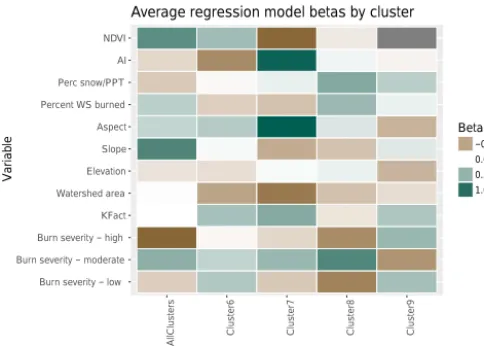
Spearman correlation identified NDVI, aridity index, per-cent of a watershed’s precipitation that falls as rain, and slope as being positively correlated with post-fire streamflow re-sponse. This metric also suggested a negative correlation be-tween response and the soil erodibility factor, watershed area, and percent low burn severity. Regression models identified only moderate burn severity and watershed area as being con-sistently positively/negatively correlated, respectively, with response. The random forest model identified only slope and percent area burned as significant watershed parameters con-trolling response.
Results will help inform post-fire runoff management de-cisions by helping to identify expected changes to flow regimes, as well as facilitate parameterization for model ap-plication in burned watersheds.
1 Introduction
mid-1980s. The greatest increases in fire frequency were found to occur in mid-elevation forests, most commonly in the North-ern Rockies, Sierra Nevada, southNorth-ern Cascades, and west-ern coast ranges in northwest-ern California and southwest-ern Oregon (Littell et al., 2009). This marked change is strongly corre-lated with climate change impacts, such as warmer springs and longer dry seasons, commonly in occurrence with re-duced winter precipitation rates and earlier spring snowmelt. Overall, Westerling et al. (2016) determine that, though land-use history may be a significant factor in the spatial distri-bution of wildfires within specific forest types, changes in fire regimes in the western US are most likely attributable to recent changes in climate. Other notable research has also provided significant correlative evidence between climate change and wildfire occurrences (Littell et al., 2009; Moritz et al., 2010).
Though wildfires are a part of the natural process of vege-tation dynamics, they cause wide-ranging changes to ecosys-tems (Neary, 2003; Santos et al., 2015) depending on numer-ous factors, most importantly burn severity. Studies examin-ing the effects of wildfires on a small scale, such as in plot-sized and laboratory experiments, show high fire tempera-tures can result in the combustion of organic matter within soils and cause permanent alteration to the chemical struc-ture of local clays, decreasing soil stability (Shakesby and Doerr, 2006). Water-repellent soil layers can be created in a discrete layer on or below the soil surface through chemical bonding of the combusted organic matter to mineral particles, potentially increasing overall topsoil erosion rates in burned regions (Wilkinson et al., 2009), though this hydrophobicity is highly variable, depending on fire behavior, burn severity, and soil properties (DeBano, 2000).
At larger scales, such as entire watersheds or multiple wa-tershed systems, studies of post-fire erosion rates have shown incompatible conclusions (Moody and Martin, 2001; Owens et al., 2013; Smith et al., 2011), though this is most likely due to the variability of precipitation events and general climate patterns (Moody et al., 2013). In terms of water quality, con-taminant levels can be dramatically increased for many years after a wildfire in both soil (Burke et al., 2010) and stream systems (Emelko et al., 2011; Stein et al., 2012; Burke et al., 2013), increasing the workload on source water protec-tion organizaprotec-tions in communities reliant upon burned wa-tersheds for drinking and agricultural water. Furthermore, wildfires are readily attributed as the cause of substantial in-creases in debris flows (Benavides-Solorio and MacDonald, 2001; Cannon et al., 2001; Meyer et al., 2001).
Studies evaluating post-fire water yield change are highly disparate owing to the transient nature of climate patterns, variations in basin geomorphology, and vegetation recovery patterns, and the resulting complex interactions (Moody et al., 2013). For example, studies in rangeland regions of the US found moderate increases in flow, infiltration, and ero-sion rates after major wildfires, with trends continuing for as long as 15 years (Emmerich and Cox, 1994; Pierson et
al., 2009; Hester et al., 1997; Kinoshita and Hogue, 2015). Fires in chaparral environments, such as in southern Cali-fornia, exhibited increased flows of up to as much as 2 or-ders of magnitude, with much of this occurring in the dry season (Coombs and Melack, 2013; Kinoshita and Hogue, 2011, 2015; Loáiciga et al., 2001). Fires in other chaparral environments were found to also yield flow increases, such as in South Africa (Lindley et al., 1988; Scott, 1993), Cyprus (Hessling, 1999), and France (Lavabre et al., 1993). Addi-tional increases to post-fire flow regimes were found in tem-perate, forested catchments as well (Neary et al., 2005; Wat-son et al., 2001). A concise summary of historic changes in US post-fire stream systems is found in Neary et al. (2005), documenting changes in first-year runoff and peak flows, en-compassing a range of ecological regions. Conversely, sev-eral studies found limited or no significant changes to hydro-logic systems post fire, or attributed fluctuations to natural annual variability (Aronica et al., 2002; Bart and Hope, 2010; Britton, 1991; Townsend and Douglas, 2000).
These discrepancies in post-fire flow response lead to the question of which watershed characteristics have the greatest influence over the observed response. Moody et al. (2013) provide a succinct summary of soil-related theories, such as reduced infiltration due to increases in soil-water repel-lency, increased overland flow velocities due to increased bare ground, and reduced infiltration caused by soil-sealing. Theories commonly found in the literature attribute flow changes to a wider range of factors, including reduction in interception and evapotranspiration (Lavabre et al., 1993; Scott, 1993) and increased hydrophobicity of soils (Neary et al., 2005). In regards to altered peak flows, conflicting ev-idence is found regarding the importance of burned water-shed areas, with some studies finding an inverse correlation between peak flows and watershed size (Biggio and Cannon, 2001; Neary et al., 2005) and others finding no relation at all (Bart and Hope, 2010).
Watersheds
Figure 1.Continental United States-scale map of the locations of the 82 watersheds utilized in this study.
2 Study area
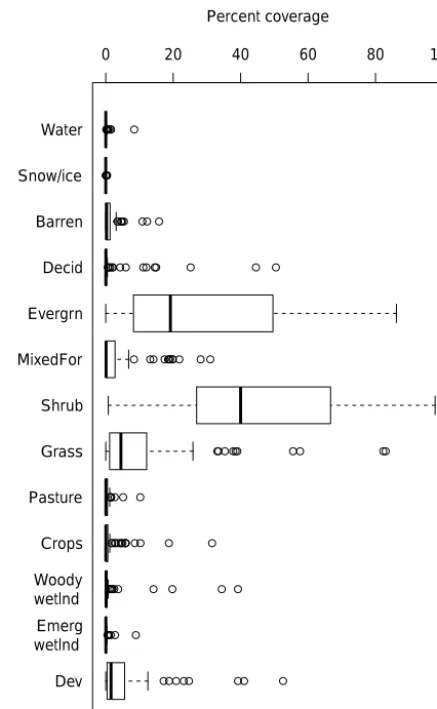
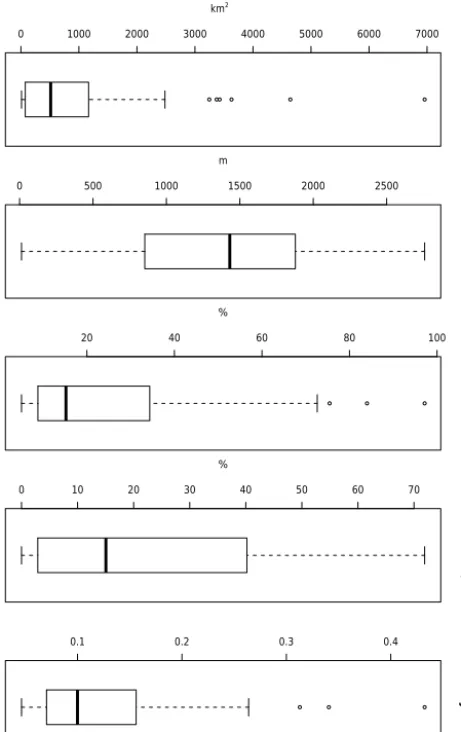
A total of 82 burned watersheds were utilized in the current study (Fig. 1), encompassing a range of spatial, temporal, cli-matological, and topographic factors (Figs. 2 and 3). Selected watersheds were limited to those with burn areas of >5 % and adequate discharge records (continuous 15-year daily flow, including 10 years pre-fire and 5 years post-fire) (U.S. Geological Survey, 2014) identified through the GAGES-II database (Falcone, 2011). The majority of available water-sheds are overwhelmingly found in the western US, predom-inantly in California, Oregon, and Idaho, with several located in the northeast, Florida, and Kentucky. Due to discharge and burn severity data limitations, the fires cover a tempo-ral range from water years 1984 through 2010. A water year is the 12-month period 1 October through 30 September des-ignated by the calendar year in which it ends. Percent area burned ranges from 5 to 97 %, with a mean of 25 %, over a range of watershed areas from 4.6 to 7000 km2. The wide spatial distribution of the studied watersheds results in mean elevations and burn-area slopes varying from 13 to 2760 m and from 0.11 to 16 %, respectively (Fig. 2).
The most important difference between many of these wa-tersheds is the variability in climate, the values of which were collected from the GAGES-II dataset (Falcone, 2011). GAGES-II watersheds have at least one 20-year period with continuous daily flow records. Average basin precipitation ranges from 29 to 220 mm yr−1, with a mean of 72 mm yr−1, and average temperature ranges from 1.4 to 23◦C, with a mean of 10◦C. Important for identifying snow dominated re-gions is the percent of precipitation (PPT) that falls as snow (%Snow/PPT), which ranges from 0 to 72 % for the study watersheds. Relative humidity ranges from 39 to 73 %, with a mean of 55, and potential evapotranspiration ranges from 400 to 1200 mm yr−1, with a mean of 633 mm yr−1.
Vegetation types vary across the watersheds as well. Ev-ergreen forest and shrub vegetation are the dominant land cover type over most watersheds used in this study (Fig. 2). The high proportion of evergreen is due to the dominance
0 20 40 60 80 100
W
ater
shed land co
ver distrib
ution
Percent coverage
Water
Snow/ice
Barren
Decid
Evergrn
MixedFor
Shrub
Grass
Pasture
Crops
Woody wetlnd
Emerg wetlnd
[image:3.612.52.286.68.198.2]Dev
Figure 2.Boxplot of National Land Cover Database (Homer et al., 2004) distribution across study watersheds.
of this study’s high elevation fires in mountainous regions and shrub prevalence is due to the abundance of study water-sheds found in the chaparral regions of southern California. Grassland, mixed forest, and developed land account for a smaller proportion of land cover types. Barren land and wet-land account for only a small percentage of wet-land cover types throughout the watersheds in this study.
3 Methods 3.1 Data collection
0 1000 2000 3000 4000 5000 6000 7000
Area
km2
0 500 1000 1500 2000 2500
Ele
v
ation
m
20 40 60 80 100
P
e
rcent burned
%
0 10 20 30 40 50 60 70
%
0.1 0.2 0.3 0.4
Aridity inde
x
P
e
rcent sno
[image:4.612.51.282.68.434.2]w/PPT
Figure 3.Boxplots summarizing the distribution of watershed area, elevation, percent area burned, percent precipitation that falls as snow, and aridity index across study watersheds.
3.1.1 Watershed selection
Selected watersheds were required to have continuous daily flow records (>95 % of daily flow records accounted for in each year) for a minimum of 10 years pre-fire and 5 years post-fire. Using the approximately 9000 watersheds in the GAGES-II dataset (Falcone, 2011), delineated watersheds were spatially cross-referenced with the Monitoring Trends in Burn Severity (MTBS) database of historic wildfires from 1984 to 2010 (Eidenshink et al., 2007). The results were again cross-referenced with USGS daily flow records (U.S. Geological Survey, 2014) to identify watersheds with the re-quired flow records, resulting in 263 unique watersheds in the US with greater than 5 % total burn area in a single water year. Of these, 23 contained 2–3 wildfires within the same year, burning over 5 % of the total area. The remainder con-tained only a single significant fire in the year of interest. Further exclusion of watersheds was based on the presence
of major dams within the watershed flow regimes extracted from the GAGES-II database (Falcone, 2011), resulting in a final collection of 82 watersheds.
3.1.2 Streamflow and precipitation data
Daily flow and peak flow data were obtained from the USGS National Water Information System (U.S. Geological Survey, 2014) subset for the range of 10 years pre-fire and 5 years post-fire for each selected watershed. Monthly precipitation data were collected from the PRISM database, a nation-wide 4 km resolution gridded monthly dataset that extrapolates station climate measurements over unmonitored areas using a topographic- and climate-based algorithm (PRISM Climate Group, 2004). Monthly national precipitation rasters were averaged for each watershed for all months within the flow record period.
3.1.3 Climatological data
Watershed climatological parameters included percent of precipitation that falls as snow (%Snow/PPT) and the aridity index (AI). The %Snow/PPT for each watershed was avail-able through the GAGES-II dataset (Falcone, 2011) and the aridity index was calculated for each watershed as
AI= Pavg
PETavg
, (1)
where Pavg is average annual precipitation and PETavg is
average annual potential evapotranspiration, both of which were available in the GAGES-II dataset.
3.1.4 Burn severity data
the percent area burned of the total watershed area. Values were categorized as unburned low severity, moderate sever-ity, and high severity (Eidenshink et al., 2007).
3.1.5 Vegetation data
Vegetation data were identified for each burn area prior to the fire event. Due to the temporal gaps in the National Land Cover Database (Homer et al., 2004), an averaged normal-ized difference vegetation index (NDVI) was collected for pre-fire burn areas to quantitatively summarize vegetation conditions, similar to previous studies (Barbosa et al., 1999; Kinoshita and Hogue, 2011; Lee and Chow, 2015). NDVI is defined as
NDVI=anir−avis anir+avis
, (2)
whereanirandavisare surface reflectance averaged over the
ranges of wavelengths in the near infrared and visible spec-trums, respectively. Despite NDVI having been shown to have accuracy issues related to atmospheric interference and variations in soil brightness (Carlson and Ripley, 1997), the extended timespan over which values were being averaged may have muted any such error responses.
Average values were collected for each watershed through national 32-day NDVI rasters hosted on Google Earth Engine (GEE) (Google, Inc., 2015), in turn calculated from Land-sat5 composite satellite data freely available through the U.S. Landsat archive at the USGS Earth Resources Observation and Science (EROS) Center (Woodcock et al., 2008). Mean NDVI values were produced for the burn areas of all water-sheds for 4 years pre-fire.
3.1.6 Soils data
Soils data were collected through an adapted version of the State Soil Geographic (STATSGO) database, a national col-lection of over 78 000 polygons containing a host of soil char-acteristics (Schwartz and Alexander, 1995). The soil erodi-bility factor (KFact) was utilized to numerically represent average soil types, as it provides a quantitative description of a soil’s erodibility. The calculation included values of par-ticle size, percent organic matter, percent clay, soil struc-ture index, and profile-permeability class factor (Goldman et al., 1986). KFact increases as the potential erodibility of a soil increases.
3.1.7 Topographic data
Utilized topographic information included watershed area and the elevation, slope, and aspect of burn areas, calculated through a 30 m resolution continental US (CONUS) digi-tal elevation model (U.S. Geological Survey, 2015). Percent burn areas of watersheds were calculated by intersection of watersheds with MTBS fire polygons.
3.2 Response variables
A range of response values were selected to quantify post-fire flow changes across a variety of flow conditions, including flows relating to dry season (low flows, baseflows) and wet season (high flows, peak flows).
3.2.1 Low, high, and peak flows
Low flow and high flow metrics were calculated for each of the 10 water years prior to the fire water year and averaged to produce a single value. A low flow value for water was computed as the average of mean daily flows with a 90 % ex-ceedance. To reduce calculation bias due to zero flow days commonly found in ephemeral stream systems, zero flow days were eliminated from exceedance value calculations. High flows were defined similarly, with a 10 % exceedance threshold used to isolate larger volume flows (Kinoshita and Hogue, 2015). Changes in low flows and high flows were calculated as the post-fire percent change from the average of 10 water years pre-fire. Post-fire values were calculated for the first year, the second year, and the 5-year mean. Peak flows were defined as the largest daily mean flow measure-ment each water year and post-fire changes were calculated as the percent change of the first year, second year, and 5-year mean peak flow measurements from the pre-fire 10-5-year mean. Percent changes in the number of zero flow days were calculated similarly.
3.2.2 Runoff ratios
The runoff ratio is defined as the fraction of total annual runoff depth over total annual precipitation:
RO=Qtot/Aws
Ptot , (3)
wherePtotis total annual precipitation,Qtot is total annual runoff depth, andAws is watershed area. Runoff ratio was calculated for the 10 years pre-fire and 5 years post-fire us-ing PRISM precipitation and USGS mean daily flow data. Post-fire runoff ratio response was calculated as the percent change between the first year, second year, and average 5-year values post-fire and the pre-fire 10-5-year mean.
3.2.3 Baseflow and Richards–Baker indices
Baseflow index, defined as the fraction of total streamflow that is baseflow (Baker et al., 2004), was calculated for each water year through the “hydrostats” R package (Bond, 2015), which applies the Lyne–Hollick filter (Ladson et al., 2013). Baseflow index response was calculated as the per-cent change in the first-, second-, and 5-year post-fire from the mean of the 10-year pre-fire.
on daily flow data through the equation
R–B index=
Pn
i=1|qi−qi−1|
Pn
i=1qi
, (4)
whereqis mean daily flow andiis time (Baker et al., 2004). Richards–Baker response was calculated as the percent change from the average value over the 10 years pre-fire to the average 1, 2, and 5 years post-fire.
3.3 k-means clustering
To create region-specific regression models, watersheds were classified into unique areas through k-means clustering (MacQueen, 1967) based on all GAGES II watersheds. This approach partitions an N-dimensional population of obser-vations into clusters with minimal variation, allowing for rel-atively simple similarity grouping. For the current study, the ideal ensemble of clusters was one that produced easily rec-ognizable regions with unique climatological characteristics. Large-scale clustering methods have been applied in prior watershed classification studies, but utilized more complex streamflow and ecological indices as parameters (McMana-may et al., 2014; Poff, 1996).
Wildfires in this study are primarily in western evergreen and shrub environments, so clustering using only these wa-tersheds would likely produce regions biased by fire occur-rence. To limit this impact, we applied the mclust pack-age in R (Fraley et al., 2012) to cluster using the entire 9000 GAGES-II watershed to produce national regions. The mclust package was chosen over the standard kmeans func-tion in R due to its inclusion of numerous model-based ap-proaches and application of the Bayes information criterion (BIC) to determine the most accurate model and cluster count (Schwarz, 1978). Various groupings of simple parameters were used for clustering, including watershed latitude and longitude, elevation, AI, %Snow/PPT, and mean monthly and seasonal flow statistics.
3.4 Control evaluation methods
Characterization of the influence of watershed geophysical parameters on flow response was performed using three ap-proaches. First, calculation of the Spearman correlation coef-ficient between independent and response variables. Second, calculation of two types of regression equations: (1) a stan-dard multiple linear regression model, and (2) a logistic re-gression model where responses greater than 20 % are as-signed a value of 1 and responses less than 20 % relative to pre-fire conditions are assigned a value of 0. Third, appli-cation of a conditional inference tree algorithm through the “party” package in R (Hothorn et al., 2006). This algorithm, also called the random forest method, first applies a signif-icance test to identify the independent variables that have the strongest association with the response variable. It then
Clustered GAGES−II watersheds
[image:6.612.312.546.65.199.2]Cluster 1 Cluster 2 Cluster 3 Cluster 4 Cluster 5 Cluster 6 Cluster 7 Cluster 8 Cluster 9
Figure 4.CONUS-scale map of the results ofk-means clustering of the GAGES-II watershed set by climate variables.
Clustered study watersheds
Cluster 1 Cluster 4 Cluster 5 Cluster 6 Cluster 7 Cluster 8 Cluster 9
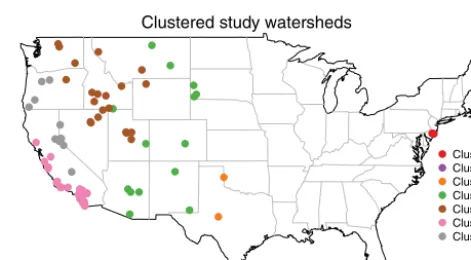
Figure 5.CONUS-scale map of thek-means clustered study water-sheds.
searches for the best split points in those independent vari-ables to partition the data into a tree.
4 Results and discussion 4.1 Clustering
[image:6.612.310.546.247.377.2]me-51
5
Low burn severity
P
ercent
6 7 8 9 05
1
5
Moderate burn severity
P
ercent
6 7 8 9
01
0
2
0
High burn severity
P
ercent
6 7 8 9 0.05
0.30
KFACT
6 7 8 9
0
4000
Watershed area
k
m
2
6 7 8 9 500
2500
Elevation
m
6 7 8 9
51
5
Slope
degrees
6 7 8 9 100
250
Aspect
degrees
6 7 8 9
20
60
Perc watershed burned
Cluster
P
ercent
6 7 8 9
03
0
7
0
Perc snow/PPT
Cluster
P
ercent
6 7 8 9
0.1
0.3
AI
Cluster
6 7 8 9 0.15
0.40
NDVI
Cluster
[image:7.612.113.485.66.316.2]6 7 8 9
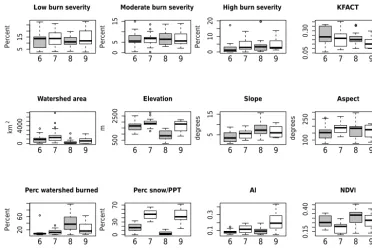
Figure 6.Boxplots of the variation in explanatory variables by cluster.
Figure 7.Boxplot of the distribution of response variables utilized in this study. Nzero refers to the number of zero flow days.
dian, in Cluster 8 watersheds. Cluster 9 watersheds have the lowest median KFact and second highest median elevations. These watersheds also have high %Snow/PPT and AI. 4.2 Response variable distribution and analyses Calculated flow response variables indicate an extremely wide range of post-fire system responses (Fig. 7). The great-est ranges occur within variables representing changes in low flows, such as first-year change to the number of zero flow days (SD=243 %), first-year baseflow index (236 %),
and 5-year change to the number of zero flow days (201 %). The tightest ranges are typically found within mean 5-year variables where extreme changes are muted, such as 5-year Richards–Baker (28 %), runoff ratio (39 %), and baseflow in-dex (48 %). Response variable means range from as low as 0.92 % (5-year Richards–Baker) to as great as 115 % (first-year change to the number of zero flow days). Due to the nature of response calculations, the number of zero flow day values were limited. First- and second-year zero flow day re-sponses were found for only 22 watersheds, and for 27 wa-tersheds for the 5-year values.
4.2.1 Trend analysis
[image:7.612.49.285.364.530.2]0 200 600
0
400
5 year mean % change 1st year
1st year % change
(a) Comparison of percent changes in low flows (n = 82/82)
0 200 600
5 year mean % change 2nd year
2nd year % change 0 200 600
0
400
5 year mean % change 1st year
1st year % change
(b) Comparison of percent changes in high flows (n = 82/82)
0 200 600
5 year mean % change 2nd year
2nd year % change
−100 100 300
−100
200
5 year mean % change 1st year
1st year % change
(c) Comparison of percent changes in runoff ratios (n = 82/82)
−100 100 300
5 year mean % change 2nd year
2nd year % change 0 200 600
0
400
5 year mean % change 1st year
1st year % change
(e) Comparison of percent changes in peak flows (n = 82/82)
0 200 600
5 year mean % change 2nd year
2nd year % change
0 500 1500
0
1000
5 year mean % change 1st year
1st year % change
(f) Comparison of percent changes in baseflow index (n = 82/82)
0 500 1500
5 year mean % change 2nd year
2nd year % change −100−100 100 300
200
5 year mean % change 1st year
1st year % change
(g) Comparison of percent changes in R−B index (n = 82/82)
−100 100 300
5 year mean % change 2nd year
[image:8.612.106.492.72.353.2]2nd year % change
Figure 8.Scatterplots of first- and second-year response variables versus 5-year means with lines-of-best-fit.
20 40 60 80 100
0
400
Percent burned
% change in LF
Low flows
20 40 60 80 100
0
400
Percent burned
% change in HF
High flows
20 40 60 80 100
0
400
Percent burned
%
ch
a
n
g
e
i
n
R
O Runoff ratios
20 40 60 80 100
0
400
Percent burned
% change in Nz
Nzeros
20 40 60 80 100
0
400
Percent burned
% change in PF
Peak flows
20 40 60 80 100
0
400
Percent burned
% change in BF
Baseflow index
20 40 60 80 100
0
400
Percent burned
% change in RB
R−B index
1st year 2nd year 5 year mean
1st year 2nd year 5 year mean
Response variables versus percent area burned
[image:8.612.105.493.404.680.2]− 1 0 0 1 02 03 0 Relativ
e percent change
Relative low flow
Year one
Year t wo
Five y ear 6 7 8 9 6 7 8 9 6 7 8 9
C: −20 0 2 0 4 0 Relativ
e percent change
Relative high flow
Year one Year t wo Five y ear 6 7 8 9 6 7 8 9 6 7 8 9 C:
Comparison of relative change in response by cluster
−20 0 1 0 2 0 3 0 Relativ
e percent change
Relative runoff ratio
Year One Year t wo Five y ear 6 7 8 9 6 7 8 9 6 7 8 9 C: − 2 0 0 2 04 06 0 Relativ
e percent change
Relative peak flow
Year one Year t wo Five y ear 6 7 8 9 6 7 8 9 6 7 8 9
C: −20 −10 0 1 0 2 0 Relativ
e percent change
Relative baseflow index
Year one Year t wo Five y ear 6 7 8 9 6 7 8 9 6 7 8 9
C: −10 0 5 10 20 Relativ
e percent change
Relative R– B index
[image:9.612.99.497.73.351.2]Year one Year t wo Five y ear 6 7 8 9 6 7 8 9 6 7 8 9 C:
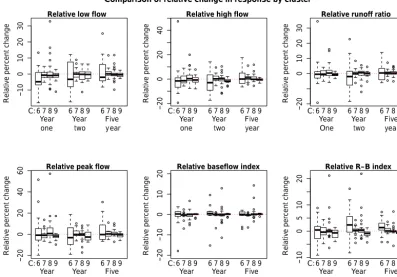
Figure 10.Boxplots of relative response variables by cluster. Relative response is actual response divided by percent area burned, in order to show response relative to fire size.
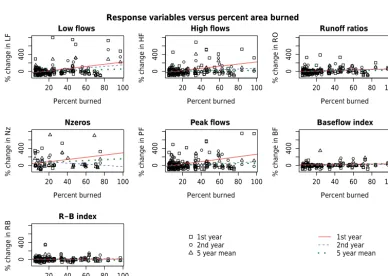
fire size. Overall, the number of zero flow days is observed to increase post-fire, though due to both a small sample size and a short time period, results are most likely unreliable. Only Richards–Baker indicates little linear correlation with burn area, yielding marginal first- and second-year slopes, and 5-year mean values decrease with percent area burned.
These findings largely confirm those of previous studies which posit that streamflow response tends to be greatest immediately following a wildfire. While there is substantial noise in the data, we find similar results. While response tends to increase overall within 5 years of a wildfire, the greatest increases are frequently found within the first year. 4.2.2 Response variability by cluster
Boxplots for response variables show differences across the four useful clusters noted above (Fig. 10). In this instance and that of the CONUS plots, all variables are scaled by divid-ing the variable by the percent area burned of the watershed in order to show relative response. Generalizing variability and magnitudes, dramatic differences can be established be-tween clusters. Most noteworthy is Cluster 9, which domi-nantly produces negative streamflow responses post-fire. The largest magnitude relative responses are found in Cluster 6, which results in the greatest variability between variables (SD=8.5). The most positive responses are found in Clus-ter 8, which frequently exhibits large positive responses and
infrequent low negative responses. Cluster 7 produces low magnitude responses. Though they are, on average, positive, there are also several negative responses.
Evaluating cluster responses when they are not scaled rel-ative to fire size percent area burned shows many similarities to the transformed results (not shown). For instance, aver-age response in Cluster 9 is still dominantly negative with an overall low magnitude. Cluster 8 demonstrates the greatest overall variability and magnitude. On average, response in this cluster is strongly positive. Cluster 7 responses are small relative to other clusters in this study with a negative trend. Cluster 6 still exhibits high variability and low magnitude. What we surmise from these results is that watersheds in the Cluster 8 region will most likely be impacted the most from wildfire in terms of flow response. Watersheds in Clusters 7 and 9 see substantially lower responses, if any at all. Clus-ter 6 may prove to be the most difficult to predict due to its high variability in response.
0.0
0.8 LF HF
0.0
0.8 RO PF
BFI
0.0
0.8
0 25 50 75 100
RB
25 50 75 100
Percent burn cutoff
R
2
ad
j
an
d
r
Simple regression: 1st year
0.0
0.8 LF HF
0.0
0.8 RO PF
BFI
0.0
0.8
0 25 50 75 100
RB
25 50 75 100
Percent burn cutoff
R
2
ad
j
an
d
r
Simple regression: 2nd year
0.0
0.8 LF HF
0.0
0.8 RO PF
BFI
0.0
0.8
0 25 50 75 100
RB
25 50 75 100
Percent burn cutoff
R
2
ad
j
an
d
r
Simple regression: 5 year mean
R2adj
R2adj>0.5
R2adj>0.5
r r <0.05
[image:10.612.115.481.62.342.2]r <0.05
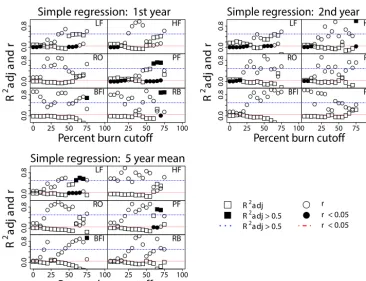
Figure 11.Scatterplots of the adjustedR2and p-value results (r) of simple linear regression modeling of response variables versus an increasing percent burn limitation. Response variables are abbreviated as LF (low flow), HF (high flow), RO (runoff ratio), PF (peak flow), BFI (baseflow index), and RB (Richards–Baker).
the largest response values in the first year after a fire. Rela-tive values tend to be negaRela-tive in the second year and posiRela-tive over the 5-year mean. Actual values are still positive in the second year.
By examining response values by cluster, we are able to identify more intricate and robust trends than by simply ex-amining the dataset as a whole. Spatially, we find that wa-tersheds in Cluster 8 produce much greater and more pre-dictable post-fire flow responses than watersheds in Clus-ters 6, 7, and 9. Responses in ClusClus-ters 7 and 9, overall, tend to be low magnitude and negative. Cluster 6 watersheds yield highly variable responses. Watersheds in Cluster 8 follow the temporal trend found when examining all study watersheds as a whole, with the greatest responses occurring in the first post-fire year and decreasing over time. However, the mag-nitude of the response of these fires skewed the results of the generalized examination at the beginning of this section. Cluster 7 watersheds, in fact, produce decreased responses in the first-year post-fire with increased flows occurring at the second-year and 5-year mean time periods. Clusters 6 and 9 exhibit little to no temporal trends at all.
Variability in response variables also generally decreases with increasing percent watershed burned. Linear regression modeling of response variables by percent watershed burned yields the error statistics found in Fig. 11 (i.e., decreas-ing sample size with increasdecreas-ing percent area burned).
Fig-ures include the adjustedR2 andp-value significance tests (α=0.05). Generally, linear modeling of first-year response variables increases in accuracy as included values are limited by increasing percent burn area. First-year low-flow, high-flow, peak-high-flow, and Richards–Baker variables show substan-tial increases in adjustedR2 once included watersheds are limited to those exceeding a 50 % burn area (n=12). In-cludedp values indicate that several of the first-year low-flow and peak-low-flow models are statistically significant.
Burn severity − low Burn severity − moderate Burn severity − high KFact Watershed area Elevation Slope Aspect Percent WS burned Perc snow/PPT AI NDVI
AllClusters
Cluster6 Cluster7 Cluster8 Cluster9
[image:11.612.313.548.63.238.2]Cluster Var iab le Cor −0.2 −0.1 0.0 0.1 0.2 Spearman correlation by cluster
Figure 12.Heatmap of the averaged Spearman correlation coeffi-cients of independent variables versus response variables, by clus-ter. WS refers to watershed.
The results from Cluster 8, a dominantly chaparral en-vironment, agree with other studies within the same re-gion (Coombs and Melack, 2013; Kinoshita and Hogue, 2011, 2015; Loáiciga et al., 2001) and in chaparral environ-ments outside the United States (Hessling, 1999; Lavabre et al., 1993; Lindley et al., 1988; Scott, 1993). As mentioned in the introduction, some studies find little to no change in streamflow post-fire (Aronica et al., 2002; Bart and Hope, 2010; Britton, 1991; Townsend and Douglas, 2000). 4.3 Influence of geophysical parameters on response 4.3.1 Spearman correlation
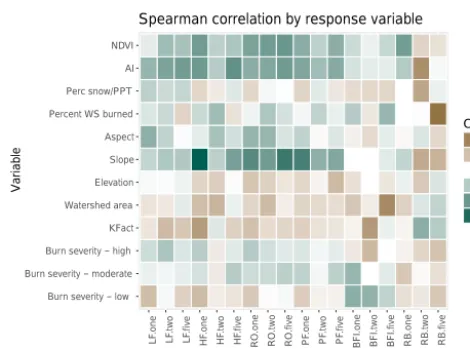
Spearman correlation between the independent and de-pendent variables, averaged across response variables, shows inconclusive results (Fig. 12). Generally, NDVI, AI, Snow/PPT, and slope are positively correlated with flow re-sponse. Low burn severity area, KFact, and watershed area are typically negatively correlated with flow response. Thus, as NDVI, AI, %Snow/PPT, and slope increase, response creases. As low burn severity, KFact, and watershed area in-crease, response decreases. More difficult to interpret are the results for other independent variables, including moderate burn severity, high burn severity, and elevation. The corre-lation of these variables appears to switch from positive to negative by cluster. Ascertaining a significance for their rela-tionships may be impossible via correlation for such a small sample size.
Correlation coefficients tend to be most different within Cluster 6, where NDVI, AI, percent area burned, KFact, high burn severity, and moderate burn severity show values con-tradicting those produced for Clusters 7–8, as well as for the fires as a whole. This is most likely indicative of a significant difference in response patterns for the region. Unfortunately,
Burn severity − low Burn severity − moderate Burn severity − high KFact Watershed area Elevation Slope Aspect Percent WS burned Perc snow/PPT AI NDVI LF .one LF .tw o LF .fiv e HF .one HF .tw o HF .fiv e R
O.one RO.tw
[image:11.612.49.289.68.236.2]o R O.fiv e PF .one PF .tw o PF .fiv e BFI.one BFI.tw o BFI.fiv e RB.one RB.tw o RB.fiv e Response Var iab le Cor −0.2 −0.1 0.0 0.1 0.2 0.3 Spearman correlation by response variable
Figure 13.Heatmap of Spearman correlation coefficients of inde-pendent variables versus each response variable, for all watersheds. Response variables are abbreviated as LF (low flow), HF (high flow), RO (runoff ratio), PF (peak flow), BFI (baseflow index), and RB (Richards–Baker). “One”, “Two”, and “Five” refer to the year of the response variable. WS refers to watershed.
identifying significant trends is difficult given the relatively small dataset currently available.
Figure 13 demonstrates the correlation coefficients found across all burned watersheds. The largest absolute correlation value is 0.32, only 20 % of coefficients are greater than 0.10, and only 10 correlations are statistically significant according to asymptoticpvalues. As relative fire size is progressively limited to larger and larger values, correlation coefficients increase. NDVI, AI, percent watershed burned, slope, high burn severity, and moderate burn severity are dominantly positively correlated with flow response. Low burn severity, KFact, and watershed area are dominantly negatively corre-lated with flow response. Elevation and %Snow/PPT display more varied correlations, but are generally negatively cor-related with flow response. From these results, we can sur-mise that as the NDVI, AI, percent area burned, slope, and moderate/high burn severity area increase, flow response val-ues will increase as well. Furthermore, as low burn severity, KFact, and watershed area increase, flow response will de-crease.
4.3.2 Regression
Burn severity − low Burn severity − moderate Burn severity − high KFact Watershed area Elevation Slope Aspect Percent WS burned Perc snow/PPT AI NDVI
AllClusters
Cluster6 Cluster7 Cluster8 Cluster9
Cluster
Var
iab
le
Beta
−0.5 0.0 0.5 1.0
[image:12.612.48.290.66.239.2]Average regression model betas by cluster
Figure 14.Heatmap of the averaged regression model beta values for each cluster. WS refers to watershed.
agreement, showing negative correlation with response. All other independent variables that were dominant under Spear-man correlation are either too variable between clusters to accurately characterize, or are opposed to the correlation re-sults. For instance, NDVI and AI can be strongly positively or negatively correlated with response depending on cluster. Clusters 7 and 8 demonstrate an expected response of inverse correlation between NDVI and runoff; i.e., as vegetation be-comes denser and ET processes recover, less water exits the watershed through streamflow.
Similarly, as AI increases, streamflow increases; i.e., in more arid watersheds post-fire vegetation is likely less dense, using less water and releasing more water through stream-flow. However, in Cluster 6, NDVI appears to be positively correlated with streamflow and AI negatively correlated. Thus, as vegetation density increases and aridity decreases, streamflow increases. These unexpected deviations in trends may be due in part to climate fluctuations that can have a strong impact on results due to the small sample size. High burn severity is shown to be negatively correlated with re-sponse for Clusters 6, 7, and 8 and all clusters combined. Be-cause the sample size of these clusters is so small (ranging fromn=12 to 29), regression results may not be appropri-ate.
4.3.3 Random forest
Application of the random forest method provided little fur-ther insight into controlling watershed parameters. Apply-ing the algorithm to the response values resulted in signifi-cant trees for only first-year low flow, high flow, runoff ratio, and peak flow, as well as for second-year low flow. For the low-flow response variables, area burned and aspect were the dominant controlling independent variables. For first-year low flow, watersheds burned greater than 23.3 % show the greatest response. Of those burned less than that threshold,
Burn severity − low Burn severity − moderate
Burn severity − high KFact Watershed area Elevation Slope Aspect Percent WS burned Perc snow/PPT AI NDVI
AllClusters
Cluster6 Cluster7 Cluster8 Cluster9
Cluster
Var
iab
le
Beta −1.0 −0.5 0.0 0.5 1.0 Average regression model betas by cluster (logical)
Figure 15.Heatmap of logical values of the averaged regression model beta values for each cluster shown in Fig. 14. WS refers to watershed.
some significant responses are found when burn areas have an aspect greater than 215◦. For second-year low flow, the largest responses are found in watersheds burned greater than 37 %.
First-year high flow, runoff ratio, and peak flow are iden-tified as being significantly affected by slope. Slopes of 7.0, 7.0, and 9.8◦ divide response, respectively. Watersheds greater than these slopes demonstrate much greater high flow, runoff ratio, and peak flow in the first year than those with gentler slopes. This may be because steeper watersheds pro-duce greater overland flow velocities or support shallower soil layers and thus have lower water absorption rates than in more gently sloped watersheds.
4.3.4 Discussion of geophysical parameters
Through Spearman correlation, the independent variables NDVI, AI, percent area burned, slope, moderate burn sever-ity, and high burn severity are positively correlated with post-fire flow response. Low burn severity, KFact, and watershed area are negatively correlated with response. The results of several regression models are less clear, with inconstant re-lationships across all fires and clusters. Generally, they show that only moderate burn severity is dominantly positively cor-related with response and that watershed area and, somehow, high burn severity are negatively correlated with response (Fig. 15). Random forest analysis shows that significant re-lationships can be found for the first-year low-flow, high-flow, runoff-ratio, and peak-flow response variables, as well as second-year low flow. These relationships are dominated by dependence on either percent burn area or by slope.
[image:12.612.313.550.69.234.2]geophys-ical parameters to produce consistent results. What can be gleaned from the various methods used in this section is that slope is frequently a strong predictor of response. Possible reasons for this are that water absorption into soil may de-crease along steeper slopes due to greater overland flow ve-locity (i.e., less time available for absorption), or that soils along steeper slopes may be shallower, thus decreasing po-tential absorption volume. Both of these possibilities may account for increased water contribution to streamflow in re-gions with greater slope.
Support for this argument is found in the Spearman cor-relation coefficient analysis in Figs. 12 and 13, where slope is shown to be strongly correlated with low-flow, high-flow, peak-flow, and runoff responses, as well as in the random for-est analysis where slope is one of the few independent vari-ables to be identified as significant.
Determining the influence of independent variables on re-sponse at the cluster level seems, with this sample size, un-reasonable. Furthermore, several explanatory variables are significantly correlated. Although averaged linear and logis-tic regression and random forest methods identify correlated values, reducing the overall number of variables in future studies may yield more understandable models. There is too much variance in flow regimes to complete a trend analysis with groupings of the size produced in this study. However, over the next decade the sample size of this study should be able to be increased significantly and provide a more robust dataset for analysis.
5 Conclusions
Post-fire changes in streamflow are found to be highly vari-able across regions of the western US and some trends can be difficult to discern or may be non-existent. In general, flow response for the study watersheds was found to be greatest in both magnitude and variability within the first year following a fire and shown to decrease over a 5-year period. Variations in flow response can be found by examining groups of water-sheds clustered by climatic variables. We find that these gen-eral trends are dominated by the high-magnitude responses of watersheds from Cluster 8. While watersheds from Clus-ters 6 and 9 do not show identifiable trends, Cluster 7 shows decreased responses in the first year following fires and posi-tive, increasing responses in just the second year and in the 5-year means, indicating that Cluster 7 watersheds have a more delayed flow response. Trends within Cluster 8 agree with other studies within the same region and in chaparral envi-ronments in other parts of the world. This study similarly identifies several regions (Clusters 6 and 9) that also do not exhibit significant distinguishable trends.
Identification of controlling watershed parameters on re-sponse yielded weak correlation metrics. Various methods showed sometimes contrary results, or none at all. Spear-man correlation indicated that watershed slope, normalized difference vegetation index (NDVI), aridity index (AI), and percent of precipitation that falls as snow (%Snow/PPT) are positively correlated with flow response. Percent area low burn severity, soil erodibility factor (KFact), and watershed area were shown to be negatively correlated with response. These correlations largely agree with the positions asserted by Moody et al. (2013), Biggio and Cannon (2001), and Neary et al. (2005). Regression models showed that only moderate burn severity and watershed area are consistently positively and negatively correlated, respectively, with flow response. Random forest models indicated that percent area burned and slope are the only significant factors, and only for first-year response metrics.
The observed changes in streamflow following wildfire identified have wide-ranging implications for better under-standing post-fire water budgets, downstream flood response, long-term water yield, and watershed modeling. Improved streamflow predictions will ultimately allow water resource managers in water-scarce regions to anticipate surplus vol-ume in their budgeting forecast calculations and also help flood forecasters to identify areas at greater risk of damage and infrastructure overload. Identification of the influence of watershed geophysical parameters on post-fire streamflow should also enable improved calibration of regional models for burned watersheds.
Data availability. Data produced for this study are available at
Appendix A: Independent variable summaries
NDVI Normalized difference vegetation index
AI Aridity index
%Snow/PPT Percent of precipitation that falls as snow Percent watershed burned Percent of watershed area burned by wildfire
Aspect Degree aspect of burned area
Slope Degree slope of burned area
Elevation Mean elevation (m) of burned area Watershed area Area of watershed (m2)
KFact Soil erodibility factor
Competing interests. The authors declare that they have no conflict of interest.
Special issue statement. This article is part of the special issue
“Vegetation changes under a changing environment and the impacts on water and carbon cycling”. It is not associated with a conference.
Acknowledgements. This work was partially supported by a USGS
internship through the Colorado Water Science Center. We thank the reviewers for their constructive comments and insight during the review process which improved our manuscript. Any use of trade, firm, or product names is for descriptive purposes only and does not imply endorsement by the U.S. Government.
Edited by: Nadia Ursino
Reviewed by: three anonymous referees
References
Aronica, G., Candela, A., and Santoro, M.: Changes in the hy-drological response of two Sicilian basins affected by fires, in: FRIEND 2002 – Regional Hydrology: Bridging the Gap between Research and Practice, edited by: van Lanen, H. A. J. and De-muth, S., Proc. Cape Town Conf., March 2002, IAHS Press, Wallingford, UK, IAHS Publ. 274, 163–172, 2002.
Baker, D. B., Richards, R. P., Loftus, T. T., and Kramer, J. W.: A new flashiness index: Characteristics and applications to Midwestern rivers and streams, J. Am. Water Resour. As. (JAWRA), 40, 503– 522, 2004.
Barbosa, P. M., Stroppiana, D., Gregoire, J. M., and Pereira, J. M. C.: An assessment of vegetation fire in Africa (1981– 1991): Burned areas, burned biomass, and atmospheric emis-sions, Global Biogeochem. Cy., 13, 933–950, 1999.
Bart, R. and Hope, A.: Streamflow response to fire in large catch-ments of a Mediterranean-climate region using paired-catchment experiments, J. Hydrol., 388, 370–378, 2010.
Benavides-Solorio, J. and MacDonald, L. H.: Post-fire runoff and erosion from simulated rainfall on small plots, Colorado Front Range, Hydrol. Process., 15, 2931–2952, 2001.
Biggio, E. R. and Cannon, S. H.: Compilation of post-wildfire runoff data from the Western United States, U.S. Geological Sur-vey, 2004-1085, 2001.
Bond, N.: hydrostats: Hydrologic indices for daily time series data, https://rdrr.io/cran/hydrostats/man/hydrostats-package.html (last access: January 2016), 2015.
Britton, D. L.: Fire and the chemistry of a South African mountain stream, Hydrobiologia, 218, 177–192, 1991.
Burke, M. P., Hogue, T. S., Ferreira, M., Mendez, C. B., Navarro, B., Lopez, S., and Jay, J. A.: The effect of wildfire on soil mercury concentrations in southern California watersheds, Water Air Soil Poll., 212, 369–385, 2010.
Burke, M. P., Hogue, T. S., Kinoshita, A., Barco, J., Wessel, C., and Stein, E.: Pre- and post-fire pollutant loads in an urban watershed in southern California, Environ. Monit. Assess., 185, 10131– 10145, 2013.
Cannon, S. H., Kirkham, R. M., and Parise, M.: Wildfire-related debris-flow initiation processes, Storm King Mountain, Col-orado, Geomorphology, 39, 171–188, 2001.
Carlson, T. N. and Ripley, D. A.: On the relation between NDVI, fractional vegetation cover, and leaf area index, Remote Sens. Environ., 62, 241–252, 1997.
Coombs, J. S. and Melack, J. M.: Initial impacts of a wildfire on hydrology and suspended sediment and nutrient export in Cal-ifornia chaparral watersheds, Hydrol. Process., 27, 3842–3851, 2013.
DeBano, L. F.: The role of fire and soil heating on water repellency in wildland environments: a review, J. Hydrol., 231, 195–206, 2000.
Eidenshink, J., Schwind, B., Brewerm K., Zhu, Z.-L., Quayle, B., and Howard, S.: A project for monitoring trends in burn severity, Fire Ecology, 3, 3–21, 2007.
Emelko, M. B., Silins, U., Bladon, K. D., and Stone, M.: Impli-cations of land disturbance on drinking water treatability in a changing climate: Demonstrating the need for “source water sup-ply and protection” strategies, Water Res., 45, 461–472, 2011. Emmerich, W. E. and Cox, J. R.: Changes in surface runoff and
sed-iment production after repeated rangeland burns, Soil Sci. Soc. Am. J., 58, 199–203, 1994.
Falcone, J.: GAGES-II: Geospatial Attributes of Gages for Evaluat-ing Streamflow, U.S. Geological Survey, Reston, Virginia, avail-able at: https://water.usgs.gov/GIS/metadata/usgswrd/ (last ac-cess: September 2015), 2011.
Fraley, C., Raftery, A. E., Murphy, T. B., and Scrucca, L.: mclust Version 4 for R: Normal Mixture Modeling for Model-Based Clustering, Classification, and Density Estimation, De-partment of Statistics, University of Washington, Technical Re-port No. 597, 57 pp., 2012.
Goldman, S. J., Jackson, K., and Bursztynsky, T. A.: Erosion and sediment control handbook, McGraw-Hill, New York City, New York, United States, 1986.
Google, Inc.: Google Earth Engine, available at: https://earthengine. google.com/, last access: September 2015.
Hessling, M.: Hydrological modelling and a pair basin study of Mediterranean catchments, Phys. Chem. Earth Pt. B 24, 59–63, 1999.
Hester, J. W., Thurow, T. L., and Taylor Jr., C. A.: Hydrologic char-acteristics of vegetation types as affected by prescribed burning, J. Range Manage., 50, 199–204, 1997.
Homer, C., Huang, C., Wylie, B., and Coan, M.: Development of a 2001 National Landcover Database for the United States, Pho-togramm. Eng. Rem. S., 70, 829–840, 2004.
Hothorn, T, Hornik, K., and Zeileis, A.: Unbiased recursive parti-tioning: A conditional inference framework, J. Comput. Graph. Stat., 15, 651–674, 2006.
Kinoshita, A. M. and Hogue, T. S.: Spatial and temporal controls on post-fire hydrologic recover in southern California watersheds, Catena, 87, 240–252, 2011.
Kinoshita, A. M. and Hogue, T. S.: Increased dry season wa-ter yield in burned wawa-tersheds in Southern California, En-viron. Res. Lett., 10, 014003, https://doi.org/10.1088/1748-9326/10/1/014003, 2015.
Lavabre, J., Torres, D. S., and Cernesson, F.: Changes in the hy-drological response of a small Mediterranean basin a year after a wildfire, J. Hydrol., 142, 273–299, 1993.
Lee, R. J. and Chow, T. E.: Post-wildfire assessment of vegetation regeneration in Bastrop, Texas, using Landsat imagery, GISci. Remote Sens., 52, 609–626, 2015.
Lindley, A. J., Bosch, J. M., and van Wyk, D. B.: Changes in water yield after fire in fynbos catchments, Water SA, 14, 7–12, 1988. Littell, J. S., McKenzie, D., Peterson, D. L., and Westerling, A. L.: Climate and wildfire area burned in western U.S. ecoprovinces, 1916–2003, Ecol. Appl., 19, 1003–1021, 2009.
Loáiciga, H. A., Pedreros, D., and Roberts, D.: Wildfire-streamflow interactions in a chaparral watershed, Adv. Environ. Res., 5, 295– 305, 2001.
MacQueen, J.: Some methods for classification and analysis of multivariate observations, Proc. Fifth Berkeley Symp. On Math. Statist. And Prob., University of California Press, 1, 281–297, 1967.
McManamay, R. A., Bevelhimer, M. S., and Kao, S.-C.: Updating the US hydrologic classification: an approach to clustering and stratifying ecohydrologic data, Ecohydrology, 7, 903–926, 2014. Meyer, G. A., Pierce, J. L., Wood, S. H., and Jull, A. J. T.: Fire, storms, and erosional events in the Idaho batholith, Hydrol. Pro-cess., 15, 3025–3038, 2001.
Moody, J. A. and Martin, D. A.: Initial hydrologic and geomorphic response following a wildfire in the Colorado Front Range, Earth Surf. Proc. Land., 26, 1049–1070, 2001.
Moody, J. A., Shakesby, R. A., Robichaud, P. R., Cannon, S. H., and Martin, D. A.: Current research issues related to post-wildfire runoff and erosion processes, Earth-Sci. Rev., 122, 10–37, 2013. Moritz, M. A., Moody, T. J., Krawchuk, M. A., Hughes, M., and Hall, A.: Spatial variation in extreme winds predicts large wild-fire locations in chaparral ecosystems, Geophys. Res. Lett., 37, L04801, https://doi.org/10.1029/2009GL041735, 2010. National Wildfire Coordinating Group: Glossary of
Wild-land Fire Terms, available at: https://www.nwcg.gov/
glossary-of-wildland-fire-terminology, last access: July 2016. Neary, D. G.: Post-wildfire watershed flood responses, in:
Sec-ond International Wildland Fire Ecology and Fire Management Congress and Fifth Symposium on Fire Forest Meteorology, 16– 20 November 2003, Orlando, Florida, American Meteorology Society, 2003.
Neary, D. G., Ryan, K. C., and DeBano, L. F.: Wildland fire in ecosystems: effects of fire on soils and water, U.S. Department of Agriculture, Forest Service, Rocky Mountain Research Station, General Technical mReport RMRS-GTR-42-volume 4, 2005. Owens, P. N., Giles, T. R., Petticrew, E. L., Leggat, M. S., Moore,
R. D., and Eaton, B. C.: Muted responses of streamflow and sus-pended sediment flux in a wildfire-affected watershed, Geomor-phology, 202, 128–139, 2013.
Pausas, J. G., Llovet, J., Rodrigo, A., and Vallejo, R.: Are wildfires a disaster in the Mediterranean basin? – A review, Int. J. Wildland Fire., 17, 713–723, 2008.
Pierson, F. B., Moffet, C. A., Williams, C. J., Hardegree, S. P., and Clark, P. E.: Prescribed-fire effects on rill and interrill runoff and erosion in a mountainous sagebrush landscape, Earth Surf. Proc. Land., 34, 193–203, 2009.
Poff, N.: A hydrogeography of unregulated streams in the United States and an examination of scale-dependence in some hydro-logical descriptors, Freshwater Biol., 36, 71–79, 1996.
PRISM Climate Group, Oregon State University, http://prism. oregonstate.edu, last access: December 2004.
Santos, R. M. B., Sanches Fernandes, L. F., Pereira, M. G., Cortes, R. M. V., and Pacheco, F. A. L.: Water resources planning for a river basin with recurrent wildfires, Sci. Total Environ., 526, 1–13, 2015.
Saxe, S. W., Hogue, T. S., and Hay, L. E.: Post-Fire Streamflow Spatial data for Western US Watersheds: U.S. Geological Survey data release, available at: https://doi.org/10.5066/F77S7MRP, 2018.
Schwartz, G. E. and Alexander, R. B.: Soils data for the Con-terminous United States Derived from the NRCS State Soil Geographic (STATSGO) Data Base, United States Geological Survey, available at: https://www.sciencebase.gov/catalog/item/ 535ea386e4b08e65d60fb441 (last access: June 2015), 1995. Schwarz, G.: Estimating the dimension of a model, Ann. Stat., 6,
461–464, 1978.
Scott, D. F.: The hydrological effects of fire in South African moun-tain catchments, J. Hydrol., 150, 409–432, 1993.
Shakesby, R. A. and Doerr, S. H.: Wildfire as a hydrological and geomorphological agent, Earth-Sci. Rev., 74, 269–307, 2006. Smith, H. G., Sheridan, G. J., Lane, P. N. J., Nyman, P., and
Hay-don, S.: Wildfire effects on water quality in forest catchments: A review with implications for water supply, J. Hydrol., 396, 170– 192, 2011.
Stein, E. D., Brown, J. S., Hogue, T. S., Burke, M. P., and Kinoshita, A.: Stormwater contaminant loading following southern Califor-nia wildfires, Environ. Toxicol. Chem., 31, 2625–2638, 2012. Townsend, S. A. and Douglas, M. M.: The effect of three fire
regimes on stream water quality, water yield and export coeffi-cients in a tropical savanna (northern Australia), J. Hydrol., 229, 118–137, 2000.
U.S. Geological Survey: National Water Information System – NWISWeb, USGS, available at: http://waterdata.usgs.gov, ac-cessed on various dates in 2014.
U.S. Geological Survey: The national map, USGS, available at: https://nationalmap.gov/elevation.html, accessed on various dates in 2015.
Watson, F., Vertessy, R., McMahon, T., Rhodes, B., and Watson, I.: Improved methods to assess water yield changes from paired-catchment studies: application to the Maroondah paired-catchments, Forest Ecol. Manag., 143, 189–204, 2001.
Westerling, A. L.: Increasing western US forest wildfire activity: sensitivity to changes in the timing of spring, Philos. T. Roy. Soc. B, 371, 20150178, https://doi.org/10.1098/rstb.2015.0178, 2016.
Westerling, A. L., Hidalgo, H. G., Cayan, D. R., and Swetnam, T. W.: Warming and earlier spring increase western US forest wild-fire activity, Science, 313, 940–943, 2006.
Whitlock, C.: Land management: Forests, fires and climate, Nature, 432, 28–29, 2004.