Page 500
DIDACTIC TEST “THE SOIL – OUR WEALTH” (10TH GRADE) Yordanka Stefanova, Zlatka Garova
University of Plovdiv, Faculty of Chemistry, Chair of General and Inorganic Chemistry with Methodology of Chemistry Teaching, Bulgaria
Abstract
In the article are presented stages of building and realization of didactic test for diagnostics of student’s level of knowledge and manifestation of some skills. The test is picked out in real conditions during the term in chemistry classes in the 10th grade. We present an analysis of the approbation
results and based on them we make the corresponding summary to chemistry education in high school.
Key words: scientific literacy, key competences, chemistry education
1. INTRODUCTION
The problem of objective diagnostics and measurement of the level of acquired knowledge, skills and competences is one of the most important in educational practice, including chemistry education. In the recent years the interest to this problem leads to a pursuit of creating didactic tests which could widen and exclude the subjectivity in diagnostics and measurement in the educational field.
From the point of view of chemistry practice the development of the problem of creating tests for diagnostics and measurement of the level of acquired knowledge, skills and competences has been provoked by the following:
Page 501
In relation to this we aim to research the level of knowledge and the manifestation of some competences in students who are at the end of their compulsory chemistry education and which knowledge and competences are important for their life as adults.
Achievement of this aim is linked to the solution of the following tasks:
Study of literature on the issue of the classification of the didactic tests and their tasks.
Analysis of the educational contents in Chemistry and preserving the environment, whose object concrete substances are, in relation to our exploratory conception
Composing the test “The soil – our wealth” in conformity with the requirements of the theory and the methodic of composing of didactic tests
Approbation of the test in the practice of chemistry education
Analysis of the quality of tests' tasks, the test as a whole and the results for the level of students' achievements in studying Chemistry and preserving the environment in 10th grade.
Choosing this specific educational content in order to compose the didactic test has been dictated by its big cognitive and practical meaning. Soil formation is a process which passes through hundreds and thousands of years. Forming a 30cm layer of soil elapses from 1000 to 10000 years, i.e. the soil-forming process is so long that soil has been reasonally considered a non-renewable resource. Soil’s main feature is its fertility, its property to supply nutrients, water, air and warmth for plants. Solving the problem about satisfying humanity’s needs of fertile soil is narrowly linked to the problem of its preservation.
Reviewing the educational content of “Chemistry and environmental preservation” in 10th grade (Bliznakov, 2002; Pavlova, 2002), presented in student books, displays the object of study as the structure and features of most of the substances whose ions are contained in the soil and the lack of experimental tasks and the presentation of facts, connected to specifying these ions and their influence on the organisms. The question about what we should do in order to limit soil pollution is only one example of the dilemma in front of contemporary society; and the active participation of the growing generation in its solution depends on their preliminary preparation to apply scientific knowledge in real situations.
2. STAGES IN COMPOSING A DIDACTIC TEST While composing the test we have been led by:
- the test has to be in line with State Educational Requirements about the educational content and with the educational program in Chemistry and environmental preservation in 10th grade
- while composing the test we have also given an account of the changes made in the working versions of the educational programs in “Chemistry and environmental preservation”
- requirements for composing a didactic test pointed in literature (Bizhkov, G. 1996; Bizhkov, G. & Kraevski, V., 2007, Marshall & Rossman, 1998).
- European Reference Framework
Stages of creation the didactic test are as they follow: Determent of test’s aims
Test’s main aim is to specify the level of students at the end of their compulsory chemistry education in acquiring knowledge and some competences linked to the problem of preserving soil from pollution.
Page 502
Subtest 1 contains 5 exercises linked to substance spread in soil from the subject Chemistry and preservation of the environment in 10th grade. Cognitive aims of this subtest are:
1. Determent whether students can specify the links between:
- the type of chemical bond and electrolytic dissociation of substances contained in soil solution; - pH levels and nature of soil solution;
- features and spread of some specific substances;
2. Determent whether students have made sense of the links between substances’ features, their application and ecological problems raised by them.
3. Determent whether students can identify reasons for soil pollution and human activities which could lead to their preservation.
Solving these tasks requires applying knowledge about practical application, spread and meaning of the studied substances.
Subtest 2 contains 5 tasks which allow us to evaluate formation of two important for contemporary man competences: evaluating scientific problems and scientific explanation of natural processes and phenomena. Cognitive aims of this subtest are:
1. Determent whether students can apply scientific knowledge while explaining facts and phenomena linked to preservation of soil from pollution.
2. Determent whether students can recognize stages and conditions for carrying out a scientific research.
Tasks included in the subtest require students to apply knowledge about studied substances in order to explain acid rains’ influence on soil and living creatures.
Content development of tests' tasks
Task system in the test has been constructed on preliminary led empiric research of each task’s qualities. Results from the preliminary approbation have been analyzed and after that the test has been corrected and evaluated by a group of experts. So at the end the final version of the test has been formed which contains 10 exercises. Task selection was made according to following requirements: - closeness of knowledge to real life situations;
- importance of knowledge for a longer period of time; - ability to form interdisciplinary bonds;
- connection of knowledge and specific cognitive procedures.
Maximal points which can be earned by a single student after successfully working out all exercises are 30 points. Lower level corresponds with 0 to 12 points, medium – 13 to 23 points and high – up to 30 points.
We made the research during the school year 2015 – 2016. Fifty 16-year old students from Parvomay and Plovdiv have participated. The results have been processed for every student as well as for every task.
Page 503
Table 1. Criteria and indexes for evaluation of acquirement level of knowledge and some competences
Levels of students' achievements Indexes
Level of knowledge acquirement
Reproductive level of knowledge
(tasks 1, 2, 3) 2 points for each task
Solving training tasks which require knowledge applied by students in familiar situations;
Productive level of knowledge (tasks 4, 5)
3 points for each task
Solving cognitive tasks which require from students to:
Apply knowledge in new situations; Discover links and relations between facts and indexes;
Competence manifestation
Scientific explanation of natural processes and phenomena;
Determent of scientific problems;
(tasks 6, 7)
3 points for each task (tasks 8, 9, 10) 4 points for each task
Solving tasks for:
Applying scientific knowledge in a situation closer to real life.
Evaluation of problems linked to influence of substances and processes on the
environment;
Applying knowledge to explain phenomena from the surrounding reality.
Identifying features of scientific research.
3. RESULTS AND ANALYSIS
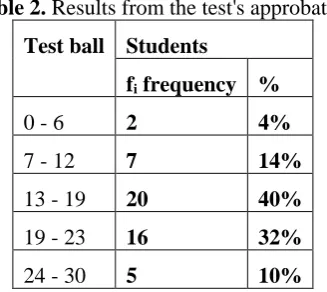
We present research results concerning indexes we have chosen in order to estimate the level of the acquired knowledge and competences in table 2.
Table 2. Results from the test's approbation Test ball Students
fi frequency %
0 - 6 2 4%
7 - 12 7 14%
13 - 19 20 40%
19 - 23 16 32%
24 - 30 5 10%
Page 504
Table 3. Absolute frequency of the number of tasks solved in the subtests
Subtest 1 Subtest 2
Points 0 -6 7 - 9 10 -12 Points 0 -6 7-11 12-15 16-18
Frequency 2 38 10 Frequency 5 32 8 5
Maximum points 12 Maximum points 18
Acquired data about students’ points from solving subtest 1 (exercise 1, 2, 3, 4, 5) shows us that students have knowledge and skills necessary for them to solve familiar not hard tasks. In Subtest 1 we include exercises with a multiple choice answer as well as such which require from students for instance to point at ways for some ions to get into soil solution, to indicate at least one reason for the change of soil’s mineral content. Analysis’ results display that most of the students do not answer questions which require a free answer.
In Subtest 2 exercises are included which need knowledge about methodology of scientific research in order to be solved by students. Working out exercise 8 and 9 requires putting different elements of information together while accomplishing a couple of consecutive activities, backing formed conclusions with arguments, showing critical and abstract thinking. In order to motivate the answer of the sixth question students need to apply knowledge from different natural sciences. Data about points gained for solving subtest 2 (exercises 6, 7, 8, 9, 10) displays that some of the students do not recognize features of the scientific research and/or meet difficulties while explaining phenomena from the surrounding universe. Results show again that most of the students do not answer questions which require a free answer.
Manifestation of skills is on medium level for most of the students who participated in the research. This shows us that the student is able to use only a few amounts of scientific knowledge, indexes, correlations to evaluate conclusions, explanations; meets difficulties while accomplishing interdisciplinary relations.
We did not observe a big difference while comparing frequencies of students’ points of the two subtests with each other. A possible reason for these results is the fact that in our student books the information about the importance and the application of studied substances and processes is traditionally displayed at the end of the lesson, most often without being connected with and based on their features where they were explained. The result is the lack of knowledge about application and importance of significant for the practice substances and processes that are applied in everyday life as well as mechanical learning of information.
4. CONCLUSION
In conclusion we could say that our research which had a limited range of students gives us the right to make the following generalizations:
1. Students at the end of their compulsory chemistry education are on a medium level of acquirement of socially important abilities which are going to help them in their lives as adults.
2. Chemistry knowledge – an object of acquirement in chemistry education - are not rationalized from practical point of view, i.e. they are “passive”. This on itself shows that priority is given to “What is being taught?” and not to “How is it being taught?” and “How do students reach knowledge?”.
Page 505 ACKNOWLEDGEMENT
Researches were conducted with the financial support of the Fund “Research and mobile projects”, Plovdiv University “Paisii Hilednarski” project NI 15 HF 001
REFERENCES
Bizhkov, G. (1996). Theory and Methodology of Didactic Tests (in Bulgarian). Sofia, “Prosveta” Publishing House.
Bizhkov, G. & Kraevski, V. (2007). Methodology and methods of pedagogical researches (in Bulgarian). Sofia University Press, Sofia.
Pavlova, М., E. Boiadgieva, V. Ivanova, M. Kirova, N. Mikova &G. Vasilev. (2002) Chemistry and environmental protection 10th grade. Pedagog6. [In Bulgarian].
Bliznakov, G., Boianova, L., Sokolova, A. & Ribarska, P. (2002). Chemistry and environmental protection 10th grade, (in Bulgarian) Anubis Publishing House, Sofia [In Bulgarian].
Marshall & Rossman. (1998) Designing Qualitative Research. Sage, Thousands Oaks
Minevska, M. & Stefanova, Y. (2007) Strategy "Skills for Life" and Program for International Student Assessment (PISA). Chemistry, (2), с.99-107, [In Bulgarian].
National Committee on Science Education Standards and Assessment. National Research Council, 1996 Available from: http://www.nap.edu/openbook.php?record_id=4962
OECD (2003a). The PISA 2003 Assessment Framework Mathematics, Reading, Science and Problem Solving knowledge and skills. Published by: OECD Publishing, Paris, p.228.
OECD (2004b). Learning for Tomorrow’s World – First Results from PISA 2003. OECD, Paris, p. 471.
OECD (2006c) Assessing Scientific, Reading and Mathematical Literacy; A Framework for PISA
2006. OECD, Paris, p.187. Available from:
http://www.oecd.org/pisa/pisaproducts/pisa2006/37464175.pdf
Key competences. European reference framework. (2007). Sofia. [In Bulgarian].
Royal Society of Chemistry. (2009). Key skills for scientists http://www.rsc.org/images/Updated_Skills_2010_tcm18-193493.pdf
Tafrova-Grigorova, A. (2013) Contemporary trends in pupils’ science education. Bulgarian Journal of
Science and Education Policy (BJSEP), 7 (1). [In Bulgarian].
Tafrova-Grigorova, A. (2011) Scientific literacy: a key goal of science education in schools
Page 506 APPENDIX 1
TEST
1. Flowers can obtain from the soil solution ions of different salts. In which row the enumerated substances can be found as ions in soil solution? Circle the correct answer.
A. CaCO3, NaCl, NH4NO3 B. MgCO3, Na2SO4, KHCO3 C. NaCl, KNO3, NH4H2PO4 D. CaCO3, KNO3, CaCl2.6H2O
2. It is known that if the soil solution is acidic, then it will have negative influence on flowers growth. This can be determined with universal indicator. Which pH values show that the solution is acidic? Circle the correct answer.
A. рН 7
B. рН 7 C. рН = 7 D. рН ≈ 7
3. Soils, that contain CO32- are called carbonated. This can be determined with HCl solution with w = 10%. Which of the chemical reactions is qualitative analysis to demonstrate the carbon ions?
A. CO2 + H2O H2CO3
B. Na2CO3 + 2HCl 2NaCl + H2CO3
C. NaOH + 2HCl 2NaCl + H2O
D. CO2 + CaO CaCO3
4. One of the following statements for soil composition and structure is wrong. Circle the correct answer.
A. The solids contain major reserves of nutrients.
B. The soil solution is the most movable, variable and active part of the soil, which flowers obtain ions from.
Page 507
5. A large part of the phosphorus which is necessary for flowers growth is contained in the soil as soluble and insoluble compounds. Its contain can be determined qualitative using a reagent for demonstrating РО43-. Which of the following substances is reagent for demonstrating РО43-?
A. AgNO3 B. KNO3 C. KSCN D. BaCl2
Express with chemical equation the qualitative analysis for detection РО43-. Specify the different ways for this ions to get in the soil solution.
6. Should everyone be responsible for protecting the soils? One of the following statements is needless, circle it.
A. Several plastic bags thrown in the field can’t be the reason for pollution the soil. B. Soils change and lose their fertility because of the nature processes of erosion.
C. Everyone is responsible for the strict observance of the international arrangements for protecting the soil, it’s fertility and resources.
D. A large part of harmful industrial emissions fall into the soil in form of powder and acid rains. Write down how you can help for protecting the soils.
7. How can we counteract the progressive pollution of soils? It’s possible to circle more than one answer.
A. When we are on an outgoing to walk on the marked routes.
B. On a trip or while on vacation to light a fire only in the exact areas for that. C. Not to throw rubbish indiscriminately, but to do it only in the designed places. D. To use less chemical fertilizer.
8. The containment, the structure and properties of soil are changing constantly because of the processes of its formation and human activities. To establish for cultivation of which crops is suitable the soil in their area, students take soil from different parts of the field where they will plant the crops. After selecting the place where they will take the sample, they removed a cube of soil and cleared it well from impurities and rubbish.
Why did the students take soil samples from different parts of the field? A. To clean more parts of the field from rubbish and impurities.
B. To take more soil for analysis.
Page 508
9. To determine the content of Cu2+ in soil solution students make the following experiments 1 and 2 1) In a test tube they pour CuSO4 solution and add dropwise K4[Fe(CN)6] solution;
2) In a test tube they put filtrate of soil and add dropwise K4[Fe(CN)6] solution. They compare the sediments in the two test tubes.
Why did the students make experiment 1?
A. To see if CuSO4 can interact with K4[Fe(CN)6];
B. Because this way more students can take part in the experiment. C. The results from experiment 1 serve as sample for comparison D. To make more experiments
Write down the reason for your answer.
10. The quantity of aluminum Al and its compounds in soil have some influence on soil solutions pH. The acid rains have influence on the solubility and the mobility of aluminum ions Al3+ As you mean the composition of acid rain specify which equation reflects the interaction between Al3 + and acid rain.
A. 2Al + 6NaOH + 6H2O 2Na3[Al(OH)6] + 6H2
B. 2Al3+ + 3SO32- Al2SO4
C. Al3+ + 3OH- Al(OH)3
D. 4Al + 3O2 2Al2O3
Explain the influence of acid rains on flowers.
Evaluation of the test's tasks
The total test ball is formed by summing the number of correct answers which correspond to a certain number of points:
Task 1. 2 points for correct answer C. Task 2. 2 points for correct answer A. Task 3. 2 points for correct answer B. Task 4. 3 points for correct answer D. Task 5. 3 points for a correct answer A. Task 6 3 points for correct answer A.