www.hydrol-earth-syst-sci.net/20/1289/2016/ doi:10.5194/hess-20-1289-2016
© Author(s) 2016. CC Attribution 3.0 License.
Enhancing the T-shaped learning profile when teaching hydrology
using data, modeling, and visualization activities
Christopher A. Sanchez1, Benjamin L. Ruddell2, Roy Schiesser3, and Venkatesh Merwade4 1Oregon State University, Corvallis, Oregon, USA
2Arizona State University, Tempe, Arizona, USA
3Chandler-Gilbert Community College, Chandler, Arizona, USA 4Purdue University, West Lafayette, Indiana, USA
Correspondence to: Christopher A. Sanchez ([email protected])
Received: 15 May 2015 – Published in Hydrol. Earth Syst. Sci. Discuss.: 1 July 2015 Revised: 11 September 2015 – Accepted: 18 March 2016 – Published: 31 March 2016
Abstract. Previous research has suggested that the use of more authentic learning activities can produce more robust and durable knowledge gains. This is consistent with calls within civil engineering education, specifically hydrology, that suggest that curricula should more often include pro-fessional perspective and data analysis skills to better de-velop the “T-shaped” knowledge profile of a professional hy-drologist (i.e., professional breadth combined with technical depth). It was expected that the inclusion of a data-driven simulation lab exercise that was contextualized within a real-world situation and more consistent with the job duties of a professional in the field, would provide enhanced learn-ing and appreciation of job duties beyond more conventional paper-and-pencil exercises in a lower-division undergraduate course. Results indicate that while students learned in both conditions, learning was enhanced for the data-driven sim-ulation group in nearly every content area. This pattern of results suggests that the use of data-driven modeling and vi-sualization activities can have a significant positive impact on instruction. This increase in learning likely facilitates the development of student perspective and conceptual mastery, enabling students to make better choices about their studies, while also better preparing them for work as a professional in the field.
1 Introduction
This call to integrate experiential learning with traditional classroom instruction is not new, and has been advocated in other fields of engineering (Duderstadt, 2007; Lattuca et al., 2006; Shulman, 2005), and has also been suggested more generally within the educational literature (e.g., Bransford et al., 1999; Brown et al., 1989). These suggestions are rooted in the simple tenet that when learners engage more deeply in the formation and development of relevant knowledge, the depth and quality of their understanding subsequently increases. This constructive process is integral to numer-ous pedagogical philosophies such as problem-based learn-ing (PBL), guided discovery learnlearn-ing, and cognitive appren-ticeship, to name a few (Alfieri et al., 2011; Brown et al., 1989; Collins, 1991; De Jong and Van Joolingen, 1998; Duch et al., 2001; Savery and Duffy, 1995; Wood, 2003).
While the various educational pedagogies mentioned above are different on several levels, they share at least two important unifying characteristics. Fundamentally, (1) they require the learner to be actively engaged in the learning ac-tivity in order to realize any learning benefit, and (2) they are usually situated within an authentic or “real” problem that the student must work to solve or address. Importantly, these characteristics imply that the problem is difficult enough that students must work towards a solution (i.e., they do not know the solution initially), and that each student has explicit en-gagement with the pursuit of this solution, as such activi-ties are often implemented in group settings (Smith et al., 2005). It has been argued that such authentic engagement fosters a more deep conceptual understanding of the mate-rial by “anchoring” the more abstract learning matemate-rial or concepts to the more accessible authentic learning scenario (CTGV, 1992; Hake, 1998). Thus, the contextualization of the material within an actual scenario increases not only re-trieval cues that the learner can use to more efficiently access factual knowledge but also likely increases the durability of the knowledge base, thereby creating a more flexible state of information that could be applied appropriately in multiple instances (Hansen, 2008; Smith and Van Doren, 2004).
Active engagement in the learning process has also been suggested as a means to increase interest in the topic to be learned (Paris and Turner, 1994; Schiefele, 1991), which might also address issues of motivation within students. Tra-ditional lecture-based instruction that forces students to work towards normative educational goals in isolation is often cited as a major complaint of engineering students, and has measurable negative effects on motivation levels (Felder et al., 1998). More authentic, problem-based activity has been shown to produce an increase in student attitudes towards the content area in general (Watters and Ginns, 2000), offering an opportunity to offset such motivation issues. Importantly, this could not only increase motivation within the lesson it-self but also potentially affect the likelihood to continue with studies in a given domain. In other words, this motivation derived within a specific context could have a direct effect on overall interest in the major or field, as learners are better
able to see how their own interests better align and apply to tangible problems.
However, efforts to adopt such authentic learning exer-cises within engineering education are often hampered by unclear learning objectives and assessment, logistical con-straints, and the use of activities that do not necessarily op-timize the learning experience (see Prince, 2004). For ex-ample, it is unclear about what degree of authenticity is re-quired, and how one can assess learning from “field activ-ities” relative to traditional instruction. For example, while PBL has been implemented successfully with electrical engi-neering students (Yadav et al., 2011), students who engaged with the PBL activity were compared to students who only had a lecture component, without the opportunity to engage in an equivalent control activity. As such, these studies can-not conclusively say that gains normally attributed to the in-structional manipulation are due to the activity alone, and could reflect the influence of other factors (e.g., differences in time spent engaging with the material). Further, what is an appropriate “field activity” in an engineering discipline, and how should these efforts be categorized and defined? As such, while this call for authentic activity is often advocated and supported theoretically, unfortunately it is not often con-sistently practiced, and thus leads to fragmented research on the issue (Prince, 2004).
1.1 Data-modeling-driven geoscience cyber-education
Standardized data and modeling-driven geoscience cyber-education (DMDGC) modules, developed and published by a dedicated community of educators, do potentially provide access to such dynamic and realistic learning experiences, while also avoiding some of the logistical barriers mentioned above (Habib et al., 2012; Merwade and Ruddell, 2012). These modules utilize contextually specific, rich, and dy-namic computer simulations that allow students to interact with current field data in a fashion equivalent to professional hydrologists. As students do not have to physically travel to a work site to collect data, nor do they require specialized tools to work with the data, these simulation activities can be easily integrated into normal laboratory sections via course-work. Most importantly, as the data are real, and also contex-tualized within a specific example, it presents an opportunity to apply hydrological concepts within a formally structured and valid situation, again consistent with professionals in the field.
An open question, however, is whether such activities do in fact realize the potential educational benefits that one might anticipate from authentic activities. Similarly, it is not known for which content areas and/or aspects of the cur-riculum such benefits are localized or strongest, if any. For example, do such activities help students better appreciate what it means to be a professional hydrological engineer? Or is this benefit localized to better understanding hydrological domain content alone? In other words, it must be evaluated whether DMDGC modules do in fact serve as an adequate opportunity to gain such authentic activity, while also permit-ting the learning and achievement of traditional class goals for knowledge attainment? It has therefore become impor-tant to pinpoint the learning benefits created by DMDGC ac-tivities, so that these activities can be optimized for content, structure, and integration with the traditional lecture format. This study directly examines the efficacy of such data-driven simulations for hydrology education at the earliest point in a potential future hydrologist’s university training: in a mandatory lower-division undergraduate earth science context that is part of general curriculum studies. At this level the student enters the classroom with very little (if any) prior knowledge about hydrologic theory, hydrology mod-els/methods, or the broad applications and societal issues in-volved with hydrological engineering. Evaluating the effects of such an intervention at this very early point provides an opportunity to examine the full effect of DMDGC implemen-tation, avoiding issues of self-selection bias and prior con-textual knowledge about the hydrology profession that might exist in upper division or graduate students in the field. In other words, in this student population we can observe the ef-fect of DMDGC activities on a breadth of knowledge related to the field and its application, beyond just core theoretical concepts and applied computer modeling skills.
Students in the DMDGC condition were given a data-driven hydrology activity that focused on urbanization and flooding, while a control group was given a paper-and-pencil-based laboratory activity of equivalent general learn-ing outcomes and effort, but lacked the specific applied con-text and data-driven components of the DMDGC. The inclu-sion of this paper-based activity is a critical methodological feature, as it permits a more appropriate evaluation of the simulation activity against an activity that is likely equally effortful and time consuming from the student perspective. Thus, any subsequent learning gains are less likely to be at-tributed to other confounding factors, and must instead be more localized to the nature of the manipulation itself. It was hypothesized that students who were presented with the DMDGC learning activities would demonstrate a better un-derstanding of theoretical and applied hydrology concepts re-lated to flooding, as their interaction with the material would be contextualized and likewise permit a dynamic exploration of the data not otherwise possible without such simulation. Further, it was also hoped that students in the simulation con-dition would develop a better appreciation for the roles of hydrological engineers and hydrology organizations in man-aging and preventing flooding problems, as they themselves are engaging in a contextualized problem within a realistic community scenario that required the intervention of hydrol-ogists.
2 Methods
2.1 Participants and experimental design
A total of 107 students (N=107) enrolled in an introductory earth science course (and corresponding laboratory sections) at a community college in the southwestern United States were solicited for participation. Participants were evaluated both before and after a sub-unit within the course that fo-cused on applying the rational method and a synthetic unit hydrograph to estimate hydrographs and flooding for urban areas experiencing land use and climate change. Of these stu-dents, 88 successfully participated in both the pre- and post-assessments, an overall completion rate of 82 %. These 88 participants were distributed among 2 different instructional conditions based on enrolled lab section: DMDGC model-ing (n=52; 79 % participation rate) and paper-based activi-ties (n=36; 88 % participation rate). All students shared the same single lecture instructor, and were thus given identical lecture content over a period of approximately 2 weeks of class.
2.2 Materials
2.2.1 Curricular materials
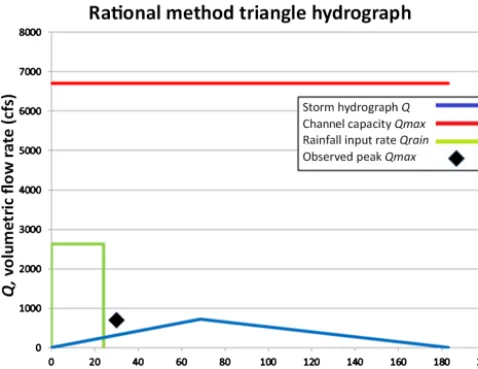
Figure 1. Illustration of the visualization produced by the DMDGC
module. The rational method and a triangular synthetic unit hydro-graph are applied to model a rainstorm’s streamflow hydrohydro-graph based on a rainfall input and watershed parameters, and this is visu-ally compared with a calculated flow channel capacity to determine whether a flood will occur during a specified design storm event. The model can be calibrated such that the timing and magnitude of the observed flood peak (black diamond) matches the modeled streamflow hydrograph (blue triangle). Adapted with permission from Ruddell and Schiesser (2012).
2008) were designed to be implemented in parallel with tra-ditional lectures. In this unit, all students were given identi-cal lectures (based on material covered in Schiesser, 2008) that covered the fundamentals of flood frequency, urbaniza-tion and land use change, flood risk, climate change effects on rainfall, and the roles and responsibilities of agencies that provide flood prediction and management services in the USA. In other words, the lecture component of the current design was identical for both laboratory groups, and the only instructional difference was whether the students received a DMDGC or paper laboratory module.
The experimental DMDGC module is written for Mi-crosoft Excel™, a widely utilized and highly accessible spreadsheet application. It is a simple stormwater hydro-graph modeling module that applies the widely utilized ra-tional method and a synthetic unit hydrograph to estimate hydrographs and flooding for urban watersheds. The model is based on assumptions optimized for a floodway in Mari-copa County, Arizona, an urbanized desert area in the south-western United States. The module has the ability to accept both observed rainfall and streamflow data so that a student may calibrate the parameters of the flood model to match any observed event. Importantly, the module is also broadly applicable to urbanizing watersheds anywhere in the world and can be adapted to other locations by simply adjusting a few model parameters and obtaining observed streamflow data for a flood event. As such, this DMDGC activity could
be applied to nearly any urban area, an option that could be used to tailor context and content respective to each student population and their corresponding physical location.
[image:4.612.48.287.67.251.2]The DMDGC module produces a visualization of mod-eled and observed hydrograph results (Fig. 1). As is visible in Fig. 1, the module emphasizes the determination of whether or not a given channel will flood during a 100-year design storm event as land use is progressively urbanized, and as the design storm changes due to climate change. These mul-tiple interacting characteristics served as the foundation for the rubric described in the next section (and in Fig. 2). The DMDGC module takes roughly 2 hours of preparation for a novice instructor and roughly 3 hours of student effort to complete.
A paper lab activity (Lab 9 in Schiesser, 2008) requir-ing a similar effort was utilized as a control for comparison with the DMDGC module. The paper module requires stu-dents to perform hand calculations and determine whether a channel will flood before and after urbanization occurs in a watershed. Like the DMDGC module, a student consid-ers the effect of issues such as rainfall infiltration, watconsid-ershed area, rainfall intensity, and channel capacity in determining a flood. Unlike the DMDGC module, the paper activity ex-plicitly addresses issues of flood frequency using recurrence interval calculations using a brief table of historical peak flow events instead of a student’s investigation of observed streamflow data. Also, no visualization or interaction is pos-sible with the paper method. The paper lab’s streamflow data are “stock” data that are hypothetical and not drawn from real-world or place-based sources. The paper module does not include customized data for the student’s local watershed, nor an observed rainfall event in the local watershed, and is not able to provide visual feedback via the flow hydrograph when the student adjusts watershed parameters or the rainfall intensity. Finally, this paper-based activity is not contextu-alized within the local environment (e.g., Maricopa county). The estimated time to complete this paper activity is also ap-proximately 3 hours. Thus, this exercise requires students to complete calculations of similar complexity and type as the DMDGC module, albeit in a paper-and-pencil form and mi-nus the place-based contextualization and interactive visual-ization components. As such, effort and time with the mate-rial (across both lecture and laboratory components) are com-parable across these instructional conditions, and not likely explanations for any subsequent effects.
2.2.2 Learning assessments
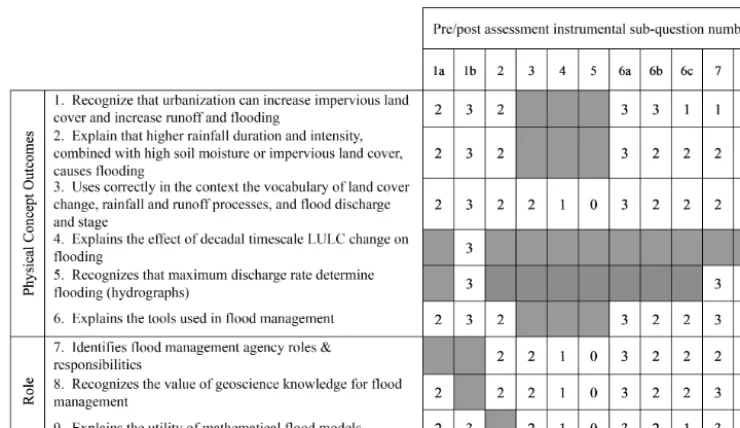
Figure 2. Example of a completed assessment matrix mapping learning outcome rubrics to instrument question responses. This example
student gave relevant responses to all questions (i.e., no “0” ratings), and the matrix generally indicates an “Apprentice” level of conceptual mastery.
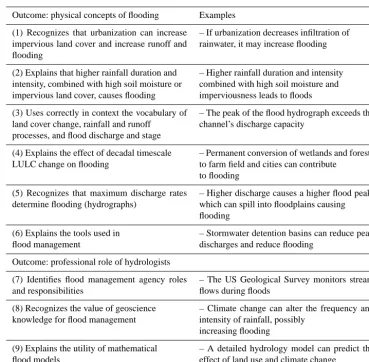
concepts related to flooding. The nine outcome areas psented in Table 2 represent areas of conceptual mastery re-garding climate, land cover, flood management, and hydrol-ogy. The first six areas specifically emphasize mastery of the physical concepts determining flooding (e.g., rainfall inten-sity and duration, hydrographs, infiltration, and stormwater management practices), and thus are indicative of a good conceptual understanding of the material itself. However, the last three outcomes were designed to assess the understand-ing of the roles and responsibilities of flood-related profes-sional agencies (e.g., agency roles and responsibilities, value of geoscience knowledge), or in other words, the potential job duties of a professional working in the field. To make this distinction more transparent, examples of conceptual mas-tery relative to the learning outcomes are also presented in Table 2. Together, these nine outcomes cover the basic phys-ical details and a “T-shaped profile” of professional and sci-entific competence (Cap-Net, 2008; McIntosh and Taylor, 2013; Pathirana et al., 2012; Pinter et al., 2013; Uhlenbrook and de Jong, 2012) needed for a basic appreciation of the profession and the social impacts of flood hydrology.
Each of the 11 questions was evaluated relative to the appropriate learning outcomes on a four-point scale (0–3) as to the level of conceptual mastery indicated by the re-sponse, where 0 indicates no relevant rere-sponse, 1 indicates a “Novice” level, 2 indicates an “Apprentice” level, and 3 indi-cates an “Expert” level. A rating of 3 approximates the level of conceptual mastery expected by a practicing hydrological professional. Some sub-questions did not assess some learn-ing outcomes; these irrelevant combinations are indicated in the Fig. 2 matrix in grey. Two hydrology educators
inde-pendently coded the level of conceptual mastery indicated by student responses on the pre-test assessment instrument, blind to condition, and indicated a high degree of inter-rater reliability across all nine learning outcomes (all ICCs > 0.91, p<0.01). The post-assessments (which were again identical to the pre-assessments) were then coded by a single coder. Table 1 gives examples of conceptual mastery for each of the nine outcomes.
3 Results
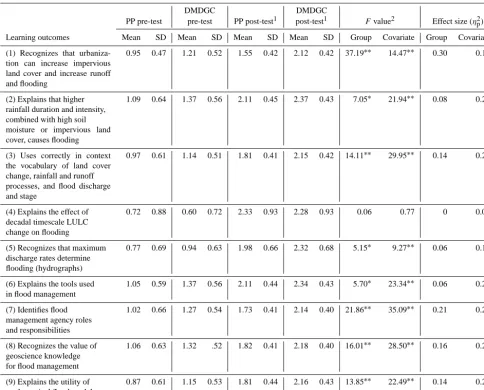
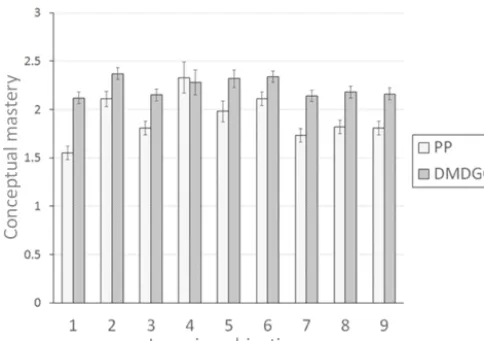
To examine the effect of the DMDGC modules on the change in student knowledge in each of the nine outcomes, a sim-ple two-way ANCOVA was conducted between laboratory groups on the post-test scores for each outcome. Pre-test scores for each measure were used as a covariate in every respective analysis to control for any differences in initial knowledge levels, and all results were evaluated for signif-icance at the level ofp<0.05. Levene’s tests for all analyses indicated a non-significant result (p>0.05), which affirms that variance was equivalent between comparison groups. Descriptive statistics for each measure by group, and allF statistics, are available in Table 3. Results are also graphed in Fig. 3.
3.1 Physical concepts of flooding
Table 1. Pre-/post-assessment instrument with model “Expert” answers.
Question Model answer
(1a) Compare Hillsdale 2000 with Hillsdale 2012: write a description of the effects of impervious cover and urbanization as the city has expanded.
As the city has expanded over time, open areas that produce relatively little runoff are being replaced with urban areas that are impervious to rainfall and therefore produce more runoff. (1b) Complete a hydrograph analysis on the axes below by
doing the following:
– Draw the flood hydrograph for an extreme rainfall event at the Hillsdale stream gage in 2000 before urban development expands; label this curve “H2000”.
– Draw the flood hydrograph for an extreme rainfall event at the Hillsdale stream gage in 2012 after urban development expands; label this curve “H2012”.
19 Table 1. Pre/Post Assessment Instrument with Model ‘Expert’ Answers
1
Question Model Answer
(1a.) Compare Hillsdale 2000 with Hillsdale 2012: write a description of
the effects of impervious cover and urbanization as the City has expanded.
As the city has expanded over time, open areas that produce relatively little runoff are being
replaced with urban areas that are impervious to rainfall and therefore produce more
runoff.
(1b.) Complete a hydrograph analysis on the axes below by doing the
following:
Draw the flood hydrograph for an extreme rainfall event at the Hillsdale stream gage in 2000 before urban development expands; label this curve “H2000”.
• Draw the flood hydrograph for an extreme rainfall event at the
Hillsdale stream gage in 2012 after urban development expands;
label this curve “H2012”.
(2) List at least two policies or practices that water managers can pursue to
reduce the damage caused by flood events.
a)Reducing urbanization
b)Reducing impervious area upstream c) Enhancing retention of stormwater onsite d)Reducing development in the floodplain e) Building levees
(3) What U.S. Federal agency is the primary provider of streamflow and
surface water resource data?
The USGS is the best answer, but NOAA is a good second choice.
(4) What U.S. Federal agency is the primary provider of rainfall and
weather data?
NOAA is the best answer, but the USGS is a good second choice. Time after start of rain storm (h)
D
is
ch
a
rg
e
(m
/s
)
3
(2) List at least two policies or practices that water managers can pursue to reduce the damage caused by flood events.
Reducing urbanization
Reducing impervious area upstream Enhancing retention of stormwater onsite Reducing development in the floodplain Building levees
(3) What US Federal agency is the primary provider of streamflow and surface water resource data?
The USGS is the best answer, but NOAA is a good second choice.
(4) What US Federal agency is the primary provider of rainfall and weather data?
NOAA is the best answer, but the USGS is a good second choice.
(5) What US Federal agency is the primary regulator and provider of flood control services?
US Army Corps of Engineers is the correct answer.
(6a.) What kind of information are these hydrologists able to provide about the future risk, frequency, severity, or damages of flood events at your location, and what tools and knowledge make it possible to provide this information?
The hydrologists can use models to estimate the frequency and severity of floods at our location, based on assumptions about land cover change and urban development that control runoff and imperviousness, and simulations of future climate change that controls the frequency, intensity, and duration of future rainfall events.
(6b.) What questions should you ask in the meeting? In your expert opinion, is this a good place to build a 50-year factory project?
If we build, what actions should we take when we build the factory to prevent flood damage?
Can you provide us with adequate warning of imminent floods so we can take action to prevent damage?
How could floods impact transportation, power, and other needs of our factory?
What kind of insurance do we need, and can we save money on the premiums by taking actions to prevent damage?
(6c.) What might happen to Compumarket if the company does not consider hydrologic risk in its business plans?
Table 1. Continued.
Question Model answer
(7) Explain the importance of streamflow and rainfall gages for flood management.
Hydrologists need streamflow and rainfall data in order to forecast the severity of current flood events downstream of a rainfall, and to develop accurate flood models to predict the impacts of flooding.
(8) What is a mathematical flood model, and why is it important?
Mathematical models of floods allow us to predict the intensity and frequency of flooding in a given location, so that we can take steps to prevent damage from floods at that location, such as a city.
Table 2. Examples of conceptual mastery for each of nine outcomes.
Outcome: physical concepts of flooding Examples (1) Recognizes that urbanization can increase
impervious land cover and increase runoff and flooding
– If urbanization decreases infiltration of rainwater, it may increase flooding
(2) Explains that higher rainfall duration and intensity, combined with high soil moisture or impervious land cover, causes flooding
– Higher rainfall duration and intensity combined with high soil moisture and imperviousness leads to floods (3) Uses correctly in context the vocabulary of
land cover change, rainfall and runoff processes, and flood discharge and stage
– The peak of the flood hydrograph exceeds the channel’s discharge capacity
(4) Explains the effect of decadal timescale LULC change on flooding
– Permanent conversion of wetlands and forests to farm field and cities can contribute
to flooding (5) Recognizes that maximum discharge rates
determine flooding (hydrographs)
– Higher discharge causes a higher flood peak, which can spill into floodplains causing flooding
(6) Explains the tools used in flood management
– Stormwater detention basins can reduce peak discharges and reduce flooding
Outcome: professional role of hydrologists (7) Identifies flood management agency roles and responsibilities
– The US Geological Survey monitors stream flows during floods
(8) Recognizes the value of geoscience knowledge for flood management
– Climate change can alter the frequency and intensity of rainfall, possibly
increasing flooding (9) Explains the utility of mathematical
flood models
– A detailed hydrology model can predict the effect of land use and climate change
on flooding
with the DMDGC modules were better able to not only un-derstand the effects of urbanization and other physical causes of flooding but also demonstrated better knowledge of maxi-mum discharge rates and impacts of flood management. The lack of result for outcome no. 4 (the effect of decadal LULC change on flooding) was not entirely unexpected, as although this content topic was originally intended to be emphasized in the lecture and lab settings, unfortunately it was not able
[image:7.612.113.482.238.599.2]Table 3. Descriptive and inferential statistics for all analyses.
DMDGC DMDGC
PP pre-test pre-test PP post-test1 post-test1 Fvalue2 Effect size (η2p)
Learning outcomes Mean SD Mean SD Mean SD Mean SD Group Covariate Group Covariate
(1) Recognizes that urbaniza-tion can increase impervious land cover and increase runoff and flooding
0.95 0.47 1.21 0.52 1.55 0.42 2.12 0.42 37.19∗∗ 14.47∗∗ 0.30 0.15
(2) Explains that higher rainfall duration and intensity, combined with high soil moisture or impervious land cover, causes flooding
1.09 0.64 1.37 0.56 2.11 0.45 2.37 0.43 7.05∗ 21.94∗∗ 0.08 0.21
(3) Uses correctly in context the vocabulary of land cover change, rainfall and runoff processes, and flood discharge and stage
0.97 0.61 1.14 0.51 1.81 0.41 2.15 0.42 14.11∗∗ 29.95∗∗ 0.14 0.26
(4) Explains the effect of decadal timescale LULC change on flooding
0.72 0.88 0.60 0.72 2.33 0.93 2.28 0.93 0.06 0.77 0 0.01
(5) Recognizes that maximum discharge rates determine flooding (hydrographs)
0.77 0.69 0.94 0.63 1.98 0.66 2.32 0.68 5.15∗ 9.27∗∗ 0.06 0.10
(6) Explains the tools used in flood management
1.05 0.59 1.37 0.56 2.11 0.44 2.34 0.43 5.70∗ 23.34∗∗ 0.06 0.22
(7) Identifies flood management agency roles and responsibilities
1.02 0.66 1.27 0.54 1.73 0.41 2.14 0.40 21.86∗∗ 35.09∗∗ 0.21 0.29
(8) Recognizes the value of geoscience knowledge for flood management
1.06 0.63 1.32 .52 1.82 0.41 2.18 0.40 16.01∗∗ 28.50∗∗ 0.16 0.25
(9) Explains the utility of mathematical flood models
0.87 0.61 1.15 0.53 1.81 0.44 2.16 0.43 13.85∗∗ 22.49∗∗ 0.14 0.21
PP is the paper-and-pencil group, DMDGC is the data and modeling-driven geoscience cyber-education group;1adjusted based on covariate analysis;2df=(1.85); criticalFvalue for
p<0.05isF >3.95;∗
p<0.05,∗∗
p<0.01.
3.2 Professional role of hydrologists
Consistent with the content results above, users of DMDGC modules also appear to have gained a better appreciation for the professional role of hydrologists and the field. Across all three sub-areas (nos. 6–9), there was a significantly higher demonstration of expertise for the simulation group, above those simply using the paper-and-pencil activities. This sug-gests that not only does engaging in such authentic activity produce a measurable benefit in learning content but this ben-efit also results in a better understanding of the professional duties within the field. This result is especially encouraging as it also could potentially indicate that such activities allow students to become better prepared for eventual careers in hydrological engineering, and thus provide a bridge between the content area and the application of knowledge.
Figure 3. Conceptual mastery scores for each learning objective by
group. Error bars represent the standard error of the mean. (1) Rec-ognizes that urbanization can increase impervious land cover and increase runoff and flooding, (2) explains that higher rainfall dura-tion and intensity, combined with high soil moisture or impervious land cover, causes flooding, (3) uses correctly in context the vocab-ulary of land cover change, rainfall and runoff processes, and flood discharge and stage, (4) explains the effect of decadal timescale LULC change on flooding, (5) recognizes that maximum discharge rates determine flooding (hydrographs), (6) explains the tools used in flood management, (7) identifies flood management agency roles and responsibilities, (8) recognizes the value of geoscience knowl-edge for flood management, and (9) explains the utility of mathe-matical flood models.
4 Discussion
While prior research in education has suggested that the use of applied examples could likely benefit learning, this sug-gestion was explicitly tested here in the context of hydrolog-ical education, using DMDGC modules. It was anticipated that the use of such dynamic and flexible simulation tools, which enable learners to contextualize and visualize the im-pact of minute changes in data over time, would lead to a marked increase in learning performance. The results of this classroom study support exactly that. Learners who were per-mitted to interact with such simulations not only were better able to understand the content itself in the form of general knowledge but these same learners were also better able to appreciate the role of professionals within the field. This in-crease was significantly larger than that experienced by the control group, which engaged with materials that required similar skills but lacked the contextual and simulation com-ponents of the DMDGC module. It is our contention that the increase in both areas (breadth and depth) was a direct result of the experience with the DMDGC module. For ex-ample, in terms of conceptual learning, the DMDGC mod-ules allowed learners to better understand the interaction of conceptual units and how to use tools like the hydrograph to anticipate flooding conditions. Similarly, this direct
expe-rience also allowed learners to better appreciate the job du-ties of practicing hydrologists, providing a tacit understand-ing of the role of agencies and geoscience education in soci-ety, which in turn led to better recall. While certainly spec-ulative, given that both groups received identical discussion regarding agency duties in lecture (and thus in a decontextu-alized, abstract sense), the fact that the DMDGC group was able to better appreciate this kind of information seems to again suggest that the concrete experience helped make this understanding of professional duties more accessible to these learners.
As such, this overall pattern of results suggests that learn-ers were gaining a more complete “T-shaped profile” of hy-drological education (Ruddell and Wagener, 2013), balanc-ing an increase in not only their specialized conceptual, quan-titative, and modeling skills within the field but also achiev-ing a more broad understandachiev-ing of the role of professionals in the field relative to real-world scenarios. This is a very encouraging result, as it suggests a dual benefit for such DMDGC training.
Further, another interesting point is that it is likely such multiple effects were observed because the participants in this study were just beginning their education in the field of hydrology, so issues of contextualized knowledge or self-selection were likely minimized in this sample. In other words, because learners were lacking a well-defined repre-sentation of not only the knowledge of the field but also the role of working professionals in the field, this training experi-ence permitted them to gain greater insight into both the field and requisite application. This fact is even more encouraging as it suggests that such interventions, introduced early in the educational trajectory, can provide a more robust and com-plete learning experience at all levels. It is possible that such increases in depth and breadth of knowledge early on could translate into more success with the material, thus likely in-creasing the likelihood of learners persisting in the pursuit of education in this domain. It appears that working with au-thentic data increases the appreciation of a novice student for the importance of the hydrology profession and for the phys-ical problems this profession addresses.
5 Conclusions
the way of computer modeling and programming. A simple spreadsheet, combined with readily available online hydro-logical data, is sufficient in this case. In other words, these computerized techniques afford instructors the opportunity to have their students engage in realistic and authentic problem-based activities without the need to manage other logistical constraints often encountered with field research (transporta-tion, materials, etc.). It is our hope that the positive findings of this study encourage investment in development of high-quality DMDGC learning materials, and the wider adoption of place-based DMDGC learning materials across the civil engineering curriculum. Implementing such learning experi-ences into the curriculum will ideally create more enriching experiences for student learners, and hopefully also develop more well-rounded and skilled practicing hydrologists.
While the current study focused on lower-division stu-dents, in future work it would also be of interest to ex-pand this program longitudinally throughout the curriculum to identify how to best deliver DMDGC content at all lev-els of the hydrology curriculum to maximize its effective-ness. Efforts are currently ongoing to do exactly this, and also expand the application of DMDGC content to hydrolog-ical concepts beyond flooding and urbanization.
Acknowledgements. This material is based upon work supported
by the National Science Foundation under Grant no. 1043996. Any opinions, findings, and conclusions or recommendations expressed in this material are those of the author(s) and do not necessarily reflect the views of the National Science Foundation. Publication of this article in an open access journal was funded by the Oregon State University Libraries and Press Open Access Fund.
Edited by: S. Uhlenbrook
References
Alfieri, L., Brooks, P. J., Aldrich, N. J., and Tenenbaum, H. R.: Does discovery-based instruction enhance learning?, J. Educ. Psychol., 103, 1–18, 2011.
ASCE: Perspectives on water resources education and training, J. Water Res. Pl. Manag., 116, 99–133, 1990.
Bransford, J. D., Brown, A. L., and Cocking, R. R.: How people learn: Brain, mind, experience, and school. National Academy Press, Washington, DC, 1999.
Brown, J. S., Collins, A., and Duguid, P.: Situated cognition and the culture of learning, Educ. Res., 18, 32–42, 1989.
Cap-Net: Economics in sustainable water man-agement training manual and facilitators’ guide, http://www.cap-net.org/training-material/ economics-in-sustainable-water-management-english/ (last access: 22 May 2013), 2008.
Cognition and Technology Group at Vanderbilt: Emerging tech-nologies, ISD, and learning environments: critical perspectives, Educ. Tech. Res., 40, 65–80, 1992.
Collins, A.: Cognitive apprenticeship and instructional technology, in: Educational Values and Cognitive Instruction: Implications
for Reform, edited by: Idol, L. and Jones, B. F., Hillsdale, NJ, Lawrence Erlbaum Associates, 121–138, 1991.
De Jong, T. and Van Joolingen, W. R.: Scientific discovery learning with computer simulations of conceptual domains, Rev. Educ. Res., 68, 179–201, 1998.
Duch, B. J., Groh, S. E., and Allen, D. E.: Why problem-based learning, A case study of institutional change in undergraduate education, edited by: Duch, B. J., Groh, S. E., and Allen, D. E., Sterling, Virginia, The Power of Problem-Based Learning, 3–11, 2001 (in Duch).
Duderstadt, J. J.: Engineering for a changing world: A roadmap to the future engineering practice, research, and education, Ann Ar-bor, MI, The University of Michigan, 2008.
Eagleson, P. S., Brutsaert, W. H., Colbeck, S. C., Cummins, K. W., Dozier, J., Dunne, T., and Zipser, E. J.: Opportunities in the hy-drologic sciences, Natl. Acad. Press, Washington, DC, 1991. Felder, R. M., Felder, G. N., and Dietz, E. J.: A longitudinal study of
engineering student performance and retention, V. comparisons with traditionally-taught students, J. Eng. Educ., 87, 469–480, 1998.
Gleeson, T., Allen, D. M., and Ferguson, G.: Teaching hydrogeol-ogy: a review of current practice, Hydrol. Earth Syst. Sci., 16, 2159–2168, doi:10.5194/hess-16-2159-2012, 2012.
Habib, E., Ma, Y., Williams, D., Sharif, H. O., and Hossain, F.: Hy-droViz: design and evaluation of a Web-based tool for improving hydrology education, Hydrol. Earth Syst. Sci., 16, 3767–3781, doi:10.5194/hess-16-3767-2012, 2012.
Hake, R. R.: Interactive-engagement versus traditional methods: A six-thousand-student survey of mechanics test data for introduc-tory physics courses, Am. J. Phys., 66, 64–74, 1998.
Hansen, M. M.: Versatile, immersive, creative and dynamic virtual 3-D healthcare learning environments: a review of the literature, J. Med. Internet Res., 10, e26, doi:10.2196/jmir.1051, 2008. Lattuca, L. R., Terenzini, P. T., Volkwein, J. F., and Peterson, G.:
The changing face of engineering education, The Bridge, Link-ing EngineerLink-ing and Society, 36, 5–13, 2006.
MacDonald, L. H.: Developing a field component in hydrologic ed-ucation, Water Resour. Bull. Am. Water Resour. Assoc., 29, 357– 368, 1993.
McIntosh, B. S. and Taylor, A.: Developing T-Shaped water profes-sionals: Building capacity in collaboration, learning, and lead-ership to drive innovation, J. Contemp. Water Res. Educ., 150, 6–17, 2013.
Merwade, V. and Ruddell, B. L.: Moving university hydrology edu-cation forward with community-based geoinformatics, data and modeling resources, Hydrol. Earth Syst. Sci., 16, 2393–2404, doi:10.5194/hess-16-2393-2012, 2012.
Miles, J. and Shevlin, M.: Applying Regression and Correlation: a Guide for Students and Re-searchers, Sage, London, UK, 2001. Nash, J. E., Eagleson, P. S., Philip, J. R., Van der Molen, W. H.,
and Klemeš, V.: The education of hydrologists (Report of an IAHS/UNESCO Panel on hydrological education), Hydrolog. Sci. J., 35, 597–607, 1990.
didactic training, Hydrol. Earth Syst. Sci., 16, 3677–3688, doi:10.5194/hess-16-3677-2012, 2012.
Pinter, N., Baer, S., Chevalier, L., Kowalchuk, R., Lant, C., and Whiles, M.: An “IGERT” Model for Interdisciplinary Doctoral Education in Water-Related Science and Policy, J. Contemp. Wa-ter Res. Educ., 150, 53–62, 2013.
Prince, M.: Does active learning work? A review of the research, J. Engin. Educ., 93, 223–231, 2004.
Ruddell, B. L. and Schiesser, R. A.: Developing a Rational Method Hydrograph Model for the Urban Desert Southwest USA, unpub-lished material, Mesa, AZ, 2012a.
Ruddell, B. L. and Schiesser, R. A.: Calibrating a Rational Method Hydrograph Model for the Urban Desert Southwest USA, unpub-lished material, Mesa, AZ, 2012b.
Ruddell, B. L. and Wagener, T.: Grand challenges for hydrology education in the 21st century, J. Hydrol. Eng., 20, A4014001, doi:10.1061/(ASCE)HE.1943-5584.0000956, 2015.
Savery, J. R. and Duffy, T. M.: Problem based learning: An instruc-tional model and its constructivist framework, Educ. Technol., 35, 31–38, 1995.
Schiefele, U.: Interest, learning, and motivation, Educ. Psychol., 26, 299–323, 1991.
Schiesser, R. A.: Geological Disasters Case Studies and Analysis (and Lab 9 manual), 1st Edn., Kendall Hunt, Dubuque, IA, ISBN-978-0-7575-5039-3, 2008.
Shulman, L. S.: If not now, when? The timeliness of scholarship of the education of engineers, J. Engin. Educ., 94, 11–12, 2005. Smith, K. A., Sheppard, S. D., Johnson, D. W., and Johnson, R. T.:
Pedagogies of engagement: Classroom-based practices, J. Engin. Educ., 94, 87–101, 2005.
Smith, L. W. and Van Doren, D. C.: The reality-based learning method: A simple method for keeping teaching activities rele-vant and effective, J. Marketing Educ., 26, 66–74, 2004. Thompson, S. E., Ngambeki, I., Troch, P. A., Sivapalan, M., and
Evangelou, D.: Incorporating student-centered approaches into catchment hydrology teaching: a review and synthesis, Hy-drol. Earth Syst. Sci., 16, 3263–3278, doi:10.5194/hess-16-3263-2012, 2012.
Uhlenbrook, S. and de Jong, E.: T-shaped competency profile for water professionals of the future, Hydrol. Earth Syst. Sci., 16, 3475–3483, doi:10.5194/hess-16-3475-2012, 2012.
Wagener, T., Weiler, M., McGlynn, B., Marshall, L., McHale, M., Meixner, T., and McGuire, K.: Taking the pulse of hydrology education, Hydrol. Proc., 21, 1789–1792, 2007.
Wagener, T., Kelleher, C., Weiler, M., McGlynn, B., Gooseff, M., Marshall, L., Meixner, T., McGuire, K., Gregg, S., Sharma, P., and Zappe, S.: It takes a community to raise a hydrologist: the Modular Curriculum for Hydrologic Advancement (MOCHA), Hydrol. Earth Syst. Sci., 16, 3405–3418, doi:10.5194/hess-16-3405-2012, 2012.
Watters, J. J. and Ginns, I. S.: Developing motivation to teach el-ementary science: Effect of collaborative and authentic learning practices in preservice education, J. Sci. Teach. Educ., 11, 301– 321, 2000.
Wood, D. F.: Problem based learning, Bmj, 326, 328–330, 2003. Yadav, A., Subedi, D., Lundeberg, M. A., and Bunting, C. F.: