https://www.scirp.org/journal/ijcns ISSN Online: 1913-3723 ISSN Print: 1913-3715
DOI: 10.4236/ijcns.2019.1210011 Oct. 18, 2019 151 Int. J. Communications, Network and System Sciences
Fixed-Time and Finite-Time Synchronization
for a Class of Output-Coupling Complex
Networks via Continuous Control
Zhiwei Li
College of Science, University of Shanghai for Science and Technology, Shanghai, China
Abstract
This paper mainly investigates the finite-time and fixed-time synchronization problem for a class of general output-coupling complex networks with output feedback nodes. The fixed-time and finite-time synchronization protocols are presented based on continuous controller strategies which can efficaciously eliminate chattering phenomenon existing in some previous results. Several sufficient conditions ensuring fixed-time and finite-time synchronization are derived by employing Lyapunov stability theory, linear matrix inequality (LMI) and adaptive technique. Furthermore, aimed at the model of this article, we study the problem of adaptive coupling strength in fixed-time synchroniza-tion which is rarely involved in previous results. Finally, several numerical examples are given to illustrate the effectiveness of our results.
Keywords
Output-Coupling Complex Networks, Fixed-Time Synchronization, Finite-Time Synchronization, Continuous Controller
1. Introduction
Over the past few decades, researches about complex dynamical networks have become more and more hot in many fields for its large-scale practicability such as information processing, World Wide Web, biological systems, neural net-works and so on [1] [2] [3] [4]. In particular, the synchronization phenomenon considered as a significant collective behavior has been attracted rapidly exten-sive attention and many excellent works have been reported in [5]-[11] and the references therein.
Regarded as a fundamental problem of cooperative control, synchronization
How to cite this paper: Li, Z.W. (2019) Fixed-Time and Finite-Time Synchroniza-tion for a Class of Output-Coupling Com-plex Networks via Continuous Control. Int. J. Communications, Network and System Sciences, 12, 151-169.
https://doi.org/10.4236/ijcns.2019.1210011
Received: September 21, 2019 Accepted: October 15, 2019 Published: October 18, 2019
Copyright © 2019 by author(s) and Scientific Research Publishing Inc. This work is licensed under the Creative Commons Attribution International License (CC BY 4.0).
http://creativecommons.org/licenses/by/4.0/
DOI: 10.4236/ijcns.2019.1210011 152 Int. J. Communications, Network and System Sciences
requires all subsystems to converge to a target state or a common value. It is worthwhile to note that most of the existing works about synchronization prob-lems of complex dynamical networks were asymptotic synchronization [5]-[11], or exponential synchronization [12] [13], which meant that the synchronization could only be actualized within infinite time. In [5], the synchronization prob-lem of general complex networks under pinning control was considered. Syn-chronization of an array of linearly coupled memristor-based recurrent neural networks with impulses and time-varying delays was investigated in [6]. In [9], the cluster synchronization problems of linearly coupled complex networks were studied by employing pinning control strategy. The authors of [12] studied the exponential synchronization problems of complex-valued complex networks with time-varying delays and stochastic perturbations via time-delayed impulsive control and coupled stochastic memristor-based neural networks with time-varying probabilistic delay coupling and impulsive delay [13]. However, in practice, we always expect that the synchronization could be achieved as quickly as possible indicating that the system can realize synchronization in a particular time period. This can be acquired by utilizing finite-time synchronization strategy proposed in [14] which has been demonstrated with many remarkable advantages includ-ing better robustness, higher precision and faster convergence rate, etc. For its prominent effect in improving convergence rate, many finite-time synchroniza-tion results were presented. [14] investigated the problem of finite-time syn-chronization for complex networks with nonidentical discontinuous nodes. In [15] results concerning the overlapping cluster finite-time synchronization of coupled complex networks via adaptive control were presented and its results can be applied to common cluster synchronization without overlap. The authors of [16] and [17] considered the finite-time synchronization of complex dynami-cal networks by periodidynami-cally intermittent control and aperiodidynami-cally intermittent control respectively. In [18], the finite-time cluster synchronization problem for complex networks were discussed by employing pinning control. Nevertheless, in the above results, the settle-time of finite-time synchronization heavily de-pends on the initial conditions of all the subsystems yet in some case, the infor-mation or knowledge of initial states is unknown or not available in advance. Furthermore, the settling time will be sufficiently large if the initial conditions are very large. These restrictions may limit its wide application in reality to some extent.
DOI: 10.4236/ijcns.2019.1210011 153 Int. J. Communications, Network and System Sciences
In [20], based on event-triggered control strategy which can significantly reduce energy consumption and the frequency of the controller updates, the fixed-time synchronization was achieved in term of multi-agent systems with nonlinear uncertainties.
From the viewpoint of coupling among nodes, complex networks mainly be divided into two representative types, that is, output-coupling complex networks and state-coupling complex networks. In [21], global asymptotic adaptive syn-chronization problem for a class of output-coupling complex networks was stu-died by employing adaptive dynamical output feedback controllers. In recent years, most of researches focus on state-coupling complex networks while out-put-coupling complex networks attracts relatively less attention let alone re-search on fixed-time and finite-time synchronization problems.
In [22] [23], controllers, unexceptionally, include sign function which plays a very important and indispensable role in fixed-time and finite-time synchroni-zation problems. However, some defects were brought such as chattering phe-nomenon [22] [23] mainly caused by the discontinuity of sign function which will do harm to the property of apparatus. Thus, in [10], to overcome these draw-backs and weaken chattering effect, a saturation function was utilized yet actual-ly this effect cannot be intrinsicalactual-ly avoided. In [15], an adaptive controller which did not contain sign function was designed, and the chattering phenomenon was easily and successfully erased. However, the controller mentioned in [15] was still discontinuous, namely, the chattering effect still existed in controller. In [24], a controller excluding sign function was designed, however, the controller in [24] is still discontinuous.
DOI: 10.4236/ijcns.2019.1210011 154 Int. J. Communications, Network and System Sciences
networks with output nodes is less investigated. In this paper, we will explore this problem deeply.
Motivated by the above discussion, the main novelties are enumerated as fol-lows: 1) the fixed-time and finite-time synchronization problem for a more gen-eral complex dynamical networks with output feedback nodes are studied; 2) to avoid chattering phenomenon existing in previous works, a continuous control-ler is designed to realize synchronization; 3) the synchronization criterions in this paper are suitable for directed and undirected complex networks; 4) the adaptive coupling strength problem for fixed-time synchronization of complex networks with output nodes is studied first time.
The rest of this paper is organized as follows. In Section 2, the model of out-put-coupling complex networks, some lemmas, assumptions and definition are presented. The sufficient criterions ensuring fixed-time synchronization and fi-nite-time synchronization of complex networks are derived in Section 3 and Sec-tion 4 respectively. In SecSec-tion 5, the adaptive coupling strength problem for fixed-time synchronization of complex networks is investigated. In section 6, some numerical simulation examples are given.
2. Problem Formulation and Preliminaries
Notations: nR and Rn n× denote the set of n-dimension vector and n n× real
matrix respectively. The superscript “T” denotes the transpose of vectors and matrices. For the matrix n n
A∈R × ,
T
2
s A A
A = + , λmin
( )
A and λmax( )
Ade-note the minimum eigenvalue and maximum eigenvalue of matrix A, respec-tively. Let =
{
1, 2,,N}
. diag[ ]
αi n∈Rn n× is the diagonal matrix withdi-agonal entries αi
(
i=1, 2,,n)
.n n n
I ∈R× is the identity matrix. For the vector
[
]
T1, , n
x= x x , 1, , T
p p p
n
x = x x . The Euclidean norm in Rn is denoted as
⋅ , i.e. T
u = u u for n
u∈R .
In this paper, we consider the following output-coupling complex networks with output nodes:
( )
( )
(
( )
)
( )
( )
( )
( )
1
,
,
N
i i i ij i i
j
i i
x t Ax t f y t c g y t u t y t Cx t i
=
= + + Γ +
= ∈
∑
(1)
where
( )
ni
x t ∈R is the system state variables of the ith dynamical node,
( )
mi
y t ∈R is the output variables of the ith dynamical node, f R: n →Rn is a
continuous function governing the dynamics of ith isolated nodes, c>0 is a coupling strength, G= gij N N× is the weight configuration matrix of the com-plex networks, n m
R×
Γ ∈ is the inner coupling matrix and m n
C∈R × is the
output matrix,
( )
n iu t ∈R is the controller designed for the system (1). For
DOI: 10.4236/ijcns.2019.1210011 155 Int. J. Communications, Network and System Sciences 1,
.
N
ii ij
j j i
g g
= ≠
= −
∑
The initial value of the complex network (1) is xi
( )
0 =xi0,i∈.Remark 1: Here, we assume that the weight configuration matrix G is not symmetric and irreducible. Therefore, the system (1) can be used to describe the directed and the undirected weighted complex networks.
Remark 2: When the output matrix C is the identity matrix IN, then (1) de-grade into
( )
( )
(
( )
)
( )
( )
1
,
N
i i i ij i i
j
x t Ax t f x t c g x t u t
=
= + +
∑
Γ + (2)
which has been deeply studied by [18] [19]. Therefore, system (1) is more gener-al than system (2).
The goal of this paper is to design suitable controllers u ti
( )
such that the states of complex network (1) synchronize into the state of following target sys-tem within a finite time and fixed time,( )
( )
(
( )
)
( )
( )
,
.
x t Ax t f y t y t Cx t
∗ ∗ ∗
∗ ∗
= +
=
(3)
Subtracting (3) from (1), the following error dynamical systems are obtained:
( )
( )
(
( )
)
( )
( )
( )
( )
( )
1
,
,
N
i i i ij j i
j
i i
e t Ae t F t c g t u t t y t y t i
ψ ψ
ψ
= ∗
= + + Γ +
= − ∈
∑
(4)
where
( )
( )
( )
,(
( )
)
(
( )
)
(
( )
)
,i i i i
e t =x t −x t∗ F ψ t = f y t − f y∗ t
( )
ie t and ψi
( )
t are the state error and output error of the ith node,respec-tively. Obviously, we have
( )
( )
( )
( )
.i t Cx ti Cx t Ce ti
ψ = − ∗ = (5)
Let
( )
T( ) ( )
T T( )
T 1 , 2 , , Ne t = e t e t e t .
Definition 1: The network (1) is said to be synchronized onto (3) within a fi-nite time, if there exists a settling time T >0 which is dependent on the initial value, such that
( )
0 for all ,e t ≡ t≥T
where e t
( )
is the solution of error dynamical system (4).Definition 2: The network (1) is said to be synchronized onto (2) within a fixed time, if there exists a settling time T >0 which is independent on the ini-tial value, such that
( )
0 for all ,e t ≡ t≥T
DOI: 10.4236/ijcns.2019.1210011 156 Int. J. Communications, Network and System Sciences
Lemma 1: [21] If n n
A∈R × is a real symmetric matrix, then
( )
T T( )
Tmin max , for any .
n
A x x x Ax A x x x R
λ ≤ ≤λ ∈
Lemma 2: [14] Suppose that a continuous, positive-definite function V t
( )
satisfies the following inequality:
( )
p( )
, 0V t ≤ −αV t ∀ ≥t
where
α
>0, 0< <p 1. Then, for any given t0,( )
0,( )
0 ,V t ≡ ∀ ≥t T x
where
( )
0(
1( )
)
0 . 1
p
V T x
p
α
− =
−
Lemma 3: [29] Suppose that a continuous, positive-definite function V t
( )
satisfies the following inequality:
( )
p( )
q( )
, V t ≤ −βV t −γV twhere β >0,γ >0,1> >p 0,q>1. Then, V t
( )
≡ ∀ ≥0, t T with(
11)
(
1 1)
.T
p q
β γ
= +
− −
Lemma 4: If ξ ξ1, 2,,ξ ≥n 0, 0< ≤
ι
1, κ>1, then1
1 1 1 1
and .
n n n n
i i i i
i i i i
n
ι κ
ι κ κ
ξ ξ ξ − ξ
= = = =
≥ ≥
∑
∑
∑
∑
Assumption 1: [26] The function f
( )
∗ is said to satisfy the lipschitzcondi-tion if there exists a positive constant
δ
such that( )
( )
.f x −f y ≤δ x−y (6)
3. Finite-Time Synchronization
In this section, we will design suitable controllers u ti
( )
such that output-coupling complex networks (1) synchronize into (3) with finite time. In order to realize this control goal, the controllers are designed as:( )
( )
( )
, ,i i i i
u t e t e t i
θ φ
β
= − − ∈ (7)
where i >0 (i∈),
θ
and φ are positive odd integers satisfying θ φ< to be determined, and β >0 is a tunable constant.Remark 3: In the previous works, the following controllers were often em-ployed in the process of realizing finite-time synchronization:
( )
1( )
2sign(
( )
)
3sign(
( )
)
( )
i i i i i
u t e t e t e t e t
θ φ
η η η
= − − − (8)
and
( )
sign1(
( )
)
(
0( )
)
2sign(
( )
)
(
0( )
)
,i i i
u t h x t h x t h x t h x t
θ φ
η η
DOI: 10.4236/ijcns.2019.1210011 157 Int. J. Communications, Network and System Sciences
where η η η1, 2, 3 are the positive control strength and h is vector valued
func-tion. Apparently, above controllers were discontinuous which may introduce the chattering problem and other superfluous behavior to the states of system and control messages frequently.
Remark 4: The controllers (7) which exclude sign function are continuous. Therefore, the chattering phenomenon can be avoided under the controller (7).
Theorem 1: Suppose that Assumption 1 holds. If there exist positive constants
i∈
such that
( )
(
max)
0,s
N
A I G
λ +δχ + ∗− Π ≤ (10)
where
(
T)
max C C
χ = λ , Π =diag
[ ]
i N, ij N NG∗ g∗
×
= , with gii c gϖ ii
∗= and
ij ij
g∗ =c g
(
i≠ j)
, where ϖ = λmax( )
ΓC s , = ΓC . Then, the controllednetwork (1) is synchronized onto the target state (3) under the controller (7) in a finite time:
( )
(
)
2 0 2 2 0 , 2 V T φ θ φ φ θ φ φβ φ θ
−
+
=
−
where
( )
T( ) ( )
1
1
0 0 0
2
N
i i
i
V =
∑
=e e .Proof: Define a Lyapunov function:
( ) ( )
T 1 1 . 2 N i i iV e t e t
=
=
∑
Calculating the derivative of V t
( )
along the trajectory of system (4), itfol-lows that
( )
( )
( )
( )
(
( )
)
( )
( )
( ) ( )
( ) ( )
T T T
1 1 1 1
T T
1 1
.
N N N N
s
i i i i ij i j
i i i j
N N
i i i i i
i i
V t e t A e t e t F t c g e t t e t e t e t e t
θ φ ψ ψ β = = = = = =
= + + Γ
− −
∑
∑
∑∑
∑
∑
Based on Lemma 1 Equation (9) and Assumption 1, we have
( )
( )
( )
( )
( )
( )
( )
( )
2 2 2
max
1 1 1
2 2 2
1 1, 1
( )
2 .
N N N
s
i i ii i
i i i
N N N
ij i j i i
i j j i i
V t A e t e t c g e t
c g e t e t e t V t
φ θ φ θ
φ φ
λ δχ ϖ
β = = = + + = = ≠ = ≤ + + + ⋅ − −
∑
∑
∑
∑ ∑
∑
Denote T
( )
( )
( )
1 , 2 , , N
E = e t e t e t , then
( )
T{
(
( )
)
*}
2 2( )
max
2s N
V t E A I G E V t
φ θ φ θ
φ φ
λ δχ β
+ +
≤ + + − Π −
By (10), it follows that
( )
22 2( )
.V t V t
φ θ φ θ
φ φ
β
+ +
≤ −
DOI: 10.4236/ijcns.2019.1210011 158 Int. J. Communications, Network and System Sciences
( )
(
)
2 0
2
2 0
. 2
V T
φ θ φ
φ θ φ
φ
β φ θ
−
+
=
−
The proof is completed.
Especially, if the output matrix C is an identity matrix with appropriate di-mensions, then we have following result.
Corollary 1: Suppose that Assumption 1 holds and C=IN. If there exist positive constants i∈ such that
( )
(
max)
ˆ 0.s
N
A I G
λ +δ + ∗− Π ≤
where Π =diag
[ ]
εi N and Gˆ∗=( )
gˆij∗ with gˆii∗=c gϖˆ ii and gˆij∗=c gˆ ij(
i≠ j)
,where ˆ max
( )
s
ϖ = λ Γ and ˆ= Γ . Then complex network (1) can achieve
fi-nite-time synchronization under the controller (7).
Corollary 2: Suppose that Assumption 1 holds, the inner coupling matrix
N
I
Γ = , output matrix C=IN and coupling strength c=1. If there exists a positive constant ε such that
( )
(
max)
0,s
N
A I G
λ + −δ + ≤
where G is the weight configuration matrix of the complex networks. Then complex network (1) can achieve finite-time synchronization under the control-ler (7).
4. Fixed-Time Synchronization
In this section, we will design suitable controllers u ti
( )
such that output-coupling complex networks (1) synchronize into the target state (3) within a fixed settling time. In order to realize this goal, we suppose( )
( )
( )
( )
,k l
i i i i i
u t e t e t e t
θ φ
ξ β γ
= − − − (11)
where θ φ, , ,k l are all positive odd integers satisfying θ φ> and k<l.
Remark 5: Obviously, the controllers (11) are continuous and the sign func-tion is excluded as well. As is well known, the role played by sign funcfunc-tion in controller is pretty significant, however, it always introduce chattering pheno-menon to the system and controller which may damage the devices. In literature [15] [18] [22] [27], the controller is composed of sign function and state error in studying the synchronization problems. In this paper, without utilizing the sign function in the controller, the chattering phenomenon is erased successfully.
Remark 6: Referring to [27], a more precise estimated value of settling time can be obtained by utilizing the controller (11).
Remark 7: Some discontinuous controllers designed by signal function and error function like
( )
( )
sign(
( )
)
sign(
( )
)
( )
p sign(
( )
)
( )
q,i i i i i i i i i
u t = −ξe t −η e t −β e t e t −γ e t e t
DOI: 10.4236/ijcns.2019.1210011 159 Int. J. Communications, Network and System Sciences
( )
( )
sign(
( )
)
sign(
( )
)
( )
sign(
( )
)
( )
,m k
h l
i i i i i i i i i
u t = −ξe t −η e t −β e t e t −γ e t e t
where m h k l, , , are all positive odd integers satisfying m>h and k<l, can
be employed in the issue of fixed-time synchronization of complex networks. However, the chattering problem and other superfluous behavior may be brought to the states of system and control messages frequently.
Theorem 2: Suppose that Assumption1 holds. If there exists positive con-stants ξ =i,i 1, 2,,N, such that
( )
(
max)
0,s
N
A I G
λ +δχ + ∗− Ξ ≤ (12)
where
(
T)
max C C
χ= λ , Ξ =diag
(
ξ ξ1, 2,,ξN)
and G( )
gij ∗ = ∗ withii ii
g∗=c gϖ and gij∗=c g ij
(
i≠ j)
. Then, under the controller (11), thecon-trolled network (1) is said to be synchronized onto the target state (3) within a fixed time
(
)
2(
)
2( )
22 2
. 2
2
l k l k
l l
l T
l k Nn
φ θ φ
φ
γ β φ θ
+ + +
= +
− −
Proof: Define a Lyapunov function as
( ) ( )
T 1 1 2 N i i iV e t e t
=
=
∑
Calculating the derivative of V t
( )
along the trajectory of error system (4),we have
( )
( )
( )
( )
(
( )
)
( )
( )
( ) ( )
( ) ( )
( ) ( )
T T 1 1 T T1 1 1
T T
1 1
.
N N
s
i i i i
i i
N N N
ij i j i i i
i j i
k
N N
l
i i i i
i i
V t e t A e t e t F t c g e t t e t e t
e t e t e t e t
θ φ ψ ψ β γ = = = = = = = = +
+ Γ −
− −
∑
∑
∑∑
∑
∑
∑
According to Lemmas 1 and Lemma 4, Equation (9) and Assumption 1, we have
( )
( )
( )
( )
( )
( )
( )
( )
( )
2 2 2
max
1 1 1
2
1 1, 1
1 1 1 1
( )
N N N
s
i i ii i
i i i
N N N
ij i j i i
i j j i i
l j
N N N N
l
ij ij
i j i j
V t A e t e t c g e t c g e t e t e t
e t e t
φ θ φ
λ βχ ϖ
β γ = = = = = ≠ = + + = = = = ≤ + + + ⋅ − − −
∑
∑
∑
∑ ∑
∑
∑∑
∑∑
( )
( )
( )
( )
( )
( )
( )
( )
( )
( )
2 2 2
max
1 1 1
2 2 2
1 1, 1
2 2 2
2
2 .
N N N
s
i i ii i
i i i
N N N
ij i j i i
i j j i i
l k l k l k
l l l
A e t e t c g e t
c g e t e t e t V t
Nn V t
φ θ φ θ
φ φ
λ βχ ϖ
DOI: 10.4236/ijcns.2019.1210011 160 Int. J. Communications, Network and System Sciences
Denote
( )
( )
( )
T1 , 2 , , N
E= e t e t e t , then
( )
{
(
( )
)
}
( )
( )
( )
T max
2 2 2 2 2
2 2 .
s
n
l k l k l k
l l l
V t E A I G E
V t Nn V t
φ θ φ θ
φ φ
λ δχ
β γ
∗
+ + + − +
≤ + + − Ξ
− −
By (12), it follows that
( )
22 2( )
22( )
2 2( )
.l k l k l k
l l l
V t V t Nn V t
φ θ φ θ
φ φ
β γ
+ + + − +
≤ − −
(13)
By employing Lemma 4, the following estimated value of settling time can be achieved
(
)
2(
)
2( )
22 2
. 2
2
l k l k
l l
l T
l k Nn
φ θ φ
φ
γ β φ θ
+ + +
= +
− −
This completes the proof.
Corollary 3: Suppose Assumption 1 holds and output matrix C=IN. If there exists positive constants ξ =i,i 1, 2,,N, such that
( )
(
max)
0,s
N
A I G
λ +δ + ∗− Ξ ≤
where Ξ =diag
(
ξ ξ1, 2,,ξN)
and G( )
gij∗ = ∗ with
ii ii
g∗=c gϖ and
(
)
ij ij
g∗=c g i≠ j . Then complex network (1) will realize fixed-time
synchroniza-tion under the controller (11).
Remark 8: It can be found that from the results of Theorem 2 that the settling time is independent on the initial value of state xi
( )
0 and x0( )
0 .Further-more, the settling time can be estimated by the dimension of node n, the design parameters and the group order N.
Remark 9: In reality, one can comprehend the theoretical basis why we design controller 11 from Theorem 1 and the proof process of Theorem 1. When
0
β γ= = , the controller u ti
( )
= −ξi ie t( )
which is widely used in [25] canen-sure that the complex networks 1 achieves asymptotical synchronization that can
be seen from (12) where
( )
T{
(
( )
)
}
max ˆ
s n
V t ≤E λ A +δ I +G∗− Ξ E, where
ma-trix
(
max( )
)
ˆs n
A I G
λ +δ + ∗− Ξ is negative definite. As for they part p i
e
β
− and
the part q i
e
γ
− , they play the role which control the complex networks such that
( )
1V t = in a fixed time T1 when V t
( )
>1 and V t( )
approaches to zero in afixed time T2 when V t
( )
≤1 respectively. Therefore, to some degree, theset-tle time T is the sum of T1 and T2.
Remark 10: It is clear that the settling time of Theorem 2 is different from the settling time of Theorem 1 and results in [5] [9] which are dependent on the
ini-tial value of ei
( )
0 . What’s more, we can easily find that the part ei( )
tθ φ
β and
the part kl
( )
ie t
γ
DOI: 10.4236/ijcns.2019.1210011 161 Int. J. Communications, Network and System Sciences
Consider the following for comparison purpose:
( )
( )
( )
( )
( )
( )
( )
( )
2
2
2 , 1,
2 , 0 1,
0, 0,
0 0 . l k
l
h t h t h t
h t h t h t h V
φ θ φ
β
γ
+
+
− ≥
=
− < <
=
=
(14)
where 22 , 22
( )
2k l l k
l Nn l
θ φ φ
β β γ γ
− − −
= = . Compared (13) with (14), it can be easily
seen that 0≤V t
( )
≤h t( )
. Consequently, to prove the fixed-time stability of (14),we just only need to study the corresponding problem of the zero solution of the above system (14).
Let
( )
2( )
z t h t
φ θ φ −
= when h t
( )
≥1. Then( )
( )
( )
20 0
1 , 0 1
0 .
z t z t
z z h
φ θ φ
θ β
φ
−
= − < ≤
= =
(15)
From (14) and (15), it can be seen that z
( )
0 →0 when h( )
0 → ∞, and( )
1z t → for z t
( )
→1.Let
( )
2( )
l k l
z t h t
−
= when 0≤h t
( )
<1. Then( )
( )
( )
1 , 0 1
0 1.
k
z t z t
l z
γ
= − − ≤ <
=
(16)
Obviously, it follows that z t
( )
→1 when h t( )
→1, and z t( )
→0 for( )
0z t → .
Accordingly, the global stability of the zero solution of (14) within fixed time has been transformed to the following two problems: 1) the solution of (15) ap-proaches to 1 in a fixed time Ta; 2) the solution of (16) reaches 0 from 1 in a fixed time Tb. Then, z t
( )
→0 in a fixed time T =Ta+Tb from any initial value z( )
0 .Remark 11: Actually, the fixed time T can be obtained easily if the fixed time Ta and Tb can be achieved. In [29], a new approach to obtain the settling time was presented according to above analysis.
5. Adaptive Adjustment of the Coupling Strength
DOI: 10.4236/ijcns.2019.1210011 162 Int. J. Communications, Network and System Sciences
( )
( )
(
( )
)
( )
( )
( )
( )
( )
( )
( )
1 T 1 , , , . Ni i i ij i i
j
i i
N
i i
i
x t Ax t f y t c t g y t u t y t Cx t i
c t α e Ce t
=
=
= + + Γ +
= ∈
= Γ
∑
∑
(17)where α is a small positive constant and u ti
( )
are same as (11).Theorem 3: Suppose that Assumption 1 holds and ΓC is a positive define
matrix. Then, the adaptively controlled complex networks can achieve fixed-time synchronization with a desirable coupling strength.
Proof: Define a Lyapunov function as
( ) ( )
(
( )
)
2 1 1 1 2 2 N i i iV e t e t c t c
α
Τ
=
=
∑
+ −Calculating the derivative of V t
( )
along the trajectory of error system (8), itfollows that
( )
( ) ( )
(
( )
)
( )
( )
( )
(
( )
)
(
( )
)
( )
( )
( )
( )
( )
(
)
( )
( )
T 1 T 0 1 1 T 1 1 N i i i Ni i i
i
k N
l
ij j i i i i
j
N
i i
i
V t e t e t c t c c t
e t Ae t f y t f y t
c g t e t e t e t
c t c e t Ce t
θ φ
α
ψ ξ β γ
= = = = = + − = + −
+ Γ − − −
+ − Γ
∑
∑
∑
∑
( )
( )
( )
(
(
( )
)
(
( )
)
)
( ) ( )
( )
( )
( )
( )
( ) ( )
( )
( )
( ) ( )
( ) ( )
T 0 1 1 T T 1 1 T T1 1 1
T T
1 1
N N
T
i i i i
i i
N N
i i i i i
i i
N n N
i ij i i i
i j i
k
N N
l
i i i i
i i
e t Ae t e t f y t f y t e t e t c e t Ce t
c t e t g Ce t c t e t Ce t e t e t e t e t
θ φ β γ = = = = = = = = = ≤ + −
− − Γ
+ Γ + Γ
− −
∑
∑
∑
∑
∑∑
∑
∑
∑
( )
( ) ( )
( ) ( )
( ) ( )
(
(
( )
(
)
)
)
( )
( )
( )
T T max 1 1 T T 12 2 2 2 2
2 2 .
N N
s
i i i i
i i
N
s
i i i N N
i
l k l k l k
l l l
A e t e t e t e t
e t e t e C c t G I cI e
V t Nn V t
φ θ φ θ
φ φ λ χ β γ = = = + + + − + ≤ +
− + Γ ⊗ + −
− −
∑
∑
∑
where T
(
( ) ( )
( )
)
1 , 2 , , n
e = e t e t e t . Then
( )
{
(
( )
)
}
( )
(
)
(
)
(
)
( )
( )
( )
max2 2 2 2 2
2 2 .
T s
n
T s
N N
l k l k l k
l l l
V t e A I e
e C c t G I cI e
V t Nn V t
φ θ φ θ
φ φ
λ βχ
β γ
+ + + − +
≤ + − Ξ
+ Γ ⊗ + −
− −
DOI: 10.4236/ijcns.2019.1210011 163 Int. J. Communications, Network and System Sciences
Obviously, we can pick suitable i,i=1, 2,,N, such that
( )
(
max)
0.s
n
A I
λ +δχ − Ξ <
Meanwhile, we also can pick suitable c such that
( )
(
s N)
N 0.c t G +I −cI <
According to the property of K product [5], namely, if c t
( )(
G+IN)
−cI N <0and Γ >C 0, then one can easily obtain that
( )
(
)
(
s N N)
0.C c t G I cI
Γ ⊗ + − <
Then, the following inequality holds:
( )
1 1( )
1( )
1 1( )
2 2 2 2 2
2 2 .
p p q q q
V t β V t γ Nn V t
+ + − − −
≤ − −
It indicates that e ti
( )
→0,i=1, 2,,N within fixed time and consequentlythe adaptively controlled complex networks can achieve fixed-time synchroniza-tion. Besides, c t
( )
→0,i=1, 2,,N. it means that c t( )
→c0, here, the c0 is anonnegative constant. The proof is completed.
6. Numerical Examples
In this section, two numerical examples are presented to show the effectiveness of the proposed theoretical analysis. Specifically, Example 1 is given to verify Theorem 1 and Example 2 is provided to illustrate Theorem 2.
Now, we consider the following two-dimensional van der pol system [21] which is presented as:
( )
( )
(
( )
)
( )
( )
, ,i i i
i i
x t Ax t f y t
y t Cx t i
= +
= ∈
(18) where T
( )
(
( )
( )
)
1 , 2
i i i
x t = x t x t is the state vector and
0 0 , 0 1
A=
( )
(
)
(
(
( )
)
(
( )
)
)
( )
(
( )
)
3( )
T
1 2
1
, , ,
3
i i i i i i
f y t = f y t f y t = y t − y t −y t
(19)
and C=
[ ]
1,1. The system (18) is a van der Pol oscillator when =1, and itstrajectories are bounded.
6.1. Example 1
Consider CNs with output nodes as
( )
( )
(
( )
)
( )
( )
( )
( )
10
1
, 1, ,10,
i i i ij i i
j
i i
x t Ax t f y t c g y t u t y t Cx t i
=
= + + Γ +
= =
∑
(20)
DOI: 10.4236/ijcns.2019.1210011 164 Int. J. Communications, Network and System Sciences
1 1 0 0 0 0 0 0 0 0 1 2 0 1 0 0 0 0 0 0 0 1 1 0 0 0 0 0 0 0 1 0 0 2 1 0 0 0 0 0 0 0 1 0 1 0 0 0 0 0
. 0 0 0 1 0 3 0 1 0 1 0 1 0 1 0 0 2 0 0 0 1 0 0 0 0 1 1 3 0 0 1 0 0 0 0 1 1 0 3 0 0 0 1 0 1 0 0 1 0 3
G − − − − − = − − − − −
Selecting the inner-coupling matrix
[ ]
T1,1
Γ = and the coupling strength c=1, we design the synchronization controller as
( )
( )
( )
, 1, ,10,i i i i
u t e t e t i
θ φ
β
= − − = (21)
We will control the CNs (18) under controllers (21) such that it will be syn-chronized onto the following target state within finite time:
( )
( )
(
( )
)
( )
( )
0 0 0
0 0
,
.
x t Ax t f y t
y t Cx t
= + = (22)
From the analysis of [21], for the function f
( )
⋅ , the parameterδ
can bese-lected as 21.22 which can satisfy Assumption1.
Take
( ) (
)
T1 0 6.321, 2
x = − , x2
( ) (
0 = −4.321, 4)
T,( ) (
)
T 3 0 2.321, 6 x = − ,( ) (
)
T4 0 0.321,8
x = − , x5
( ) (
0 = 1.679,10)
T,( ) (
)
T 6 0 3.679,12 x = ,( ) (
)
T7 0 5.679,14
x = , x8
( ) (
0 = 7.679,16)
T,( ) (
)
T 9 0 9.679,18 x = ,
( ) (
)
T10 0 11.679, 20
x = and x0
( ) (
0 = 0.065, 0.1)
T.Take θ =1,φ=3 and step-length = 0.0001. Actually, as long as
{
1 2 10}
min , , ,
ξ = ξ ξ ξ sufficiently large, the CNs (18) are finite-timely synchro-nized onto (22) under controller (21). In the following numerical simulations, we take
(
)
diag 55.369, 59.341, 60.33, 55.57, 66.01, 70.03, 71.44, 77.2,87.21,88.36 .
Ξ =
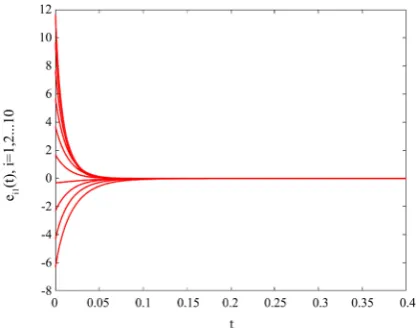
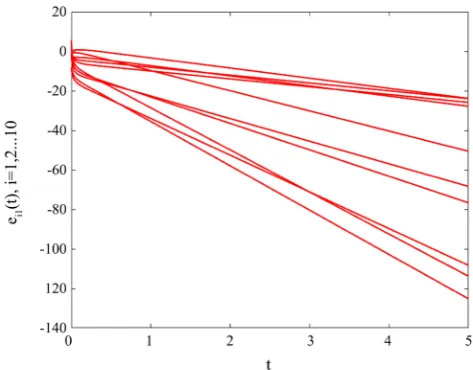
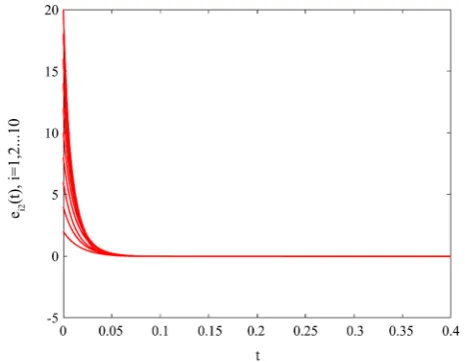
Take θ =1,φ=3,β =5, we get T0 =0.071. Figure 1, Figure 2 show the time
response of error systems without control and Figure 3 and Figure 4 present that the synchronization is achieved in finite time.
6.2. Example 2
Consider the networks (21), similar to numerical simulation of Example1, fixed- time synchronization controllers are designed as follows:
( )
( )
, 1, ,10.k l
i i i i i
u t e e e t i
φ θ
β γ
= − − − = (23)
Take
( ) (
)
T1 0 6.321, 2
x = − , x2
( ) (
0 = −4.321, 4)
T,( ) (
)
T 3 0 2.321, 6 x = − ,( ) (
)
T4 0 0.321,8
x = − , x5
( ) (
0 = 1.679,10)
T,( ) (
)
T 6 0 3.679,12 x = ,( ) (
)
T7 0 5.679,14
x = , x8
( ) (
0 = 7.679,16)
T,( ) (
)
T 9 0 9.679,18 x = ,
( ) (
)
T10 0 11.679, 20
DOI: 10.4236/ijcns.2019.1210011 165 Int. J. Communications, Network and System Sciences
[image:15.595.271.478.143.300.2]Take k=5,l=3 and step-length = 0.00005, other relative parameters are as same as Example 1. Take β γ= =5, we obtain settling time T =0.06861. Fig-ure 5 and FigFig-ure 6 show the time response of error systems without controller and Figure 7 and Figure 8 present that the fixed-time synchronization is realized.
[image:15.595.270.477.334.491.2]Figure 1. Time response of synchronization errors without controller (21).
Figure 2. Time response of synchronization errors without controller (21).
[image:15.595.269.478.523.687.2]DOI: 10.4236/ijcns.2019.1210011 166 Int. J. Communications, Network and System Sciences
[image:16.595.256.492.300.482.2]Figure 4. Time response of synchronization errors under controllers (21) with θ=1,φ=3,β =5.
Figure 5. Time response of synchronization errors without controller (23).
[image:16.595.255.492.515.700.2]DOI: 10.4236/ijcns.2019.1210011 167 Int. J. Communications, Network and System Sciences
Figure 7. Time response of synchronization errors under controllers (23) with θ=1,φ=3,k=5,l=3,β=5,γ=5.
Figure 8. Time response of synchronization errors under controllers (23) with θ=1,φ=3,k=5,l=3,β=5,γ=5.
7. Conclusion
In this paper, the issue of the fixed-time and the finite-time synchronization for a class of general output-coupling complex networks with output feedback nodes are discussed. Under the novel continuous controllers, the chattering phenome-non is eliminated and the fixed-time and finite-time synchronization are achieved as well. Then, the adaptive coupling strength problem for fixed-time synchroni-zation of complex networks with output nodes is investigated. Finally, the avail-ability of proposed fixed-time and finite-time synchronization frame are dem-onstrated by several numerical examples.
Conflicts of Interest
[image:17.595.257.490.292.473.2]DOI: 10.4236/ijcns.2019.1210011 168 Int. J. Communications, Network and System Sciences
References
[1] Stogatz, S. and Stewart, I. (1993) Coupled Oscillators and Biological Synchroniza-tion. Scientific American, 269, 102-109.
https://doi.org/10.1038/scientificamerican1293-102
[2] Strogatz, S.H. (2001) Exploring Complex Networks. Nature, 410, 268-276. https://doi.org/10.1038/35065725
[3] Xie, Q., Chen, R.G. and Bolt, E. (2002) Hybrid Chaos Synchronization and Its Ap-plication in Information Processing. Mathematical and Computer Modelling, 1, 145-163. https://doi.org/10.1016/S0895-7177(01)00157-1
[4] Gray, C.M. (1994) Synchronous Oscillations in Neural Systems. Journal of Compu-tational Neuroscience, 1, 11-38. https://doi.org/10.1007/BF00962716
[5] Yu, W.W., Chen, G.R. and Lv, J.H. (2009) On Pinning Synchronization of Complex Dynamical Networks. Automatica, 45, 429-435.
https://doi.org/10.1016/j.automatica.2008.07.016
[6] Zhang, W., Li, C., Huang, T. and He, X. (2015) Synchronization of Memris-tor-Based Coupling Recurrent Neural Networks with Time-Varying Delays and Im-pulses. IEEETransactionsonNeuralNetworksandLearningSystems, 26, 3308-3313. https://doi.org/10.1109/TNNLS.2015.2435794
[7] Han, F., Wei, G.L., Ding, D.R. and Song, Y. (2017) Finite-Horizon Bounded H Synchronisation and State Estimation for Discrete-Time Complex Networks: Local Performance Analysis. IETControlTheoryandApplications, 11, 827-837. https://doi.org/10.1049/iet-cta.2016.1161
[8] Shen, B., Wang, Z.D., Ding, D.R. and Shu, H.S. (2013) H-Infinity State Estimation for Complex Networks with Uncertain Inner Coupling and Incomplete Measure-ments. IEEETransactionsonNeuralNetworksandLearningSystems, 24, 2027-2037.
https://doi.org/10.1109/TNNLS.2013.2271357
[9] Wu, W., Zhou, W.J. and Chen, T.P. (2009) Cluster Synchronization of Linearly Coupled Complex Networks under Pinning Control. IEEE Transactions on Circuits and Systems I: Regular Papers, 56, 829-839.
https://doi.org/10.1109/TCSI.2008.2003373
[10] Lam, H. and Leung, F. (2006) Synchronization of Uncertain Chaotic Systems Based on the Fuzzy-Model-Based Approach. International Journal of Bifurcation and Chaos, 16, 1435-1444. https://doi.org/10.1142/S0218127406015404
[11] Guan, Z., Liu, Z., Feng, G. and Wang, Y. (2010) Synchronization of Complex Dy-namical Networks with Time-Varying Delays via Impulsive Distributed Control. IEEE Transactions on Circuits and Systems I: Regular Papers, 57, 2182-2195. https://doi.org/10.1109/TCSI.2009.2037848
[12] Zhang, L., Yang, X.S., Chen, X. and Feng, J.W. (2017) Exponential Synchronization of Complex-Valued Complex Networks with Time-Varying Delays and Stochastic Perturbations Via Time-Delayed Impulsive Control. AppliedMathematicsand Com-putation, 306, 22-30.https://doi.org/10.1016/j.amc.2017.02.004
[13] Bao, H., Park, J. and Cao, J. (2016) Exponential Synchronization of Coupled Sto-chastic Memristor-Based Neural Networks with Time-Varying Probabilistic Delay Coupling and Impulsive Delay. IEEE Transactions on Neural Networks and Learn-ing Systems, 27, 190-201. https://doi.org/10.1109/TNNLS.2015.2475737
DOI: 10.4236/ijcns.2019.1210011 169 Int. J. Communications, Network and System Sciences
[15] Jiang, S.Q., Lu, X.B., Xie, C. and Cai, S.M. (2017) Adaptive Finite-Time Control for Overlapping Ciuster Synchronization in Coupled Complex Networks. Neurocom-puting, 266, 188-195.https://doi.org/10.1016/j.neucom.2017.05.031
[16] Mei, J., Jiang, M., Wu, Z. and Wang, X. (2015) Periodically Intermittent Controlling for Finite-Time Synchronization of Complex Dynamical Networks. Nonlinear Dy-namics, 79, 295-305.https://doi.org/10.1007/s11071-014-1664-y
[17] Liu, M., Jiang, H.J. and Hu, C. (2017) Finite-Time Synchronization of Delayed Dy-namical Networks via Aperiodically Intermittent Control. Journal of the Franklin Institute, 4, 5374-5397.https://doi.org/10.1016/j.jfranklin.2017.05.030
[18] Liu, X.W. and Chen, T.P. (2018) Finite-Time and Fixed-Time Cluster Synchroni-ozation with or without Pinning Control. IEEE Transactions on Cybernetics, 48, 950-955. https://doi.org/10.1109/TCYB.2016.2630703
[19] Zhang, W.L., Li, C.D., Huang, T.W. and Huang, J.J. (2018) Fixed-Time Synchroni-zation of Complex Networks with Nonidentical Nodes and Stochastic Noise Per-turbations. PhysicaA, 492, 1531-1542.https://doi.org/10.1016/j.physa.2017.11.079 [20] Liu, J., Yu, Y., Wang, Q. and Sun, C.Y. (2017) Fixed-Time Event-Triggered
Con-sensus Control for Multi-Agent Systems with Nonlinear Uncertainties. Neurocom-puting, 260, 497-504.https://doi.org/10.1016/j.neucom.2017.04.061
[21] Li, Q.B., Guo, J., Sun, C.Y. and Wu Y.Y. (2017) Adaptive Synchronization for a Class of Output-Coupling Complex Networks with Output Feedback Nodes. IET ControlTheory, 11, 3372-3380.https://doi.org/10.1049/iet-cta.2017.0568
[22] Hong, Y., Wang, J. and Cheng, D. (2006) Adaptive Finite-Time Control of Nonli-near Systems with Parametric Uncertainty. IEEE Transactions on Automatic Con-trol, 51, 858-862. https://doi.org/10.1109/TAC.2006.875006
[23] Aghababa, M. and Agahababa, H. (2012) Adaptive Finite-Time Synchronization of Non-Autonomous Chaotic Systems with Uncertainty. Journal of Computational and Nonlinear Dynamics, 8, Article ID: 031006. https://doi.org/10.1115/1.4023007 [24] Yang, X. and Hu, J. (2016) Finite-Time Synchronization of Coupled Networks with
Markovian Topology and Impulsive Effects. IEEE Trans Automatic Control, 61, 2256- 2261.https://doi.org/10.1109/TAC.2015.2484328
[25] Lu, W.L. and Chen, T.P. (2004) Synchronization of Coupled Connected Neural Networks with Delays. IEEE Transactions on Circuits and Systems I: Regular Pa-pers, 51, 2494-2503. https://doi.org/10.1109/TCSI.2004.838308
[26] Chen, T.P., Liu, X.W. and Lu, W.L. (2007) Pinning Complex Networks by a Single Controller. IEEE Transactions on Circuits and Systems I: Regular Papers, 54, 1317- 1326. https://doi.org/10.1109/TCSI.2007.895383
[27] Liu, X. and Chen, T. (2015) Fixed-Time Cluster Synchronization for Complex Net-works via Pinning Control. arXiv:1509.03350.
[28] Yang, X. and Cao, J. (2010) Finite-Time Stochastic Synchronization of Complex Net- works. Applied Mathematical Modelling, 34, 3631-3641.
https://doi.org/10.1016/j.apm.2010.03.012
[29] Yang, X., Lam, J., Ho, D. and Feng, Z. (2017) Fixed-Time Cluster Synchronization for Complex Networks with Impulsive Effects via Non-Chattering Control. IEEE TransAutomaticControl, 62, 5511-5521.