Full Length Research Article
AN EXPLORATORY STUDY TO ASSESS THE KNOWLEDGE OF MOTHERS REGARDING
NUTRITIONAL NEEDS OF CHILDREN
*
Thressia John
College of Nursing, CMC and Hospital, Ludhiana, Punjab, India
ARTICLE INFO ABSTRACT
The study was conducted to assess the knowledge of mothers regarding nutritional needs of children in a selected hospital, Ludhiana, Punjab. The aim of the study was to assess the knowledge of mothers regarding nutritional needs of children with a view to find out the deficit areas and prepare guidelines on nutritional needs. Non experimental exploratory research design was used in the study. The data was collected from 100 mothers using purposive sampling technique whose children were in the age group of 1–5 years. A structured interview schedule was used for data collection. The conceptual framework was based on Three Phase Theory by Fitts and Posner (1967). Data collected was analysed using descriptive and inferential statistics. The findings of the study revealed that majority of mothers (89%) had average level of knowledge, few (9%) had below average level of knowledge and minimum number of mothers (2%) had good level of knowledge. The conclusion of the study revealed average level of knowledge among majority of the mothers regarding nutritional needs of children. Hence, to improve the nutritional status of the child, it is very important to develop a guideline on nutritional needs of children so as to make the mothers aware of the nutritional needs of children.
Copyright © 2015 Thressia John.This is an open access article distributed under the Creative Commons Attribution License, which permits unrestricted use, distribution, and reproduction in any medium, provided the original work is properly cited.
INTRODUCTION
The birth of the child is a significant event in the family. The health of a growing child is always a matter of great concern to the parents. Early childhood constitutes the most crucial period of life when the foundation is laid for cognitive, social, emotional, physical/ motor development and cumulative lifelong learning. The physical health of the child is important because it is associated with mental and social development. Most of the children have not been protected over years which led them to be the most vulnerable, dependent and least powerful population group in India (Sasikala and Jayagouri, 2008). Nutrition has a major effect on health. Nutrition refers to the availability of energy and nutrients to the body’s cells in relation to body requirements. It is the process of being nourished by which a living organism assimilates food and uses it for growth, development and maintenance. Better nutrition means stronger immune systems, less illness, better health and learning capabilities. Better nutrition is a prime entry point towards ending poverty and a milestone towards achieving better quality of life (Raju SM, 2010). Young children tend to establish eating habits during the first 2 to 3 years of life.
*Corresponding author: Thressia John
College of Nursing, CMC and Hospital, Ludhiana, Punjab, India
During childhood, the eating preference and attitude related to food habits are established by family influences and culture. In homeless and migrant children population, problems like nutritional deficiencies, growth and development delays, depression, hunger and behavioural problems are common due to inadequate food intake. Family and peer group play a major role in shaping the eating habits of children. The knowledge, attitude and practices in families regarding food have a great impact on children as they imitate their elders (Hockenberry and Wilson, 2009).
Children in the age group of one to five years are always on the go and need a wide variety of food for growth and health. Offering a range of different foods over the course of the week will help the child to get proper nutrition they need. Under– fives need diet that contains good amount of fat. They should not be given too much fibre-rich foods as these may fill them up so much they cannot eat enough to provide them with adequate calories and nutrients. However, as kids approach school age, they should gradually move towards a diet that is lower in fat and higher in fibre and by the age of five, their diet should be low in fat, sugar and salt and high in fibre with five fruit and vegetable a day – just like adults (Bia, 2013).
ISSN: 2230-9926
International Journal of Development Research
Vol. 5, Issue, 10, pp. 5770-5774, October,2015
DEVELOPMENT RESEARCH
Article History: Received 10th July, 2015
Received in revised form 30th August, 2015
Accepted 05th September, 2015 Published online 31st October, 2015
Review of Literature
Studies have shown that mothers lack knowledge regarding nutritional needs of children. Majority of studies have shown that demographic characteristics significantly affect mothers’ knowledge regarding nutrition. Study done to assess the impact of educational interventions on knowledge of mothers regarding child care and nutrition proved that there was significant improvement in knowledge of mothers with educational programmes on nutrition (Sharma S and Nagar S, 2006). Another study done on mothers of school going children revealed that knowledge of food and nutrition are significantly and positively correlated with socioeconomic status, mothers’ schooling, occupational level, housing condition and age (Ivanovic, Castro and Ivanovic, 1997). Another similar study showed that maternal schooling was positively associated with weight for age for both wealthier and poorer households (Ruel, Habicht, Pinstrup and Grohn, 1992). These studies are somewhat similar to another study conducted on 154 parents who showed lower dietary adequacy of children’s food intake in mothers with low educational level, high ranked occupation and lower level of nutritional knowledge. The highest food intake scores were found in children of mothers with high education and mothers without a job (Shookri, Layle, Fouad, Sadeq and Saif, 2011).
In a research conducted on prevalence of nutritional problems, majority of children were seen to be malnourished and mothers lacked knowledge on nutritional problems. Khokhar, Sinj, Taiwan, Rasania, Bandhan and Mehra, 2003 found that out of 600 children, 60 (29%) children were undernourished and (3.92%) were severely undernourished. Results were similar for a cross sectional study which showed 90% of children were underweight in the age group of 4-6 years (Mitra, Kumar, Chakrabarty and Bharty, 2007). A report was presented in (Times of India, 2009) by United Nations Development Programme which showed 45.5% of children were stunted and 15.9% severely stunted, 32.6% were underweight and wasting was present in 16.2%. Similar findings were noted in a study (Sharma and Barkha, 2006) which showed prevalence of underweight (37.4%), stunting (46.3%), wasting (41.5%) as well as different grades of malnutrition were assessed. Studies have shown that the degree of malnutrition was affected by mother’s education and knowledge regarding nutritional needs of children. It was found that 96% of children had protein energy malnutrition, whose mother followed faulty feeding practices and had less knowledge of nutritional needs (Iqbal, 1999). Another study suggests that malnutrition was associated with mothers’ consumption of alcohol (Setswe, 1994).
Need of the Study
India hosts 57 million i.e., more than a third of the world’s 146 million undernourished children. Children between the age of 1 – 5 years who constitute a vulnerable segment of the population from the nutritional standpoint, account for over 11% of the population in India. More than 6000 Indian children below 5 years die every day due to malnourishment and lack of basic micronutrients like vitamin A, iron, iodine and folic acid. The prevalence of malnutrition in 1 – 5 years children based on the weight for age is reported as mild
(49.2%), moderate (35.5%) and severe (2.90%) (Anthony and Laxmaiah, 2008). The researcher during her experience in paediatric unit and community area felt that Indian mothers lack knowledge about the nutritive requirements for their children during different stages of their life. Most of the time they were also unable to identify the various nutritional deficiencies present in their children on time. So the researcher felt a strong need to find out the existing knowledge among mothers so as to uplift their knowledge regarding nutritional needs of children.
Research problem
“An exploratory study to assess the knowledge of mothers regarding nutritional needs of children in a selected hospital, Ludhiana, Punjab.”
Objectives
To assess the knowledge of mothers regarding nutritional
needs of children.
To find out the relationship of knowledge of mothers with
selected variable such as age, education, occupation, number of children, religion, type of family, family income, source of information.
To identify the deficits in areas of knowledge.
To prepare guidelines with a view to improve mothers
knowledge regarding nutritional needs of children.
Assumption
Mothers have less knowledge regarding nutritional needs of children.
Conceptual framework
The conceptual frame work of the present study is based on “three phase theory” described by Fitts and Posner (1967).
Operational Definitions
Knowledge refers to the mother’s range of factual
information regarding nutritional needs of children.
Mothers refer to women having children 1 to 5 years of
age.
Nutritional Needs refer to the balance between the supply
of nutrients and energy according to body’s demand in order to ensure growth, maintenance and specific functions among children between 1 – 5 years of age.
Children refer to a human offspring, a boy or a girl
between 1 to 5 years.
MATERIALS AND METHODS
Research approach and Research design
Independent Variables
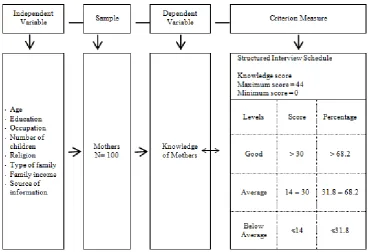
The independent variables of this study were age, education, occupation, number of children, religion, type of family, family income, source of information.
Dependent Variable
Knowledge of mothers regarding nutritional needs of children.
Selection of the field for study
A study was conducted on mothers having children in the age group of 1-5 years attending the outpatient department of paediatric medicine, surgery and well-baby clinic of Christian Medical College and Hospital, Ludhiana, Punjab.
Target population
The target population of the study was the mothers attending the child health care areas of selected hospital, Ludhiana, Punjab, India.
Sample and Sampling Technique
The sample size was 100 mothers of children in the age group 1- 5 years and purposive sampling technique was used for data collection.
Selection and Development of Tool
An interview schedule was used to assess the knowledge of mothers regarding nutritional needs of children.
Description of Tool
The interview schedule used in the study had following 2 parts:
Part 1: Sample Characteristics
This part consisted of items for obtaining personal information i.e. age, education, occupation, number of children, religion, type of family, family income and source of information.
Part 2: Interview Schedule
This part consisted of structured multiple choice questions regarding different aspects of knowledge of mothers regarding nutritional needs of children. This interview schedule consisted of 44 multiple choice items, each item consisted of one correct answer among the 4 choices and each correct answer carried 1 mark.
Reliability of Tool
The reliability of the tool was established by Karl Pearson’s coefficient of correlation using split half method and Spearman’s brown prophecy formula. The reliability of the tool was r = 0.8. Hence, the tool was reliable.
Data Collection Procedure
The data collection for the study was carried out from 10th December to 22nd December 2012. Before commencing the task of data collection procedure, formal permission was obtained from the Medical Superintendent, Principal of College of Nursing and Heads of the Department of Paediatric Medicine and Paediatric Surgery of Christian Medical College and Hospital, Ludhiana. The tool was translated to Hindi language by experts. Sample consisted of 100 mothers and verbal consent was taken from the respective subjects. Purposive sampling technique was used. Structured tools were used to collect data.
Criterion Measure
The criterion measure used in the study was knowledge score on nutritional needs of children. The knowledge score refers to the total score on knowledge items by mothers.
Ethical consideration
[image:3.595.121.492.531.783.2]Approval from the research and ethical Committee, College of Nursing, Christian Medical College and Hospital, Ludhiana
was taken to conduct an exploratory study on knowledge of mothers regarding nutritional needs of children. The researcher discussed the purpose of the study with the Medical Superintendent and written permission was obtained thereafter. An inaugural verbal consent was taken from the mothers. Anonymity of the subject and confidentiality of information was maintained.
RESULTS
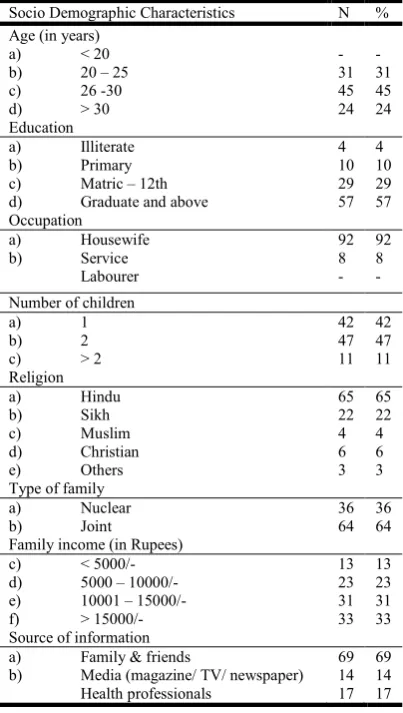
[image:4.595.316.555.51.200.2]Table 1 depicts that majority of mothers 45% were in age group of 26 – 30 years, 57% were graduate and above, 92% were housewives, 47% had 2 children, 65% were Hindus, 64% belonged to joint family, 33% of mothers had monthly family income of > Rs. 15000 and 69% of mothers got information from family and friends.
Table 1. Frequency and Percentage Distribution of Sample Characteristics
Socio Demographic Characteristics N % Age (in years)
a) < 20 b) 20 – 25 c) 26 -30 d) > 30 Education - 31 45 24 - 31 45 24 a) Illiterate b) Primary c) Matric – 12th d) Graduate and above Occupation 4 10 29 57 4 10 29 57 a) Housewife b) Service c) Labourer 92 8 - 92 8 -
Number of children
a) 1
b) 2
c) > 2 Religion 42 47 11 42 47 11 a) Hindu b) Sikh c) Muslim d) Christian e) Others Type of family
65 22 4 6 3 65 22 4 6 3 a) Nuclear b) Joint
Family income (in Rupees)
36 64
36 64
c) < 5000/- d) 5000 – 10000/- e) 10001 – 15000/- f) > 15000/- Source of information
13 23 31 33 13 23 31 33
a) Family & friends
b) Media (magazine/ TV/ newspaper)
c) Health professionals
69 14 17 69 14 17
[image:4.595.62.264.276.633.2]Objective 1. To assess the knowledge of mothers regarding nutritional needs of children
Table 2. Depicts that majority of the mothers had average knowledge regarding nutritional needs of children
Level of Knowledge Score Percentage Good
Average Below Average
> 30 14 – 30
< 14
> 68.2 31.8 – 68.2 < 31.8
Fig.2 depicts that according to education, mean knowledge score on nutritional needs among mothers was highest (20.83) in graduates and above, followed by (20.14) who were matric – 12th pass, (15.5) were primary and least, (11.75) were illiterate. Hence, it can be concluded that education had significant relationship with knowledge of mothers regarding nutritional needs of children.
Fig. 3 depicts that according to the number of children, mean knowledge score on nutritional needs among mothers having 1 child was highest (20.64), followed by (20.31) in those having 2 children and least (14.90) in mothers having >2 children. Hence, it can be revealed that number of children had significant relationship with knowledge of mothers regarding nutritional needs of children.
Conclusion
Maximum number of mothers had average level of knowledge regarding nutritional needs of children. Maximum number of mothers had knowledge in areas of introduction to nutrition. Education of mothers and number of children had significant impact on the knowledge of mothers regarding nutritional needs of children.
REFERENCES
Anthony, G.M. and Laxmaiah, A. 2008. Human development, poverty, health and nutrition situation in India. Indian J.
Med Res., 128(4): 198-205.
Bia, B. 2013. First food for baby: Irish food board, http://www.bordbia.ie/ reviewed on 23/2/2013.
Fitts and Posner. 1967. Learning and skilled performance in human performance. Beamont C A: Brock- Cole.
[image:4.595.311.557.302.420.2] [image:4.595.74.249.699.741.2]Hossain, I.M. 1999. Nutritional and immunization status: Weaning Practices and socioeconomic conditions of under
five children in three villages of Bangladesh. Indian
Journal of Public Health, 43(1):37 – 41.
Ivanovic, D., Castro, C.G. and Ivanovic, R. 1997. Food and Nutritional Knowledge of School Age Children’s Mother from elementary and high school of different socio economic levels. Arch Lationoam nutrition 47 (3): 248-255.
Khokar, A., Singh, S., Taiwan, R., Rasania, S.K., Bandhan, S.R. and Mehra, M. A study of malnutrition among children 6 months to 2 years from resettlement colony of Delhi. Indian J
Mitra, M., Kumar, K.V., Chakrabarty, S. and Bharati, P. 2007. Nutritional status of kumar tribal children in Chattisgarh.
Indian Journal of Pediatrics; 74: 63-69.
Raju, S.M. 2010. Nutrition and Biochemistry for nurses. 1st ed. New Delhi: Jaypee Brothers.
Ruel, M.T., Habich, J.P., Pinstrup, A.P. and Grohn, Y. 1992. The mediating effects of maternal nutritional knowledge on the association between maternal schooling and
nutritional status in Lesotho. American Journal of
Epidemiology, 135(8): 904 -914.
Sasikala, T. and Jayagouri, S. 2008. Effectiveness of structure teaching programme on acute respiratory infection. Nightingale Nursing Times 4 (3): 12 – 14.
Setswe, G. 1994. Prevalence and risk factors for malnutrition
among children under 5 years. Curations Journal, 17(3):
33-35.
Sharma and Barkha. 2006. Nutritional status of preschool children of Raj Gond: A tribal population in Madhya
Pradesh. Malaysian Journal of Nutrition, 12(2): 145-155.
Sharma, S. and Nagar, S. 2006. Impact of educational intervention on knowledge of mothers regarding child care
and nutrition. Journal of social Science, 12(2): 139-142.
Shookri, A.A., Layle, A., Fouad, H., Sadeq, A.S. and Saif, A.L. 2011. Effect of mothers’ nutritional knowledge and
attitude on Omani children’s dietary Intake. Oman Med
Journal, 12(6); 122 -124.
Times of India. Rich and Poor: City kids malnourished. New Delhi Report No. 221, 2009.