5995
THE RELATIONSHIP BETWEEN CELLULAR PHONE
ADDICTION AND SELF-ESTEEM OF ELEMENTARY
SCHOOL STUDENTS IN HIGHLY MOBILE ENVIRONMENT
1KWANG-OK LEE, 2HYUN-JU CHAE
1Assistant professor, Sangmyung university, Department of Nursing, Cheonan, Korea 2Assistant professor, Joongbu University, Department of Nursing, Geumsan, Korea
E-mail: 1[email protected], 2[email protected]
ABSTRACT
The purpose of this study was to investigate the cellular phone addiction status and the relationship between cellular phone addiction and self-esteem of elementary school students in today’s highly mobile environment. The study participants were 1,173 upper grade elementary school students in Chungnam province. Data were collected by a self-administered questionnaire from November 5 to 26, 2012. Collected data were analyzed using the IBM SPSS 20.0 program with descriptive statistics, Pearson’s correlation coefficient, independent t-test, one-way ANOVA and Scheffe test. The level of the cellular phone addiction in upper grade elementary school students was generally low but high risk students also existed. In addition, a negative correlation was observed between self-esteem and cellular phone addiction in upper grade elementary school students. These results suggest that various interventions to prevent and manage the cellular phone addiction should be provided for elementary school students in today’s highly mobile environment and interventions for high risk students of cellular phone addiction should be provided urgently. In addition, inclusion of interventions to increase the self-esteem of upper grade elementary school students in those interventions should be also needed.
Keywords: Cellular Phone, Addiction, Self-Esteem, Elementary School, Mobile Environment
1. INTRODUCTION
The Cellular phone is a versatile and accessible device [1]. It is very attractive especially for young people, but whose use involves a risk of maladaptive or problematic use such as abuse, addictive behavior [1, 2, 3]. In recent day, cellular phones are seen as essential in maintaining social relationships [4, 5], and many young people cannot envision and existence without cellular phones [6, 21]. This dependence on cellular phone coincides with the emergence of the Smart phone [6].
The number of cellular phone holders among the upper grade elementary school students is increasing. In 2016, 77% of upper grade elementary school students have a cellular phone and 68.2% of them have a smart phone in South Korea, which was 4.7% (cellular phone) and 8.9% (smart phone) higher than that of the previous year [7]. These data imply that cellular phone enables addictive behavior in upper grade elementary school students, and the risk of cellular phone addiction in elementary school students, especially in upper grade, is emerging as a serious social problem [8, 9].
Addictive behavior defined by the user's progressive exclusion of other activities, causing physical, mental, and social damage [10], and loss of control over the behavior is an essential element of any addiction [6]. Therefore, cellular phone addiction is an excessive attention and uncontrolled dedication to cellular phone despite its negative impact on one's well-being [11, 12].
5996 tendency [16, 21, 22]. In today’s highly mobile environment, possibility of cellular phone addictions is getting higher. Therefore, it is important for healthcare providers to investigate the degree and related factors of cellular phone addiction and provide interventions and strategies to prevent cellular phone addiction based on evidence.
In addition, considering the fact that cellular phone addictions may also be an indicator of other problems and the age of one's first cellular phone possession was negatively correlated the probability of problematic use in the future [6], interventions and strategies for elementary school students are critical and urgent issues. An increasing number of studies have focused on cell phone addictions [12], however, most studies conducted for adolescent or young adult. Therefore, this study will investigate the cellular phone addiction status of upper grades elementary school students. And self-esteem is suggested a critical factor influenced the cellular phone addiction, studies on relationships self-esteem and cellular phone addiction of elementary school students are also insufficient. Therefore, this study will also investigate the relationships between cellular phone addiction and self-esteem of upper elementary school students.
2. METHODS
2.1 Research design
This study was descriptive study to investigate the cellular phone addiction status and relationships between cellular phone addiction and self-esteem of upper grades elementary school students.
2.2 Research Subject
The study subjects were 1,173 upper grade elementary school students from three elementary schools in Chungnam province.
2.3 Research Tools
Cellular phone addiction was measured using modified and revised scale of the cellular phone addiction scale developed by Jang [23]. Jang's scale consists of 20 items with a 5 point Likert scale (1-5), with higher scores indicating higher level of cellular phone addiction. In this study, minor word revisions and elimination of several items of this scale were made for suitable to upper grade elementary students. Modified and revised scale consists of 15 items (learning disorder 5 items, life disorder 5 items, relationship disorder 5 items) and content validity of this scale was confirmed by three elementary school teachers. The internal consistency reliability was Cronbach’s α = .90 in this study.
esteem was measured using the Self-esteem scale translated by Cho [24]. Cho's scale consists of 20 items with a 5 point Likert scale (1-5), with higher scores indicating higher level of self-esteem. In this study, minor word revisions and elimination of several items of this scale were made for suitable to upper grade elementary students. Modified and revised scale consists of 13 items and content validity of this scale was confirmed by three elementary school teachers. The internal consistency reliability was Cronbach’s α = .82 in this study.
2.4 Data Collection
Data were collected using a self-report questionnaire from November 5 to 26, 2012. For the collection of research data, the researcher first contacted the teachers of upper grade elementary schools and explained the research purpose, contents of research questionnaire, time to filling out a questionnaire, and assurance of no disadvantage for the nonparticipants in this research. After explanations, written informed consents and research questionnaires were distributed to teachers those who permit to conduct this study. Distribution and collection of research questionnaires and informed consents from research subjects were carried out by teachers.
2.5 Data Analysis
Collected data were analyzed using the IBM SPSS 20.0 program with descriptive statistics, Pearson’s correlation coefficient, independent t-test, one-way ANOVA and Scheffe test.
Descriptive statistics were used to describe the general characteristics, cellular phone addiction and self-esteem. Independent t-test and one-way ANOVA were used to analyze cellular phone addiction according to general characteristics.
Pearson’s correlation coefficient was used to analyze the relationship between cellular phone addiction and self-esteem.
3. RESULTS
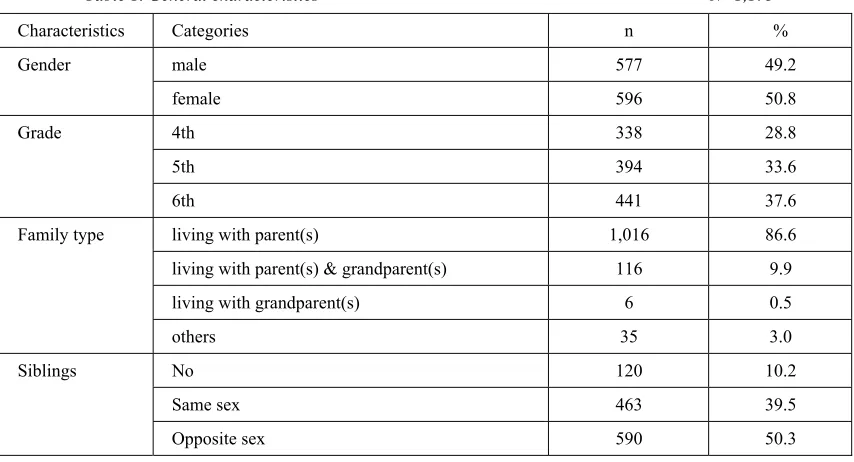
3.1 General Characteristics Of Subjects
5997
Table 1. General characteristics N=1,173
Characteristics Categories n %
Gender male 577 49.2
female 596 50.8
Grade 4th 338 28.8
5th 394 33.6
6th 441 37.6
Family type living with parent(s) 1,016 86.6
living with parent(s) & grandparent(s) 116 9.9
living with grandparent(s) 6 0.5
others 35 3.0
Siblings No 120 10.2
Same sex 463 39.5
Opposite sex 590 50.3
3.2 Cellular phone addiction and Self-esteem
Cellular phone addiction and self-esteem degree of research subjects are showed in Table 2. Mean scores of cellular phone addiction were 22.84 out of 75.00 (30.45 out of 100.0). Among the area of cellular phone addiction, mean scores
of life disorder (8.04±3.51) were the highest and those of learning disorder (7.34±2.96) were the lowest.
Mean scores of self-esteem were 46.74 out of 65.00 (71.91 out of 100.0).
Table 2. Cellular phone addiction and Self-esteem
Total score Minimum score Maximum score Mean±SD
Cellular phone addiction 75 15.00 63.00 22.84±8.41
learning disorder 25 5.00 21.00 7.34±2.96
life disorder 25 5.00 23.00 8.04±3.51
relationship disorder 25 5.00 22.00 7.46±2.93
Self-esteem 65 17.00 65.00 46.74±7.12
SD=standard deviation
3.3 Cellular Phone Addiction According To General Characteristics
Cellular phone addiction according to general characteristics is showed in Table 3. The higher the grade, the higher the mean score of cellular phone addiction (F=50.21, p<.001).
The students living with parent(s) showed higher score of cellular phone addiction than other students (t=1.98, p=.048), however, cellular phone
[image:3.612.95.523.482.594.2]5998
Table 3. Cellular phone addiction according to general characteristics
Characteristics Categories n Mean±SD t or F p
Gender male 577 22.54±8.04 1.23 .220
female 596 23.14±8.76
Grade 4tha
338 19.74±6.19 50.21 <.001
(a<b<c) 5thb
394 22.47±8.23
6thc
441 25.55±9.15
Family type living with parent(s) 1,016 23.03±8.49 1.98 .048
others 157 21.61±7.82
Siblings No 120 23.65±8.81 .634 .531
Same sex 463 22.71±8.38
Opposite sex 590 22.80±8.35
SD=standard deviation
3.4 Relationships Between Self-Esteem And Cellular Phone Addiction
Relationships between self-esteem and cellular phone addiction are showed in Table 4. A negative correlation was observed between self-esteem and
cellular phone addiction (r=-.367, p<.001).
Negative correlations were also observed between self-esteem and three areas of cellular phone addiction.
Table 4. Relationship between Cellular phone addiction and self-esteem
cellular phone
addiction learning disorder disorder life relationship disorder
self-esteem -.367** -.312** -.334** -.338**
**p<.001
4. DISCUSSION
In this study, mean scores of cellular phone addiction were 22.84 out of 75.00 (30.45 out of 100.0). This result consistent with previous study reporting that the pattern of cellular phone use in elementary school students did not show the severe addiction pattern [21]. This result also consistent with previous study reporting that the mean scores of cellular phone addition were 37.37 out of 100.0 [25]. Researches about cellular phone addiction of elementary school students were not much [21]. But, considering the result of previous study and this study, it is assumed that the degree of elementary school students’ cellular phone addiction is generally low. However, maximum score of cellular phone addiction was 63.00 out of 75.00 (84 out of 100.0), this score means high risk
of cellular phone addiction. Lee & Lee (2012) reported that there was a great deal of variability between elementary school students in the pattern of cellular phone use [21]. In addition to, there is a difference between result from self-reported questionnaires and self-implication [12]. Therefore, although the mean scores of cellular phone addiction is showed low level, it is needed to take an interest about elementary school students’ cellular phone addiction. It is also needed to develop and apply for interventions and strategies to prevent elementary school students’ cellular phone addiction and application of interventions to manage of cellular phone addiction for high risk students is needed urgently.
[image:4.612.86.504.432.475.2]5999 program reduce the cellular phone addiction tendency of higher grade elementary school students [27]. However, other studies reported conflicting results that education programs for elementary school students about cellular phone use were not effective on self-efficacy and self-control about cellular phone use [8, 26]. Therefore, continuous and repetitive studies to develop effective interventions and strategies for preventing and controlling cellular phone addiction of elementary school students should be conducted. In this study, the higher the grade, the higher the mean score of cellular phone addiction (F=50.21,
p<.001). The higher the grade, the probability of
long time exposure to cellular phone is high. This means that the cellular phone addiction risk of higher grade students can be much higher than that of lower grade students. The result of this study can be explained in this context. Therefore, considering the result of this study, 6th grade elementary school
students can be the most risk group and needed more interest and interventions than any other elementary school students. However, the younger the age of first possession of one's own cellular phone, the probability of cellular phone addictive use is high [12]. Particularly, the greatest risks of problematic or addictive use are found when one's own phone is first obtained at an age of younger than 13 years [20]. The greater dependence of cellular phone exists in Korea [12], and the age of firsts cellular phone possession is getting lower. Therefore, interventions and strategies according to elementary school grade should be developed and applied to prevent and manage cellular phone addiction.
In this study, the students living with parent(s) showed higher score of cellular phone addiction than other students (t=1.98, p=.048). Family
strengths were negative correlation with cellular phone addiction of elementary school students [9]. Parental factors were significantly related to cellular phone addiction of elementary school students, among parental factors, open communication was negative correlation, while problem communication and rejecting/restrictive or permissive/neglecting parenting behavior were positive correlation with cellular phone addiction of elementary school students [21]. However, this study investigate only the family type and most students (86.6%) lived with their parents. Therefore, repetitive studies about family type and celluar phone addiction should be conducted.
In this study, cellular phone addiction according to gender did not showed significant difference. Several studies reported that women
exhibit a higher level of attachment to ad dependence on their cellular phone compared with men [28, 29, 30]. However, other studies reported little or no difference in cellular phone dependence across male and female cellular phone users [25, 31]. Therefore, repeated studies about cellular phone addiction according to gender should be conducted. In additions, most previous studies about cellular phone addiction, like other additions, are lack of clear terminology [32], studies to clarification of terminology also should be conducted along with these studies.
In this study, a negative correlation was observed between self-esteem and cellular phone addiction (r=-.367, p<.001), and negative
correlations were also observed between self-esteem and three areas of cellular phone addiction. These results are consistent with previous studies reporting the negative correlation between self-esteem and cellular phone addiction [16, 19, 21]. Self-esteem is found in the majority of researches on problematic use of cellular phone [21]. The personal trait most consistently associated with addictive behavior is low self-esteem and women with low self-esteem are the most vulnerable group [1]. To prevent and manage cellular phone addiction of elementary school students, various strategies and interventions are needed. Considering the result of this study and previous studies, self-esteem can be the important factor of prediction and control the cellular phone addiction of elementary school students.
6000 predictors of addictive cellular phone use [34]. This can be consistent with the fact that cellular phone addiction has correlation with loneliness [35] and the need for social approval above mentioned. Therefore, increase of self-esteem should be involved in interventions and strategies to prevent and manage cellular phone addiction of elementary school students.
5. CONCLUSIONS
This study was conducted to investigate the cellular phone addiction status and relationships between cellular phone addiction and self-esteem of upper grades elementary school students in today’s highly mobile environment .
This study found that the degree of the cellular phone addiction in upper grade elementary school students was generally low but high risk students also existed. Therefore, considering today’ highly mobile environment and growing possibility of cellular phone addiction, various interventions and strategies to prevent and manage the cellular phone addiction should be provided for elementary school students and interventions for high risk students of cellular phone addiction should be provided urgently.
This study also found that there were negative correlations between self-esteem and cellular phone addiction of elementary school students in upper grades. Therefore, strategies to increase of self-esteem for elementary school students should be involved in interventions and strategies to prevent and control the cellular phone addiction of elementary school students.
In today’s highly mobile environment, cellular phone use has rapidly increased and probability of addictive use of cellular phone also has increased. Therefore, healthcare providers should investigate the degree and related factors of cellular phone addiction and provide interventions to prevent and manage cellular phone addiction based on evidence. Continuous studies to investigate the degree and related factors of cellular phone addiction should be needed. Developing and applying interventions to prevent and manage cellular phone addiction should be also needed for healthy and desirable mobile environment.
REFERENCES:
[1] E.J. Pedrero Perez, M.T. Rodriguez Monje, and J.M. Ruiz Sanchez De Leon, “Mobile phone abuse of addiction: A review of the literature”,
Adicciones, Vol. 24, No. 2, 2012, pp. 139-152.
[2] X. Sanchez-Carbonell, M. Beranuy, M. Castellana, A. Chamarro, and U. Oberst, “Internet and cell phone addiction: Passing fad of disorder”, Addicciones, Vol. 20, No. 2, 2008,
pp. 149-159.
[3] M. Takao, S. Takahashi, and M. Kitamura, “Addictive personality and problematic mobile phone use”, Cyberpsychology and Behavior,
Vol. 12, No. 5, 2009, pp. 501-507.
[4] R. Junco, and G.A. cole-Avent, “An introduction to technologies commonly used by college students”, New Directions for Student Service, Vol. 124, 2008, pp. 3-17.
[5] R. Junco, and S.R. Cotton, “No A 4 U: The relationship between multitasking and academic performance”, Computer & Education, Vol. 59, No. 2, 2012, pp. 505-514.
[6] J.A. Roberts, L.H. Yaya, and C. Manolis, “The invisible addiction: Cell-phone activities and addiction among male and female college students”, Journal of Behavioral Addictions,
Vol. 3, No. 4, 2014, pp. 245-265.
[7] Korea Information Society Development Institute (KISDI), “Korean media panel survey”, KISDI Stat report, 16-21, 2016, pp.
1-8.
[8] H.Y. Koo, “Effects of cell phone use education program on knowledge, attitudes, self-efficacy and self-control of cell phone use in elementary school students”, Journal of Korean Academy of Child Health Nursing, Vol. 18, No. 3, 2012,
pp. 109-118.
[9] S.W. Jang, “The explanatory of personal, family, school variables on cellular phone addiction by the elementary school students”,
Journal of Learner-Centered Curriculum and Instruction, Vol. 11, 2011, pp. 291-310.
[10] R. Shambare, R. Rugibana, and T. Zhowa, “Are mobile phones the 21th century addiction”, African Journal of Business Management, Vol. 6, No. 2, 2012, pp. 573-577.
[11] J.A. Roberts, and S.F. 3rd Pirog, “A preliminary investigation of materialism and impulsiveness as predictors of technological addictions among young adults”, Journal of Behavioral Addictions, Vol.2, No. 1, 2013, pp.
6001 [12] J. De-Sola Gutierrez, F. Rodriguez de Fonseca,
and G. Rubio, “Cell-phone addiction: A review”, Front Psychiatry, Vol. 24, No. 7,
2016, pp. 175.
[13] F.J. Labrador Encinas, and S.M. Villadangos Gonzalez, “Adolescents and new technologies: Behaviours pointing a possibble addiction problem”, Psicothema, Vol. 22, No. 2, 2010,
pp. 180-188.
[14] J. Billieux, M. van der Linden, and L. Rochat, “The role of impulsivity in actual and problematic use of the mobile phone”, Applied Cognitive Psychology, Vol. 22, No. 9, 2008, pp.
1195-1210.
[15] M. Choliz, “Mobile-phone addiction in adolescence: The test of mobile phone dependence (TMSD)”, Progress in Health Science, Vol. 2, No. 1, 2012, pp. 33-44.
[16] S.W. Jang, S.J. Kim, S.Y. Choi, and J.Y. Lee, “The effect of self-esteem, school adjustment, mental health on elementary school students’ cellular phone addiction”, The Journal of Child Education, Vol. 22, 2013, pp. 243-256.
[17] R.A. Sansone, and L.A. Sansones, “Cell phones: The psychosocial risks”, Innovations in Clinical Neuroscience, Vol. 10, No. 1, 2013,
pp. 33-37.
[18] J.C. Fondevila Gascon, M. Carreras Alcalde, J.L. Del Olmo Arriaga, and M.J. Pesqueira Zamora, “The impact of instant messaging in students in the form of stress and anxiety for learning: Empirical analysis”, DIM, Vol. 30,
2014, pp. 1-15.
[19] J.H. Ha, B. Chin, D.H. Park, S.H. Ryu, and J. Yu, “Characteristics of excessive cellular phoneuse in Korean adolescents”,
Cyberpsychology and Behavior, Vol. 11, No. 6,
2008, pp. 783-4.
[20] S. Sahin, K. Ozdemir, A. Unsal, and N. Temiz, “Evaluation of mobile phone addiction level and sleep quality in university students”,
Pakistan Journal of Medical Science, Vol. 29,
No. 4, 2013, pp. 913-918.
[21] A.R. Lee, and K.G. Lee, “The effects of parental factors, friend’s factors, and psychological factors on the addictive mobile phone use of children”, The Journal of Child Education, Vol. 21, 2012, pp. 27-39.
[22] O. Senormanci, O. Saracli, N. Atasoy, G. Senormanci, F. Kokturk, and L. Atik, “Relationship of internet addiction with cognitive style, personality, and depression in university students”, Comprehensive Pscychiatry, Vol. 55, No. 6, 2014, pp.
1385-1390.
[23] H.J. Jang, “The psychological characteristics of adolescents addictive using cellular phone”, Unpublished master’s thesis, Sungshin Women’s University, 2002.
[24] Y.S. Cho, “The effects of self-esteem and attatchment on interpersonal problem solving ability in adolescent”, Unpublished master's thesis, Kookmin University. 1998.
[25] H.S. Yoo, K.O. Min, “Effect of mental health, academic self-efficacy, school life adjustment on cellular phone addiction of elementary”, The Journal of Child Education, Vol. 24, 2015, pp.
213-227.
[26] H.Y. Koo, “Effects of a prevention program for media addiction on television addiction, internet addiction, cellular phone addiction, and impulsiveness in elementary school students”, Child Health Nursing Research,
Vol. 19, No.4, 2013, pp. 270-281.
[27] J.Y. Lee, and H.K. Yu, “Development of a group counseling program to reduce cellular phone addiction tendency of elementary school students in high grade”, The Korean Journal of educational methodology Studies, Vol. 25,
2013, pp. 29-49.
[28] M. Hakoama, S. Hakoyma, “The impact of cell phone use on social networking and developing among college students”, The American Association of Behavioral and Social Science Journal, Vol. 15, 2011, pp. 1-20.
[29] L.A. Jackson, Y. Zhao, A. Kolenin, H.E. Fitsgerald, R. Harold, and A. von Eye, “Race, gender, and information technology use: The new digital divide”, Cyberpsychology and Behavior, Vol. 11, No. 4, 2008, pp. 437-442.
[30] C. Jenaro, N. Flores, M. Gomez-Vela, F. Gonzalez-Gil, and C. Caballo, “Problematic internet and cell-phone use: Psychological, behavioral, and health correlates”, Addiction Research and Theory, Vol. 15, No. 3, 2007, pp.
309-320.
[31] R. Junco, D. Merson, and D.W. Salter, “The effect of gender, ethnicity, and income on college students’ use of communication technologies”, Cyberpsychology, Behavior and Social Networking, Vol. 13, No. 6, 2010, pp.
619-627.
[32] X. Carbonell, E. Guardiola, M. Beranuy, and A. Belles, “A bibliometric analysis of the scientific literature on internet, video games, and cell phone addiction”, Journal of the Medical Library Association, Vol. 97, No. 2,
6002 [33] S.E. Caplan, “Relations among loneliness,
social anxiety, and problematic Internet use”,
Cyberpsychology and Behavior, Vol. 10, No. 2,
2007, pp. 234-242.
[34] J. Billieux, “Problematic use of the mobile phone use: A literature review and the pathways model”, Current Psychiatry Review,
Vol. 8, No. 4, 2012, pp. 1-9.
[35] M. Bhardwaj, M.S.J. Ashok, “Mobile phone addiction and loneliness among teenagers”, The Internet journal of Indian Psycholog, Vol. 2,