S oli h ull Gy p sy a n d T r a v ell e r
a c c o m m o d a ti o n a s s e s s m e n t :
Fi n al r e p o r t
B r o w n , P, S c ullio n, LC a n d M o r ri s, GJ
T i t l e S oli h ull Gy p sy a n d T r a v ell e r a c c o m m o d a ti o n a s s e s s m e n t : Fi n al r e p o r t
A u t h o r s B r o w n , P, S c ullio n , LC a n d M o r r i s, GJ
Typ e M o n o g r a p h
U RL T hi s v e r si o n is a v ail a bl e a t :
h t t p :// u sir. s alfo r d . a c . u k /i d/ e p ri n t/ 3 5 8 2 8 / P u b l i s h e d D a t e 2 0 1 2
U S IR is a d i gi t al c oll e c ti o n of t h e r e s e a r c h o u t p u t of t h e U n iv e r si ty of S alfo r d . W h e r e c o p y ri g h t p e r m i t s , f ull t e x t m a t e r i al h el d i n t h e r e p o si t o r y is m a d e f r e ely a v ail a bl e o nli n e a n d c a n b e r e a d , d o w nl o a d e d a n d c o pi e d fo r n o
n-c o m m e r n-ci al p r iv a t e s t u d y o r r e s e a r n-c h p u r p o s e s . Pl e a s e n-c h e n-c k t h e m a n u s n-c ri p t fo r a n y f u r t h e r c o p y ri g h t r e s t r i c ti o n s .
1
Solihull Gypsy and Traveller Accommodation
Assessment
Final Report
Philip Brown, Lisa Scullion and Gareth Morris
Salford Housing & Urban Studies Unit
University of Salford
2
About the Authors
Lisa Scullion and Philip Brown are Research Fellows and Gareth Morris is a Research
Associate in the Salford Housing & Urban Studies Unit (SHUSU) at the University of Salford.
The Salford Housing & Urban Studies Unit is a dedicated multi-disciplinary research and consultancy unit providing a range of services relating to housing and urban management to public and private sector clients. The Unit brings together researchers drawn from a range of disciplines including: social policy, housing management, urban geography, environmental management, psychology, social care and social work.
Study Team
Core team members:
Dr Philip Brown Dr Lisa Scullion Gareth Morris Victoria Morris
Interviewers:
3
Acknowledgements
Without the time, expertise and contributions of a number of individuals and organisations, this study could not have been completed. Officers from within Solihull Metropolitan Borough Council provided guidance and assistance throughout the project and thanks must go to all of them for their support.
Special thanks are also due to our three interviewers – Sharon Finney, Tracey Finney and Mary Philbin – for their invaluable fieldwork assistance.
Particular thanks must, of course, go to the people who found the time to talk to us and answer our questions in a full, honest and patient manner. It is hoped that this report is able to accurately reflect their experiences and needs.
4
Contents
About the Authors... 2
Acknowledgements... 3
Contents ... 4
Glossary ... 6
Executive Summary ... 8
1. Introduction ... 11
Background and scope ... 11
Research approach... 11
Structure of the report... 12
2. Policy context... 13
Planning policy 2006-2011 ... 13
Regional planning policy... 13
Planning policy within Solihull Metropolitan Borough Council... 14
Emerging national planning policy ... 14
Defining Gypsies and Travellers ... 16
Housing / accommodation need ... 17
Defining a pitch ... 18
Conventions... 18
3. The bi-annual Caravan Count and size of the population ... 19
Caravan numbers and trends from the Caravan Count ... 19
The size of the local Gypsy and Traveller community... 20
4. Authorised social and private sites... 22
Socially rented sites... 22
Authorised private sites ... 22
Permanent private site residents: findings from the survey... 22
5. Planning and unauthorised sites... 26
Planning applications for Gypsy and Traveller sites... 26
Unauthorised development of Gypsy and Traveller sites ... 26
Unauthorised developments residents: findings from the survey ... 27
5
6. Gypsies and Travellers in social and private bricks and mortar accommodation ... 31
Estimating the size of the Gypsy and Traveller population in bricks and mortar housing... 31
Bricks and mortar housing residents: findings from the survey ... 32
Housing experiences of site-based respondents ... 33
7. Travelling... 35
8. Future accommodation, household formation and accommodation affordability ... 38
Future accommodation... 38
Household concealment... 40
Household formation ... 41
Accommodation affordability ... 43
9. Experiences of employment, education and health services ... 45
Employment experiences... 45
Education experiences ... 46
Access to health services... 46
10. Travelling Showpeople ... 48
11. An assessment of accommodation need ... 49
A note on the assessment of accommodation need... 49
Explanation of the need requirement elements... 52
Exploring tenure preference in relation to accommodation need ... 56
12. An assessment of need for transit accommodation ... 58
Need for transit sites and stopping places... 58
13. Conclusions... 60
Appendix 1: The assessment methodology... 62
6
Glossary
The following terms are used in this report and / or are used in conjunction with planning for Gypsy, Traveller and Showpeople accommodation. As such these terms may need some clarification. In the case of those which are related to Gypsy and Traveller accommodation and culture, it is noted that a number of these terms are often contested and debated. It is not the intention of the authors to present these terms as absolute definitions; rather, the explanations provided are those the authors used in this assessment as their frames of reference.
Term Explanation
Amenity block / shed On most residential Gypsy / Travellers sites these are buildings
where basic plumbing amenities (bath / shower, WC and sink) are provided at the rate of one building per pitch.
Authorised social site An authorised site owned by either the local authority or a
Registered Housing Provider.
Authorised Private site An authorised site owned by a private individual (who may or
may not be a Gypsy or a Traveller). These sites can be owner-occupied, rented or a mixture of owner-occupied and rented pitches.
Bricks and mortar Permanent mainstream housing.
Caravan Mobile living vehicle used by Gypsies and Travellers. Also
referred to as trailers.
Caravan Count Bi-annual count of Gypsy and Traveller caravans conducted every
January and July by local authorities and published by the CLG.
Chalet In the absence of a specific definition the term ‘chalet’ is used
here to refer to single storey residential units which resemble mobile homes but can be dismantled.
Core Strategy Key compulsory Development Plan Document in the Local
Development Framework which sets out principles on which other Development Plan Documents are built.
Department for Communities and Local Government (CLG)
The main government department responsible for Gypsy and Traveller accommodation issues
Development Plan Documents (DPDs) Documents which outline the key development goals of the Local
Development Framework.
Gypsy and Traveller Accommodation Needs Assessment (GTAA)
The main document that identifies the accommodation requirements of Gypsies and Travellers.
Doubling-up To share a pitch on an authorised site.
Gaujo / Gorger Literal translation indicates someone who is not of the Romany
Gypsy race. Romany word used mainly, but not exclusively, by Romany Gypsies to refer to members of the settled community / non-Gypsy / Travellers.
Green Belt A policy or land use designation used to retain areas of largely
undeveloped, wild, or agricultural land surrounding or neighbouring urban areas.
Gypsy Members of Gypsy or Traveller communities. Usually used to
describe Romany (English) Gypsies originating from India. This term is not acceptable to all Travellers.
Gypsies and Travellers(as used in this
report)
Homes and Communities Agency (HCA)
National housing and regeneration agency. Has been responsible for administering the Gypsy and Traveller Site Grant since 2009 / 2010.
Local Plan / Local Development Framework (LDF)
A set of documents which a Local Planning Authority creates to describe their strategy for development and use of land in their area of authority.
Pitch / plot Area of land on a site / development generally home to one
licensee household. Can be varying sizes and have varying caravan occupancy levels. Often also referred to as a plot, particularly in relation to Travelling Showpeople. There is no agreed definition as to the size of a pitch / plot.
Pulling-up To park a trailer / caravan.
Regional Spatial Strategy (RSS) Previous planning approach across England. In July 2010 the
government announced its decision to revoke RSSs.
Settled community / people Reference to non-Travellers (those who live in houses).
Site An authorised area of land on which Gypsies and Travellers are accommodated in trailers / chalets / vehicles. Can contain one or multiple pitches.
Static caravan Larger caravan than the ‘tourer’ type. Can be moved but only
with the use of a large vehicle. Often referred to simply as a trailer.
Stopping place Locations frequented by Gypsies and Travellers, usually for short
periods of time.
Suppressed / concealed household Households, living within other households, who are unable to set
up separate family units and who are unable to access a place on an authorised site, or obtain or afford land to develop one.
Trailer Term commonly used by Gypsies and Travellers to refer to a
moveable caravan.
Transit site Site intended for short stays. Such sites are usually permanent,
but there is a limit on the length of time residents can stay.
Travelling Showpeople Commonly referred to as Showmen, these are a group of
occupational Travellers who work on travelling shows and fairs across the UK and abroad.
Unauthorised Development This refers to a caravan / trailer or group of caravans/trailers on
land owned (possibly developed) by Gypsies and Travellers without planning permission.
Unauthorised Encampment Residing in caravans / trailers on private / public land without the
landowner’s permission (for example, at the side of the road, on a car park or on a piece of undeveloped land).
Executive Summary
The Study
1. The Housing Act 2004 placed a duty upon local authorities to produce assessments of accommodation need for Gypsies and Travellers. In 2008 Solihull Metropolitan Borough Council published a joint Gypsy and Traveller Accommodation Needs Assessment (GTAA) along with Birmingham and Coventry City Councils. This GTAA provided an overview of the accommodation and related needs and experiences of the Gypsy and Traveller population.
2. In November 2011 Solihull Metropolitan Borough Council commissioned the Salford Housing & Urban Studies Unit (SHUSU) at the University of Salford to produce a Gypsy, Traveller and Travelling Showpeople Accommodation Assessment for the borough. The primary purpose of this report is to provide an evidence base to inform the future development of planning policies through the Local Development Framework. This report presents the projection of requirements for the following periods:
1stJanuary 2012 – 31stDecember 2016
1stJanuary 2017 – 31stDecember 2021
1stJanuary 2022 – 31stDecember 2026
3. The assessment was undertaken by conducting a review of the following data sources:
Previous assessments of need and information submitted through the previous regional planning process;
The policy and guidance context;
The bi-annual Caravan Count;
Information from the local authority with regards to pitch provision and supply; and
A survey of 75 Gypsies and Travellers currently residing in site-based and bricks and mortar accommodation across the borough of Solihull.
Local accommodation provision
5. There is no one source of information about the size of the Gypsy and Traveller population in the borough. Our best estimate is that there are at least 325 local Gypsies and Travellers living in the borough. The population was found across a range of accommodation types:
There are7 authorised permanent private sitesin the borough. Together these accommodate approximately 49 pitches / households.
There is1 authorised private sites with temporary consentin the borough accommodating a single individual.
There are3 unauthorised developments(land owned by Gypsies and Travellers but developed without planning permission) within the borough. It is estimated that these sites accommodate approximately 14 pitches / households.
It is estimated that there are at least40 households living in bricks and mortar housingin the borough.
There areno socially rented sitesin the borough.
There is no yard-based accommodation forTravelling Showpeoplein the borough.
Characteristics of local Gypsies and Travellers
6. The survey of Gypsies and Travellers identified some of the important characteristics of the local population:
Household size is larger than in the settled / non-Traveller population at 3 persons across the whole sample.
A significant proportion of the sample (16%) were households over 60 years of age.
The majority of Gypsies and Travellers in trailers and in housing can be seen to belong, in some way, to the borough. The vast majority of people had lived in the borough for over 10 years. Many of these were born or had strong family links in the area.
The local population is dominated by Romany Gypsies (72%) with a smaller number of Irish Travellers (19%).
Accommodation need and supply
7. There are no signs that the growth in the Gypsy and Traveller population will slow significantly. Research from the Equalities and Human Rights Commission (EHRC) has indicated that around 6,000 additional pitches for Gypsies and Travellers are
immediately required to meet the current shortage of accommodation within England.
8. This study has taken a thorough assessment of the need arising from all sites
(permanent, temporary and unauthorised) present at the time of the survey. As such this assessment of need should be regarded as a reasonable and robust assessment of need upon which to base planning decisions going forward. Sites given planning permission or developed through new social provision after the 1stJanuary 2012 contribute to the need requirements detailed in the table below.
Table i: Summary of Gypsy, Traveller and Travelling Showpeople accommodation and pitch need (1stJanuary 2012 - 31stDecember 2026)
Gypsy and Traveller Accommodation Need Total (No. of pitches)
Current authorised residential provision (pitches / plots) 49
Residential need 2012–2016 (pitches / plots) 26
Residential need 2017–2021 (pitches / plots) 6 Residential need 2022–2026 (pitches / plots) 6
Residential need 2012–2026 (pitches / plots) 38
9. It is recommended that this assessment of accommodation need is repeated in due course (circa 5 years) to ensure this assessment remains as accurate as possible.
1.
Introduction
Background and scope
1.1 The Housing Act 2004 placed a duty upon local authorities to produce assessments of accommodation need for Gypsies and Travellers. In 2008, along with Birmingham and Coventry City Councils, Solihull Metropolitan Borough Council published a Gypsy and Traveller Accommodation Needs Assessment (GTAA)1. This GTAA provided an
overview of the accommodation and related needs and experiences of the Gypsy and Traveller communities; crucially, identifying the accommodation need – in the form of residential pitch shortfall – of the population on an individual borough level. This assessment found a need for 17 pitches to be provided within the borough of Solihull between 2007 and 2012; with an additional 9 from 2012 – 2017, based on estimated family formation. This assessment did not identify any need for Travelling
Showpeople pitches in the borough, given that there was no Travelling Showpeople site in Solihull. Following this GTAA and the LDF Core Strategy (now called the Local Plan), which sets out the proposed approach to the ‘Provision of Sites for Gypsies and Travellers’, a total of 12 pitches have been approved (by regularising longstanding unauthorised sites). This left an unmet need of 5 pitches to 2012 and 9 to 2017 (as highlighted above).
1.2 In November 2011, Solihull Metropolitan Borough Council commissioned the Salford Housing & Urban Studies Unit (SHUSU) at the University of Salford to produce a Gypsy and Traveller Accommodation Assessment update. The primary purpose of this update is to provide an updated evidence base to feed into a Gypsy and Traveller Site Allocations Development Plan Document (DPD) and the LDF Local Plan. This report presents the projection of requirements for the following periods:
1stJanuary 2012 – 31stDecember 2016
1stJanuary 2017 – 31stDecember 2021
1stJanuary 2022 – 31stDecember 2026
Research approach
1.3 The approach to this study involved bringing together various existing data sources with empirical research with the Gypsy and Traveller communities across the borough. Details about the methodology for the assessment can be found in Appendix 1. The methodology entailed a review of the following data sources:
Previous assessments of need and information submitted through the previous regional planning process;
The policy and guidance context;
The bi-annual Caravan Count;
1Centre for Urban and Regional Studies (CURS) (2008)Joint Gypsy and Traveller Accommodation Assessment:
Birmingham, Coventry and Solihull Councils, online at:
Information from the local authority with regards to pitch provision and supply; and
A survey of 75 Gypsies and Travellers currently residing in site-based and bricks and mortar accommodation across the borough of Solihull.
Structure of the report
1.4 This report is intended to assist Solihull Metropolitan Borough Council in the formulation of planning policies for the provision of accommodation for the Gypsy and Traveller communities. It sets out the background and current policy context, identifies the estimated Gypsy and Traveller population of the borough and presents evidence of need arising within the borough.
Chapter 2looks at the past, present and emerging policy context in the area of Gypsy, Traveller and Travelling Showpeople accommodation.
Chapter 3looks at the trends in caravan numbers evident from the bi-annual Caravan Count.
Chapter 4presents the findings from across all authorised private sites based on information provided by Solihull Metropolitan Borough Council and obtained through the survey of Gypsy and Traveller households.
Chapter 5looks at the level of planning applications made in the borough, the presence of unauthorised sites and the views of households on unauthorised sites obtained through the household survey.
Chapter 6looks at the numbers of Gypsies and Travellers living in bricks and mortar accommodation as well as drawing upon the views of people obtained through the household survey.
Chapter 7looks at issues associated with travelling in order to shed some light on travelling patterns and experiences of Gypsies and Travellers throughout the borough.
Chapter 8looks at a range of issues including the movement intentions of the sample, the formation of new households and concealment of existing ones and the accommodation preferences of the Gypsy and Traveller population.
Chapter 9covers a range of issues around the experience of employment, education and health services within the borough.
Chapter 10looks briefly at the issue of Travelling Showpeople in the borough.
Chapter 11provides the numerical assessment of accommodation need for the borough.
Chapter 12looks briefly at the issue of transit need in the borough.
Chapter 13provides concluding comments on the assessment.
1.5 The base date for this assessment is the 1stJanuary 2012. Accommodation provided
2.
Policy context
2.1 This chapter looks at the current, past and emerging policy context impacting on the assessment of need and the provision of accommodation for Gypsies, Travellers and Travelling Showpeople.
Planning policy 2006-2011
2.2 The main document for detailing planning policy in England over the 2006-2011 period was the ODPM Circular 01 / 2006Planning for Gypsy and Traveller Caravan Sites. This specified that the aims of legislation and policy were to:
ensure that Gypsies and Travellers have fair access to suitable accommodation, education, health and welfare provision;
reduce the number of unauthorised encampments and developments;
increase significantly the number of Gypsy and Traveller sites in appropriate locations and with planning permission in order to address under-provision by 2011;
protect the traditional travelling way of life of Gypsies and Travellers;
underline the importance of assessing accommodation need;
promote private site provision; and
avoid Gypsies and Travellers becoming homeless, where eviction from unauthorised sites occurs and where there is no alternative accommodation.
2.3 Travelling Showpeople are included in separate planning guidance, CLG Circular 04/07, which aims to ensure that the system for pitch assessment, identification and allocation as introduced for Gypsies and Travellers is also applied to Travelling Showpeople.
Regional planning policy
2.4 ODPM Circular 01/2006 made it clear that borough level requirements identified in GTAAs were to be submitted to the relevant Regional Planning Body (RPB)2. The RPB
would then, in turn, provide pitch requirements on a borough by borough basis once a strategic view of needs had been taken through the process of producing the Regional Spatial Strategy (RSS).
2.5 During early 2010 the West Midlands Regional Assembly published the West Midlands Regional Spatial Strategy Phase Three Revision: Interim Policy Statements and Policy Recommendations. Along with other issues, this document included two policy statements that cover the sub-regional apportionment of pitches for Gypsies, Travellers and Travelling Showpeople based on the previous round of GTAAs and subsequent consultation. It was the intention that this document would feed into the
2In the case of the West Midlands this was the West Midlands Regional Assembly (WMRA) which was then
West Midlands Regional Spatial Strategy and that the pitch requirements would be adopted by the Local Development Frameworks across the West Midlands region.
2.6 In July 2010 the Secretary of State announced his intention to revoke all Regional Strategies, as a consequence the West Midlands RSS was not completed. Local authorities were advised to continue to develop LDF Local Plans and, where these had already been adopted, use the adopted Development Plan Documents as the local planning framework. Specific guidance was provided in July 2010 in the form of a letter from the Chief Planner in order to assist in the determination of provision for Gypsy and Traveller sites3. With respect to the needs of Gypsies and Travellers this guidance stated that:
“Local councils are best placed to assess the needs of travellers. The abolition of Regional Strategies means that local authorities will be responsible for determining the right level of site provision, reflecting local need and historic demand, and for bringing forward land in DPDs. They should continue to do this in line with current policy.Gypsy and Traveller Accommodation Assessments(GTAAs) have been
undertaken by all local authorities and if local authorities decide to review the levels of provision these assessments will form a good starting point. However, local
authorities are not bound by them. We will review relevant regulations and guidance on this matter in due course.”
Planning policy within Solihull Metropolitan Borough Council
2.7 The current development policy being used to determine Gypsy, Traveller and Travelling Showpeople accommodation need in the borough is the Solihull Unitary Development Plan 2006. This currently does not have a policy towards Gypsy and Traveller sites.
2.8 The Council is currently working on producing the Local Plan for the borough. The Solihull Draft Local Plan Pre-Submission Draft was published for a 6 week period of public representation in January 2012. A draft Gypsy and Traveller policy is contained in Section 8 of the Draft Local Plan. Policy P6 outlines the Council’s policy and
justification on the provision of sites for Gypsies and Travellers and outlines that the provision of pitches beyond 2012 will be determined through a Gypsy and Traveller Site Allocations Development Plan Document.
2.9 In July 2011 the Council published aGypsy and Traveller Site Allocations Development Plan Document (DPD) Options Paperto enable public consultation on the shape and content of the emerging Gypsy and Traveller Site Allocations DPD.
Emerging national planning policy
2.10 The government is currently formulating a radically different planning framework for England and Wales in the form of the National Planning Policy Framework (NPPF). The draft NPPF has been recently released for public consultation. Among the many
significant changes to the planning system, the NPPF proposes a greater role for communities in the planning process.
2.11 The precise planning framework that will be implemented for Gypsy, Traveller and Travelling Showpeople accommodation provision has not been finalised. However, the government has indicated their intention to pursue the following actions:
1. To replace Circulars 01/06 and 04/2007 with new ‘light-touch’ guidance. 2. The introduction of stronger planning enforcement powers to help local
authorities deal with breaches of planning control and limiting the opportunities for retrospective planning applications.
3. The encouragement of local authorities to provide, in consultation with the local community, an appropriate number of Gypsy and Traveller sites that reflect local and historic demand. Exploration of incentives for site provision and innovative ways in which Gypsy and Traveller sites can be funded and maintained.
4. The co-ordination of action across government to tackle the discrimination and poor social outcomes faced by Gypsies and Travellers.
2.12 In April 2011 the government issued a consultation document (Planning for traveller sites) (CLG, 2011). This outlined that the new policy for Gypsy and Traveller provision aims to:
enable local planning authorities to make their own assessment to set their own pitch / plot targets;
encourage local planning authorities to plan for sites over a reasonable timescale;
protect Green Belt from development;
remove repetition of national planning policy that is set out elsewhere;
remove unjustified differences in policy in the two circulars, and between the two circulars and other policy statements;
remove unnecessary guidance and context so that planning policy documents contain only policy;
ensure that local planning authorities, working together, have fair and effective strategies to meet need through the identification of land for sites;
promote more private Traveller site provision while recognising that there will always be those Travellers who cannot provide their own sites;
reduce the number of unauthorised developments and encampments and make enforcement more effective if local planning authorities have had regard to this policy;
ensure that the development plan includes fair, realistic and inclusive policies;
reduce tensions between settled and Traveller communities in plan making and planning decisions; and
enable provision of suitable accommodation from which Travellers can access education, health, welfare and employment infrastructure.
2.13 At the time of writing (February 2012) the final document outlining Gypsy and Traveller planning policy has not been released. However, this assessment has anticipated certain aspects of the proposed policy in order to ensure the findings of this assessment are valid for the long-term. In particular, we have placed additional onus on the assessment of ‘local and historic’ need as this has been indicated to be a core feature of the policy by both the Secretary of State and the draft planning guidance. In addition to endeavouring to anticipate potential developments in policy, it should be noted that this assessment also followed the CLG guidance produced in 2007 in relation to carrying outGypsy and Traveller Accommodation Needs
Assessments4(please see Appendix 1 for further detail of assessment methodology).
Defining Gypsies and Travellers
2.14 Defining Gypsies and Travellers is not straightforward. Different definitions are used for a variety of purposes. At a very broad level the term ‘Gypsies and Travellers’ is used by non-Gypsies and Travellers to encompass a variety of groups and individuals who have in common a tradition or practice of nomadism. More narrowly both Romany Gypsies and Irish Travellers are recognised minority ethnic groupings.
2.15 At the same time Gypsies and Travellers have been defined for accommodation and planning purposes. The statutory definition of Gypsies and Travellers for Gypsy and Traveller Accommodation Assessment required by the Housing Act 2004 is:
(a) persons with a cultural tradition of nomadism or of living in a caravan; and (b) all other persons of a nomadic habit of life, whatever their race or origin, including:
(i) such persons who, on grounds only of their own or their family’s or dependant’s educational or health needs or old age, have ceased to travel temporarily or permanently; and
(ii) members of an organised group of travelling showpeople or circus people (whether or not travelling together as such).
2.16 There is a separate definition for planning purposes as specified in ODPM Circular 01/2006 which offers a narrower definition and excludes Travelling Showpeople:
Persons of nomadic habit of life whatever their race or origin, including such persons who on grounds only of their own or their family’s or dependants’ educational or health needs or old age have ceased to travel temporarily or permanently, but excluding members of an organised group of travelling show people or circus people travelling together as such.
2.17 This definition focuses more narrowly upon people who either still travel or have ceased to do so as a result of specific issues.
2.18 A separate definition of Travelling Showpeople is provided by CLG Circular 04/2007:
Members of a group organised for the purposes of holding fairs, circuses or shows (whether or not travelling together as such). This includes such persons who on the grounds of their own or their family’s or dependants’ more localised pattern of trading, educational or health needs or old age have ceased to travel temporarily or permanently, but excludes Gypsies and Travellers as defined in ODPM Circular 1/2006.
2.19 It is proposed by the government that the emerging policy will have a definition for ‘travellers’ which will encompass all Gypsies, Travellers and Travelling Showpeople. Given that this policy has not yet been released, this assessment has adopted the Housing Act 2004 definition and has sought to be inclusive in the Gypsy and Traveller groupings. This has been adopted as it is recognised that this definition is "…more pragmatic and wider and enables local planning authorities to understand the possible future accommodation needs of this group and plan strategically to meet those needs"5.
Housing / accommodation need
2.20 For Gypsies and Travellers, the definition of housing need is varied slightly to acknowledge the different contexts in which members of these communities live. The general definition of housing need is “households who are unable to access suitable housing without some financial assistance”, with housing demand defined as “the quantity of housing that households are willing and able to buy or rent”6.
2.21 In recognising that in many cases these definitions are inappropriate for Gypsies and Travellers, the guidance on producing Gypsy and Traveller Accommodation
Assessments refers to distinctive requirements that necessitate moving beyond the limitations of the definition for both caravan dwellers and those in bricks and mortar housing7. For caravan dwelling households, need may take the form of those:
who have no authorised site on which to reside;
whose existing site accommodation is overcrowded or unsuitable, but who are unable to obtain larger or more suitable accommodation; and
who contain suppressed households who are unable to set up separate family units and are unable to access a place on an authorised site, or obtain or afford land to develop one.
5CLG (2011)Planning for traveller sites.Consultation Paper, April, London: HMSO
http://www.communities.gov.uk/documents/planningandbuilding/pdf/1886164.pdf
6ODPM (2006)Definition of the term 'Gypsies and Travellers' for the purposes of the Housing Act 2004.
Consultation Paper, February, London: HMSO.
2.22 In the context of bricks and mortar dwelling households, need may take the form of:
those whose existing accommodation is overcrowded or unsuitable (including unsuitability by virtue of psychological aversion to bricks and mortar
accommodation).
2.23 The needs presented in this report reflect both the definition of Gypsies and Travellers as used in the Housing Act 2004, which gives an overall strategic level of accommodation need, and also Circular 01/2006 which indicates the proportion of need for operational purposes. It should also be noted that in line with commentary from the CLG – as highlighted earlier – steps have been taken within this report to analyse need in the context of ‘local and historic demand’.
2.24 Housing need is assessed at the level of a single family unit or household (broadly a group of people who regularly live and eat together). On Gypsy and Traveller sites, this is assumed to equate to a ‘pitch’; in housing, to a separate dwelling.
Defining a pitch
2.25 There is no set definition for what constitutes a Gypsy and Traveller residential pitch. In the same way as in the settled community, Gypsies and Travellers require various accommodation sizes, depending on the number of family members.
2.26 The convention used in this report is that a pitch is the place on a Gypsy and Traveller site accommodating a single family / household. In some cases a single pitch may account for the entire site. The number of caravans that a household uses can be a single unit (trailer, touring caravan, static, chalet, etc.) or more. In order to ensure comparability across accommodation types it is important to determine a convention when translating caravan numbers into pitches / households.
2.27 The convention in the last round of GTAAs, and an approach advocated by CLG guidance, was the use of a 1.7 caravan to pitch ratio. Taking a more locally informed approach this assessment has indicated that from a base of 53 site based
interviewees a total of 66 caravans are owned / used. This provides a 1.2 caravan to pitch ratio across the sample8. Therefore throughout this assessment a 1.2 caravan to pitch ratio is used to determine need where required.
Conventions
2.28 Two conventions are followed in this report:
Percentages in text and tables are rounded to the nearest whole number; this means that they do not always sum to exactly 100.
‘Quotes’ included from Gypsies and Travellers are sometimes in first and sometimes in third person form because interviews were not audio recorded. They are distinguished by being in italic type and usually inset.
8Although we attempted to distinguish between caravans used for living, sleeping and storage the survey
3.
The bi-annual Caravan Count and size of the population
3.1 This chapter looks at the Gypsy and Traveller Caravan Count in order to present what is known about Gypsies and Travellers within the borough of Solihull. This chapter also presents information on the estimated size of the Gypsy and Traveller
population.
Caravan numbers and trends from the Caravan Count
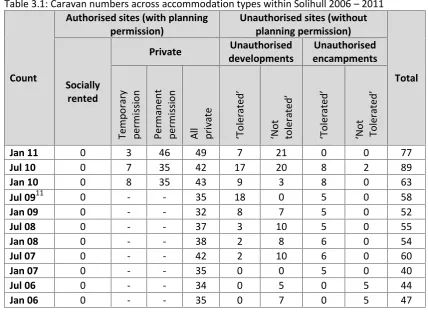
[image:20.595.102.531.387.706.2]3.2 The bi-annual Caravan Count provides a snapshot of the local context in terms of the scale and distribution of caravan numbers across the borough. However, there are well documented issues with the robustness of the count9, which require any analysis to be treated with a degree of caution. Such issues include: the ‘snapshot’ nature of the data, the inclusion of caravans and not households, the exclusion of Travelling Showpeople10, and the exclusion of Gypsies and Travellers in housing. Nevertheless, the Caravan Count provides a useful starting point in assessing the current picture and recent trends. Indeed, in the absence of other datasets it is virtually the only source of information on Gypsy and Traveller caravan data. With regard to the borough of Solihull the Caravan Counts, over time, offer little information for analysis purposes. However, in order to broadly illustrate the caravan numbers within the study area this information is presented below in Table 3.1 below.
Table 3.1: Caravan numbers across accommodation types within Solihull 2006 – 2011
Count
Authorised sites (with planning permission)
Unauthorised sites (without planning permission)
Total Socially
rented
Private developmentsUnauthorised encampmentsUnauthorised
Te m po rar y pe rm issi on Pe rm an en t pe rm issi on A
ll privat
e ‘T ol er at ed ’ ‘N ot to le ra te d’ ‘T ol er at ed ’ ‘N ot To le rat ed ’
Jan 11 0 3 46 49 7 21 0 0 77
Jul 10 0 7 35 42 17 20 8 2 89
Jan 10 0 8 35 43 9 3 8 0 63
Jul 0911 0 - - 35 18 0 5 0 58
Jan 09 0 - - 32 8 7 5 0 52
Jul 08 0 - - 37 3 10 5 0 55
Jan 08 0 - - 38 2 8 6 0 54
Jul 07 0 - - 42 2 10 6 0 60
Jan 07 0 - - 35 0 0 5 0 40
Jul 06 0 - - 34 0 5 0 5 44
Jan 06 0 - - 35 0 7 0 5 47
9Niner, P. (2002)Review of the ODPM Caravan Count, London: ODPM.
10The January 2011 count included a count of Travelling Showpeople caravans for the first time; however,
Solihull does not have a Travelling Showpeople site, so this has not increased the caravan count total.
11Please note that data which breaks down private sites into permanent/temporary permission was not
3.3 Table 3.1 shows the following:
The caravans in Solihull are all on private or unauthorised sites (there are no socially rented sites).
Overall caravan numbers have increased by 64% between Jan 2006 – Jan 2011. The data suggests that this increase is largely the result of increased caravans on ‘not tolerated’ unauthorised developments. For example, from Jan 2010 – Jan 2011, there was an increase from 3 to 18 caravans on ‘not tolerated’
unauthorised developments.
Since July 2006 the number of caravans counted on ‘not tolerated’ unauthorised encampments has either been zero or very small indeed.
There appears to be little seasonality in caravan numbers (i.e. absence of significant summer travelling); in fact the caravan numbers appear to increase slightly during the summer counts which may suggest visitors staying in the area for short periods during the summer.
3.4 Figure 3.1 below illustrates the trends in caravan numbers recorded in the Caravan Count and described above.
The size of the local Gypsy and Traveller community
3.5 For most minority ethnic communities, presenting data about the size of the community in question is usually relatively straightforward (with the exception of communities who have large numbers of irregular migrants and migrant workers etc. amongst them). However, for Gypsies, Travellers and Travelling Showpeople, one of the most difficult issues is providing accurate information on the size of the
[image:21.595.104.546.353.625.2]and key stakeholders, together with our survey findings, in order to provide a best estimate as to the size of the local Gypsy and Traveller population at the time of the assessment.
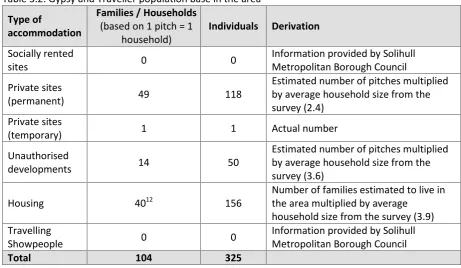
3.6 Table 3.2 presents the estimation of the size of the Gypsy and Traveller population. Using the best information available we estimate that there are at least 325
[image:22.595.104.566.182.450.2]individuals or 104 households in the study area.
Table 3.2: Gypsy and Traveller population base in the area
Type of
accommodation
Families / Households
(based on 1 pitch = 1 household)
Individuals Derivation
Socially rented
sites 0 0
Information provided by Solihull Metropolitan Borough Council Private sites
(permanent) 49 118
Estimated number of pitches multiplied by average household size from the survey (2.4)
Private sites
(temporary) 1 1 Actual number Unauthorised
developments 14 50
Estimated number of pitches multiplied by average household size from the survey (3.6)
Housing 4012 156 Number of families estimated to live inthe area multiplied by average
household size from the survey (3.9) Travelling
Showpeople 0 0
Information provided by Solihull Metropolitan Borough Council
Total 104 325
12We did not receive any information regarding the accurate size of the Gypsy and Traveller bricks and
4.
Authorised social and private sites
4.1 A certain degree of caution needs to be taken when extrapolating the characteristics, trends and needs of the Gypsy and Traveller population from the Caravan Counts and other such data alone. In order to provide more specific information on the local Gypsy and Traveller population, this section draws upon the information provided by Solihull Metropolitan Borough Council on site provision within the borough as well as information obtained through a survey of Gypsy and Traveller households.
Socially rented sites
4.2 There are currently no socially rented sites in the borough.
Authorised private sites
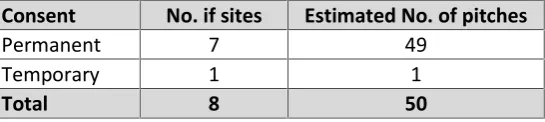
[image:23.595.111.384.368.429.2]4.3 This section looks at private sites across the study area. There are 8 authorised private sites in the borough; of these 7 have permanent planning permission – this includes one larger site (permission for 25 pitches), and 6 smaller sites (i.e. between and 1 and 7 pitches). There is 1 temporary authorised private site (with 1 pitch)13.
Table 4.1: Private authorised sites
Consent No. if sites Estimated No. of pitches
Permanent 7 49
Temporary 1 1
Total 8 50
4.4 We assume all sites are at capacity as we are unable to assess otherwise. However, it should be noted that we were alerted to a small number of potential vacancies existing on at least one permanent site; however this cannot be verified.
4.5 It was not thought that any sites in the area were planned to close. It has been thought that planned expansion at Birmingham Airport could lead to the
displacement of a site and further requirements; however, consultation with officers at Solihull Council said this is not going to impact on sites in Solihull.
4.6 According to information received from the local authority, of the 17 pitches required between 2007-2012 as stated in the previous GTAA, 12 pitches have been granted planning permission.
Permanent private site residents: findings from the survey
4.7 A total of 39 people were interviewed on the permanent private sites (80% of the private population). Of these, 18 respondents rented (46%) and 15 owned (38%) the pitch they were occupying. A further 6 respondents (8%), indicated that there was some ‘other’ means on ownership / renting. When asked to elaborate, these
13For reasons beyond our control, we were unable to consult with the sole resident of this site for this
respondents indicated that the site was leased from the Council jointly to the family. The majority of respondents (87%) owned their trailers; 5 people indicating that they rented their trailers (13%).
4.8 Most respondents (79%) reported that they had 1 trailer / chalet / unit. However, 7 respondents (18%) had 2 trailers, and 1 respondent (3%) indicated that they had 3 trailers. The average number was 1.2 caravans per household.
4.9 When asked whether they had enough space for their household, 27 respondents said yes (69%) and 12 said no (31%). The reasons that were given for needing more space are shown in Table 4.2 below.
Table 4.2: Reasons for needing more space (private sites)
Reasons Number %
Need larger caravans / trailers / units 7 58 Need more bedrooms / living space 7 58 Need a larger site 6 50 Need a larger pitch 5 42 Need more caravans / trailers / units 4 33
Note: This is based on a question that allowed respondents to select multiple answers
4.10 A total of 12 respondents (31%) reported that they accommodated visitors on their site on a short term basis; the remainder (27 respondents - 69%) said that they did not accommodate visitors. In terms of who visited the site, with the exception of 2 respondents, people indicated that it was mainly family members who visited for short periods multiple times a year, for example:
“Two daughters and their children, usually for summer months, [with] 2 trailers”
“Family members, [stay] between 2 weeks and 2 months, once a year - they bring their own trailers”
“My wife’s sister sometimes stays for a week in the summer and brings one trailer with her”
“Family / friends, 1-2 weeks, 2 - 3 times a year, they bring their own trailers”
4.12 The majority of respondents on the permanent private sites said they had lived in the area (i.e. the borough of Solihull) for more than 10 years (34 respondents - 87%)14. The same percentage also reported that they had lived on their current site for more than 10 years (see Table 4.3). A small number of respondents indicated that they had been living in the area for 1 – 3 years.
Table 4.3: Length of time living in the area and on the site
Length of time Living in areaNumber % Number %Living on site
10 years or more 34 87 34 87 Between 5-10 years 1 3 2 5 Between 3-5 years - - - -Between 1 -3 years 4 10 3 8 Between 6-12 months - - -
-Total 39 100 39 100
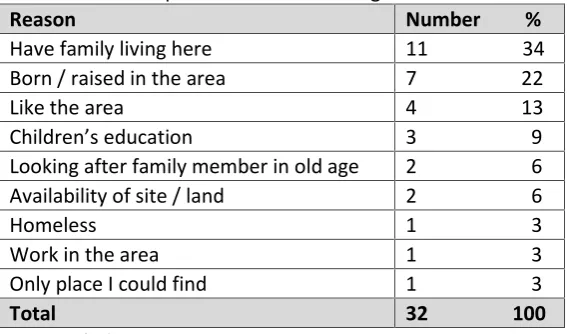
4.13 When asked why they had come to live in the general area people cited a variety of reasons (see Table 4.4 below). The most common reasons cited however was that they had family living in the area (34%) or were born / raised in the area (22% of respondents).
Table 4.4: Most important reason for living in the area
Reason Number %
Have family living here 11 34 Born / raised in the area 7 22
Like the area 4 13
Children’s education 3 9 Looking after family member in old age 2 6 Availability of site / land 2 6
Homeless 1 3
Work in the area 1 3 Only place I could find 1 3
Total 32 100
Note: excludes 7 non-responses
4.14 With regards to the respondents who had been living in the area / on their site for less than 10 years, they had moved to Solihull from the following places: Bedworth, Birmingham, Falkirk, Tamworth and Wolverhampton.
4.15 A total of 32 respondents (82%) reported that they never left the study area throughout the year, while the remaining 7 respondents (18%) reported that they lived in the area between 41-51 weeks of the year. The most common reason for leaving the area was to attend fairs (particularly Appleby Fair); however, individual respondents made reference to the following:
14It should be noted that the interviewers directed respondents to interpret ‘the area’ throughout the survey
[image:25.595.107.391.374.541.2]“With best mate for 2 weeks at her own ground”
“Go to Scotland back to family and hopefully get work”
4.16 One respondent stated that they had a base somewhere else; this was a private site with temporary planning permission in Warwickshire. This respondent went on to explain that they were hoping to move to this site in the future:
5.
Planning and unauthorised sites
5.1 The development of sites for Gypsies and Travellers can be a major source of tension between Gypsies and Travellers and the settled population. The current planning system is intended to create conditions where there is no need for unauthorised developments because land will be allocated for authorised site development within the Local Development Framework. This chapter focuses upon the development of Gypsy and Traveller sites without planning permission. This chapter then looks at the presence of unauthorised encampments in the area.
Planning applications for Gypsy and Traveller sites
5.2 A total of 13 planning applications involving the development or extension of Gypsy and Traveller sites have been received in the borough since 2006. In summary the outcomes of the 13 applications were:
Approved 7 applications
Allowed on appeal 1 application
Refused 3 applications
Dismissed on appeal 1 application
In progress 1 application
5.3 It is clear that a number of applications are being approved, although a number of these applications were existing temporary sites which were granted full permanent planning permission.
5.4 Reasons given for refusal were generally around the development being
inappropriate within the Green Belt. Inappropriate development in the Green Belt has also been cited as a reason for refusal of the Eaves Green Lane development, as well as a number of others issues which are:
Impact on rural character and appearance;
Impact on hedgerows and wildlife;
Poor access to local services; and
Increased vehicular traffic and highway safety issues.
Unauthorised development of Gypsy and Traveller sites
5.5 Since 2006 there have been a total of 7 instances of unauthorised development relating to Gypsy and Traveller sites in the borough. Of these 7:
3 have been granted planning permission;
2 have had their applications refused;
1 application is pending a decision; and
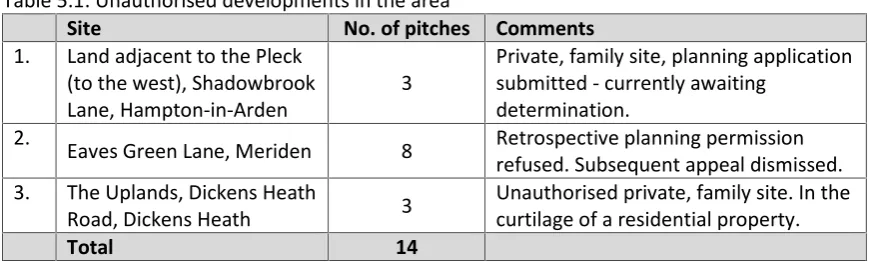
5.6 At the time of the study there were a total of 3 unauthorised developments within the borough. See Table 5.1 below. It is estimated that these 3 sites accommodate 14 pitches / households.
Table 5.1: Unauthorised developments in the area
Site No. of pitches Comments
1. Land adjacent to the Pleck (to the west), Shadowbrook Lane, Hampton-in-Arden
3
Private, family site, planning application submitted - currently awaiting
determination.
2. Eaves Green Lane, Meriden 8 Retrospective planning permission refused. Subsequent appeal dismissed. 3. The Uplands, Dickens Heath
Road, Dickens Heath 3
Unauthorised private, family site. In the curtilage of a residential property.
Total 14
Unauthorised developments residents: findings from the survey
5.7 A total of 14 households were interviewed on unauthorised developments, with representation across all 3 sites. In terms of number of trailers / chalets / units households had, these sites demonstrated a similar profile to residents of private sites with most having a single trailer (10 respondents - 71%) or two trailers (4 respondents - 29%). The average was 1.3 caravans per household.
5.8 When asked whether they had enough space for their household, 11 respondents said yes (79%) and 3 respondents said no (21%). The reasons that were given for needing more space are shown in Table 5.2 below.
Table 5.2: Reasons for needing more space (unauthorised developments)
Reasons Number %
Need more caravans / trailers / units 3 100 Need larger caravans / trailers / units 3 100 Need more bedrooms / living space 3 100 Need a larger site 2 67 Need a larger pitch 2 67
Note: This is based on a question that allowed respondents to select multiple answers
5.9 A total of 5 respondents (42%) reported that they accommodated visitors on their site on a short term basis. Like the residents on the private authorised sites, people indicated that it was mainly family members who visited for short periods; however, a number of people suggested that visitors would stay in their trailers rather than bringing trailers with them:
“Brother and family, 1 or 2 times a year, they don't bring trailers with them”
“Family, couple of times a year, for 2-4 weeks; they would stay in chalet, not bring trailers”
5.10 Most people (10 respondents – 71%) reported that accommodating visitors was not a problem on their site. The 4 respondents who did say it was a problem made
reference to having a lack of space, particularly if people brought trailers with them.
5.11 The majority of respondents on the unauthorised developments said they had lived in the area (i.e. borough of Solihull) for more than 10 years (10 respondents - 71%), with an additional 3 respondents living in the area for between 5-10 years (21%) (see Table 5.3). With regards to how long people had been living on unauthorised
developments, the majority of respondents had been living there for less than 5 years, with over half of the respondents living there for 1-3 years (57%).
Table 5.3: Length of time living in the area and on the site
Length of time Number %Living in area Number %Living on site
10 years or more 10 71 2 14 Between 5-10 years 3 21 - -Between 3-5 years 1 7 3 21 Between 1 -3 years - - 8 57 Between 6-12 months - - 1 7
Total 14 100 14 100
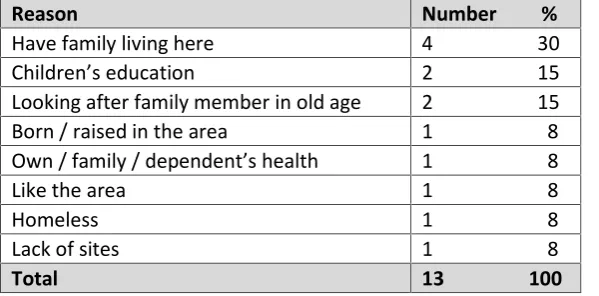
[image:29.595.106.406.450.598.2]5.12 When asked why they had come to live in the general area people cited a variety of reasons (see Table 5.4 below). Like the residents on the private authorised sites, the most common reason (4 respondents – 30%) was that they had family living in the area.
Table 5.4: Most important reason for living in the area
Reason Number %
Have family living here 4 30 Children’s education 2 15 Looking after family member in old age 2 15 Born / raised in the area 1 8 Own / family / dependent’s health 1 8 Like the area 1 8 Homeless 1 8 Lack of sites 1 8
Total 13 100
Note: excludes one missing case
5.13 A total of 10 respondents (71%) reported that they never left the study area
throughout the year. The remaining respondents reported that they lived in the area between 41-51 weeks of the year (2 respondents – 14%) or that they did not know how many weeks of the year they lived there (2 respondents – 14%). The
respondents who left the site mainly went to fairs or to visit family; however; some respondents indicated that they didn’t like to leave their site as they were currently trying to get planning permission:
“We don’t all leave at the same time as we are trying to get it passed - so we take it in turns”
5.14 None of the respondents on the unauthorised developments had a base somewhere else.
Unauthorised encampments: findings
5.15 The presence and incidence of unauthorised encampments can be a significant issue that impacts upon local authorities, landowners, Gypsies and Travellers and the settled population. Unauthorised encampments are often the type of
accommodation which has become synonymous with Gypsies and Travellers due to often residing on public and private land.
5.16 Due to the nature of unauthorised encampments (i.e. unpredictability, seasonal fluctuations, etc.), it is often very difficult to grasp a comprehensive picture of need for residential and / or transit accommodation without considering a range of interconnected issues. However, as seen in Chapter 3 the level of encampment ‘not tolerated’ has been at zero (or very low i.e. only 2 caravans in total since July 2006). Indeed during the fieldwork for this assessment we did not receive notification of any unauthorised encampments within the borough.
5.17 The local authority has a written policy for managing unauthorised camping by Gypsies and Travellers and has a joint protocol with the Police. It is understood that it is usual practice for an officer from the local authority to make first contact with Gypsies and Travellers who are encamped within the borough.
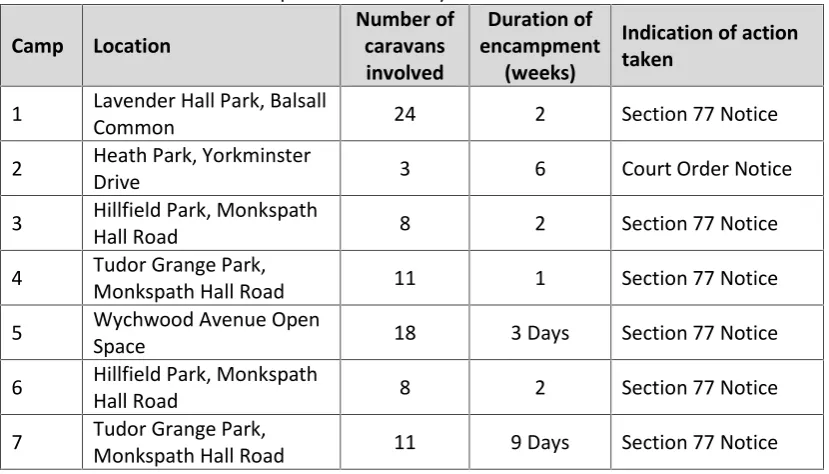
5.18 There is no official log of unauthorised encampments within the borough but it is thought that the number of encampments occurring are at quite a low level. It is estimated by the local authority that there has been between 1 and 5 encampments per year since 2009; however, it was stated that there were no encampments during 2011.
Table 5.5: Unauthorised encampments 1stJanuary 2009 – 31stDecember 2010
Camp Location
Number of caravans involved
Duration of encampment
(weeks)
Indication of action taken
1 Lavender Hall Park, BalsallCommon 24 2 Section 77 Notice 2 Heath Park, YorkminsterDrive 3 6 Court Order Notice 3 Hillfield Park, MonkspathHall Road 8 2 Section 77 Notice 4 Tudor Grange Park,Monkspath Hall Road 11 1 Section 77 Notice 5 Wychwood Avenue OpenSpace 18 3 Days Section 77 Notice 6 Hillfield Park, MonkspathHall Road 8 2 Section 77 Notice 7 Tudor Grange Park,Monkspath Hall Road 11 9 Days Section 77 Notice
5.20 The average encampment size consisted of 12 caravans / trailers and the average duration that encampments lasted was 15 days.
5.21 There were reportedly more encampments in the area in summer and most households on unauthorised encampments were deemed to be ‘in transit’.
6.
Gypsies and Travellers in social and private bricks and mortar
accommodation
6.1 The numbers of Gypsies and Travellers currently accommodated within bricks and mortar accommodation are unknown, but potentially large. Movement to and from housing is a major concern for the strategic approach, policies and working practices of local authorities.
Estimating the size of the Gypsy and Traveller population in bricks and mortar housing
6.2 Neither the local authority officers nor members of the local Gypsy and Traveller communities in the area were able to accurately estimate the size of the Gypsy and Traveller population in bricks and mortar housing in the borough. The following information was provided by Solihull Metropolitan Borough Council:
During 2011 two households who ascribed as being a ‘Gypsy or Traveller’ were housed by Solihull Community Housing (SCH).
6 households from within Solihull who ascribed as being a ‘Gypsy or Traveller’ were currently registered for social housing (5 indicated they were ‘Irish Traveller’ and 1 ‘Gypsy’).
No homelessness applications have ascribed as being a ‘Gypsy or Traveller’.
6.3 The Commission for Racial Equality’s 2006 report,Common Ground: Equality, good race relations and sites for Gypsies and Irish Travellers, suggested that the housed population is around 3 times the size of the trailer-based population. However, this provides a potential housed population of 192 households. This figure would appear unrealistic given the size of the borough and the lack of households found in bricks and mortar accommodation in the previous GTAA. In the absence of accurate
evidence as to the numbers in housing, an alternative approach would be to base the estimate of the base population of Gypsies and Travellers living in houses on the number of interviews with bricks and mortar-based households we secured (22 interviews). However, it is likely that this would be an understatement of the actual housed population. As such the estimate contained in the previous GTAA of 40 households is taken as an estimate of the housed population here. This estimate was seen as generally realistic by stakeholders at the time.
6.4 A more accurate estimation of the numbers of Gypsies and Travellers in houses will only be possible when a number of issues are resolved:
Gypsies and Travellers feel able to disclose their ethnic group in monitoring forms
Monitoring forms allow for the ethnic groups as options
The data from the Census 2011 is released
Bricks and mortar housing residents: findings from the survey
6.6 A total of 22 people were interviewed in bricks and mortar accommodation: 12 respondents were owner-occupiers (55%); 7 were social housing tenants (32%); and 3 were private tenants (14%).
6.7 In terms of the size of the dwelling:
15 respondents had 3 bedrooms (68%);
3 respondents had 2 bedrooms (14%);
3 respondents (all owner-occupiers) had 4 or more bedrooms (14%); and
1 respondent had 1 bedroom (5%).
6.8 The majority of respondents (18 – 82%) indicated that they had enough space in their home; 4 respondents said they did not (2 living in private rented, 1 in socially rented accommodation and 1 owner occupier).
6.9 When asked why they did not feel they had enough space, 1 respondent indicated that they would like more bedrooms or living space, while 1 respondent stated:
“Would like a drive to put a trailer on”
6.10 The respondent who was an owner occupier indicated that they needed a larger site and more caravans / trailers / units; this related to the fact that they lived in bricks and mortar but had a site attached the property as well.
6.11 In total, 9 households (41%) in bricks and mortar accommodation still owned trailers. All these households had just 1 trailer.
6.12 The majority of respondents currently living in bricks and mortar accommodation said that they had lived in the area (i.e. borough of Solihull) for more than 10 years (19 respondents - 86%). A high percentage of people had also been living in their current home for more than 10 years (14 respondents - 64%) (see Table 6.1 below).
Table 6.1: Length of time living in the area and in the house
Length of time Number %Living in area Number %Living in house
10 years or more 19 86 14 64 Between 5-10 years 2 9 3 14 Between 3-5 years 1 5 3 14 Between 1 -3 years - - 2 9 Between 6-12 months - - -
-Total 22 100 22 100
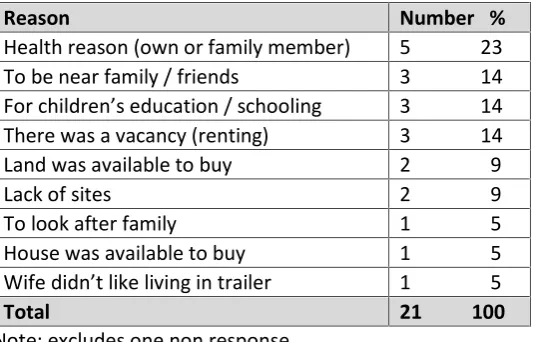
Table 6.2: Main reason for living in current house
Reason Number %
Health reason (own or family member) 5 23 To be near family / friends 3 14 For children’s education / schooling 3 14 There was a vacancy (renting) 3 14 Land was available to buy 2 9 Lack of sites 2 9 To look after family 1 5 House was available to buy 1 5 Wife didn’t like living in trailer 1 5
Total 21 100
Note: excludes one non response
6.14 As can be seen, there were a range of reasons given. Just under a quarter of respondents suggested that they were living in bricks and mortar accommodation because of health reasons; two of these respondents made specific reference to health problems of other family members. Following health reasons, people made reference to proximity to family / friends, children’s education and, for those who were renting, a property becoming available. Two respondents stated that land was available to buy, suggesting that they had self-built properties.
6.15 The majority of people who were currently living in housing had lived there all their adult life (41%) (see Table 6.3). However, as can be seen, people had moved into housing from a range of accommodation types, with a number of people moving to their current accommodation from transit sites (6 respondents – 27%). All but 2 respondents had moved into housing in Solihull from outside the borough (for example, from Birmingham, Cambridge, Coventry, Luton, Nuneaton, Peterborough and St Helens). The 2 respondents who had moved into housing from within Solihull had both been living on an unauthorised encampment in the study area.
Table 6.3: Accommodation prior to current house
Reason Number %
Been here all adult life 9 41
Transit site 6 27
Unauthorised encampment 2 9 Residential council site 2 9 Residential private site – temporary permission 1 5 Bricks and mortar (social rented) 1 5 Private site with bungalow on 1 5
Total 22 100
Housing experiences of site-based respondents
[image:34.595.108.416.516.657.2]6.17 With regards to why they had lived in a house, 4 respondents (44%) indicated health reasons, 2 of whom made reference to ill health of parents; a further 3 respondents (33%) indicated that they had moved there with family / parents; 1 respondent (11%) said they were born / raised in a house; and 1 respondent (11%) had moved into a house due to a lack of sites.
6.18 When asked to rate their experience of living in a house: 3 respondents said good or very good (33%); 4 respondents (44%) were ambivalent (i.e. said neither good nor poor); and 2 respondents said very poor (22%).
6.19 With regards to why they stopped living in that house, 5 respondents (55%) indicated that they moved out because they got married. The remaining 4 respondents made reference to individual reasons; for example, a vacancy came available on their current site, they left for work reasons, they were fearful of harassment, and their children were experiencing discrimination at a nearby school.
7.
Travelling
7.1 In order to shed some light on the travelling patterns and experiences of Gypsies and Travellers throughout the study area, respondents were asked about a range of issues associated with travelling.
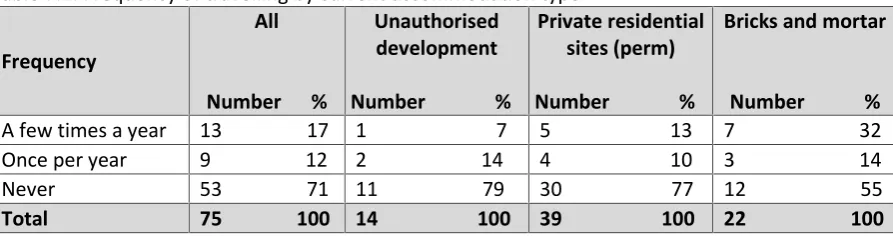
[image:36.595.111.558.233.351.2]7.2 One of the most important issues to gain some information on was the frequency that households travelled. The vast majority of people reported that they never travelled or travelled seasonally, which generally means for short periods during the summer months. Table 7.1 breaks this down by accommodation type.
Table 7.1: Frequency of travelling by current accommodation type
Frequency
All
Number %
Unauthorised development
Number %
Private residential sites (perm)
Number %
Bricks and mortar
Number %
A few times a year 13 17 1 7 5 13 7 32 Once per year 9 12 2 14 4 10 3 14
Never 53 71 11 79 30 77 12 55
Total 75 100 14 100 39 100 22 100
7.3 Across the sample as a whole, 53 respondents (71%) indicated that they never travelled. However, the data suggests variation between site-based residents
(particularly unauthorised sites) and those in bricks and mortar accommodation, with housed residents being more likely to travel a few times a year (32%, compared to sample average of 17%)15. The residents on the unauthorised developments were
least likely to travel (79% indicated that they never travel). As highlighted previously (Chapter 5), some residents on unauthorised sites suggested that they did not like to travel while they were trying to get planning permission on their site.
7.4 Table 7.2 below illustrates the main reasons given for not travelling. As can be seen, health and educational needs featured for a number of respondents. However, individual respondents made reference to a variety of reasons, including work and family commitments or a general desire to be settled. The following are some of the comments that were made:
“Settled and children will go to school in the next year or so”
“We are settled now, [we] like the facilities that we have now”
“Settled because of work and family”
“[It’s] not safe to move up and down anymore”
15This is a common finding from other areas of the UK where the researchers have undertaken GTAAs. It is also