6108
A NOVEL SWARM INTELLIGENCE BASED ENERGY
EFFICIENT PROTOCOL FOR WIRELESS SENSOR
NETWORKS
1SUPREET KAUR, 2RAJIV MAHAJAN
1Research Scholar, Department of Computer Science & Engineering, Punjab Technical University, Punjab,
India
2Principal, Golden Group of Institutes, Punjab, India
E-mail: 1oberoisupreet9 @gmail.com, 2[email protected]
ABSTRACT
Energy efficiency has recently turned out to be primary issue in wireless sensor networks. Sensor networks are battery powered, therefore become dead after a certain period of time. Thus, improving the data dissipation in energy efficient way becomes more challenging problem, in order to improve the lifetime for sensor devices. The clustering and tree based data aggregation for sensor networks, can enhance the network lifetime of wireless sensor networks. Hybrid Ant colony optimization (ACO) and particle swarm optimization (PSO) based energy,, efficient clustering and tree based routing protocol is proposed. Initially, clusters are formed on the basis of remaining energy, then, hybrid ACOPSO based data aggregation will come in action to improve the inter-cluster data aggregation further. Extensive analysis demonstrates that proposed protocol considerably enhances network lifetime over other techniques.
Keywords: Wireless Sensor Networks, Ant Colony Optimization, Energy Efficient, Particle Swarm Optimization.
1. INTRODUCTION
Wireless Sensor Networks (WSNs) is an ad hoc network of small and low-cost computational nodes that sense the valuable information and forward to a central unit for further processing[1]. The sensor networks can be divided into four parts namely, sensors, network among sensors, centralized unit to gather information, and resources which analyze the data[1]. It is useful to monitoring forest fire-tracking, disaster management, military surveillance, humidity, pressure, temperature, and much more. Clustering is a technique which systematically arranges the objects to enhance the capability of data analysis. It has a significant role in WSNs as it divides the sensor nodes into groups and saves energy consumption due to additional communication [2].
The challenges in clustering are selection and assignment of Cluster Head (CH) and cluster formation. Routing protocols play an important role in WSNs to reduce the energy consumption between sensors and sink, thus enhances network life time. Because it is hard to change or recharge batteries of sensors when working in hostile situation. It can be realized by choosing an
appropriate path between sensor nodes and sink that needs less energy and enhance the network life. Nikolidakis et al. (2013) [3] utilized Equalized CH Election Routing Protocol (ECHERP) to save energy through balanced clustering. This protocol used Gaussian elimination method to select the CHs. Tarhani et al. (2014) [4] implemented a distributed algorithm known as Scalable Energy Efficient Clustering Hierarchy (SEECH) to select CHs and relays separately. It would reduce the burden from CHs and increase the network life time.
6109 sensor’s residual energy and regional average energy of every sensor in all clusters.
Azharuddin et al. (2015)[8] addressed the issues of fault tolerance and energy consumption in WSNs by integrating distributed clustering and routing approaches.It recovers failed sensor nodes using distributed run time. Shen et al. (2015) [9] solved the problem of delay in message transmission in underwater WSNs using Location-Aware Routing Protocol (LARP).In this method, position knowledge of sensor nodes is used to facilitate message transmission. Kiani et al. (2015)[10] utilized reinforcement learning technique to implement an intelligent routing protocol. The protocol has capability to save energy, enhance the network life time, better load balancing, and minimize the packet delays.
Shankar et al. (2016) [11] used hybrid Particle Swarm Optimization (PSO) and Harmony Search Algorithm (HSA) to select CH efficiently utilizing minimum energy. This method achieved global search with better convergence as compared to other methods.Aslam et al. (2016) [12] designed two routing protocols for energy efficient path planning in heterogeneous WSNs. These routing protocols are Advanced heterogeneity-aware Centralized Energy Efficient Clustering (ACEEC) and Two-Hop heterogeneity-aware CEEC (THCEEC). Base Station (BS) utilizes these routing protocols to select the suitable Cluster-Heads (CHs) taking into account residual energy, initial energy, distance to BS, and regional flag. Sabet and Naji (2016) [13] implemented the multi-level route-aware clustering (MLRC) technique to save energy in decentralized clustering protocols. The main advantage of this protocol is that it creates a cluster and routing tree, simultaneously, to reduce an unnecessary generation of routing control packets.
Ray and De(2016) [14] designed a method to balance the load of CHs by creating balanced clusters using energy efficient clustering protocol based on K-means approach ( EECPK-means).The selection of initial centroid is enhanced by utilizing midpoint algorithm. Jia et al. (2016) [15] solved the issue of irrationally CH selection that may cause overlapping and unbalanced utilization of energy among sensor nodes using dynamic CH selection. It increases the survival time of network by saving energy of sensor nodes.Gentz et al. (2016) [16] combined the synchronization and scheduling in clustered WSNs using pulse-coupled synchronization and scheduling (PulseSS) protocol.
Mann and Singh (2017) [17] improved the solution search equation of Artificial Bee Colony (ABC). An improved ABC (iABC) metaheuristic
technique enhances its exploitation capabilities. Student's-t distribution is used for population sampling which further enhances global convergence. Based on iABC, BeeCluster, i.e., energy efficient clustering protocol is implemented to find optimal CHs. Nayak and Vathasavai (2017) [18] utilized type-2 fuzzy logic in WSNs to make a decision for CH efficiency. This method saves energy when CH becomes overburdened. CH can make an intelligent decision and share the load among the sensor nodes which further improves the lifetime of network. Yoon et al. (2013) [19] used message success rate strategy to solve node concentration issue of cluster based routing protocols.The most thoroughly used power keeping strategy is the info aggregation. Knowledge aggregation at the sink by the average person nodes effects into flooding of the info that in turn causes the maximum power use thus degrading the system lifetime. In this paper, we propose improved method for General Self-Organized Tree based Energy Balance routing protocol (GSTEB). In present GSTEB protocol routing tree is manufactured where tree centered routing is performed to transmit knowledge to the bottom section. However in that, if the parent node dies, the topography must be repaired again that'll consume a lot of power and there might be loss of knowledge also. To prevail around the problem of sign delay and knowledge reduction in the system because of the nodes disappointment in the root to sink, cluster based aggregation process can be utilized. In big system, well- organized sign of knowledge to the sink requires obtaining the maximum route according to how many trips; therefore, knowledge can be aggregated at the group head which is to be transmitted to the bottom station. The clustering strategy may minimize knowledge redundancy and reduce the congestive routing traffic in knowledge transmission. Following the clustering tree centered routing at the cluster-heads, it is required to obtain the shortest route, between the source and the sink, but the smallest route issue is NP-Hard in nature [20].
Contribution: Following are our main
contributions in this research paper:
1. First of all, we have evaluated the performance of some well-known existing energy efficient protocols for WSNs. 2. Based upon the comparative analysis we
6110 3. We have designed and implemented a
well-known hybrid ACO-PSO based clustering GSTEB protocols to enhance the results further.
4. Extensive analysis has also been done to evaluate the effectiveness of the proposed technique.
Rest of the paper is organized as follows: In Section 2, network energy model is described for WSNs. Section 3, describes the proposed technique with suitable mathematical formulation. Experimental Set-up and results are demonstrated in Section 4. Concluding remarks are demonstrated in Section 5.
2. NETWORK ENERGY MODEL
In this research work, we have randomly deployed WSN with sensor nodes in M*N network field. All nodes, even including the sink are stationary in nature. Each node has its own unique identification number. Each node monitors the given environment and communicates data with sink. Whenever communication is done given node has to spend some energy based upon the distance (D) with sink. All the communication links are symmetric in nature.
2.1 Energy Model
Whenever a node is sent or received, it has to spend some energy based upon two channel propagation models called free space ( power loss) for the purpose of one-hop or direct transmission and the multipath fading channel ( power loss) for packet transmission via multihop. Therefore, energy consumption model can be mathematically defined as follows:
(1)
here is the size of data packet, is free space energy loss, mp is multipath energy loss. is a threshold distance which determines which energy model will be used. It can be calculated as follows:
(2)
2.2 CH Formation
In this section level-based clustering will be discussed. CHs are formed using energy aware threshold function. Which means nodes who has more energy will have more probability to become CHs. Each node generates random value and try to
become CH. If random value is less than evaluated Threshold (T(i)), then it will become CH, become member node otherwise. T(i) can be mathematically evaluated as follows
For all nodes if > (3) Here r represents the current round in WSNs network lifetime, is the current energy of given node i.
represents average remaining energy which is evaluated using eqn. (4).
for every node i (4)
N is the number of total nodes.
3. ACOPSO BASED GSTEB TECHNIQUE
In this section, we propose an ACOPSO-GSTEB based routing to develop shortest path among available CHs and sink. ACOPSO is a well-known metaheuristic technique which can find optimal path between given set of nodes with sink as destination.
3.1 Ant Colony Optimization (ACO) based path selection
1. Initialize CHs as ants combined with sink as Destination.
2. Going of virtual ant depends on the amount of pheromone on the CH distances.
3. The first in ACO could be the trail collections between neighboring clusters, some synthetic ants (CHs) are simulated from the CHs to the sink.
4. The ahead ants are choosing the following CH randomly for initially taking the data from the length matrix and the ants who are successful in achieving the sink are
updating the
pheromone deposit at the edges visited by them by an amount (CL), where M is the sum total journey period of the ant and D a constant price that is adjusted in line with thefresh
6111 5. The following set of the ants can now
study on the pheromone deposit feedback leftbythe formerly visited successful ants and will soon be guided to follow along with the quickest path.
6. When someone ant walks from CHi to CHj, the chance in the selection principle for a simple ant is:
7. // where represents the amount of pheromone deposit from CHi to CHj; is the trail visibility function that is equivalent to the reciprocal of the energy distance between CHi and CHj; is the parameter to adjust the amount of pheromone ; is a parameter to adjust the heuristic visibility function
8.
9.
//where represents Energy distance metric between two CHs i and j; ||.||2 represents the Euclidean distance; is the overhead energy of transmitter electronics and is the transmission energy and is a coefficient of amplifying and is the pack size.
10. values will be updated by all the ants which have reached the BS successfully. 11. Pheromone evaporation on the edge
between is implemented by
thehe formula
// before adding the P, the evaporation action has to be performed. The evaporation helps to find the shortest path and provide that no other path will be assessed as the shortest. This evaporation of pheromones has an intensity ρ.
12. When CHs is not chosen by artificial ants, the amount of decreases exponentially. 13. Every moment of the time, t = {1, 2, 3,
4,n}.All the ants will, after n interations find the solution and leave the calculated by the following formula:
//Where is the amount of pheromone being deposited. 14. If ant k has passed some edge between the
CHs, it will leave P which is inversely proportional to the total length of all edges, ant k has passed from starting CH to BS by using formula:
// is the amount of P ant k deposits on the edges visited //where
is the total length of all the edges. 15. Now the path with best P value(minimum
distance) is selected and assigned as initial
solution for partial swarm
optimization(PSO) as given in following section:
PSO initializes itself with output of ACO solutions so called particles. Each particle keeps the stored record for all its coordinates which are related to obtaining the optimal solution by following the current best particles. Objective function of every particle is evaluated and stored. The fitness value of the current optimum particle is called pBest. When all the generated populations are considered then the best value is chosen among the generated population and that particular best value is the best solution called gBest. In this paper minimum path cost is taken as objective function. PSO always try to change the velocity of every particle towards its pBest. The velocity is determined by random terminologies, which is having randomly generated numbers for velocity towards pBest.
PSO always stores and maintains a record of results for three global variables such as target value or condition, gBest, and termination value. Every evaluated particle of PSO comprises the following information:
(i) A data which can represent a global solution so called gBest.
6112 (iii) pBest value.
1. First of all, we have assumed all CHs as particles which have two dimensions such as particle position and velocity.
2. Now initiate solutions based upon random distribution. Number of random solution are based upon the size of population.
3. Now estimation of fitness value will be done using fitness function which is minimum path distance. The distance between two nodes will be calculated using Euclidian distance as:
(5) 4. Generation of new particles from the initial set of random solutions. Formation of new particles from the old one is a generation of a new particle.
4.1 Estimation of new velocity:
The current velocity of a taken particle is considered the rate at which the particle’s position is changed. New velocity is calculated as shown in Eq. (6).
(6) where is inertia weight and and are basic PSO tuning parameters. represents the velocity and determines the position value.
4.2 Estimation of new position of the particle is as follows:
(7) 5. Calculation of fitness value for is estimated by using fitness function given in3
6. Fitness value of old particle and new particle is compared and the best one is selected for the next iteration:
x
Here is old known best value so far and is new fitness value.
7. For every iteration, one best solution is selected as a pBest. The particle which has maximum fitness value in the current iteration is selected as pBest solution.
8. The pBest solutions from all iterations of the particle in which has maximum among all solutions are selected as a gBest solution. Finally, the particle which has a gBest solution is elected as current inter cluster data aggregation path.
4. EXPERIMENTAL SET-UP AND
RESULTS
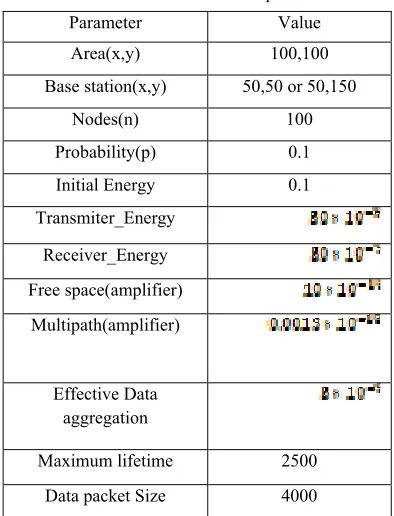
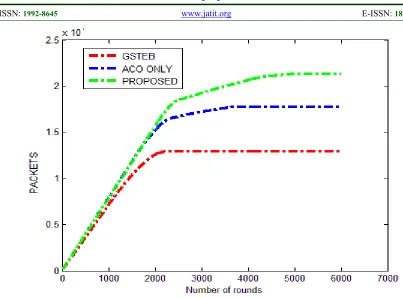
[image:5.612.319.516.345.603.2]The MATLAB simulation tool is used for simulation purpose. It evaluates the performance of the proposed technique with existing technique i.e. GSTEB on the following metrics i.e. stability period, network lifetime, residual energy (average remaining energy), and throughput by taking 100 sensor nodes. Other parameters for simulation are adapted from the GSTEB. The sensors distributed arbitrarily in a 100 100 area with base station at (50m, 150m). Table 1 shows the various simulation parameters for comparative analysis.
Table 1: WSNs Set-Up.
Parameter Value
Area(x,y) 100,100
Base station(x,y) 50,50 or 50,150
Nodes(n) 100
Probability(p) 0.1
Initial Energy 0.1
Transmiter_Energy
Receiver_Energy
Free space(amplifier)
Multipath(amplifier)
Effective Data aggregation
Maximum lifetime 2500
Data packet Size 4000
6113
Figure 1: Comparison of Throughput Analysis
Network lifetime of a network is the time when first and last ever node die in the network. Figure 2 represents the comparison of the proposed technique with available one. The figure is cleary indicating that the network lifetime of the proposed
technique is significantly improved. Compared to available protocols, it is found that the network lifetime of the proposed technique is quite more than available well-known protocols.
[image:6.612.113.495.452.696.2]6114 Residual energy of a network is the time when last ever node die in the network. Figure 3 represents the comparison of the proposed technique with available one. The figure is cleary indicating that the residual energy of the proposed technique is
[image:7.612.120.486.153.393.2]significantly improved. When compared with available protocols, it is found that the Residual energy of the proposed technique is consistent and maximized than available well-known protocols.
Figure 3: Comparison of Residual Energy
5. CONCLUSIONS
This paper proposes a hybrid protocol which utilizes clustering; ACOPSO based clustering protocol for WSNs. It decomposes the sensor network into numerous segments thus called clusters and cluster heads are chosen in every cluster. Then, tree based data aggregation come in action and collects sensing information directly from cluster heads by utilizing short distance communications. The ACOPSO optimization evaluates the shortest path among sink and cluster heads. The use of compressive sensing reduces the packet size which is going to be transmitted in the sensor network. The MATLAB simulation tool is used for simulation purpose. It evaluates the performance of the proposed technique with existing technique i.e. GSTEB on the following metrics i.e. stability period, network lifetime, residual energy (average remaining energy), and throughput by taking 100 sensor nodes. Other parameters for simulation are adapted from the GSTEB. The sensors distributed arbitrarily in a 100 100 area with base station at (50m, 50m). Extensive analysis shows that the hybrid protocol considerably enhances network lifetime by conserving the energy in more efficient manner
than other protocols at present deployed for sensor networks.
There is no conflict of interest regarding the publication of this paper.
REFRENCES:
[1] Arora, Vishal kumar, “A survey on LEACH and other’s routing protocols in wireless sensor network”, Optik-International Journal for Light and Electron Optics, 2016, pp. 6590-6600.
[2] Abbasi, Ameer Ahmed, “A survey on clustering algorithms for wireless sensor networks”
Computer communications 30, 2007, pp.
2826-2841.
[3] Nikolidakis, Stefanos A, “Energy efficient routing in wireless sensor networks through balanced clustering”, Algorithms 6, 2013, pp.
29-42.
6115 [5] Wahid, Abdul,, “A reliable and energy efficient
routing protocol for underwater wireless sensor
networks”, International Journal of
Communication Systems 27, 2014, pp.
2048-2062.
[6] Thakkar, Ankit, “Cluster head election for energy and delay constraint applications of wireless sensor network”, IEEE sensors Journal 14, 2014, pp. 2658-2664.
[7] Leu, Jenq-Shiou, “Energy efficient clustering scheme for prolonging the lifetime of wireless sensor network with isolated nodes.”, IEEE communications letters 19, 2015, pp. 259-262.
[8] Azharuddin, Md, PratyayKuila, “Energy efficient fault tolerant clustering and routing algorithms for wireless sensor networks”,
Computers & Electrical Engineering 41, 2015,
pp. 177-190.
[9] Shen, Jian,, “A novel routing protocol providing good transmission reliability in underwater sensor networks”, Journal of information technology, 2015, pp. 171-178.
[10]Kiani, Farzad, “Efficient intelligent energy routing protocol in wireless sensor networks”,
International Journal of Distributed Sensor Networks 11, 2015, pp. 626-632.
[11]Shankar, T., S. Shanmugavel, “Hybrid HSA and PSO algorithm for energy efficient cluster head selection in wireless sensor networks”, Swarm
and Evolutionary Computation 30, 2016, pp.
1-10.
[12] Aslam, Muhammad, “Adaptive energy-efficient clustering path planning routing protocols for heterogeneous wireless sensor networks”,
Sustainable Computing: Informatics and Systems 12, 2016, pp. 57-71.
[13] Sabet, Maryam,, “An energy efficient multi-level route-aware clustering algorithm for wireless sensor networks: A self-organized approach”, Computers & Electrical Engineering 56,2016, pp.399-417.
[14]Ray, Anindita, “Energy efficient clustering protocol based on K-means (EECPK-means)-midpoint algorithm for enhanced network lifetime in wireless sensor network”, IET Wireless Sensor Systems 6, 2016, pp. 181-191.
[15] Jia, Dongyao, “Dynamic cluster head selection method for wireless sensor network”, IEEE Sensors Journal16, 2016, pp. 2746-2754.
[16]Gentz, Reinhard, “PulseSS: A pulse-coupled synchronization and scheduling protocol for clustered wireless sensor networks”, IEEE
Internet of Things Journal 3, 2016, pp.
1222-1234.
[17] Mann, Palvinder Singh, “Improved metaheuristic based energy-efficient clustering protocol for wireless sensor networks”,
Engineering Applications of Artificial Intelligence 57, year, pp. 626-632.
[18] Nayak, Padmalaya, “Energy Efficient Clustering Algorithm for Multi-Hop Wireless Sensor Network Using Type-2 Fuzzy Logic”,
IEEE Sensors Journal 17, 2017, pp. 4492-4499.
[19] Yoon, Min, “An energy-efficient routing protocol using message success rate in wireless sensor networks”, 2013, pp.15-22.