3623
FROM THE W3C GOOD SOCIAL ONTOLOGIES TO A
UNIFIED SEMANTIC MODEL FOR OSN
1ASMAE EL KASSIRI, 2FATIMA-ZAHRA BELOUADHA
1Ph.D Student, AMIPS Research Team, Department of Computer Sciences, The Engineers Mohammedia
School, Mohammed V University, Morocco
2Professor, AMIPS Research Team, Department of Computer Sciences, The Engineers Mohammedia
School, Mohammed V University, Morocco
E-mail: 1[email protected], 2[email protected]
ABSTRACT
The Online Social Networks (OSN) are networks resulting from social media users and interactions. Exploiting the semantic web technologies to present the OSN data, in this paper, we propose using the W3C recommended ontologies as good ones named Friend Of A Friend (FOAF) ontology and Semantically-Interconnected Online Communities (SIOC) ontology; to meet the interoperability, aggregation and analysis needs, we propose also a FOAF and SIOC extensions to participate to engineering a Unified Semantic Model (USM) for OSN. The Unified Semantic Model will permit modelling the most popular social media.
Keywords: FOAF, SIOC, SIOCA, SIOCT, exSIOCInt, exFOAF, exSIOCA, exSIOCT, Unified Semantic Mode
USM, OSN
1. INTRODUCTION
This document provides details to construct a Unified Semantic Model USM able to present the most popular social media data and interactions. It have to allow presenting the different social media and aggregating data essentially to ensure interoperability and multi-aspect analysis. Actually, this work is the improvement results of existent works [1] [2] [3] where the present authors have already proposed the USM idea reusing existent ontologies with some new ontologies extending the existent ones. To bealigned with the W3C recommended ontologies, the authors have reformulated their extensions.
Mika was the first to propose the idea of social networks semantic representation based on ontologies, especially the FOAF ontology to represent the social network individuals [4]. Chen et al. have also supported the idea, have demonstrated the proximity between the structures of ontologies and social networks, and have validated their propositions by an example of scientific researchers’ networks (Chen, Wei and Qingpu 2010).
Kumar and Joshi propose the responsibilities of the Government domain ontology to guide the tweets extraction from Twitter in order to analyze only the tweets concerning the studied subject that is the satisfaction of the Government Indian citizens. The authors confirm that their results have an accuracy of 77% [5]. The [6] approach is
based on the Product Review Opinion Ontology (PROO) and the Semantic Web Rule Language (SWRL); it exploits the online people's opinions about product properties in natural language to generate rules allowing deducing the feelings nature expressed for a product properties.
The [7] approach extracts the data from cultural events social media (e.g. New York art scene, Silicon Valley startup scene, Seattle indie music scene), and models them according to an ontology dedicated to cultural scenes. On the other hand, Luz was limited to tourism networks and proposed the Tours Plan Ontology (TPO) reusing the FOAF ontology, describing three areas of knowledge: tourism, social interactions and profiles of users [8]. While Pankong et al. propose an ontology of activities combined with the FOAF ontology to represent the people, their links and their most interesting subjects (based on the frequencies of interactions and evaluations) identified from an OSN [9].
The totality of the cited Works are specific to limited types of OSN except Mika’s model that is only aligned with the FOAF ontology.
3624 Actually, the authors are motived by many factors:
The OSN evolutionary success;
The OSN small actors purchasing phenomena by the giants, such as the Tumbler purchase by Yahoo in Mai 2013, and Facebook who bought Instagram, WhatsApp and Oculus in 2014. The USM could allow having the same model for these different social medias and simplifying their data aggregation and analysis;
The necessity of ensuring the interoperability between OSN proved by the OGP;
The adoption of the W3C of the FOAF and SIOC as good ontologies;
The FOAF success in representing users in OSN1.
The USM aims the OSN presentation for aggregating and analyzing its data. Therefore, the objective of this paper is presenting modules FOAF and SIOC retained for the USM and the main extensions done to meet the actual popular OSN and the principal elements for the Analysis methods studied in the literature.
[image:2.612.93.299.503.667.2]This paper is organized in five sections. The second section present the modules used from the FOAF and the SIOC ontology and its elements adopted in the USM model with its limits. The third section is dedicated to the FOAF and SIOC extension related works. The section four exposes a case study to experiment the proposed USM. The fifth section presents a critical evaluation of the USM. This work perspectives and conclusion are the subject of the sixth section.
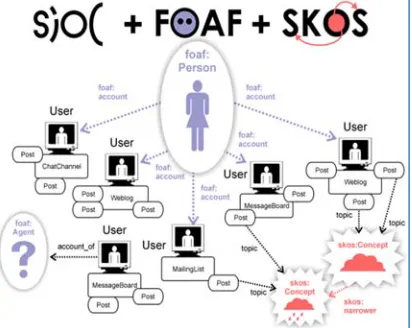
Figure 1: Combination Of The Social Ontologies To Present Social Media2
1http://www.w3.org/wiki/FoafSites
2. THE USM ONTOLOGICAL
ENGAGEMENT: REUSED MODULES
The USM ontology engineering was designed by ontological reengineering based on selected modules from W3C recommended good ontologies, named FOAF, SIOC and its modules SIOC Access SIOCA and SIOC Types SIOCT. It was created according three steps: i) the semantic engagement; ii) the ontological engagement; iii) the validation engagement.
This section is dedicated to the first steps and a first part of the ontological engagement.
2.1. The USM Semantic Engagement
The semantic engagement is the first step in the ontology live cycle. It consists in identifying concepts and terminology of the ontology.
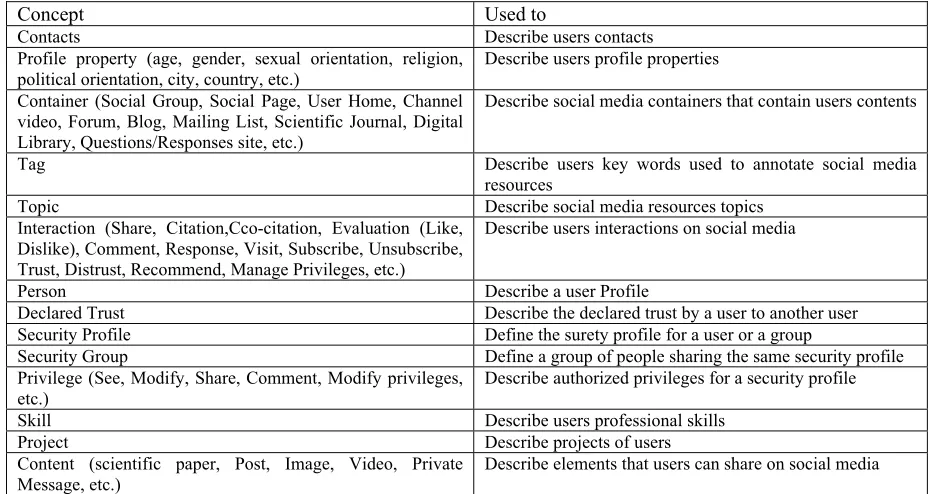
By analyzing 147 documents associated to Social Mining. And by the study of the most popular social media (Facebook, Twitter, Google+, YouTube, IEEE Explorer, Research Gate, Yahoo-Answer, etc.), a list of a set of concepts was established (see Table 4)
2.2. The FOAF module
The FOAF ontology, conceived in 2000, was recommended by the W3C Consortium as a good ontology to describe persons and their relationships [10]. It’s based on a rich vocabulary [11] composed from multiple classes and properties. Actually, FOAF is a documents web network. Each document describe a person, and can be exploited by machines to extract people’s information and relationships.
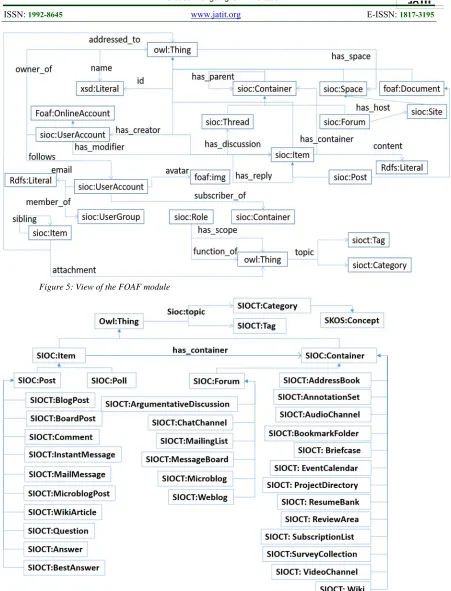
In fact, the FOAF is adapted to describe users’ profiles on social media. Then, as figured on Figure 4, the FOAF Module considered in this work considers eight classes:
Agent, a sub-class of the OWL universal class
Thing, and the super-class of three other
classes: Person, Group and Organization,
Person, refers to an OSN user,
Group, constitutes agents group that are
typically persons,
Organization, corresponds to a social
institution such an enterprise or a public establishment,
3625
Project, presents generally projects needing
many persons collective effort,
Document, a web document generalizing two
sub-classes: Image and
PersonalProfileDocument that is an RDF
document describing a person properties,
OnlineAccount, defines an Agent online
account. It’s specialized by three classes:
OnlineE-commerceAccount,
OnlineGamingAccount and
OnlineChatAccount representing,
respectively, E-commerce, games and chat (online discussion) accounts,
LabelProperty, models all RDF properties with
a text value. It ensures the compatibility with the OWL 2.0 DL language.
The considered module preserves the majority of properties allowing describing the persons and their profiles. It can be classified into four categories:
Properties defining the person identity. These properties give person identity information such the first name (foaf:familyName), the
birthday (foaf:birthday); the age (foaf:age); the
gender (foaf:gender) and the person image
(foaf:img).
Properties describing person coordinates. They give the contact information such the Web page (foaf:homePage) linking a Thing object to a
document, the mail (foaf:mbox) and the Skype
identifier (foaf:skypeID) linking, respectively,
an agent to a Thing object and an agent to an online account de type Skype.
Person web activities properties. They are the
foaf:account associating an agent to its online
account, the foaf:topic_interest associating a
topic to its interesting Things and the
foaf:publications linking a person to a web
documents containing his publications list, generally in a human interpretable format.
Relationships: these properties defines relationships linking directly or indirectly a person to another or to a group, to a project or to an organization (e.g. foaf:knows, foaf:schoolHomepage,
foaf:workplaceHomepage,
foaf:currentProject , foaf:pastProject, foaf:member, etc.).
2.3. The SIOC Module
Created on 2004, The SIOC ontology was proposed [12] to describe information from online communities. In fact, some classes and properties
were token as a USM module to describe the users’ interactions on the social media.
As shown on the Figure 6, the USM holds 10 SIOC classes, named:
UserAccount. a foaf:OnlineAccount sub class
linking the FOAF module to the SIOC module, it presents a user online account;
UserGroup. presents a set of regrouped
UsersAccount according an objective or an
interest. This class can’t be mapped to the
foaf:Group modelling an agents group
(organizations, persons or groups), so it’s possible to deduce a foaf:Group from a
UserGroup and not the inverse.
Space. presents a data hosting space like a web
site, a desktop or a file share;
Container. a high level abstract concept
reflecting any element conceived to contain shared items on the web;
Item. models any shared item on a container on
the web;
Site. A Space sub-class modelling a data space
accessible via the web;
Forum. A Container sub-class modelling a
forum. It’s a public virtual web space of discussion and exchange about a specific topic;
Post. A sub-class of both the Item class and the
foaf:Document class. It design a shared message (text, image, etc.) by a UserAccount on a Forum.
Thread. A Container sub-class presenting a
discussion thread constituted from Posts and Items.
Role. It’s a UserAccount function in a particular
resource like Forum or Site. It can be a moderation or administration function or a set of access privileges.
The SIOC module neglects a unique class named Community. It presents an online community constituted of people, resources, sites, etc. it’s an implicit information not directly declared on social media but deducible, so the USM ontology didn’t save it.
The SIOC module properties are:
UserAccount description properties. The
avatar property links a user to an Image. The email property informs which email address the
user uses especially for the concerned account. The owner_of property defines the resources
(weblogs, image gallery, etc.) belonging to the user propriety. The subscriber_of property
3626 for. The follows property links an account to other accounts followed by the user. The
member_of defines the users groups
(UserGroups).
Containers description properties. There are
three properties: The has_parent property links
a son Container to his father Container. The
has_space property links a resource, especially
a Container, to his Space. The has_host
property associates a Forum to his hosting Site.
Items description properties. The has_creator
property defines for an Item his UserAccount
creator. The content property defines the Item’s
textual content. The attachment property associates it to the attached document URI. The
topic property assigns a tag or a category
(SIOCT classes) to define its interest domain. The addressed_to property links it to his
destination (UserAccount, email, etc.). The has_discussion property associates it to a
Thread. The has_modifier property defines
UserAccounts having modify it. The has_reply
property expresses that an Item was shared as
response to another. The sibling property links
an Item to its twine that can belong to another
Container or have another language or topic.
Roles description properties. There are two
properties. The function_of property defines the
UserAccount having this Role, and the
has_scope property defines the resource (Site,
Container, Forum, etc.) under its emprise.
Instancesdescription properties. There are two properties. The name property attributes a name
to any class instance, and the id property
attributes a unique ID.
The saved module neglects some properties to have a clear description of implicit data without redundancies. Per example, the module eliminates the administrator_of property because it can be presented thanks to Role class and its two properties. Statistic can be deduced, so the relative properties were unsaved (e.g. num_authors, num_items, num_replies, etc.). The authors think that the versioning and dating properties proposed by SIOC are insufficient because it concern especially the earliest or the latest interaction, so they didn’t keep it and replace it in the extension proposed (see exSIOCInt).
2.4. The SIOCT
SIOCT (SIOC Types) proposed by [13] specializes the classes: Container, Forum, Item and
Post (see Figure 9Error! Reference source not found.).
This module specializes the Container class by fourteen sub-classes named: AddressBook, AnnotationSet, AudioChannel, BookmarkFolder, Briefcase, EventCalendar, ImageGallery, ProjectDirectory, ResumeBank, ReviewArea, SubscriptionList, SurveyCollection, VideoChannel and Wiki. It also specializes the Forum class by five sub-classes named: ArgumentativeDiscussion, ChatChannel, MailingList, MessageBoard, Microblog and Weblog. The Item class is specialized by the class Poll, and the Post class by the sub-classes: BlogPost, BoardPost, Comment (Commentaire), InstantMessage, MailMessage, MicroblogPost, WikiArticle, Question, Answer and BestAnswer.
SIOCT proposes also two other classes named Tag and Category that can be used as objects of the sioc:topic property. The Category class is a sub-class of the skos:Concept class. SKOS (Simple Knowledge Organization System), propsed by [14], is a data model for sharing and linking of Knowledge Organization Systems (KOS) such as taxonomies, thesaurus and classification schemes.
2.5. The SIOCA
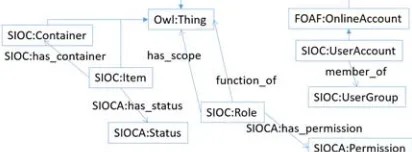
[image:4.612.315.521.534.610.2]The SIOCA (SIOC Access), proposed by [13], defines two other classes: Permission to define the actions types that a Role can exercise and Status to precise the items status (public, draft, etc.). Two other properties were defined: has-permission to precise permissions attributes to a Role, and has_status to associate an Item to its publication Status.
Figure 2: SIOCA Module of Roles descriptions
3. THE USM ONTOLOGICAL
ENGAGEMENT: THE EXTENDED
MODULES
3627 FOAF and SIOC concepts and the identified concepts from the semantic engagement.
This section presents the mapping results and explains the extended modules to cover the missing concepts.
3.1. The USM Semantic Engagement and its
[image:5.612.90.287.190.364.2]mapping with the Selected Modules
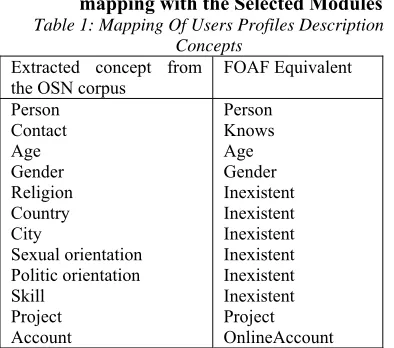
Table 1: Mapping Of Users Profiles Description Concepts
Extracted concept from
the OSN corpus FOAF Equivalent Person Contact Age Gender Religion Country City Sexual orientation Politic orientation Skill Project Account Person Knows Age Gender Inexistent Inexistent Inexistent Inexistent Inexistent Inexistent Project OnlineAccount
The mapping results permit identifying a concepts set (e.g. city, country, skill, etc.) that are not supported by FOAF module. These concepts correspond to properties enriching the profile description from the point view identity and professional by specifying his skills.
Table 2: Mapping Of Users Online Activities Concepts
Extracted concept from
the OSN corpus SIOC Equivalent Reply Inexistent View Inexistent Tagging Inexistent Like Inexistent Dislike Inexistent Cite Inexistent Share Inexistent Modify sioc:has_modifier
(property) Visit Inexistent Subscribe sioc:subscriber_of
(property) Churn Inexistent Modify Confidentiality
Status Inexistent Private Message Inexistent
follows sioc:follows (property) Trust Inexistent
Recommend Inexistent Add Friend Inexistent Remove Friend Inexistent Grant Role Inexistent
Revoke Role Inexistent Modify Role Inexistent
[image:5.612.308.530.192.392.2]The mapping results demonstrate that the identified concepts are not supported by SIOC except some properties that are inadequate due to the timing criteria that is primordial for OSN analysis.
Table 3: Mapping Of Users Online Activities Concepts
Extracted concept from the OSN corpus
SIOC Equivalent
Forum sioc:Forum Scientific Network Inexistant Digital Library Inexistant Blog sioct:Weblog Video Channel sioct:VideoChannel Mailing List sioct:MailingList User Home sioct:Weblog Social Page sioct:Weblog Social Group sioct:Weblog Content sioc:Item
Post sioc:Post
Image exif:IFD (reused in SIOCT) Video dcmit:image (reused in
SIOCT) Scientific paper Inexistant
Tag sioct:Tag
The mapping results demonstrate that many identified concepts are not supported by SIOCT.
3.2. The exFOAF Module
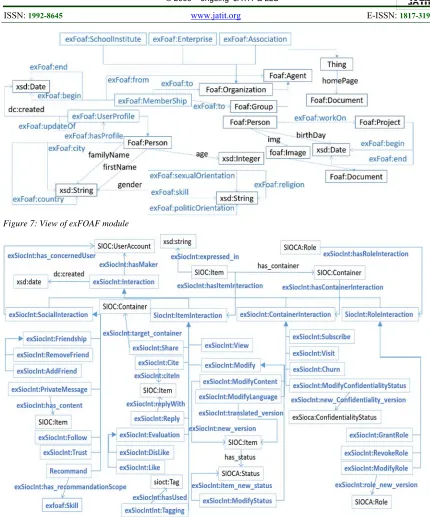
The properties set of Person class describe the person profile. The profile is created by a person who can update it over the time. Then, it’s necessary to take into account the time notion to identify valid user profile properties. In this direction, as shown in the Figure 7, we propose integrating the userProfile new class and other new classes and properties:
The userProfile class. presents the user profile created by a person. It’s a Person sub-class that is associated to his owner (Person) by the
hasProfile property. So the user profile is a
person and inherit the Person set properties.
The identity description properties. correspond to city, country, religion, sexualOrientation and politicOrientation textual properties associated
to the foaf:Person class.
The professional description property. is the
skill textual property associated to the foaf:Person class.
The profile timing properties. There are two properties: created and updatedOf. The created
3628 Date class to define its creation date. The
updateOf property links a userProfile to itself
to express that a userProfile is an update of another one.
Otherwise, by analyzing the considered FOAF module, it was noted that other classes and properties concerning projects, organizations, and groups have to be refined. Concerning projects, the foaf:currentProject and foaf:pastProject properties define actual and old users projects without specifying time or projects explicitly (it take their value in Thing not in Project). In addition, the relationship between a user and his projects can be defined using the homepage property linking a person to a document describing a project, but the document is generally wrote in a human interpretable format. However, the project concept is an important concept in the OSN analysis deserving being described in a more clear way allowing, for example, detecting experts or predicting a person's skills over time. Then, we propose to extend the FOAF module by the following properties set:
workOn. links directly a person to his projects,
begin. associates a project to its beginning date,
end. Like the begin property, it links a project to its ending date.
Concerning organizations, we have also observed that a person is generally connected implicitly to his organizations thanks to two properties: foaf:schoolHomepage and foaf:workplaceHomepage, giving, respectively, his scholar institution and his work organizations. These properties connect persons to documents (organizations home pages). To better exploit users belonging organizations information, we extend the FOAF module by the following classes and properties:
Enterprise. a foaf:Organization sub-class to express the work establishment,
SchoolInstitute : another foaf:Organization
sub-class expressing the school establishment,
Association. another foaf:Organization sub-class expressing associations that a person can subscribe to,
MemberShip. It’s a new class expressing a belonging relationship allowing specifying that a person belongs to an organization as student, employee, or adherent.
from. This property links the Person class to the Membership class to design that a person is a member.
to. This property associates the Membership
class to the Organization class to express that such person belongs to such organization.
begin. links Membership class to date class to
express when this relationship began.
end. Like the begin property, it links Membership class to date class to express when the membership ended. If no date linked, the membership is always valid.
Concerning the groups, we have noted that the property foaf:member linking a group to his members (Agent type) don’t allow defining the membership period (begin and end). So, like the Organization class, it’s better to use the Membership class with the begin and end properties to define the membership period, and the from and to properties to associate, respectively, an agent to Membership, and Membership to a Group.
The Figure 7 presents the extended FOAF module adopted by the USM ontology to describe users’ profiles. The proposed extensions use the exFOAF (extended FOAF) prefix, and are illustrated in blue.
3.3. exSIOCInt (extended SIOC for
Interactions)
The online interactions modeling in the module of social web description is primordial especially for the OSN analysis. The interactions timing is also important to monitor the OSN evolution. To fill the absence of these concepts types in the SIOC module, exSIOCInt enriches the USM ontology by a set of new classes and properties. The main class is an abstract class named Interaction. This class is linked to xsd:date by the created property to indicate the online interaction date, and to sioc:OnlineAccount by the hasMaker property to indicate the interaction source. It’s also specialized by four sub-classes: ItemInteraction, ContainerInteraction, SocialInteraction, and RoleInteraction to distinguish between interactions on an Item, on a Container, a UserAccount or a Role. Each of these subclasses is modeled by a set of subclasses and properties that we present in the following (see Figure 8).
3629 a Container and its topics. The ModifyConfidentialityStatus informs about the Container confidentiality sequential updates. Two other properties were added to complete these classes: hasContainerInteraction associates the Container class to the ContainerInteraction class; and new_Confidentiality_Status links the ModifyConfidentialityStatus class to the ConfidentialityStatus class to indicate the new container status.
The exSIOCInt module proposes other classes to describe the items interactions: Reply, View, Tagging, Evaluation with its two sub-classes named Like and Dislike; Cite, Share, and Modify with its sub-classes that are ModifyContent, ModifyLanguag and ModifyStatus. The ModifyLanguage allows expressing the twin items notion expressed in SIOC by the sibling property. These classes needs adding other properties like: hasItemInteraction to link items to its interactions, replyWith to associate an item to Reply class, citeIn to indicate the item destination of the Cite interaction, hasUsed to link the Tagging interaction to the used tags, target_container to associate a target container to the Share interaction, item_new_version to associate the item resulting to the ModifyContent interaction, translated_version to associate the item resulting to the ModifyLanguage interaction, expressed-in to link an item to its language expressed by a xsd:string, new_status to link the new status to the ModifyStatus interaction.
Concerning the SocialItnteraction sub-classes, there are seven: PrivateMessage to model the action of sending a private message, Follow to express the desire of an account to follow another account actualities, Trust to express an explicit trust from an account to another, FriendShip with its two sub-classes AddFriend and RemoveFriend, and Recommend to express that an account recommend the skills of another one. Actually, there are properties associated to these classes: has_concernedUser to precise the SocialInteraction target account, has_content to indicate the sent item in a PrivateMessage interaction, and has_recommendationScope to indicate the exfoaf:skill subject of recommendation made by an account to another.
The exSiocInt module view dedicated to the role interactions proposes three sub-classes for the RoleInteraction class: GrantRole, RevokeRole and ModifyRole. This view gives information about
3 https://www.researchgate.net/
trust and reputation and its evolution over time. The RoleInteraction class use the property hasRoleInteraction to associate it to the concerned Role, when the ModifyRole class is linked to a second Role by the role_new_version property to express that the second Role is the result of the first Role modification.
3.4. ExSIOCT
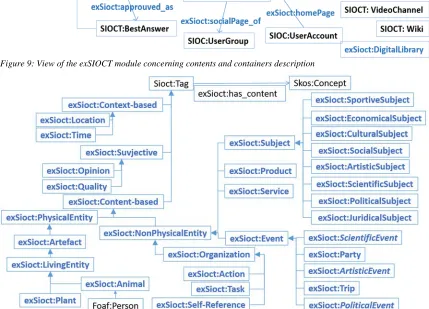
The first objective of the exSIOCT module is extending the SIOCT module by new classes as sub-classes of Container, Forum and Item, and properties. The added classes are: ScientificNetwork (to model networks like ResearchGate3), DigitalLibrary (to model libraries like IEEE Xplorer4), UserHome (to model users’ containers on networking sites as Facebook), SocialGroup (to model containers dedicated to users groups to share items related to their common interests) and Paper (to model scientific papers that are shared on scientific networks and digital libraries). Four new properties were added: homepage (to link a UserAccount to his UserHome), socialPage_of (to link a UserGroup to its SocialPage), has_author (to relate a Paper to his author), and approved_as (to indicate that an Answer were approved as a best answer).
The second objective of exSIOCT is extending SIOCT to better describe tags. It’s based on four categories identified in [15]: Content-based to describe resources contents (many sub-classes proposed such PhysicalEntity, Artefact, LivingEntity, Animal, Person, Plant, NonPhysicalEntity and Organization), Context-based to give contextual information (two sub-classes named Place and the Time), Subjective to express subjective information (two sub-classes named Opinions and Quality), and Organizational (to indicate a task, an action or a self-reference) (see
Table 5). To meet the social media analysis needs, exSIOCT specializes the NonPhysicalEntity by the sub-classes named: Product for commercialized products with its sub-classes, Service for services ensured by providers, Event specialized by many sub-classes (ScientificEvent, PoliticalEvent, ArtisticEvent, Trip, and Party), and Subject to classify topics into eight sub-classes (ScientificSubject, PoliticalSubject, ArtisticSubject, CulturalSubject, SportiveSubject, SocialSubject, EconomicalSubject and JuridicalSubject). The
3630 module proposes also a new property has_content to link a Tag to a skos:concept (see Figure 10).
3.5. exSIOCA
exSIOCA extends SIOCA module to specialize roles and privileges on the social media. Its conception is inspired from the Access Management Ontology (AMO) [16].
The module specializes the Role class by seven sub-classes: Owner, Administrator, Moderator, Subscriber, Member, Guest and SpecifiedRole for created roles by a UserAccount. It describes permissions by new sub-classes of Permission class: ShareContent, ViewContent, ModifyContent, DeleteContent, ChangeStatus and ChangeUserRights. The Status class (describing the items status) also was specialized by three new sub-classes: Public, Private and Draft. Moreover, a new class was defined named ConfidentialityStatus (to describe the containers confidentiality status) with its sub-classes: Private, Secret and Closed.
4. CASE STUDY: FACEBOOK
In order to carry out the USM ontology utility, data can be aggregated from Facebook, Google+ and Twitter via APIs available for developers like Graph API5, Google API6 and Twitter API7.
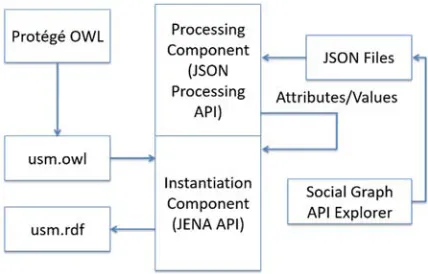
In this paper, the Facebook graph API was used in a java application to instantiate the USM ontology. These social media data are generated in JSON (JavaScript Object Definition) format. The JSON format is a generic simple text data format, derivative from objects notation JavaScript and used to represent structured information in Web applications.
The application allows generating a RDF file from both a JSON file of social media data and the USM ontology. It consists of two components: Processing Component and Instantiation Component. The Processing Component mission is analyzing the JSON files in order to identify the different pairs (attribute, value) using the JSON Processing8 API. The Instantiation Component is designed to instantiate the USM ontology. Using the Jena9 API recommended for semantic applications development, it reads and reuses the USM pairs
5
https://developers.facebook.com/blog/post/2017/07/18/graph-api-v2.10/
6 https://developers.google.com/api-client-library/java/
[image:8.612.314.528.141.278.2](attribute, value) to generate the RDF triplets in a RDF file.
Figure 3: Application architecture for USM ontology automated instantiation
The objective of this step is testing the ability of the different USM modules to ensure their objectives. Bellow, it’s defined some scenarios and its according situation on social media and its presentation in the USM ontology.
In this paper a scenario example was taken for each module. In totality, there are five scenarios. To carry out the USM ontology usability, each scenario JSON file is transformed according the USM ontology.
4.1. FOAF and ExFOAF Scenario
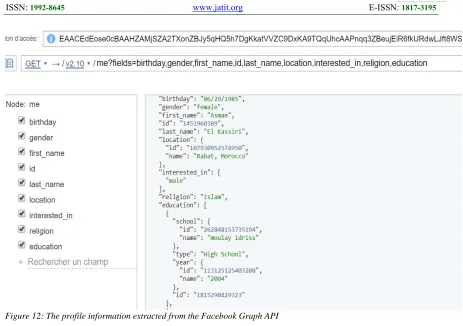
Taking the case of a created profile on Facebook (see Figure 12Error! Reference source
not found.). The according USM ontology
modeling, especially in exFOAF module, is shown in Error! Reference source not found..
4.2. SIOC, SIOCT, exSIOCT and
ExSIOCInt scenarios
Two scenarios were taken from Facebook Graph API. The first one presents a sharing posts (see Figure 14), the second one is a Person Tagging scenario (see Figure 16).
The scenarios’ transformation to the USM ontology are given in Figure 15 and Figure 17.
4.3. SIOCA and ExSIOCA scenarios
3631 Two scenarios were taken from Facebook. The first one models a Group Page scenario (see Figure 18), the second one is a scenario of status and permissions (see Figure 19). Facebook doesn’t offer a way to extract permissions and status change history.
PS. The Graph API Status_type block corresponds to sioca:status. It takes values in {mobile_status_update, created_note, added_photos, added_video, shared_story, created_group, created_event, wall_post, app_created_story, published_story, tagged_in_photo, approved_friend}.
The scenarios’ transformation to the USM ontology are given in Figure 20 and Figure 21.
5. A CRITICAL EVALUATION
In this document, the authors present an ontology adapted to model the various most popular social media data that can be used to aggregate the data since several media. They validated the ontology engineering by a set of scenarios corresponding to needs established during the USM ontology scope definition (the first step of an ontology creation).
On the other hand, and for an objective viewpoint, it is necessary to mention that a real social media data migration towards the USM ontology isn’t rather simple. Why is explained below:
To be able to extract the data since every social media, it is necessary to learn and to master the development tools offered by the concerned media.
Only the user can grant the right to reach his stored data in a social media thanks to a token access that gives access to a data part, and even if the user give a total access, the media does not authorize it because the offered development API doesn’t allow it, for example Facebook offers no way for:
Extracting hashtags used with posts, only the persons tags are available and only for photos;
Deducing the events nature;
Identifying and classifying keywords from the posts texts
It is necessary to use Natural Language Processing (NLP) algorithms for various languages because the languages diversity used on the social media, and more specifically the
Named Entity Recognition (NER) and the Topic Segmentation:
The NER to extract the proper names of products, people, places, etc.
The Topic Segmentation to identify covered topics on the shared items.
Generally, aggregating data from several media isn’t an obvious objective cause of extracting data difficulties mentioned above.
Actually, another alternative (an ontology objective) is the USM use by the social media as a storage model and/or an analysis model to present and aggregate data from the related media (e.g. Instagram and Facebook, YouTube and Gmail and Googles +), and guide the users to classify their published data (like for places and persons on Facebook) to avoid NLP automatic treatments (heavy to realize and uncertain results). Per example: when a user types a product name, the media asks him if he means such product.
Sur, the OSN as the Facebook will not use the USM, a public model, for the data storage (data will be more vulnerable), but they can use it as a basic analysis model.
6. PERSPECTIVES AND CONCLUSION
To conclude, it is necessary to call back that the USM ontology allows representing semantically the various categories of social media:
Media of personal networking like Facebook, Google +, of professional networking like LinkedIn and Viadeo, and of scientific networking like ResearchGate and IEEEexplorer;
Microblogging Media (Twitter);
Sharing Media of photos like Instagram, of videos like YouTube or of movies like openload;
Forums;
Blogs;
Question-Response sites;
Bookmarking platforms (Pinterest);
Collaborative Media (Wikipedia and commentçamarche).
3632 aggregation outside the related media administration would not be evident.
Having defined the USM ontology objectives and the scope, it was designed according to the three main steps:
The semantic commitment based on the social media and the OSN analysis documentary corpus study to identify the domain terminology;
The ontological commitment consisted in defining the identified concepts semantics and relationships. It was based on ontological reengineering by existent ontologies reusing
and extension (FOAF, SIOC, SIOCT and SIOCA);
The operational commitment aiming the ontology validation by a scenarios set defined the ontology scope and objectives.
[image:10.612.91.519.263.428.2]In future works, the present authors will explain how reuse this model as an analysis pretreatment model by an analysis ontology for the OSN analysis various types raised in the literature.
[image:10.612.87.556.468.715.2]Figure 4: The FOAF module View
Table 4: The identified Concepts from the Documents Corpus and Social Media uses
Concept Used to
Contacts Describe users contacts
Profile property (age, gender, sexual orientation, religion, political orientation, city, country, etc.)
Describe users profile properties
Container (Social Group, Social Page, User Home, Channel video, Forum, Blog, Mailing List, Scientific Journal, Digital Library, Questions/Responses site, etc.)
Describe social media containers that contain users contents
Tag Describe users key words used to annotate social media resources
Topic Describe social media resources topics
Interaction (Share, Citation,Cco-citation, Evaluation (Like, Dislike), Comment, Response, Visit, Subscribe, Unsubscribe, Trust, Distrust, Recommend, Manage Privileges, etc.)
Describe users interactions on social media
Person Describe a user Profile
Declared Trust Describe the declared trust by a user to another user Security Profile Define the surety profile for a user or a group
Security Group Define a group of people sharing the same security profile Privilege (See, Modify, Share, Comment, Modify privileges,
etc.) Describe authorized privileges for a security profile
Skill Describe users professional skills
Project Describe projects of users
Content (scientific paper, Post, Image, Video, Private Message, etc.)
3633
Figure 5: View of the FOAF module
3634
Figure 7: View of exFOAF module
3635
[image:13.612.90.519.363.672.2]Figure 9: View of the exSIOCT module concerning contents and containers description
3636
Table 5 : The [14] Tags categorization
Main category Subcategory SuperCategory Examples
Content-based Physical entity Content-based food, heart Artefact Physical entity finger,table Living entity Artefact clone, life Animal Living entity pet, caterpillar Person Animal friend, syster, Asmae Plant Living entity tree, flower
Non-physical entity Content-based Feminism, noise Organization Non-physical entity ibm, religion, Google Context-based Location Context-based Morocco, Fez
Time Context-based Nineties, yesterday Subjective Opinion Subjective So cute, unforgettable
Quality Subjective Golden picture, geometric elegance Organization Self-reference Organization Her, missing you
Task Organization Time for change, don’t want to know Action Organization Eating, read book
3637
Figure 12: The profile information extracted from the Facebook Graph API
[image:15.612.91.449.406.572.2]3638
[image:16.612.95.551.356.640.2]Figure 14: The shared posts information extracted from the Facebook Graph API
3639
[image:17.612.91.522.450.658.2]Figure 16: A tagging interaction example from Facebook
3640
[image:18.612.91.512.195.659.2]Figure 18: The groups’ roles extracted from Facebook Graph API
Figure 19: The Items’ status examples extracted from Facebook
3641
Figure 21: The Items’ status JSON file (Error! Reference source not found.) transformed into USM ontology
REFERENCES
[1] A. EL KASSIRI and F.-Z. BELOUADHA, "ActOnto: An extension of the SIOC standard for social media analysis and interoperability," in Third IEEE International Colloquium in Information Science and Technology (CIST'14), 2014.
[2] A. EL KASSIRI and F.-Z. Belouadha, "Towards a Unified Semantic Model for Online Social Networks Analysis and Interoperability," 10th International Conference on Intelligent Systems: Theories and Applications (SITA), pp. 62-67, 2015.
[3] A. EL KASSIRI and F.-Z. BELOUADHA, "Towards a Unified Semantic Model for Online Social Networks to Ensure Interoperability and Aggregation for Analysis," in Graph Theoretic Approaches for Analyzing Large-Scale Social Networks,
IGI Global, 2017, pp. 267-292.
[4] P. Mika, "Modelling and aggregating social network data," in Social Networks and the Semantic Web, vol. 5, Springer US, 2007, pp.
93-120.
[5] A. Kumar and A. Joshi, "Ontology Driven Sentiment Analysis on Social Web for Government Intelligence," Proceedings of the Special Collection on eGovernment Innovations in India, pp. 134-139, 2017.
[6] D. T. Santosh and B. V. Vardhan, "PROO ontology development for learning feature specific sentiment relationship rules on reviews categorisation: a semantic data mining approach," International Journal of
Metadata, Semantics and Ontologies, vol.
11, no. 1, pp. 29-38, 2016.
[7] M. Hamdaqaa, L. Tahvildaria, N. LaChapelleb and B. Campbellb, "Cultural scene detection using reverse Louvain optimization," Science of Computer Programming, 24 1 2014.
[8] N. M. A. Luz, Interviewee, PhD. Thesis: Semantic Social Network Analysis.
[Interview]. 9 2010.
[9] N. Pankong, S. Prakancharoen and M. Buranarach, "A Combined Semantic Social Network Analysis Framework to Integrate Social Media Data," in Knowledge and Smart Technology (KST), 2012 4th International Conference on, 2012.
[10] J. Golbeck and M. M. Rothstein, "Linking social networks on the web with FOAF: a semantic web case study," ceeding AAAI'08 Proceedings of the 23rd national conference on Artificial intelligence , vol. 2, pp.
1138-1143, 2008.
[11] D. Brickley and L. Miller, "FOAF Vocabulary Specification 0.98," 9 Août
2010. [Online]. Available:
http://xmlns.com/foaf/spec/. [Accessed 4 Juin 2013].
[12] A. Harth, J. G. Breslin, I. O'Murchu and S. Decke, "Linking Semantically-Enabled Online Community Sites," 1st Workshop on FOAF, Social Networking, and the Semantic Web, Galway, Ireland, p. Article. 5, 2004.
3642 D. Fensel and J. Hendler, Eds., Springer Berlin Heidelberg, 2011, pp. 467-506. [14] A. Miles and S. Bechhofer, "SKOS Simple
Knowledge Organization System Reference," 18 08 2009. [Online]. Available: https://www.w3.org/TR/skos-reference/. [15] I. Cantador, I. Konstasm and J. M. Jose,
"Categorising social tags to improve folksonomy-based recommendation," Web Semantics: Science, Services and Agents on the World Wide Web, vol. 9, no. 1, pp. 1-15,
March 2011.
[16] M. Buffa, C. Faron-Zucker and A. Kolomoyskaya, "Gestion sémantique des droits d’accès au contenu: l’ontologie AMO," in Revue des Nouvelles Technologies de l'Information, 2010.
[17] L. Chen, S. Wei and Z. Qingpu, "Semantic Description of Social Network Based on Ontology," Proceeding ICEE '10 Proceedings of the 2010 International Conference on Business and E-Government, pp. 1936-1939, 7-9 5 2010.
[18] A. Masoumzadeh and J. Joshi, "Ontology-based access control for social network systems," Int. J Information Privacy, Security and Integrity, vol. 1, no. 1, pp. 59
-78, 2011.
[19] V. Kumar and S. Kumar, "Access Control Framework for Social Network System using Ontology," International Journal of Computer Applications, vol. 79, no. 4, 2013.
[20] P. Mika, "Ontologies are us: A unified model of social networks and semantics,"
International Semantic Web Conference, p.
522–536, 2005.
[21] L. Chena, S. Weib and Z. Qingpu, "Semantic Description of Social Network Based on Ontology," International Conference on E-Business and E-Government, pp. 1936
-1939, 2010.
[22] A. Masoumzadeh and J. Joshi, "Ontology-based access control for social network systems," Int. J Information Privacy, Security and Integrity, vol. 1, no. 1, pp. 59
-78, 2011.
[23] V. Kumar and S. Kumar, "Access Control Framework for Social Network System using Ontology," International Journal of
![Table 5 : The [14] Tags categorization](https://thumb-us.123doks.com/thumbv2/123dok_us/8903091.955685/14.612.82.540.102.569/table-the-tags-categorization.webp)