IJPSR (2015), Vol. 6, Issue 7 (Research Article)
Received on 12 November, 2014; received in revised form, 12 January, 2015; accepted, 18 March, 2015; published 01 July, 2015 METHOD DEVELOPMENT AND VALIDATION OF ZOPICLONE IN BULK AND TABLET DOSAGE FORM USING RP-HPLC
I. Chopra *, J. Kaur, D. K. Yadav, M. Hasan, P. K. Tyagi and B. Kumar
College of Pharmacy, Shree Ganpati Institute of Technology, Ghaziabad -201302, Uttar Pradesh, India
ABSTRACT: Zopiclone belongs to a class of medicines commonly called Z-drugs. It is a novel hypnotic agent used in the treatment of insomnia. Its mechanism of action is based on modulating benzodiazepine receptors. A Reverse Phase High Performance Liquid Chromatography method was developed and validated for the quantification of zopiclone in bulk and tablet dosage form. Chromatography was achieved using a Waters X Bridge C18 column (50 x 2.1 mm, 5μ) eluted with a mixture of mobile phase composed of ammonium bicarbonate (5mM, neutral) and acetonitrile in a gradient mode at a flow rate of 1 ml/min. The detection of eluent from the column was detected using photo diode array detector (PDA) at 214nm. The stability indicating assay method was developed and validated as per the ICH guidelines using the required parameters. Linearity was observed within the concentration range of 50-300μg/ml with coefficient of correlation 0.999. The LOD and LOQ were 9.416μg/ml and 28.534μg/ml, respectively. The mean recovery was found to be 100.1%.
INTRODUCTION: Zopiclone (Fig. 1) is 6-(5-chloropyridin-2-yl)-7-oxo- 6, 7 - dihydro - 5H- pyrrolo[3,4-b]pyrazin-5-yl-4-methylpiperazine-1-carboxylate1. Zopiclone is a nonbenzodiazepine hypnotic from pyrazolopyrimidine class used in the treatment of insomnia. While Zopiclone is a hypnotic agent with a chemical structure unrelated to benzodiazepines, barbiturates, or other drugs with known hypnotic properties, it interacts with
the gamma-aminobutyric acid-benzodiazepine
(GABABZ) receptor complex. Zopiclone exerts its
action by binding on the benzodiazepine receptor complex and modulation of the GABABZ receptor
chloride channel macromolecular complex.
QUICK RESPONSE CODE
DOI:
10.13040/IJPSR.0975-8232.6(7).2876-81
Article can be accessed online on:
www.ijpsr.com
DOI link: http://dx.doi.org/10.13040/IJPSR.0975-8232.6(7).2876-81
Both zopiclone and benzodiazepines act indiscriminately at the benzodiazepine binding site on α1, α2, α3 and α5 GABAA containing receptors
as full agonists causing an enhancement of the inhibitory actions of GABA to produce the therapeutic (hypnotic and anxiolytic) and adverse effects of zopiclone 2-4.
Its molecular formula is C17H17ClN6O3 and its
molecular weight is 388.808 g/mol. It has following structural formula:
FIG. 1: MOLECULAR STRUCTURE OF ZOPICLONE Keywords:
Zopiclone, Stability-indicating assay, Gradient elution, RP-HPLC method
Correspondence to Author: Isha Chopra
Research Scholar, College of Pharmacy, Shree Ganpati Institute of Technology, Ghaziabad-201302, Uttar Pradesh, India.
A simple and sensitive method for routine usage is generally desirable. Therefore, a need of simple, reliable, inexpensive, and accurate stability indicating method for analysis of Zopiclone as bulk or as tablet dosage form is always welcomed. The present study was aimed to develop and validate stability indicating method for the quantification of zopiclone in its tablet dosage forms.
MATERIALS AND METHODS: 5-14
Chemical and Reagents:
The separation of the analyte was done by using Waters e2695 HPLC instrument with a Waters X Bridge C18 column (50 x 2.1 mm, 5μ) column. The
instrument was equipped with a pump (2695), injector, PDA Detector (2996) and column oven. Data acquisition was done by using Empower software. Degassing of the mobile phase was done by using an ultrasonic bath sonicator. A Mettler Toledo (XS 205 dual range) electronic balance was used for weighing the materials. Class ‘A’ Borosil glassware were employed for volumetric and general purpose in the study. The reference sample of Zopiclone was gifted by Jubilant Life Sciences, Noida. The tablets of Zopiclone (The branded formulation of Intas Pharmaceuticals) were procured from the local market. Ammonium bicarbonate (AR grade, Merck), Acetonitrile (HPLC grade, Sigma Aldrich), Methanol (HPLC grade, Sigma Aldrich), water (Milli-Q / HPLC grade) were used.
Chromatographic Conditions Table 1:
Preparation of 5mM Ammonium bicarbonate solution:
385 mg Ammonium bicarbonate was weighed and dissolved in 1000 ml Milli-Q water, mixed well, filtered and degassed.
Mobile Phase:
Buffer and Acetonitrile were taken in separate bottles, filtered through 0.2µ Nylon membrane filter paper, sonicated, degassed and mixed automatically as per the method.
Diluent:
Milli-Q water: Acetonitrile (ACN) in a ratio (30:70) was mixed well, sonicated and degassed. It was also used as blank solution.
Preparation of Standard Solution:
About 5 mg of Zopiclone standard was weighed accurately and transferred to a 10ml volumetric flask. A little quantity of diluent was added to dissolve; sonicated and degassed. The volume was made up to 10 ml and sonicated (500ppm). Further 2 ml of the above solution was diluted to 5 ml with diluents (200ppm).
Preparation of Sample (Tablet Formulation):
10 tablets of Zolpidem, each containing 7.5 mg of Zopiclone, were weighed and powdered. To prepare 200μg/ml concentration of sample solution, a quantity of powder equivalent to 10 mg (110.005 mg) was weighed approximately and transferred to a 10 ml dried volumetric flask. The sample was initially dissolved in diluent and sonicated for 15 min. The volume was made up to 10ml and filtered through 0.2μm Nylon filters. Then 2 ml of this solution was further diluted to 5 ml with same diluent to get the final concentration of 200μg/ml and sonicated for 15 min again.
TABLE: 1 OPTIMIZED CHROMATOGRAPHIC
CONDITIONS S.
No.
Parameter
Optimized Optimized Condition
1 Instrument (HPLC) Waters e2695 PDA Detector 2 Column Waters X-Bridge C18 (2.1 x
50 mm, 5μm)
3 Mode Gradient
4 Mobile phase Ammonium bicarbonate: Acetonitrile 5 Column Oven 25 ºC 6 Auto sampler
Temperature 15º C 7 Flow rate 1 ml/min 8 Detector Photodiode array 9 Temperature Ambient room temperature 10 Detection
wavelength 214nm 11 Injection volume 5µl 12 Retention time
(RT) 3.423 ± 0.400 min 13 Run time 6.00 min
Method Validation:
Specificity:
The method specificity was assessed by comparing the chromatograms obtained from a placebo solution containing a mixture of most commonly used excipients without the drug and another solution containing the excipients with the drug. These solutions were prepared in the diluent. The drug to excipient ratio used was similar to that in the commercial formulation. The mixtures were filtered through 2μ membrane filter before injection. The placebo solution and the sample solution (placebo and the drug) were injected into HPLC system separately in triplicate and the relevant chromatograms observed.
Precision:
System precision:
Six replicates of standard solution of Zopiclone were injected into HPLC system.
Method precision:
The precision of the procedure was determined by repeatability. Six sample preparations were made from a single batch of Zopiclone tablets and analyzed as per the proposed method.
Intermediate precision (Ruggedness):
Ruggedness of method was verified by analyzing six sample preparations of same batch used under method precision as per proposed method by different analysts using different instrument and on different day. The amount of Zopiclone in Zopiclone tablets was determined. % RSD for % assay of Zopiclone was calculated, for six preparations.
Accuracy:
The placebo was spiked with known amounts of Zopiclone (API) at about 50%, 100% and 150% of test concentration prepared in triplicate at each level. Amount of Zopiclone was quantified and % recovery was calculated from amount found and actual amount added. % Recovery at each level was calculated.
Linearity:
Linearity of response was performed using the standard solution in a range of 50ppm to 300ppm [50% - 150% of the test concentration].
Stability in analytical solution:
Stability of Zopiclone in analytical solution was verified by analyzing sample solution initially and also at different time intervals up to 48 hrs when the sample was stored at room temperature.
Robustness:
To evaluate robustness, following variations were made in the method and the samples were analyzed in triplicate. Change in Flow rate by (10%), Change in Organic content variation in mobile phase (± 2mM). System suitability was evaluated in each condition and results were compared with method precision results.
Limit of Detection and Limit of Quantification:
Limit of detection (LOD) is defined as the lowest concentration of analyte that gives a measurable response. LOD is determined based on signal to noise ratio (S/N) of three times typically for HPLC methods. The limit of quantification (LOQ) is defined as the lowest concentration that can be quantified reliably with a specified level of accuracy and precision.
RESULTS AND DISCUSSION: A mixture of
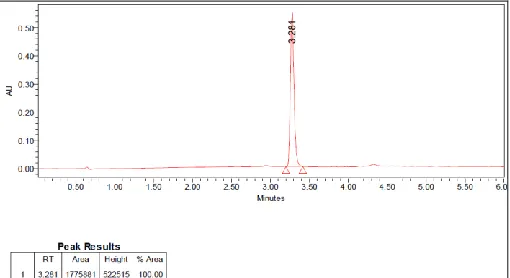
mobile phase composed of ammonium bicarbonate (5 mM, neutral) and acetonitrile in a gradient mode at a flow rate of 1 ml/min was found to be a suitable solvent system. Fig. 2 shows a typical chromatogram obtained from the analysis of a reference standard using the proposed method for zopiclone. As shown in this figure, a symmetrical peak represents zopiclone. The retention time observed in the assay (3.28 min) associated with the simple sample preparation (for tablets) allowed a rapid determination of the drug in pharmaceutical products Fig.3.
[image:3.612.315.570.586.725.2]FIG. 3: A REPRESENTATIVE CHROMATOGRAM OF SAMPLE SOLUTION
Specificity:
There was no interference from blank and placebo at the retention time of analyte peak. The absence of additional peaks in the chromatogram indicates non interference of the commonly used excipients in the tablets and hence the method is specific Fig. 4.
FIG. 4: A REPRESENTATIVE CHROMATOGRAM OF ZOPICLONE FROM THE TABLET SOLUTION
Precision:
System Precision: % RSD of Zopiclone peak area counts from six replicate injections of standard solution was less than 2.0 and it meets the acceptance criterion. The results were summarized in Table 2.
TABLE 2: SYSTEM PRECISION DATA
Method precision:
The %RSD for %Assay of Zopiclone for six sample preparations was less than 2.0% and meets the acceptance criterion.
Intermediate precision (Ruggedness): % RSD for % assay of Zopiclone was less than 2.0% and meets the acceptance criteria. Overall % RSD for % assay of Zopiclone obtained from ruggedness and method precision was less than 2.0% and meets the acceptance criteria. The results were summarized in
Table 3.
Accuracy:
Analytical method meets acceptance criteria for recovery study. Hence the method is accurate and precise. The results were summarized in Table 4.
TABLE 3: PRECISION DATA WITH RUGGEDNESS
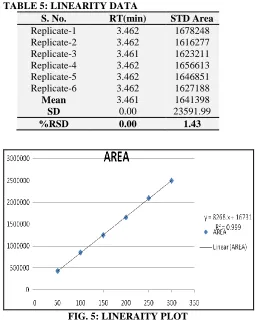
Linearity: The results are tabulated in Table 5 and represented graphically Fig. 5. The relevant correlation coefficient value is more than 0.99.
S. No. Replicate Standard Area Sample Sample Area
1 Replicate-1 2059527
Sample 1 2151964 2 Replicate-2 2068670
3 Replicate-3 2066117 4 Replicate-4 2066515
Sample 2 2151982 5 Replicate-5 2081561
6 Replicate-6 2089489
Average 2071979.8 2151973
SD 11212.80 12.73
%RSD 0.54 0.00
%Assay 102.8%
S. No. Sample % Assay
1 Precision 1 100.2
2 Precision 2 100.5
3 Precision 3 100.7
4 Precision 4 100.8
5 Precision 5 100.7
6 Precision 6 100.7
7 Robustness 1 101.6
8 Robustness 2 100
9 Robustness 3 100.4
10 Robustness 4 103.5
Average SD % RSD
100.91 1.004
TABLE 4: ACCURACY DATA Spike
Level
Sample area
Average area
Sample Wt. (mg)
Amount added (µg)
Amount recovered
(µg)
% Recovery Average %
recovery SD % RSD
50%
1004636
1006953 25 250
258.81 100.52
103.76 0.23 0.22
1009150 259.97 100.99
1007073 259.44 100.77
100%
2004082
1999895.8 25 500
513.06 102.61
102.76 0.34 0.33
1991575 515.54 103.11
2009917 516.28 103.26
150%
2932132
2942735 25 750
755.36 100.71
101.08 0.33 0.33
2944956 758.66 101.16
[image:5.612.45.300.222.548.2]2951118 760.25 101.37
[image:5.612.43.283.624.737.2]TABLE 5: LINEARITY DATA
FIG. 5: LINERAITY PLOT
Stability in analytical solution:
Cumulative %RSD is less than 2.0 at each time interval. The results are tabulated in Table 6.
TABLE 6: SOLUTION STABILITY DATA
The solution was found to be stable up to 48 hrs at room temperature. Hence it is concluded that the proposed analytical method meets the pre-established acceptance criteria.
Robustness:
The results obtained are tabulated in Table 7 and 8. Overall %RSD is than 2.0% for individual experiment. As method meets pre-established acceptance criterion, the method is considered to be robust for small changes in flow rate, concentration of buffer for mobile phase.
TABLE 7: CHANGE IN FLOW RATE DATA a) For increase in flow
b) For decrease in flow
S. No. RT(min) STD Area
Replicate-1 3.462 1678248 Replicate-2 3.462 1616277 Replicate-3 3.461 1623211 Replicate-4 3.462 1656613 Replicate-5 3.462 1646851 Replicate-6 3.462 1627188
Mean 3.461 1641398
SD 0.00 23591.99
%RSD 0.00 1.43
Replicate Standard Area Sample
Area
% Assay
Replicate-1 2092695
2205052
103.5
Replicate-2 2097550
Replicate-3 2110513
Replicate-4 2093387
2202254
Replicate-5 2122197
Replicate-6 2093387
Average 2108581.3 2203653
SD 7931.44 1978.48
%RSD 0.38 0.09
Hours RT Area % Assay
0 Hr 3.666 2124908 96.7
12 Hr 3.664 2166315 98.6
24 Hr 3.667 2193228 99.9
48 Hr 3.628 2196776 100.0
Average 3.656 2170306 98.8
SD 0.018 33180.79 1.53
%RSD 0.49 1.52 1.54
Replicate Standard area Sample
area
% Assay
Replicate-1 1745476
1771424
100.4
Replicate-2 1764112 Replicate-3 1756160 Replicate-4 1736315
1775200 Replicate-5 1743366
Replicate-6 17480170
Average 1748907.7 1773312
SD 9855.18 2670.03
TABLE 8: CHANGE IN BUFFER CONCENTRATION DATA
a) Increase in buffer concentration:
b) Decrease in buffer concentration
Limit of Detection and Limit of Quantification:
The LOD and LOQ of Zopiclone obtained by the proposed method were 9.416 and 28.534μg/mL respectively.
CONCLUSION: Developed assay method is
simple, rapid, accurate, precise, economical, specific and reproducible for the quantitative determination of Zopiclone with good resolution in short time and high sensitivity.
The flow rate programming of gradient mobile phase, cut down an overall time of sample analysis and thereby made the method more cost effective and rapid and produced a quicker method for zopiclone detection using basic buffer.
ACKNOWLEDGEMENTS: I express my humble
regards to Mrs. Richa Singhal (Head of HPLC Department) Jubilant Chemsys R&D Centre, Noida, whose expertise helped me to carry out my research successfully.
REFERENCES:
1. Daenens P Mannaert E, Tytgat J. Detection of 2-Amino-5-Chloropyridine in Urine as a Parameter of Zopiclone (Imovane |Intake using HPLC with Diode Array Detection. Journal of Analytical Toxicology 1997; 21: 208-12. 2. Blanchard JC, Julou L: Suriclone: a new cyclopyrrolone
derivative recognizing receptors labeled by benzodiazepines in rat hippocampus and cerebellum. J Neurochem 1983; 40 (3): 601–7.
3. Skerritt J, Johnston G: Enhancement of GABA binding by benzodiazepines and related anxiolytics. European Journal of Pharmacology 1983; 89 (3-4): 193–8.
4. De D P, Macdonald Rl: Effects of non-sedative anxiolytic drugs on responses to GABA and on diazepam-induced enhancement of these responses on mouse neurones in cell culture. British Journal of Pharmacology 1988; 95 (1): 109–20.
5. ICH, Q2 (R1) Validation of Analytical Procedures: Harmonized Tripartie Guideline Text and Methodology Current Step 4 Version.
6. ICH, Q2 (R1) Validation of analytical procedures: International Conference on Harmonization: June. 1994. 7. Indian Pharmacopoeia: Government of India, Ministry of
Health and Family Welfare; Vol. 3, Published by the Controller of Publications: Delhi, 1996, pp 25-27.
8. Mistri HN, Jangid AG, Pudage A and Shrivastav P: HPLC-ESI-MS/MS validated method for simultaneous quantification of zopiclone and its metabolites, N-desmethyl zopiclone and zopiclone-N-oxide in human plasma.J Chromatogr B Analyt Technol Biomed Life Sci 2008; 137-148
9. Kumar HK, Vijaya BD, Jagadeesh B, Ravindranath L K, Veera K N and Venkateswarulu V: A rapid LC-MS/MS method for quantitation of eszopiclone in human plasma: application to a human pharmacokinetic study.Biomedical Chromatography 2011; 26 (2): 225-31.
10. Rao B, Nagendrakumar MV, Sivanadh AVD and Bramhachari PV: Development of new Reverse phase -HPLC method for analysis and assay of Zopiclone in Formulation. Journal of Pharmacy Research 2011; 4(1): 248.
11. Souri E, Shirvin A, Shabani RN, Alvandifar F and Tehrani MB: Validated Stability Indicating HPLC Method for Determination of Zolpidem in the Presence of Its Degradation Products.The Open Conference Proceedings Journal2012; 3:13-17.
12. Lanka ARP, Rao JVLNS, Pamidi S, Vara PJ, Hotha KK: UPLC Method for the Determination of Eszopiclone and Its Related Impurities. International Journal of Analytical and Bioanalytical Chemistry 2012; 2(4): 241-246.
13. KonozE,Sarrafi AHM, Abdolahnejad R and Zonoz MB: Development and Validation of a Reversed-Phase HPLC Method for the Estimation of Zolpidem in Bulk Drug and Tablets. Journal of Chemistry 2013; 2013:1-6.
14. Eliassen E, Kristoffersen L: Quantitative determination of zopiclone and zolpidem in whole blood by liquid–liquid
extraction and UHPLC-MS/MS. Journal of
chromatography B 2014; 971: 72-80.
All © 2013 are reserved by International Journal of Pharmaceutical Sciences and Research. This Journal licensed under a Creative Commons Attribution-NonCommercial-ShareAlike 3.0 Unported License. This article can be downloaded to ANDROID OS based mobile. Scan QR Code using Code/Bar Scanner from your mobile. (Scanners are available on Google Playstore)
Replicate Standard area Sample area % Assay
Replicate-1 1860346
1909252
101.6
Replicate-2 1854263 Replicate-3 1861863 Replicate-4 1854924
1902761 Replicate-5 1854534
Replicate-6 1852915
Average 185674.2 1906006.5
SD 3681.16 4589.83
%RSD 0.20 0.24
Replicate Standard area Sample area % Assay
Replicate-1 1916050
1924832
100
Replicate-2 1960701 Replicate-3 1888299 Replicate-4 1909604
1913332 Replicate-5 1896047
Replicate-6 1884475
Average 1900196 1919082
SD 12554.50 8131.73
%RSD 0.66 0.42
How to cite this article: