BIROn - Birkbeck Institutional Research Online
Bell, T.A. and Viti, S. and Williams, D.A. and Crawford, Ian and Price, R.J.
(2005) The chemistry of transient microstructures in the diffuse interstellar
medium. Monthly Notices of the Royal Astronomical Society 357 (3), pp.
961-966. ISSN 0035-8711.
Downloaded from:
Usage Guidelines:
Please refer to usage guidelines at
or alternatively
The chemistry of transient microstructure in the diffuse
interstellar medium
T. A. Bell,
1S. Viti,
1D. A. Williams,
1I. A. Crawford
2and R. J. Price
11Department of Physics & Astronomy, University College London, Gower Street, London WC1E 6BT 2School of Earth Sciences, Birkbeck College, Malet Street, London WC1E 7HX
Accepted 2004 December 1. Received 2004 October 5; in original form 2004 April 16
A B S T R A C T
Transient microstructure in the diffuse interstellar medium (ISM) has been observed towards Galactic and extragalactic sources for decades, usually in lines of atoms and ions, and, more recently, in molecular lines. Evidently, there is a molecular component to the transient mi-crostructure. In this paper, we explore the chemistry that may arise in such mimi-crostructure. We use a photodissociation region (PDR) code to model the conditions of relatively high density, low temperature, very low visual extinction and very short elapsed time that are appropriate for these objects. We find that there is a well-defined region of parameter space where detectable abundances of molecular species might be found. The best matching models are those where the interstellar microstructure is young (<100 yr), small (∼100 au) and dense (>104cm−3).
Key words: ISM: molecules – ISM: structure.
1 I N T R O D U C T I O N
Observational evidence for microstructure on a Solar system scale in the diffuse interstellar medium (ISM) has been accumulating for the last three decades. Measurements include very long baseline interferometry (VLBI) of H atom 21 cm absorption towards extra-galactic sources (Dieter, Welch & Romney 1976; Diamond et al. 1989; Davis, Diamond & Goss 1996), absorption of atomic lines towards transversely moving pulsars (Frail et al. 1994), absorp-tion differences towards stellar binaries (Meyer & Blades 1996; Lauroesch, Meyer & Blades 2000) and towards multiple systems and clusters (Kemp, Bates & Lyons 1993; Langer, Prosser & Sne-den 1990; Lauroesch & Meyer 1999), and secular variations over intervals of a few years along the line of sight to single stars (Hobbs et al. 1991; Danks & Sembach 1995; Blades et al. 1997; Cha & Sembach 2000; Crawford et al. 2000; Price, Crawford & Barlow 2000; Danks et al. 2001; Welty & Fitzpatrick 2001). Marscher, Moore & Bania (1993) find secular changes in formaldehyde ab-sorption towards extragalactic sources, the first report of molecular tracers of microstructure. Moore & Marscher (1995) infer structure on scales of order 10 au, with number densities possibly larger than 106 cm−3, from further formaldehyde observations towards
extra-galactic sources. They also find spatial variations in formaldehyde and hydroxyl absorption line profiles towards the extended radio galaxy 3C 111. Lucas & Liszt (1993) and Liszt & Lucas (2000) have used similar observations to explore the range of chemistry in diffuse and translucent clouds. It is also well known (Falgarone,
E-mail: [email protected]
Puget & Perault 1992) that structure at larger scales (∼0.01 pc) exists in nearby clouds.
Crawford (2002) has recently detected absorption in lines of CH at the specific velocity (different to that of the surrounding medium) of a previously reported variable component in the line of sight toκVel. Using a simple chemical model, Crawford obtained a value for the number density of the CH-containing microstructure towardsκVel that was consistent with the density inferred from measurements of the CaI/CaIIratio at the same velocity component:nH∼103cm−3.
The measured CH column density would require the path-length to be more than 1 order of magnitude larger than the assumed transverse size, supporting the view that the structure may be extended in the line of sight, either as a filament or a sheet.
The most detailed study of molecular microstructure to date has been made by Rollinde et al. (2003). These authors made spec-troscopic observations of the runaway reddened star HD 34078 (whose velocity transverse to the line of sight is∼100 km s−1)
over a 3-yr period, supplemented by data from earlier epochs, to probe the foreground cloud distributions of CH, CH+, CN and DIB carriers on scales from 1–150 au. Their results show that the CH column density increased by 20 per cent in 10 yr while the CH+ col-umn density and two DIB strengths were unchanged. The CN column density shows a modest rise in this period.
Although some authors have argued that some of the radio ev-idence for microstructure is flawed by poor data handling (e.g. Stanimirovic et al. 2003), the evidence in favour of the existence of microstructure now seems overwhelming. The general conclusion is that microstructure has a scale of 10–100 au and has typical densi-ties much larger than the ambient interstellar density. The transverse visual extinction is therefore very small and the gas in the structure can only be poorly shielded from the interstellar radiation field.
962
T. A. Bell et al.
The origin of the microstructure has been the subject of intense study (Pety & Falgarone 2000; Gwinn 2001). Some authors argue that it cannot originate through non-magnetic hydrodynamics and it has been suggested that it may be excited in regions of high mag-netic pressure by slow-mode magnetosonic waves (Hartquist, Falle & Williams 2003). However it is formed, it is overpressured and must be transient. Rollinde et al. (2003) inferred from their ob-servations that the variations were not the result of dense clumps passing through the line of sight. We are inclined to agree with their conclusion on dynamical grounds and emphasize that the transience of the microstructure implied by the high overpressure must affect the chemistry. It is unclear whether these structures are extended, i.e. filamentary or sheet-like, or whether they are compact objects. Extended objects could have longer path-lengths along the line of sight, if the orientation is suitable, and therefore the constraints on density could be relaxed as compared with compact objects. The geometry may be related to the origin of these objects.
The purpose of this paper is to explore the chemistry that may arise in the conditions apparently appropriate for the transient mi-crostructure: rapid transition from relatively low to relatively high density, low temperature, very low transverse visual extinction, and subject to the normal interstellar radiation and particle fields. In Section 2, we describe the model in more detail, and present in Section 3 our predictions of detectable chemistry as functions of time and depth into the slab. In Section 4, we describe the region of parameter space in which detectable molecular column densities might be found and discuss the relevance of possible detections to the geometry of the structure.
2 T H E M O D E L
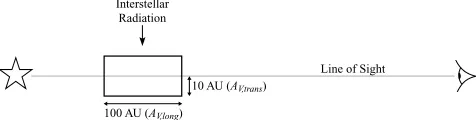
We model the region crudely as a semi-infinite slab illuminated from one side; the density rises as a step function at the edge of the slab. We compute the chemistry as a function of time and transverse depth position within the slab, restricting our attention to the edge region (see Fig. 1). What is unusual about this calculation compared with other studies of diffuse clouds is that the region of interest into the slab transversely to the line of sight is restricted to∼10 au and to a very short evolutionary age, typically less than 103yr.
These tiny spatial and time domains are usually ignored in studies of diffuse clouds (but note the models proposed by Cecchi-Pestellini & Dalgarno 2000 to account for H+3 and other species in the line of sight towards Cygnus OB2). We have therefore had to develop a chemical code in which particular attention is given to early time and edge effects. This code is a development of the photodissociation region (PDR) code written by Viti and Thi (Papadopoulos, Thi & Viti 2002).
Line of Sight Interstellar
Radiation
10 AU (AV,trans)
[image:3.612.54.292.593.653.2]100 AU (AV,long)
Figure 1. Model geometry of microstructure at the velocity of the variable component in the line of sight toκVel (different from that of the surrounding medium) with a depth transverse to the line of sight of 10 au and an elongated length along the line of sight of 100 au. The interstellar radiation field striking the microstructure transversely to the line of sight drives the chemistry in the microstructure, its intensity falling off withAV,trans. The contribution to
column densities from species within the microstructure is calculated along the line of sight through the structure, over a visual extinctionAV,long.
We investigate the chemistry in transient microstructure using a PDR code that self-consistently determines the chemistry and thermal balance on a one-dimensional adaptive spatial grid (Pa-padopoulos et al. 2002; to be described in detail in a subsequent paper). While the physical structure of the slab is assumed fixed, the chemistry within it will be strongly time- and space-dependent. We have chosen gas phase elemental abundances, relative tonH, as
follows:
He/H =0.075, C/H =1.79×10⁻⁴,
N/H =8.52×10⁻⁵,
O/H =4.45×10⁻⁴,
Na/H =8.84×10⁻⁷,
Mg/H =5.12×10⁻⁶,
Si/H=8.21×10−7,
S/H =1.43×10⁻⁶,
Cl/H=1.1×10−7,
Ca/H=5.72×10−10,
Fe/H=6.19×10−6.
The fraction of hydrogen initially contained in H2is unknown; the
chemistry will depend strongly on this factor. We note that the struc-tures are dense and, if set up as proposed by Hartquist et al. (2003), would be found in post-shock regions. Hence, it is plausible to as-sume a significant fraction of H2in the slab. We have arbitrarily set
n(H2)/nH=0.4 and we note that the chemical abundances predicted
by the model should be proportional to this parameter. Because we are considering theadditional contributionto molecular species pro-duced by chemistry in the microstructure, all other molecular abun-dances are set to zero initially. A total of 128 species are included in the model, connected through a network of over 1500 reactions, including ionization and recombination of atoms. Freeze-out and mantle evaporation processes have been neglected as a result of the short time-scales over which these structures evolve and their low visual extinction.
The filamentary or sheet-like nature of such objects is accounted for by assuming that the line of sight is within the slab and at a transverse depth of 10 au from its surface (see Fig. 1). Column densities are then simply proportional to the length of the line of sight within the slab.
Because the physical conditions within these regions are uncer-tain, a large range of parameter space is examined to provide a thorough investigation of microstructure chemistry. The effect of varying the slab density and age, as well as the environmental pa-rameters of incident radiation field strength and cosmic ray ioniza-tion rate (ζ) are all considered, producing a four-dimensional grid of test parameters.
Observational estimates of microstructure density generally vary between 103n
H105cm−3, with some indications of even higher
densities. We have explored the model chemistry for this density range and have made some additional calculations for the higher densities suggested by the formaldehyde observations of Moore & Marscher (1995). Slab ages of 1–1000 yr are considered. Radiation strengths and cosmic ray ionization rates of1
3, 1 and 3 times the
stan-dard interstellar values (1 Habing and 1.3×10⁻¹⁷s−1, respectively)
are also considered.
3 M O D E L R E S U LT S
The purpose of our study is to investigate whether there exists a parameter space of densities, radiation fields, cosmic ray ionization rates and dimensions where molecules can be formed in the variable
C
2004 RAS, MNRAS357,961–966
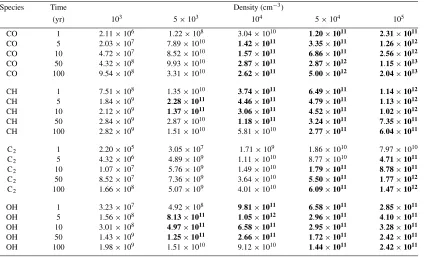
Table 1. Column densities (cm−2) for molecular species along the line of sight within a microstructure of transverse depth 10 au and elongation factor 10 along the line of sight. The region is subject to standard interstellar radiation and particle fields of 1 Habing (1.6×10⁻³erg cm−2s−1) andζ=1.3×10⁻¹⁷s−1. Values in bold indicate potentially detectable abundances (with column densities
>1011cm−2).
Species Time Density (cm−3)
(yr) 103 5×10³ 104 5×10⁴ 105
CO 1 2.11×10⁶ 1.22×10⁸ 3.04×10¹⁰ 1.20×10¹¹ 2.31×10¹¹
CO 5 2.03×10⁷ 7.89×10¹⁰ 1.42×10¹¹ 3.35×10¹¹ 1.26×10¹²
CO 10 4.72×10⁷ 8.52×10¹⁰ 1.57×10¹¹ 6.86×10¹¹ 2.56×10¹²
CO 50 4.32×10⁸ 9.93×10¹⁰ 2.87×10¹¹ 2.87×10¹² 1.15×10¹³
CO 100 9.54×10⁸ 3.31×10¹⁰ 2.62×10¹¹ 5.00×10¹² 2.04×10¹³
CH 1 7.51×10⁸ 1.35×10¹⁰ 3.74×10¹¹ 6.49×10¹¹ 1.14×10¹²
CH 5 1.84×10⁹ 2.28×10¹¹ 4.46×10¹¹ 4.79×10¹¹ 1.13×10¹²
CH 10 2.12×10⁹ 1.37×10¹¹ 3.06×10¹¹ 4.52×10¹¹ 1.02×10¹²
CH 50 2.84×10⁹ 2.87×10¹⁰ 1.18×10¹¹ 3.24×10¹¹ 7.35×10¹¹
CH 100 2.82×10⁹ 1.51×10¹⁰ 5.81×10¹⁰ 2.77×10¹¹ 6.04×10¹¹
C2 1 2.20×10⁵ 3.05×10⁷ 1.71×10⁹ 1.86×10¹⁰ 7.97×10¹⁰
C2 5 4.32×10⁶ 4.89×10⁹ 1.11×10¹⁰ 8.77×10¹⁰ 4.71×10¹¹
C2 10 1.07×10⁷ 5.76×10⁹ 1.49×10¹⁰ 1.79×10¹¹ 8.78×10¹¹
C2 50 8.52×10⁷ 7.36×10⁹ 3.64×10¹⁰ 5.50×10¹¹ 1.77×10¹²
C2 100 1.66×10⁸ 5.07×10⁹ 4.01×10¹⁰ 6.09×10¹¹ 1.47×10¹²
OH 1 3.23×10⁷ 4.92×10⁸ 9.81×10¹¹ 6.58×10¹¹ 2.85×10¹¹
OH 5 1.56×10⁸ 8.13×10¹¹ 1.05×10¹² 2.96×10¹¹ 4.10×10¹¹
OH 10 3.01×10⁸ 4.97×10¹¹ 6.58×10¹¹ 2.95×10¹¹ 3.28×10¹¹
OH 50 1.43×10⁹ 1.25×10¹¹ 2.66×10¹¹ 1.72×10¹¹ 2.42×10¹¹
OH 100 1.98×10⁹ 1.51×10¹⁰ 9.12×10¹⁰ 1.44×10¹¹ 2.42×10¹¹
Table 2. Column densities (cm−2) for neutral and singly ionized calcium along the line of sight within a microstructure of transverse depth 10 au and elongation factor 10 along the line of sight. The region is subject to standard interstellar radiation and particle fields.
Species Time Density (cm−3)
(yr) 103 5×10³ 104 5×10⁴ 105
CaI 1 5.62×10⁴ 1.90×10⁶ 7.49×10⁶ 1.80×10⁸ 6.41×10⁸
CaI 5 2.75×10⁵ 9.28×10⁶ 3.63×10⁷ 8.20×10⁸ 2.73×10⁹
CaI 10 5.39×10⁵ 1.81×10⁷ 6.98×10⁷ 1.46×10⁹ 4.43×10⁹
CaI 50 2.36×10⁶ 7.38×10⁷ 2.64×10⁸ 3.19×10⁹ 6.26×10⁹
CaI 100 4.00×10⁶ 1.17×10⁸ 3.82×10⁸ 3.12×10⁹ 5.13×10⁹
CaII 1 1.10×10⁹ 4.30×10⁹ 1.02×10¹⁰ 5.50×10¹⁰ 1.13×10¹¹
CaII 5 1.10×10⁹ 4.30×10⁹ 1.02×10¹⁰ 5.44×10¹⁰ 1.11×10¹¹
CaII 10 1.17×10⁹ 4.82×10⁹ 9.39×10⁹ 5.38×10¹⁰ 1.01×10¹¹
CaII 50 1.16×10⁹ 4.76×10⁹ 9.20×10⁹ 5.19×10¹⁰ 9.95×10¹⁰
CaII 100 1.16×10⁹ 4.72×10⁹ 9.08×10⁹ 5.17×10¹⁰ 1.01×10¹¹
components and also to determine the time-dependent nature of such structures. In the next two subsections, we make predictions, based on our models, of the physical conditions and time-dependence of the microstructure, respectively.
In all the results reported here, we have assumed an elongation factor of 10; i.e. the path-length along the line of sight through the microstructure is 10×the transverse depth, 10 au.
3.1 Physical characteristics of the microstructure
The results of our chemical model suggest that only a few molec-ular species are formed in large enough quantities in the proposed scenario to be potentially detectable. They include CH, CH2, CO,
C2and OH. In our model, these species are only produced in great
enough quantities to be detectable under certain physical conditions (see Tables 1 and 2, and Figs 2 and 3). In Table 1, we list the column densities of CO, CH, C2and OH as a function of density and time
at a transverse depth of 10 au into the microstructure slab, corre-sponding to a transverse visual extinction of approximately 10−4
to 10−2 mag for number densities in the range 103 to 105 cm−3,
making the assumption that the elongation factor along the line of sight (described above) is 10. Column densities larger than 1011cm−2 are shown in bold in Table 1, indicating a reasonable
lower limit for molecular species that are potentially detectable. As-suming that the microstructure has a transverse spatial dimension of 10 au, a minimum density of 104cm−3is necessary for most species
to be detectable. Table 2 lists the column densities for CaIand CaII. Because atoms have stronger oscillator strengths than molecules,
[image:4.612.104.516.420.559.2]
964
T. A. Bell et al.
20 40 60 80 100
Time (yr) 3.5 4.0 4.5 5.0 log nH (cm -3) 11.0 11.211.4 11.6 11.8 12.0 12.2 12.4 12.6 12.8 13.0
20 40 60 80 100
Time (yr) 3.5 4.0 4.5 5.0 log nH (cm -3) 11.0 11.211.4 11.6 11.8 12.0 12.2 12.4 12.6 12.8 13.0
20 40 60 80 100
[image:5.612.329.543.62.527.2]Time (yr) 3.5 4.0 4.5 5.0 log nH (cm -3) 11.0 11.2 11.4 11.6 11.8 12.0 12.2 12.4 12.6 12.8 13.0
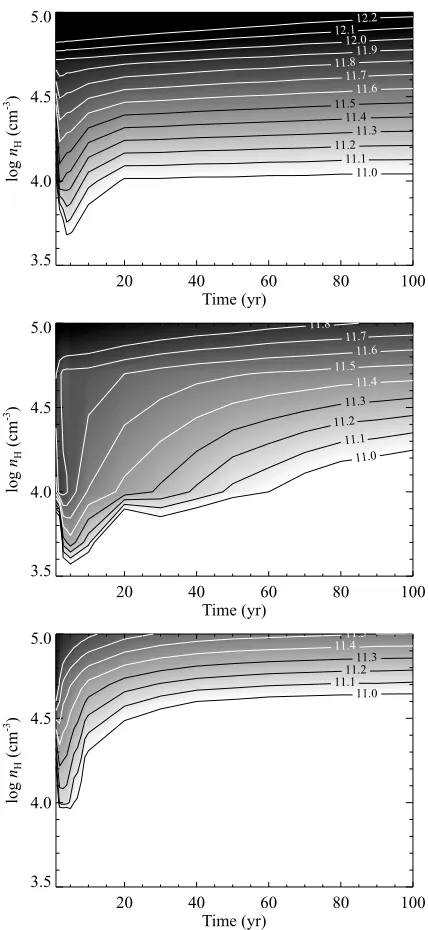
Figure 2. Contours of log CO column density as a function of density and time for a microstructure of transverse depth 10 au, elongated by a factor of 10 along the line of sight, and a cosmic ray ionization rate ofζ=1.3× 10⁻¹⁷s−1. From top to bottom, the three figures are for incident radiation field strengths of 1
3, 1 and 3 Habing, respectively.
these species are detectable at lower column densities than the limit of 1011cm−2imposed in Table 1. Figs 2 and 3 show how the column
densities of CO and CH behave as a function of density, time and ra-diation field. We find that CO is particularly sensitive to variations in the number density and its column density can vary by over 2 orders of magnitude in the number density range considered here. Its sen-sitivity to the radiation field is more subtle: at early times (<20 yr) and low densities (<104cm−3), a weak radiation field (<1 Habing)
yields a longer time-scale (∼100 yr) for the production of detectable CO. CH, on the other hand, shows a strong sensitivity to the radia-tion field employed. In fact, if the field is stronger than 1 Habing, CH can only remain detectable at high densities (>5×104cm−3).
20 40 60 80 100
Time (yr) 3.5 4.0 4.5 5.0 log nH (cm -3) 11.0 11.1 11.2 11.3 11.4 11.5 11.6 11.7 11.8 11.9 12.0 12.1 12.2
20 40 60 80 100
Time (yr) 3.5 4.0 4.5 5.0 log nH (cm -3) 11.0 11.1 11.2 11.3 11.4 11.5 11.6 11.7 11.8
20 40 60 80 100
[image:5.612.66.281.65.526.2]Time (yr) 3.5 4.0 4.5 5.0 log nH (cm -3) 11.0 11.1 11.2 11.3 11.4 11.5
Figure 3. Contours of log CH column density as a function of density and time for a microstructure of transverse depth 10 au, elongated by a factor of 10 along the line of sight, and a cosmic ray ionization rate ofζ=1.3× 10⁻¹⁷s−1. From top to bottom, the three figures are for incident radiation
field strengths of13, 1 and 3 Habing, respectively.
In general, CH is formed and then destroyed very quickly. These trends restrict the parameter space for which both CO and CH can be present in the microstructureat the same time. None of the species seem to have a strong dependence on the rate of cosmic ray ioniza-tion employed.
The most remarkable result is that, even at the earliest times shown, if the number density is sufficiently high then potentially detectable column densities of the species listed above are attained. Thus, the high density drives a chemistry fast enough to overcome the losses as a result of the strong radiation field. Because the trans-verse visual extinctions considered are close to zero, the region is essentially unshielded. Note, for example, that the total extinction
C
2004 RAS, MNRAS357,961–966
along the line of sight towardsκVel observed by Crawford (2002) is small [E(B−V)=0.11] and that the transverse extinction at the variable component must be significantly less than this. By assum-ing that the transverse extinction is close to zero, we are therefore estimating the lower limit of the additional contribution to column densities from species generated in the microstructure.
The adopted column density of H2is, however, sufficiently large
to ensure that the H2 photodissociation rate is too slow to cause
significant loss of H2on the time-scales considered here.
The fact that high densities are necessary in order to produce suf-ficiently large molecular abundances in the microstructure is con-sistent with the conclusions of Moore & Marscher (1995) who find that, if the molecular variability is indeed a result of density struc-ture, the number densities need to be at least 106 cm−3. In fact,
Marscher et al. (1993) and Moore & Marscher (1995) detect both H2CO and OH in their time variability study. In our study, OH is
present as long as the density is>5×103cm−3and does indeed
show time variability (see Table 1). H2CO, however, never reaches
a high enough abundance to be detectable for the number densities considered here. In order to see whether densities as high as the ones considered by Moore & Marscher (1995) could produce significant amounts of H2CO, we ran two more models at 106and 107cm−3
un-der standard interstellar conditions. We find that at 106cm−3, H 2CO
is only just barely close to the lower limit of detectability for times
500 yr, while at 107cm−3, H
2CO becomes detectable after only
50 yr. These models further support the Moore & Marscher (1995) findings.
3.2 Time-dependence of the chemistry
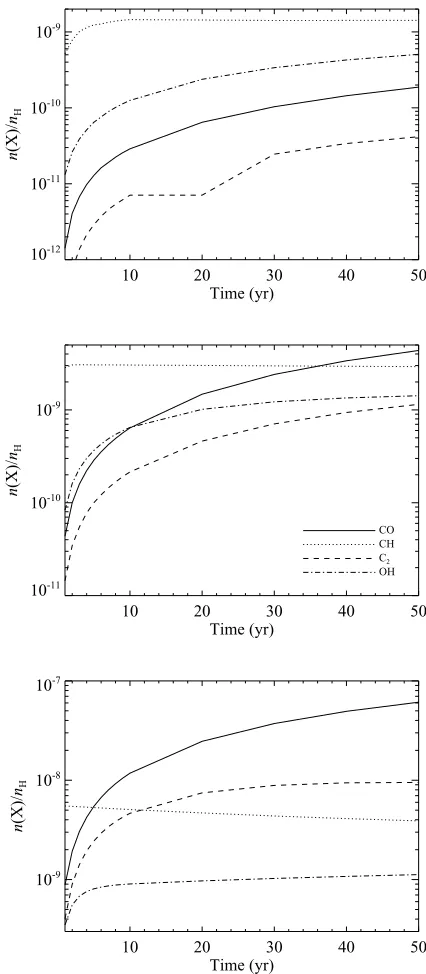
Tables 1 and 2, and Fig. 4 show how the different species behave as a function of time. We now briefly discuss the time variability of each species for number densities104cm−3. CO takes∼5–10 yr
to form in significant amounts and its abundance increases steadily with time. For CO to be abundant, therefore, the microstructure would need to exist for at least 10 yr. CH, on the other hand, forms in less than 1 yr, but is subsequently destroyed (in part to form CO) within the first 100 yr. C2 takes over 10 yr to form in detectable
quantities, then survives in the gas for at least 300 yr, although its abundance starts to decline. OH behaves in a similar manner to CH in that it forms within 1 yr but starts being converted into other species almost immediately and by 500 yr its abundance is too low to be detectable. CaIIis present, confirming the detection of Crawford (2002) at the velocity of the microstructure. However, it cannot be used as a diagnostic test of the microstructure age because its abundance is invariant. CaI, on the other hand, shows
consider-able time variability, though whether the variations are large enough to be detectable is less certain. Of course, these variations are not reflected in the column densities of CaII, because its abundance is several orders of magnitude higher. The CO column density un-der appropriate parameter choices generally exceeds those of other molecular species. Thus, for a number density of 104 cm−3, by
100 yr the CO column density has built up to 2.6×1011cm−2,
while those for CH and C2 are 5.8×10¹⁰and 4.0×1010cm−2,
respectively. Although the amounts by which CH, OH, C2, etc.
de-cline with time are very small and may therefore seem insignificant, they are indeed real and consistent with the gas phase chemistry that is taking place. The behaviour described above is expected for the usual gas phase chemical networks: CO and C2column
densi-ties increase monotonically over the time span considered here. A feed molecule for the networks producing CO and C2is CH, and its
column density declines slightly over this period, showing that CH
10 20 30 40 50
Time (yr) 10-12
10-11
10-10
10-9
n
(X)/
nH
10 20 30 40 50
Time (yr) 10-11
10-10
10-9
n
(X)/
nH
CO CH C2
OH
10 20 30 40 50
Time (yr) 10-9
10-8
10-7
n
(X)/
[image:6.612.331.544.61.548.2]nH
Figure 4. Fractional abundances of CO (solid line), CH (dotted), C2
(dashed) and OH (dash-dot) at a transverse visual extinction ofAV,trans=
10−4 mag into the microstructure, subject to an incident radiation field strength of 1 Habing and a cosmic ray ionization rate ofζ=1.3×10⁻¹⁷ s−1. From top to bottom, the three figures are for microstructure densities of
103, 104and 105cm−3, respectively.
is being converted into other species; no significant loss of CH by photodissociation occurs in the time interval explored here.
In summary, for CO and C2to form, the microstructure needs to
survive at least 10 yr. On the other hand, it cannot be much older than∼50 yr if CH is indeed observed.
Unfortunately, detection of CO by absorption in its resonance line requires a UV spectrometer in an orbital observatory; none is currently available. However, CH and C2 are detectable from
the ground. It appears from this work that these molecules should
966
T. A. Bell et al.
have comparable abundances in transient microstructure of number density∼104cm−3.
4 C O M PA R I S O N S W I T H O B S E RVAT I O N S A N D C O N C L U S I O N S
This study was prompted in part by the molecular detection ob-tained by Crawford (2002) at the velocity (different to that of the surrounding medium) of previously reported microstructure in the line of sight towards κ Vel. Hence we now briefly compare our models with such observations. In Table 2 of Crawford (2002), the observed column densities of CaI, CaII(two velocity components)
and CH are listed, respectively, as 3.2×10⁹, 2.0×10¹¹and 6.2
×1010, 2.7×1011cm−2. If we assume an elongation factor of 10
along the line of sight and a gas density of the order of∼105cm−3,
the observed CH column density can be easily reached at very early times (∼10 yr) and maintained. If instead the density of the mi-crostructure is closer to 104cm−3then we infer a maximum age for
the microstructure of about 50 yr, after which most CH would be destroyed. Hence, observations of CH indicate that such filamentary or sheet-like structures are likely to be younger than 50 yr. The ob-served CaIand CaIIcolumn densities can be produced in the model if the microstructure has a number density of∼5×104cm−3and
is older than 10 yr (see Table 2).
In order to further test the predicted molecular abundances, we conducted a high-resolution search for interstellar C2 at the
ve-locity of the variable component towards κ Vel using the Ultra-High-Resolution Facility (UHRF; Diego et al. 1995) at the Anglo-Australian Telescope in 2003 February. 16 individual exposures were made of the region containing the Q(4) line at 8763.751 Å, with a total integration time of 4.9 h. Data reduction and calibration was as described by Crawford (1997, 2002). The final continuum signal-to-noise ratio was 480, but the Q(4) line was not detected. The resulting 3σupper limit to the equivalent width of the Q(4) line was 0.09 mÅ, yielding an upper limit to theJ=4 column density of
N(J=4)1.95×1011cm−2(using the oscillator strength adopted
by Crawford 1997). At the high densities (nH=103to 105cm−3)
expected for these variable components, the rotational populations will be approximately thermal and forT ∼100 K we expect the total C2column density to be N(C2)∼4×N(J = 4) (e.g. van
Dishoeck 1984). Thus, our observations implyN(C2)1012cm−2
in the variable interstellar component towardsκVel. This is con-sistent with the model results given in Table 1 forNH105cm−3.
More sensitive searches for C2 would appear to be worthwhile, as
these would be able to constrain the model results at lower densities. The best matching models for observations at the velocity of the variable component in the κ Vel line of sight seem therefore to be those for a young (∼50 yr), transient (<100 yr), high density (>104cm−3), small (∼10 au), slightly elongated (by about a factor
of 10 along the line of sight) structure, immersed in an ambient radiation field.
The main result of this paper is that essentially unshielded inter-stellar gas can develop detectable column densities of molecules on very short time-scales (<100 yr) for path-lengths of the order of 100 au along the line of sight, if the density is∼104 cm−3 or higher.
This time and density domain is a region of parameter space not previously explored. The calculations presented here are pseudo-time-dependent, in that the slab structure is fixed.
If the cause of such microstructure is indeed magnetohydrody-namic, then the filamentary objects likely to be responsible for the effects observed towardsκVel and elsewhere are probably waves moving at magnetosonic sound speed. More complex and realistic models are now being explored (Garrod et al. 2005).
AC K N OW L E D G M E N T S
TAB is supported by a Particle Physics and Astronomy Research Council (PPARC) studentship. SV acknowledges individual finan-cial support from a PPARC Advanced Fellowship. DAW thanks the Leverhulme Fund for the Leverhulme Emeritus Award. The authors are very grateful to Dr T. Nguyen for initial studies of these prob-lems. We thank the referee for constructive comments that helped to improve an earlier draft of this paper.
R E F E R E N C E S
Blades J. C., Sahu M. S., He L., Crawford I. A., Barlow M. J., Diego F., 1997, ApJ, 478, 648
Cecchi-Pestellini C., Dalgarno A., 2000, MNRAS, 313, L6 Cha A., Sembach K. R., 2000, ApJS, 126, 399
Crawford I. A., 1997, MNRAS, 290, 41 Crawford I. A., 2002, MNRAS, 334, L33
Crawford I. A., Howarth I. D., Ryder S. D., Stathakis R. A., 2000, MNRAS, 319, L1
Danks A. C., Sembach K. R., 1995, AJ, 109, 2627
Danks A. C., Walborn N. R., Vieira G., Landsman W. B., Gales J., Garcia B., 2001, ApJ, 547, L155
Davis R. J., Diamond P. J., Goss W. M., 1996, MNRAS, 283, 1105 Diamond P. J., Goss W. M., Romney J. D., Booth R. S., Kalberla P. M. W.,
Mebold U., 1989, ApJ, 347, 302 Diego F. et al., 1995, MNRAS, 272, 323
Dieter N. H., Welch W. J., Romney J. D., 1976, ApJ, 206, L113 van Dishoeck E. F., 1984, PhD thesis, Univ. Leiden
Falgarone E., Puget J.-L., Perault M., 1992, A&A, 257, 715
Frail D. A., Weisberg J. M., Cordes J. M., Mathers C., 1994, ApJ, 436, 144 Garrod R. T., Williams D. A., Hartquist T. W., Rawlings J. M. C., Viti S.,
2005, MNRAS, 356, 654 Gwinn C. R., 2001, ApJ, 561, 815
Hartquist T. W., Falle S. A. E. G., Williams D. A., 2003, Ap&SS, 288, 369 Hobbs L. M., Ferlet R., Welty D. E., Wallerstein G., 1991, ApJ, 378, 586 Kemp S. N., Bates B., Lyons M. A., 1993, A&A, 278, 542
Langer G. E., Prosser C. F., Sneden C., 1990, AJ, 100, 216 Lauroesch J. T., Meyer D. M., 1999, ApJ, 519, L181
Lauroesch J. T., Meyer D. M., Blades J. C., 2000, ApJ, 543, L43 Liszt H. S., Lucas R., 2000, A&A, 355, 333
Lucas R., Liszt H. S., 1993, A&A, 276, L33
Marscher A. P., Moore E. M., Bania T. M., 1993, ApJ, 419, L101 Meyer D. M., Blades J. C., 1996, ApJ, 464, L179
Moore E. M., Marscher A. P., 1995, ApJ, 452, 671 Papadopoulos P. P., Thi W.-F., Viti S., 2002, ApJ, 579, 270 Pety J., Falgarone E., 2000, A&A, 356, 279
Price R. J., Crawford I. A., Barlow M. J., 2000, MNRAS, 312, L43 Rollinde E., Boiss´e P., Federman S. R., Pan K., 2003, A&A, 401, 215 Stanimirovic S., Weisberg J. M., Hedden A., Devine K. E., Green J. T., 2003,
ApJ, 598, L23
Welty D. E., Fitzpatrick E. L., 2001, ApJ, 551, L175
This paper has been typeset from a TEX/LATEX file prepared by the author.
C
2004 RAS, MNRAS357,961–966