1370
MINIMIZING THE CHANNEL SWITCHING EVENTS FOR
QOS-BASED ROUTING IN COGNITIVE RADIO AD-HOC
NETWORK
1TAUQEER SAFDAR, 2HALABI HASBULLAH, 3 TANZILA SABA* and 4AMJAD REHMAN
1
PhD-IT Student Department of Computer & Information Sciences, Universiti Teknologi PETRONAS Bandar Seri Iskandar, 31750 Tronoh, Perak Darul Ridzuan, Malaysia.
2
Assoc. Prof., Department of Computer & Information Sciences, Universiti Teknologi PETRONAS Bandar Seri Iskandar, 31750 Tronoh, Perak Darul Ridzuan, Malaysia.
3
College of Computer and Information Sciences Prince Sultan University Riyadh, 11586 Saudi Arabia
4
College of Computer and Information Systems Al-Yamamah University Riyadh, 11512 Saudi Arabia
*Contact author [email protected]
ABSTRACT
Wireless network connectivity systems have very short capacity to adhere the changes due to spectrum mobility and user interference to maintain the Quality of Service (QoS) parameters during end-to-end routing in Cognitive Radio Ad-Hoc Network (CRAHN). The reconfiguration of the network layer parameters in secondary users is challenging and demanding in case of sudden arrival of primary user on its licensed channel and spectrum mobility. Whenever, secondary user senses the primary user activity called as user interference, secondary user has to switch to any other available channel to continue its transmission. This channel switching increases due to the user interference and spectrum mobility which degrades the average data rate. Hence, it will effect directly on the QoS-based end-to-end routing in CRAHN. The addition of reinforcement learning techniques in network management can reduce the channel switching events and user interference by improving the QoS-based routing. This paper presents an algorithm for channel selection in cross-layer approach to minimize the number of channel switching events for QoS-based routing in CRAHN. The methodology is based on the previous network state observation of the primary user for its channel selection and secondary user will explore it for future routing decisions. It can be implemented using a learning agent in a cross-layer approach and modifying some existing routing parameters of Ad-Hoc On-Demand Distance Vector (AODV) routing protocol. This methodology is also very useful as the existing routing protocol can be modified for Cognitive Radio Ad-Hoc Network (CRAHN). We provide a self-contained learning method based on reinforcement-learning techniques which can be used for developing QoS-based routing protocols for CRAHN. We simulated the proposed algorithm using Cognitive Radio Cognitive Network (CRCN) simulator based on NS-2. The results are evaluated and compared with another routing protocol for CRAHN on the basis of some QoS parameters for the proposed algorithm. The results are evaluated and compared with the existing AODV routing protocol on the basis of some QoS parameters for the proposed algorithm. The proposed methodology can provide the basic use of Artificial Intelligence in routing protocols for CRAHN.
Keywords: Channel Switching; User Interference; Reinforcement Learning; Routing Protocols; QoS.
1. INTRODUCTION
A Cognitive Radio (CR) is an extension of software defined radios by adding the self-configuring ability in wireless networking [1]. This ability makes it to sense its radio environment and share the spectrum/ channel availability on MAC layer. The addition of network layer for the connectivity of end-to-end makes distinction between CR and Cognitive Radio Network (CRN).
1371 Radio Ad-Hoc Network (CRAHN) [2]. CRAHN facing many issues and condition become even worst in case of spectrum mobility and user interference i.e. reallocation of under-utilized channels while sudden arrival of primary user. CRAHN is envisioned to dynamically adapt operating parameters according to the surrounding environment. For network resource management and connectivity purpose in ad-hoc networks, secondary/ unlicensed users encounter challenges such as lack of cooperation between users, spectrum mobility, user interference etc. Due to the dynamic spectrum access every secondary user has limited channel availability for its transmission in CRAHN. Whenever any primary user activity is sensed, secondary user has to switch to any other available and vacant channel to continue its transmission. During this channel switching the data rate of the network can be decreased and Quality of Service (QoS) of the network degraded in end-to-end routing. The increment of user interference will affect more on channel switching events and consequently QoS of the network will be affected. This degradation in performance is challenging in real time transmission networks. There are a lot of research is doing in this to improve the QoS during the end-to-end routing decisions in CRAHN.
In the perspective of user interference, reinforcement learning can be used as a mathematical model to map these challenges in the ad-hoc network [3]. The users participating in learning can learn from past experiences to determine future actions on the basis of their past and future decisions [4]. In some recent works, learning algorithms are used on MAC layer for channel selection in CRAHN. This learning system of channel selection can be implemented in a cross-layer model so that during the end-to-end routing channel selection decisions are also done on network layer. As cross-layer approaches could be utilized for the efficient utilization of limited resource [5-8].
This research presents an implementation of a method which is working on the principle of self-configuration and self-learning in a cross-layer context, which can overcome the current limitations of spectrum mobility and user interference in CRAHN. This is also presenting the methodology to improve the routing decisions in case of frequent channel switching events. It is permitting each secondary user to observe, analyze and act in order to minimize the channel switching events and user interference to improve the overall throughput of
the network. Our methodology is to reinforce the routing strategy of the AODV routing protocol with reinforcement-learning techniques at network layer. The reinforcement learning techniques can be embedded into a learning agent, which can move in a cross-layer fashion using the spectrum mobility manager in network architectural stack of CRAHN [8]. This is implemented using reinforcement learning algorithms of reconfigurable routing parameters at network layer in CRAHN with No-External Regret Learning, Q-Learning and Learning Automata. The updated resource management architecture enables secondary users, to efficiently learn future routing strategies on the basis of past and future primary user activities, thereby selecting the appropriate available channel for the secondary user. Hence, this is also very important that the evaluation of current routing protocols with new trends is crucial and demanding.
The rest of the paper is organized as follows: Section 2 presents a review of related work. Section 3 gives an overview of our proposed methodology implemented using the Cross-Layer Network Architecture. Section 4 describes in detail the mathematical modeling of the learning techniques implementation in routing. Section 5 explains the simulations and discusses the analysis of the results achieved by proposed algorithm. Section 6 concludes by projecting future research directions.
2. RELATED WORK
1372 availability of CCC to maintain the channel availability decision for secondary users in the environment of CRN. In CRN the resources are shared and managed by central entity, hence the CCC availability and functioning is not beneficial for CRAHN. The decisions are based on the database query for the available vacant channels to map the spectrum. This type of routing solution can be proposed for some specific network such as TV stations network but not for general purpose routing solutions of CRAHN. For the general case local spectrum knowledge based routing solutions are more important.
In the perspective of general solution for the routing problem a detailed survey have been done in Sun et al. [32]. Authors have presented the performance evaluation on the basis of local spectrum knowledge based spectrum management for three popular routing solutions available. The highlighted issues are also very important and related to the QoS issues for end-to-end routing. The basic three routing solutions for CRAHN on the basis of local spectrum knowledge are as: SAMER [20], Coolest Path [22], and CRP [29]. All these have presented routing solutions using NS-2 simulator based simulations and developed some new routing parameters to include the extra conditions of spectrum mobility and user mobility. These three routing protocols are developed and evaluated on different transmission parameters. The first one SAMER was produced the higher throughput results using some new parameters including in existing routing solution. It is based on finding the end-to-end routing path based on the highest throughput while observing the link quality and user activities conditions during the transmission. The dynamic spectrum access property of CRAHN was not observed due to the limitation of user activity modeling. On the other hand, CRP is designed to find the end-to-end routing path with the lowest end-to-end delay while considering the more protection to primary users which is degrading the transmission performance of secondary users. The channel selection is not based on the spectrum mobility which is the basic property of CR. Contrary; the most important solution is available in the form of Coolest Path which gives the implementation idea of dynamic spectrum access and spectrum mobility at the same time. The end-to-end routing path is selected on the basis of link stability and highest spectrum availability. This was the first time when user interference was considered in designing the routing protocol for CRAHN in the presence of spectrum mobility and time-varying availability of
transmission parameters. It has been shown through the simulations that user interference can effect on the spectrum mobility and handled using new parameters. The primary user activity is calculated using the ON/OFF model of Markov model of machine learning. The effect of user interference was not observed on channel switching events when the PU activity observed. It has not observed any effect on the channel switching events due to the spectrum mobility and user interference. All of the above protocols have lack of considering the channel switching events for the user interference. The channel selection decision for secondary users during the routing at network layer affected by the user interference is not considered in spectrum mobility and time-varying availability environment.
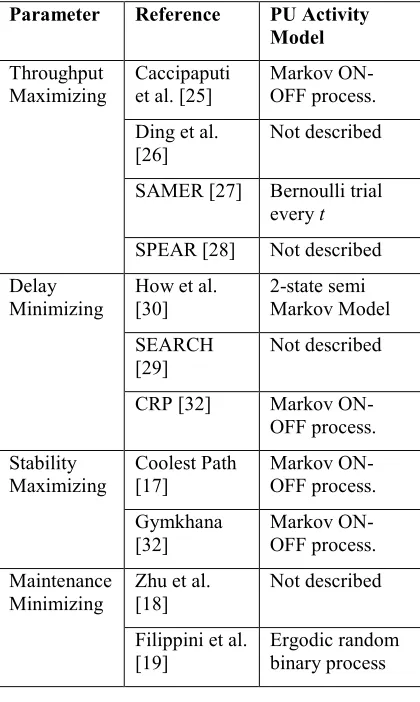
1373 on the basis of different parameters such as throughput maximization [17-21], route-stability [22-25], delay minimizing [24-28], route maintenance [22-25]. The proposed methodology considers all the solutions and hence it is improving the average data rate and minimizing the end-to-end delay to improve the overall QoS parameters of routing. Summary for all of these routing protocols is shown in Table 1.
Table 1: Summary of Routing Protocols for CRAHN
Parameter Reference PU Activity Model
Throughput Maximizing
Caccipaputi et al. [25]
Markov ON-OFF process.
Ding et al. [26]
Not described
SAMER [27] Bernoulli trial every t
SPEAR [28] Not described
Delay Minimizing
How et al. [30]
2-state semi Markov Model
SEARCH [29]
Not described
CRP [32] Markov
ON-OFF process.
Stability Maximizing
Coolest Path [17]
Markov ON-OFF process.
Gymkhana [32]
Markov ON-OFF process.
Maintenance Minimizing
Zhu et al. [18]
Not described
Filippini et al. [19]
Ergodic random binary process
3. CROSS-LAYER NETWORK ARCHITECTURE
To change the functionality of software defined radios [1] to work as cognitive radio, learning is very essential function that must be added in it [33]. The learning function make radios to enable the receiving of its environments inputs about any changes and on the basis of it system exhibit its behavior. In order to improve the system performance, if any changes occur in surrounding environment, system needs to learn by the interaction with environments to cope those changes. This learning functionality can be added at
the time of routing in CRAHN, so that during the routing decisions channel decisions can be updated. The use of some Artificial Intelligence (AI) based learning technique can fulfill such kind of certain task using the mathematical model. Hence, Reinforcement Learning (RL) is one of the very popular AI based learning technique used for the routing based task in CRAHN.
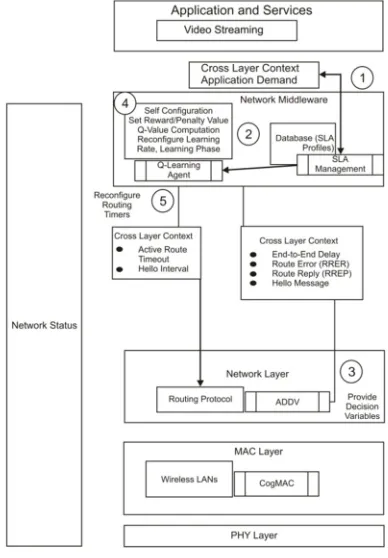
In RL, the learner gets the reward and punishment response through indirect feedback from its opponents for the correct action. Therefore, it does not depend only on the exploration for the reward decisions rather exploitation also taken into consideration while making any future decisions for its action. As end-to-end routing of a user is also involved the routing decisions for future routing decisions on the basis of previous reward and punishment methodology. Hence we are using RL approach for the methodology of our routing protocol in CRAHN so that it must be aware of the channel and user interferences. The RL-based learning agent can be implemented in a cross-layer approach in network architectural stack of CRAHN to make aware of the channel selection decisions at the time of end-to-end routing. Detail of the implementation, mathematical modeling and use of planning and decision in routing for future route decision will be discussed in this section and the implementation of RL technique is shown in Figure 1.
1374 are incorporated the channel quality of particular action at specific state and time.
[image:5.612.320.514.189.468.2]The Q-learning based learning agent is implemented in cross-layer of network architectural stack as shown in Figure 1. The working of the learning agent is based in the following steps and also shown in Figure 2.
Figure 1: Proposed Cross Layer Network Architectural Stack for CRAHN.
Step 1: The learning block at the middleware layer collects the channel requirement of secondary user to resolves the user interference and spectrum mobility challenges (to minimize the channel switching events due to user interference and resulted in maximizing of average data rate).
Step 2: The performance requirement is received by learning agent in the middleware layer in the form of reward and punishment value, calculated by the use of Q-tables.
Step 3: The AODV [--] reactive routing protocol is used on network layer. It facilitates the learning agent with ACK, Hello Interval, ACTIVE ROUTE TIMEOUT, ROUTE ERROR (RERR) and ROUTE REPLY (RREP) messages to carry the Q-values for the reward and punishment decisions variables to pass in the cross-layer.
Step 4: Learning agent will take the action on the basis of function, calculated on the basis on Q-learning mathematical function which will be discussed in next Section IV.
Step 5: Routing parameters will be reconfigure according to the ACK, hello interval, ACTIVE ROUTE TIMEOUT (ART), RERR and RREP.
[image:5.612.101.291.189.422.2]Step 6: All the above steps will work in a loop iteratively to observe the effects of environment changes occurred by the user interferences and channel switching.
Figure 2. Working Steps of Q-Learning agent implemented in cross-layer
4. MATHEMATICAL MODELLING
We consider T pairs of secondary users (SUs) coincide with primary users (PUs) in the same geographical area. The SUs are connected as an ad-hoc network and can listen to all other users for the network resource management. The C vacant available channels are there which can access by SUs in the absence of PUs. There is no central entity to control the resource management and using a channel sharing mechanism. For the purpose of channel sharing, multiple access network designed is used to select and communicate between the users. The channel transmission rate (Rtr) is calculated to evaluate the network performance in case of bandwidths difference of channels.
The overall system is modeled as a mathematical model of non-cooperative game as {T, {Si}i∈ T ,
{Ui}i∈ T}. Where T is defined already and Si is the
1375 utility function of user i such as Ui : Si → Rtr to choose the policy of sa from the policy set for the recent policy of its strategy profile of its competitor: S−i. Users can choose any policy from the set of policies if no more user can differ at more to its policy. This state mathematically called Nash Equilibrium Point (NEP) and only occur if and only if Eq. (1) exists.
, ∀ ∋ , ∋ (1) where Ui is the utility function which can be calculated using the Eq. (2).
, log (2)
where log (.) is used as natural logarithmic function and the constants β, γ, and δ in the utility function are user defined. The policy can be chosen that used for the channel transmission of a channel and packet arrival rate λ for user i ∈ T. For the purpose of channel assignment which is effected by the user interference, Q-learning based channel selection algorithm is included in current routing parameters. To reach at the above defined NEP point, it is very important that the learning effect of Q-Learning will give the state of channel selection. Now in the above Eq. (2) if SUs will utilize just simple natural logarithmic without any learning policy, channel assignment faces the user interference as an operation overhead and increases the frequency of channel switching events.
The Q-Learning implementation during the channel selection decision will make it possible to select a better channel for its end-to-end transmission on the basis of its previous experience. The mathematical model of Q-Learning is includedto decide the channel policy in the set of policies. Now the Q-Learning is used to calculate the Q-tables [34] and the values will be updated based on the quality of channel and reward which can be selected using the Eq. (3).
! , " , " #$% , , " &(3)
where Qt+1(s, a) and Qt(s, a) represent Q values in Q-table of a user at time (t + 1) and trespectively for choosing an action a from policy s. E [U(sa,
s−a)] imply the average reward and α is the learning rate. The learning rate is used to determine the updating of Q-values. It is very important to balance the network state of routing protocol and performance of secondary users. Hence, to avoid intrusive changes in the network state, learning rate is used as a fixed rate of 0.02. A channel will be selected on the basis of Q-value which can be
collected using the э-greedy exploration. Secondary user chooses a random channel with Э probability of channel selection. In Q-table the э-greedy exploration is given with probability of (1− э). The exploration of future routing decisions of a Secondary User will start if the value of э is very high and the updating э of will be done after each successful packet transmission as,
∋ ∋ '() *( + ,* *+∋ (4)
From Eq. (4), the probability of selecting a channel is calculated using Eq. (5).
- !
.1 ∋ 0 ∋
1() *( + ,* *+2 3 , " 4 546 7
∋
1() *( + ,* *+ 87469: 6
(5)
The SUs can exchange channel
information to facilitate Q-learning. As given in Eq. (5), users rely on its own packet exchange information for Q-learning so that users periodically access the channel. As a result, the learning rate for any user in the network is long. Here, we consider that users embed the average channel reward information with the ACK message. This follows with, all other users in the channel updating the Q-table using this average channel reward information. This small change in the MAC protocol will cost very small amount of extra time to transmit the ACK packet. Also, for the sake of simplicity we consider received ACK packets are error free.
In the implementation of learning agent based on Q-Learning, each user will calculate two Q-values such as Qpenalty and Qreward. The Qpenalty shows the punishment value in Q-table for unstable network status and in this case the ART and Hello interval value will be decreased. On the other hand, Qreward produces the network stable state and in this case the reward value will be updated with increment in the value of ART and Hello interval. The Qpenalty and Qreward can be calculated as following:
(*; < = 1 # , " (*; < = # >, "> (6)
+*? +)
1376 also be calculated using the End-to-End delay as given by:
@6:"9A >, ">
+*? +) B CDDE !
DDEF G
H I
B DDEF G
DDE (8)
Whenever a RREP packet arrives at back to the source with a defined path from the source to destination the reward value will updated and contrary the penalty can be calculated as:
J6B"K7L >, "> (*; < = B DDE
DDEF G (9)
In case of broken path due to user interference, a RERR packet will be generated which will be sent to the source to inform the path status. Here, EEDt is showing the recent End-to-End Delay of a user at a specific time t whereas EEDmax representing the maximum End-to-End Delay of any time. The n is showing the normalization constant. To see the overall routing performance, end-to-end delay calculated from source to destination plays a vital role. Hence, end-to-end routing is tightly coupled with the end-to-end delay and the effect of it can be observed using the reward and penalty function [37]. The values of penalty and reward will be updating using the ART and Hello interval as follows:
Step 1: The learning duration time = 30 seconds, and the increment or decrement of ART and Hello intervals will be done with equal probability.
Step 2: On the reception of RREP, ROUTE REPLY message will be sent and the reward will be calculated with updating the Qreward, and Go To step 4.
Step 3: On the reception of RERR, ROUTE REPLY message will be sent and the penalty value will be calculated by updating the Qpenalty, and Go To step 4.
Step 4: Check if Qreward> Qpenalty, then decrease the value of ART and Hello Interval by 1, otherwise increase each value by 1.
The channel selection algorithm based on Q-Learning is given below, which is used to minimize the channel switching events in case of user interference.
5. SIMULATIONS AND RESULT ANALYSIS
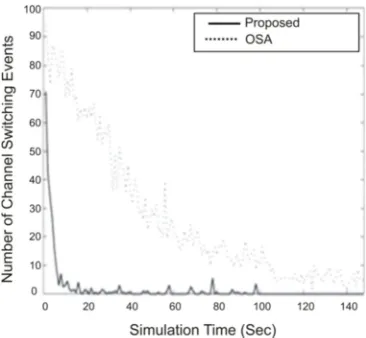
Simulations are performed using software based network simulator for network-level simulations known as Cognitive Radio Cognitive Network (CRCN) [36,41,42]. This simulator uses the services of Network Simulator -2 (NS-2) [37,43,44]. The main reason for choosing this simulator is to provide the performance evaluations based on the dynamic spectrum resource allocation and user control management algorithms on network-level. It also supports the Cognitive Radio Ad-Hoc Networking protocols such as MAC and Routing protocols. The realistic network traffic is generated using the NS-2 topology patterns. The spectrum management parameters such as transmission power, propagation and etc. are reconfigured for every user by providing the multi-radio multi-channel PHY layer [36]. The proposed algorithm is evaluated on the basis of some QoS parameters such as number of channel switching events, average data rate and end-to-end delay and compared it with the other routing protocol Opportunistic Spectrum Access (OSA) in CRN offered based on learning [34]. The simulation parameters are listed in Table 2.
1377 Figure 4 indicates that the proposed algorithm offered a very good channel selection algorithm based on learning mechanism as it is improving the average data rate. Due to the decrement in channel switching events for overall transmission of a SU, the average data rate can be improved. Hence, the proposed methodology can be very useful for the real time networks. The effect of user interference can be managed using learning mechanism. This is also very important to improve the overall QoS-based routing protocol for CRAHN. To observe the QoS-based routing parameters for analyzing the proposed algorithm end-to-end delay must be evaluated for the end-to-end transmission.
Table 2: Simulation Parameters
Parameter
Value
No. of cognitive nodes 50
No. of channels 3
Bandwidth, Channel 1, 2 & 3 2 MHz, 4 MHz & 6 MHz
Data type Best effort
Packet Payload 8184 bits
Packet arrival rate, λ Uniform (1,5)
MAC header 272 bits
MAC protocol 802.11
CogMAC β, γ,&δ of utility function 0.16, 0.8 & 400
α 0.02
Update parameter 100
PHY header 127 bits
ACK 112 bits + PHY header
RTS 160 bits + PHY header
CTS 112 bits + PHY header
Slot time 50 μs
DIFS 128 μs
SIFS 28 μs
Bit rate, channel 1, 2 & 3 2 Mb/s, 4 Mb/s, 6 Mb/s
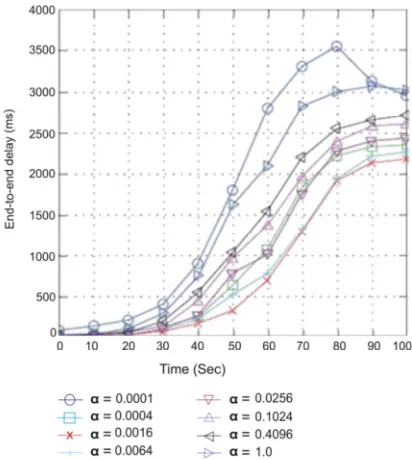
Figure 5 shows the result for end-to-end delay (EED) and compared with OSA routing protocol, which clearly shows the significant difference in it. The EED results can also be used to calculate the overall throughput of the network. The throughput improvement for real time networks such as TV networks is based on the EED specifically for broadcasting networks. The EED calculated on the assumption of balance network state between primary and secondary users by fixing the learning rate. Now this is very important to see the effect of learning rate on the implementation of learning agent in our proposed algorithm for EED calculation. Figure 6 indicated the effect of learning rate α and according to it when learning rate is
[image:8.612.85.301.277.541.2]approximately 0.0016 then the end-to-end delay is minimum.
Figure 3: Number of channel switching events.
Figure 4: Average data rate for the Secondary Users.
[image:8.612.317.500.313.487.2]1378
Figure 5: End-to-End Delay for the Secondary Users.
Figure 6: The effect of learning rate on EED.
6. CONCLUSION
Routing is the major perception of end-to-end transmission and Quality of Service (QoS) for the wireless network system. This issue even turns worse in case of Cognitive Radio Ad-Hoc Network (CRAHN). The implementation of Artificial Intelligence (AI)-based learning techniques has optimized the performance of PHY and MAC layer protocols for CRAHN. Insufficient consideration has been given in research to promote learning techniques at network layer for improving the QoS for end-to-end routing protocols in CRAHN. We
contended that the integration of learning from the previous channel selection experience for routing can improve the future routing decisions for Secondary Users to improve the QoS-based routing in CRAHN. This is done by the implementation of learning agent in cross-layer network architectural stack. The proposed algorithm is implemented using autonomously reconfigured network systems with a cross-layer approach. The proposed algorithm can be applied for large CRAHN to improve the QoS for the overall network where the characteristics of a network can change frequently and the number of nodes is participating more. The mathematical model is presented for the proposed algorithm and the simulations are carried using CRCN simulator based on NS-2 simulator. The performance is evaluated and compared with one routing protocol offered for CRAHN based on learning algorithm which shows the significant improvement in QoS-based routing. Hence, the proposed protocol is having much better QoS-based routing performance in CRAHN than the OSA routing protocol. The proposed methodology is only applicable for the CRAHN and not for CRN where the resources are managed centrally. This enhancement will make enable the TV broadcast networks to utilize as cognitive radio ad-hoc networks. Each node must take its own channel selection decisions for the routing decisions. The channels information must be available to the network layer, so that the learning mechanism can in-cooperated with MAC layer. There are many other learning techniques are available which must be tried to solve the mentioned routing problem. In future we want to investigate the performance of our algorithm with other QoS-based routing parameters like throughput etc. and by the implementation of more learning techniques in real test bed scenario. The other reinforcement learning techniques can also be considered for the overall purpose of channel selection and routing at the same time. The effect of other learning techniques on this issue is very interesting research area and must be evaluated and simulated.
ACKNOWLEDGEMENT
Authors are thankful to RTC Prince Sultan University for providing equipments to conduct this research.
REFRENCES:
[1] A. Rehman and T. Saba "Evaluation of artificial intelligent techniques to secure information in enterprises", Artificial Intelligence Review, vol.
42(4), 2014, pp. 1029-1044, doi.
[image:9.612.94.300.314.544.2]1379 [2] M. Youssef, M. Ibrahim, M. Abdelatif, L. Chen,
and A.V Vasilakos, “Routing metrics of cognitive radio networks: A survey,” IEEE
Communications Surveys & Tutorials, vol. 16,
no. 1, 2014, pp. 92–109.
[3] Ming, J.,Ping, J. and Chiun, R. "Provably Secure Password-based Threeparty Key
Exchange Protocol with Computation
Efficiency", Journal of Business and
Technovation, vol.2(2), 2014, pp-117-126.
[4] L. Busoniu, R. Babuska, and B. De Schutter, “A
Comprehensive Survey of Multiagent
Reinforcement Learning,” IEEE Transactions on Systems, Man, and Cybernetics, Part C:
Applications and Reviews, vol. 38, no. 2, 2008,
pp. 156–172.
[5] Bashardoost, M., Mohd Rahim, M.S., Saba, T. Rehman, A. "Replacement Attack: A New Zero Text Watermarking Attack". 3D Research, vol. 8(8), 2017, doi:10.1007/s13319-017-0118-y [6] A. Rehman and T. Saba. "Evaluation of
artificial intelligent techniques to secure information in enterprises", Artificial
Intelligence Review, vol. 42(4), 2014, pp.
1029-1044, doi. 10.1007/s10462-012-9372-9. [7] A. Rehman, S. Alqahtani, A. Altameem, T.
Saba. "Virtual machine security challenges: case studies", International Journal of Machine
Learning and Cybernetics vol. 5(5), 2014, pp.
729-742, doi. 10.1007/s13042-013-0166-4. [8] H. Al-Turkistani, and T. Saba "Collective
Intelligence for Digital Marketing", Journal of
Business and Technovation, vol.3(3), 2015, pp.
194-203.
[9] I. F. Akyildiz, W.-Y. Lee, M. C. Vuran, and S. Mohanty, “Next generation/dynamic spectrum access/cognitive radio wireless networks: a survey,” Computer Networks, 2006.
[10] Khodamoradi, M. Bozorgmanesh, M. and Ghorbani, E."Usage of Data and Correspondence Advancements (ICT) In Instruction" Journal of Business and
Technovation, vol.2(2), 2014, pp.131-135.
[11] Saba, T. Rehman, A. AlGhamdi, J.S. (2016) Weather forecasting based on hybrid neural
model Applied water Science,
doi:10.1007/s13201-017-0538-0.
[12] P. Venkatraman and B. Hamdaoui,
“Cooperative Q - learning for Multiple Secondary Users in Dynamic Spectrum Access,” in Proc. 7th Int. Wireless Communications and Mobile Computing Conf.
(IWCMC), 2011.
[13]H. Li, “Multi-agent Q-learning of Channel Selection in Multi-user Cognitive Radio Systems: A Two by Two Case,” in Proc. IEEE Int. Conf. Systems, Man and Cybernetics SMC 2009, 2009.
[14] Q. Cheng and B. Kollimarla, “Joint Channel and Power Allocation Based on User Satisfaction for Cognitive Radio,” in Proc. 43rd Annual Conf. Information Sciences and Systems CISS 2009, Baltimore, MD, Mar. 2009.
[15] M. Ma and D. H. K. Tsang, “Impact of Channel Heterogeneity on Spectrum Sharing in Cognitive Radio Networks,” in Proc. IEEE Int.
Conf. Comm. ICC ’08, Beijing, May 2008.
[16] A. Ghosh and W. Hamouda, “Cross-layer Antenna Selection and Channel Allocation for MIMO Cognitive Radios,” IEEE Transactions
on Wireless Communications, vol. 10, no. 11,
pp. 3666–3674, 2011.
[17] A. S. Cacciapuoti, M. Caleffi, and L. Paura, “Reactive routing for mobile cognitive radio ad hoc networks,” Ad Hoc Networks, 2012. [18] M.S. Amin and A. Noori "Mechanism For Farm
Mechanization and Careful Planning Using Geographic Information System (GIS)" Journal of Business and Technovation, vol.4(1), 2016, pp. 23-28
[19] I. Pefkianakis, S. H. Wong, and S. Lu, “Samer: spectrum aware mesh routing in cognitive radio networks,” in New Frontiers in Dynamic
Spectrum Access Networks, IEEE, 2008.
[20] Kem, Y. "Use of Information Technology in Urban Planning and Design: An Urban Architecture Study" Journal of Business and
Technovation, vol. 4(1), 2016, pp. 1-9
[21] K. R. Chowdhury and M. D. Felice, “Search: A routing protocol for mobile cognitive radio ad-hoc networks,” Computer Communications, 2009.
[22] Jun,S. Mii, S. and Kao, C. "New CMT-SCTP With Increased Speed of Data Transmission Using Fuzzy Logic", Journal of Business and
Technovation , vol. 4(2), 2016, pp. 66-74
[23] Ahmed Saeed, Mohammad Ibrahim, Khaled Harras, Moustafa Youssef, et al., “A low-cost large-scale framework for cognitive radio routing protocols testing,” in Communications
(ICC), International Conference on. IEEE,
2013, pp. 2900–2904
[24] Al-Turkistani, H. and Saba, T. "Collective Intelligence for Digital Marketing", Journal of
Business and Technovation, vol.3(3), 2015, pp.
1380 [25] Filippini, I. Ekici, E. and Cesana, M.
“Minimum maintenance cost routing in cognitive radio networks,” in Proc. 6th IEEE International Conference on Mobile Adhoc and
Sensor Systems, 2009.MASS’09.
[26] G.M. Zhu, I. F. Akyildiz, and G.-S.Kuo, “Stod-rp: A spectrumtree based on-demand routing protocol for multi-hop cognitive radio networks,” in Proc of IEEE Global
Telecommunications Conference, 2008.
[27] K. R. Chowdhury and I. F. Akyildiz, “Crp: A routing protocol for cognitive radio ad hoc networks,” IEEE Journal on Selected Areas in
Communications, 2011.
[28] A. Guirguis, M. Ibrahim, K. Seddik, K. Harras, F.Digham, and M. Youssef, “Primary user aware k-hop routing for cognitive radio networks,” in Proc. on IEEE Global
Telecommunications Conference
(GLOBECOM). 2015.
[29] R. E. Tuggle, “Cognitive multipath routing for mission critical multihop wireless networks,” in Proc. on IEEE System Theory (SSST), 2010. [30] A. Abbagnale and F. Cuomo, “Gymkhana: a
connectivity-based routing scheme for cognitive radio ad hoc networks,” in INFOCOM IEEE Conference on Computer Communications Workshops, 2010.
[31] S. Deng, J. Chen, H. He, and W. Tang, “Collaborative strategy for route and spectrum selection in cognitive radio networks,” in Proc. of IEEE Conf. on Future Generation Communication and Networking (FGCN 2007), 2007.
[32] L. Sun, W. Zheng, N. Rawat, V. Sawant, and D. Koutsonikolas, “Performance comparison of routing protocols for cognitive radio networks,” in MASCOTS, IEEE, 2013.
[33] S. Haykin, “Cognitive radio: brain-empowered wireless communications,” Selected Areas in
Communications, IEEE, 2005.
[34] T. Saba and A. Rehman. Machine Learning and Script Recognition, Lambert Academic
publisher, 2012, pp.35-40.
[35] G. Bianchi, “Performance Analysis of the IEEE 802.11 Distributed Coordination Function,”
IEEE J. on Sel. Areas in Comm., vol. 18(3), pp.
535–547, Mar. 2000.
[36] A. Rehman and T. Saba. "Neural network for document image preprocessing", Artificial
Intelligence Review, vol. 42(2), 2014, pp
253-273, doi. 10.1007/s10462-012-9337-z.
[37] K. K. Vadde. and V. R. Syrotiuk, "On Timers of Routing Protocols in MANETs," in Proc. Of 3rd International Conference on AD-HOC Networks & Wireless, July 2004.
[38] http://stuweb.ee.mtu.edu/~ljialian/index.htm [39] http://www.isi.edu/nsnam/ns/ns-build.html [40] G. Bianchi, “Performance Analysis of the IEEE
802.11 Distributed Coordination Function,”
IEEE J. on Sel. Areas in Comm., vol. 18(3), pp.
535–547, Mar. 2000.
[41] T.Saba and A. Rehman "Effects of artificially intelligent tools on pattern recognition", International Journal of Machine Learning and
Cybernetics, vol. 4, 2012, pp. 155-162. doi.
10.1007/s13042-012-0082-z.
[42] T. Saba. "Pixel intensity based cumulative features for moving object tracking (MOT) in darkness", 3D Research vol. 7 (10), 2016, pp.1-6, doi.: 10.1007/s13319-016-0089-4
[43] Arafat, S. and Saba, T. "Social Media Marketing Vs Social Media Commerce: A Study on Social Media’s Effectiveness on Increasing Businesses’ Sales" Journal of
Business and Technovation, vol. 4(3), 2016, pp.
134-147.
[44] M. Mundher, M. Muhamad, D. Rehman, A. Saba, T. Kausar, F. (2014) Digital watermarking for images security using discrete slantlet transform, Applied Mathematics and
Information Sciences, vol. 8(6), PP: 2823-2830,
doi:10.12785/amis/080618.
[45] K. Neamah, D. Mohamad, T. Saba, A. Rehman, "Discriminative features mining for offline handwritten signature verification", 3D
Research vol. 5(3), 2014,
doi.10.1007/s13319-013-0002-3
[46] T. Saba, A. Rehman, M. Elarbi-Boudihir (2014). "Methods and strategies on offline cursive touched characters segmentation: a directional review", Artificial Intelligence
Review vol. 42 (4), pp. 1047-1066.
doi.10.1007/s10462-011-9271-5
[47] T. Saba S. Al-Zahrani A. Rehman. "Expert system for offline clinical guidelines and treatment" Life Sci. Journal, vol. 9(4), pp. 2012, pp.2639-2658.
[48] M. Elarbi-Boudihir, A. Rehman and T. Saba "Video motion perception using optimized Gabor filter". International Journal of Physical