ISSN: 1992-8645 www.jatit.org E-ISSN: 1817-3195
COMPARING THE SIMILARITIES MEASUREMENT OF
FACE EXPRESSION-RECOGNITION BASED ON 2DLDA
MODIFICATION METHOD
1
FITRI DAMAYANT, 2WAHYUDI SETIAWAN, 3SRIHERAWATI, 4AERI RACHMAD
1,2,3,4
Faculty of Engineering, University of Trunojoyo Madura, Indonesia E-mail: [email protected], [email protected]
ABSTRACT
Facial expression recognition is the development of face recognition in an environment of pattern recognition (feature recognition). Research on facial expression recognition is very useful in many fields, for example in the field of human computer interaction, in this case the computer recognizes facial expressions of the user, then the computer programmatically perform the appropriate instructions to the facial expression of the user. Facial expressions can also be used as a measure of customer satisfaction with public services. In this study, the facial expression recognition applications were built to measure customer satisfaction with the process of feature extraction using the Modified Two Dimensional Linear Discriminant Analysis (Modified 2DLDA) to obtain input characteristics on each face. 2DLDA modification method is the development of methods 2DLDA; which may have the similarity measurement using Euclidean Distance, Manhattan Distance, and Two Dimensional Correlation Coefficient. The combination of these test methods uses Jaffe database which is a database that contains Japanese female facial expression. The highest test results using the Euclidean Distance is 88.57%, the Manhattan Distance method is 89.92%, and the method Two Dimensional Correlation Coefficient of 90.48%.
Keywords: Facial Expressions, Euclidean, Manhattan,Two Dimensional Correlation- Coefficient, Modified 2DLDA
1. INTRODUCTION
Intelligent system is a system that allows the computer to have a system of reasoning and intelligence thinking like human. The development of intelligent systems have several research fields such as pattern recognition, geographic information systems, decision-making systems, and others.
Recognition system facial expression is the development of face recognition system which in an environment of pattern recognition now is more and more being studied. This is because the demand to develop something is more advanced in the field of intelligent systems. So that the computer does not only recognize a person's face, but also to recognize facial expressions of someone including anger, disgust, fear, happiness, neutral, sad or surprised.
There are several studies of such facial expression recognition research which is done by Neeta Sarode, Shalini Bhatia in 2010, entitled "Facial Expression Recognition" [1]. Their study was about crating software for facial expression recognition using local 2D appearance-base approach and data test using Jaffe database. These
studies showed recognition with an accuracy of 81%.
Yong Xu, Zhu Qi, Yan Chen in 2013 also have similar research which is entitled "An Improvement to the Nearest Neighbor Classifier's Face Recognition Experiment" [2]. The study discusses the use of a modified method of nearest neighbor for facial expression recognition. The data test are AR database. These studies showed recognition with an accuracy of 89%.
Mandeep Kaur, Rajeev Vashisht, Nirvair Neerv in 2010, was doing a research in the same area which is entitled "Recognition of Facial Expressions with Princicpal Component Analysis (PCA) and Singular Value Decomposition (SVD)" [3]. This study uses Princicpal Component Analysis (PCA) and Singular Value Decomposition (SVD) for the introduction of facial expressions which the database also used Jaffe database. The level of accuracy of the study reached 80%.
ISSN: 1992-8645 www.jatit.org E-ISSN: 1817-3195
The second step is the measurement of similarity, which is the measurement between the image of testing with the image of training is to get the value that is used as a benchmark to find the most similar image.
Methods Linear Discriminant Analysis (LDA) is a method of extracting feature that is aimed to find the projection linear (commonly called the 'fisherimage'), to maximize matrix covariance between objects (between-class covariance matrix), and also to minimize matrix covariance within the object itself (within-class covariance matrix) [4]. LDA also imposes a separate statistical properties of each object [5].
The LDA method uses models based on vector data representation. Generate vectors typically have a higher dimension. This is a drawback of the method of LDA [6]. Method Two Dimensional Linear Discriminant Analysis (2DLDA) directly assess within-class scatter matrix of images without image transformation matrix into a vector, and it solves singular problems in within-class scatter matrix [7]. 2DLDA uses fisher criterion to find the optimal projection discriminatory.
Methods 2DLDA search the value of R and L values which are used to calculate the within-class and between-class scatter scatter. So there are two values within-class scatter i.e. SWR dan S
L W,, as
well as the value of two SRb and S L
bbetween-class scatter. The calculation of two values within-class scatter and the two values between-class scatter causes computation which is required even greater. Modification Method Two Dimensional Linear Discriminant Analysis (Modified 2DLDA) directly assess without transformation matrix image into vector image. 2DLDA modification method calculates the value of within-class scatter and the between-class scatter values. This can reduce the computation time required.
In this study, we modified the method of Two Dimensional Linear Discriminant Analysis (Modified 2DLDA). This 2DLDA modification method can directly assess without transformation matrix image into vector image. Moreover, this method calculates the value of within-class scatter and the between-class scatter values. The advantage of using this modification of 2DLDA method in comparison with 2DLDA is, 2DLDA modification can reduce the needed-computation time, while 2DLDA method may take a longer period to compute. 2DLDA modification method is used as a feature extraction and an introduction of process using several methods of measurement of distance, namely: Euclidean Distance, Manhattan Distance,
and Two Dimensional Correlation Coefficient. The results from the combination of these methods were compared to obtain optimal accuracy results.
2. SYSTEM DESIGN 2.1.Feature Extraction
Feature extraction in the training process is conducted by using Modified Two Dimensional Linear Discriminant Analysis (Modified 2DLDA). This stage aims to get the features that are selected from the data enter training. These features are selected obtained from all the facial features, look for eigenvalues and eigenvectors greatest. Features that are selected will be used for the classification process is used for training and testing data feature extraction.
Feature extraction in the testing process is done by taking the feature extraction results on the training process applied to the test data. Feature extraction results on this test data will be used as input to the classification process testing.
2.2.Two Dimensional Linear Discriminant
Analysis (2DLDA)
2DLDA is the development of methods of LDA. In LDA on face recognition with 2D matrix, it must first be transformed into a one-dimensional shape vector image. While on 2DLDA or image projection technique which is called as direct matrix 2D facial image does not need to be transformed into the form of a vector image, but scatter image matrix can be formed directly by using the original image matrix.
{A1,….,An}is n matrix image, where Ai
(i=1,…,k) is r x c matrix. Mi (i=1,…,k) is the
average of the classroom to the training image i and
M is the average image of all training data. Assuming
l
1 x2
l
dimension (dimensional space)L
⊗
R shows the tensor product, L span {u1,…,ul
1} and R span {v1,..,vl
2}. Thus, itdefined two matrix L = [u1,…,u
l
1] and R =[v1,..,v
l
2] [8].Feature extraction method is to find the L and R so that the space of the original image (original image space) ) Ai is converted into
low-dimensional image space which becomes Bi =
Bi=LTAiR. Low dimensional space is obtained by a
linear transformation L and R, the distance Db
between-class and within-class distance Dw defined
in equation (1) and (2).
Db = n L M M R k
i
i T
i ( )
1
−
∑
=
2
F , (1)
ISSN: 1992-8645 www.jatit.org E-ISSN: 1817-3195
Dw =
2
1
)
(
i F k i x TR
M
X
L
i−
∑ ∑
= ∈Π
, (2)
where F is Frobenius norm.
The review is 2
F
A
= Ptrace(ATA) = trace(AAT) to A. So that the equation (7) and (8) can be further represented as the equation (3) and (4).Db = trace( ( ) ( ) ) 1 L M M RR M M L
n i T
T k
i
i T
i − −
∑
=
,
(3)
Dw = trace( ( ) ( ) ).
1 L M X RR M X L T i T i k i x T i − −
∑ ∑
= ∈Π
(4) Similarly, LDA, 2DLDA method is to find the matrix L and R, so that the class structure of the original space remains in the projection room. So, the benchmark (criterion) can be defined as an equation (5).
J1(L,R) = max W
b D
D
. (5)
It is clear that the equation (5) consists of
the transformation matrix L and R. The optimal transformation matrix L and R can be obtained by maximizing Db and minimizing Dw. However, it is
very difficult to calculate the optimal L and R simultaneously. Two optimization functions can be defined to obtain L and R. For a definite R, L can be obtained by completing an optimization function according to the equation (6).
J2(L) = maxtrace((LTS
R WL)
-1
(LTSbRL)), (6)
which
SbR = T
i T k
i
i
i
M
M
RR
M
M
n
(
)
(
)
1
−
−
∑
=
, (7)
SWR = ( ) ( ) .
1 T i T i k i x M X RR M X i − −
∑ ∑
= ∈Π
(8)
Note that the size of the matrix and
S
WRdan SRb is r x r smaller than the size of the matrix Sw and Sb in classical LDA.
For a definite L, R can be obtained by solving the optimization function in equation (9).
J3(R) = maxtrace((R T
SWL R)
-1
(RTSLbR)),
(9)
which
SbL =
(
)
(
)
1
M
M
LL
M
M
n
i T T k i ii
−
−
∑
=
,
(10)
SWL =
(
)
(
),
1 i T T i k i x
M
X
LL
M
X
i−
−
∑ ∑
= ∈Π
(11)
SLwand SbL matrix size is c x c is smaller than the size of the matrix Sw and Sb in classical LDA.
2.3 Modification of Two Dimensional Linear
Discriminant Analysis (Modification of 2DLDA)
This method is the development of 2DLDA methods which can calculate class-scatter and within-class scatter only once. So that, the computing time is less than the 2DLDA method. In this method, the calculation of 2DLDA between class scatter and within class scatter is done twice, they are calculating SLwdan SLb,
S
WR dan SbR. The method of computing time 2DLDA is used to perform feature extraction of Ο(n3), whereas the method of modification 2DLDA only takes amounted Ο(n2).Here is the algorithm method 2DLDA Modification:
1. Input is a matrix x
2. Calculating mi=
∑
∈Π i x ix
n
1
is the average
class i, and m =
n
1
∑ ∑
= ∈Πk
i x i
x
1 is the
global average.
3. Calculating the between class scatter matrix. Between class scatter matrix (Sb) is the distance
matrix between classes. In accordance with the equation Sb =
T i i
k
i 1
n
i(
m
−
m
)(
m
−
m
)
∑
= 4. Calculating the within class scatter matrix.Within class scatter matrix (Sw) is the distance
matrices in the same class. In accordance with the equation
Sw=
T k
i x i i i
m
x
m
x
)(
)
(
1
∑ ∑
= ∈Π−
−
5. Calculating the generalized eigenvalue (λ
i)and eigenvector (V) of Sbdan Sw in accordance
with equation (12) using SVD.
Z = . (12)
ISSN: 1992-8645 www.jatit.org E-ISSN: 1817-3195
2.4 Distance Measure
Facial expression recognition is essentially matching two facial expressions by constituting one facial expression facial expressions which have been trained and placed in a database; and then compared with images or image expression test of new facial expression. The match is using the distance measurement method. Basically, the distance measurement is used to calculate the difference between the two vectors images in eigenspace. After the image is projected into space facial expression of the face, the next task is to determine where the image of a facial expression is most similar to the image in the database. There are many ways to measure the degree of similarity and distance among the Euclidean distance, Manhattan, and 2D Correlation Coefficient. Moreover, it will ultimately be compared to the distance which has the highest level of compatibility.
2.5 Euclidean Distance
Euclidean space is finite-dimensional space with valuable real. Euclidean distance between two points is the length of the hypotenuse of a right triangle. Where x is the image of training and y is the input image test. If x = (x1, x2, x3, ..., xn) and y = (y1, y2, y3, ..., yn) are two points in space Eulidean n, the Euclidean distance x to y is according to the equation ( 13) :
(13)
If the vector in Euclidean Distance value is close to 0, then the image of testing and training image is stated to resemble.
2.6 Manhattan Distance
Manhattan Distance is one of the most widely used measurement which involves replacing the squared difference by summing the absolute differences of the variables. This procedure is called absolute block or better known as the city block distance. Equation (14) is a measurement using the Manhattan Distance.
(14) If the vector in Manhattan Distance value is close to 0, then the image of testing and training image stated to resemble.
2.7 2D Correlation Coefficient
In this study, the third method is used to measure the similarity is 2D Correlation Coefficient
This method aims to measure the distance between the image similarity testing with imagery training. Weight matrix testing the data will be processed by the 2D Correlation Coefficient which works by comparing the entire result of reduction in the value matrix of the i-th weight training data and value-i weight matrix to the data of testing with its square root. Data are considered most similar is the maximum value of each data comparison results of testing and training [9].
(15)
Where:
A = weight training image
B = weight testing image
= weighted average of the training image = weighted average of the testing image
3. EXPERIMENTS AND RESULTS
3.1 Data Training
The trial of facial expression recognition system developed in this study is conducted at the Jaffe Database which was taken from 10 samples of Japanese women. Each women has three poses and 7 expression of happiness, sadness, surprised, anger, disgusted, fear, and neutral. Thus, each sample of 21 poses represents the total data of 210 images. All the images have the intensity of gray (greyscale) with a size of 256 x 256.
The parameters which were used in this test were:
1. Variation of the sequence of training samples per class is used. In Jaffe Database sequence data taken as training data varies, not sequential as preliminary data in the database.
2. The amount of training samples per class is used. The amount of data used in the training process is divided into several scenarios.
3. The number of features taken in the process of training and testing. Feature fetch as much as 5, 10 and 15.
3.2 Testing Method
ISSN: 1992-8645 www.jatit.org E-ISSN: 1817-3195
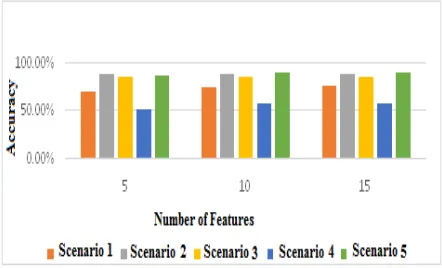
Scenario testing is done by varying the sequence of face images in a database, varying the amount of training data, and varying the features is taken. The test was carried out using five variations in the amount of training data, shown in Table1.
Table 1.Test Scenario
3.3 Testing Result
These test method are in three groups. The first group uses 2DLDA Modified method for feature extraction and Euclidean method is for classification. The second group uses modification methods 2DLDA for feature extraction and classification methods to Manhattan. The third group uses methods Modification 2DLDA for feature extraction and 2D Correlation Coefficient method for classification. The test results for each group of methods can be seen in the following sections of this section:
3.4 The Result of Recognition by Using 2DLDA Modification Method and Euclidean
Method.
Figure 1 shows the recognition accuracy by using Modified 2DLDA and Euclidean method for retrieval features 5, 10 and 15.
Figure1. Graph Of The Recognition Accuracy Using Facial Expression Recognition 2DLDA Modification
Methods And The Methods Of Euclidean
3.5 Results of Treatment using the Modified 2DLDA and methods Manhattan
Figure 2 shows the recognition accuracy by using Modified 2DLDA and methods for retrieval features Manhattan 5, 10 and 15.
Figure 2. Graph Accuracy Of Facial Expression Recognition Method 2DLDA Modification And Methods
Manhattan
3.6 Results of Treatment using the Modified 2DLDA and methods of 2D Correlation Coefficient
Figure 3 shows the recognition accuracy by using Modified 2DLDA and 2D Correlation Coefficient method for making feature 5, 10 and 15.
Figure 3. The Resulting Graph The Accuracy Of Facial Expression Recognition Method 2DLDA Modification
And Methods Of 2D Correlation Coefficient
3.7 Analysis and Results of Testing System
[image:5.612.314.535.355.489.2]ISSN: 1992-8645 www.jatit.org E-ISSN: 1817-3195
Table 1 Results Of Comparative Recognition Accuracy
4. CONCLUSION
4. CONCLUSION
The highest percentage of accuracy of facial expression recognition using the Modified-2D Correlation 2DLDA Coeffisient is equal to 90.48%. There are three important variables that affect the success rate of introduction, ie sequence variations of training samples per class, the number of training samples per class, and the number of features. The factors which affect the failure of an image can be recognized correctly due to the similarity of facial expression or pose different between one person and another person.
5. SUGGESTION
This research will continue to develop using classification method other than the method of measuring distance. The test can be developed by using a database of other facial expressions.
REFRENCES:
[1] Sarode, N., & Bhatia, S. “Facial Expession Recognition”, International Journal on Computer Science Engineering (IJCSE), 2 (5), 1552-1557, 2010.
[2] Xu, Y., Zhu, Q., Chen, Y., & Pan, J.-S. “An Improvement to the Nearest Neighbor Classifier an Face Recognition Experiment”,
International Journal of Innovative Computing, Information & Control (ICIC), 9 (2), 543-554, 2013.
[3] Kaur, M., Vashisht, R., & Neeru, N. “Recognition of Facial Expressions with Princicpal Component Analysis (PCA) and Singular Value Decomposition (SVD)”,
International Journal of Computer Application, 9 (12), 36-40, 2010.
[4] Zheng, W.-S., Lai, J. H. & Li, S. Z., “1D-LDA vs. 2D-LDA: When is vector-based linear discriminant analysis better than matrix-based”,. Pattern Recognition, 41, 2156-2172, 2008.
[5] Wahyuningrum, R. T., & Damayanti, F., “Comparative Study Introduction Imagery Based Aesthetic Smiles Dentistry Using PCA
and 2D-2D-LDA method”, KURSOR, 5,212-222, 2010.
[6] Belhumeur, P. N., Hespanha, J. P., & Kriegman, D. J. “ Eigenfaces vs Fisherfaces Recognition Using Class Specific Linear Projection”, IEEE Transactions on Pattern Analysis and Machine Intelligence, 19 (7), 711 – 720, 1997
[7] Gao, Q. X., Zhang, L., & Zhang, D. “Face Recognition Using FLDA With Single Training Image Per Person”, Applied Mathematics and Computation, 205, 726-734, 2008.
[8] Liang, Z., Li, Y. & Shi, P. “A note on two-dimensional linear discriminant analysis”,
Pattern Recognition Letters, 29, 2122-2128, 2008.