2935
A REVIEW OF ACADEMIC PERFORMANCE FACTORS IN
THE CONTEXT OF E-LEARNING: THEORIES AND
EMPIRICAL STUDIES
1MBANGATA L., 2EYONO OBONO S.D.
1Masters Student, Durban University of Technology, Department of Information Technology, South Africa
2Associate Prof. Durban University of Technology, Department of Information Technology, South Africa
E-mail: 1[email protected], 2[email protected]
ABSTRACT
There are currently more than 500 commercial Learning software packages and 300 educational Learning software packages, and their benefits to their users are well documented. For instance, with e-Learning, the rigidity of teaching and learning timetables can be overcome. Shockingly, high education still witnesses intolerable levels of academic failure even in this e-Learning era. This study will therefore attempt to examine the impact of e-Learning on academic performance based on the perceptions of academics. It is a literature review of thirty-four (34) studies. Its findings reveal that according to the perceptions of academics, the impact of e-Learning on academic performance depends on: the demographics of the learners; their intensity of use of e-Learning; their self-efficacy and learning approach; their sense of community and interactivity; their perceptions on the suitability of e-Learning; and their motivation and pride. This study also recommends more research on the validation of its proposed theoretical framework, and its identified factors, because the reviewed literature is not unanimous on their perceived effect on the impact of e-Learning on academic performance. The main contribution of this study is to broaden the scope of academic performance factors in the context of e-Learning compared to similar past reviews with a limited pre-defined scope of academic performance factors.
Keywords: e-Learning, Academic Performance, Learning Theories, Theoretical Model, Literature Review
1. INTRODUCTION
There are currently many definitions for e-Learning. For example, Guri-Rosenblit (2005:469) defines e-Learning as “the use of electronic media for a variety of learning purposes that range from add-on functions in conventional classrooms to full substitution for the face-to-face meetings by online encounters”. For Zhang (2003), e-Learning refers to any type of learning situation when instructional content is delivered electronically via the Internet when and where people need it. As for Hrastinski (2008:1755) e-Learning refers to teaching and learning “online through network technologies”. All these three examples of e-Learning definitions are insisting on the online aspect of e-Learning, but offline versions of e-Learning also exist. There are two types of Learning, namely synchronous e-Learning, and asynchronous e-Learning. These two e-Learning types are well contrasted by Hrastinski (2008) who defines synchronous e-Learning as a learning process that occurs in a two-way real-time communication, and asynchronous e-Learning as a learning process that occurs in a one way
non-real-time communication. Examples of asynchronous e-Learning tools include discussion boards, e-mails, repository; while examples of synchronous tools include chats and video conferencing. These e-Learning tools are sometimes hosted in specialised e-Learning software packages known as learning management systems or learning content management systems.
2936 conveniently provide satisfactory responses to their students’ queries and to share ideas and resources with their peers. For universities, e-Learning is able to compensate for shortages of academic staff and for the lack of infrastructure. Its ability to provide learning strategies that are economically viable is a win-win formula both for parents and for university administrations.
It cannot be taken for granted that the above highlighted benefits of e-Learning always translate to its successful adoption, hence, the purpose of this study to examine existing theories on the factors affecting the perceptions of academics on the impact of e-Learning on academic performance. The adoption of e-Learning in other contexts different from the higher education sector (e.g. primary and secondary education, cooperate training) is consequently excluded from the scope of this study.
2. STATEMENT OF PROBLEM
One would expect that the above presented benefits of e-Learning would have eradicated academic failure by now, but unfortunately, the surprising fact is that academic failure remains high especially in universities despite all the above presented benefits of e-Learning. Consequently, the main problem at the heart of this study is the high failure rate in universities in this e-Learning era. For example, Sadler and Erasmus (2005) report that black students only enjoyed a pass rate of 21% in 2003, and a mere 9% in 2004, at the University of South Africa’s CTA (Certificate in the Theory of Accounting). They also mention a university with a failure rate of 72%. The same authors are adamant that “there is a huge number of students enrolling in tertiary education who do not graduate” (Bennedsen and Caspersen, 2007: 4). Similar trends are reported by Selingo (2013) according to whom only 38 percent of Fairleigh Dicknson’s students graduated in 2006. These reported failure rates in tertiary education are alarming; hence the need to investigate them further in this e-Learning era.
3. AIM AND OBJECTIVES
The above first two sections can be summarized in two sentences. On one hand, there is a perception that e-Learning and its LMSs and LCMSs are so powerful that they have the ability to combat academic failure. On the other hand, there is another perception that e-Learning with all its LMSs and LCMSs are not powerful enough to combat academic failure. These are legitimate
perceptions emanating from diverse sources according to various factors. The aim of this study is therefore to design a theoretical model of the perceived factors affecting the impact of e-Learning on academic performance, from the perspective of universities academics. This aim will be achieved by three objectives: a) To identify from the existing literature the main perceived factors affecting the impact of e-Learning on academic performance, from the perspective of universities academics, b) To identify suitable theories supporting the perceived factors affecting the impact of e-Learning on academic performance, from the perspective of universities academics from the existing literature, and c) To compare the current literature review against similar previously published reviews and to highlight its research gaps.
The above announced aim and objectives can be translated into the following research question and sub-questions:
Research question: How can a theoretical model be crafted from the knowledge of the perceived factors affecting the impact of e-Learning on academic performance, from the perspective of universities academics?
First sub-question: What are the main perceived factors affecting the impact of e-Learning on academic performance, from the perspective of universities academics in the existing literature?
Second sub-question: What are the theories that are supporting the existing studies on the perceived factors affecting the impact of e-Learning on academic performance, from the perspective of universities academics?
Third sub-question: What is the added value of this literature review on the perceived factors affecting the impact of e-Learning on academic performance, from the perspective of universities academics, compared to similar existing reviews?
4. EXISTING LITERATURE REVIEWS ON THE IMPACT OF E-LEARNING ON ACADEMIC PERFORMANCE
This section intends to provide a concise presentation of existing literature reviews on the impact of e-Learning on academic performance. This study only found four (4) existing literature reviews on the impact of e-Learning on academic performance: Bernard et al. (2004), Li and Ma (2010), Lahti et al. (2012), and Broadbent and Poon (2015).
2937 on the impact of distance education (DE) and traditional classroom-based instruction on student achievement, attitude, and retention. It includes papers published in the time period between 1985 and 2002. These papers were collected from various data sources such as Electronic databases (e.g. ProQuest, ERIC, PyscINFO), Web search engines (e.g. Google, AlltheWeb, and Teoma), conference proceedings (e.g. E-Learn, SITE, WebNet), reference lists of several earlier reviews (e.g. Allen et al., 2002; Cavanaugh 2001; Shachar 2002), and the manual search of distance learning journals (e.g. Distance Education, the Journal of Distance Education, Open Learning). Studies included in this review all had higher education students and/or academics as participants. Bernard et al. (2004) found that synchronous DE has a small but significantly negative effect on students’ achievement and on their attitude, however, it has as small but significantly positive effect on their retention. This study also found that asynchronous DE has as a negative effect on students’ attitude and an even bigger negative effect on their retention. However, it has a significantly positive effect on students’ achievement.
Li and Ma (2010) is a presentation of forty-six (46) existing studies on the impact of the use of Computer Technology (CT) on academic performance in mathematics for K-12 learners. It includes papers published in the time period between 1990 and 2006. These papers were collected from research databases such as ERIC (1990–2006), Education Full Text (995–2006), ProQuest Digital Dissertations and Thesis Full-text, and PsycINFO (1990–2006). Studies from Li and Ma (2010)’s review included elementary school learners, secondary school learners, middle school learners, junior high school learners, and high school learners either from public schools or from private schools. These studies were either surveys or experiments. The overall finding from Li and Ma (2010) supports the positive impact of the use of Computer Technology (CT) on academic performance in mathematics for K-12 learners.
The literature review conducted by Broadbent and Poon (2015) is a presentation of twelve (12) existing studies on the impact of self-regulated learning on academic performance in higher education. It includes papers published in the time period between 2004 and December 2014. These papers were collected from research databases such as PsycINFO, CINAHL Complete, ERIC, MEDLINE, and psychARTICLES. Studies
included in this review all had higher education students as participants. These studies were surveys or experiments. The following nine (9) factors were found to have an effect on the impact of e-Learning on students’ academic performance: metacognition, time management, effort regulation, peer learning, elaboration, rehearsal, organisation, critical thinking, and help seeking.
Lahti et al. (2012) is a presentation of eleven (11) existing studies on the impact of e-Learning on knowledge, skills, and satisfaction for nursing students. It includes papers published in the time period between 1948 and 2010. These papers were collected from research databases such as MEDLINE, CINAL, Psychinfo, and Eric. These databases were searched during the month of May 2010 and during the month of December 2010. Studies included in this review all used experiments only as their research method. This review does not present the factors that are influencing the impact of e-Learning on academic performance; instead it simply presents results from existing literature supporting that e-Learning has an impact on the knowledge, skills, and satisfaction of nursing students.
The current review is different from each of the other above presented four reviews as hereby briefly outlined. The review conducted by Bernard et al. (2004) focuses on distance education (DE), but the current review focuses on e-Learning. Moreover, the review conducted by Li and Ma (2010) focuses on mathematics for K-12 learners but the current review does not restrict itself to one single academic subject area. Similarly, the review conducted by Lahti et al. (2012) focuses on nursing students but the current review does not restrict itself to one single academic subject area. Finally, the review conducted by Broadbent and Poon (2015) focuses on the self-regulated learning approach but the current review does not restrict itself to one single learning approach.
2938 included in this review used higher education students as participants, compared to studies from Li and Ma (2010)’s review included elementary school learners, secondary school learners, middle school learners, junior high school learners, and high school learners either from public schools or from private schools. The overall finding from Li and Ma (2010) supports the positive impact of the use of Computer Technology (CT) on academic performance in mathematics for K-12 learners, whereas, the current study propose a theoretically sound model of factors effecting academic performance in an e-Leaning context.
The main difference between the current study and the study by Broadbent and Poon (2015) is that, the study by Broadbent and Poon (2015) only reviewed existing studies on the impact of self-regulated learning on academic performance in higher education, while, the current study reviewed the general impact of e-Learning.
The current review included papers published in the time period between 2003 and 2016 as compared to the review by Bernard et al. (2004) that included studies published in the time period between 1985 and 2002. Studies included in the current review are either survey or experiment studies with empirical results whereas, the study by Bernard et al. (2004) did not specify this information. Also, the current study developed a theoretically sound model as compared to the study by Bernard et al. (2004) that only reported the findings of the review.
5. RATIONALE
This study is different from the above reviewed studies in a sense that these existing reviews either specific to one target group such as nursing (e.g. Lahti et al., 2012) or to one learning approach such as self-regulated learning approach (e.g. Broadbent and Poon, 2015), but this current review covers all types of target groups and all types of learning approaches. One may ask why are learning approaches such as self-regulated learning or target groups such as nursing important when considering academic performance in e-Learning, and why is there a need to conduct another literature review when these two factors are changed? Learning approaches and target groups are certainly important when considering academic performance in e-Learning simply because academic performance factors may differ from one target group to another target group, as well as from one
learning approach to another learning approach. This is the main reason why there is a need to conduct a different literature review when these two factors are changed in order to explore more on the impact of e-Learning om academic performance.
6. METHODOLOGY
This study used a systematic literature review methodology as defined by Ford et al. (2011) who asserts that “a systematic literature review is a summary and assessment of the state of knowledge on a given topic”. This study started with the googling of the composite keyword “factors affecting” + “impact of e-Learning” + “academic performance” in google scholar in pursuit of the first objective of this study. Let us acknowledge from the onset that restricting the selection of papers to google scholar is an important limitation and other databases such as Taylor & Francis and Web of Science could also be considered. The choice of google scholar by this study is simply linked to the fact that google scholar can be considered as a gateway to access free publications. This search led to the selection of thirty-four (34) studies that are reporting on the impact of e-Learning on academic performance in higher education. It included papers published in the time period between 2003 and 2016. These papers were selected if they were freely available on google scholar and if they contained some empirical results either from surveys, from experiments, or from case studies. This search took place during the time period between the month of February 2017 and the month of April 2017. The findings of this review are presented on the next section as a result of the analysis of the secondary data that was collected by this study.
7. FINDINGS
2939 this review uses paper identification numbers for the identification of its studies. These tables also make use of the following abbreviations: POC (Positive Correlation), NEC (Negative Correlation), and NOC (No Correlation)
7.1 Authors and publication years
[image:5.612.315.521.155.281.2]Thirty-nine (39) different names are cited as the main authors of the thirty-four (34) papers of this review. There is more than one paper in this review for three of these authors: Islam (2012, 2013, 2015), Lee and Lee (2008), Lee (2009), McGill (2008), and McGill and Klobas (2008). Almost half of these papers (49%) were published during the time period between the year 2008 and the year 2012. Almost a third (36%) of the papers were published during the time period between 2013 and the year 2017; and the fifteen percent (15%) were published during the time period between 2003 and the year 2007.
Figure 1: No. Of Papers Per Time Period
7.2 Continents and countries
Antarctica is the only continent that is not represented in the thirty-four (34) papers included in this review. Europe is represented in this review by thirty percent (31%) of the studies. Asia is represented by thirty-one (30%) of the studies. North America is represented by eighteen percent (18%) of the studies. Australia is represented by fifteen percent (15%) of the studies, and Africa is represented by six percent (6%) of the studies. European countries represented by this review are Spain with three (3) studies, Finland with three (3) studies, Netherlands with two (2) studies, France, and Greece with one (1) study each. Asian countries represented by this review are Malaysia with three (3) studies, Taiwan with two (2) studies and South Korea with two (2) studies, Philippines, Korea Republic, and Qatar (1) with one (1) study each. North American countries represented by this review are Canada with four (4) studies and USA
[image:5.612.91.298.346.476.2]with two (2) studies. The Australian counties represented in this review is Australia with five (5) studies. African countries represented in this review are Kenya with one (1) study, and Nigeria with one (1) study.
Figure 2: No. Of Papers Published Per Continent
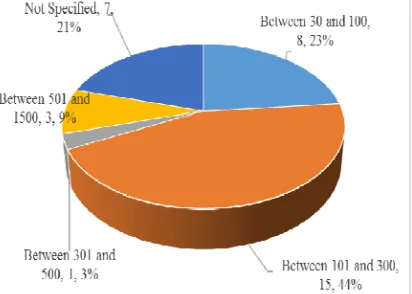
7.3 Sample sizes and research populations Students from higher education institutions constitute the research population of all the thirty-four (34) papers included in this review. Forty-thirty-four percent (44%) of the studies have a sample size between 101 and 300. Twenty-three (23%) have a sample size between 30 and 100. Twenty-one percent (21%) of the studies did not specify their sample size. Nine percent (9%) of the studies have a sample size between 501 and 1500, and three percent (3%) of the studies have a sample size between 301 and 500.
Figure 3: No. Of Papers Published Per Sample Size Interval
7.4 Research instruments
[image:5.612.316.522.474.621.2]2940 adopted their research instrument from Lee at al. (2002 and 2008), and the same applies for Goodhue and Thompson (1995), Sun et al. (2008), and Pintrich et al. (1991 and 2000).
Figure 4: No. Of Papers Published for the different Research Instruments (Scales)
7.5 Theories and models
Almost half (49%) of the studies included in this review did not specify their theoretical model or framework. Fifteen percent (15%) of the studies used a self-developed theoretical framework. Twelve percent (12%) of the studies adopted TAM as their theoretical framework. Six percent (6%) of the studies adopted Technology-to-performance chain model, and the same applies for Information systems success model, as well as the structural equation model
Figure 5: No. Of Papers Published Per Theory or Model
7.6 Analysis methods
Fifty percent (50%) of the studies included in this review used Pearson correlation as their
[image:6.612.313.522.190.362.2]analysis method. Fourteen percent (14%) of the studies used SEM (structural equation modelling), twelve percent (12%) of the studies used t-test and the same applies to PLS (partial least square). Six percent (6%) of the studies used ANOVA and only one percent (1%) used ANCOVA. Three percent (3%) of the studies did not specify their analysis method.
Figure 6: No. Of Papers Published Per Research Method
7.7 Academic performance factors and the new conceptual model
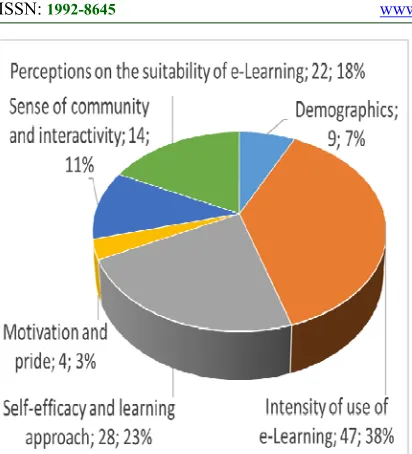
The different academic performance factor identified by the thirty-four (34) studies included in this review can be grouped into six (6) categories: a) Demographics; b) Intensity of use of e-Learning, c) Self-efficacy and learning approach, d) Sense of community and interactivity, e) Perceptions on the suitability of e-Learning, and f) Motivation, pride, and computer anxiety.
[image:6.612.91.300.495.666.2]2941
Figure 7: No. of factors affecting academic performance
7.7.1 Demographics
Six (06) studies [05, 06, 09, 16, 24, 32] from this review have studied the impact of six (6) demographic factors on academic performance in the e-Learning context. These six (06) demographic factors are Gender/sex, Age, Subject, Location setting, and On-line distance education experience. The findings from these six (6) studies differ on the existence and nature of the correlation between the above identified demographic factors and academic performance in the e-Learning context. For example, study number sixteen (16) and study number twenty-four (24) found that age does not have any effect on academic performance in the context of e-Learning, but study number nine (09) found that age has a negative effect on academic performance in the context of e-Learning. Further details on these correlations can be seen on Table 1.
Table 1: Demographic factors
No Variable(s) Result
05 On-line distance education
experience POC
06 Gender
Location setting Subject
POC POC POC
09 Age NEC
16 Gender
Age NOC NOC
24 Age NOC
32 Gender POC
7.7.2 Intensity of use of e-Learning
Twenty (20) studies [01, 02, 03, 04, 06, 08, 09, 10, 16, 17, 18, 21, 23, 26, 27, 29, 30, 31, 32, 33]
[image:7.612.91.297.74.301.2]from this review have studied the impact of intensity of use of e-Learning on academic performance. The forty-one (41) e-Learning intensity of use factors identified by these twenty (20) studies are presented by Table 2. For example, some of these factors include the number of quiz viewed, the number of online classes, and the hours spent online. The findings from these studies differ on the existence and on the nature of the correlation between e-Learning intensity of use and academic performance. For example, study number one (01) found that the number of quiz viewed has a positive impact on academic performance in the e-Learning context, but study number eight (08) found that the number of quiz viewed does not have any effect on academic performance in the context of e-Learning. Further details on these correlations can be seen on Table 2
7.7.3 Self-efficacy and learning approach Fifteen (15) studies [02, 07, 09, 12, 15, 16, 19, 20, 21, 22, 24, 25, 28, 31, 32] from this review have studied the impact of self-efficacy and learning approach on academic performance in the e-Learning context. The twenty-six (26) self-efficacy and learning approach factors identified by these fifteen (15) studies are presented by Table 3. For example, some of these factors include internet self-efficacy, collaborative learning, and ability to use communication tools. The findings from these studies differ on the existence and on the nature of the correlation between self-efficacy and learning approach, and academic performance in the e-Learning context. For example, study number twenty-one (21) found that internet self-efficacy has a negative impact on academic performance in the e-Learning context.
Table 2: Intensity of use of e-Learning
N
o Variable(s) Result 01 Number of online sessions
Number of links viewed Number of quiz views Number of wiki views Largest period of inactivity Average time per session Irregularity of study interval Time until first activity Number of discussion posts Irregularity of study time
2942 08 Reading and posting messages
Quiz efforts
Number of files viewed Number of assignments viewed Number of Quizzes viewed Number of Chat talk
POC POC POC NOC NOC NOC
09 Number of online class NEC 10 Use of blended e-Learning NOC 16 Time spent on e-learning
Time spent on non-relevant readings
Time spent on relevant readings
NOC NOC NOC
17 Time Flexibility Time-On-Task Working time Time of the day
POC POC NOC NOC
18 Task-technology fit POC 21 Contribution of e-Learning
component in the overall Course structure
NOC
23 Use of Mac-CARE POC 26 Use of LearningSpace POC 27 Overall grade for all courses
Class participation Forum posting quantity Forum posting quality
POC POC NOC NOC
29 Total studying time in LMS POC 29 Regularity of learning interval in
LMS
POC
29 Number of downloads
Login frequency in LMS POC NOC 30 Participation in e-Learning POC 31 Engagement with peers and
teachers
POC
32 32
Task-Technology Fit LMS (WebCT) Utilization
POC NOC 33 Accessing tutorial resources
Virtual lectures accessed
[image:8.612.259.515.62.396.2]POC POC but study number thirty-two (32) found that internet self-efficacy has a positive effect on academic performance in the context of e-Learning. Further details on these correlations can be seen on Table 3.
Table 3: Self-efficacy and learning approach
No Variable(s) Result
02 Improved learning process POC 02 Self-Development Outcome NOC 07 Collaborative learning POC 09 Ability to work independently POC
09 Computer self-efficacy NEC
12 Level of assistance towards learning
POC
15 Level of learning assistance POC
16 ICT use ability NOC
16 Own efficiency estimation NOC
19 Intrinsic goal orientation POC
19 Self-efficacy for SRL POC
19 Self-efficacy for e-Learning POC 19 Ability to manage one’s learning
environment
POC
20 Self-regulated learning strategy POC 21 Student learning style POC 21 Ability to interact with other
students using e-learning NOC 22 Self-efficacy for learning and
performance POC
22 Verbal ability POC
22 Internet self-efficacy NEC
22 Intrinsic goal orientation POC 22 Ability to manage time and
studying environment
NOC
24 Computer self-efficacy NEC
24 Locus on control NEC
25 Ability to use communication
tools POC
28 Self-regulatory efficacy (moderate learning environment) NEC 31 Using collaborative learning POC
31 Self-regulation POC
32 Internet self-efficacy POC
7.7.4 Motivation and pride
Four (04) studies [16, 21, 25, 31] from this review have studied the impact of motivation and pride on academic performance in the e-Learning context. The four (4) motivation and pride factors identified by these four (4) studies are motivation, student self-motivation, autonomous motivation, and pride. The findings from these studies all agree that motivation and pride have a positive impact on academic performance in the e-Learning context.
2943 performance in the e-Learning context, but paper number thirty-one (31) found that interactions with instructors have a positive effect on academic performance in the context of e-Learning. Further details on these correlations can be seen on Table 4.
Table 4: Sense of community and interactivity
No Variable(s) Result
08 Content creation contribution Number of Chat talk
POC NOC 12 Level of assistance towards
building social community POC 21 Electronic feedback from
instructor
Contribution of e-Learning component in the overall Course structure
POC NOC
24 Feeling of belongness to a community as a results of the use of CMC
Metacognitive activity
POC
NOC 27 Creation of negative e-Learning
friends
Creation of positive e-Learning friends
Creation of neutral e-Learning friends
NEC
NOC
NOC
29 Interactions with peers
Interactions with instructor POC NOC 31 Interactivity with peers
Interactivity with instructor POC POC
7.7.6 Perceptions on the suitability of e-Learning
Eleven (11) studies [07, 09, 13, 15, 18, 20, 21, 22, 24, 28, 31] from this review have studied the impact of perceived e-Learning suitability on academic performance. The sixteen (16) perceived e-Learning suitability factors identified by these eleven (11) are presented by appendix A. For example, some of these factors include perceived usefulness of e-Learning and e-Learning satisfaction. The findings from these studies differ on the existence and nature of the correlation between the identified perceptions on the suitability of e-Learning and academic performance. For example, study number seven (7), thirteen (13), twenty-one (21), twenty-four (24), and twenty-eight (28) all agree that e-Learning satisfaction has a positive impact on academic performance, but study number twenty (20) found that e-Learning satisfaction has no impact on academic performance. Further details on these correlations can be seen on Table 5.
Table 5: Perceptions on the suitability of e-Learning
No Variable(s) Result
07 Students’ satisfaction with LMS POC 09 Perceived ease of use of
e-learning
Perceived usefulness of e-learning
POC NEC
11 Perceived compatibility POC
12 Level of assistance towards
learning POC
13 Perceived satisfaction Perceived convenience Perceived engagement Perceived learning
POC POC POC POC 15 Level of learning assistance POC 18 Perceived impact on learning NOC 20 Satisfaction with e-Learning
system NOC
21 Electronic feedback from instructor
User satisfaction
Instructor knowledge and facilitation
POC POC NOC
22 Verbal ability Help seeking
POC NEC 24 Perceptions on the reliability of
e-Learning technology
Perceptions on e-Learning technologies ability to support group work
E-Learning Satisfaction
POC
POC
POC 28 Satisfaction with learning
environment POC
31 Enjoyment POC
7.7.7 New conceptual model
2944
Figure 8: The new conceptual model
The influence of students’ demographics and their intensity of use of e-Learning on their academic performance is supported by the Welberg’s theory of education. Similarly, the influence of students’ motivation and their sense of pride on their academic performance is supported by the self-determination theory. On the other hand, the self-regulated theory is justifying the influence of self-efficacy and learning approach on academic performance. Similarly, the task technology fit theory supports the relationship between student perceptions on the suitability of e-Learning and their academic performance in the e-Learning context. Finally, the social constructivism theory links students’ sense of community and interactivity to their academic performance.
Figure 9: Theoretically sound model of factorsaffecting academic performance in the e-Learning context
7.7.8 Theoretically sound model of factors affecting academic performance in the e-Learning context
Welberg's theory of educational productivity (1981 and 1984) posits that there are nine factors which contribute to variances in students' cognitive and affective outcomes: ability or prior achievement, age or stage of maturity, motivation or self-concept, amount of time, quality of the instructional experience, the home, the classroom social group, the peer group outside school, and the
use of time outside school. These factors influence one another, and they are also influenced by learner’s academic performance (Welberg, 1984).
According to Kusurkar et al., (2013), the Self-Determination Theory (SDT) advocates that the more determined, motivated, and self-directed are students, the more improved are their academic performance, their adjustment, and their overall well-being. SDT considers the quality of motivation to be more important than its quantity. As for Black and Deci (2000), SDT suggests that motivated behaviors are either autonomous or controlled.
According to Yu and Jo (2014:269), social constructivism is one the fundamental theories for educational technology, where “learning is a self-developing process by creating or reorganizing a concept or cognitive structure” using learners’ experiences and beliefs. Dagar and Yadav (2016) define social constructivism as an epistemological view of knowledge acquisition, in which social interaction has a central role in the learning process. Social constructivism focuses both on the learning environment and on learners’ ability to self-reflect on subject matters. It proposes that learning happens because of the replication of previous experiences by learners, and because of their cultural, physical, and social settings.
The task-technology fit theory (TTFT) suggests that information systems affect users’ performance depending upon the fit between the users’ task requirements and the functionality of the system (Goodhue and Thompson, 1995). According to Staples and Seddon (2004), TTFT also suggests that the impact on users’ performance depends on the fit between the individual characteristics of the users and the functionality of the system. The bottom line of the task-technology theory is that the performance of a technology and its utilisation directly depend on how it fits with the task at hand.
[image:10.612.92.296.440.571.2]2945 behavior for his or her personal goals and achievements (Schunk, 2000). In the SRLT, motivated students display a high level of effort and persistence, they develop a high level of interest in their learning, as well a high level of self-confidence to learn how to achieve their tasks (Schunk, 1986).
8. LIMITATIONS AND CONTRIBUTION OF
THE CURRENT STUDY
This new conceptual framework has the merit of being well supported theoretically and it proposes some key factors that affect the academic performance of students and were not mentioned by the four previous above presented reviews. These theories are the Walberg's theory of educational productivity, the self-determination theory, the social constructivism, the task-technology fit theory, and the self-regulated learning theory. These new factors are demographics, intensity of use of e-Learning, self-efficacy and learning approach, sense of community and interactivity, perceptions on the suitability of e-Learning, and motivation and pride.
The proposal of a new theoretically sound conceptual model of academic performance factors in the e-Learning context is the main innovation of this study compared to the four above presented reviews, in addition to the fact that these reviews have a narrow focus. In fact, all the studies reviewed by Broadbent and Poon (2015) are only focusing on self-regulated learning. On the other hand, all the studies reviewed by Lahti et al. (2012) are only focusing on nursing students. However, the fact that this review only made use of free research studies downloadable from the internet can be seen as one of its main limitation.
For those who would like to find out how is this newly proposed model working, the answer is quite simple. This model simply states that, according to the existing literature, the impact of e-Learning on the academic performance of a student is influenced by:
i) The demographic background of that student ii) The intensity of use of e-Learning by that
student
iii) The motivation and pride of that student iv) The level of self-efficacy in the learning
approach of that student
v) The sense of community and interactivity of that student, and
vi) The perceptions of that student on the suitability of e-Learning.
This conceptual model may be important for various stakeholders in the high education sector should they want to find out more on the factors that are affecting the impact of e-Learning on academic performance. Researchers may also use this conceptual model for future research on the impact of e-Learning on academic performance. Moreover, researchers who will not read this paper will not be made aware of the latest factors that are affecting academic performance in the context of e-Learning nor of the theoretical foundations of these effects.
Another way of judging the contribution of this paper is by comparing its findings with the findings of the four above reviewed studies. The findings of this study are summarising the academic performance factors in the context of e-Learning into six variables: students’ demographic background, their intensity of use of e-Learning, their motivation and pride, their level of self-efficacy in the learning approach, their sense of community and interactivity, and their perceptions on the suitability of e-Learning.
The literature review conducted by Bernard et al. (2004) is not looking at the factors that may affect academic performance in the context of e-Learning, but it is reviewing existing literature on how synchronous and asynchronous distance education and face-to-face learning may have an impact on students’ achievement outcomes.
As for Li and Ma (2010), its findings are summarising existing literature on the impact of e-Learning on academic performance. The literature review conducted by Lahti et al., (2014) is not looking at the factors that may affect academic performance in the context of e-Learning, but its summarises existing literature on the impact of e-Learning on students’ knowledge level, their learning skills level, and their learning methods’ satisfaction.
2946 their rehearsal, their organization, their critical thinking, and their help seeking abilities.
It is important to compare the conceptual model of this study with existing classical technology adoption models such as the Technology Acceptance Model (TAM) and Unified Theory of Acceptance and Use of Technology (UTAUT) whose main focus is on technology acceptance, ease of use, and usefulness. A quick analysis of the conceptual framework of this study shows that its component on the intensity of use of e-Learning includes the technology acceptance factor (see table 2), and its component on perception on the suitability of e-Learning includes the ease of use and usefulness factors (see table 5).
9. RECOMMENDATIONS FOR FUTURE
RESEARCH
This review has unearthed evidence from existing literature on the factors affecting instructors’ perceptions on the impact of e-Learning on academic performance. Unfortunately, the findings from the reviewed studies differ on the existence and nature of the correlation between e-Learning and most of the identified factors. More research is therefore needed on reasons behind these conflicting results.
10. CONCLUSION
This study has shown that the examination of existing e-Learning literature can be used as a tool for the construction of a conceptual framework of the factors affecting instructors’ perceptions on the impact of e-Learning on academic performance. The conceptual model proposed by this study claims that, in the context of e-Learning, students’ academic performance is influenced by their demographic profile, their intensity of use of e-Learning, their motivation and pride, their perceptions on the suitability of e-Learning, their sense of community and interactivity, and their self-efficacy and learning approach. This conceptual framework is supported by five theories: The Welberg’s theory of education, the self-regulated theory, the self-determination theory, the social constructivism theory, and the task technology fit theory. Nevertheless, more empirical research projects are required in order to test the validity of this framework. More research is also needed on the factors that are identified by certain studies as influencers of academic performance in the e-Learning context while other studies are exhibiting different results on these factors. This
study acknowledges its two main limitations: the use of google scholar as the sole database for the selection of its studies, and the fact that it does not incorporated many studies published between 2016 and 2018.
REFRENCES:
[1] Guri-Rosenblit, Sarah. "‘Distance education’and ‘e-learning’: Not the same thing." Higher education 9, no. 4 (2005): 467-493.
[2] Zhang, Dongsong, and Jay F. Nunamaker. "Powering e-learning in the new millennium: an overview of e-learning and enabling technology." Information systems frontiers 5, no. 2 (2003): 207-218.
[3] Hrastinsky, S. "Asynchronous and synchronous e-learning. Educause." (2008).
[4] Cantoni, Virginio, Massimo Cellario, and Marco Porta. "Perspectives and challenges in e-learning: towards natural interaction paradigms." Journal of Visual Languages & Computing 15, no. 5 (2004): 333-345.
[5] Bouhnik, Dan, and Tali Marcus. "Interaction in distance-learning courses." Journal of the American Society for Information Science and Technology 57, no. 3 (2006): 299-305.
[6] Sadler, E., and B. J. Erasmus. "The academic success and failure of black chartered accounting graduates in South Africa: A distance education perspective." Meditari Accountancy Research 13, no. 1 (2005): 29-50. [7] Bennedsen, Jens, and Michael E. Caspersen.
"Failure rates in introductory programming." AcM SIGcSE Bulletin 39, no. 2 (2007): 32-36. [8] Selingo, Jeffrey J. “College (un) bound: The
future of higher education and what it means for students.” Houghton Mifflin Harcourt, 2013.
[9] Bernard, Robert M., Philip C. Abrami, Yiping Lou, Evgueni Borokhovski, Anne Wade, Lori Wozney, Peter Andrew Wallet, Manon Fiset, and Binru Huang. "How does distance education compare with classroom instruction? A meta-analysis of the empirical literature."
Review of educational research 74, no. 3
(2004): 379-439.
[10] Li, Qing, and Xin Ma. "A meta-analysis of the effects of computer technology on school students’ mathematics learning." Educational Psychology Review 22, no. 3 (2010): 215-243. [11] Lahti, Mari, Heli Hätönen, and Maritta
2947 satisfaction: a systematic review and meta-analysis." International journal of nursing studies 51, no. 1 (2014): 136-149.
[12] Broadbent, Jim, and W. L. Poon. "Self-regulated learning strategies & academic achievement in online higher education learning environments: A systematic review."
The Internet and Higher Education 27 (2015):
1-13.
[13] Ford, James D., Lea Berrang-Ford, and Jaclyn Paterson. "A systematic review of observed climate change adaptation in developed nations." Climatic change 106, no. 2 (2011): 327-336.
[14] Conijn, Rianne, Chris Snijders, Ad Kleingeld, and Uwe Matzat. "Predicting student performance from LMS data: A comparison of 17 blended courses using Moodle LMS." IEEE Transactions on Learning Technologies 10, no. 1 (2017): 17-29.
[15] Fayomi, Oluyemi Oyenike, C. K. Ayo, Lady A. Ajayi, and Uchechukwu Emenas Okorie. "The Impacts of E-Learning in Facilitating Academic Performance Among Private Secondary Schools and Tertiary Institutions in Ota, Ogun State, Nigeria." (2015).
[16] Regueras, Luisa M., Elena Verdu, MarÍa F. Munoz, MarÍa A. Perez, Juan P. de Castro, and MarÍa JesÚs Verdu. "Effects of competitive e-learning tools on higher education students: A case study." IEEE Transactions on Education 52, no. 2 (2009): 279-285.
[17] Chong, CheeKeong, CheeHeong Lee, YouHow Go, and CheeHoong Lam. "Factors affecting the usage of WBLE (Web-Based Learning Environment): A Malaysian private university experience." In Proceedings of the International Conference on e-Learning, 2010. pp. 64-71.
[18] Dodd, Charlene, Dale Kirby, Tim Seifert, and Dennis Sharpe. "The impact of high school distance e-learning experience on rural students’ university achievement and persistence." Online Journal of Distance Learning Administration 12, no. 1 (2009): 1-12.
[19] Owinoi. O.S. “Impact of e-learning on academic perormance - A case study of group learning.” 2016 (Unpublished Journal)
[20] Othman, M. S., & Musa, M. A. “The improvement of students’ academic performance by using social media through collaborative learning in Malaysian higher
education.” Asian Social Science 10, no. 8, (2014): 210.
[21] Zacharis, N. Z. “A multivariate approach to predicting student outcomes in web-enabled blended learning courses.” The Internet and Higher Education 27, no. 1, (2015), 44-53. [22] Galy, E., Downey, C., & Johnson, J. The effect
of using e-learning tools in online and campus-based classrooms on student performance. Journal of Information Technology Education 10, no.1, (2011): 210-230.
[23] Al-Saai, A., Al-Kaabi, A., & Al-Muftah, S. “Effect of a blended e-learning environment on students’ achievement and attitudes toward using e-learning in teaching and learning at the university level”. International Journal for
Research in Education (IJRE) 29, no: 1,
(2011): 34-55.
[24] Owston, R., York, D., & Murtha, S. “Student perceptions and achievement in a university blended learning strategic initiative.” The
Internet and Higher Education 18, no:1,
(2013): 38-46.
[25] Islam, A. N. “Understanding e-learning system usage outcomes in hybrid courses.” In System Science (HICSS), 2012 45th Hawaii
International Conference on IEEE. (2012,
January) pp. 118-127.
[29] Castillo-Merino, D., & Serradell-López, E. “An analysis of the determinants of students’ performance in e-learning.” Computers in
Human Behavior 30, no:1 (2014): 476-484.
[30] Romero Velasco, M., & Barberà Gregori, E. “Quality of Learners' Time and Learning Performance Beyond Quantitative Time-on-Task.” (2011).
[31] McGill, T. J., & Klobas, J. E. “A task– technology fit view of learning management system impact.” Computers & Education 52, no: 2, (2009)” 496-508.
[32] Sharma, Sheryl, Geoffrey Dick, Wynne W. Chin, and Lesley Land. "Self-Regulation and E-Learning." In ECIS, (2007): pp. 383-394. [33] Lee, J. K. “The effects of self-regulated
learning strategies and system satisfaction regarding learner's performance in e-learning environment.” Journal of Instructional Pedagogies 1, (2009): 30.
2948 Decision Sciences Journal of Innovative Education 4, no: 2, (2006): 215-235.
[35] Lynch, R., & Dembo, M. “The relationship between self-regulation and online learning in a blended learning context.” The International Review of Research in Open and Distributed Learning 5, no: 2, (2004).
[36] Johnson, J., & Galy, E. “The use of E-learning tools for improving Hispanic students' academic performance.” Journal of Online Learning and Teaching, 9, no: 3, (2013): 328. [37] Giesbers, B., Rienties, B., Tempelaar, D., &
Gijselaers, W. “Investigating the relations between motivation, tool use, participation, and performance in an e-learning course using web-videoconferencing.” Computers in Human Behavior, 29, no: 1, (2013): 285-292.
[38] Ladyshewsky, R. K. “E-learning compared with face to face: differences in the academic achievement of postgraduate business students. [This article is an expanded and revised version of a previously published article entitled'Online learning versus face to face learning: What is the difference?'In Seeking Educational Excellence.” Proceedings of the Teaching and Learning Forum (13th: 2004: Murdoch University, Perth).]. Australasian Journal of Educational Technology 20, no:3, (2004): 316. [40] Yang, H. L., and Tang, J. H. "Effects of social
network on students' performance: a web-based forum study in Taiwan." Journal of
Asynchronous Learning Networks 7, no. 3
(2003): 93-107.
[41] Lee, J. K., & Lee, W. K. “The relationship of e-Learner’s self-regulatory efficacy and perception of e-Learning environmental quality.” Computers in Human Behavior, 24, no: 1, (2008): 32-47.
[42] Yu, T., & Jo, I. H. “Educational technology approach toward learning analytics: Relationship between student online behavior and learning performance in higher education.” In Proceedings of the Fourth International Conference on Learning Analytics and
Knowledge, (2014, March). (pp. 269-270).
[43] Michinov, N., Brunot, S., Le Bohec, O., Juhel, J., & Delaval, M. Procrastination, participation, and performance in online learning environments. Computers & Education, 56, no: 1, (2011): 243-252.
[44] Al-Rahmi, W., & Othman, M. “The impact of social media use on academic performance among university students: A pilot study.
Journal of information systems research and innovation 4, no: 12, (2013): 1-10.
[45] McGill, T., Klobas, J., & Renzi, S. “The relationship between LMS use and teacher performance: The role of task-technology fit.” ACIS 2008 Proceedings, (2008): 82.
[46] Villavicencio, F. T., & Bernardo, A. B. “Positive academic emotions moderate the relationship between self-regulation and academic achievement.” British Journal of Educational Psychology, 83, no: 2, (2013): 329-340.
[47] Chang, C. S., Liu, E. Z. F., Sung, H. Y., Lin, C. H., Chen, N. S., & Cheng, S. S. “Effects of online college student’s Internet self-efficacy on learning motivation and performance.” Innovations in education and teaching international 51, no: 4, (2014): 366-377.
[48] Crampton, A., Ragusa, T. A., & Cavanagh, H. “Cross-discipline investigation of the relationship between academic performance and online resource access by distance education students.” Research in Learning Technology, 20, no: 1, (2012): 14430.
[49] Watson, W. R., & Watson, S. L. “What are learning management systems, what are they not, and what should they become.” TechTrends, 51, no: 2, (2007): 29.
[50] Welberg, H.J. “Improving the productivity of America's schools.” Educational leadership, 41, no: 8, (1984): pp.19-27.
[51] Kusurkar, R.A., Ten Cate, T.J., Vos, C.M.P., Westers, P. and Croiset, G. “How motivation affects academic performance: a structural equation modelling analysis.” Advances in health sciences education, 18, no: 1, (2013): pp.57-69.
[52] Black, A.E. and Deci, E.L. “The effects of instructors' autonomy support and students' autonomous motivation on learning organic chemistry: A self-determination theory perspective.” Science education, 84, no: 6, (2000): pp.740-756.
[53] Dagar, V., and Yadav, A. “Constructivism: A paradigm for teaching and learning.” Arts Social SciJ 7, (2016). 200.
[54] Goodhue, D.L. and Thompson, R.L. “Task-technology fit and individual performance.” MIS quarterly, 19, no: 2, (1995) pp.213-236. [55] Staples, D.S. and Seddon, P. “Testing the
2949
Computing (JOEUC) 16, no: 4, (2004):
pp.17-36.
[56] Schunk, D.H. and Ertmer, P.A. “Self-regulation and academic learning: Self-efficacy enhancing interventions.” In Handbook of self-regulation (2000): pp. 631-649)
2950 APPENDIX A: LIST OF REVIEWED PAPERS
Study No. Authors and Year
Findings
1. Conijn (2017)
23 variables such as:
Number of online sessions – POC; Number of links viewed – POC; Number of quiz views – POC; Number of wiki views – POC; Largest period of inactivity – NEC; Average time per session – NEC; Irregularity of study interval – NEC; Time until first activity – NEC; Number of discussion posts – NOC; Irregularity of study time – NOC
2. Fayomi (2015)
Studying through e-learning – POC; Improved learning process – NOC; Self—Development Outcome – NOC 3. Regueras et
al (2009)
Use of QUEST e-Learning tool – POC
4. Chong
(2010) Use of WBLE e-Learning tool – NEC 5. Dodd (2009) On-line distance education
experience (compared to traditional distance education experience) – POC
6. Owinoi (2016)
Hours spent online – POC; Gender – POC; Location setting – POC Subject – POC
7. Othman (2014)
Collaborative learning – POC; Students’ satisfaction with LMS – POC
8. Zacharis (2015)
29 variables such as:
Reading and posting messages – POC; Content creation contribution – POC; Quiz efforts – POC; Number of files viewed – POC; Number of assignments viewed – NOC; Number of Quizzes viewed – NOC; Number of Chat talk – NOC 9. Galy et al
(2011)
Perceived ease of use of e-Learning – POC; Ability to work
independently – POC; Perceived usefulness of e-learning – NEC; Computer self-efficacy – NEC; Age – NEC; Number of online class – NEC; Computer Anxiety – NOC
10. Al-Saai et al (2011)
Use of blended e-Learning – NOC
11. Islam (2015) Perceived compatibility – POM 12. Islam (2013) Level of assistance towards
learning – POC; Level of assistance towards building social community – POC
13. Owston et al (2012)
Perceived satisfaction – POC; Perceived convenience – POC Perceived engagement – POC; Perceived learning – POC
14. Islam (2012) Level of learning assistance – POC 15.
Castillo-Merino and Serradell-López (2013)
Motivation – POC; Time spent on e-learning – NOC
ICT use ability – NOC; Time spent on non-relevant readings – NOC Time spent on relevant readings – NOC; Own efficiency estimation – NOC; Sex – NOC; Age – NOC 16. Romero and
Barbera (2011)
Time Flexibility – POC; Time-on-Task – POC; Working time – NOC; Time of the day – NOC
17. McGill and Klobas (2008)
Task-technology fit – POC; Perceived impact on learning – NOC
18. Sharma
(2007) Intrinsic goal orientation – POC; efficacy for SRL – POC; Self-efficacy for e-Learning – POC; Ability to manage one’s learning environment – POC
19. Lee (2009) Self-regulated learning strategy – POC; Satisfaction with e-Learning system – NOC
20. Eom (2006) Student self-motivation – POC; Student learning style – POC; Electronic feedback from instructor – POC; User satisfaction – POC; Instructor knowledge and facilitation – NOC; Ability to interact with other students using learning – NOC; Contribution of e-Learning component in the overall Course structure – NOC 21. Lynch and
Dembo (2004)
Self-efficacy for learning and performance – POC; Verbal ability – POC; Help seeking – NEC; Internet self-efficacy – NEC; Intrinsic goal orientation – NOC; Ability to manage time and studying environment – NOC 22. Bianchi et al
(2008) Use of Mac-CARE – POC 23. Johnson et al
(2009)
Perceptions on the reliability of e-Learning technology – POC; Perceptions on e-Learning technologies ability to support group work – POC; Feeling of belongness to a community as a result of the use of CMC – POC; Level of interaction with other students using e-learning – POC; E-Learning Satisfaction – POC; Computer self-efficacy – NEC; Locus on control – NEC; Age1 – NOC; Metacognitive activity – NOC
24. Giesbers et al (2013)
2951
APPENDIX A (CONT’D.): LIST OF
REVIEWED PAPERS
25. Ladyshewsky (2004)
Use of LearningSpace – POC
26. Yang and Tang (2003)
Overall grade for all courses – POC; Class participation – POC; Creation of negative e-Learning friends – NEC; Creation of positive e-Learning friends – NOC; Creation of neutral e-Learning friends – NOC; Case based learning – NOC; Forum posting quantity – NOC; Forum posting quality – NOC
27. Lee and Lee (2008)
Satisfaction with learning
environment – POC; Self-regulatory efficacy (moderate learning environment) – NEC 28. Yu and Jo
(2014)
Total studying time in LMS – POC; Regularity of learning interval in LMS – POC; Number of downloads – POC; Interactions with peers – POC; Login frequency in LMS – NOC;
Interactions with instructor – NOC 29. Michinov et al
(2010) Participation in e-Learning – POC; Procrastination to participate in e-Learning – NEC
30. Al-Rahim and Othman (2013)
Interactivity with peers – POC; Interactivity with the teacher – POC; Engagement with peers and teachers – POC; Using collaborative learning – POC
31. McGill et al (2008)
Task-Technology Fit – POC; LMS (WebCT) Utilization – NOC 32. Villavicencio
and Bernardo (2013)
Self-regulation – POC; Enjoyment – POC; Pride – POC
33. Chang (2014) Internet self-efficacy – POC; Gender1 (Females) – POC
34. Crampton et al (2012)