Technology (IJRASET)
Unmanned Terrain with Rocker
Bogie Suspension
Aditya.V Mechatronics, MGIT
Abstract: A rover is a vehicle for driving over rough terrain, especially one driven by remote control over extraterrestrial terrain. Robotic rovers are used extensively for exploratory and reconnaissance purposes in the fields of scientific exploration and defense. This project focuses on the design and development of a rover with autonomous driving and environmental sensing capability. It can be used as an exploratory rover, providing information about the terrain and surrounding atmosphere. It can also be used as a surveillance robot to alert people in areas with security threats like national borders, terrorist occupied territories etc., where it is difficult for humans to work. The rover will be having a Rocker Bogie Suspension system with 6 wheels for greater stability in maneuvering over obstacles. It can avoid un-mountable obstacles and can traverse over mountable obstacles. Instructions are sent to the rover by a remote computer connected over Wi-Fi. The rover is equipped to send a live video feed and sensor data to the remote computer.
Keywords: Rocker, Bogie, Suspension, Terrain, Rover, Micro Controller, Sensor, Arduino, Raspberry Pi
I. INTRODUCTION
[image:2.612.254.360.424.504.2]Robotic rovers and other remotely operated vehicles (ROVs) are an application of Tele robotics. Tele robotics is the area of robotics concerned with the control of semi-autonomous robots from a distance, chiefly using Wireless network (like Wi-Fi, Bluetooth, the Deep Space Network, and similar) or tethered connections. It is a combination of two major subfields, operation and tele-presence. Rovers were used and are extensively being used for planetary exploration and military operations. They create an opportunity to make scientific experiments at places where it is impossible for humans to explore.
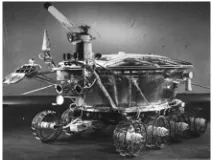
Figure 1.1 Lunokhod Rover
A. Rovers In Exploration
Technology (IJRASET)
reach another planet. NASA, the space agency of the United States, launched Mars Pathfinder on 1996-12-04; it landed on Mars in a region called Chryse Planitia on 1997-07-04.[15] From its landing until the final data transmission on 1997-09-27, Mars Pathfinder returned 16,500 images from the lander and 550 images from Sojourner, as well as data from more than 15 chemical analyses of rocks and soil and extensive data on winds and other weather factors.
[image:3.612.326.459.138.272.2]
Fig 1.2 Sojourner rover on Mars Fig 1.3 Spirit rover (Artist's conception)
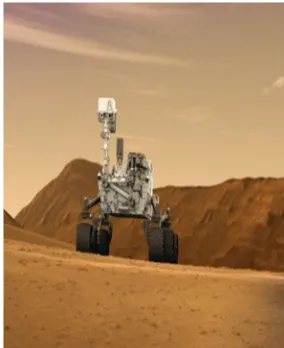
Spirit shown in figure1.3 is a robotic rover on Mars, active from 2004 to 2010. It was one of two rovers of NASA's ongoing Mars Exploration Rover Mission. It landed successfully on Mars at 04:35 Ground UTC on January 4, 2004, three weeks before its twin, Opportunity (MER-B), landed on the other side of the planet. Its name was chosen through a NASA-sponsored student essay competition. The rover became stuck in late 2009, and its last communication with Earth was sent on March 22, 2010. Opportunity is a robotic rover on the planet Mars, active since 2004. It is the remaining rover in NASA's ongoing Mars Exploration Rover Mission. Launched from Earth on July 7, 2003, it landed on the Martian Meridiani Planum on January 25, 2004 at 05:05 Ground UTC (about 13:15 local time), three weeks after its twin Spirit (MER-A) touched down on the other side of the planet. On July 28, 2014, NASA announced that Opportunity, after having traveled over 40 km (25 mi) on the planet Mars, has set a new "off-world" record as the rover having driven the greatest distance, surpassing the previous record held by the Soviet Union's Lunokhod 2 rover that had traveled 39 km (24 mi) On 26 November 2011, NASA's Mars Science Laboratory mission was successfully launched for Mars. The mission successfully landed the rover Curiosity shown in figure1.4 on the surface of Mars in August 2012, whereupon the rover is currently helping to determine whether Mars could ever have supported life, and search for evidence of past or present life on Mars. The rover's goals include: investigation of the Martian climate and geology; assessment of whether the selected field site inside Gale Crater has ever offered environmental conditions favorable for microbial life, including investigation of the role of water; and planetary habitability studies in preparation for future human exploration. Curiosity is quoted to be the most sophisticated rover ever built by NASA Administrator Charles Bolden. It is also the inspiration behind this project.
[image:3.612.225.367.527.701.2]
Technology (IJRASET)
II. LITERATURE SURVEY
[image:4.612.211.402.114.253.2]A. The Rocker Bogie Suspension
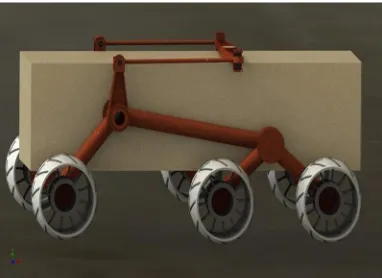
Figure 2.1 - Rocker Bogie Suspension
The Rocker-Bogie system has been the suspension arrangement used in the Mars rovers. It is currently NASA's favored design. The term “rocker” comes from the rocking aspect of the larger links on each side of the suspension system. These rockers are connected to each other and the vehicle chassis through a differential. Relative to the chassis, when one rocker goes up, the other goes down. The chassis maintains the average pitch angle of both rockers. One end of a rocker is fitted with a drive wheel and the other end is pivoted to a bogie. The term “bogie” refers to the links that have a drive wheel at each end. Robots using rocker bogie mechanism makes use of a suspension mechanism that consists of several rigid elements connected through joints of a certain number of degrees of freedom (DOF) resulting in a structure that has one system DOF. This enables them to move along uneven terrain without losing contact with the ground. The suspension has 6 wheels with symmetric structure for both sides. Each side has 3 wheels which are connected to each other two with links. The main linkage called rocker has 2 joints while first joint is connected to front wheel, the other joint is assembled to another linkage called bogie, which is similar to train wagon suspension member.
1) Advantages: Load on each wheel is nearly identical.
Has no axles or springs which helps to maintain equal traction force on all the wheels.
Can climb over blocks twice the height of the wheel while keeping all 6 wheels on the ground. Each wheel can individually lift almost the entire mass.
Distributing the weight and drive torque to six wheels instead of four, gives the rover greater traction and stability.
As with any suspension system, the tilt stability is limited by the height of the center of gravity. Most of the mechanical construction of the chassis involves the suspension components. The main body is a box that houses the electronics and batteries. The chassis of the rover is constructed using nylon plastic sheet which houses all the electronics. The rocker arm and bogie are constructed using Cpvc pipes
After a literature survey about the dimensions to be considered in a rocker bogie system, the following points were selected.
Generally a rocker-bogie system can lead to uneven wheel loads but this can be counteracted when using the setup, more exactly the bogie must be sized to be half of the rocker arm length and the chassis mounting point of the rocker arm has to be at one third of the arm’s length.
Technology (IJRASET)
Figure 2.2 - Different views of structure Figure 2.3 Calculating different parameters If all other dimensions are kept the same, varying the height H, in below figure also varies
the angle ‘θ’. As the value of θ increases and becomes close to 90°, the forces required to keep the rover system rigid become
exponentially increased.
Further modification to the design is made to simplify the structure and the differential arm is attached to the top of the suspension system in line with the bearing mounting point. This eliminates the tie rod between the differential arm and the bearing assembly. A lag screw is instead used to serve the purpose of a tie rod.
B. Construction
1) Mechanical Components: CPVC Pipes Nylon (Polyamide)
Ball Bearings Nuts and Bolts Wheels
2) Electronic Components: Raspberry Pi Arduino Uno
ATmega 328 DC MOTORS
L298N MOTOR DRIVERS ULTRASONIC SENSOR
BAROMETRIC PRESSURE SENSOR (BMP 180) Webcam
III. OPERATIONAL BLOCK DIAGRAMS
A. Interfacing Microcontroller With Ultrasonic Sensors And Motor Drivers To Run Motors
Technology (IJRASET)
B. Interfacing Raspberry Pi With Wifi Dongle, USB Webcam And Barometric
[image:6.612.43.536.149.278.2]1) Pressure Sensor: The Raspberry Pi is made to act like a web server to stream data on request. It is made to stream live video data continously and sensor values upon request. The required 5v and 2A supply to the rasberry Pi is given through the UBEC from the lead acid battery. The block diagram is shown in figure 3.24
Figure 3.3
IV. RESULTS AND DISCUSSION
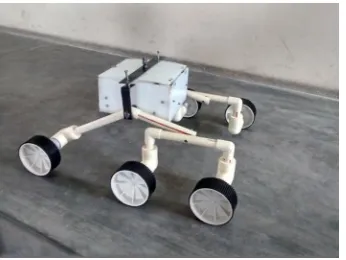
[image:6.612.102.275.358.488.2] [image:6.612.327.499.358.486.2]The unmanned terrain rover with rocker bogie suspension system is constructed and is tested in different terrains. The completed structure is shown in figure 5.1
Figure 4.1 Completed Mechanical Structure Figure 4.2 Getting down from a height
The rover is tested over various terrains and its operation is found to be satisfactory. As expected, it evades un mountable obstacles and traverses over obstacles which are less than 1.5 times the size of its wheel diameter. Following pictures show the rover traversing obstacles.
[image:6.612.177.416.564.695.2]Technology (IJRASET)
Figure 4.4
The sensor information is obtained by the remote computer in its graphical user interface.
V. APPLICATIONS AND SCOPE
A. Applications
The project focuses on developing a platform which can be used for many applications. The rover can travel in uneven terrain autonomously with the help of the rocker bogie suspension system and the sensor values obtained from the rover help in evaluating the atmospheric conditions present around the rover. It can be used for exploration in places which require continuous environmental and video surveillance. Reconnaissance is one of the major applications of such rovers. It can also be used for geological mapping of unknown terrain as it can even provide live video feed and images of the terrain being explored. Information about the terrain and the climate around it can be studied and recorded for mapping.
B. Future Scope
One of the main problems of this rover is the limitation offered by the battery power and the communication range. When these limitations are answered by using solar panels to charge the battery and mobile data cards for internet connectivity, the rover can be made operational in real time and can be left in a remote terrain for continuous operation. With higher computing electronics, a higher level of autonomy can be given to the rover in navigation by using GPS modules and path planning algorithms. Devices and subsystems like autonomous robotic arm, stereo camera and various useful sensors can also be attached to the rover to further enhance its functionality.
VI. CONCLUSION
The unmanned terrain rover with rocker bogie suspension is completed successfully and its operation is tested and found to be correct. The main objective of the project, which is to show that – like the sophisticated planetary rovers which are deployed to explore other planets, rovers can also be made at a lower cost, with commercial off- the-shelf components to explore our own Earth and help us in better ways, is accomplished.
VII. ACKNOWLEGEMENT
During this project we have had support from a large number of people to whom we owe great amount of gratitude. There is however one person, our mentor Mr. Abdul, who made this report work possible and who supported and pushed us throughout the whole process. Therefore a special recognition goes out to him, Thank You!
REFERENCES
[1] Joseph L. Amato, Jon J. Anderson, Thomas J. Carlone and Michael E. Fagan, “ORYX 2.0: A Planetary Exploration Mobility Platform”, Worcester Polytechnic Institute, April 2011.
[2] Tom Corona, Chris Gumm, Kevin Hummel, Nick Socky, Jason Duane, Jimmy Congleton, Joe Haslem and Matt Canavra, “Team PYREX 2014 Robo-Ops Final Technical Report”, VirginiaTech college of Aerospace Engineering, 2014.
Technology (IJRASET)
[4] Richard Grimmett, “Raspberry Pi Robotic Projects”, Packt Publishing, First Edition, February 2014.
[5] David P. Miller and Tze-Liang Lee, “High-Speed traversal of Rough Terrain Using a Rocker Bogie Mobility System”, School of Aerospace & Mechanical Engineering, University of Oklahoma.
[6] Firat Barlas, “Design of a Mars Rover Suspension Mechanism”, Izmir Institute of Technology, June 2004.
AUTHOR PROFILE