economic impact of home telemonitoring in
chronic heart failure
–
CardioBBEAT
Hofmann
et al.
Hofmannet al. Trials (2015) 16:343
M E T H O D O L O G Y
Open Access
First outline and baseline data of a randomized,
controlled multicenter trial to evaluate the health
economic impact of home telemonitoring in
chronic heart failure
–
CardioBBEAT
Reiner Hofmann
1, Heinz Völler
2,3, Klaus Nagels
1, Dominik Bindl
1*, Eik Vettorazzi
4, Ronny Dittmar
1,5,
Walter Wohlgemuth
1,6, Till Neumann
7, Stefan Störk
8, Oliver Bruder
9, Karl Wegscheider
4, Eckhard Nagel
1,
Eckart Fleck
10and on behalf of the CardioBBEAT Investigators
Abstract
Background:Evidence that home telemonitoring for patients with chronic heart failure (CHF) offers clinical benefit over usual care is controversial as is evidence of a health economic advantage.
Methods:Between January 2010 and June 2013, patients with a confirmed diagnosis of CHF were enrolled and randomly assigned to 2 study groups comprising usual care with and without an interactive bi-directional remote monitoring system (Motiva®). The primary endpoint in CardioBBEAT is the Incremental Cost-Effectiveness Ratio (ICER) established by the groups’difference in total cost and in the combined clinical endpoint“days alive and not in hospital nor inpatient care per potential days in study”within the follow-up of 12 months.
Results:A total of 621 predominantly male patients were enrolled, whereof 302 patients were assigned to the intervention group and 319 to the control group. Ischemic cardiomyopathy was the leading cause of heart failure. Despite randomization, subjects of the control group were more often in NYHA functional class III–IV, and exhibited peripheral edema and renal dysfunction more often. Additionally, the control and intervention groups differed in heart rhythm disorders. No differences existed regarding risk factor profile, comorbidities, echocardiographic parameters, especially left ventricular and diastolic diameter and ejection fraction, as well as functional test results, medication and quality of life. While the observed baseline differences may well be a play of chance, they are of clinical relevance. Therefore, the statistical analysis plan was extended to include adjusted analyses with respect to the baseline imbalances.
Conclusions:CardioBBEAT provides prospective outcome data on both, clinical and health economic impact of home telemonitoring in CHF. The study differs by the use of a high evidence level randomized controlled trial (RCT) design along with actual cost data obtained from health insurance companies. Its results are conducive to informed political and economic decision-making with regard to home telemonitoring solutions as an option for health care. Overall, it contributes to developing advanced health economic evaluation instruments to be deployed within the specific context of the German Health Care System.
Trial registration:ClinicalTrials.gov NCT02293252; date of registration: 10 November 2014
Keywords:Home telemonitoring, Chronic heart failure (CHF), Incremental Cost-Effectiveness Ratio (ICER), Mortality, Telemedicine, Health economics
* Correspondence:[email protected] 1
Institute for Healthcare Management and Health Sciences, University of Bayreuth, Prieserstraße 2, 95444 Bayreuth, Germany
Full list of author information is available at the end of the article
Background
Chronic heart failure (CHF) is one of the most fre-quently diagnosed diseases causing disability and death in the Western hemisphere. It is characterized by a prevalence that increases with age [1]. In Germany, heart failure is the most common reason for hospitalization with about 396,000 cases in 2013 [2]. Direct medical costs related to heart failure account for 1–2 % of total health care expenditure [3].
In the majority of cases, home telemonitoring solu-tions in health care delivery to patients with CHF show advantages over usual care in terms of clinical outcomes. Several meta-analyses reveal that total mortality and number of hospitalizations tend to decrease, while pa-tients’ quality of life improves [4–6]. Two subsequently published trials (Telemedical Interventional Manage-ment in Heart Failure trial (TIM-HF) [7], Telemonitor-ing in patients with Heart Failure trial (TELE-HF) [8]) show neutral findings in general. However, the health economic impact has not been clearly demonstrated so far [9]. A meta-analysis by Klersy et al. (2011) states that the difference in costs between remote patient monitor-ing and usual care ranges from Euro300 to Euro1000, fa-voring remote patient monitoring because of a lower hospitalization rate. Thus, direct costs for hospitalization were approximated by diagnosis-related group tariffs [10]. A more detailed evaluation of efficiency and economic feasibility could help to determine cost-effectiveness and to avoid misallocation of resources [11].
The CardioBBEAT trial was designed to assess the health economic impact of a dedicated home telemoni-toring system for patients with CHF based on actual costs directly obtained from patients’ health care pro-viders. The present report provides details on the outline of the study and an analysis of the study population’s baseline data.
Methods
Study design
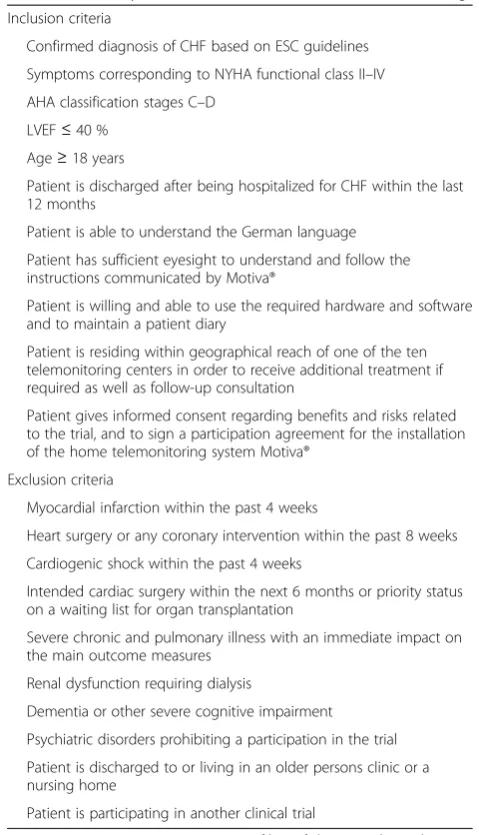
CardioBBEAT represents a randomized, controlled, open, multicenter trial with two prospective study arms. Patients were recruited at ten study sites from five areas of varying economic status in Germany: namely, Berlin, Branden-burg, Bavaria, Hamburg and North Rhine-Westphalia. This diversity allows for investigating the impact of re-gional differences in medical care, with general medical care predominating in rural districts compared to pdominantly specialist care in urban areas. Each site was re-sponsible for recruiting as well as following-up on their patients. Specified information about inclusion and exclu-sion criteria is displayed in Table 1.
The study has been conducted in accordance with the principles stated in the Declaration of Helsinki, the Good Clinical Practice (International Conference on
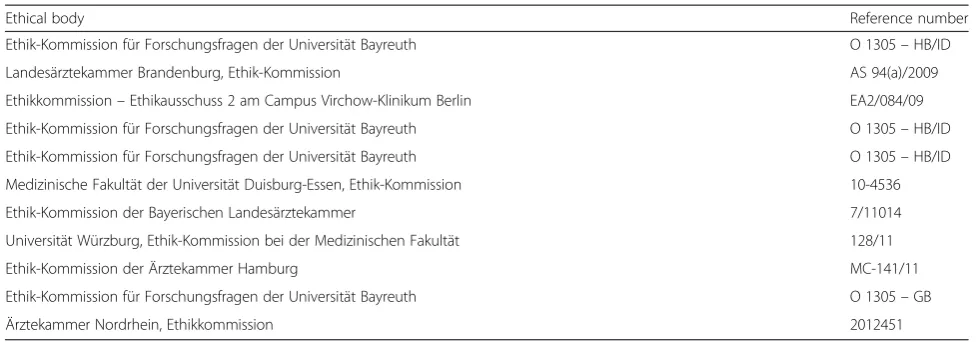
Harmonization), and national as well as local regula-tions. The research protocol was approved by the re-sponsible ethics committees (Table 2), and written informed consent was obtained from all patients prior to any study-related procedures. The study is moni-tored by an independent external institute to ensure that every participating site abides by the study proto-col and to perform external quality control of the data.
Setting
[image:3.595.301.541.98.516.2]During the trial, all patients receive best medical treat-ment according to the current guidelines of the European Society of Cardiology (ESC) [12, 13].
Table 1Summary of inclusion and exclusion criteria at screening
Inclusion criteria
Confirmed diagnosis of CHF based on ESC guidelines
Symptoms corresponding to NYHA functional class II–IV
AHA classification stages C–D
LVEF≤40 %
Age≥18 years
Patient is discharged after being hospitalized for CHF within the last 12 months
Patient is able to understand the German language
Patient has sufficient eyesight to understand and follow the instructions communicated by Motiva®
Patient is willing and able to use the required hardware and software and to maintain a patient diary
Patient is residing within geographical reach of one of the ten telemonitoring centers in order to receive additional treatment if required as well as follow-up consultation
Patient gives informed consent regarding benefits and risks related to the trial, and to sign a participation agreement for the installation of the home telemonitoring system Motiva®
Exclusion criteria
Myocardial infarction within the past 4 weeks
Heart surgery or any coronary intervention within the past 8 weeks
Cardiogenic shock within the past 4 weeks
Intended cardiac surgery within the next 6 months or priority status on a waiting list for organ transplantation
Severe chronic and pulmonary illness with an immediate impact on the main outcome measures
Renal dysfunction requiring dialysis
Dementia or other severe cognitive impairment
Psychiatric disorders prohibiting a participation in the trial
Patient is discharged to or living in an older persons clinic or a nursing home
Patient is participating in another clinical trial
Patients in the control group only receive best medical treatment as stated above, whereas patients in the inter-vention group additionally receive home telemonitoring-supported care that connects them to the participating care providers by individual guideline-compliant care plans using the telemedicine-system Motiva® (Philips Medical Systems GmbH, Hamburg, Germany).
Motiva® is an interactive bi-directional home telemoni-toring system that provides remote monitelemoni-toring, em-powers patients to manage their disease state more effectively and enables physicians to keep in contact with the patient at home on a daily basis. Patients measure their vital signs (blood pressure, heart rate, and weight) every day and Motiva® transfers the data to the relevant telemonitoring center. In doing so, signals of decompen-sation regarding their heart function can be detected at an early stage and counteractive measures can be taken. In addition, patients receive information via Motiva®, i.e. coaching material, evaluations, reminders, and feedback regarding their health status as well as references to po-tentially necessary CHF treatment adaptations. If ques-tionnaires reveal any problems, patients receive a phone call from the study site. Additionally, patients receive standardized questionnaires related to symptoms of car-diac decompensation, hypotension or hypertension or abnormal pulse rates. A call from the telemedicine cen-ter is made if patients gain more than 2 kg within 3 days, if their systolic blood pressure exceeds 140 mmHg or is lower than 90 mmHg, or their resting heart rate exceeds 80 bpm or is lower than 50 bpm.
A secured broadband connection (Digital Subscriber Line (DSL) or Universal Mobile Telecommunications System (UMTS)) and a set-top box turn the patient’s television into their center of personalized care pro-tected by a patient-specific password. Thus, patients can transfer all information about their health status to their attending physician safely.
Motiva® is been provided by Philips Medical Systems GmbH, Hamburg, Germany. The telecommunication in-frastructure to transfer patients’ data is made available by T-Systems International GmbH, Frankfurt, Germany. Both are provided without any obligations that could in-fluence the study.
Randomization
To assign patients to one of the two study arms, CardioBBEAT used a centralized stacked randomization technique. Patients at home who were managed in car-diologic practices were randomized patient-individually. Patients primarily managed by their general practitioner (GP), on the other hand, were cluster-randomized by their GP’s medical practices, to minimize carry-over effects and to keep the organizational effort manageable. The results of the randomization process with regard to the patients were displayed via the study’s electronic Case Report Form (eCRF) directly after inclusion into the trial. The study center in charge did inform the pa-tients’attending physicians whether their respective pa-tients were enrolled in the trial and to which study arm they were assigned.
Treatment patterns
After patients are discharged from inpatient care, their GPs or outpatient medical specialists will provide their ambulatory care. These physicians have access to indi-vidual patient care plans and are authorized to complete or modify them.
[image:4.595.54.543.98.269.2]Subjects enrolled in the control group receive best medical treatment according to the current guidelines of the European Society of Cardiology (ESC). Subjects en-rolled in the intervention group are additionally sup-ported by the telemedicine system Motiva® installed at the patients’home usually within 2 weeks.
Table 2List of ethical bodies
Ethical body Reference number
Ethik-Kommission für Forschungsfragen der Universität Bayreuth O 1305–HB/ID
Landesärztekammer Brandenburg, Ethik-Kommission AS 94(a)/2009
Ethikkommission–Ethikausschuss 2 am Campus Virchow-Klinikum Berlin EA2/084/09
Ethik-Kommission für Forschungsfragen der Universität Bayreuth O 1305–HB/ID
Ethik-Kommission für Forschungsfragen der Universität Bayreuth O 1305–HB/ID
Medizinische Fakultät der Universität Duisburg-Essen, Ethik-Kommission 10-4536
Ethik-Kommission der Bayerischen Landesärztekammer 7/11014
Universität Würzburg, Ethik-Kommission bei der Medizinischen Fakultät 128/11
Ethik-Kommission der Ärztekammer Hamburg MC-141/11
Ethik-Kommission für Forschungsfragen der Universität Bayreuth O 1305–GB
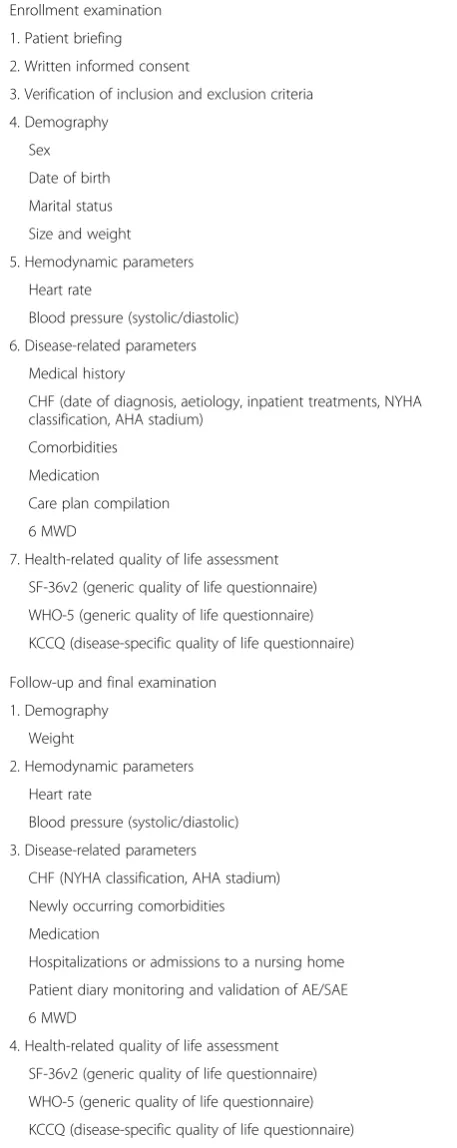
All trial participants maintain a patient diary and are urged to document any health disturbances at least once a week, such as hospitalizations (date of hospitalization, reason for admission, and length of stay), consultations by any physician, and change in medication or dose rate as well as adverse effects. In addition, every patient has to participate in 3 trial-specific examinations (Table 3) at their relevant study site, that take place at the time of enrollment and after 6 as well as 12 months.
Clinical outcome measures
The primary outcome measure to assess the benefit of home telemonitoring is the combined clinical endpoint
“days alive and not in hospital nor inpatient care per po-tential days in study.” For deceased patients, the loss in lifetime is taken into account by setting the denominator to 360 days, for patients lost to follow-up, time to last contact is used. Secondary outcome measures are total mortality, number of inpatient treatments, length of stay in hospital or nursing home, functional state of health and health-related quality of life. These will be deter-mined by the following parameters: days survived in the study, number of hospitalizations for any reason during the study (especially cardiac and heart failure-related reasons), number of days in hospital or nursing home per study month, generic (short form health survey with 36 questions using norm-based scoring (SF-36v2), World Health Organization Five, well-being index (WHO-5)) and disease-specific (Kansas City Cardio-myopathy Questionnaire, (KCCQ)) health-related qual-ity of life as well as medical condition and capacqual-ity of each patient.
CardioBBEAT may also be able to differentiate between particular sub-groups (e.g. gender-specific, NYHA-specific, urban/rural, diabetes mellitus) while analyzing the effectiveness of the intervention. The expectation is that several patient groups can be identified which are particularly suited for home telemonitoring with regard to clinical and/or economic outcome.
Cost data
[image:5.595.300.529.102.677.2]CardioBBEAT aims to reflect the impact of home tele-monitoring within an actual health care setting based on originally obtained cost data subdivided into cost of intervention, cost of inpatient and outpatient care, re-habilitation, nursing, and life-saving appliances. To this end, cost data are obtained from patients’health insur-ance companies and later on validated using the re-cords of the telemonitoring centers, GPs and medical specialists as well as patients’diaries. Health insurance data will be obtained similarly for both, patients in the intervention group as well as the control group to avoid ascertainment bias.
Table 3Trial-specific examinations
Enrollment examination
1. Patient briefing
2. Written informed consent
3. Verification of inclusion and exclusion criteria
4. Demography
Sex
Date of birth
Marital status
Size and weight
5. Hemodynamic parameters
Heart rate
Blood pressure (systolic/diastolic)
6. Disease-related parameters
Medical history
CHF (date of diagnosis, aetiology, inpatient treatments, NYHA classification, AHA stadium)
Comorbidities
Medication
Care plan compilation
6 MWD
7. Health-related quality of life assessment
SF-36v2 (generic quality of life questionnaire)
WHO-5 (generic quality of life questionnaire)
KCCQ (disease-specific quality of life questionnaire)
Follow-up and final examination
1. Demography
Weight
2. Hemodynamic parameters
Heart rate
Blood pressure (systolic/diastolic)
3. Disease-related parameters
CHF (NYHA classification, AHA stadium)
Newly occurring comorbidities
Medication
Hospitalizations or admissions to a nursing home
Patient diary monitoring and validation of AE/SAE
6 MWD
4. Health-related quality of life assessment
SF-36v2 (generic quality of life questionnaire)
WHO-5 (generic quality of life questionnaire)
All data are analyzed with appropriate statistical methods to determine the economic effectiveness of home telemonitoring for patients with CHF. Common approaches for the analysis of cost data such asttests, analysis of covariance, bootstrap techniques or permu-tation tests will be compared regarding their feasibil-ity, the validity of underlying assumptions and their stability and robustness in particular if missing values have to be taken into account.
Especially when analyzing cost data or determining the Incremental Cost-Effectiveness Ratio (ICER), as-sumptions are made regarding discount rate, utilities, projections or estimation of costs, which are based on uncertain hypotheses. To better understand the out-comes of these analyses, CardioBBEAT uses sensitivity analyses considering best-case and worst-case scenarios to demonstrate in which way the outcomes depend on these assumptions and how they affect their assessment.
Statistical analysis
The primary endpoint ICER, consisting of the group’s difference in total cost and the combined clinical end-point “days alive and not in hospital nor inpatient care per potential days in study”, is calculated with confi-dence intervals obtained by resampling methods. The comparative conventional endpoint “event-free survival” to measure the intervention’s effectiveness is evaluated using the Kaplan-Meier analysis and log rank tests. To incorporate possible repeated hospitalizations of a pa-tient, additional analyses will be performed, e.g. com-parison of quarterly data and recurrent event analysis.
Secondary outcome measures such as number of stays in hospital per quarter, health-related quality of life or time of survival are analyzed via permutation test, co-variance analysis or log rank test as part of the Kaplan-Meier analysis.
Furthermore, the trial uses a cluster-randomization technique and, therefore, correlation effects can evolve due to the collective treatment of patients in a cardi-ology center, medical practice, or by a single study
nurse. Such effects can result in incorrect p values. CardioBBEAT uses frailty and multi-level models to as-sess if and where such correlations occur. The magni-tude of these correlations will be measured and the p values will be rectified.
Since at planning stage neither an established statis-tical method to directly compare costs and ICERs nor sufficient data to estimate the variability of cost esti-mates was available, the sample size was determined based on literature data. With respect to clinical end-points, the figures were rather stable and converged to a minimum of 300 patients per group. Since the primary endpoint was expected to be mainly driven by clinical events, it was assumed that the sample size will also be sufficient for the continuously distributed ICER.
Results
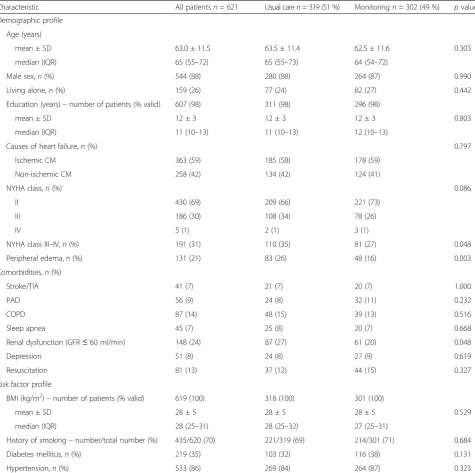
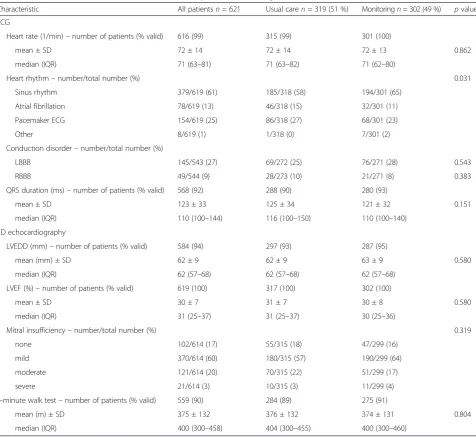
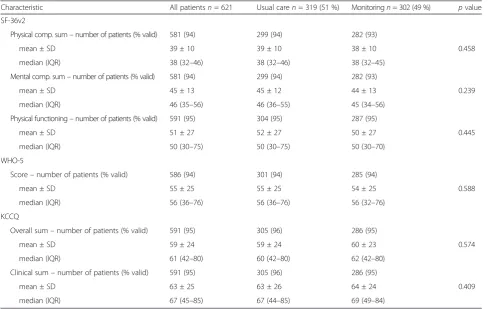
The study group comprised 621 patients, predominantly men. Four hundred and seventy-two (76 %) patients were treated by 449 GPs and 149 (24 %) were treated in 119 cardiologic practices. Three hundred and two pa-tients were randomized into the intervention group and 319 patients into the control group. Ischemic cardiomy-opathy was the leading cause of heart failure (59 %). Al-though randomly assigned, subjects of the control group were significantly more often in NYHA func-tional classes III or IV and exhibited peripheral edema or renal dysfunction, respectively, more frequently (Table 4). Additionally, the control and intervention group differed in heart rhythm disturbances (Table 5). No differences were detected regarding risk factor profile, comorbidities, echocardiographic parameters, especially left ventricular and diastolic diameter and ejection fraction, as well as functional test (6 MWD) results, medication and quality of life (Tables 4, 5, 6 and 7).
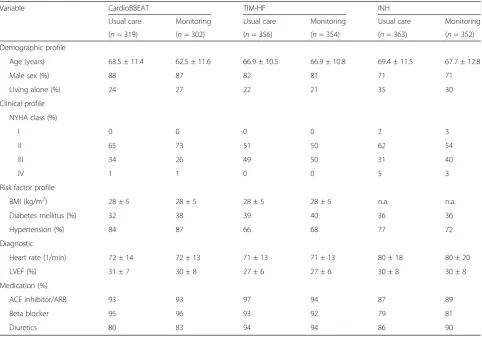
[image:6.595.58.290.104.144.2]In comparison with recently published German trials (TIM-HF [7], Interdisciplinary Network for Heart failure study (INH) [14]) the CardioBBEAT target population was slightly younger and comprised more male patients with fewer in NYHA classes III and IV. Nevertheless, all patients were either categorized in AHA stages C or D and every fifth patient of the given cohort was diag-nosed with peripheral edema; this suggests that the study population had a comparable degree of heart failure. Regarding comorbidities and risk factor profile, the study population was very similar, particularly for diabetes or renal dysfunction. Remarkably, it revealed a left bundle branch block in approximately 25 % of the population, a rhythm disorder with a known worse prognosis [15]. Furthermore, detailed information on prognostic relevant therapies was documented. Besides a high proportion of guideline-based pharmacotherapy Table 3Trial-specific examinations(Continued)
In case a patient dies during the trial
Date of death
Cause of death
6 MWD6-minute walking distance, AEadverse event,AHAAmerican Heart Association, staging of heart failure,ESCEuropean Society of Cardiology,KCCQ Kansas City Cardiomyopathy Questionnaire with 23 items for measuring disease-specific domains in CHF,LVEFleft ventricular ejection fraction,NYHA
including beta blockers and ACE inhibitors/ARB inhibi-tors, the study population was treated with mineralo-corticoid receptor blockers in 71 % of all cases. A cardioverter-defibrillator or a resynchronization system was implanted in two thirds of our patients (compar-able to TIM-HF study [7]) with a consider(compar-able prognos-tic impact on primary and secondary endpoints. Table 8 compares the most important baseline characteristics with TIM-HF [7] and INH [14].
Discussion
[image:7.595.60.536.100.573.2]Several recent randomized controlled trials (RCTs), in-cluding TIM-HF [7, 16] and INH [14], have proven the positive clinical effects of home telemonitoring on several groups of patients diagnosed with CHF. The meta-analyses of Clark et al. [4], Klersy et al. [5] and Inglis et al. [6] also showed its potential to improve several clinical outcomes such as quality of life. How-ever, many results were not statistically significant Table 4Baseline characteristics of the CardioBBEAT study participants
Characteristic All patientsn= 621 Usual caren= 319 (51 %) Monitoringn= 302 (49 %) pvalue Demographic profile
Age (years)
mean ± SD 63.0 ± 11.5 63.5 ± 11.4 62.5 ± 11.6 0.303
median (IQR) 65 (55–72) 65 (55–73) 64 (54–72)
Male sex,n(%) 544 (88) 280 (88) 264 (87) 0.990
Living alone,n(%) 159 (26) 77 (24) 82 (27) 0.442
Education (years)–number of patients (% valid) 607 (98) 311 (98) 296 (98)
mean ± SD 12 ± 3 12 ± 3 12 ± 3 0.803
median (IQR) 11 (10–13) 11 (10–13) 12 (10–13)
Causes of heart failure,n(%) 0.797
Ischemic CM 363 (59) 185 (58) 178 (59)
Non-ischemic CM 258 (42) 134 (42) 124 (41)
NYHA class,n(%) 0.086
II 430 (69) 209 (66) 221 (73)
III 186 (30) 108 (34) 78 (26)
IV 5 (1) 2 (1) 3 (1)
NYHA class III–IV,n(%) 191 (31) 110 (35) 81 (27) 0.048
Peripheral edema,n(%) 131 (21) 83 (26) 48 (16) 0.003
Comorbidities,n(%)
Stroke/TIA 41 (7) 21 (7) 20 (7) 1.000
PAD 56 (9) 24 (8) 32 (11) 0.232
COPD 87 (14) 48 (15) 39 (13) 0.516
Sleep apnea 45 (7) 25 (8) 20 (7) 0.668
Renal dysfunction (GFR≤60 ml/min) 148 (24) 87 (27) 61 (20) 0.048
Depression 51 (8) 24 (8) 27 (9) 0.619
Resuscitation 81 (13) 37 (12) 44 (15) 0.327
Risk factor profile
BMI (kg/m2)–number of patients (% valid) 619 (100) 318 (100) 301 (100)
mean ± SD 28 ± 5 28 ± 5 28 ± 5 0.529
median (IQR) 28 (25–31) 28 (25–32) 27 (25–31)
History of smoking–number/total number (%) 435/620 (70) 221/319 (69) 214/301 (71) 0.684
Diabetes mellitus,n(%) 219 (35) 103 (32) 116 (38) 0.131
Hypertension,n(%) 533 (86) 269 (84) 264 (87) 0.323
mostly due to the fact that effects were too small despite adequately sized studies.
Another meta-analysis by Klersy et al. [10] focused on the economic impact of remote patient monitoring. It showed that management of HF patients by remote monitoring is cost-saving due to a substantial reduction in health care resource utilization, mostly driven by a reduction in the number of HF hospitalizations. How-ever, cost data in this meta-analysis was estimated using 3 diagnosis-related group reimbursements (minimum, median, maximum over countries) and 3 different inci-dence rates and their lower and upper 95 % CI (confi-dence interval). These facts reflect the requirement for
additional study-derived and reliable evidence based on originally obtained cost data unlike previously negoti-ated prices.
In CardioBBEAT, the follow-up care of patients was more diverse than expected: the number of participating practices was higher whereas the number of patients per practice was lower than expected, resulting in an incom-plete use of the random blocks implemented in the eCRF and slightly unequal sample sizes between the random groups. However, slight differences in group sizes are of no concern with respect to unbiasedness of results.
[image:8.595.60.537.98.535.2]At first glance, an imbalance in baseline variables stands out. But, even with perfect randomization the Table 5Baseline characteristics of the CardioBBEAT study participants-Diagnostic
Characteristic All patientsn= 621 Usual caren= 319 (51 %) Monitoringn= 302 (49 %) pvalue ECG
Heart rate (1/min)–number of patients (% valid) 616 (99) 315 (99) 301 (100)
mean ± SD 72 ± 14 72 ± 14 72 ± 13 0.862
median (IQR) 71 (63–81) 71 (63–82) 71 (62–80)
Heart rhythm–number/total number (%) 0.031
Sinus rhythm 379/619 (61) 185/318 (58) 194/301 (65)
Atrial fibrillation 78/619 (13) 46/318 (15) 32/301 (11)
Pacemaker ECG 154/619 (25) 86/318 (27) 68/301 (23)
Other 8/619 (1) 1/318 (0) 7/301 (2)
Conduction disorder–number/total number (%)
LBBB 145/543 (27) 69/272 (25) 76/271 (28) 0.543
RBBB 49/544 (9) 28/273 (10) 21/271 (8) 0.383
QRS duration (ms)–number of patients (% valid) 568 (92) 288 (90) 280 (93)
mean ± SD 123 ± 33 125 ± 34 121 ± 32 0.151
median (IQR) 110 (100–144) 116 (100–150) 110 (100–140)
2D echocardiography
LVEDD (mm)–number of patients (% valid) 584 (94) 297 (93) 287 (95)
mean (mm) ± SD 62 ± 9 62 ± 9 63 ± 9 0.580
median (IQR) 62 (57–68) 62 (57–68) 62 (57–68)
LVEF (%)–number of patients (% valid) 619 (100) 317 (100) 302 (100)
mean ± SD 30 ± 7 31 ± 7 30 ± 8 0.580
median (IQR) 31 (25–37) 31 (25–37) 30 (25–36)
Mitral insufficiency–number/total number (%) 0.319
none 102/614 (17) 55/315 (18) 47/299 (16)
mild 370/614 (60) 180/315 (57) 190/299 (64)
moderate 121/614 (20) 70/315 (22) 51/299 (17)
severe 21/614 (3) 10/315 (3) 11/299 (4)
6-minute walk test–number of patients (% valid) 559 (90) 284 (89) 275 (91)
mean (m) ± SD 375 ± 132 376 ± 132 374 ± 131 0.804
median (IQR) 400 (300–458) 404 (300–455) 400 (300–460)
Table 6Baseline characteristics of the CardioBBEAT study participants-Therapy
Characteristic All patientsn= 621 Usual caren= 319 (51 %) Monitoringn= 302 (49 %) pvalue Medication
ACE inhibitor/ARB,n(%) 577 (93) 297 (93) 280 (93) 0.974
Beta blocker–number/total number (%) 591/620 (95) 303/319 (95) 288/301 (96) 0.826
MR antagonist,n(%) 439 (71) 232 (73) 207 (69) 0.291
Diuretics,n(%) 506 (82) 255 (80) 251 (83) 0.360
Glycosides,n(%) 95 (15) 50 (16) 45 (15) 0.876
Amiodarone,n(%) 80 (13) 48 (15) 32 (11) 0.125
Anticoagulation,n(%)
Vitamin K antagonist 231 (37) 122 (38) 109 (36) 0.637
Other 42 (7) 24 (8) 18 (6) 0.538
Devices,n(%)
Pacemaker 101 (16) 61 (19) 40 (13) 0.061
ICD 0.280
with monitoring 63 (10) 31 (10) 32 (11)
without monitoring 242 (39) 134 (42) 108 (36)
CRT-D 89 (14) 40 (13) 49 (16) 0.232
ACEangiotensin converting enzyme,ARBangiotensin receptor blocker,CRT-Dcardiac resynchronization therapy combined with defibrillationICDimplantable cardioverter defibrillator,MRmineralocorticoid receptor
Table 7Baseline characteristics of the CardioBBEAT study participants–Quality of life
Characteristic All patientsn= 621 Usual caren= 319 (51 %) Monitoringn= 302 (49 %) pvalue SF-36v2
Physical comp. sum–number of patients (% valid) 581 (94) 299 (94) 282 (93)
mean ± SD 39 ± 10 39 ± 10 38 ± 10 0.458
median (IQR) 38 (32–46) 38 (32–46) 38 (32–45)
Mental comp. sum–number of patients (% valid) 581 (94) 299 (94) 282 (93)
mean ± SD 45 ± 13 45 ± 12 44 ± 13 0.239
median (IQR) 46 (35–56) 46 (36–55) 45 (34–56)
Physical functioning–number of patients (% valid) 591 (95) 304 (95) 287 (95)
mean ± SD 51 ± 27 52 ± 27 50 ± 27 0.445
median (IQR) 50 (30–75) 50 (30–75) 50 (30–70)
WHO-5
Score–number of patients (% valid) 586 (94) 301 (94) 285 (94)
mean ± SD 55 ± 25 55 ± 25 54 ± 25 0.588
median (IQR) 56 (36–76) 56 (36–76) 56 (32–76)
KCCQ
Overall sum–number of patients (% valid) 591 (95) 305 (96) 286 (95)
mean ± SD 59 ± 24 59 ± 24 60 ± 23 0.574
median (IQR) 61 (42–80) 60 (42–80) 62 (42–80)
Clinical sum–number of patients (% valid) 591 (95) 305 (96) 286 (95)
mean ± SD 63 ± 25 63 ± 26 64 ± 24 0.409
median (IQR) 67 (45–85) 67 (44–85) 69 (49–84)
[image:9.595.56.545.408.717.2]expected number of statistically significant differences between baseline variables is 5 % or 2.45 of the 49 base-line comparisons in Tables 4, 5, 6 and 7, on average. In case of independence of the baseline variables, the ob-served number of significances will thus follow a bino-mial distribution with p= 0.05. In CardioBBEAT, 4 out of 49 baseline comparisons (8.2 %) were significant. In case of independence, 4 or more significant comparisons would occur in 23 % of the cases even in perfect randomization. The observed baseline differences could thus well be a play of chance. However, NYHA func-tional class, peripheral edema, heart rhythm, and renal dysfunction were clinically highly relevant variables that might bias the conclusions even if evoked by chance. Therefore, the statistical analysis plan was extended to include adjusted analyses with respect to the baseline imbalances.
Conclusions
CardioBBEAT is a RCT that adds a comprehensive cost assessment to the clinical component of the study
[image:10.595.57.540.99.437.2]including actual costs generated by patients, health services and health products. The corresponding data have been obtained directly from patients’health insur-ances including statutory sickness funds and private in-surances. This will provide more reliable information about the cost-effectiveness of home telemonitoring in CHF patients based on the actual health care setting. CardioBBEAT may also be able to differentiate between particular sub-groups (gender-specific, NYHA-specific, urban/rural, diabetes mellitus) while analyzing the ef-fectiveness of the intervention. The expectation is that important patient groups, which are better suited for the input of telemedicine with regard to the clinical and/or economic outcome, can be identified. The study results, reflecting a guideline-compliant, highly accurate treatment of the whole CardioBBEAT study population shown above, will significantly contribute to the exist-ing data basis on home telemonitorexist-ing in CHF. There-fore, it adds to informed political and economic decision-making within the specific context of the German Health Care System.
Table 8Compared baseline characteristics of the CardioBBEAT, TIM-HF and INH study participants
Variable CardioBBEAT TIM-HF INH
Usual care Monitoring Usual care Monitoring Usual care Monitoring
(n= 319) (n= 302) (n= 356) (n= 354) (n= 363) (n= 352) Demographic profile
Age (years) 63.5 ± 11.4 62.5 ± 11.6 66.9 ± 10.5 66.9 ± 10.8 69.4 ± 11.5 67.7 ± 12.8
Male sex (%) 88 87 82 81 71 71
Living alone (%) 24 27 22 21 35 30
Clinical profile
NYHA class (%)
I 0 0 0 0 2 3
II 65 73 51 50 62 54
III 34 26 49 50 31 40
IV 1 1 0 0 5 3
Risk factor profile
BMI (kg/m2) 28 ± 5 28 ± 5 28 ± 5 28 ± 5 n.a. n.a.
Diabetes mellitus (%) 32 38 39 40 36 36
Hypertension (%) 84 87 66 68 77 72
Diagnostic
Heart rate (1/min) 72 ± 14 72 ± 13 71 ± 13 71 ± 13 80 ± 18 80 ± 20
LVEF (%) 31 ± 7 30 ± 8 27 ± 6 27 ± 6 30 ± 8 30 ± 8
Medication (%)
ACE inhibitor/ARB 93 93 97 94 87 89
Beta blocker 95 96 93 92 79 81
Diuretics 80 83 94 94 86 90
Individual gratitude
Study center home telemonitoring teams
German Heart Institute Berlin
Fleck Eckart, Prof. Dr. Furundzija Vesna, Dr. Götze Stephan , PD Dr.
Roser Mattias, Dr. Ahmed-Taner Funda, Dr. Weinkopf Katharina
Gültekin Nicole Post Monica
Klinik am See Rüdersdorf
Völler Heinz, Prof. Dr. Belozerov Sergej, Dr. Michely Beate, Dr.
Hartwig-Zaidan Ines Stolze Kirsten Salzwedel Annett
University Hospital Essen
Neumann Till, Prof. Dr. Krings Peter, Dr.
Comprehensive Heart Failure Center Würzburg
Störk Stefan, Prof. Dr. Angermann Christiane, Prof. Dr. Reichert Clemens, Dr.
Schmidt Maximilian, Dr. Menhofer Dominik, Dr. Hartner Gabriele
Schupfner Elisabeth
Contilia Heart and Vascular Center Essen
Bruder Oliver, PD Dr. Blank Elisabeth Grosch Bernhard, Dr.
Seifert Vanessa, Dr. Waidelich Lioba, Dr. Keinhorst Jens
Reuter Vanessa Steffen Melanie
Munich Municipal Hospital Bogenhausen
Leber Alexander, PD Dr. Antoni Diethmar, Dr. Kloos Patrick, Dr.
Landwehr Peter, Dr. Tomelden June
Vivantes Medical Center Berlin Neukölln
Darius Harald, Prof. Dr. Meincke Carsten, Dr. Kirchner Aenn
Maselli Astrid
Jewish Hospital Berlin
Graf Kristof, Prof. Dr. Bolay Miriam, Dr. Pfürtner Mona, Dr.
Fischer Lidia
University Heart Center Hamburg-Eppendorf
Patten-Hamel Monica, PD Dr. Molz Simon, Dr. Sinning Christoph, Dr.
de Boer Imkje Hermes Monika Kupper-Schmidt Claudia
Hospitals Essen Süd
Koslowski Bernd, Dr. Kemper Nicole Reintges Nicole
Technology partners
Philips Medical Systems Boeblingen GmbH
Brüge Armin, MBA, Dipl.-Ing. Bui Nhat Kha, Certified Engineer, Dipl. Can. Theol. Goldbach Udo, Dipl.-Ing.
Richter Wolfgang, Dr. Sarantos Melanie Westerteicher, Christoph, Dipl.-Ing.
T-Systems International GmbH
Bruns Uta Cech Martin, Dipl.-Ing. Foth Gerd, Dipl.-Ing.
Hauptmann Imke
Study and project management
Abbreviations
ACE:angiotensin converting enzyme; AE: adverse event; AHA: American Heart Association, staging of heart failure; ARB: angiotensin receptor blocker; BMI: body mass index; CHF: chronic heart failure; CI: confidence interval; CM: cardiomyopathy; COPD: chronic obstructive pulmonary disease; CRT-D: cardiac resynchronization therapy combined with defibrillation; DSL: Digital Subscriber Line (broadband connection); ECG: electrocardiogram; eCRF: electronic Case Report Form; ESC: European Society of Cardiology; GFR: glomerular filtration rate; GP: general practitioner; HF: heart failure; ICD: implantable cardioverter defibrillator; ICER: Incremental Cost-Effectiveness Ratio; INH: Interdisciplinary Network for Heart failure study; KCCQ: Kansas City Cardiomyopathy Questionnaire with 23 items for measuring disease-specific domains in CHF; LBBB: left bundle branch block; LVEDD: left ventricular end-diastolic dimension; LVEF: left ventricular ejection fraction; MR: mineralocorticoid receptor; MWD: minute walking distance; n.a.: not available; NYHA: New York Heart Association, classification of heart failure; PAD: peripheral arterial disease; RBBB: right bundle branch block;
RCT: randomized controlled trial; SAE: serious adverse event; SF-36v2: short form health survey with 36 questions using norm-based scoring; TELE-HF: Telemonitoring in patients with Heart Failure trial; TIA: transient ischemic attack; TIM-HF: Telemedical Interventional Management in Heart Failure trial; UMTS: Universal Mobile Telecommunications System (mobile cellular system); WHO-5: World Health Organization Five, well-being index.
Competing interests
The authors declare that they have no competing interests.
Authors’contributions
RH made substantial contributions to the development, implementation and management of the study, drafted the manuscript and will perform the economic analysis and interpretation of data. HV made substantial contributions to conception and design of the study, is principal investigator and head of clinical trial, member of steering committee, revised the manuscript critically and will perform the clinical interpretation of data. KN made substantial contributions to the development and coordination of the study, is head of health economics evaluation, member of steering committee, sponsor, and revised the manuscript critically. DB made substantial contributions to the development and management of the study, drafted the manuscript, is corresponding author and will perform the economic analysis and interpretation of data. EV made substantial contributions to conception and design of the study, drafted the manuscript and will perform the biometry and statistical analysis and interpretation of data. RD made substantial contributions to conception, design, implementation and management of the study and revised the manuscript critically. WW made substantial contributions to
conception, design and implementation of the study and revised the manuscript critically. TN made substantial contributions to acquisition of data, is principal investigator and revised the manuscript critically. SS made substantial contributions to acquisition of data, is principal investigator and revised the manuscript critically. OB made substantial contributions to acquisition of data, is principal investigator and revised the manuscript critically. KW made substantial contributions to conception and design of the study, is head of biometry and statistical analysis, member of steering committee and revised the manuscript critically. EN made substantial contributions to conception and design of the study, is head of health economics evaluation, member of steering committee, sponsor, and revised the manuscript critically. EF made substantial contributions to conception and design of the study, is principal investigator and head of clinical trial, member of steering committee, revised the manuscript critically and will perform the clinical interpretation of data. All authors read and approved the final manuscript.
Funding
The CardioBBEAT trial is supported by the Federal Ministry of Education and Research in cooperation with (and managed by) the German Aerospace Center (grant number 01KX0805). The home telemonitoring system Motiva® is provided by Philips Medical Systems GmbH, the electronic infrastructure by T-Systems International GmbH.
Author details 1
Institute for Healthcare Management and Health Sciences, University of Bayreuth, Prieserstraße 2, 95444 Bayreuth, Germany.2Rehabilitation Center for Internal Medicine, Klinik am See, Seebad 84, 15562 Rüdersdorf, Germany. 3Center of Rehabilitation Research, University of Potsdam, Am Neuen Palais 10, 14469 Potsdam, Germany.4Department of Medical Biometry and Epidemiology, University Medical Center Hamburg-Eppendorf, Martinistraße 52, 20246 Hamburg, Germany.5Professional Board of German Surgeons, Luisenstraße 58/59, 10117 Berlin, Germany.6Radiology, University Medical Center of Regensburg, Franz-Josef-Strauß-Allee 11, 93053 Regensburg, Germany.7Clinic for Cardiology, University Hospital Essen, Hufelandstraße 55, 45147 Essen, Germany.8Comprehensive Heart Failure Center Würzburg and Department of Internal Medicine I, University of Würzburg, Straubmühlweg 2a, 97078 Würzburg, Germany.9Contilia Heart and Vascular Center, Department of Cardiology and Angiology, Elisabeth Hospital Essen, Klara-Kopp-Weg 1, 45138 Essen, Germany.10Department of Medicine/ Cardiology, German Heart Institute Berlin, Augustenburger Platz 1, 13353 Berlin, Germany.
Received: 26 November 2014 Accepted: 24 July 2015
(Continued)
Nagels Klaus, Prof. Dr. Dr. Nagel Eckhard, Prof. Dr. mult. Wohlgemuth Walter, Prof. Dr. Dr.
Dittmar Ronny, Dr. Hofmann Reiner Bindl Dominik
Department of Medical Biometry and Epidemiology
Wegscheider Karl, Prof. Dr. Balzer Klaus Treszl Andras, Dr.
Vettorazzi Eik
Monitoring
Clinical Trial Center North
Freese Ralf, Dr. Papavlassopoulos Martin, Dr. Henkes Liliane, Dr.
Borregaard Saskia, Dr.
Development of cost data set
AOK Nordost
Kornek Stefanie Schönfelder Moritz
DAK-Gesundheit
Wobbe Stefanie
TK
References
1. Cleland JGF, Swedberg K, Follath F, Komajda M, Cohen-Solal A, Aguilar JC, et al. The EuroHeart Failure survey programme–a survey on the quality of care among patients with heart failure in Europe: Part 1: patient characteristics and diagnosis. Eur Heart J. 2003;24:442–63.
2. Federal Statistical Office–Destatis. Gesundheit: Fallpauschalenbezogene Krankenhausstatistik. https://www.destatis.de/DE/Publikationen/Thematisch/ Gesundheit/Krankenhaeuser/
FallpauschalenKrankenhaus2120640137004.pdf?__blob=publicationFile. 2013. Accessed 24 Sep 2014.
3. Federal Statistical Office–Destatis. Gesundheitsberichterstattung des Bundes: Krankheitskosten in Mio.€. http://www.gbe-bund.de. 2014. Accessed 24 Sep 2014.
4. Clark RA, Inglis SC, McAlister FA, Cleland JGF, Stewart S. Telemonitoring or structured telephone support programmes for patients with chronic heart failure: systematic review and meta-analysis. BMJ. 2007;334:942. 5. Klersy C, de Silvestri A, Gabutti G, Regoli F, Auricchio A. A meta-analysis of
remote monitoring of heart failure patients. J Am Coll Cardiol. 2009;54:1683–94.
6. Inglis SC, Clark RA, McAlister FA, Stewart S, Cleland JGF. Which components of heart failure programmes are effective? A systematic review and meta-analysis of the outcomes of structured telephone support or telemonitoring as the primary component of chronic heart failure management in 8323 patients: Abridged Cochrane Review. Eur J Heart Fail. 2011;13:1028–40. 7. Koehler F, Winkler S, Schieber M, Sechtem U, Stangl K, Böhm M, et al.
Impact of remote telemedical management on mortality and hospitalizations in ambulatory patients with chronic heart failure: the Telemedical Interventional Monitoring in Heart Failure Study. Circulation. 2011;123:1873–80.
8. Chaudry SI, Mattera JA, Curts JP, Spertus JA, Herrin J, Zhenqiu L, et al. Telemonitoring in patients with heart failure. N Engl J Med. 2010;363:2301–9. 9. Heinen-Kammerer T, Wiosna W, Nelles S, Rychlik R. Monitoring von
Herzfunktionen mit Telemetrie. Cologne, Germany: DAHTA@DIMDI. 2006;30. 10. Klersy C, de Silvestri A, Gabutti G, Raisaro A, Curti M, Regoli F, et al.
Economic impact of remote patient monitoring: an integrated economic model derived from a meta-analysis of randomized controlled trials in heart failure. Eur J Heart Fail. 2011;13:450–9.
11. von der Schulenburg JM G, Greiner W, Jost F, Klusen N, Kubin M, Leidl R, et al. German recommendations on health economic evaluation: third and updated version of the Hanover Consensus. Value Health. 2008;11:539–44. 12. Dickstein K, Cohen-Solal A, Filippatos G, McMurray JJV, Ponikowski P, et al. ESC Guidelines for the diagnosis and treatment of acute and chronic heart failure 2008: the Task Force for the Diagnosis and Treatment of Acute and Chronic Heart Failure 2008 of the European Society of Cardiology. Developed in collaboration with the Heart Failure Association of the ESC (HFA) and endorsed by the European Society of Intensive Care Medicine (ESICM). Eur Heart J. 2008;29:2388–442.
13. McMurray JJV, Adamopoulos S, Anker SD, Auricchio A, Böhm M, Dickstein K, et al. ESC Guidelines for the diagnosis and treatment of acute and chronic heart failure 2012. The Task Force for the Diagnosis and Treatment of Acute and Chronic Heart Failure 2012 of the European Society of Cardiology. Developed in collaboration with the Heart Failure Association (HFA) of the ESC. Eur Heart J. 2012;33:1787–847.
14. Angermann CE, Störk S, Gelbrich G, Faller H, Jahns R, Frantz S, et al. Mode of action and effects of standardized collaborative disease management on mortality and morbidity in patients with systolic heart failure: the Interdisciplinary Network for Heart Failure (INH) study. Circ Heart Fail. 2012;5:25–35.
15. Dissmann R, Kamke W, Reibis R, Herbstleb J, Wegscheider K, Völler H. Prognostic impact of left bundle-branch block in the early stable phase after acute myocardial infarction. Int J Cardiol. 2008;130:438–43. 16. Koehler F, Winkler S, Schieber M, Sechtem U, Stangl K, Böhm M, et al.
Telemedicine in heart failure: pre-specified and exploratory subgroup analyses from the TIM-HF trial. Int J Cardiol. 2012;161:143–50.
Submit your next manuscript to BioMed Central and take full advantage of:
• Convenient online submission
• Thorough peer review
• No space constraints or color figure charges
• Immediate publication on acceptance
• Inclusion in PubMed, CAS, Scopus and Google Scholar
• Research which is freely available for redistribution Submit your manuscript at