www.ijraset.com Vol. 2 Issue VII, July 2014
ISSN: 2321-9653
I N T E R N A T I O N A L J O U R N A L F O R R E S E A R C H I N A P P L I E D S C I E N C E AN D
E N G I N E E R I N G T E C H N O L O G Y (I J R A S E T)
Page 81
Brain Computer Interface
Nikhil Chhabra#1, Mayank singh#2, Sachit Vashisht#3,Dewesh Malik#4
#1
ECE #2ECE #3ECE #4ECE ,
#1, #2, #3, #4
Dronacharya College Of Engineering
Abstract:-A BRAIN COMPUTER INTERFACE (BCI) is a direct communication pathway between the brain and an external device. The concept of BCI had coined in 1970s at the University of California Los Angeles (UCLA). Growth in neuroscience and brain imaging technologies allow us to interface directly with the human brain. This can be made possible with the help of sensors that can monitor physical processes that occur within the brain. In this technology, communication system does not depend on brain normal output pathways of peripheral nerves and muscles. In this system, user is supposed to manipulate their brain activity to produce signals that can be employed to control computer by using brain waves. Practical use of BCI depends on the development of appropriate application, attention to need and desires of individual user.
Keywords:- Brain Computer Interface(BCI), Electroencephalography (EEG), augmentative communication
1.INTRODUCTION
Brain computer interface provide user a direct communication pathway between brain and computer that does not depend on brain normal output pathways of peripheral nerves and muscles. Two basic requirements are met for a communication channel between the brain and computer : features that are useful to distinguish several states of brain and methods for the detection and classification of such states implemented in real time. The BCI technology basically comes mainly for those with severe motor disabilities that prevent them from using normal augmentative communication methods.
Over the past few years BCI had shown a great increment in research, from 1995 to now BCI research groups has been increased from 5 to 20.
There are various techniques available for monitoring the brain but Electroencephalography (EEG) is the best possible choice for the implementation of BCI. Electroencephalography is the recording of electric potentials
produced by the electrical field activity in brain, today most commonly measured by an array of electrodes attached to the scalp using water-based gel, so using this technique it is possible to monitor the physical process that occurs within brain. In order to produce resourceful brain signals user is sometimes or always supposed to manipulate its brain activity.
So, user’s training is major concern of BCI.
There are various issues that are coming in the way for the further development of BCI. The first issue is the information transfer rate, currently BCI is using a information transfer rate of 5-20 bits/minute. This rate will take several minutes even to transfer a word. Second issue is related with the training provided to the user. The third issue is SNR .i.e., signal to noise ratio for EEG based systems is very less.
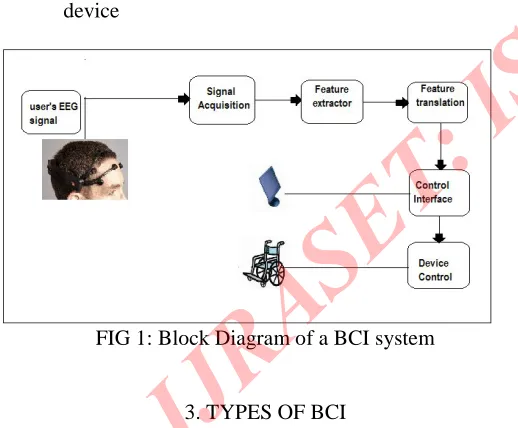
2.FUNCTIONAL PARTS
are:- signal acquisition system is first block and it consists of electrodes ,amplifiers and analog filters ,in this block electrodes basically responsible for pickin up the electric activity of brain and forwardind them to system .
A Feature extractor converts the brain signal into appropriate feature components.Here EEG signals are filtered by digital bandpass filter. Then amplitude samples are squared to obtain the power samples and these samples are averaged for trails and then applied to next bllock i.e feature translation.
The function of translator is to classifing the feature components into logical controls which means it is responsible for changing the response from into logical form .
The control interface than converts the logical controls into semantic controls.
The device controller that converts the semantic controls to physical device commands, which are different for different applications.
[image:3.612.27.286.381.595.2] Finally the device commands are executed by the device
FIG 1: Block Diagram of a BCI system
3. TYPES OF BCI
There are various types of brain computer interfaces and their purpose is to intercept the electrical signals that pass between neurons in the brain and translate them to a signal that is sensed by an external device using various translation algorithm.
In this method electrodes are inserted into the brain tissue to read the signals of neurons and this type of BCI could be used for blind or parelised pepols. Earlier this method was employed for the study of BCI. The results using this method were very accurate but there were still some complications like loss of signal due to reaction of brain towards the foreign objects.
B. LESS INVASIVE METHODS:
These are implanted inside the skull but rest outside the brain to record electrocorticography (ECoG) signals which can measure the electrical activity of brain over a smaller area and hence provides higher signal to noise ratio.
C . NON-INVASIVE METHODS:
In this method electroencephalographs (EEG) signals are employed as these signals have various advantages over other signals like higher temporal resolution, low cost. Recent EEG systems have better spatiotemporal resolution of up to 256 electrodes over total area of the scalp yet it cannot read from deep parts of brain.
4. EEG COMPONENTS USED IN BCI
EEG signals are basically divided in four bands namely Delta band (0.5Hz –4 Hz), Theta band (4Hz –8Hz), Alpha band (8Hz – 12Hz) and Beta band (14Hz – 30Hz). There are four main categories of EEG components used in BCI systems and these are:
A. NEURONAL POTENTIALS:
These are basically voltage spikes that are generated from single from a single neuron. Because of high invasiveness, earlier this was the only method which is used for research purposes in the animal.
B. SLOW CORTICAL POTENTIAL (SCP):
This results from the shifting of polarization of some dendrites. It will result in negative SCP if there is higher synchronization between the potentials of dendrites, however fall in synchronization will cause positive SCP. This change in SCP occurs in between 0.5-10 seconds from start of event.
C. OSCILLATORY EEG ACTIVITY:
This is caused by the network of neurons that create a feedback loop. With the increase in the synchronization of neurons , oscillations of EEG decrease.
www.ijraset.com Vol. 2 Issue VII, July 2014
ISSN: 2321-9653
I N T E R N A T I O N A L J O U R N A L F O R R E S E A R C H I N A P P L I E D S C I E N C E AN D
E N G I N E E R I N G T E C H N O L O G Y (I J R A S E T)
Page 83 These potentials occur after a fixed time from an external or internal event like, responses to external physical stimuli that can be a visual or auditory stimuli.
5.CONCLUSIONS
So, a brain computer interface is basically a communication and control channel that does not depend on brain’s normal output pathways of peripheral nerves and muscles. At present BCI is trying to be valuable for those whose severe neuromuscular disabilities don’t allow them to use conventional augmentative communication method. Currently BCI is using invasive or non-invasive method. Recording method of BCI seeks to maximize signal to noise ratio. Noise can be a brain activity different from specific rhythms that comprises of BCI input. Various temporal and spatial filters can reduce such types of noise and thereby increases signal to noise ratio. So, BCI development depends on the interdisciplinary cooperation between neuroscientists, engineers, psychologists, computer scientists and rehabilitation specialists.
6 FUTURE CHALLENGES
Further development of BCI will depend on both basic and applied research. Basic research that develops processing methods that improve SNR and applied research that can help in finding the areas where BCI can play an essential role. Speed and accuracy should be improved so that private industries are likely to display greater interest and to provide substantial support. Higher performance (in terms of information transfer rate) can be expected by using more sophisticated signal processing methods, optimized for each user individually.Better translation algorithm that is more realistic and more efficient should be developed that decreases the challenges.
REFRENCES
[1] Brain–Computer Interface Technology: A Review
Jonathan R.Wolpaw (Guest Editor), Niels Birbaumer,William J. Heetderks, Dennis J. McFarland, P. Hunter Peckham,
Gerwin Schalk, Emanuel Donchin, Louis IEEE TRANSACTIONS ON REHABILITATION ENGINEERING,
VOL. 8, NO. 2, JUNE 2000A. Quatrano, Charles J. Robinson, and Theresa M. Vaughan
[2] Design and Implementation of a Brain-Computer Interface With High Transfer Rates
Ming Cheng*, Xiaorong Gao, Shangkai Gao, Senior Member, IEEE, and Dingfeng Xu IEEE TRANSACTIONS ON BIOMEDICAL ENGINEERING, VOL. 49, NO. 10, OCTOBER 2002
[3] BRAIN COMPUTER INTERFACE AND ITS TYPES - A STUDY Anupama.H.S1, N.K.Cauvery2, Lingaraju.G.M3 International Journal of Advances in Engineering & Technology, May 2012.