Technology(IJRASET)
Multimodal Biometric System using Fingerprint
and Iris
Deepak Saraswat
Abstract- A single biometric identifier in making a personal identification is often not able to meet the desired performance requirements. Biometric identification based on multiple biometrics represents an emerging trend. Automated biometric systems for human identification measure a “signature” of the human body, compare the resulting characteristic to a database, and render an application dependent decision. These biometric systems for personal authentication and identification are based upon physiological or behavioral features which are typically distinctive, although time varying, such as Face recognition, Iris recognition, Fingerprint verification, Palm print verification in making a personal identification. Multi-biometric systems, which consolidate information from multiple biometric sources, are gaining popularity because they are able to overcome limitations such as non-universality, noisy sensor data, large intra-user variations and susceptibility to spoof attacks that are commonly encountered in uni-biometric systems. In this paper, it addresses the concept issues and the applications strategies of multi-biometric systems. This study proposes a blending of multimodal fingerprint and Iris recognition technique. Our task is two section composition first is feature extraction from both the modalities and then feature level fusion of the extracted features and finally applying a encryption technique to the fused output.
Keywords—multibiometric, unimodal, encryption, multimodal ,security .
I. INTRODUCTION
Multibiometric systems are being increasingly deployed in many large scale biometric applications because they have several advantages such as lower error rates and larger population coverage compared to unibiometric systems. A number of bio-crypto algorithms have been proposed, they have limited practical applicability due to the trade-off between recognition performance and security of the template Multimodal biometric systems that infer personal identification based on multiple physiological or behavioral characteristics are preferred. Consider, for example, a network logon application where a biometric system is used for user authentication. If a user cannot provide good fingerprint image due to a cut in the finger for example, then face and voice or other biometric identifiers can be used instead (or in conjunction). Voice identification as well cannot operate efficiently in a noisy environment or in the case where the user has some illness affecting his voice. Facial recognition is not suitable if the background is
cluttered, or if the person’s stored information are severalyears old. For these reasons among others, multimodal biometric systems found their way to emerge in the recent and advanced authentication and security applications Here, we are using two modalities. Fingerprint and Iris are the two modalities discuss in our paper. Fingerprint module takes fewer times, in taking the fingerprint template, as its size is smaller it will take reasonable time in taking the Fingerprint template and accepting the template. In Iris system what happens that this system is accepting everywhere, at the time of capturing the eye image no physical interaction is needed with the sensors. So you can capture the image from everywhere and used the template for recognition.
A. Levels of Fusion:The information of the multimodal system can be fused at any of the four modules.
B. Fusion at the sensor level:In this the raw data from different sensors are fused. In it the data is fused at very early stage so it has a lot of information as compared to other fusion levels. Very less work has been done in this area.
Technology(IJRASET)
D. Matcher Score Level: Each system provides a matching score indicating the proximity of the feature vector with the template vector. The scores obtained from different matchers are not homogeneous, score normalization technique is followed to map the scores obtained from different matchers on to a same range. These scores contain the richest information about the input.
E. Fusion at the Decision Level:The final outputs of the multiple classifiers are combined. A majority vote scheme can be used to make final decision. Biometric systems that integrate information at the early stages are more effective than those in which integration is done in later stages. So fusion at the feature level is expected to give better recognition results but it is difficult to integrate at this level because feature sets of the various systems may not be compatible. More over all commercial Biometric
systems don’t provide access to the feature sets, which they use in their products.\
Fig1-Fussion at different levels matching of the biometric characteristic.
F. Types of the Multimodal Systems
Single biometric trait, multiple sensors Multiple biometrics
Multiple units, single biometric traits: Multiple snapshots of single biometric
G. Modes of Operation
A multimodal biometric system can work in three modes:
1) Serial mode:In the serial mode the output of one biometric characteristic is used to reduce the no of possible identities before the next characteristic is used.
2) Parallel mode:In it the information from multiple characteristics is taken together to perform recognition.
3) Hierarchical mode:In it individual classifiers are combined in a tree like structure. This mode is well suited where we have large no of classifiers.
II. RELATED STUDY
Technology(IJRASET)
multimodal biometric systems have been widely adopted to overcome the shortcomings of unimodal biometric systems . Among various multimodality options, fingerprint and finger vein multimodality ensures higher performance and spoofing resistance. This multimodal technology has reached an unparalleled level of security, accuracy and performance. P.S.Sanjekar [3] has thrown some light on the
shortcomings of unimodal biometrics such as noisy data, intra class variation, and spoofing which result in the system that possess less accuracy and low security. To overcome these problems and to rise level of security multimodal biometrics came. Multimodal biometrics makes the use of multiple source of information for personal authentication.. Vijay M. Mane[4] stated that the fusion of multiple biometrics helps to minimize the system error rates. Fusion options include processing biometric modalities sequentially until an acceptable match is obtained. Another one works in a way that combine scores from separate classifiers for every modality. He stressed on the fact that most of the biometric systems deployed in real world applications are unimodal that possess considerably high
false acceptance rate (FAR) and false rejection rate (FRR). he also explained that todays unimodal system are having limited discrimination capability. Shweta Malhotra [5] here author presents an approach to enhance the invisible watermarking technique with cryptography. The biometric trait is modified using invisible watermark information and is further secured using cryptography. The template is made more secure using encryption techniques like AES, MAES and finally stored in database.
[image:4.612.190.443.396.736.2]III. PROPOSED MULTIBIOMETRIC SYSTEM
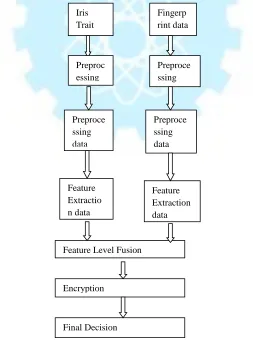
Fig. 2 shows the block diagram of the proposed multimodal biometric recognition system. First we apply pre processing to extract the region of interest i.e feature extraction from each biometric image. Then the feature vectors are extracted from each biometric separately, after this we encrypt the fused template in which one image comes at front another at background. Then that fused image which is output of feature extracted fingerprint and eye is encrypted to achieve security hence based on this, a final decision is made. Iris Trait Preproc essing Preproce ssing data Feature Extractio n data Fingerp rint data Preproce ssing Preproce ssing data Feature Extraction data
Feature Level Fusion
Encryption
Technology(IJRASET)
Fig 2- Proposed Systems
Iris recognition is considered to be one of the most accurate biometric technologies when compared to other technologies This is because the false match and false nonmatch errors are very small, which implies a very high The Iris identification system consists of three stages, the first stage is the iris analysis which involves iris localization and extraction and encoding. The last stage is the recognition stage which involves Only the significant features of the iris must be encoded in order to generate the iris code for the the proposed system, binary string , segmented iris ,noise removal functions are used for extracting the features the iris images. Finally matching is done using the calculated Hamming distance (HD) which is a measure of the number of
A fingerprint is composed of many ridges and furrows. These ridges and furrows present good similarities in each small local However, shown by intensive research on fingerprint recognition, fingerprints are not ridges and furrows. For the fingerprint image pre processing stage, used a Histogram Equalization and Fourier
Interest extraction is done.
by 32 pixels) and perform the Fourier transform according to:
, 1, 2, ..., 31 and v = 0, 1, 2, ..., 31. In order to enhance a specific block by its dominant magnitude a set of times. Where the magnitude of the original FFT =
In general, only a Region of Interest (ROI) is useful to be recognized for each fingerprint image. The image area without effective it only holds background information. Then the bound of the remaining effective area is minutia in the bound region are confusing with those spurious minutia that are generated when the ridges are
minutia match algorithm determines whether the two minutia sets are from
assumptions:
-head should not be tilted). size of image.
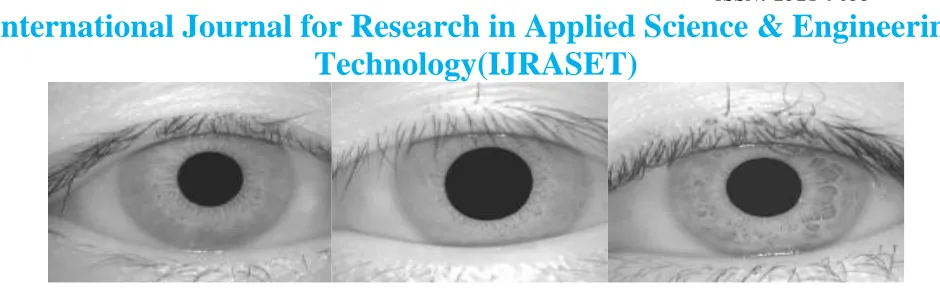
radiuses. For a normal human subject, the irises are not that different, and have a diameter of around 12 mm (the normal human pupil is around 2-3 mm in daylight and can go to 7mm during night time). First of all input is given that is image of iris from the cassia database from where we have gathered the required
Technology(IJRASET)
Fig 3- Sample images for one person from CASIA iris Then we extract feature from this input image using
Step 1 Take input the image of which eye detection has to be performed. Step 2: Convert colour image into grayscale image.
Step 3: Smoothen the image to remove noise present in the image and to avoid any feature that is not of interest using Gaussian mask.
Step 4: Detect the edges of the image using the Prewitt operator.
Step 5: Detect the iris (black circular region inside eye) using Hough transform for circle detection. Step 6: Store the center and radii of the circles thus detected from the previous step.
Step 7: Detect the presence of the ellipses surrounding the circle again using the Hough transform. Step 8: Geometrically match each of the detected circle enclosed in an ellipse
[image:6.612.146.450.293.671.2]Step 9: Rule out the pair of eyes based on geometrical considerations from the above step. After performing feature extraction steps we get segmented and polar output of iris
Fig 4- Desired features are extracted from iris
Fig 5- Noisy part of the image
IV. CONCLUSION
Technology(IJRASET)
REFERENCES
[1] K.Sasidhar, Vijaya L Kakulapati, Kolikipogu Ramakrishna &K.KailasaRao, “Multimodal Biometric Systems –Study To ImproveAccuracy And Performance”
International Journal of Computer Science & Engineering Survey (IJCSES), Vol.1, No.2, November 2010, pp. 54-61.
[2] T.Sheeba , M.Justin Bernard, “ Survey on Multimodal BiometricAuthentication Combining Fingerprint and Finger vein” International Journal of Computer Applications (IJCA), Vol. 51, No.5, August 2012pp.55-60
[3] P. S. Sanjekar , J. B. Patil, “An Overview Of Multimodal Biometrics” Signal & Image Processing : An International Journal(SIPIJ) Vol.4, No.1, February 2013, pp. 57-64.
[4] Vijay M. Mane , Dattatray V. Jadhav , “Review of Multimodal Biometrics: Applications, challenges and Research Areas” ,International Journal of Biometrics and Bioinformatics (IJBB), Volume 3, No. 5 , 2013, pp. 90-95.
[5] Sumeet kaur “Enhancing template security by a biometric keygenerating cryptosysytem”, IJARCSSE, Vol. 3,Issue 8, pp 973-976, August 2013
[6] Debnath bhattacharya “ Biometric Authentiction :A Review ” Vol. 2 ,Issue 3 , Sep 7 2009 , pp 13-26
[7] Parvinder S.Sandhu, Iqbldeep Kaur, Amit Verma, Samriit Jindal“Biometric Methods & Implementation of Algorithms ” Vol.3 Issue8 , 2009 , pp 492-496
[8] Harpreet Saini & Kanwal Garg “Comparitive Analysis of Various Biometric Techniques for database Security ” IJSR (Internationaljournal of Science and Research ) Vol. 2 Issue 4, pp150-153, April 2013
[9] Sulochana Sonkamble & Dr. Ravindra Thool “Survey Of Biometric Recognition Systems And Their Applications ” Journal of Theoretical And Applied Information Technology(JATIT) , pp 45- 51, 2005
[10] Nandakumar, K., 2008. “Multibiometric systems: Fusion strategiesand template security”. Ph.D.Thesis, Department of ComputerScience and Engineering, Michigan State University.
[11] “Biometric template encryption” by A.K.Mohapatra, Madhvi Sandhu IGIT,GGSIP University,Kashmere GateDelhi Published in International Journal of Advanced Engineering & Application, Jan. 2010