comment
reviews
reports
deposited research
interactions
information
refereed research
Protein family review
MAP kinase phosphatases
Aspasia Theodosiou
*
and Alan Ashworth
Addresses: *Biomedical Sciences Research Centre Alexander Fleming, PO Box 74145, Varkiza 166-02, Athens, Greece. The Breakthrough Breast Cancer Research Centre, Institute of Cancer Research, Fulham Road, London SW3 6JB, UK.
Correspondence: Alan Ashworth. E-mail: [email protected]
Summary
Mitogen-activated protein MAP kinases are key signal-transducing enzymes that are activated by a wide range of extracellular stimuli. They are responsible for the induction of a number of cellular responses, such as changes in gene expression, proliferation, differentiation, cell cycle arrest and apoptosis. Although regulation of MAP kinases by a phosphorylation cascade has long been recognized as significant, their inactivation through the action of specific phosphatases has been less studied. An emerging family of structurally distinct dual-specificity serine, threonine and tyrosine phosphatases that act on MAP kinases consists of ten members in mammals, and members have been found in animals, plants and yeast. Three subgroups have been identified that differ in exon structure, sequence and substrate specificity.
Published: 26 June 2002
GenomeBiology2002, 3(7):reviews3009.1–3009.10
The electronic version of this article is the complete one and can be found online at http://genomebiology.com/2002/3/7/reviews/3009 © BioMed Central Ltd (Print ISSN 1465-6906; Online ISSN 1465-6914)
The mitogen-activated protein (MAP) kinases are evolution-ary conserved enzymes that play an important role in orchestrating a variety of cellular processes, including prolif-eration, differentiation and apoptosis [1,2]. To date, four major discrete groups of MAP kinases have been identified in mammalian cells, known as the extracellular signal-regulated kinases (ERK1 and ERK2), the c-Jun amino-terminal kinases (JNK1, JNK2 and JNK3), the p38 kinases (p38a, p38b, p38g and p38d) and ERK5/Big MAP kinase 1 (BMK1). MAP kinases are part of a three-tiered cascade consisting of a MAP kinase, a MAP kinase kinase (MAPKK, MKK or MEK) and a MAP kinase kinase kinase (MAPKKK or MEKK). Phos-phorylation of the threonine and tyrosine residues in the T-loop of the MAP kinase, by its upstream kinase, results in activation. The activation of MAP kinases is not a simple switch, however, as both the duration and magnitude of acti-vation is crucial in determining the physiological outcome in cells [3]. Thus, it seems likely that dephosphorylation of the MAP kinases is vital for their control. This is achieved by removal of phosphate groups from either the threonine residue or the tyrosine residue, or both. Both protein serine/threonine phosphatases and protein tyrosine phos-phatases have been reported to dephosphorylate MAP kinases. In the past decade, however, some dual-specificity
phosphatases (DSPs) have been recognized as key players for inactivating different MAP kinase isoforms; this class of phosphatases has been designated MAP kinase phos-phatases (MKPs).
Although the MKPs form a structurally and functionally dis-tinct subclass among the large number of protein phos-phatases present in eukaryotic genomes, there is a great deal of confusion regarding their classification. In this article we discuss the family of classical MKPs that have been defini-tively shown to play a role in the de-activation of MAP kinases. Where relevant, we also mention the closely related low-molecular-weight phosphatases, whose role in MAP kinase regulation is controversial. Other more distantly related DSP families, including members of the FYVE family, which have high sequence similarity to myotubularin, and of the Cdc25 family, which dephosphorylate cyclin-dependent kinases, are beyond the scope of this review.
Gene organization and evolutionary history
Gene organization
genomes (see Table 1). They all share some common features, including an extended active-site motif with significant sequence similarity to the corresponding region of the VH-1 protein tyrosine phosphatase that was isolated from vaccinia virus [4]. In addition, their amino termini contain two short regions that are homologous to sequences that flank the Cdc25 phosphatase catalytic site [5] and a cluster of basic amino-acid residues that play an important role in binding to the MAP kinases [6]. The MKPs can be further subdivided into groups depending on their substrate specificity for the MAP kinases, subcellular localization (nuclear, cytoplasmic or both) and the structural organization of their genes.
A gene closely related to the MKP family is STYX. The protein encoded by STYX contains many of the hallmarks of the MKPs but lacks a critically important catalytically active cys-teine residue, having a glycine instead [7]. Interestingly, alteration of this glycine residue to cysteine renders the STYX protein catalytically active, suggesting that other critical residues have been retained. STYX appears to function as a phosphotyrosine/phosphoserine/phosphothreonine-binding protein analogous to the SH2 and PTB domains. It is unclear whether it plays any role in signaling through the MAP kinase pathways, however.
Evolutionary history
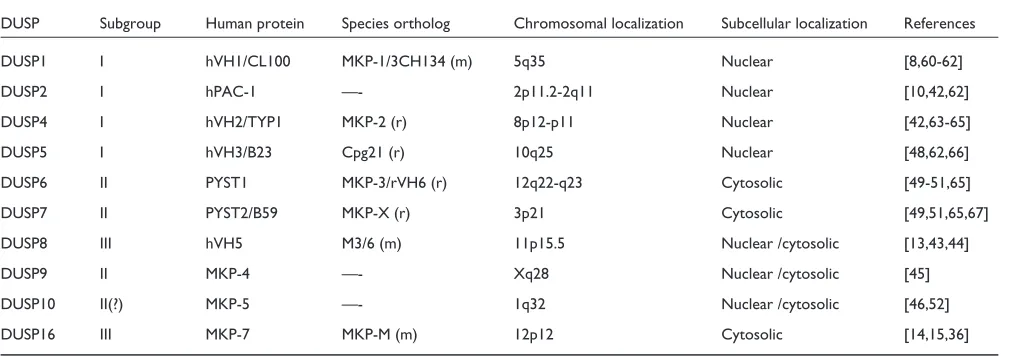
On the basis of structures predicted from genomic sequence, the MKPs can readily be divided into the following sub-groups: subgroup I, DUSP1, DUSP2, DUSP4 and DUSP5; subgroup II, DUSP6, DUSP7, DUSP9 and DUSP10; and sub-group III, DUSP8 and DUSP16 (Figure 1, Table 1). Division into these three subgroups is also supported by phylogenetic
analysis (Figure 2), and to a considerable extent by sub-strate preference.
The genes of subgroup I consist of four exons [8-11], and the exact positions of the introns are highly conserved. The first exon encodes the amino terminus of each of the three pro-teins and ends within the second of the Cdc25 homology (CH2) domains. The active-site motif of all four proteins is encoded within exon 4, and the length of exon 3 is identical for all these DUSPs, suggesting that they arose from a common ancestral gene.
Subgroup II genes (DUSP6, 7and 9, and provisionally 10) consist of three exons [12]. As with subgroup I, exon 1 encodes the amino terminus and the 3¢-most exon encodes the active site. Unlike subgroup I, however, the central portion of the protein is encoded by a single exon. DUSP10
has an intron/exon structure consistent with a placement within subgroup II, but it shares some features with members of subgroup III, such as a similar MAP kinase docking-site motif and similar substrate specificity. In addi-tion, it has an extended amino-terminal region that is not present in any of the other DUSPs. Assignment of DUSP10
to subgroup II or III or to its own subgroup may need re-evaluation in the future.
[image:2.609.55.567.516.694.2]The genes of subgroup III (DUSP8and DUSP16) consist of six exons [13-15]. The lengths of exons 2, 3, 4 and 5 are iden-tical in the two genes. Unlike the two previous subgroups, however, exon 1 encodes only the first of the CH2 domains. Exon 2 ends within the same region of the second CH2 domain as does exon 1 of subgroups I and II, however. The
Table 1
Classification and chromosomal and subcellular localization of DUSP genes
DUSP Subgroup Human protein Species ortholog Chromosomal localization Subcellular localization References
DUSP1 I hVH1/CL100 MKP-1/3CH134 (m) 5q35 Nuclear [8,60-62]
DUSP2 I hPAC-1 —- 2p11.2-2q11 Nuclear [10,42,62]
DUSP4 I hVH2/TYP1 MKP-2 (r) 8p12-p11 Nuclear [42,63-65]
DUSP5 I hVH3/B23 Cpg21 (r) 10q25 Nuclear [48,62,66]
DUSP6 II PYST1 MKP-3/rVH6 (r) 12q22-q23 Cytosolic [49-51,65]
DUSP7 II PYST2/B59 MKP-X (r) 3p21 Cytosolic [49,51,65,67]
DUSP8 III hVH5 M3/6 (m) 11p15.5 Nuclear /cytosolic [13,43,44]
DUSP9 II MKP-4 —- Xq28 Nuclear /cytosolic [45]
DUSP10 II(?) MKP-5 —- 1q32 Nuclear /cytosolic [46,52]
DUSP16 III MKP-7 MKP-M (m) 12p12 Cytosolic [14,15,36]
comment
reviews
reports
deposited research
interactions
information
refereed research
central portion of the protein is encoded by two exons, as in subgroup I, rather than the single exon of subgroup II. This suggests that subgroup II genes may have diverged earlier and that subgroup I and III genes may be more closely related to each other. Exon 5 encodes the catalytic site of these DUSPs but not the carboxyl terminus; the sixth exon encodes the large extended carboxyl terminus, with the intron between the catalytic domain and the carboxyl termi-nus of the protein being diagnostic of this subgroup.
Overall, the high conservation of some intron/exon bound-aries within all three subgroups of DUSPs indicates a common ancestral gene for each subgroup. The similarities of substrate specificity among subgroup members suggest that these ancestral genes are themselves likely to have shown some substrate preference.
[image:3.609.56.556.86.342.2]Dual specificity phosphatases have been found in a wide variety of phylogenetically distinct eukaryotes, including Figure 1
Gene structure of the DUSPs. Three distinct gene structures have been described for the DUSPs, allowing their classification into subgroups I, II and III. Structural motifs (CH2 domains, docking domain and catalytic domain) in the encoded proteins are indicated by shaded shapes and exons by boxes and roman numerals. The dashed box in subgroup II is an alternatively spliced exon.
III
Cdc25 homology (CH2) domains
Catalytic sites
Docking domains
I
i
ii
iii
iv
II
i
ii
iii
i
ii
iii
iv
v
vi
Figure 2
Phylogenetic analysis of DUSP sequences. Human DUSP amino-acid sequences were aligned and a phylogenetic tree derived using Clustal W [68] on DNASTAR. The length of the branches is proportional to sequence divergence between proteins. Subgroups I, II, and III are shaded (see text for further details).
DUSP1
DUSP4
DUSP5
DUSP2
DUSP10
DUSP6
DUSP7
DUSP9
DUSP16
DUSP8
I
II
[image:3.609.64.559.394.564.2]yeasts, worms, flies and plants, as well as mammals. Although budding yeast does not encode any predicted protein tyrosine kinases, it has 16 dual specificity and low-molecular-weight phosphatases and five phosphatase-like
STYX genes. A direct role has been demonstrated for the budding yeast dual specificity phosphatase gene MSG5 in the regulation of the MAP kinase Fus3 [16]. Six MKPs have been noted in the Drosophila melanogaster genome sequence [17]. Of these, two have been characterized: puck-ered has been shown to encode a MKP that inactivates
basket, the Drosophila equivalent of mammalian JNK [18]; in addition, a Drosophila DUSP6-like gene has recently been identified [19]. The sequence of the Caenorhabditis elegans
genome includes 26 predicted DSPs, including some MKPs [20]. One of these, LIP-1, has been suggested to inactivate MAP kinase, mediating inhibition by the ligand Notch of a signaling pathway involving the GTPase Ras, during
C. elegansvulval development [21]. Moreover, at least two MKPs have been identified in Arabidopsis thaliana, one of which is required for relief from genotoxic stress [22].
Characteristic structural features
Catalytic domain
All the DUSPs share strong amino-acid sequence identity over their catalytic domains (37%-50%), with members of certain subgroups sharing up to 75% identity (for example, DUSP6 with DUSP7 and DUSP9 or DUSP8 with DUSP16). The catalytic domain invariably contains the highly con-served consensus sequence ,X26(V/L)X(V/I)H+
XAG(I/V)-S4SXT(I/V)XXAY(L/I)M, in the single-letter amino-acid code where X is any amino acid. The three amino acids indi-cated in bold have been shown to be absolutely essential for catalysis. The cysteine is required for the nucleophilic attack of the phosphorus of the substrate and the formation of the thiol-phosphate intermediate; the conserved arginine binds the phosphate group of the phosphotyrosine or phospho-threonine, enabling transition-state stabilization; whereas the aspartate enhances catalysis by protonating the leaving group oxygen [23].
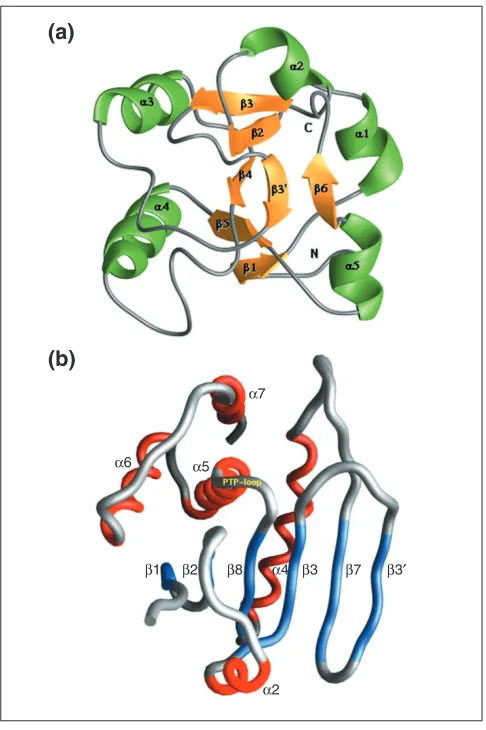
Determination of the crystal structure of the catalytic domain of DUSP6 [24] has revealed that this domain adopts a shallow cleft conformation, similar to that of VH1-related phosphatase (VHR) [25]. Within this cleft, the phosphatase is able to accommodate both phosphotyrosine and phosphothreonine side chains. In the absence of substrate, DUSP6 exists in a low-activity state, with key residues (Arg299 and Asp262 in DUSP6) disengaged from interaction. Upon binding of the substrate ERK2, however, the active-site residues are rearranged, adopting a catalytically active conformation [24] and enabling the dephosphorylation of both Thr183 and Tyr185 in ERK2 (Figure 3b). In particular, Asp262 (the con-served aspartate in the consensus sequence) is located in a loop, 5.5 Å away from the nucleophilic cysteine and arginine in the active site. This suggests that the loop must undergo
con-formational rearrangement for activation. Upon binding of the substrate ERK2, closure of the Asp262 loop over the active site occurs, positioning the aspartate residue for catalysis. Thus DUSP6 adopts a catalytically active conformation [24].
CH2 domains
The amino terminus is much less conserved in the DUSPs than the catalytic domain. Nevertheless, all DUSPs contain at their amino terminus two conserved regions that show simi-larity to the Ccd25 phosphatase, designated CH2 domains. In Cdc25, these domains flank the catalytic site of the enzyme, whereas in the DUSPs they are found upstream of the active site [5]. They have been suggested to play a role in substrate binding, but this has yet to be formally demonstrated.
Docking sites
[image:4.609.313.556.327.692.2]All DUSPs have, near to their amino termini, a MAP kinase docking site, which consists of a cluster of positively charged
Figure 3
Three-dimensional structure of DUSP6. (a)The amino-terminal Erk-binding (EB) domain, reproduced with permission from [38]. (b)The catalytic domain, reproduced with permission from [24].
α6 α5
α4
α7
α2
β1 β2 β8 β3 β7 β3′
(a)
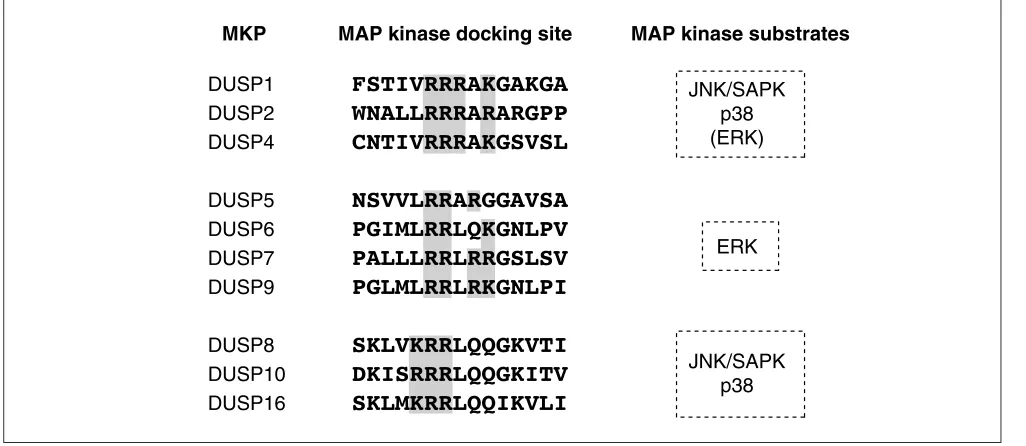
amino acids [6]. It has been proposed that the number of consecutive positively charged residues in this docking site of MKPs may play a role in determining binding specificity and therefore catalytic activity (Figure 4) [14]. The corre-sponding docking site on the MAP kinases has been shown to consist of negatively charged residues (known as the common docking domain, CD), suggesting that electrostatic interactions are critical for the binding of MAP kinases and MKPs. Consistent with this suggestion, an altered form of ERK2 (D319N) corresponding to the Drosophila sevenmaker
mutation is highly compromised in its ability to bind to, and activate, DUSP6 [26,27]. The low-molecular-weight DSPs do not have the MAP kinase docking site present in MKPs, but VHR (a low-molecular-weight DSP) has been shown to be capable of inactivating ERK in cells [28,29], suggesting that it may have a distinct mechanism of interaction.
Further regions that are potentially important for docking to and activation by MAPKs have now been defined in certain subsets of MKPs. The FXFP motif, and variants of this sequence (present in DUSP1, DUSP4, DUSP6, DUSP7 and DUSP9) has been shown to mediate ERK binding [30-32]. Another such region is the D-domain (or D-box), which comprises a cluster of basic residues amino-terminal to an L/I-X-L/I motif [30,32,33]. The consensus for this site was derived from alignment of the sequence of the delta domain of c-Jun, the docking site for JNK, with similar motifs found in other transcription factors that are known targets of the MAP kinases. This domain is present in all MKPs identified to date [34] and is thought to mediate binding to both JNK
and ERK MAP kinases [30,32]. Given the diversity of docking sites, the prevailing view is that the affinity of the MKPs for their substrates may be governed by the number, type and accessibility of docking sites.
PEST sequences
The subgroup III DUSPs, DUSP8 and DUSP16, have an extended carboxyl terminus containing PEST sequences (abundant in proline, glutamate, serine and threonine residues) that are frequently found in rapidly degraded teins [35]. Removal of the PEST sequences from these pro-teins can result in their stabilization ([36] and our unpublished observations), consistent with a role for the domain in rapid turnover.
Regulation of MKPs
In 1998, Arkinstalls group [27] demonstrated that binding of DUSP6 to purified ERK2 enhances the catalytic activity of the phosphatase. Since then, several papers have attempted to elucidate the mechanism of catalytic activation of DUSP6 [37,38] and to define the regions of interaction between DUSP6 and ERK2. The derivation of the solution structure of the ERK2-binding (EB) domain of DUSP6 [38] has pro-vided considerable insight into this issue (Figure 3a). The EB domain of DUSP6 contains a positively charged cluster of arginine residues that binds to a highly negatively charged region of ERK2. This binding causes a conformational change in DUSP6, affecting the association of its EB domain with its catalytic domain, which results in the re-positioning of the conserved aspartate residue (Asp262 in DUSP6).
comment
reviews
reports
deposited research
interactions
information
[image:5.609.54.567.466.689.2]refereed research
Figure 4
Classification of DUSPs on the basis of MAP kinase docking site. The sequence thought to be responsible for MAP kinase interaction in DUSPs is shown, as is substrate preference. This results in a DUSP subclassification similar to that obtained by analysis of gene structure (Figure 1) or amino-acid sequence similarity (Figure 2). Adapted from [14].
DUSP1
FSTIVRRRAKGAKGA
DUSP2
WNALLRRRARARGPP
DUSP4
CNTIVRRRAKGSVSL
DUSP5
NSVVLRRARGGAVSA
DUSP6
PGIMLRRLQKGNLPV
DUSP7
PALLLRRLRRGSLSV
DUSP9
PGLMLRRLRKGNLPI
DUSP8
SKLVKRRLQQGKVTI
DUSP10
DKISRRRLQQGKITV
DUSP16
SKLMKRRLQQIKVLI
JNK/SAPK
p38
(ERK)
ERK
JNK/SAPK
p38
These conformational effects, in conjunction with the cat-alytic domain binding to phosphorylated ERK2, allosteri-cally trigger the rearrangement of DUSP6 active-site residues, resulting in a high-activity state of the phosphatase (Figure 5). This mechanism of activation of DUSP6 by its substrate may be generally applicable to the DUSPs; recent data support a similar model for both DUSP4 and DUSP9 [27,39], and binding of DUSP1 to p38 results in the catalytic activation of the phosphatase [40].
An alternative regulatory mechanism is exemplified by the binding of DUSP1 to ERK1, which results in phosphorylation of the phosphatase [41]. This phosphorylation does not directly affect the phosphatase activity of DUSP1, but instead leads to its stabilization, by reducing the rate of proteosome-mediated degradation of this rather labile protein [41].
Localization and function
Most DUSPs display wide tissue distribution but some show a rather restricted expression pattern. These include: DUSP2, which is predominantly expressed in hematopoietic tissues [42]; DUSP8, which is expressed mainly in brain, as well as in heart and lung [43,44]; DUSP9, which is detected in placenta, kidney and fetal liver [45]; and DUSP10, which
appears to be restricted to liver and skeletal muscle [46]. Detailed information on expression patterns during develop-ment is not available for most DUSPs.
The DUSPs vary in their subcellular locations and can be subdivided into three major groups on the basis of location. One group consists of members expressed exclusively in the nucleus, including DUSP1, DUSP2, DUSP4 and DUSP5 [42,47,48] whereas another group includes DUSP6, DUSP7 and DUSP16, which are predominantly expressed in the cytoplasm [12,14,15,49-51]. Some DUSPs (DUSP8, DUSP9 and DUSP10) show both cytoplasmic and nuclear localiza-tions [44-46,52]. It is of interest that DUSP9 shows punctate nuclear staining, which is reminiscent of the pattern dis-played by promyelocytic leukemia (PML) protein [45]. Moreover, DUSP9 and PML co-localize in a significant pro-portion of cells, suggesting a potential role for DUSP9 as a regulator of kinases that phosphorylate PML. The recently identified DUSP16 has been shown to act as a shuttle protein [15]; it has both an active nuclear localization signal (NLS) and a nuclear export signal (NES), and it has been suggested to function by translocating into the nucleus, where it inter-acts with and dephosphorylates its substrates (JNK and/or p38) and then subsequently transports them to the cyto-plasm. The sequence of the NES region of DUSP8 is very
Figure 5
Activation of DUSP6 phosphatase by interaction with substrate ERK. This is a simplified schematic representation of ERK binding to DUSP6, resulting in catalytic activation. The carboxy-terminal catalytic domain is represented by a circle and the amino terminus containing the ERK binding (EB) domain by a rectangle. DUSP6 appears to exist in a low-activity state until binding to ERK through the EB domain results in a conformational change, triggering activation of the phosphatase. This results in ERK dephosphorylation and subsequent dissociation of the complex.
T
Y
P
P
MEK
T
Y
P
P
ERK
ERK
ERK
ERK
C
DUSP6
inactive
DUSP6
active
N
N
C
N
C
DUSP6
active
T
Y
T
similar to that of DUSP16, and it therefore seems possible that DUSP8 also shuttles between cytoplasm and nucleus. Despite the wealth of data supporting the role of MKPs in the regulation of MAP kinases in cell-culture systems, there is as yet no direct in vivo evidence confirming this in mammals. Disruption of the DUSP1gene in mice causes no obvious phenotype [53]. Moreover, DUSP1-deficient embry-onic fibroblasts and stem cells display no abnormalities in the regulation of MAP kinases. Genetic studies in yeasts,
Drosophilaand Arabidopsishave provided evidence for a role for MKPs in the regulation of MAP kinases in vivo, however. In Drosophila, mutations in puckered(encoding an MKP) cause severe developmental defects, resulting in embryonic lethality due to hyperactivation of Drosophila
JNK and failure of dorsal closure [18]. Moreover, a mutant has been identified in Arabidopsis that develops normally but is hypersensitive to genotoxic stress as a result of disrup-tion of a gene that encodes a MKP, AtMKP1. AtMKP1 is required for maintaining the MAP kinase activity at levels that contribute to genotoxic stress resistance rather than those that trigger cell death [22].
Substrate specificity
Assessment of substrate specificity for the DUSPs has proved problematic because many of the assays used do not reflect the situation in vivo. From data published so far, however, it seems that many of the DUSPs have preferred substrates. For example, after transfection into mammalian cells, DUSP6 completely inactivates ERK1 and ERK2, even at low concentrations, but not JNK or p38 kinases [49,54]; similarly, DUSP9 also displays some specificity towards ERK [45]. In contrast, DUSP8 and DUSP16 appear highly specific for the inactivation of JNK and p38 kinases but fail to inhibit ERK activation [14,15,54]; similarly, DUSP10 displays speci-ficity for p38 and JNK kinases [46,52]. These specificities should be treated with caution, as they may be specific to a certain cell type or physiological status [26,55,56]. Some of the specificity may reside in the docking sites present on the various MKPs, but it must be emphasized that access to sub-strate may be an equally important factor in regulating specificity in vivo.
Frontiers
MAP kinase activation has been implicated in oncogenic transformation, tumor formation and metastasis [57-59]. This suggests that the MKPs could have a role in tumorigenesis, perhaps as tumor suppressors. Several MKPs have been mapped to regions of the human genome altered in human cancer, but direct evidence for such a role is at present lacking. It will be interesting to see whether this family of genes plays a part in the development of cancer or other diseases.
The lack of relevant mammalian models makes it difficult to assign a physiological role to these phosphatases. Given the
overlapping substrate specificity displayed by members of the various subgroups, in addition to the similar tissue dis-tributions, it seems likely that there will be a certain degree of redundancy. This issue could be addressed by combined gene targeting of the members of each subgroup. Such an approach, in conjunction with further genetic biochemical and cell biological analyses of other model organisms should result in the elucidation of the precise biological roles of these enzymes in controlling key signaling pathways. Further insight into the regulation of these phosphatases by their substrates will be gained by determining the three-dimensional structures of representative members of each subgroup, both free and in complex with their targets. Finally, the adoption by the community of a common nomen-clature (such as the DUSP system used here and recom-mended by the Human Gene Nomenclature committee) will considerably facilitate progress in this important area.
Acknowledgements
We thank Den Moore for figure preparation. A.T. is a Marie Curie Fellow. We thank Cancer Research UK and Breakthrough Breast Cancer for financial support.
References
1. Schaeffer HJ, Weber MJ: Mitogen-activated protein kinases: specific messages from ubiquitous messengers. Mol Cell Biol
1999, 19:2435-3444.
A review discussing how the regulation and localization of the MAP kinases, in conjunction with the participation of scaffold proteins and adapters, may determine different biological outcomes.
2. Chang L, Karin M: Mammalian MAP kinase signalling cascades.
Nature2001, 410:37-40.
A comprehensive review of mammalian MAP kinase signaling, focusing on the functions of the MAPK cascades.
3. Marshall CJ: Specificity of receptor tyrosine kinase signalling: transient versus sustained extracellular signal regulated kinase activation. Cell1995, 80:179-185.
An excellent review on the role of the ERK MAP kinase pathway in dif-ferentiation and cell-fate determination: Marshall proposes that the duration of ERK activation is crucial in determining the biological outcome.
4. Guan K, Broyles SS, Dixon JE: A Tyr/Ser protein phosphatase encoded by vaccinia virus. Nature1991, 350:359-362.
Cloning of VH1, the first member of the dual specificity phosphatase family. Demonstration that recombinant VH1 hydrolyzes substrates containing both phosphotyrosine and phosphoserine.
5. Keyse SM, Ginsburg M: Amino acid sequence similarity between CL100, a dual-specificity MAP kinase phosphatase, and cdc25. Trends Biochem Sci1993, 18:377-378.
Identification of two regions of amino-acid sequence similarity between the two phosphatases CL100 (DUSP1) and Cdc25. The authors propose a possible role for these regions in substrate interaction.
6. Tanoue T, Adachi M, Moriguchi T, Nishida E: A conserved docking motif in MAP kinases common to substrates, acti-vators and regulators. Nat Cell Biol2000, 2:110-116.
Identification of a docking site in ERK2, designated common docking domain, which is used in common for recognition and binding of its activators, substrates and regulators. A corresponding domain is also found in p38 and JNK/SAPK kinases.
7. Wishart MJ, Dixon JE: Gathering STYX: phosphatase-like form predicts functions for unique protein-interaction domains.
Trends Biochem Sci1998, 23:301-306.
A comprehensive review of STYX domains. The authors present exam-ples of several phosphatase-like proteins containing STYX domains and discuss their potential roles in mediating intracellular signaling.
comment
reviews
reports
deposited research
interactions
information
8. Noguchi T, Metz R, Chen L, Mattei M-G, Carrasco D, Bravo R: Structure, mapping, and expression of erp, a growth factor-inducible gene encoding a nontransmembrane protein tyro-sine phosphatase, and effect of ERP on cell growth. Mol Cell Biol1993, 13:5195-5205.
Structure and chromosomal localization of the murine erp gene (DUSP1). Stable expression of ERP in transfected NIH 3T3 fibroblasts resulted in growth inhibition and altered cell morphology.
9. Kwak S, Hakes D, Martell K, Dixon JE: Isolation and characteri-zation of a human dual specificity protein-tyrosine phos-phatase gene. J Biol Chem1994, 269:3596-3604.
Isolation of the human CL100(DUSP1) gene, the characterization of its promoter and determination of the intron/exon boundaries. CL100 expression in discrete neuronal populations is also presented.
10. Yi H, Morton CC, Weremowicz S, McBride OW, Kelly K: Genomic organization and chromosomal localization of the DUSP2 gene, encoding a MAP kinase phosphatase, to human 2p11.2-q11. Genomics1995, 28:92-96.
Structure and chromosomal localization of the human DUSP2gene.
11. Zhang T, Choy M, Jo M, Roberson MS: Structural organization of the rat mitogen-activated protein kinase phosphatase 2 gene. Gene2001, 273:71-79.
Genomic organization of the rat MKP-2(DUSP4) gene, and characteri-zation of its 5¢ untranslated region. Comparison of the structure of human MKP-1(DUSP1) and rat MKP-2genes.
12. Dowd S, Sneddon AA, Keyse SM: Isolation of the human genes encoding the Pyst1 and Pyst2 phosphatases: characteriza-tion of Pyst2 as a cytosolic dual-specificity MAP kinase phos-phatase and its catalytic activation by both MAP and SAP kinases. J Cell Sci1998, 111:3389-3399.
Genomic organization of the human genes encoding the Pyst1 (DUSP6) and Pyst2 (DUSP7) phosphatases. The subcellular localization of Pyst2 protein is also determined.
13. Nesbit MA, Hodges MD, Campbell L, de Meulemeester TM, Alders M, Rodrigues NR, Talbot K, Theodosiou AM, Mannens MA, Naka-mura Y, et al.: Genomic organization and chromosomal local-ization of a member of the MAP kinase phosphatase gene family to human chromosome 11p15.5 and a pseudogene to 10q11.2. Genomics1997, 42:284-294.
Structure of human DUSP8 and its localization to chromosome 11p15.5. The authors also report the identification of a pseudogene on chromosome 10q11.2.
14. Tanoue T, Yamamoto T, Maeda R, Nishida E: A novel MAPK phosphatase MKP-7 acts preferentially on JNK/SAPK and p38aaand bbMAPKs. J Biol Chem2001, 276:26629-26639.
Identification and characterization of human MKP-7 (DUSP16), which shows substrate preference for JNK and p38. The authors also propose a tentative classification of MKPs based on the sequence characteristics of their MAP kinase-docking sites.
15. Masuda K, Shima H, Watanabe M, Kikuchi K: MKP-7, a novel mitogen-activated protein kinase phosphatase, functions as a shuttle protein. J Biol Chem2001, 276:39002-39011.
The authors present the cloning of human and mouse MKP-7 (DUSP16). They propose that this phosphatase also functions as a shuttle protein as it has both a nuclear export and a nuclear localization signal in its sequence.
16. Doi K, Gartner A, Ammerer G, Errede B, Shinkawa H, Sugimoto K, Matsumoto K: MSG5, a novel protein phosphatase promotes adaptation to pheromone. EMBO J1994, 13:61-70.
Isolation of the phosphatase MSG5 as a suppressor of pheromone-stimulated G1 arrest in yeast cells. Loss of Msg5 function leads to increased activation of Fus3. These findings coupled with the in vitro dephosphorylation of Fus3 by Msg5 suggested a role for Msg5 in nega-tive feedback control of MAP kinase signaling.
17. Morrison DK, Murakami MS, Clephon V: Protein kinases and phosphatases in the Drosophila genome. J Cell Biol 2000, 150:F57-F62.
A review of the kinases and phosphatases in the Drosophilagenome. Provides an excellent link to a detailed table of all the genes identified in Drosophila.
18. Martin-Blanco E, Gampel A, Ring J, Virdee K, Kirov N, Tolkovsky AM, Martinez-Arias A: puckered encodes a phosphatase that mediates a feedback loop regulating JNK activity during dorsal closure in Drosophila. Genes Dev 1998, 12:557-570.
The identification of puckered, encoding a DrosophilaMKP homolog. Mutations in this gene led to cytoskeletal defects resulting in failure of dorsal closure. Martin-Blanco et al.demonstrate that this phosphatase
mediates a feedback loop regulating JNK activity during Drosophila development.
19. Kim S-H, Kwon H-B, Kim Y-S, Ryu J-H, Kim K-S, Ahn Y, Lee W-J, Choi K-Y: Isolation and characterization of a Drosophila homologue of mitogen-activated protein kinase phos-phatase-3 which has a high substrate specificity towards extracellular-signal-regulated kinase. Biochem J2002, 361: 143-151.
Characterization of DrosophilaMKP-3 (DUSP6). When expressed in cultured Schneider cells, DMKP-3 inhibits DERK activity and binds with DERK via its amino-terminal domain.
20. Plowman GD, Sudarsanam S, Bingham J, Whyte D, Hunter T: The protein kinases of Caenorhabditis elegans: a model for signal transduction in multicellular organisms. Proc Natl Acad Sci USA
1999, 96:13603-13610.
A comprehensive review of the kinase and phosphatase families identi-fied in C. elegans.
21. Berset T, Hoier EF, Battu G, Canevascini S, Hajnal A: Notch inhibi-tion of RAS signaling through MAP kinase phosphatase LIP-1 during C. elegans vulval development. Science 2001, 291:1055-1058.
Genetic dissection of the role of LIP-1 phosphatase during cell fate determination in vulval development in the worm.
22. Ulm R, Revenkova E, di Sansebastiano G-P, Bechtold N, Paszkowski J: Mitogen-activated protein kinase phosphatase is required for genotoxic stress relief in Arabidopsis. Genes Dev 2001, 15:699-709.
The identification of an Arabidopsis mutant that is hypersensitive to genotoxic stress treatments (UV-C and methyl methanesulphonate). This sensitivity is due to disruption of the gene AtMKP1, encoding an ArabidopsisMKP homolog, which is a key regulator of MAP kinase activ-ity in vivo.
23. Denu JM, Dixon JE: Protein tyrosine phosphatases: mecha-nisms of catalysis and regulation. Curr Opin Chem Biol 1998, 2:633-641.
This review outlines the common catalytic mechanism employed by protein tyrosine phosphatases and ways of regulating phosphatase activity.
24. Stewart AE, Dowd S, Keyse SM, McDonald NQ: Crystal structure of the MAPK phosphatase Pyst1 catalytic domain and impli-cations for regulated activation. Nat Struct Biol1999, 6:174-181.
The crystal structure of the catalytic domain of Pyst1 (DUSP6). This reveals that in the absence of substrate the active site is distorted, sug-gesting that it undergoes conformational change upon ERK2 binding. Using site-directed mutagenesis Stewartet al.identify an aspartate that is essential for catalysis.
25. Yuvaniyama J, Denu JM, Dixon JE, Saper MA: Crystal structure of the dual-specificity protein phosphatase VHR. Science 1996, 272:1328-1331.
The authors determine the crystal structure of the human dual speci-ficity phosphatase VHR, and show that it forms a shallow active-site cleft that allows for the hydrolysis of phosphoserine, phosphothreonine or phosphotyrosine residues.
26. Chu Y, Solski PA, Khosravi-Far R, Der CJ, Kelly K: The mitogen-activated protein kinase phosphatases PAC1, MKP-1 and MKP-2 have unique substrate specificities and reduced activity in vivotoward the ERK2 sevenmakermutation. J Biol Chem1996, 271:6497-6501.
The authors demonstrate that the phosphatases PAC-1 (DUSP2), MKP-1 (DUSP1) and MKP-2 (DUSP4) show unique substrate specifici-ties. PAC-1 is specific for ERK and p38, MKP-2 for JNK, and ERK and MKP-1 for p38 and JNK. All three phosphatases show reduced activity toward the ERK2 sevenmaker mutant.
27. Camps M, Nichols A, Gillieron C, Antonsson B, Muda M, Chabert C, Boschert U, Arkinstall S: Catalytic activation of the phos-phatase MKP-3 by ERK2 mitogen-activated protein kinase.
Science1998, 280:1262-1265.
This paper shows that MKP-3 (DUSP6) is activated by direct binding to purified ERK2 and that this activation is specific to ERK2. Similarly, MKP-4 (DUSP9) is also activated by ERK2 binding. The authors suggest that this mechanism may underlie the substrate specificity of this group of enzymes.
28. Todd JL, Tanner KG, Denu JM: Extracellular regulated kinases (ERK) 1 and ERK2 are authentic substrates for the dual-specificity protein-tyrosine phosphatase VHR. J Biol Chem
1999, 274:13271-13280.
29. Alonso A, Saxena S, Williams S, Mustelin T: Inhibitory role for dual specificity phosphatase VHR in T cell antigen receptor and CD28-induced Erk and Jnk activation. J Biol Chem2001, 276:4766-4771.
Evidence that VHR, when expressed exogenously in Jurkat T cells, counteracts the Erk and Jnk MAP kinases and all reporter genes depending on them. The authors also show that catalytically inactive VHR behaves as a ‘dominant negative’ mutant.
30. Jacobs D, Glossip D, Xing H, Muslin AJ, Kornfeld K: Multiple docking sites on substrate proteins form a modular system that mediates recognition by ERK MAP kinase. Genes Dev
1999, 13:163-175.
Suggestion that the FXFP motif is a docking site that mediates ERK binding to substrates in multiple protein families. The authors also iden-tify another motif, designated D domain/box, that mediates binding to both ERK and JNK kinases. Their findings suggest that the overlapping substrate specificities of these kinases may result from recognition of shared or unique docking sites.
31. Zhou B, Wu L, Shen K, Zhang J, Lawrence DS, Zhang Z-Y: Multiple regions of MAP kinase phosphatase 3 are involved in its recognition and activation by ERK2. J Biol Chem 2001, 276:6506-6515.
Using site-directed mutagenesis, three regions within the MKP-3 (DUSP6) sequence that are important for its binding to ERK2 are determined. In addition, the authors demonstrate that the FTAP motif in the carboxyl terminus of the phosphatase is absolutely essential for ERK2-induced MKP-3 activation.
32. Fantz DA, Jacobs D, Glossip D, Kornfeld K: Docking sites on sub-strate proteins direct extracellular signal-regulated kinase to phosphorylate specific residues. J Biol Chem 2001, 276:27256-27265.
The paper focuses on the functions of the FXFP and D-domain docking sites. In addition to mediating ERK binding, these sites can direct phos-phorylation on specific serine/threonine residues adjacent to proline residues.
33. Yang, S-H, Whitmarsh AJ, Davis RJ, Sharrocks AD: Differential tar-geting of MAP kinases to the ETS-domain transcription factor Elk-1. EMBO J1998, 17:1740-1749.
Evidence that, in addition to the ERK MAP kinases, the JNKs are also targeted to Elk-1 by the D domain, and that this targeting is essential for phosphorylation and activation of Elk-1.
34. Johnson TR, Biggs JR, Winbourn SE, Kraft AS: Regulation of dual-specificity phosphatases M3/6 and hVH5 by phorbol esters. J Biol Chem2000, 275:31755-31762.
An examination of the regulation of M3/6/hVH-5 (DUSP8) in response to PMA treatment. Activation of JNK stimulates M3/6 phosphorylation and a delta-domain like motif in M3/6, the deletion of which inhibits the phosphatase activity of the enzyme, is identified.
35. Rechsteiner M, Rogers SW: PEST sequences and regulation by proteolysis. Trends Biochem Sci1996, 21:267-271.
This review focuses on the experimental evidence supporting the hypothesis that PEST sequences target proteins for rapid degradation, and on the mechanisms responsible for this degradation.
36. Matsuguchi T, Musikacharoen T, Johnson TR, Kraft AS, Yoshikai Y: A novel mitogen-activated protein kinase phosphatase is an important negative regulator of lipopolysaccharide-medi-ated c-Jun N-terminal kinase activation in mouse macrophage cell lines. Mol Cell Biol2001, 21:6999-7009.
Cloning of mouse MKP-M (mouse ortholog of DUSP16), a cytosolic MKP, which shows substrate specificity for JNK and p38. MKP-M is con-stitutively expressed in mouse macrophage cell lines with increased expression upon LPS stimulation.
37. Fjeld CC, Rice AE, Kim Y, Gee KR, Denu JM: Mechanistic basis for catalytic activation of mitogen-activated protein kinase phosphatase-3 by extracellular signal-regulated kinase. J Biol Chem2000, 275:6749-6757.
This paper provides biochemical evidence that ERK activates MKP-3 (DUSP6) through the stabilization of the active phosphatase conformation.
38. Farooq A, Chaturvedi G, Mujtaba S, Plotnikova O, Zeng L, Dhalluin C, Ashton R, Zhou M-M: Solution structure of ERK2 binding domain of MAPK phosphatase MKP-3: structural insights into MKP-3 activation by ERK2. Mol Cell2001, 7:387-399.
The solution structure of the ERK2 binding domain of MKP-3 (DUSP6). The authors also use biochemical analysis and define regions within the amino terminus of MKP-3 that are used for binding ERK2 but also inter-act with the carboxy-terminal catalytic domain, and propose a mecha-nism for the catalytic activation of MKP-3.
39. Chen P, Hutter D, Yang X, Gorospe M, Davis RJ, Liu Y: Discordance between the binding affinity of mitogen-activated protein kinase subfamily members for MAP kinase phosphatase-2 and their ability to activate the phosphatase catalytically. J Biol Chem2001, 276:29440-29449.
The catalytic activity of recombinant MKP-2 (DUSP4) is enhanced by ERK1 and JNK1. The authors also show that MKP-2 binds preferentially to ERK and p38, and define the region of interaction within the amino-terminus of the phosphatase.
40. Hutter D, Chen P, Barnes J, Liu Y: Catalytic activation of mitogen-activated protein (MAP) kinase phosphatase-1 by binding to p38 MAP kinase: critical role of the p38 C-termi-nal domain in its negative regulation. Biochem J2000, 352: 155-163.
MKP-1 (DUSP1) binds directly to p38 MAP kinase both in vitroand in vivoand this interaction results in the catalytic activation of MKP-1.
41. Brondello J-M, Pouyssegur J, McKenzie FR: Reduced MAP kinase phosphatase-1 degradation after p42/p44MAPK-dependent phosphorylation. Science1999, 286:2514-2517.
MKP-1 (DUSP1) is a labile protein and is targeted for proteosomal degradation via ubiquitination but phosphorylation of MKP-1 by ERK leads to the stabilization of the phosphatase.
42. Rohan PJ, Davis P, Moskaluk CA, Kearns M, Krutzsch H, Siebenlist U, Kelly K: PAC-1: a mitogen-induced protein nuclear tyrosine phosphatase. Science1993, 259:1763-1766.
The PAC-1 (DUSP2) phosphatase, cloned from human T cells. PAC-1 is predominantly expressed in hematopoietic tissues and is localized to the nucleus.
43. Martell KJ, Seasholtz AF, Kwak SP, Clemens KK, Dixon JE: hVH-5: a protein tyrosine phosphatase abundant in brain that inacti-vates mitogen-activated protein kinase. J Neurochem 1995, 65:1823-1833.
Isolation and characterization of human hVH-5 (DUSP8), which is abundant in brain. The expression pattern of hVH-5 in mouse embryos reveals abundant and wide distribution in the central and peripheral nervous system.
44. Theodosiou AM, Rodrigues NR, Nesbit MA, Ambrose HJ, Paterson H, McLellan-Arnold E, Boyd Y, Leversha MA, Owen N, Blake DJ et al.: A member of the MAP kinase phosphatase gene family in mouse containing a complex trinucleotide repeat in the coding region. Hum Mol Genet1996, 5:675-684.
This paper describes the cloning and characterization of the mouse M3/6(DUSP8) gene, which maps to distal mouse chromosome 7 and is predominantly expressed in brain. The subcellular localization of M3/6 is cell-type-dependent.
45. Muda M, Boschert U, Smith A, Antonsson B, Gillieron C, Chabert C, Camps M, Martinou I, Ashworth A, Arkinstall S: Molecular cloning and functional characterization of a novel mitogen activated protein kinase phosphatase, MKP-4. J Biol Chem 1997, 272:5141-5151.
Human MKP-4 (DUSP9), a phosphatase that is highly selective for ERK, maps to human Xq28 and displays distinct subcellular localization.
46. Theodosiou A, Smith A, Gillieron C, Arkinstall S, Ashworth A: MKP5, a new member of the MAP kinase phosphatase family, which selectively dephosphorylates stress-activated kinases. Oncogene1999, 18:6981-6988.
Cloning of human MKP5(DUSP10) and mapping to human chromo-some 1q32. Demonstration that MKP5 preferentially binds to and inac-tivates the p38 and JNK kinases.
47. Guan K-L, Butch E: Isolation and characterization of a novel dual specific phosphatase, HVH2, which selectively dephos-phorylates the mitogen-activated protein kinase. J Biol Chem
1995, 270:7197-7203.
Isolation and characterization of human HVH2 (DUSP4), a nuclear MKP that shows substrate selectivity for ERK1 and ERK2.
48. Kwak SP, Dixon JE: Multiple dual specificity protein tyrosine phosphatases are expressed and regulated differentially in liver cell lines. J Biol Chem1995, 270:1156-1160.
Identification of human hVH-3 (DUSP5) and comparison of its levels of expression and tissue distribution to other known members of the family of MKPs.
49. Groom LA, Sneddon AA, Alessi DR, Dowd S, Keyse SM: Differen-tial regulation of the MAP, SAP and RK/p38 kinases by Pyst1, a novel cytosolic dual-specificity phosphatase. EMBO J
1996, 15:3621-3632.
Identification of human Pyst1 (DUSP6) and Pyst2 (DUSP7). Pyst 1 is the first member of the MKPs that is localized exclusively in the cytoplasm, is
not encoded by an immediate early gene and shows substrate speci-ficity for ERK.
50. Mourey RJ, Vega QC, Campbell JS, Wenderoth MP, Hauschka SD, Krebs EG, Dixon JE: A novel cytoplasmic dual specificity protein tyrosine phosphatase implicated in muscle and neu-ronal differentiation. J Biol Chem1996, 271:3795-3802.
The cloning and characterization of rat rVH6 (DUSP6), a cytoplasmic MKP. The authors also show that in PC12 cells the expression of rVH6 is induced during nerve growth factor-mediated differentiation, whereas in muscle cells it is highly expressed during proliferation.
51. Muda M, Boschert U, Dickinson R, Martinou J-C, Martinou I, Camps M, Schlegel W, Arkinstall S: MKP-3, a novel cytosolic protein-tyrosine phosphatase that exemplifies a new class of mitogen-activated protein kinase phosphatase. J Biol Chem
1996, 271:4319-4326.
This paper describes the cloning and characterization of rat MKP-3 (DUSP6) and MKP-X (DUSP7), and shows that MKP-3 is a cytosolic MKP that specifically inactivates ERK. Expression studies of MKP-3 reveal that it is enriched within the CA1 layer of the hippocampus.
52. Tanoue T, Moriguchi T, Nishida E: Molecular cloning and charac-terization of a novel dual specificity phosphatase, MKP-5. J Biol Chem1999, 274:19949-19956.
Human MKP-5 (DUSP10), which shows substrate specificity for p38 and JNK, is localized in both the cytoplasm and the nucleus and its expression is induced by stress stimuli.
53. Dorfman K, Carrasco D, Gruda M, Ryan C, Lira SA, Bravo R: Dis-ruption of the erp/mkp-1gene does not affect mouse devel-opment: normal MAP kinase activity in ERP/MKP-1-deficient fibroblasts. Oncogene1996, 13:925-931.
MKP-1 (DUSP1) knockout mice show no phenotypic or histological abnormalities.
54. Muda M, Theodosiou A, Rodrigues N, Boschert U, Camps M, Gillieron C, Davies K, Ashworth A, Arkinstall S: The dual speci-ficity phosphatases M3/6 and MKP-3 are highly selective for inactivation of distinct mitogen-activated protein kinases. J Biol Chem1996, 271:27205-27208.
Demonstration that M3/6 (DUSP8) displays high substrate specificity for JNK and p38 whereas MKP-3 (DUSP6) is highly selective for ERK MAP kinases.
55. Hirsch DD, Stork PJS: Mitogen-activated protein kinase phos-phatases inactivate stress-activated protein kinase pathways in vivo. J Biol Chem1997, 272:4568-4575.
Examination of the ability of MKP-1 (DUSP1) and MKP-2 (DUSP4) to dephosphorylate JNK1 and JNK2. Both phosphatases are able to block the activation of c-Jun, and in PC12 cells they are both transcriptionally induced upon nerve growth factor (NGF) stimulation.
56. Reffas S, Schlegel W: Compartment-specific regulation of extracellular signal-regulated kinase (ERK) and c-Jun N-ter-minal kinase (JNK) mitogen-activated protein kinases (MAPKs) by ERK-dependent and non-ERK-dependent induc-tions of MAPK phosphatase (MKP)-3 and MKP-1 in differen-tiating P19 cells. Biochem J2000, 352:701-708.
Regulation of MKP-1 (DUSP1) and MKP-3 (DUSP6) during induction of neuronal differentiation in mouse P19 cells. The authors demonstrate that the levels of the two phosphatases increase with different kinetics, in different cell compartments and through distinct pathways.
57. Mansour SJ, Matten WT, Hermann AS, Candia JM, Rong S, Fukasawa K, Vande Woude GF, Ahn NG: Transformation of mammalian cells by constitutively active MAP kinase kinase. Science 1994, 265:966-970.
Expression of constitutively active MAPKK mutants in cells results in activation of AP-1-regulated transcription and formation of transformed foci and tumors in nude mice.
58. Cowley S, Paterson H, Kemp P, Marshall CJ: Activation of MAP kinase kinase is necessary and sufficient for PC12 differenti-ation and for transformdifferenti-ation of NIH 3T3 cells. Cell 1994, 77:841-852.
Constitutively active and interfering mutants of MAPKK1 are generated and their effects in PC12 and NIH 3T3 cells are assessed. In these cell lines, activation of MAPKK is necessary and sufficient for cell differentia-tion and proliferadifferentia-tion, respectively.
59. Webb CP, Van Aelst L, Wigler MH, Vande Woude GF: Signaling pathways in Ras mediated tumorigenicity and metastasis.
Proc Natl Acad Sci USA1998, 95:8773-8778.
The tumorigenic and metastatic potential of effector domain mutants of oncogenic Ras is assessed.
60. Keyse SM, Emslie EA: Oxidative stress and heat shock induce a human gene encoding a protein-tyrosine phosphatase.
Nature1992, 359:644-647.
Cloning of the first member of the MKPs, human CL100(DUSP1). They demonstrate that it has phosphatase activity and show that it is induced by oxidative stress and heat shock.
61. Charles CH, Abler AS, Lau LF: cDNA sequence of a growth factor-inducible immediate early gene and characterization of its encoded protein. Oncogene1992, 7:187-190.
The paper describes the isolation and characterization of the mouse 3CH134(DUSP1) gene.
62. Martell KJ, Kwak S, Hakes DJ, Dixon JE, Trent JM: Chromosomal localization of four human VH1-like protein-tyrosine phos-phatases. Genomics1994, 22:462-464.
The chromosomal localization of DUSP1, DUSP2and DUSP5genes.
63. King AG, Ozanne BW, Smythe C, Ashworth A:Isolation and char-acterization of a uniquely regulated threonine, tyrosine phosphatase (TYP 1) which inactivates ERK2 and p54jnk.
Oncogene1995, 11:2553-2563.
Isolation of TYP1 (DUSP4), a nuclear MKP that specifically inactivates ERK2 and JNK.
64. Misra-Press A, Rim CS, Roberson MS, Stork PJS: A novel mitogen-activated protein kinase phosphatase. J Biol Chem 1995, 270:14587-14596.
Isolation and characterization of rat MKP-2 (DUSP4), mapping of its expression in the rat brain and demonstration that both NGF and epi-dermal growth factor (EGF) induce a rapid increase in MKP-2 mRNA levels.
65. Smith A, Price C, Cullen M, Muda M, King A, Ozanne B, Arkinstall S, Ashworth A: Chromosomal localization of three human dual specificity phosphatase genes (DUSP4, DUSP6, and DUSP7).
Genomics1997, 42:524-527.
Mapping the human phosphatases DUSP4, 6and 7to chromosomes 8p12-p11, 12q22-23 and 3p21, respectively.
66. Ishibashi T, Bottaro DP, Michieli P, Kelley CA, Aaronson SA: A novel dual specificity phosphatase induced by serum stimu-lation and heat shock. J Biol Chem1994, 269:29897-29902.
Report of the isolation and characterization of human B23 (DUSP5). Demonstration that B23 displays substrate selectivity for ERK and that it is induced by serum stimulation and heat shock.
67. Shin D-Y, Ishibashi T, Choi TS, Chung E, Chung IY, Aaronson SA, Bottaro DP: A novel human ERK phosphatase regulates H-ras and v-rafsignal transduction.Oncogene1997, 14:2633-2639.
The paper describes the cloning of the human B59 (DUSP7) MKP. It also shows that cotransfection of NIH3T3 cells with B59 inhibits mor-phological transformation caused by H-rasand v-rafoncogenes.
68. Thompson JD, Higgins DG, Gibson TJ: CLUSTAL W: improving the sensitivity of progressive multiple sequence alignment through sequence weighting, position-specific gap penalties and weight matrix choice.Nucleic Acids Res1994, 22:4673-4680.
![Figure 2Phylogenetic analysis of DUSP sequences. Human DUSP amino-acid sequences were aligned and a phylogenetic tree derived using Clustal W [68] on](https://thumb-us.123doks.com/thumbv2/123dok_us/8649757.867327/3.609.56.556.86.342/phylogenetic-analysis-sequences-sequences-aligned-phylogenetic-derived-clustal.webp)