501
©IJRASET (UGC Approved Journal): All Rights are ReservedFree Vibration Response of Functionally Graded
Material Plate Subjected To Simply Supported and
Simply Supported-Clamped Boundary Conditions
Pankaj Bohra1, Piyush Sharma2, Dr. Manish Bhandari3, Shailendra Bohra4, Ved Prakash5 1
Lecturer Mechanical Engineering, Government Polytechnic College Bagidora, Distt. Banswara Rajasthan
2
Phd. Scholar, M.B.M Engineering College, JNVU Jodhpur Rajasthan
3
Assistant Professor, Deptt. of Mechanical Engineering, M.B.M Engineering College JNVU Jodhpur Rajasthan
4
Associate Professor Deptt. Of Mechanical Engineering, VIET Jodhpur Rajasthan
5
Lecturer Civil Engineering, Government Polytechnic College Bagidora, Distt. Banswara Rajasthan
Abstract: Response of Free Vibration behaviour of Functionally Graded Aluminium / Zirconia plates using finite element method. In this study, the following boundary conditions of FGM plate are considered: (i) all edges are simply supported (SSSS) (ii) two adjacent edges are simply supported and other two adjacent edges are clamped (SSCC). Functionally Graded Material Plate are assumed to be isotropic and effective material properties of FGM plate are graded in thickness direction. Material properties idealization are defined by simple distribution laws which are defined in terms of the volume fractions of the constituent’s i.e. Power law function (P-FGM), Sigmoidal-function (S-FGM) and Exponential function (E-FGM). The present finite model is established using ANSYS parametric design language code in the ANSYS platform. An 8-node 3-D solid-shell element (SOLSH190) based on the first-order shear-deformation theory is used for the above analysis. The finite element model of the FGM plate is subdivided into a sufficient number of layers, and its associated material properties are then laminated to establish the through-thickness variation of effective material properties. The layered structure need not necessarily indicate the gradual change in material properties so that a sufficient number of layers can be substantially approximated to the gradation of effective material properties. Comparative studies and convergence tests with different mesh refinements were performed to demonstrate the efficiency / accuracy of the current model. Numerical results are presented in the form of a non-dimensional frequency parameter. Parametric investigation is carried out for different supporting conditions, plate-aspect ratios, effect of material gradient index of FGM plates.
Keywords: Functionally Graded Plate, First-order shear deformation theory, Non-dimensional frequency parameter,
Material-gradation index, aspect ratio (b/a).
I. INTRODUCTION
Materials have played an important role in the development of our society. The scientific use of base materials available in various inorganic and organic compounds has paved the way for the
502
©IJRASET (UGC Approved Journal): All Rights are Reservedcontinuously in the preferred direction of structural member. The FGM materials and their composition are selected based on the function that the material has to perform. Ceramic metal
[image:3.612.77.539.276.666.2]FGMs are commonly used as thermal barrier coating material, where the ceramic surface will withstand temperature and the metal matrix will provide strength. The idea of FGM originated in Japan in 1984 for space research, in the form of a temperature resistant material that can withstand a temperature of 2000K and a thermal gradient of one thousand Kelvin with thickness less than ten mili-meters. Functionally graded materials can also be used under adverse operating conditions such as high temperature and humid environment. These materials have applications in rocket heat shields, structural walls of thermal and acoustic insulation, wear resistant coatings, thermoelectric generators, heat exchanger tubes, fusion reactor thermal coatings and electrically insulating metal / ceramic joints. FGMs consisting of metal and ceramic components are well known for improving the properties of thermal barrier systems due to cracking or delamination, which is often observed in conventional multilayer systems, and is avoided because of a smooth transition between the components of system properties [28]. The structural unit of a FGM can be represented by the material gradient index. Material gradient index indicates the rate at which material properties are varying. The chemical composition, geometric configuration and physical state of the FGM’s depend on the material gradient index. The most common FGMs are metal / ceramic composites wherein the ceramic part has good heat resistance and the metal part has excellent fracture toughness.
Figure 1: Representation of modern material hierarchy [28]
503
©IJRASET (UGC Approved Journal): All Rights are Reserved [image:4.612.177.438.340.575.2]configuration. FGMs were developed by combining the advanced technical material in the form of particulates, fibers, whiskers or platelets. In the continuous drive to improve structural performance, FGM are developed to scale microscopically material architecture to optimizecertain functional properties of structures [28].
Table 1
Illustration of a Metal-Ceramic FGM [82]
High temperature side Ceramic rich Heat resistant
Good anti-oxidant properties Low thermal conductivity Low temperature side Metal rich Mechanical toughness,
strength
High thermal conductivity High fracture toughness In between Ceramic + Metal Effective thermal stress
relaxation throughout
In FGM the gradation of properties may be continuous at the microscopic level, or they may be discontinuous (layered-laminated) which may be formed by gradients of metals, ceramics, polymers or porosity / density variations as shown in Figure 2.
Figure 2: Gradient of FGMs; (a) continuously graded and (b) discretely layered FGMs
The gradation in properties of the material reduces thermal stresses, residual stresses, and stress concentration factors. If two dissimilar materials are bonded together, there is a very high chance that debonding will occur at some extreme loading conditions, be it static, dynamic, or thermal loads.
II. LITERATUREREVIEW
504
©IJRASET (UGC Approved Journal): All Rights are Reserved505
©IJRASET (UGC Approved Journal): All Rights are Reserved506
©IJRASET (UGC Approved Journal): All Rights are Reserved507
©IJRASET (UGC Approved Journal): All Rights are Reservedelement formulations, one is Timoshenko beam formulation which considers effect of transverse shear and other is Euler Bernoulli beam formulation which neglects effect of transverse shear. It is noticed that consideration of transverse shear in the formulation of FGM beam increases flexibility of short beams and reduces frequencies. Effect of transverse shear is more dominant for clamped beams as compared with other boundary conditions. Koteswara Rao D et al. [32] developed finite element model of functionally graded composite shell structure using 8 noded layered shell element (SHELL99). Response and characteristic of functionally graded spherical shells were studied and compared with response of homogenous shell structures under static uniform distributed load and thermo-mechanical loading. Structural response of functionally graded shells is found between the responses of the homogeneous shells made of ceramic and metal. Free vibration analysis of thick and thin functionally graded shell structures for only first and second mode shapes. D.K. Jha et al. [33] presented a higher order shear and normal deformation theory (HOSNT) to investigate free vibration behaviour of functionally graded elastic, rectangular plates with simply supported edges. Governing equations of motion are derived by Hamilton’s principle using HOSNT. Navier’s solution method using double Fourier series is used to compute the result with required accuracy. The results concluded that as the material gradient index increases, the natural frequency decreases significantly. Mohammad Talha and B.N. Singh [34] studied the thermo-mechanical deformation of shear deformable metal ceramic plates (FGM) subjected to various load and boundary conditions. The analysis is performed with higher order shear deformation theory with reasonable improvement in transverse displacement using FEM. The temperature-dependent mechanical properties are assumed and graded according to simple power law distribution of volume constituents in the thickness direction. Fundamental equations for FGM plate are derived using a variational approach taking into account the traction-free boundary condition at the top of plate and a C0 continuous iso-parametric Lagrange element with thirteen degree of freedom per node is developed and used to calculate the results. Convergence tests and validation studies were performed to verify the accuracy of the present formulation. It is concluded that in all kinds of boundary conditions when thermal effect is considered, the bending behaviour of the functionally graded plate is not necessarily between that of the metal and the ceramic plate.
K. Swaminathan and D. T. Naveen Kumar [35] presented finite element formulation based on first order shear deformation theory to determine natural frequency of simply supported FGM plates. Results of Exact 3-Dimensional elasticity solution are compared with computational analysis. Results are presented for FGM plates with varying side-to-thickness ratio, plate aspect ratio & material gradation index. Shuohui Yin [36] developed non-uniform rational B-spline (NURBS) based iso-geometric analysis with classical plate theory to investigate free vibration analysis of thin non-homogenous functionally graded material plates and shells. For thin non-homogenous FGM plates, mid-plane displacements are neglected in classical plate theory that’s why classical plate theory is not accurate to analysis non-homogenous thin FGM plate with moderate material gradient indexes. Mid-plane displacements effects are not minimized without introducing new unknown variable the physical neutral surface is introducedinto CPT which is known as
CPT_neu. The NURBS basis function is used to implement geometric description and deflection field approximation. Z.X. Lei et al. [37] investigate free vibration analysis of functionally graded nano-composite plates reinforced by single walled carbon nano-tubes (SWCNTs) using element-free kp-Ritz method. Effective material properties of CNTRCs are approximated by extended rule of mixture or Eshelby–Mori–Tanaka scheme. First-order shear deformation plate theory with considering transverse shear & rotary inertia effect and a kernel particle estimate is used to approximate the two- dimensional displacement field. Various examples are solved in computational simulation to study the effects of carbon nano-tube volume fraction, plate-aspect ratio and width-to-thickness ratio with temperature change on natural vibration frequencies and mode shapes of various FG-CNTRC plates.
Alshorbagy et al. [38] studied finite element analysis of thermo-mechanical behaviour of functionally graded material plates using first-order shear deformation theory. A series of simulations are performed to investigate characteristic of FGM plates which are exposed to thermo-mechanical loads and to determine the effect of heat source intensity. The results of the numerical simulation concluded that there is a difference in the plate deflection when one considers the effect of shifting of the neutral plane position. But neutral plane of the FGM plate is shifted toward the surface with higher Young's modulus. But the position of the neutral plane depends mainly on the ratio of the modulus of elasticity of the two plate constituents. The main advantage of the FGM plate versus the conventional laminate plate is that the variation in stresses and strains without any kind of singularities is smooth in the functionally graded plate due to the continuity of the material properties distribution along the thickness of the plates.Natarajan et al. [39] studied mechanical & thermal buckling and free vibration behaviour of FGM plates using cell-based smoothed finite element method with discrete shear gap technique. Plate kinematics are based on first-order shear deformation theory and discrete gap method is used to prevent shear locking. The shear correction factor is evaluated by the use of energy equivalence principle. Mori-Tanaka homogenization method is used to approximate effective for FGM plates with curvilinear stiffeners are
508
©IJRASET (UGC Approved Journal): All Rights are Reservedsignificantly influence the natural frequencies while the volume fraction exponent is between 0 and 2. Huu-Tai Thai et al. [42] presented a new simple first order shear deformation theory to investigate bending and free vibration response of FGM plates. The present FSDT model contains only four unknown variables and resembles the classical theory of plates in many aspects regarding equation of motions, boundary conditions and stress-resultant expressions. Comparative and validation studies show that the present theory can achieve the same accuracy of the conventional FSDT that has more unknown variables.
ERROR!REFERENCE SOURCE NOT FOUND.. MATHEMATICAL IDEALIZATION OF FUNCTIONALLY GRADED MATERIALS
FGMs are extremely heterogeneous, so it is important to idealize them as continua with their mechanical properties changing gradually with respect to the spatial co-ordinates. In FGM material properties are likely to follow a gradation through the thickness in a continuous profile. Most of the investigations related to functionally graded material, use the power-law function, sigmoid function or exponential function to define the volume fractions functions. So FGM plates with power-law, exponential, or sigmoid function will be considered in this study. Consider a rectangular plate as shown in Fig 3.
x
&y
are the coordinates of the plane of the plate, whereas the z -axis originated at the middle surface of the plate is in the direction of thickness. The material on the top (upper) surface of the plate is ceramic rich whereas the bottom (lower) surface material is metal rich. Effective material properties, such as Young’s modulus & the Poisson’s ratio, on the top and bottom surfaces are different but are selected according to the performance criteria. However, the Young’s modulus & Poisson’s ratio of the plates vary continuously only in the thickness direction (z-axis) i.e.,E
E(z)
, but Poisson’s ratio has less effect on deformation than that of Young’s modulus, so Poisson’sratio is assumed constant
(
ν
constant)
through thickness of FGM plate. The"
z"
is varying from"
h/2"
at top surface"0"
atthe middle of the thickness, to
"-h/2"
at bottom surface and z is the thickness co-ordinate. Young’s modulus in the thickness direction of FGM plates vary according to power-law functions (P-FGM), Sigmoid functions (S-FGM) or with exponential functions (EFGM).Figure 3: The Geometry of an FGM plate.
A. The material properties of Power Law FGM (P-FGM) plates (Vigot-Model) [30]
The volume fraction of the P-FGM is assumed to vary according to power-law function. The effective material properties at an arbitrary point within the structural domain, like Young’s modulus
E
, Poisson’s ratioν
, mass densityρ
, coefficient of thermal expansionα
of the FGM plate are the effective material propertiesP
. These properties are position dependent & can be expressed according to rule of mixtures.(z)
V
P
(z)
V
P
P(z)
t t
b b (1)1
(z)
V
(z)
509
©IJRASET (UGC Approved Journal): All Rights are Reservedn
t
2
1
h
z
(z)
V
Where(n
0)
(3)Where
P
denotes a generic material property like elastic modulus, whereP
t andP
b denotes the property of the top and bottomfaces of the plate respectively &
h
is the total thickness of the plate.V
t(z)
&V
b(z)
are the volume fractions of the constituentof the top and bottom faces of the plates. The volume fractions of the constituent of the top (upper) surface of the plate follows a simple power−law as,
n
t
2
1
h
z
(z)
V
(4)Where n is a material gradient index and it is a non-negative volume fraction index which describes the material variation profile through the thickness of the plate and may be adjusted to attain the optimum distribution of the constituent material.
At the bottom surface:
(
z
/
h
)
1
/
2
; soV
t(z)
0
andP(z)
P
b (Metal)At the top surface:
(
z
/
h
)
1
/
2
; soV
t(z)
1
andP(z)
P
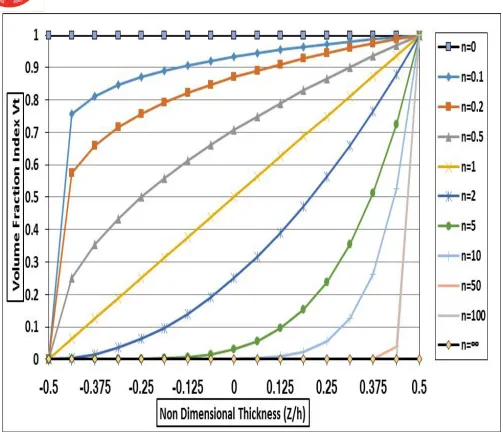
t (Ceramic)At n=0 the plate is a fully ceramic plate while at n=∞ the plate is completely metal. The variation of volume fraction in the thickness
510
©IJRASET (UGC Approved Journal): All Rights are ReservedFigure 4: Variation of volume fraction through plate thickness for various values of the power-law index n
511
©IJRASET (UGC Approved Journal): All Rights are Reservedb
κ
n
2h
h
2z
]
b
κ
t
[
κ
κ(z)
b
ρ
n
2h
h
2z
]
b
ρ
t
[
ρ
ρ(z)
b
α
n
2h
h
2z
]
b
α
t
[
α
α(z)
b
E
n
2h
h
2z
]
b
E
t
[E
E(z)
(5)B. The Material Properties of Sigmoidal FGM (S-FGM) Plates
In the case of adding an Functionally Graded Material of a single power-law function to the multi-layered composite, stress concentrations induce on one of the interfaces where the material is continuous but changes rapidly [10]. So, Chung & Chi (2001) defined the volume fraction using two power-law functions to make sure smooth distribution of stresses among all the interfaces. Then the two power-law functions are defined by:
2
h
z
0
for
2
h
z
2
h
2
1
1
(z)
g
n1
(6)0
z
2
for
2
h
z
2
h
2
1
(z)
g
n2
h
(7)By the use of rule of mixture, the Young’s modulus of elasticity of the S-FGM can be calculated by:
2
h
z
0
for
E
(z)]
g
[1
E
(z)
g
E(z)
1 1
1 2
(8)0
z
2
E
(z)]
g
[1
E
(z)
g
E(z)
2 1
2 2
h
(9)512
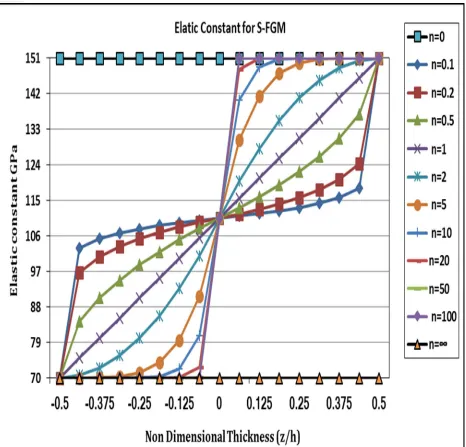
©IJRASET (UGC Approved Journal): All Rights are ReservedFigure 5: The Variation of Elastic constant for S-FGM
C. The Material Properties of Exponential FGM (E-FGM) Plates
Exponential function used to describe the material properties of FGMs as follows [10]
2 h z BAe
E(z)
(10)With
a
E
2
and
2 1E
E
ln
B
2 h z E E ln h 1 2 2 1e
E
E(z)
(11)513
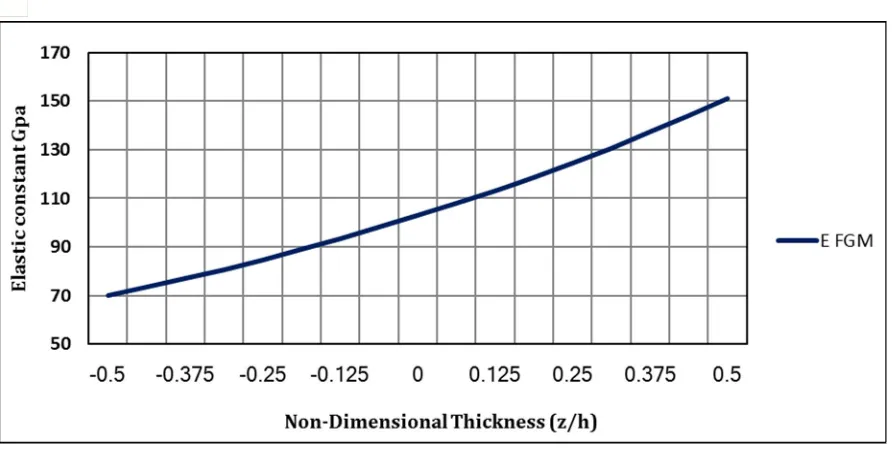
©IJRASET (UGC Approved Journal): All Rights are ReservedFigure 6: Variation of Elastic constant in E-FGM plate.
IV.MODALANALYSISOFFUNCTIONALLYGRADEDMATERIALPLATE
[image:14.612.85.531.67.292.2]Modal analysis is used to determine the natural frequencies & mode shapes of a structural element. Modal analysis is a linear analysis in ANSYS. Different mode extraction methods, such as Block Lanczos, Supernode, PCG Lanczos, reduced, un-symmetric, damped, & QR damped are available. Block Lanczos is used in the present analysis. Block Lanczos is used for large symmetric Eigen-value problems and it uses the sparse matrix solver [82]. The solution steps in ANSYS APDL are
Figure 7: Solution steps in ANSYS mechanical APDL
V. FREEVINRATIONANAYLSISOFFGMPLATESSUNJECTEDTOONLY MECHANICALLOADING Free vibration response of FGM plates subjected to mechanical and thermal loadings are computed using ANSYS 15.0 for Aluminium/Zirconia rectangular plate for various aspect ratios and boundary conditions. Computed results are compared and validated with those available in literature. The analysis is carried out for thickness ratio, and aspect ratio with various volume fraction indices of P-FGM, S-FGM and E-FGM. The following parameters are used in above analysis.
A. Plate dimensions
(a
b
0.2
m)
and thicknessh
0.01
m
.B. Uniformly distributed loading chosen was equal to
q
10
6N/m
2514
©IJRASET (UGC Approved Journal): All Rights are Reserved.
b
,
0
y
at
0
UZ
UX
.
,
0
at x
0
UZ
UY
a
(b) Simply supported-Simply supported-Clamped-Clamped (SSCC) as shown in Figure 8 (b)
[image:15.612.71.539.78.312.2].
b
y
and
,
at x
0
UZ
UY
UX
.
0
y
at
0
UZ
UX
and
,
0
at x
0
UZ
UY
a
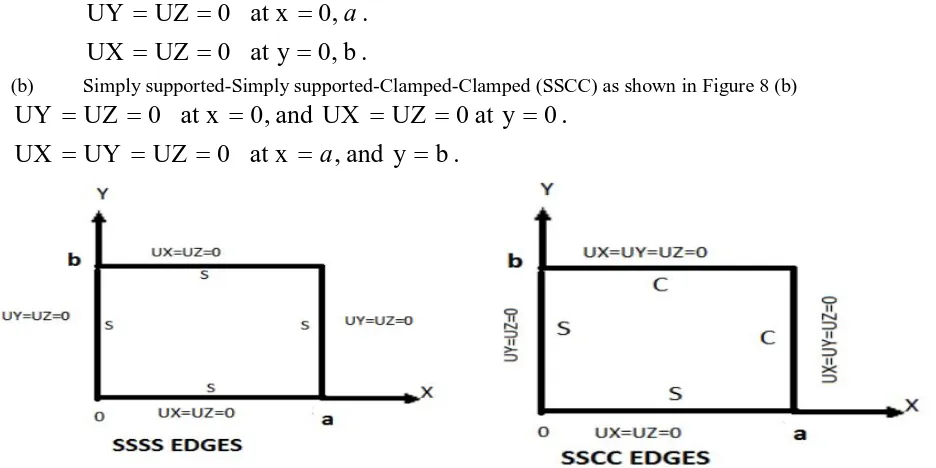
Figure 8: Representation of SSSS and SSCC support condition for Free Vibration analysis
D. The results are presented in terms of Non-dimensional frequency parameter which is obtained by applying 3-dimensional
frequency continume method is
2 4 2 2 2
)
1
(
12
h
E
a
b
c c
[23]VI. CONVERGENCE AND VALIDATION STYDY
The convergence study is performed for the mesh size and number of layers required for finite element analysis. First five non dimensional frequencies of free vibration of the FGM square plate are considered and the results are compared with published results. A 3-D 8-Node Structural Solid Shell element (SOLSH190) is used for analysis in ANSYS APDL. The functionally graded material section is considered as an equivalent laminate section for the finite element modelling. In this analysis 16 number of
laminate layers section are considered approximately to represent the FGM. For this study an
Al/ZrO
2 FGM Square platehaving
b/a
1.0
,a/h
20
(where a, b, h are width, length and thickness of the plate respectively) was taken. The material properties of metal and ceramicare:-Table 2 Material Property of Metal and Ceramic FGM
Material Property Aluminium (metal) Zirconia (ceramic)
Young’s Modulus (E) 70 GPa 151 GPa
Density
2707
Kg/m
3 3000Kg/m
3Thermal Conductivity K 204 W/mK 2.09 W/mk
Coefficient of Thermal
Expansion α
C
0 -6
/
23x10
10x10
-6/
0C
[image:15.612.50.559.558.719.2]515
©IJRASET (UGC Approved Journal): All Rights are ReservedBoundary Condition- all sides of FGM plate are simply supported (SSSS). Non-dimensional frequency parameter is
4 4
2 2 2
)
υ
1
(
12
h
E
b
a
c c
[23] (12)The convergence studies are conducted for simply supported isotropic FGM plate with
n
0
&
n
1.
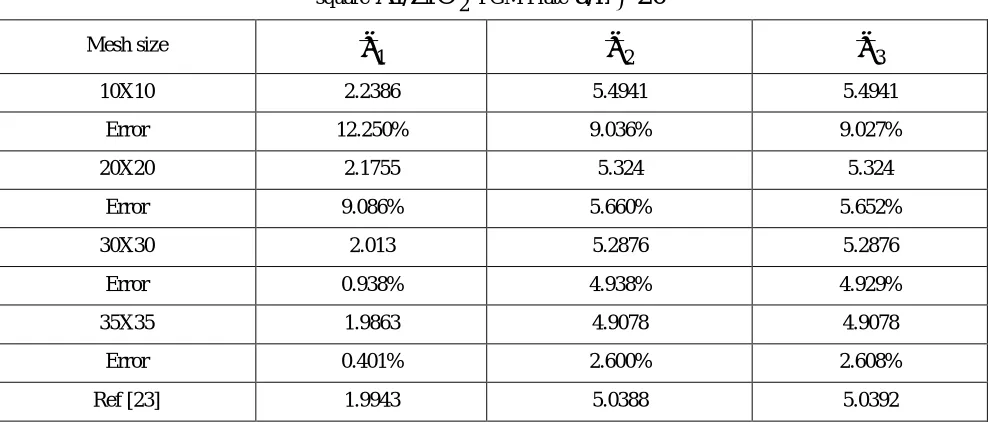
First five frequencies are observed with increase in number of mesh size. The Table 5.1 and Table 5.2 show the convergence of non-dimensional frequencyparameter with volume fraction index n=0 and n=1 for SSSS
Al/ZrO
2 FGM plates. The results show good convergence for [image:16.612.60.554.238.449.2]mesh size 35X35. The mesh size 35X35 is used in present study.
Table 3: Convergence of Non-Dimensional Frequency Parameter (
ω
) with material gradation indexn
0
(ceramic) for SSSS squareAl/ZrO
2 FGM Platea/h
20
Mesh size
1
ω
ω
2ω
310X10 2.2386 5.4941 5.4941
Error 12.250% 9.036% 9.027%
20X20 2.1755 5.324 5.324
Error 9.086% 5.660% 5.652%
30X30 2.013 5.2876 5.2876
Error 0.938% 4.938% 4.929%
35X35 1.9863 4.9078 4.9078
Error 0.401% 2.600% 2.608%
Ref [23] 1.9943 5.0388 5.0392
Table 4: Convergence of Non-Dimensional Frequency Parameter (
ω
) with material gradation indexn
1
for SSSS square 2Al/ZrO
FGM Platea/h
20
Mesh size
1
ω
ω
2ω
310X10 1.8553 4.7634 4.7634
Error 6.946% 9.953% 9.953%
20X20 1.8245 4.5309 4.5309
Error 5.171% 4.587% 4.587%
30X30 1.8112 4.4072 4.4072
Error 4.404% 1.731% 1.731%
35X35 1.7386 4.3201 4.3021
Error 0.219% 0.279% 0.695%
Ref [23] 1.7348 4.3322 4.3322
[image:16.612.69.543.493.697.2]516
©IJRASET (UGC Approved Journal): All Rights are ReservedVII. RESULTS AND ANALYSIS
Based on the procedures and analyses of foregoing sections, FGM free vibration response of SSSS, SSCC rectangular plates are studied. Natural Frequencies are calculated through Modal analysis using ANSYS and results are presented in non-dimensional frequency parameter.
[image:17.612.54.564.200.314.2]A. Variation of Non-Dimensional Frequency Parameter with Aspect Ratio for SSSS FGM Plates
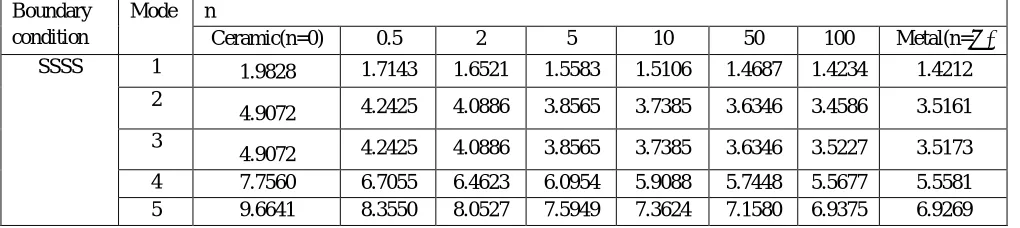
Table 5:Variation of the Frequency Parameter
ω
ω
12
(1
ν
2)
ρ
ca
2b
2/
π
4E
ch
2 with the volume fraction index (n) for(SSSS) Square (b/a=1.0), (
Al/ZrO
2) P-FGM plates (a/h=20)Boundary condition
Mode n
Ceramic(n=0) 0.5 2 5 10 50 100 Metal(n=∞)
SSSS 1 1.9828 1.7143 1.6521 1.5583 1.5106 1.4687 1.4234 1.4212 2
4.9072 4.2425 4.0886 3.8565 3.7385 3.6346 3.4586 3.5161 3
[image:17.612.66.559.383.503.2]4.9072 4.2425 4.0886 3.8565 3.7385 3.6346 3.5227 3.5173 4 7.7560 6.7055 6.4623 6.0954 5.9088 5.7448 5.5677 5.5581 5 9.6641 8.3550 8.0527 7.5949 7.3624 7.1580 6.9375 6.9269
Table 6: Variation of the Frequency Parameter
ω
ω
12
(1
ν
2)
ρ
ca
2b
2/
π
4E
ch
2 with the volume fraction index (n) for(SSSS) Square (b/a=1.0), (
Al/ZrO
2) S-FGM plates (a/h=20)Boundary condition
Mode n
Ceramic(n=0) 0.5 2 5 10 50 100 Metal(n=∞)
SSSS 1 1.9828 1.7386 1.7371 1.7357 1.7335 1.7313 1.7313 1.4212
2
4.9072 4.3028 4.2991 4.2954 4.2894 4.2838 4.2838 3.5161 3
4.9072 4.3028 4.2991 4.2954 4.2894 4.2838 3.7503 3.5173 4 7.7560 6.8007 6.7948 6.7889 6.7804 6.7716 6.7716 5.5581 5 9.6641 8.4737 8.4663 8.4579 8.4474 8.4364 8.4363 6.9269
Table 7: Variation of the Frequency Parameter
ω
ω
12
(1
ν
2)
ρ
ca
2b
2/
π
4E
ch
2 with the volume fraction index (n) for(SSSS) Square (b/a=1.0), (
Al/ZrO
2) E-FGM plates (a/h=20)Boundary condition Mode Exponential FGM
SSSS 1 1.7040
2 4.2171
3 4.2171
4 6.6652
5 8.3049
[image:17.612.43.544.554.668.2]517
©IJRASET (UGC Approved Journal): All Rights are Reserved [image:18.612.47.562.101.332.2]index between n=0 to ∞. Figure 11 shows comparison of non-dimensional frequency parameter for P-FGM, S-FGM having material gradient index n=2 and E-FGM.
Figure 9: Variation of non-dimensional frequency parameter with material gradient index of P-FGM and aspect ratio b/a=1.0 for
SSSS
Al/ZrO
2plates.Figure 10: Variation of non-dimensional frequency parameter with material gradient index of S-FGM and aspect ratio (b/a=1.0) for
[image:18.612.52.564.390.649.2]518
©IJRASET (UGC Approved Journal): All Rights are ReservedFigure 11: Comparison of non-dimensional frequency parameter with material gradient index n=2 of P-FGM, S-FGM & E-FGM
with aspect ratio (b/a=1.0) for SSSS
Al/ZrO
2 plates. [image:19.612.52.562.64.298.2]B. Variation of Non-Dimensional Frequency Parameter with Aspect Ratio for SSCC FGM Plates
Table 8: Variation of the Frequency Parameter
ω
ω
12
(1
ν
2)
ρ
ca
2b
2/
π
4E
ch
2 with the volume fraction index (n) for(SSCC) Square (b/a=1.0), (
Al/ZrO
2) P-FGM plates (a/h=20)Boundary condition
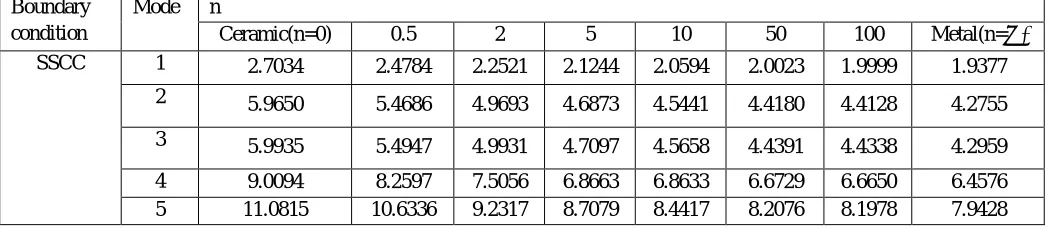
Mode n
Ceramic(n=0) 0.5 2 5 10 50 100 Metal(n=∞)
SSCC 1 2.7034 2.4784 2.2521 2.1244 2.0594 2.0023 1.9999 1.9377
2 5.9650 5.4686 4.9693 4.6873 4.5441 4.4180 4.4128 4.2755
3 5.9935 5.4947 4.9931 4.7097 4.5658 4.4391 4.4338 4.2959
4 9.0094 8.2597 7.5056 6.8663 6.8633 6.6729 6.6650 6.4576 5 11.0815 10.6336 9.2317 8.7079 8.4417 8.2076 8.1978 7.9428
Table 9: Variation of the Frequency Parameter
ω
ω
12
(1
ν
2)
ρ
ca
2b
2/
π
4E
ch
2 with the volume fraction index (n) for(SSCC) Square (b/a=1.0), (
Al/ZrO
2) S-FGM plates (a/h=20)Boundary condition
Mode n
Ceramic(n=0) 0.5 2 5 10 50 100 Metal(n=∞)
SSCC 1 2.7034 2.3703 2.3680 2.3649 2.3619 2.3588 2.3588 1.9377
2 5.9650 5.2299 5.2249 5.2181 5.2115 5.2044 5.2047 4.2755
3 5.9935 5.2549 5.2499 5.2430 5.2365 5.2296 5.2296 4.2959
[image:19.612.45.569.408.523.2]519
©IJRASET (UGC Approved Journal): All Rights are ReservedTable 10: Variation of the Frequency Parameter
ω
ω
12
(1
ν
2)
ρ
ca
2b
2/
π
4E
ch
2 with the volume fraction index (n) for(SSCC) Square (b/a=1.0), (
Al/ZrO
2) E-FGM plates (a/h=20)Boundary condition Mode Exponential FGM
SSCC 1 2.3229
2 5.1254
3 5.1500
4 7.7414
5 9.5218
For functionally graded material plates with SSCC boundary conditions value of non-dimensional frequency parameter decreases by increasing material gradient index (n) and aspect ratio (b/a) of plate, which is shown in figure 12 & 13. SSCC FGM plates having variation in material property according to Sigmoid (S-FGM) law, non-dimensional frequency parameter does not have significant variation with increasing power law index (n) but variation in material property according to Power-law (P-FGM) distribution, non-dimensional frequency parameter shows substantial variation by increasing material gradient index between n=0 to ∞. Comparison of non-dimensional frequency parameter with Power-law, Sigmoid-law and Exponential FGM is shown in figure 14.
Figure 12: Variation of non-dimensional frequency parameter with material gradient index n of P-FGM and aspect ratio for
[image:20.612.50.563.330.697.2]520
©IJRASET (UGC Approved Journal): All Rights are ReservedFigure 13: Variation of non-dimensional frequency parameter with material gradient index n of S-FGM and aspect ratio for
SSCC
Al/ZrO
2plates.Figure 14: Comparison of non-dimensional frequency parameter with material gradient index n=2 of P-FGM, S-FGM &
[image:21.612.58.555.383.680.2]521
©IJRASET (UGC Approved Journal): All Rights are ReservedC. Variation of Non-Dimensional Frequency Parameter with Material Gradient Index n for SSSS FGM Plates
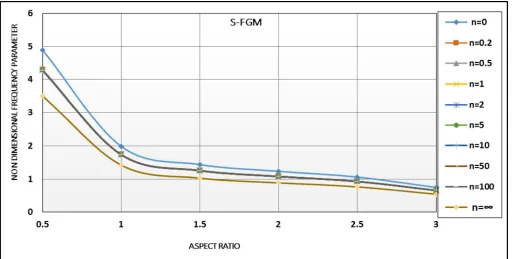
Non-dimensional frequency parameter for SSSS FGM plates decreases as by increasing value of both volume fraction index (n) and plate aspect ratio for P-FGM as shown in figure 15. For S-FGM variation in non-dimensional frequency parameter is relatively very small for most values of volume fraction index (i.e. n>0 and n<∞), its value only changes for volume fraction index at n=0 and n=∞.
[image:22.612.49.567.211.451.2]So value of frequency parameter is almost constant for most values of volume fraction index. As plate aspect ratio increases non-dimensional frequency parameter reduces as shown in figure 15 to 17. Figure 17 shows variation of frequency parameter for E-FGM with all simply supported edges (SSSS).
Table 11: Variation of the First- Frequency Parameter
ω
ω
12
(1
ν
2)
ρ
ca
2b
2/
π
4E
ch
2 with the volume fraction index (n)for (SSSS) (
Al/ZrO
2) P-FGM, E-FGM plates (a/h=20) with aspect ratio. AspectRatio
n=0 n=0.2 n=0.5 n=1 n=2 n=5 n=10 n=50 n=100 n=∞ E-EGM
0.5 4.8972 4.6693 4.4817 4.2927 4.0804 3.8487 3.7309 3.6273 3.6229 3.5101 4.2085
1 1.9828 1.8906 1.7143 1.7379 1.6521 1.5583 1.5106 1.4687 1.4234 1.4212 1.7040
1.5 1.4361 1.3728 1.3167 1.2588 1.1965 1.1286 1.0941 1.0637 1.0624 1.0293 1.2341
2 1.2350 1.1806 1.1323 1.0826 1.0290 0.9706 0.9409 0.9148 0.9137 0.8852 1.0614
2.5 1.0621 1.0153 0.9738 0.9310 0.8850 0.8347 0.8092 0.7867 0.7858 0.7613 0.9128
3 0.7435 0.7107 0.6817 0.6517 0.6195 0.5843 0.5664 0.5507 0.5500 0.5329 0.6389
Table 12: Variation of the First- Frequency Parameter
ω
ω
12
(1
ν
2)
ρ
ca
2b
2/
π
4E
ch
2 with the volume fraction index (n)for (SSSS) (
Al/ZrO
2) S-FGM, E-FGM plates (a/h=20) with aspect ratio.Aspect Ratio
n=0 n=0.2 n=0.5 n=1 n=2 n=5 n=10 n=50 n=100 n=∞ E-EGM 0.5 4.8972 4.2942 4.2940 4.2910 4.2904 4.2850 4.2796 4.2741 4.2741 3.5101 4.2085
1 1.9828 1.7387 1.7386 1.7381 1.7371 1.7357 1.7335 1.7313 1.7313 1.4212 1.7040
1.5 1.4361 1.2593 1.2592 1.2584 1.2581 1.2565 1.2550 1.2534 1.2533 1.0293 1.2341
2 1.2350 1.0830 1.0829 1.0822 1.0820 1.0806 1.0793 1.0779 1.0779 0.8852 1.0614
2.5 1.0621 0.9314 0.9313 0.9307 0.9305 0.9293 0.9282 0.9270 0.9270 0.7613 0.9128
[image:22.612.45.571.500.692.2]522
©IJRASET (UGC Approved Journal): All Rights are ReservedFigure 15: Non-dimensional frequency parameter v/s material index n of P-FGM for SSSS
Al/ZrO
2 rectangular plate.Figure 16: Non-dimensional frequency parameter v/s material gradient index n of S-FGM for SSSS
Al/ZrO
2 rectangular [image:23.612.58.555.382.675.2]523
©IJRASET (UGC Approved Journal): All Rights are ReservedFigure 17: Non-dimensional frequency parameter v/s aspect ratio for Exponential FGM SSSS
Al/ZrO
2 rectangular plate.D. Variation of Non-Dimensional Frequency Parameter with Material Gradient Index n for SSCC FGM Plates
Table 13: Variation of the First- Frequency Parameter
ω
ω
12
(1
ν
2)
ρ
ca
2b
2/
π
4E
ch
2 with the volume fraction index (n)for (SSCC) (
Al/ZrO
2) P-FGM, E-FGM plates (a/h=20) with aspect ratio.Aspect Ratio
n=0 n=0.2 n=0.5 n=1 n=2 n=5 n=10 n=50 n=100 n=∞ E-EGM
0.5 6.9110 6.5892 6.3359 6.0572 5.7574 5.4307 5.2642 5.1182 5.1126 4.9535 5.9383
1.0 2.7034 2.5775 2.4784 2.3693 2.2521 2.1244 2.0594 2.0023 1.9999 1.9377 2.3229
1.5 2.0027 1.9094 1.8360 1.7553 1.6684 1.5737 1.5256 1.4833 1.4816 1.4355 1.7208
2.0 1.6021 1.5275 1.4688 1.4042 1.3347 1.2590 1.2205 1.1867 1.1852 1.1484 1.3767
2.5 1.3618 1.2984 1.2485 1.1936 1.1345 1.0701 1.0374 1.0087 1.0075 0.9761 1.1702
[image:24.612.43.577.385.683.2]524
©IJRASET (UGC Approved Journal): All Rights are ReservedTable 14 Variation of the First- Frequency Parameter
ω
ω
12
(1
ν
2)
ρ
ca
2b
2/
π
4E
ch
2 with the volume fraction index (n) for(SSCC) (
Al/ZrO
2) S-FGM, E-FGM plates (a/h=20) with aspect ratio.Aspect Ratio
N=0 S-FGM N=0.2
S-FGM N=0.5
S-FGM N=1
S-FGM N=2
S-FGM N=5
S-FGM N=10
S-FGM N=50
S-FGM N=100
N=∞ E-EGM
0.5 6.9110 6.0599 6.0594 6.0547 6.1069 6.0456 6.0381 6.0302 6.0301 4.9535 5.9383
1.0 2.7034 2.3704 2.3703 2.3685 2.3680 2.3649 2.3619 2.3588 2.3588 1.9377 2.3229
1.5 2.0027 1.7560 1.7559 1.7546 1.7542 1.7519 1.7497 1.7474 1.7474 1.4355 1.7208
2.0 1.6021 1.4048 1.4047 1.4037 1.4034 1.4015 1.3998 1.3980 1.3980 1.1484 1.3767
2.5 1.3618 1.1941 1.1940 1.1931 1.1929 1.1913 1.1898 1.1883 1.1883 0.9761 1.1702
3.0 1.1575 1.0150 1.0149 1.0141 1.0139 1.0126 1.0113 1.0100 1.0100 0.8297 0.9946
For SSCC FGM plate value of non-dimensional frequency parameter reduces by increasing value of material gradient index for P-FGM. Its value is maximum for n=0 and minimum for n=∞, as shown in figure 18.
Figure 18: Non-dimensional frequency parameter v/s material gradient index n of P-FGM for SSCC
Al/ZrO
2 rectangular [image:25.612.52.564.399.657.2]525
©IJRASET (UGC Approved Journal): All Rights are ReservedFigure 19: Non-dimensional frequency parameter v/s material gradient index n of S-FGM for SSCC
Al/ZrO
2 rectangularplate.
Figure 20: Non-dimensional frequency parameter v/s aspect ratio for Exponential FGM SSCC
Al/ZrO
2 rectangular plate.In case of Sigmoid SSCC FGM plate there is small variation in material properties i.e. elastic constant, so variation in non-dimensional frequency parameter is very small and its value is constant for most values of material gradation index. Non-dimensional frequency parameter changes for only values of n=0 and n=∞. Frequency parameter is maximum for n=0 and minimum
[image:26.612.64.555.381.617.2]526
©IJRASET (UGC Approved Journal): All Rights are ReservedIX. CONCLUSION
An extensive study of free vibration analysis of square and rectangular functionally graded material plates subjected to both uniformly distributed load and Thermo mechanical loading I presented. Analysis is performed using ANSYS 15.0 APDL software. A Solid-Shell element (SOLSH190) based on first-order shear deformation theory is used for above analysis. Effective material properties of functionally graded material plate are calculated for each layer according to Simple Power law (P-FGM), Sigmoid law (S-FGM) and Exponential law (E-FGM). Accuracy of present methodology i.e. number of FGM layers, element type is justified by performing convergence and validation studies. Results obtained from above analysis is in good agreement with those available in literature. The following important conclusions are observed from the result obtained from free vibration analysis considering various parameters viz. different material gradient index i.e. P-FGM, S-FGM, E-FGM laws, plate aspect ratio thermal loadings and various combination of boundary conditions.
A. It is concluded that free vibration frequency of FGM plate is maximum for pure ceramic(n=0) and minimum for metal (n=∞) &
decreases gradually as volume fraction index n increases. By increasing value of material gradient index n, sharing of ceramic(ZrO2)phase in FGM plate decreases and sharing of Aluminium phase increases which tends t reduce the stiffness of
FGM plate and thereby reducing the natural frequency, because th Young’s Modulus of Aluminium is 151GPa and Young’s Modulus of Zirconia is 70GPa.
B. It is concluded that an increase in plate aspect ratio, leads to decrease in stiffness of plate,and consequently the value of non-dimensional frequency parameter decreases.
C. To study influence of boundary conditions of plate, a set of two types of boundary conditions i.e., SSSS, and SSCC are considered here. It is expected that stiffer boundaries yield higher value of non-dimensional frequency parameter whereas less stiff boundaries correspond to lower values of non-dimensional frequency parameter. In above analysis, order of non-dimensional frequency parameter is SSCC>SSSS. It means that Simply Supported and Clamped (SSCC) boundary condition is stiffer than Simply Supported (SSSS) boundaries are very less stiff.
REFERENCES
[1] G. N. PRAVEEN and J. N. REDDY, “Nonlinear Transient Thermo-elastic Analysis ofFunctionally Graded Ceramic-Metal Plates” Int. Journal of Solids Structures, 1998 Vol. 35. No.3, pp. 4457-447
[2] J. N. Reddy, “Analysis of functionally graded plates” INTERNATIONAL JOURNAL FORNUMERICAL METHODS IN ENGINEERING, 2000 Vol. 47, pp. 663 -68
[3] Z.-Q. CHENG and R. C. BATRA, “Exact Correspondence between Eigenvalues ofMembranes and Functionally Graded Simply Supported Polygonal Plates” Journal of Sound andVibration, 2000 Vol. 229(4) pp. 879-89
[4] A. Chakraborty, S. Gopalakrishnana, J.N. Reddy, “A New Beam Finite Element for th Analysis of Functionally Graded Materials” International Journal of Mechanical Sciences 200 Vol.45 pp.519-53
[5] L.F.Qian and R.C.Batra, “Transient Thermoelastic Deformation of a Thick FunctionallyGraded Plate” International Journal of Thermal Stresses 2004 Vol. 27 pp 705–74
[6] A.J.M. Ferreira, R.C. Batra, C.M.C. Roque, L.F. Qian, P.A.L.S. Martins “Static Analysis ofFunctionally Graded Plates using Third-order Shear Deformation Theory And a MeshlessMethod” International Journal of Composite Structures 2005, Vol. 69 pp.449-457
[7] A.M. Zenkour, “A Comprehensive Analysis of Functionally Graded Sandwich Plates: Pa 2-Buckling and Free Vibration” International Journal of Solids and Structures 2005, Vol. 42 pp.5243–525
[8] R.C. Batra, J.Jin, “Natural Frequencies of a Functionally Graded Anisotropic Rectangula plate” International Journal of Sound and Vibration 2005, Vol. 282 pp. 509-516
[9] J. Woo, S.A. Meguid, L.S. Ong, “Nonlinear Free Vibration Behaviour of FunctionallyGraded Plates” International Journal of Sound and Vibration 2006, Vol. 289 pp.595-611
[10] Shyang-Ho Chi, Yen-Ling Chung, “Mechanical Behavior of Functionally Graded Material
[11] Plates Under Transverse Load —Part I: Analysis” International Journal of Solids and Structures2006, Vol. 43 pp.3657-367
[12] Shyang-Ho Chi, Yen-Ling Chung, “Mechanical Behavior of Functionally Ggraded Material
[13] Plates under Transverse Load—Part II: Numerical results” International Journal of Solids andStructures 2006, Vol. 43 pp. 3675–36
[14] Serge Abrate, “Free vibration, Buckling, and Static Deflections of Functionally GradedPlates” Composites Science and Technology 2006, Vol.66 pp.2383-239
[15] T. Prakash, M. Ganapathi, “Asymmetric Flexural Vibration and Thermoelastic Stability o
[16] FGM Circular Plates using Finite Element Method” International Journal of Composites 2006:Part B Vol 37 pp.642-64
[17] C.M.C. Roque, A.J.M. Ferreira, R.M.N. Jorge, “A Radial Basis Function Approach For th
[18] Free Vibration Analysis of Functionally Graded Plates using a Refined Theory” Journal of Soun and Vibration 2007, Vol.300 pp.1048-107
[19] Hiroyuki Matsunaga, “Free Vibration and Stability of Functionally Graded Plates According to a 2-D Higher-Order Deformation Theory” Journal of Composite Structures 2008Vol. 82 pp. 499-51
527
©IJRASET (UGC Approved Journal): All Rights are Reserved[21] Farzad Ebrahimi, Abbas Rastgo, “An Analytical Study on The Free Vibration of Smart Circular Thin FGM Plate Based on Classical Plate Theory” Journal of Thin-Walled Structures2008, Vol. 46 pp. 1402– 140
[22] X.Zhao, Y.Y.Lee, K.M. Liew, “Free Vibration Analysis of Functionally Graded Platesn Using The Element-Free kp-Ritz Method” Journal of Sound and Vibration 2009, Vol.319 pp 918-93
[23] Wei Zhang, Jie Yang, Yuxin Hao, “Chaotic Vibrations of An Orthotropic FG Rectangular Plate based on Third-Order Shear Deformation Theory” Journal of NonlinearDynamics 2010 Vol. 59 pp.619-66
[24] Sh. Hosseini, Hashemi , M.Es’haghi , M.Karimi, “Closed-form Vibration Analysis of ThickAnnular Functionally Graded Plates With Integrated Piezoelectric Layers” International Journalof Mechanical Sciences 2010, Vol.52 pp.410-42
[25] D.Y. Liu , C.Y. Wang, W.Q. Chen, “Free vibration of FGM plates with in-plane materialinhomogeneity” Journal of Composite Structures 2010, Vol. 92 pp. 1047–10
[26] Sh. Hosseini-Hashemi , H. Rokni Damavandi Taher , H. Akhavan , M. Omidi , “Fre Vibration of Functionally Graded Rectangular Plates using First-order Shear Deformation PlateTheory” Journal of Applied Mathematical Modelling 2010, Vol. 34 pp. 1276–129
[27] Mohammad Talha, B.N. Singh, “Static response and free vibration analysis of FGM plate using higher order shear deformation theory” Journal of Applied Mathematical Modelling 2010,Vol. 34 pp. 3991–40
[28] Song Xiang, Yao-xing Jin, Ze-yang Bi, Shao-xi Jiang, Ming-sui Yang, “A n-order Shear
[29] Deformation Theory for Free Vibration of Functionally Graded and Composite Sandwich Plates Journal of Composite Structures 2011 Vol.93 pp. 2826–283
[30] Abdelkader Benachour , Hassaine Daouadji Tahar, Hassen Ait Atmane, Abdelouahe
[31] Tounsi, Meftah Sid Ahmed, “A Four Variable Refined Plate Theory for Free Vibrations of Functionally Graded Plates with Arbitrary Gradient” International journal of Composites 2011Vol. Part B (42) pp. 1386–139
[32] J. Suresh Kumar, B. Sidda Reddy, C. Eswara Reddy and K. Vijaya Kumar Reddy, “Higher
[33] Order Theory for Free Vibration Analysis of Functionally Graded Material Plates” ARP Journal of Engineering and Applied Sciences October 2011, Vol.6 No 10 pp.105
[34] Y.X. Hao, W. Zhang, J. Yang, “Nonlinear Oscillation of a Cantilever FGM RectangularPlate Based on Third-Order Plate Theory and Asymptotic Perturbation Method” Journal ofComposites 2011 Part B Vol.42 pp. 402-4
[35] D.K. Jha, Tarun Kant, R.K. Singh, “A Critical Review of Recent Research on FunctionallyGraded Plates” Journal of Composite Structures 2013, Vol. 96 pp. 833–84
[36] T. Prakash, M.K.Singha, M.Ganapathi, “A Finite Element Study on The Large Amplitude Flexural Vibration Characteristics of FGM Plates under Aerodynamic Load” InternationalJournal of Non-Linear Mechanics 2012, Vol. 47 pp. 439–447
[37] Hui-Shen Shen, Zhen-Xin Wang, “Assessment of Voigt and Mori–Tanaka models fo Vibration Analysis of Functionally Graded Plates” Journal of Composite Structures 2012 Vol. 94pp. 2197–220
[38] K. Sanjay Anandrao, R.K. Gupta, P. Ramachandran, and G. Venkateswara Rao, “FreeVibration Analysis of Functionally Graded Beams” Defence Science Journal May 2012, Vol. 62,No. 30, pp. 139-146
[39] Koteswara Rao D, Blessington P. J, Tarapada Roy, “Finite Element Modeling and Analysisof Functionally Graded (FG) Composite Shell Structures” ICMOC Procedia Engineering 2012, Vol. 38 pp. 3192 – 319
[40] D.K. Jha, Tarun Kant, R.K. Singh, “Higher order shear and normal deformation theory fornatural frequency of functionally graded rectangular plates” journal of Nuclear Engineering anDesign 2012, Vol. 250 pp. 8– 1
[41] Mohammad Talha and B N Singh, “Thermo-Mechanical Deformation Behavior o Functionally Graded Rectangular Plates Subjected to Various Boundary Conditions andLoadings” International Journal of Aerospace and Mechanical Engineering 2012, Vol. 6:1 pp.
[42] K. Swaminathan, D. T. Naveenkumar, “Assessment of First Order Computational Modelfor Free Vibration Analysis of FGM Plates” International Journal of Scientific & EngineeringResearch May-2013 Volume 4, Issue 5 pp. 115-11
[43] Shuohui Yin, Tiantang Yu, and Peng Liu, “Free Vibration Analyses of FGM Thin Plates n Isogeometric Analysis Based on Classical Plate TheorNeutral
[44] Surface” HindawiPublishing Corporation Advances in Mechanical Engineering Volume 2013, Article ID 634584,10 pageZ.X. Lei, K.M. Liew, J.L. Yu, “Free Vibration Analysis of Functionally Graded Carbon
[45] Nanotube-Reinforced Composite Plates using the Element-Free kp-Ritz Method in ThermalEnvironment” Journal of Composite Structures 2013, Vol. 106 pp. 128-13
![Figure 1: Representation of modern material hierarchy [28]](https://thumb-us.123doks.com/thumbv2/123dok_us/8298574.853665/3.612.77.539.276.666/figure-representation-modern-material-hierarchy.webp)
![Table 1 Illustration of a Metal-Ceramic FGM [82]](https://thumb-us.123doks.com/thumbv2/123dok_us/8298574.853665/4.612.177.438.340.575/table-illustration-of-a-metal-ceramic-fgm.webp)