2018 International Conference on Physics, Computing and Mathematical Modeling (PCMM 2018) ISBN: 978-1-60595-549-0
Advances in Chinese Carbon Capture and Storage Technology Based on
Patent Information Analysis: Perspective on Technological Components
Hong-hua QIU
1,2,*1School of Law, Northwest University, Xi`an City, Shaanxi Province, 710127, P.R. China
2Max Planck Institute for Innovation and Competition, Marstallplaz 1, 80539 Munich, Germany
*Corresponding author
Keywords: Carbon capture and storage technology, Patent information analysis, Technological component, Technological innovation, China.
Abstract. As an effective technical means to mitigate climate change, both innovation activities and patent protection of carbon capture and storage technology has been promoted greatly in China. The advances of the technological components of Chinese carbon capture and storage technology were investigated from several patent indicators, such as total patent number, geographical distribution of patent applications, main patent applicants and highest-value patents. It is concluded that the technological innovative capabilities of Chinese domestic applicants need to be further improved to compete with foreign applicants in the area of carbon capture and storage technology.
Introduction
Along with rapid economic growth, our demand for energy is increasing dramatically. An obvious consequence of this situation is an increase in the use of fuels, particularly conventional fossil fuels. However, the abundant use of fossil fuels may cause many serious problems due to their adverse effects on the environment and the emissions of carbon dioxide, a major anthropogenic greenhouse gas (GHG) [1]. Carbon capture and storage (CCS) technology has been developed as a potential technical means to allow the continued use of fossil-fuelled power stations whilst preventing emissions of carbon dioxide from reaching the atmosphere [2], it has been regarded as a key technological option to reduce the emissions of carbon dioxide, it can play important role in meeting various atmospheric carbon dioxide stabilization targets [3]. CCS technology is currently considered to be technically feasible at commercial scale, and a number of R&D activities, such as large-scale electricity generation projects, have been proposed [4]. CCS technology can contribute up to 15-55% of the cumulative global climate change mitigation effort by 2100 and reduce the costs of stabilizing atmospheric carbon dioxide concentrations by 30 percent or more [5]. According to the Blue Map Scenario of International Energy Agency (IEA), CCS technology will reduce 19 percent carbon dioxide, which means that a total amount of over 8 Gt of carbon dioxide will be captured, transported and stored per year by 2050 [6].
CCS technology is not a single technology but consists of sets of technological components associated with capturing, transporting and storing carbon dioxide [7]. Thus, CCS technology refers to a series of technologies; the components of CCS technology comprise three steps: capture, transportation and storage. Carbon dioxide is captured at fixed point sources, then the captured carbon dioxide is compressed to a liquid and supercritical fluid to be transported by pipeline or ship to the place where it can be stored, such as geology, ocean and mineralization, and so on [9].
arising from coal burning accounts for approximately 80 percent of total industrial carbon emissions [10]. In order to reduce fossil fuel-related carbon dioxide emissions, it is necessary for China to deploy CCS technology, actually, CCS technology has been discussed intensively in China in recent years [11]. In order to obtain the developing opportunities for enhancing the coordination and cooperation with international community, China is engaged in several international initiatives that focused on CCS technology. Meanwhile, Chinese government also carried out guiding policy, key research programs, and key demonstration projects to promote the development of CCS technology in China [12].
As is known, patent system is an important way to protect innovative achievements. A patent document contains rich technological innovation. Patent documents provide valuable information about geographical, sectoral, and technological distribution of technological inventions, they can represent the outcome of the inventive process and commercial impact and become a particularly appropriate indicator to capture the proprietary and competitive dimension of technological change [13]. Additionally, patent documents are available in large numbers and for a long-time period, we can get valuable information not only on the rate of inventive activities, but also on their developing directions [14].
Patent Search and Data Collection
In this study, we used INNOGRAPHY (https://app.innography.com/) to carry out patent search to collect Chinese carbon capture and storage patents. INNOGRAPHY is a CPA global company, it is founded in 2007 and based in Austin, Texas. INNOGRAPHY is the world`s premier patent analytics provider, its proprietary software suite combines 100 million corrected patent documents, combined with many other data sources and unique visualization technologies, to enable users to quickly gain valuable insights for optimizing their patent portfolios and understanding current and potential competitors.
Regarding to patent search string, we used “carbon”, “CO2” and “carbon dioxide” to definite the keyword of “carbon dioxide”; and then, as to the technological components of CCS, we used keywords/terms to definite “capture”, “transportation” and “storage”, separately. We also used “storage*” and “sequestrat*” to definite “carbon storage technology”. Furthermore, we used Cooperation Patent Classification (CPC) to search CCS patent documents, because CPC assign a special classification for emerging technologies, which make our patent search more accurate and convenient. The definition of CPC used in our study can be described as following:
Y General Tagging of New Technological Developments; General Tagging of Cross sectional
Technologies Spanning Over Several Sections of the IPC; Technical Subjects Covered by Former USPC Cross-Reference Art Collections [XRACS]
Y02 Technologies or Applications for Mitigation or Adaptation Against Climate Change
Y02C Capture, Storage, Sequestration or Disposal of Greenhouse Gases [GHG]
Analysis and Results
Development of Chinese Carbon Capture Technology
applicants from foreign countries, General Electric Company (U.S.) filed the most patents (85)
[image:3.595.65.533.123.229.2]followed by Air Liquide (41). Tianjin University ranked the 3rd with 34 patents.
Table 1. Top 10 patent applicants of carbon capture technology in China.
Applicant Patents Applicant Patents
General Electric Company 85 Praxair, Inc. 25
Air Liquide 41 Toshiba Corporation 24
Tianjin University 34 China Petroleum & Chemical Corp. 23
Chinese Academy of Sciences 31 Linde AG 22
Zhejiang University 30
Exxon Mobil Corporation 22
Air Products & Chemicals, Inc. 29
[image:3.595.62.538.336.483.2]PatentStrength was developed by INNOGRAPHY based on 12 different factors, it has been widely used to predict patent value, find the highest-value patents and assess patent portfolios. Table 2 lists Top 10 highest-value patents in Chinese carbon capture technology based on PatentStrength value, of which, only 3 patents filed by domestic applicants, in contrast, there are 6 patents filed by America applicants, and 1 patent filed by Australia applicant.
Table 2. Top 10 highest-value carbon capture patents in China.
Patent number Applicant Patent
Strength Patent number Applicant
Patent Strength
CN104334721 Akermin, Inc. (US) 83 CN102232004 Akermin Inc. (US) 64
CN103648612 Enverid Systems Inc
(US) 75 CN103958027 Basf Se (US) 63
CN101516473 Commw Scient Ind
Res Org (AU) 73 CN106621705
Carbon Engineering Limited
Partnership (US) 63
CN102210966 Aibang Chinese Co.,
Ltd.(CN) 67 CN103896300
Shanghai Advanced Research Institute, Chinese Academy of Sciences (CN)
63
CN102083512 Innosepra LLC; Jain
Ravi (US) 67 CN106422656
Guangdong Guangshan New
Material Co., Ltd. (CN) 62
Development of Chinese Carbon Transportation Technology
Table 3. Top 6 patent applicants of carbon transportation technology in China.
Applicant Patents Applicant Patents
Praxair, Inc. 3 General Electric Company 2
Mitsubishi Gas Chemical Company, Inc. 3 Southeast University 2
[image:3.595.66.534.569.776.2]Renaissance Energy Res Corp. 3 Saudi Arabian Oil Company 2
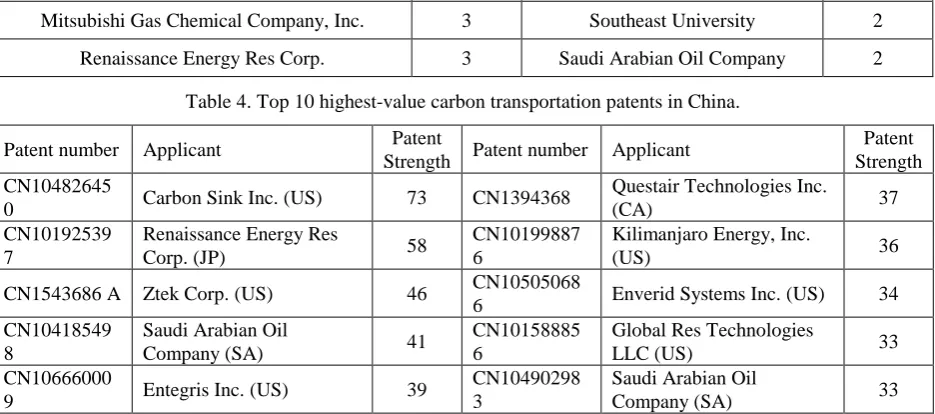
Table 4. Top 10 highest-value carbon transportation patents in China.
Patent number Applicant Patent
Strength Patent number Applicant
Patent Strength CN10482645
0 Carbon Sink Inc. (US) 73 CN1394368
Questair Technologies Inc.
(CA) 37
CN10192539 7
Renaissance Energy Res
Corp. (JP) 58
CN10199887 6
Kilimanjaro Energy, Inc.
(US) 36
CN1543686 A Ztek Corp. (US) 46 CN10505068
6 Enverid Systems Inc. (US) 34
CN10418549 8
Saudi Arabian Oil
Company (SA) 41
CN10158885 6
Global Res Technologies
LLC (US) 33
CN10666000
9 Entegris Inc. (US) 39
CN10490298 3
Saudi Arabian Oil
The total number of Chinese carbon transportation patents is 52, of which there are 16 patents filed by Chinese domestic applicants, and other 36 patents filed by 41 foreign applicants from 8 countries. The America applicants filed the most carbon transportation patents in China (19) followed by Japanese applicants (10), the applicants from Norway also filed 3 carbon transportation patents in China. Table 3 lists the Top 6 applicants who filed most carbon transportation patents in China, it can be seen that both U.S. and Japan has 2 applicants. Table 4 lists the Top 10 highest-value carbon transportation patents in China, of which there 6 patents filed by America applicants, 2 patents filed by Saudi Arabia, and no patent filed by Chinese domestic applicants.
Development of Chinese Carbon Storage Technology
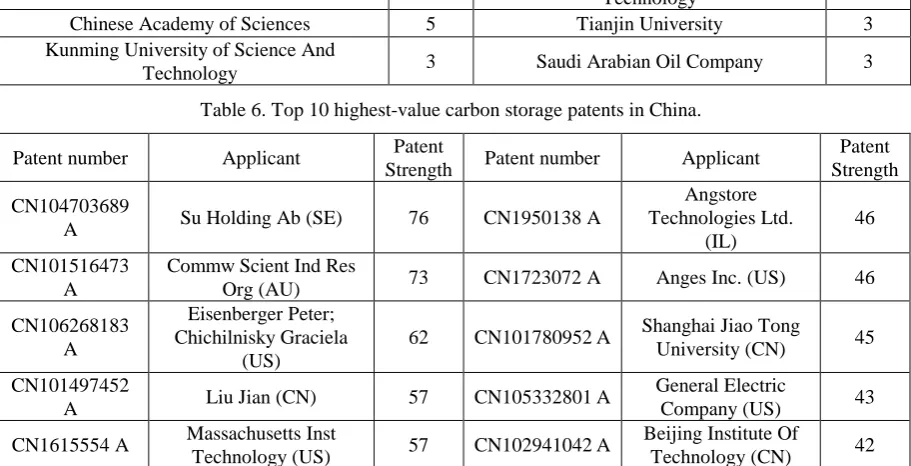
The total number of Chinese carbon storage patents is 126, of which there are 75 patents filed by domestic applicants, and other 51 patents filed by foreign applicants. There are 84 companies from total 15 foreign countries have carried out patent activities in Chinese carbon storage technology, among them, the America applicants filed the most patents (20) followed by Japanese applicants (7) and European applicants (6). Table 5 lists the top 6 patent applicants of Chinese carbon storage technology, of which there are 4 applicants from China, both U.S. and Saudi Arabia have 1 applicant. General Electric Company from U.S. filed the most carbon storage technology in China (10) followed by Chinese Academy of Sciences (5). Table 6 lists the TOP 10 highest-value carbon storage patents in China, of which there are 3 filed by America applicants and 2 filed by Chinese domestic applicants.
Table 5. Top 6 patent applicants of carbon storage technology in China.
Applicant patents Applicant patents
General Electric Company 10 Beijing University of Chemical
Technology 3
Chinese Academy of Sciences 5 Tianjin University 3
Kunming University of Science And
[image:4.595.72.528.396.629.2]Technology 3 Saudi Arabian Oil Company 3
Table 6. Top 10 highest-value carbon storage patents in China.
Patent number Applicant Patent
Strength Patent number Applicant
Patent Strength
CN104703689
A Su Holding Ab (SE) 76 CN1950138 A
Angstore Technologies Ltd.
(IL)
46
CN101516473 A
Commw Scient Ind Res
Org (AU) 73 CN1723072 A Anges Inc. (US) 46
CN106268183 A
Eisenberger Peter; Chichilnisky Graciela
(US)
62 CN101780952 A Shanghai Jiao Tong
University (CN) 45
CN101497452
A Liu Jian (CN) 57 CN105332801 A
General Electric
Company (US) 43
CN1615554 A Massachusetts Inst
Technology (US) 57 CN102941042 A
Beijing Institute Of
Technology (CN) 42
Conclusions
countries/region filed more patents than Chinese domestic applicants; furthermore, most of the competitive applicants are from these developed countries/regions. Chinese domestic applicants have more patents in the technological area of carbon storage; however, regarding to the highest-value patents, most of them filed by foreign applicants in all three technological components, especially in the field of carbon transportation technology, all the valuable patents owned by foreign applicants. Therefore, Chinese technological innovation level in CCS technology needs to be further improved in the near future [15].
To sum up, this research contributes to our understanding of how CCS technology develops in China and differs between domestic applicants and foreign applicants. However, it should be noted that, different strategies for patent retrieval may lead to different retrieval results. In this study, we use CPC to search CCS patents, which can improve the accuracy and efficiency of our research, but also possible omit the patent documents assigned in other classifications. This should be given enough attention in our future research.
Acknowledgement
The research work was supported by Science and Technology Program of Xi`an, China (Grant No. 2016039SF/RK02) and Foundation of Shaanxi Educational Committee (Grant No. 16JK1725). The author is grateful for the financial sponsorship of Chinese Scholarship Council (CSC) to support his study in Max Planck Institute for Innovation and Competition as a visiting scholar. Special thanks to my supervisor, Professor Dietmar Harhoff, the director of Max Planck Institute for Innovation and Competition. He not only provides me with very nice research conditions but also offers me lots of valuable and constructive comments/suggestions for my research.
References
[1]Leung D Y C, Caramanna G, Maroto-Valer M M. An overview of current status of carbon dioxide
capture and storage technologies[J]. Renewable & Sustainable Energy Reviews, 2014, 39(39):426-443.
[2]Boothandford M E, Abanades J C, Anthony E J, et al. Carbon capture and storage update[J].
Energy & Environmental Science, 2013, 7(1):130-189.
[3]Azar C, Lindgren K, Larson E, et al. Carbon Capture and Storage From Fossil Fuels and Biomass
– Costs and Potential Role in Stabilizing the Atmosphere[J]. Climatic Change, 2006, 74(1-3):47-79.
[4]Gibbins J, Chalmers H. Carbon capture and storage [J]. Energy Policy, 2008, 36(12):4317-4322.
[5]Bobicki E R, Liu Q X, Xu Z H, et al. Carbon capture and storage using alkaline industrial
wastes.[J]. Progress in Energy & Combustion Science, 2012, 38(2):302-320.
[6]Scott V, Gilfillan S, Markusson N, et al. Last chance for carbon capture and storage[J]. Nature
Climate Change, 2013, 3(2):105-111.
[7]Coninck H D, Stephens J C, Metz B. Global learning on carbon capture and storage: A call for
strong international cooperation on CCS demonstration[J]. Energy Policy, 2009, 37(6):2161-2165.
[8]Pires J C M, Martins F G, Alvim-Ferraz M C M, et al. Recent developments on carbon capture and
storage: An overview[J]. Chemical Engineering Research & Design, 2011, 89(9):1446-1460.
[9]Duan H X. The public perspective of carbon capture and storage for CO2 emission reductions in
China.[J]. Energy Policy, 2010, 38(9):5281-5289.
[10]Zhang X, Fan J L, Wei Y M. Technology roadmap study on carbon capture, utilization and
[11]Viebahn P, Vallentin D, Höller S. Prospects of carbon capture and storage (CCS) in China’s power sector-An integrated assessment[J]. Applied Energy, 2015, 157: 229-244.
[12]Liu H, Gallagher K S. Driving Carbon Capture and Storage forward in China[J]. Energy
Procedia, 2009, 1(1):3877-3884.
[13]J. Kürtössy. Innovation indicators derived from patent data[J]. Social & Management Sciences,
2004, 12(1): 91-101.
[14]Archibugi D, Planta M. Measuring technological change through patents and innovation
surveys[J]. Technovation, 96, 16(9):451-468.
[15]Qiu, H.-H.; Yang, J. An Assessment of Technological Innovation Capabilities of Carbon