2016 International Conference on Electronic Information Technology and Intellectualization (ICEITI 2016) ISBN: 978-1-60595-364-9
Research on Software Framework
and Validation of a High-pressure Fuel
Injection System
Jiasi Wang, Liang Xiang, Ying Zhang and Ting Sun
ABSTRACT
Programmable logic devices (PLDs) and their software have found extensive application in communication and electrical devices. It seems difficult to conduct test on the performance and functions of device circuit before it is formed. During PLD software test, test cases of standard interfaces, including clock frequency, are hard to reuse, which would cause reduced testability of PLD software. In order to solve problems of poor reusability, low efficiency and scalability, this paper studied the reusable PLD device software test technology, made an regression analysis of typical PLDs and defects and proposed judgment basis applicable to the test methods, procedures and results for embedded PLD device software[1].
INTRODUCTION
During PLD software test, test cases of standard interfaces, including clock frequency, are hard to reuse, which would cause reduced testability of PLD software. In order to solve problems of poor reusability, low efficiency and scalability, this paper studied the reusable PLD device software test technology, made an regression analysis of typical PLDs and defects and proposed judgment basis applicable to the test methods, procedures and results for embedded PLD device software[2].
_________________________
The PLD software test method mainly focuses on the special and complicated structure of PLD embedded system. In this method, through recurrent and iterative analysis of typical PLD series, peripheral circuit scheme and software defects, data preparation format, initial condition setting, software testing strategies, procedures and result processing programs that are applicable to some type of performance indicators of the specific device and system safety and reliability were obtained and the problems of “depth” and “width” of the embedded software test based on PLDs were solved, which provided support for credibility and controllability of integrated dynamic test and system test of PLD software.
The visualized and real-time display module of test signals adopts the test environment structure that combines vertical and horizontal reuse. According to diversified signal forms and timing sequences of PLD system, acquisition methods including digital level signal, analog signal, timing signal, energy signal and encoding signal were designed in a modular way. Generate operations were designed according to different test requirements including simulation frequency, chip type and interface characteristic so as to conduct accurate measurement and real-time display of PLD test data to the maximum extent. In the demand test case analysis method, problem domains of I/O signals were classified; problem domains of PLD I/O signals and boundary conditions of signals were intelligently searched with a combination of vertical and horizontal reuse; and the quantitative analysis results on the effect of different test demand coverage rates and test cases in different test schemes were submitted to testers for comparison and analysis.
SCHEME
Objectives and Basic Ideas
Objectives of the study: To propose an embedded software test method system and judgment evaluation system based on PLDs, design the test strategy and visualized and automatic test method based on software demand, and provide support for innovation and development of PLD software test method.
Basic ideas of the study:
(1) Complete analysis of PLD software test system. According to connected factors of software test and device test based on PLDs, basic principles, applicable scope and input and output interfaces of professional engineering software, including QuartusII, LEDA, Time Quest, Spyglass_CDC and ModelSim were profoundly analyzed so as to provide basis for building a reasonable framework of integrated test platform for embedded software based on PLDs.
under different test levels in detail. Through recurrent and iterative analysis of typical PLDs, peripheral circuit scheme and software defects, the data preparation format, initial condition setting, software test strategies, procedures and result processing programs applicable to different types of PLDs and peripheral devices were proposed.
(3) Real-time performance and measuring accuracy of test output signal display. Coverage Information Collector generates and initiates test case sequence dataset, acquires data from the dataset and delivers data to Scoreboard components. Scoreboard components need to extract interface signals from data at the transaction level and convert them into test data first and then distribute test data via bus to the test case library and Coverage Information Collector according to the parallel test cases checked so as to realize the real-time display and accurate measurement of PLD output signals including control feedback and sequence to the maximum extent.
(4) Coverage of test demand and measurability of test case sufficiency. PLD test demand relates to digital level signal, analog signal, sequence signal, energy signal and encoding signal, etc. Signals range greatly, with sequence signal being the most typical. According to diversified signal forms and sequences of PLD system, a test environment structure integrating vertical and horizontal reuse was built. General operations were designed according to different test requirements including simulation rate, chip type and interface characteristic. Through coverage of vertical and horizontal reuse, quantitative analysis was made on the coverage of test demand of PLD software and sufficiency of test cases.
KEY TECHNOLOGIES AND DIFFICULTIES SOLVED
Reusable PLD Software Test Method System
Software test is a process where a program runs by using a group of test data carefully designed according to software demand and internal structure of the program so as to find program errors. During PLD software test, language type method coverage test needs to be defined, test of all methods in software shall be implemented, call means shall be tested and available combinational modes shall be called.
environment simpler. Also, as the model used in interface test is a proven reusable model, it can effectively improve the reliability assurance of PLD software.
Coverage Information Collector generates and initiates the test case sequence dataset, acquires data through the dataset and delivers data to Scoreboard components. Scoreboard components need to extract interface signals from data at the transaction level and convert them into test coverage rate first and then distribute test data via bus to the test case library and Coverage Information Collector according to the conditions of test cases.
A reusable coverage information collector mainly includes three subcomponents according to test platform levels, namely Sequence Generator.
Sequence Generator generates the excitation needed in test scene at the transaction level. The generator initiates the test case sequence dataset, acquires data from the dataset and then delivers data to Driver. Driver first extracts signals from data at the transaction level and converts them into the data acceptable to DUP pins. Monitor converts interface signals into data at the transaction level for analysis of test components at a higher level.
Normally, Coverage Information Collector operates under two modes, active and passive. Reusable components generate excitation and monitor interface signal data under active mode while only monitor interface signal data under passive mode. Test sequence is used to generate transactional items and send them to Driver via Sequence Generator. Driver generates excitation according to the information stored in transactional items. Efforts should be made to test sequence in order to generate different excitations. Different excitations or test cases shall be applied to DUT in test. The difference in test cases is mainly reflected in test sequence. And test sequence library is just like a package of many test sequences.
Coverage Information Collector lies at the Command layer and directly acquires interface signal information. In the current test, test process management is quite crucial. The coverage rate driving test method is based on automatic statistics of coverage information. Coverage rate model may also be built in the Monitor of reusable components; however, the usage of Monitor would be limited due to its universality. As coverage information statistics refer to coverage statistics of specific function points, they are closely correlated with specific functions. PLD software test platform designs Coverage Information collector as an independent test component.
Reusability Study Method of Test Platform Structure Integrating Vertical and Horizontal Reuse
In order to realize the reusability of PLD software test platform, the PLD software test platform is functionally categorized. The main idea is described as follows: The universal model relating to peripheral interfaces of PLD is designed as Coverage Information Collector and the functional module closely correlated with DUT is realized in a separate test component. During a complete test process, the whole DUT is subject to a system-level test following module level test. Vertical and horizontal reuse of test cases encapsulated by functional modules is realized in system test, with up to 100% reusability rate during the functional module test step.
VERTICAL REUSE
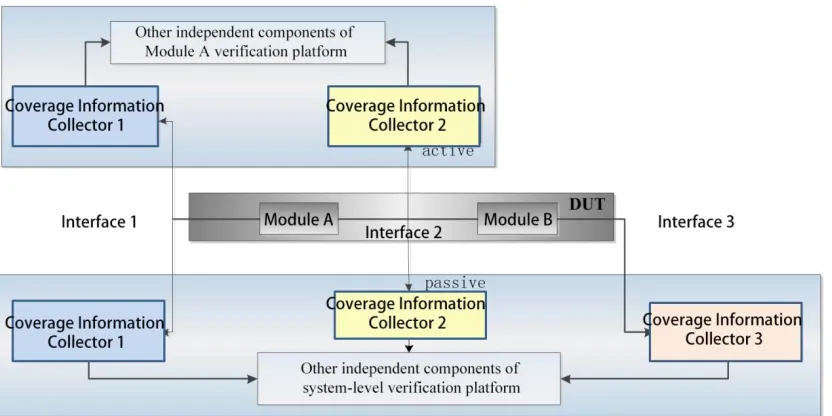
As the interface of Coverage Information Collector is capsulated, it may be directly reused on the test platform at the system level, no matter whether it is used as internal or peripheral interface in module level test on the PLD software test platform. The only difference lies in that, for internal interface, Coverage Information Collector components would be defined as passive mode. They only monitor and acquire signals rather than drive signals. As shown in Figure1. DUT is composed of Module A and Module B. The test platform of Module A is composed of Coverage Information Collector 1 for interface 1, Coverage Information Collector 2 for interface 2 and other independent components. In system-level test, both Coverage Information Collectors 1 and 2 of Module A can be vertically reused in system-level test. And Coverage Information Collector 2 adopts passive working mode, with only Monitor reserved.
It can be seen that classification based on reusable components and the establishment of a standard coverage information collector for common PLD software interfaces can effectively realize vertical reuse of test platform. Horizontal reuse aims to make the reuse of test platform in different projects, especially the similar projects, available. It can greatly improve the reliability and credibility of PLD software test.
Coverage Information Collector 3 adopts passive mode and Coverage Information Collectors 1 and 3 adopt the active mode.
[image:6.612.101.517.409.527.2]Figure 1. Vertical Reuse of Reusable Test Platform.
Figure 2. Structure of DUT-A Test Platform.
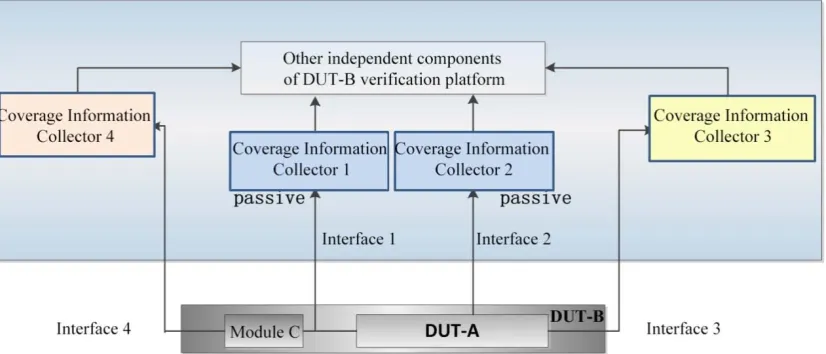
C. and automatic testing module and coverage rate collector are reserved. Thus, during functional test of DUT-B, data test and coverage rate statistics may still be conducted on DUT-A interfaces.
[image:7.612.101.514.183.360.2]In a similar fashion, the DUT-B test platform can also be horizontally reused in other similar tests, especially when there are Module C interfaces. The reusable coverage information collector 4 may be horizontally reused in a direct way.
Figure 3. Structure of DUT-B Horizontal Reuse Test Platform.
CONCLUSION
This paper proposed a technical mode featuring “test case library+ Coverage Information Collector+Scoreboard components”, and data preparation format, initial condition setting, software test procedures and result processing procedures that are applicable to different types of PLDs and peripheral devices through recurrent and iterative analysis of declared sample data, thus realizing credibility and controllability of PLD software test.
By adopting the test environment integrating vertical and horizontal reuse, this paper also proposed the PLD software test case reuse model, designed generate operations according to different test requirements including simulation rate, chip type and interface characteristic and adopted vertical and horizontal reuse for coverage, which provided support for real-time display and accurate measurement of test data.
REFERENCES
1. GJB/Z102-1997 Guidelines on Software Reliability [S].