2017 2nd International Conference on Computer Science and Technology (CST 2017) ISBN: 978-1-60595-461-5
A Digital Forensic Framework for Cloud Based on VMI
Rui YANG, Jiang-chun REN
*, Shuai BAI and Tian TANG
College of Computer, National University of Defense Technology, Changsha, Hunan, China 410073
a[email protected], b[email protected], c[email protected], d[email protected]
*Corresponding author
Keywords: Cloud, Digital forensic analysis, Virtual machine introspection.
Abstract. Traditional digital forensic methods become exceedingly feeble in cloud due to the fact that the basic infrastructure turns to virtualized environment. Leveraging properties of virtualization, virtual machine introspection has showed potential for cloud forensic. In this paper, we propose a novel framework, which contains a trustworthy independent agency, to provide memory digital forensic analysis (DFA) for virtual machines (VMs) in cloud. With the assistance of cloud platform, memory dump files can be obtained and transferred to the agency for further DFA, where information of VMs can be extracted using the proper tools. We described the constructional design of the framework. Test results showed the versatility of DFA and ability of malware detection. The framework indicates DFA can be purchased as a service only when there is a need in order to reduce the expenditures on maintaining exclusive facility and furnish standard procedure to multiple cloud platforms.
Introduction
Although Cloud Computing is not a new concept any more, it does profoundly change the whole IT industry and people's daily life. Cloud computing frees cloud service user (CSU) from purchasing physical devices repeatedly and maintaining them personally [1]. Cloud service provider (CSP) can maximize the potential computing ability of the physical devices. Purchase-on-demand becomes a win-win for both CSPs and CSUs. The core of cloud computing is generally divided into three layers: IaaS, PaaS and SaaS. IaaS provides the basic configurable infrastructure service which satisfies the CSU's need of computing/storage/network etc.
As enterprises look for ways to adopt cloud computing and increase server consolidation, security issues become crucial [2]. Virtualization technology has been brought in to optimize utilization of resources for multi-tenant usage model. However, these fundamental properties of cloud computing make cloud-based attacks hard to prevent and crimes difficult to investigate [3]. Virtualization offers advantages and introduces new challenges to the field of digital forensics as well. Investigators need to detect malfunction and analyze malware in virtual environments. Currently digital forensics covers a very vast field where there are abundant developments of novel approaches for investigating digital crimes [4].
external circumstance [5]. VMI can demonstrate excellent view of details in virtual machine so it rapidly gains popularity among researchers.
An obvious way to utilize VMI is to embed VMI tools into Virtual Machine Manager (VMM) for the advantage of hypervisor supremacy. This method works fine while the shortcomings are predictable. VMM keeps the whole virtualization system functioning, any extra addition to VMM should be cautious. Besides, VMM also faces the risk of getting tampered by malware, so VMI not fully relying on VMM indirectly improves the reliability of the final results.
In this paper, we propose a trustworthy independent framework of digital forensic analysis for cloud. It separates the forensic work into two parts: VMM saves the context of a virtual machine (VM) and transfers it to the external agency; the trustworthy independent agency completes the remaining part of forensic analysis. With the assistance of this framework, forensic analysis can be efficiently accomplished outside the VMM.
We summarize the major contributions of this paper as follows:
The proposed framework can separate digital forensic analysis (DFA) from VMM to relieve its burden, meanwhile enhance credibility of DFA;
The proposed framework can assemble numerous DFA tools and render assistance to various cloud platforms, meanwhile enhance diversity of DFA;
The proposed framework can encapsulate DFA as a service for cloud, meanwhile enhance independence of DFA.
The rest of this paper is organized as follows: §II states background; §III gives description of problems and assumptions focused by us; §IV describes the designs and architecture of the proposed framework; §V shows the implementation and evaluation; §VI concludes this paper’s work; §VII discusses on our current and future work.
Background
Virtualization & VMI
Virtualization Technology (VT) covers a wide range of concepts. Generally speaking, VT integrates hardware resources and redistributes them according to demands. This heritage makes VT one of the fundamental technologies applied in cloud [6]. Normally cloud possesses a vast quantity of physical devices from which CSP sets up a resource pool and a hypervisor, also known as VMM, for management. CSUs perform tasks in their own VMs.
Forensic Memory Analysis
Digital forensics used to be the procedure to identify, obtain, preserve, analyze and submit electronic forensics in computer, peripheral equipment and internet, with the intention to testify criminal act and reconstruct crime scene. Digital forensics has been developing from static forensics to dynamic forensics and then into the latest stage of forensics under cloud computing environment [11].
According to a survey conducted in 2012 by Gartner [12], sixty percent of all virtualized servers are more vulnerable than their physical counterparts. To this end, researchers have focused on leveraging properties of virtualization technology as security features. Forensic Memory Analysis (FMA) [13] utilizes VMI to pull information from memory of guest VMs through VMM, then generates high-level semantics (e.g. active processes, loaded kernel modules, system calls and network connections etc.) upon low-level raw bits. It is known to all that any execution needs to be accomplished via memory, the state of memory will reflect true state of the VM [14]. By doing memory analysis in an out-of-box way, researchers are able to detect malicious activity that might not be as obvious when viewed from inside. For instance, rootkits attempt to hide themselves from anti-malware software by altering certain system calls results, but all running processes will be discovered if the process table in memory are directly read via VMI. In this case, detecting rootkits [15] could be easier. Security-as-a-Service
Typically, Security-as-a-Service (SecaaS) involves applications such as anti-virus software delivered over the internet, but the term can also refer to security management provided by an external organization [16]. With cloud computing prevailing in business and daily life, CSUs are looking forward to more secure cloud service [17]. In the traditional business companies, they defend against security attacks by means of deploying facilities and hiring security experts for their own, which is adjudged unworthy by many companies. Entrepreneurs tend to buy security service only when needed so that SecaaS can alleviate the disbursement for security issues.
Related Work
Lares [8] is an in-VM introspection architecture in which the hypervisor injects hooks in kernel components of interest to monitor (e.g. system call dispatcher). Each one of these hooks invokes a corresponding handler that is also injected by the hypervisor. In[18] author proposed the digital forensic framework for cloud environment, which consists of three layers: front layer, middle-layer and back-end. Each layer has their component required for cloud forensics.
Description
This paper focuses on the goal of establishing a trustworthy independent agency to inspect thoroughly into VMs in cloud platforms. We propose the framework and expectations are hopefully to be satisfied as follow:
Utilize the open-source forensic tools to extract understandable information
from the low-level raw data for further analysis;
Establish credible data transmission between cloud platforms and the
independent agency while the method needs to be effective and efficient;
Store the original source data, DFA results as well as operation logs for audit;
Expand the availability not only to multiple mainstream operating systems
including Microsoft Windows and Linux, but also to multiple virtualization software, such as Xen and KVM.
In order to achieve the goals we propose above, a new VM digital forensic framework need to be built on the basis of assumptions: Firstly, we suppose that the virtual machine monitor lying upon the cloud platform possesses the ability to dump the low-level raw data of a specific VM. Meanwhile neither can this ability be tampered nor can the dumped data be altered. Secondly, we assume that the agency maintains independence from the cloud platforms. Thirdly, it is of great importance that we will ignore the risk of alteration to data during transmission and concentrate more on the data processing in the independent agency.
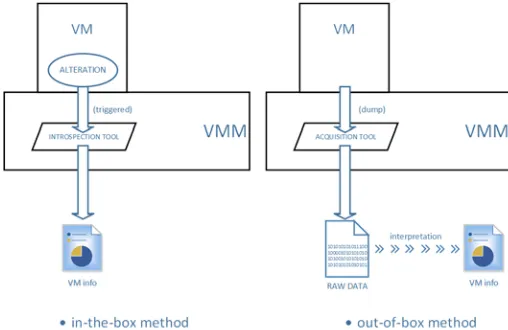
[image:4.612.181.435.379.544.2]There is no panacea for us to rule out all the risks that may get involved, so we hope to report the situation in our solutions crimes.
Figure 1. Virtual machine introspection methods.
Design & Architecture
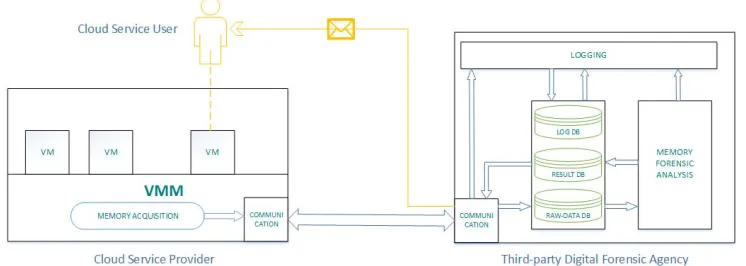
We have created an architecture comprising four modules as depicted in Fig. 2. Correspondingly, the framework we design consists of four components: credible-transmission component, data-storage component, digital-forensic component and operation-logging component.
Main Architecture
inspection function out of VMM. Secondly, we aim to provide reliable digital forensic service from a trustworthy independent agency outside cloud platforms. The ability of agency is only limited by the tools deployed in it, which means the agency is able to integrate toolkits to gratify as many DFA demands as possible. In addition, the agency does not provide services exclusively for any platform in order to make efficient use of physical resources. We will exhibit explicit explanation of the framework blew.
Figure 2. Structure of the proposed digital forensic framework.
Components
Credible-transmission Component. Considering that there can only be a limited number of cloud platforms, an efficient way to transfer the source data is to establish private links between cloud platforms and the agency. The transmission is implemented via a mechanism which imitates the process of TCP. We use a three-way handshake to start a transmission. The three-way handshake occurs:
1) DTR: The transmission is initiated by the cloud platform sending a DTR (Data Transmission Require) to the agency. The agency sets the sequence number to a random value i.e. A.
2) DTR-ACK: In response, the agency replies with a DTR-ACK. The acknowledgment number is set to the negative number of the received sequence number i.e. -A, and the sequence number that the agency chooses to respond the cloud platform is another random number, B.
3) ACK: Finally, the cloud platform sends an ACK back to the agency. The sequence number is set to the received acknowledgment value i.e. -A, and the acknowledgment number is set to the negative number of the received sequence number i.e. -B.
After the connection has been established, we utilize the private link to securely transfer the actual information. When the transmission is done, we terminate the transmission by using a four-way handshake. When the agency wishes to stop its half of the transmission, it transmits a FIN packet, which the cloud platform acknowledges with an ACK. Therefore, a typical tear-down requires a pair of FIN and ACK segments from each endpoint.
platform, the big-sized source data derived from VMs will be pilling up. NoSQL database provides a mechanism for storage and retrieval of data which is modeled in means other than the tabular relations used in relational databases. After credible-transmission component completes transferring the data from cloud platform to agency, we save the original data into database for subsequent analysis or system recovery. Furthermore, database also takes the responsibility to document the analysis results and the operation logs. If there are audit requirements, the stored data will be the valuable evidence for deep examination. In summary, it organizes all the related data throughout the whole analysis procedure.
Forensic-analysis Component. This is the essential component in the framework where the analysis work is implemented. What this component can do is only restricted by the tools deployed. Typically, the procedure is as follow:
1) select the target VM and determine what to do (for example, to extract processes list in memory or to scan socket connections);
2) retrieve the associated source data from storage component;
3) choose theappropriate tools to exert its ability on the source data (for example, utilize a tool named drakvuf on Windows7 to trace internal kernel functions
from arbitrary binaries of a Windows7 VM);
4) analyze the results generated by the tools and identify the problem, then produce a standardized report;
5) store the report into storage component. If abnormalities are discovered, do feature extraction and add them to the agency’s feature library.
In addition, this module can be highly customized. It allows full-scale standard digital forensic procedures or specific tool even with specific command to satisfy different CSUs.
Operation-logging Component. No matter which component works, it leaves a trail of operations. We need to document them as in detail as possible from the time when request for data transmission is received to which forensic tool gets involved or which command is invoked. The documents themselves don't mean too much, but imagine this scenario: when dealing with professional CSUs, a result report along with an elaborate log will gain much more credibility than merely a result report. In another scenario: when the supervision institution needs to scrutinize the agency in order to grant it authority, the logs bear the best testimony to its validity and reliability.
Implement & Evaluation
In this section, we shall discuss the technical aspects of the architecture described previously and its relationship to the requirement of the system described in section IV. Implement
LibVMI is a library for simplifying the reading and writing of memory in running virtual machines, which gains its popularity in VMI research and related applications. Volatility is one of the best open-source memory forensics tools for analyzing RAM, which is based on python and supports analysis for Linux, Windows, Mac as well as Android systems. Volatility is capable of analyzing raw dumps, crash dumps, VMware dumps (.vmem), virtualbox dumps and many others.
will be using KVM, our host operating system will be Linux Mint 17, and we will be using the newest version of Volatility. When testing our tool, we will be using various operating system releases and a variety of test cases. We will conduct several experiments in order to illustrate the capabilities of our framework.
Table 1. Information about hardware for experiment.
Model CPU Memory Hard Drive
PC Dell Vostro 3900 Intel Core i3-4170 @3.7GHz 8G DDR3 500G HDD Server Huawei RH2288H V2 Intel Xeon e5-2600 @3.3GHz 64G DDR3 2T HDD
Evaluation
Based on the experiment environment that was described in the previous section, the experiments were conducted. Below we present three evaluation results. First part presents an evaluation that how same operating system with different size of memory impacts on VMI by comparing the performance of multiple VMI applications. Second part describes an experiment that is developed to illustrate VMI capabilities for different operating system releases with memory of equal size. Final part demonstrates a case that how we detect a hidden process caused by malware.
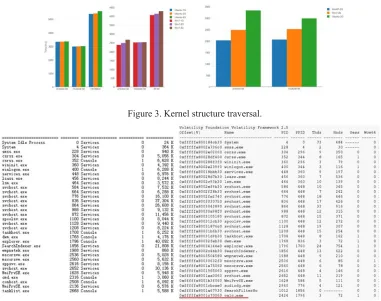
VMI Efficiency Due to Difference of Memory Size. We booted up three VMs of same operating system (Windows7 SP1 64-bit) in the VMM. We separately allocated memory of different size to each VM (1G RAM, 2G RAM, 4G RAM) and rebooted these VMs for respectively dumping each one’s memory to a corresponding file. Then we booted up another three VMs with same operating system (Ubuntu16.04 64-bit) of different memory size like before. Then we applied multiple VMI applications on these memory dump files and tested the running time of each application. We tested the running time of each application ten times to get a final average result. The results from this test can be seen in Fig 3.
VMI Efficiency Due to Difference of Operating Systems. We booted up three VMs of different operating systems (WindowsXP SP3 32-bit, Windows7 SP1 64-bit, Ubuntu16.04 64-bit) in the VMM. We equally allocated 2G RAM to each VM and rebooted these VMs for dumping memory of each VM to a file respectively. Similarly, to the previous experiment, we applied multiple VMI applications on these memory dump files and tested the running time of each application. We still tested the running time of each application ten times to get a final average result. The results from this test can be seen in Fig. 3.
Detect Hidden Processes. Finally, we would like to test our framework’s ability to detect rootkits that attempt to hide processes from the operating system (Windows 7 SP1 64-bit). We used the Hacker Defender rootkit in this VM and initialized it to hide
processes. We asked a colleague to hide some processes without telling us and we tested whether the framework can display the hidden processes. The left half of Fig. 4 shows the internal view from the tampered VM using the built-in function tasklist. The Hacker Defender successfully hid the calc.exe process. The right half of Fig. 4 shows
the external result from applying VMI application process-list on the VM’s memory
Figure 3. Kernel structure traversal.
Figure 4. Processes cross-view of the compromised VM.
The first experiment indicates that the size of RAM can exert little influence on the running time when we apply the same VMI application on VMs of same operating system. However, the second experiment reveals that difference of operating system can have an impact on the running time. That is to say, different data structures in RAM caused by different operating systems affect the efficiency of extracting high level sematic information from memory dump files. Meanwhile the results also imply that a whole forensic analysis can be disassembled into multiple basic tasks to speed up the procedure with the aid of proper pipelining processing. The third experiment shows that our framework was able to detect the hidden processes, further demonstrating its ability to detect possible rootkits or other malware if we deploy the relevant tools.
Conclusions
One of the reasons that traditional digital forensic methods are no longer competent to the task of forensics in cloud environment is virtualization technology. The paper proposed a trustworthy independent framework for cloud forensic. The research focuses on digital forensic analysis using virtual machine introspection which can truly demonstrates internal details of a virtual machine.
that satisfies the design requirements and takes into account the spectrum of duties. The proposed framework has demonstrated to be effective and economical to furnish multiple cloud platforms with standard DFA procedure.
Discussion & Future Work
We presented a forensic framework for cloud, which allows digital forensic analysis to be offered as a service by a trustworthy independent agency. Numerous forensic tools and open-source packages are integrated to simultaneously provide forensic analysis for different cloud service users on different cloud platforms.
Compared to existing scenarios that keep deployment and maintenance of forensic module inside the cloud platform, this novel framework allows digital forensic of VMs to be transferred from the cloud platform to an independent agency. Our framework leaves the memory acquisition to VMM. We evaluate proof-of-concept implementation of our framework. Results prove the feasibility of offering forensic analysis as a cloud service. Our prototype does not address the complexity when VMM tries to dump the memory of a specific VM or duplicate the VM’s virtual disk. Our main work begins with transferring the original source data to the agency through a reliable private link. Generally, the memory dump file used to be relatively large which poses a burden on transmission and storage. The Advanced Forensics File format 4 (AFF4) is an open source format used for the storage of digital evidence which is utilized in the Pmem suite of memory acquisition tools. The Pmem images are standard AFF4 images so they can also be used to acquire disks and logical files as well. Further work will investigate whether this technique can be applied to memory acquisition in mainstream VMM. We also plan to concentrate on tactics to increase efficiency of digital forensic in the agency, such as adopting container techniques to multi-task concurrently or optimizing the digital forensic analysis schemes based on particular toolkits.
Acknowledgment
This material is based upon work supported by the National Natural Science Foundation of China, under Grant No. 61303191 and No. 61402508. And it is also supported by the National High Technology Research and Development Program of China (863), under Grant No.2015AA016010.
References
[1] Biggs, S., Vidalis, S. Cloud Computing: The impact on digital forensic investigations[C]// Internet Technology and Secured Transactions, 2009. ICITST 2009. International Conference for. IEEE, 2009:1-6.
[2] Damshenas, M., Dehghantanha, A., Mahmoud, R., et al. Forensics investigation challenges in cloud computing environments[C]// International Conference on Cyber Security, Cyber Warfare and Digital Forensic. IEEE, 2012:190-194.
[3] Ryoo, J., Rizvi, S., Aiken, W., et al. IEEE Security & Privacy Magazine, 2014, 12(6):68-74.
[5] Nance, K., Bishop, M., Hay, B. Investigating the Implications of Virtual Machine Introspection for Digital Forensics[C]// International Conference on Availability, Reliability and Security. IEEE, 2009:1024-1029.
[6] Zhang, L., Zhang, D., Wang, L. Live digital forensics in a virtual machine[C]// International Conference on Computer Application and System Modeling. IEEE, 2010: V4-328-V4-332.
[7] Crawford, M., Peterson, G. Insider Threat Detection Using Virtual Machine Introspection[C]// Hawaii International Conference on System Sciences. IEEE Computer Society, 2013:1821-1830.
[8] Payne, B. D., Carbone, M., Sharif, M., et al. Lares: An Architecture for Secure Active Monitoring Using Virtualization[C]// Security and Privacy, 2008. SP 2008. IEEE Symposium on. IEEE, 2008:233-247.
[9] Kumar Alluri, B. K. S. P., Geethakumari, G. A digital forensic model for introspection of virtual machines in cloud computing[C]// IEEE International Conference on Signal Processing, Informatics, Communication and Energy Systems. IEEE, 2015:1-5.
[10] Nance, K., Bishop, M., Hay, B. Investigating the Implications of Virtual Machine Introspection for Digital Forensics[C]// International Conference on Availability, Reliability and Security. IEEE, 2009:1024-1029.
[11] Chen, H. Y. Cloud crime to traditional digital forensic legal and technical challenges and countermeasures[C]// IEEE Workshop on Advanced Research and Technology in Industry Applications. IEEE, 2014:990-994.
[12] Information on http://www.gartner.com/it/page.jsp?id=1322414
[13] Harrison, C., Cook, D., Mcgraw, R., et al. Constructing a Cloud-Based IDS by Merging VMI with FMA[C]// IEEE, International Conference on Trust, Security and Privacy in Computing and Communications. IEEE Computer Society, 2012:163-169. [14] Poore, J., Flores, J. C., Atkison, T. Evolution of digital forensics in virtualization by using virtual machine introspection[C]// ACM Southeast Conference. ACM, 2013:30.
[15] Hua, Q., Zhang, Y. Detecting Malware and Rootkit via Memory Forensics[C]// 2015 International Conference on Computer Science and Mechanical Automation (CSMA). IEEE Computer Society, 2015:92-96.
[16] Eleyan, A., Eleyan,, D. Forensic Process as a Service (FPaaS) for Cloud Computing[C]// Intelligence and Security Informatics Conference. IEEE, 2015:157-160.
[17] Ruan, K., Carthy. J,, Kechadi, T., et al. Ifip Advances in Information & Communication Technology, 2011:35-46.
[18] George Sibiya, H. S. V., Fogwill, T. International Information Management Corporation, 2012.
[20] Reilly, D., Wren, C., Berry, T. International Journal Multimedia & Image Processing Pg, 2011, 1:270.