Error Analysis for Learning-based Coreference Resolution
Olga Uryupina
Institute of Linguistics, Russian Academy of Science
B. Kislovsky per. 12/1, Moscow, Russia
Abstract
State-of-the-art coreference resolution engines show similar performance figures (low sixties on the MUC-7 data). Our system with a rich linguistically motivated feature set yields significantly better performance values for a variety of machine learners, but still leaves substantial room for improvement. In this paper we address a relatively unexplored area of coreference resolution – we present a detailed error analysis in order to understand the issues raised by corpus-based approaches to coreference resolution.
1.
Introduction
Robust coreference resolution is essential for various NLP tasks, such as Information Extraction or Question Answer-ing. Although there has been much attention to the prob-lem, state-of-the-art coreference resolution algorithms still only have a moderate performance (around 60% F-measure for coreference chains on the MUC-7 data).
Recent studies (Cristea et al., 2002; Barbu et al., 2002) claim that existent (knowledge-poor) algorithms are only able to account for “easy” coreference links and sug-gest more sophisticated frameworks to deal with complex anaphora resolution cases.
We have built a learning-based coreference resolution en-gine incorporating various kinds of linguistic information (Uryupina, 2006; Uryupina, 2007). Our system relies on 351 nominal features (1096 boolean/continuous), rep-resenting surface (122 features), syntactic (64), semantic (29), and salience-based (136) properties of markables and markable pairs. We have evaluated its performance for a variety of publicly available machine learners (SVM
, C4.5, Ripper, Slipper, MaxEnt), observing a consistent sig-nificant improvement over the state-of-the-art level (Soon et al., 2001). The system’s performance with the SVM
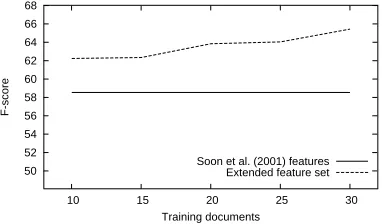
classifier (F-score of 65.4%) is, to our knowledge, the best result on the MUC-7 data reported so far in the literature. Moreover, our learning curves (see Figure 1, dashed line) show no signs of convergence, suggesting that we can get even better performance values by annotating more training material or improving our learning strategy.
Although our rich feature set has brought significant im-provement, the results still lie in sixties. Our SVM
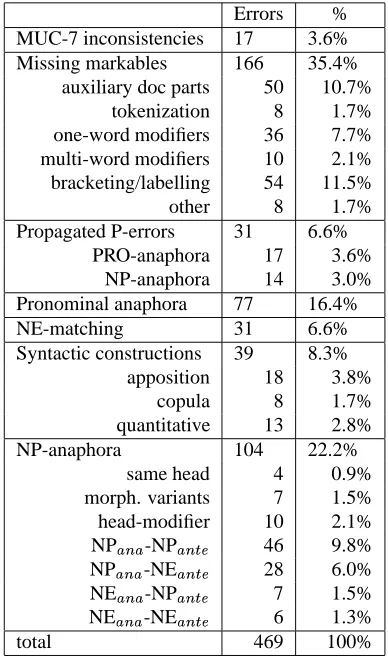
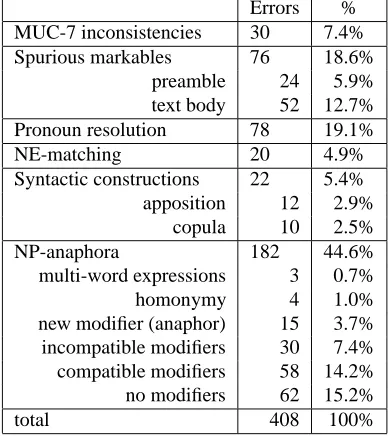
classifier has missed 469 of the 1299 manually annotated links (recall value of 63.9%) and suggested 408 spurious links (precision value of 67.0%).
We have performed a detailed error analysis to identify pos-sible directions for future work on our system. We also be-lieve that our error analysis would be helpful for any coref-erence resolution algorithm: most state-of-the-art systems share very similar performance figures on the MUC data and we therefore assume that they also share very similar problems.
We discuss the most common errors in Section 2. The
er-ror analysis has revealed several major problems with our approach (and, we believe, most state-of-the-art corefer-ence resolution systems): insufficient data quality (Sec-tion 3.), shortages of preprocessing modules (Sec(Sec-tion 4.), inadequate features (Section 5.) and deficiencies in the res-olution strategy (Section 6.).
50 52 54 56 58 60 62 64 66 68
10 15 20 25 30
F-score
Training documents
Soon et al. (2001) features Extended feature set
Figure 1: Learning curve (F-score) for SVM
: linguis-tically rich feature set (dashed line) vs. Soon et al. (2001) features (solid line).
2.
Distribution of errors
Below we provide a very brief overview of the errors made by our system. Tables 1 and 2 summarize the distribution of our recall and precision errors. Additional examples and a more detailed analysis are provided in (Uryupina, 2007).
2.1. Recall errors
Errors %
MUC-7 inconsistencies 30 7.4%
Spurious markables 76 18.6%
preamble 24 5.9%
text body 52 12.7%
Pronoun resolution 78 19.1%
NE-matching 20 4.9%
Syntactic constructions 22 5.4%
apposition 12 2.9%
copula 10 2.5%
NP-anaphora 182 44.6%
multi-word expressions 3 0.7%
homonymy 4 1.0%
new modifier (anaphor) 15 3.7% incompatible modifiers 30 7.4% compatible modifiers 58 14.2%
no modifiers 62 15.2%
total 408 100%
Table 2: Precision errors on the testing data (20 MUC-7 “formal test” documents).
3.
Data
We have used the MUC-7 corpus in our study. It consists of 30 training (“dry-run”) and 20 testing (“formal”) one-page documents. Below we outline several problems with the theoretic assumptions of the MUC guidelines and the annotation quality.
The definition of IDENT coreference, as advocated by the MUC-7 guidelines, is problematic. Van Deemter and Kib-ble (2001) point out that the MUC annotation scheme fails to separate the coreference relation proper from several other phenomena, such as bound anaphora or predicate nominals. It is difficult for any classifier to learn such a complex distribution, involving different (though related) phenomena.
The MUC evaluation metric is too biased towards recall:
BC-CD-RADIO-SHARES-BLOOM. . .
CD Radio stock rose 2 7/8 to 13 5/8 in trading of400,300 shares , more than quadruple the
three-month daily average of88,700 shares.
Most coreference resolution systems would link all the three markables into a chain: & “SHARES”, “400,300 shares”, “88,700 shares”' . But even if some system is able to rule out the possibility of “400,300 shares”and “88,700 shares” referring to the same object, it would have to decide which markable should be kept in the chain, and which one not. The fact that a system has correctly avoided a spurious link is not directly rewarded by the MUC-7 scorer. Even a substantial improvement in the system’s precision (for example, by discarding automatically identified dis-course new entities) does not necessary lead to a better MUC F-score. If we want to use a coreference resolu-tion engine as a preprocessing module for some other en-gine, for example, an Information Extraction system, we might want to have a classifier with a high precision level and therefore opt for another scoring scheme, such as the BCUBED metric (Baldwin et al., 1997).
The corpus is very small and simply does not contain enough material for training (the “formal training” docu-ments provided by MUC-7 are not annotated). Our classi-fiers show no signs of convergence when we train them on 10, 15, 20, 25, or all the 30 “dry-run” documents (Figure 1). We need a larger dataset (for example, the ACE corpus) to make better use of our rich feature set.
The annotation quality can be improved. Deficiencies of manual annotation for the testing corpus inevitably de-crease the evaluation score for any rule- or learning-based system. The same problems with the training material make the data noisy and thus potentially deteriorate the
perfor-mance level of any learning-based approach.
To summarize, we have to revise the definition of corefer-ence and the scoring scheme and then accurately annotate more training material. As a first step in this direction, we plan to re-train our classifier on an already existing larger corpus (ACE).
4.
Preprocessing modules
We rely on external modules for segmenting MUC doc-uments into sentences2 (Reynar and Ratnaparkhi, 1997), parsing (Charniak, 2000), NE-tagging (Curran and Clark, 2003) and determining semantic properties of our mark-ables (Miller, 1990). The first three modules are fully auto-matic corpus-based NLP systems. The WordNet ontology is a large manually created resource.
All the modules have some shortages that may decrease the performance of our system. For example, appositive-coordinate constructions are intrinsically difficult for pars-ing:
Those materials, in turn, were encased inKevlar ,
a synthetic fiber
, andNomex to achieve
a test strength of 400 pounds.
A typical state-of-the-art parser has no knowledge that helps prefer the 2-entities interpretation (“Kevlar,a syn-thetic fiber, and Nomex”) over the 3-entities interpreta-tion (“Kevlar,a synthetic fiber, andNomex”).
Errors committed by the external modules result in incor-rect markables and spurious or missing links. A possible remedy would be creating a family of mini-parsers, specif-ically trained to analyze problematic constructions relevant for coreference resolution.
We have to improve the interaction with our preprocessing modules and adjust the external resources to cover specific problems relevant for our task (e.g., train a mini-parser for appositive-coordinate constructions or an NE-tagger for TI-TLEs or PRODUCTs).
5.
Features
Our classifier relies on 351 feature (1096 boolean/continuous). Not all of them, however, are equally important. We have not performed any feature selection and therefore our feature set is highly redundant. Ng and Cardie (2002) have demonstrated that (manual) feature selection can significantly improve the performance
2We have not encountered any errors directly caused by
level of a linguistically motivated coreference resolution algorithm.
Some phenomena are covered by many features simultane-ously. For example, most of our name-matching and some salience features are produced by enumerating and combin-ing possible values for a set of parameters. This results in a pool of highly inter-correlated features. Even though each feature brings an important bit of information, the whole set has a degree of redundancy that is too high for machine learning. We have to reduce the number of features to get a better classifier.
Some phenomena are covered by our feature set, but the corresponding features are almost ignored by the classifier. For example, we have features to account for abbreviations, but neither C4.5, nor SVM
make any use of them. Our training data does not contain enough abbreviations to learn any reliable patterns. We have to increase the training cor-pus to get better results.
Finally, some phenomena are still not covered by our fea-ture set. For example, we do not account for quantitative constructions (such as the link between ”three-month daily average” and “88,700 shares” in our CD Radio example above). On the one hand, there is always room for improve-ment: even a system with millions of features can always be augmented with some new information. On the other hand, obtaining values for more sophisticated features is a very difficult task: we need additional external resources and they are likely to introduce errors. We believe that our system already has a lot of encoded information and there-fore we have to improve the algorithm itself rather than in-troduce more knowledge. This view is supported by our learning curves: they show no signs of convergence, sug-gesting that we still can get better results with the same feature set.
We plan to investigate feature selection and ensemble learn-ing with different feature splits to make better use of our features.
6.
Resolution strategy
Our system has a very simple resolution scheme, suggested by Soon et al. (2001) and then followed by most studies on coreference: candidate antecedents for each anaphor are proposed to the classifier one-by-one from right to left un-til a positive instance is found. The strategy is very local and does not take into account any other markables, when establishing a link between an anaphor and a candidate an-tecedent.
This may lead to error propagation:
The company also said the Marine Corps has begun testingtwo of its radars as part of a short-range
ballistic missile defense program. That testing could lead to an order for theradars
that could
be worth between$60 million and$70 million.
Our preprocessing modules have suggested several candi-date antecedents for “the radars”: “The company”, “the Marine Corps”, “two”, “its radars”. . . “order”. The can-didates have been submitted to the classifier one-by-one, starting from the closest markable (“order”) and proceeding
backwards. The classifier has correctly discarded most can-didates, but then at some point has established a spurious link from “the radars” to “its radars”. It has never seen any earlier markables, including the correct antecedent “two of its radars”.
If our classifier has suggested a spurious antecedent for some markable at an early processing stage (precision er-ror), it will never see any truly positive testing instances and will be unable to resolve the anaphor ( recall error). If the classifier has missed the correct antecedent (recall er-ror), it starts processing too distant markables and is likely to suggest some spurious markable (precision error). Our system sometimes merges several chains into one – it finds pairs of markables (belonging to different chains in the manually annotated data) that seem to be coreferent and links them. The properties of other markables from the af-fected chains are completely ignored.
Both problems could be avoided by shifting to a more global resolution strategy, operating on chains instead of markables. Theoretic studies of coreference usually have a global view, talking, for example, about “discourse enti-ties”. Practical approaches, however, almost never go be-yond the markable level. The only algorithm operating di-rectly on chains has been advocated by Luo et al. (2004).
7.
Conclusion
In this paper we have presented the error analysis for a data-driven coreference resolution engine.
Our system relies on a rich feature set and is potentially able to resolve most difficult anaphora cases discussed in the lit-erature. It yields significantly better performance on the MUC-7 than state-of-the-art systems for a variety of ma-chine learners.
Still, the performance can be improved further. We have performed a detailed analysis of our recall and precision er-rors (Tables 1 and 2). The data show that some erer-rors can hardly be avoided within a shallow framework (correspond-ing to “tricky anaphors” of Cristea et al. (2002)). A large group of anaphors, however, could have been resolved cor-rectly even by a corpus-based algorithm, without relying on deeper analysis.
Our error analysis has suggested several directions for fu-ture work: improving the training material, more elaborated integration of the external modules, and investigating more global resolution strategies (reasoning in terms of chains instead of markables).
8.
References
Breck Baldwin, Tom Morton, Amit Bagga, Jason Baldridge, Raman Chandraseker, Alexis Dimitriadis, Kieran Snyder, and Magdalena Wolska. 1997. Descrip-tion of the UPenn camp system as used for coreference. In Message Understanding Conference Proceedings. Catalina Barbu, Richard Evans, and Ruslan Mitkov. 2002.
A corpus based investigation of morphological disagree-ment in anaphoric relations. In Proceedings of the
Lan-guage Resources and Evaluation Conference.
American Chapter of the Association for Computational Linguistics, pages 132–139.
Dan Cristea, Oana Postolache, and Ruslan Mitkov. 2002. Handling complex anaphora resolution cases. In
Pro-ceedings of the 4th Discourse Anaphora and Anaphor Resolution Colloquium.
James R. Curran and Stephen Clark. 2003. Language inde-pendent NER using a maximum entropy tagger. In
Pro-ceedings of the Seventh Conference on Natural Language Learning, pages 164–167.
Xiaoqiang Luo, Abe Ittycheriah, Hongyan Jing, Nanda Kambhatla, and Salim Roukos. 2004. A mention-synchronous coreference resolution algorithm based on the bell tree. In Proceedings of the 42nd Annual Meeting
of the Association for Computational Linguistics.
George Miller. 1990. Wordnet: An on-line lexical database. International Journal of Lexicography. Vincent Ng and Claire Cardie. 2002. Improving machine
learning approaches to coreference resolution. In
Pro-ceedings of the 40th Annual Meeting of the Association for Computational Linguistics, pages 104–111.
Massimo Poesio, Olga Uryupina, Renata Vieira, Mi-jail Alexandrov-Kabadjov, and Rodrigo Goulart. 2004. Discourse-new detectors for definite description resolu-tion: a survey and preliminary proposal. In Proceedings
of the Reference Resolution Workshop at ACL’04.
Jeffrey C. Reynar and Adwait Ratnaparkhi. 1997. A max-imum entropy approach to identifying sentence bound-aries. In Proceedings of the Fifth Conference on Applied
Natural Language Processing.
Wee Meng Soon, Hwee Tou Ng, and Daniel Chung Yong Lim. 2001. A machine learning approach to coreference resolution of noun phrases. Computational Linguistics
(Special Issue on Computational Anaphora Resolution),
27(4):521–544.
Olga Uryupina. 2006. Coreference resolution with and without linguistic knowledge. In Proceedings of the
Language Resources and Evaluation Conference.
Olga Uryupina. 2007. Knowledge Acquisition for