2017 2nd International Conference on Manufacturing Science and Information Engineering (ICMSIE 2017) ISBN: 978-1-60595-516-2
A Novel Image Encryption Scheme Based on
Single Random Phase Encoding and Chaos
Yonggang Su, Chen Tang, Zhenkun Lei and Zhaoyi Wang
ABSTRACT
In this paper, a novel image encryption scheme based on single random phase encoding and chaos is proposed. In the proposed scheme, the random phase mask is generated by Henon map, and the chaos parameters of Henon map can replace the whole phase mask to serve as the secret keys. Thus the management and transmission of secret keys are more convenient in the proposed scheme. Additionally, the proposed scheme contains only one random phase mask, which makes it more efficient and concise to implement. The performance of the proposed scheme has been demonstrated by extensive experiments.1
INTRODUCTION
Due to the rapid development of the Internet and modern communication techniques, more and more images are transmitted via the open networks. How to secure the transmission of images has become a serious problem to be faced. To address this problem, various encryption schemes for images have been proposed in the past few years. Among them, the double random phase encoding (DRPE) based encryption schemes have been studied extensively. The DRPE technique in Fourier transform (FT) domain was first proposed by Refregier and Javidi to encrypt an image into a noise-like pattern [1]. Subsequently, the DRPE technique has been successfully extended to some other transform domains, such as the fractional
1Yonggang Su, Chen Tang, Zhaoyi Wang, School of Electrical and Information Engineering,
Tianjin University, Tianjin, China;
Fourier transform (FrFT) domain [2], the Fresnel transform (FrT) domain [3], the Gyrator transform (GT) domain [4], and so on.
[image:2.612.147.448.345.433.2]The DRPE technique has opened new fields of research in image encryption. However, the management and transmission of the secret keys in most of the DRPE-based encryption schemes are inconvenient because the whole phase mask keys with the same size of the encrypted image have to be sent to the authorized receiver side to decrypt the original image. To address this problem, some researchers proposed to use the chaotic maps to generate the random phase mask, and use the chaos parameters to replace the whole phase mask to act as the secret key. For example, Singh et al. used the Logistic map, Tent map and Yorke map to generate the phase masks in an FrFT-based DRPE scheme [5]. Sui et al. used the Logistic map to generate the phase masks in a GT-based DRPE scheme [6]. In our previous work, we used the Duffing map, the Tinkerbell map and the mixed chaotic maps to generate the phase masks in a lens FT-based DRPE scheme [7] and a single-shot digital holography-based DRPE scheme [8], respectively. Apart from the above-mentioned problem, most of the DRPE-based encryption schemes are complex and hard to implement.
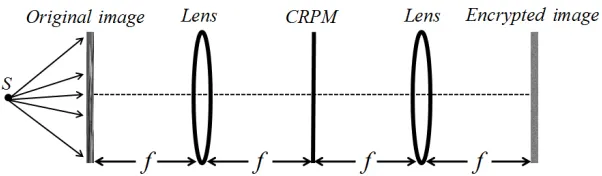
Figure 1. Schematic of the proposed image encryption scheme.
THE PROPOSED IMAGE ENCRYPTION SCHEME
In this section, the proposed image encryption scheme based on SRPE and chaos is described in detail. As shown in Fig.1, a spherical wave is generated to illuminate and encode the original image placed in the input plane, and then the encoded image is Fourier transformed. After that, the transformed image is multiplied by the chaotic random phase mask (CRPM), and then is inverse Fourier transformed to generate the encrypted image. The decryption process of the proposed scheme is the simple reversed process of the encryption. The detailed steps of the encryption process are as follows.
Step 1: The original image is encoded by the spherical wave.
o, o o o, o o, o
f f S (1)
Where
o, o
denotes the coordinates of the input plane; fo and f denote theoriginal image and the encoded image, respectively; S denotes the spherical wave which can be expressed as
,
exp 2 o2 o2o o
A i
S z
z z
(2)
Where A is the amplitude of the spherical wave; z is the distance between the light source and the input plane; and is the wavelength.
[image:3.612.231.365.447.503.2](a) (b) (c)
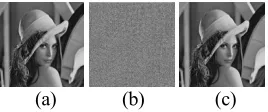
Figure 2. Test image “Lena” and its encryption and decryption results. (a) Original image, (b)
encrypted image, and (c) decrypted image.
Step 2: The encoded image is Fourier transformed and multiplied by the CRPM.
1, 1
o, o
1, 1
f FT f C (3)
Step 3: The scrambled image is inverse Fourier transformed to generate the encrypted image.
2, 2
1, 1
f IFT f (4)
Where f denotes the encrypted image;
2, 2
denotes the coordinates of the output plane; and IFT denotes the inverse Fourier transform.The detailed steps of the decryption process are as follows.
Step 1: The encrypted image is Fourier transformed and multiplied by the conjugation of the CRPM.
1, 1
2, 2
1, 1
d
f FT f C
(5)
Where fd denotes the preliminary decrypted image; C denotes the conjugation
of the CRPM.
Step 2: The preliminary decrypted image is inverse Fourier transformed to retrieve the encoded image.
,
1, 1
d o o d
f IFT f (6)
Where fd denotes the retrieved encoded image
Step 3: The retrieved encoded image is multiplied by the conjugation of the spherical wave to decode the original image.
, , ,
d o o d o o o o
f f S (7)
Where fd denotes the final decrypted image; and S denotes the conjugation of
the spherical wave.
EXPERIMENTAL RESULTS AND ANALYSIS
[image:4.612.206.390.573.632.2](a) (b) (c) (d)
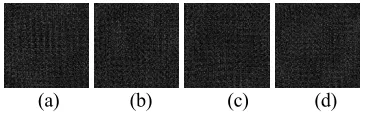
Figure 3. Decryption results of “Lena” with (a) x01016, (b) y01016, (c) 1.4 10 16,
In this section, the performance of the proposed image encryption scheme has been evaluated by extensive experiments, including the visual and quantitative test, the sensitivity of secret keys, the key space analysis, and the robustness against statistical attack and noise attack. Moreover, the proposed scheme is also compared with the FT-based DRPE scheme [1] in terms of the robustness against statistical attack, noise attack and occlusion attack. All experiments are conducted on a personal computer having Intel Core i5-4590 3.30 GHz CPU with 4 GB RAM, and using Matlab version R2010b under the Windows 7 environment. To conduct these experiments, the grayscale image “Lena” shown in Fig. 2(a) is chosen as the test image. For the proposed scheme, the initial conditions and control parameters of Henon map are respectively set as x00, y00, 1.4 and 0.3. The parameters of the spherical wave are respectively set as A10, z50mm and 632.8nm. For the
FT-based DRPE scheme [1], the random phase masks are generated by a random generator.
Visual And Quantitative Test
In this subsection, the encryption and decryption performance of the proposed scheme has been tested. Fig. 2(b) shows the encryption result of “Lena”, from which one can find that the main information of the original image has been successfully hidden into a noise-like pattern. Fig. 2(c) shows the decryption result of “Lena” with all correct secret keys, from which one can find that the difference between the decrypted image and the original image cannot be discerned visually. To quantitatively measure the difference between the decrypted image and the original image, the correlation coefficient (CC) is calculated. The CC is defined as
2
2
, o o d d
o d
o o d d
E f E f f E f
CC f f
E f E f E f E f
(8)
Where fo and fd denote the original image and the decrypted image,
respectively; E is an expectation operator. The higher the CC value is, the smaller
the difference between the decrypted image and the original image will be. The calculated value of CC between the Fig. 2(c) and Fig. 2(a) is 1, which implies that the original image can be retrieved completely from the encrypted pattern.
Sensitivity of Secret Keys
the decryption results of “Lena” when one of the secret keys is incorrect and others are correct, from which one can find that any useful information about the original image cannot be recognized visually. The calculated values of CC between the Figs. 3(a)-(d) and Fig. 2(a) are 0.0087, 0.0095, 0.0079 and 0.0062, respectively; which implies that the original image cannot be retrieved completely. Both the visual and quantitative testing results have demonstrated that the proposed scheme is vastly sensitive to the variation of the secret keys.
[image:6.612.166.429.207.264.2](a-1) (b-1) (a-2) (b-2) (a-3) (b-3)
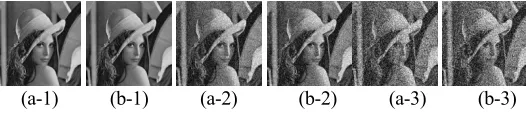
Figure 4. Decryption results of “Lena” from the noise-affected encrypted images with k0.1, 0.5
k , and k1.0, respectively. (a-1)-(a-3) The FT-based DRPE scheme [1],
and (b-1)-(b-3) the proposed scheme.
Key Space Analysis
In this subsection, the key space of the proposed scheme has been analyzed. For the proposed scheme, the four parameters of Henon map serve as the secret key. As above mentioned, when these four chaos parameters have the deviations of 1.0 10-16, the original image cannot be retrieved from the encrypted pattern completely. However, when these four chaos parameters have the deviations of 1.010-17, the original image can be retrieved completely from the encrypted pattern. Therefore, the key space of the proposed scheme is approximate to (1016)4=1064. Such a large key space can make the brute-force attack be infeasible.
Robustness Against Statistical Attack
Robustness Against Noise Attack
In this subsection, the robustness of the proposed scheme against noise attack has been tested. The proposed scheme is also compared with the FT-based DRPE scheme [1] in this testing. To conduct this testing, the Gaussian random noise is added to the encrypted image in the following way.
1
e e
f f kG (9)
Where fe and fe denote the encrypted image and the noise-affected encrypted
image, respectively; k is a weight factor to adjust the noise strength; and G denotes the Gaussian random noise with zero mean and standard deviation 1. Fig.4 shows the decryption results of “Lena” when k is set to 0.1, 0.5 and 1.0. The calculated
values of CC between the Figs. 4(a-1)-(b-3) and the Fig. 2(a) are 0.9888, 0.7982, 0.5491 and 0.9889, 0.8001, 0.5472, respectively. From the visual and quantitative results, one can find that the performance of the proposed scheme can be comparable with the FT-based DRPE scheme [1]. Additionally, although the images become more blurred with the increase of k, the main content of the original image
[image:7.612.152.444.431.492.2]decrypted by the proposed scheme can still be recognized visually. The above results indicate that the proposed scheme has high robustness against noise attack.
TABLE I. CORRELATION COEFFICIENTS OF ADJACENT PIXELS IN ORIGINAL AND ENCRYPTED IMAGES.
Correlation coefficients Methods Directions
Horizontal Vertical Diagonal
Original image -- 0.9637 0.9423 0.9285
Encrypted image Proposed Ref. [1] 0.0372 0.0035 -0.0056 0.0459 0.0498 0.0063
CONCLUSIONS
ACKNOWLEDGMENTS
This work was supported by the National Natural Science Foundation of China (Grant nos. 61177007, 11472070, 11772081).
REFERENCES
1. P. Refregier, B. Javidi. 1995. “Optical image encryption based on input plane and Fourier plane random encoding,” Opt. Lett. 20: 767-769.
2. Z. Liu, S. Li, W. Liu, Y. Wang, S. Liu. 2013. “Image encryption algorithm by using fractional Fourier transform and pixel scrambling operation based on double random phase encoding,” Opt. Laser. Eng. 51: 8-14.
3. X. Li, Q. Wang, S. Kim, I. Lee. 2016. “Encrypting 2D/3D image using improved lensless integral imaging in Fresnel domain,” Optics Commun. 381: 260-270.
4. H. Singh, A.K. Yadav, S. Vashisth, K. Singh. 2015. “Double phase-image encryption using gyrator transforms, and structured phase mask in the frequency plane,” Opt. Laser. Eng. 67: 145-156.
5. N. Singh and A. Sinha. 2008. “Optical image encryption using fractional Fourier transform and chaos,” Opt. Lasers Eng. 46: 117-123.
6. L. Sui, B. Zhou, X. Ning, and A. Tian. 2016. “Optical multiple-image encryption based on the chaotic structured phase masks under the illumination of a vortex beam in the gyrator domain,” Opt. Express 24: 499-515.
7. Y. Su, C. Tang, B. Li, X. Chen, W. Xu, Y. Cai. 2017. “Single-lens Fourier-transform-based optical color image encryption using dual two-dimensional chaotic maps and the Fresnel transform,” Appl. Optics. 56: 498-505.
8. Y. Su, C. Tang, B. Li, X. Chen, W. Xu, Z. Lei. 2017. “Optical image encryption based on mixed chaotic maps and single-shot digital holography,” Trans. Tianjin Univ. 23:184-19.