2017 2nd International Conference on Information Technology and Management Engineering (ITME 2017) ISBN: 978-1-60595-415-8
The Research on Combinative Modeling Architecture based on Network
for Simulation of System of Equipment’s Operating Efficiency
Zheng WANG
College of Information System and Management, National University of Defense Technology, Changsha, Hunan, China
Keywords: Modeling and simulation, System of system of equipment, Combinative modeling.
Abstract. In allusion to these features, such as much of simulation platform of system of equipment’s operating efficiency, the complexity of command, information interaction relationship, simulation operation rules and so on, the basic simulation model-based networked combinative modeling architecture is put forward. This architecture is high-effectively combinative and extensive, can describe the simulation field of system of equipment’s operating efficiency in detail, especially the comparatively looser organization, command, coordination, confrontation and other relationships between components of each subsystem and between each subsystem, which can be the modeling basis for simulation of system of equipment’s operating efficiency.
Introduction
With the development of science and technology and the traction of military needs, the complementary and restrictive relationship is enhanced increasingly. Each equipment’s operating efficiency is shown by system of equipment, i.e. the extent that system of equipment meets specific mission within the specified time under specific conditions[1]. The focus is required to improve effectiveness of the entire system of equipment, overall optimize the system of equipment, but the optimization premise is that its operating efficiency is evaluated scientifically. For system of equipment’s operating efficiency evaluation, Computer Simulation has got widely attention due to its advantages of high-efficiency and low-cost. Its main advantage is to be able to fully consider the impact of staff, equipment and combat environment on equipment’s efficiency.
For equipment’s operating efficiency and its evaluation, many domestic and foreign scholars have done lots of fruitful research. United States stated that the efficiency was used as the comprehensive index to assess system or equipment, such as weapon system’s efficiency evaluation model established by U.S. WSEIAC. USSR paid more attention to coordinative operating efficiency and entire system efficiency of system of equipment, and provided the efficiency evaluation model described by process indicator[2]. In 2001, RAND established model and method system for C4ISR system’s operating efficiency evaluation, and applied them to the reseach of navy, army and air force in the 21 century[3][4].Domestically, Jianxin Huang etc. analyzed basic features of system of equipment based on information system and simulation evaluation requirements, studied the system efficiency simulation development and evaluation process based on Agent modeling simulation (ABMS) method, and established the reference architecture of system’s efficiency evaluation technology, which was composed of system’s efficiency evaluation preparation, joint combat scenario editing, ABMS system simulation engine, combat process performance and results statistics,and comprehensive evaluation of system’s efficiency, etc[5].
between components of each subsystem and between each subsystem, which can be the modeling basis for simulation of system of equipment’s operating efficiency.
Modeling Features for Simulation of System of Equipment's Operating Efficiency
In terms of system modeling, the most fundamental internal motivation of war complex system evolution is the adaptability of individual and the complex relationship between individuals in the war complex system, such as command and control relationship, information interaction relationship, and coordination, confrontation and other complex relationships. The emergence of information warfare further highlights complexity problems of warfare. For the effective development of system of equipment’s operating efficiency simulation, in addition to face various complexity of war, solutions have to be provided for the modeling problems of many simulation platforms and basic models and relationship under the complex war environment.. Under the influence of many uncertainty facts of combat environment and complexity of fleet size, multiple-unit combat process is a complex control problem, whose complexity mainly shows the following aspects:
(1) Modeling complexity: controlled system (multiple-unit) contains many different kinds of equipment with various features. In addition, the complex dynamic combat environment also increases the difficulty of system modeling.
(2) Combination complexity: system deduction status and input index is increased with the number of equipment and targets; therefore, this problem is a difficult NP problem.
(3) Radom complexity: the existence of uncertainty facts increases the complexity of problem. Uncertainty, facts mainly contains the following: inaccuracy of modeling; inadequacy of measuring and effects and noise; uncertainty of enemy actions.
(4) Distribution complexity: as many distributed and deployed combat units need to be analyzed simultaneously, the analysis method is acquired to maximize the operating efficiency of groups and achieve the de-confliction.
(5) Time complexity: decision must be adjusted by new information, and current decision will affect future information and then future decision.
Research on efficiency evaluation method of system-to-system confrontation requirements under information conditions is the core support technology of typical military complex system. Under the condition of joint operations, operating efficiency evaluation needs to analyze and decide the extend that various kinds of weapons or weapon systems and combat actions can achieve the target in joint operations. The proposed networked combinative modeling architecture can describe the comparatively looser organization, command, coordination, confrontation and other relationships between components of each subsystem and between each subsystem well with its high-effectively combinative and extensive model representation capability.
Agent-Based Fundamental Modeling Approach
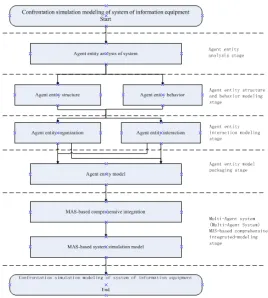
Dynamic features for information confrontation system of system of equipment at a moment result from interactions among many weapon systems, C2 unit, combat perception unit, combat space, information space and other elements. Due to the existence of entity in the confrontation system of system of equipment and self-organization, sociality, self-regulation and motility similar to Agent’s, Agent-based system confrontation simulation modeling can gain on features for information confrontation system of system of equipment better, which is a new effective approach.
Figure 1. Agent-based unity modeling framework for system confrontation simulation.
It is divided into five stages: Agent entity analysis, Agent entity structure and behavior modeling, Agent entity interaction modeling, Agent entity model packaging stage, and multi-Agent system (Multi-Agent System) MAS-based comprehensive integrated-modeling.
Networked Combinative Simulation Modeling Architecture
Overview of Combinative Modeling Architecture
Currently, High Level Architecture (HLA) standard is used as unified simulation protocol to develop the operating efficiency simulation for application of existing simulation and integration of model and individual development of each application field, so it is applied and practiced widely. However, its disadvantages are shown increasingly, such as difficult model integration, low simulation operation efficiency, complicated management, etc. With the further study of complex system and its soaring simulation requirements, due to the lack of descriptive capability of its conception model and strong model specification and architecture, HLA is very hard to implement a good combinative simulation. Design thought of combinative modeling architecture is to use the guiding principle of application development based on combinative modeling architecture, which has something in common with the guiding thought of software engineering. However, in allusion to certain application field, especially the efficiency simulation system of fighter, they have their own features and distinct differences, including hierarchical modeling, componentized modeling, number-based modeling, and standardized modeling[8].
Top-Level Combinative Model Architecture
operations, combinative model architecture of networked air-defense anti-missile system is extended and established.
(1)Platform combinative model architecture
[image:4.612.161.464.168.336.2]The core of platform model architecture is platform model, as shown in Figure 2. Platform model is classified as Air Object, Surface Object, Ground Object, Sub-object and Space Object. Each type of platform can be further divided in accordance with the function principle. Warship, Air Defense Base, Satellite are the main platforms used by air-defense anti-missile system of networked system.
Figure 2. Platform model architecture.
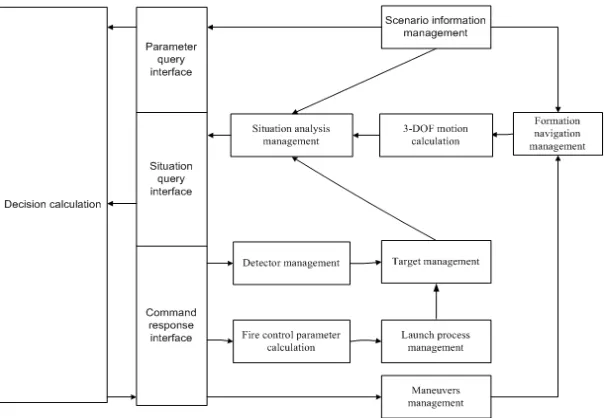
According to the idea of hierarchical modeling, the Platform model implements most functions of the platform model architecture and each subclass mainly implements its specific functions. The module structure of Platform model class is shown in Figure 3. Firstly, separate the decision-making calculation module, describe it in the form of a script and schedule it with the platform model. Decision-making calculation module and various types of Platform models are interacted through three types of interfaces, of which parameter query interface is responsible for providing the performance parameters of the platform and its accessory equipments as well as mission tasks; situation query interface is responsible for calling the situation analysis management model to provide information such as platform status, target state, threat level, attackability, attack status and optimal attack weapon type for decision-making calculation module; command response interface receives commands such as weapon firing and detector jammer operations after decision-making calculation.
[image:4.612.161.465.512.721.2](2)Weapon combinative model architecture
[image:5.612.158.471.192.377.2]The composition and structure of the weapon model architecture are shown in Figure 4. The core class is Weapon, including point killing weapons such as Weapon, Mine, Depth Charge, Bomb and Ballistic, as well as Weapon With Seeker such as Torpedo and Missile. Weapon With Seeker combination, has seeker probe, provides Sensor Holder interface for the seeker to obtain its precise spatial position and attitude information. For missiles with a semi-active radar seeker, the semi-active seeker can obtain relevant information about the illumination radar (type: Fire Control Radar) via the Semi-Active Seeker Holder interface provided by Missile. Surface-to-air missile is the main platform used by the networked air and missile defense system.
Figure 4. Weapon Model Architecture
The common parts of weapon model or guided weapon model include: Dynamic model based on local coordinate system, execution architecture based on finite state machine, intersection calculation based on fuze and reporting mechanism of damage results, which can be described in an abstract manner and customized and extended by subclass models of weapons at all levels on the basis of inheritance.
(3)Detector combinative model architecture
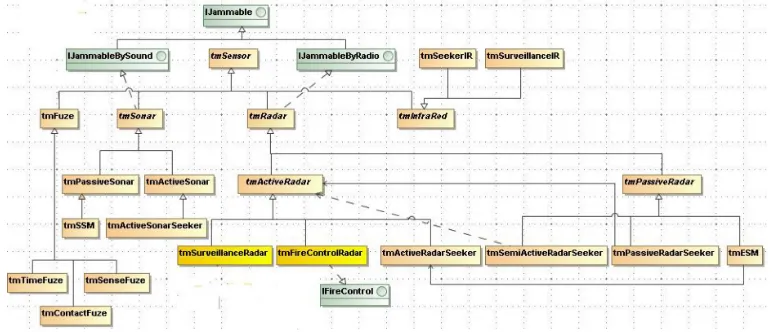
The composition and structure of the detection model architecture are shown in Figure 5. The core class is Weapon, including Sonar, Radar, Infra-Red and Fuze, of which Sonar and Radar can be conducted active jamming by the enemy, so they achieve the IJammableBySound and IJammableByRadio interfaces by which the active jammer can implement active jamming on detectors. Fire control radar model achieves the IFireControl interface by which the missile model can obtain guidance information required by mid-range tracking target. Surveillance radar and fire control radar are the main platforms used by the networked air and missile defense system.
[image:5.612.119.505.567.733.2]Case Analysis
After the architecture is setting up, the next step is to design specific models and related algorithm on the basis of the above architecture. This paper takes the air defense and anti-missile mission as background and further designs experimental cases and analyzes experimental results to verify the combinability of the combinative model architecture.
Case Description
A force relies on the superior mobile, invisible and attacking performances of the fifth generation of F22 fighter, attempting to violate our airspace for investigation activities and despising our combat capability. Our army has learned the intelligence of action line of the hostile forces and decided to fight back, in order to combat the arrogance of the hostile forces and enhance our defense capability. Our army commanded a theater air defense command center to deploy networked air and missile defense system in the enemy investigation route area and was determined to minimize the time, manpower, weapons and other resources to destroy the aircraft. See Table 1 for forces deployment conditions of red and blue party.
Table 1. Forces Deployment of Red and Blue Party.
Forces allocation The blue party is an airport, attached a F22 fighter (loading 1 airborne radar, 1 missile warning device and 2 anti-radiation missiles); the red party is composed of 1 C300 air defense position unit, 2 early warning radar positions, 1 theater air defense command center and 1 stand-by AWACS (loading 1 airborne radar). Air defense position unit is
fitted with 1 radar and 8 surface-to-air missiles.
Deployment methods Assume the early-warning radar position of the red party is arranged with good cooperation, i.e., having early-warning detection capabilities over the incoming target lines; air alert AWACS conducts early warning detection on the air defense region. If the
blue party is detected, the early warning radar and AWACS will guide the air defense position to conduct target tracking and attacking; the fighter of the blue party flies over the
hybrid group of air defense positions according to the default route and through the early warning radar detection range intersection of the red party to start airborne radar to search
the red party.
Operational rules When the red party destroys the aircraft of the blue party, the interception is successful; if the blue party breaks the defense of the red party or destroys the command post, the blue
party wins. Experiment and Analysis
The experimental cases include optimal guidance and cooperative guidance in networked air and missile defense system. Each case includes detailed experimental design, configuration of simulation, simulation result analysis and two-dimensional situation representation. They present the basic simulation model, communication network model and dynamic interactive model of networked combinative simulation modeling and verifies the combinability of combinative model architecture.
[image:6.612.101.515.599.727.2](1)Networked air-defense anti-missile_optimal guidance
Table 2. Experiment Settings of Optimal Guidance. Experimental
object
Networked air-defense and anti-missile _ optimal guidance Experimental
method
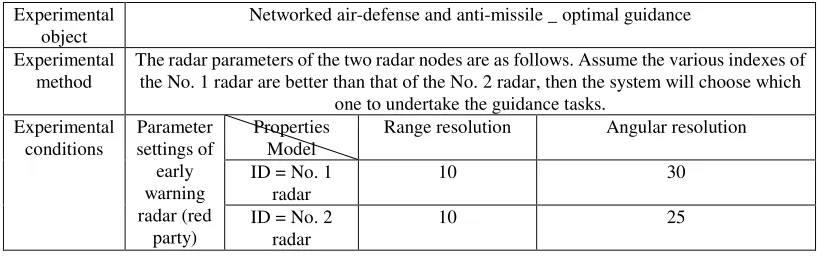
The radar parameters of the two radar nodes are as follows. Assume the various indexes of the No. 1 radar are better than that of the No. 2 radar, then the system will choose which
one to undertake the guidance tasks. Experimental conditions Parameter settings of early warning radar (red party) Properties Model
Range resolution Angular resolution ID = No. 1
radar
10 30
ID = No. 2 radar
When the aircraft enters weapon range, if two radars are tracking at the same time, the system should choose whom to undertake guidance tasks. The experiment configurations of optimal guidance are shown in Table 2.
As shown in Figure 6 (a), the aircraft of the blue party has successively entered the detection ranges of two ground-based early warning radars of the red party. The range resolution of No. 2 radar is more distant than that of No. 1 radar and the aircraft of the blue party firstly enters the detection range of No. 2 radar, so No. 2 radar firstly starts and detects the targets.
No. 2 radar then transmits preliminary information of threat object to the regional command and control center through the communication network, informing the threat target is approaching. The air defense command center preferentially chooses the No. 2 radar to carry out target tracking, at meantime informs the ground air defense unit of the incoming situations according to the indication of incoming targets and releases fire control radar starting command. The fire control radar of ground air defense unit starts and carries on detection and tracking in guiding airspace.
(a) (b)
[image:7.612.173.455.242.488.2](c)
Figure 6. Basic Operational Process of Optimal Guidance.
The regional command and control center merges the target detection information into a unified Common Operational Picture (COP) and provides real-time and accurate battle situation information for each unit in the system by means of broadcasting. On the one hand, the regional command and control center distributes the COP information to the combat units, which will make decisions based on received target detection information and carry out the interception point calculation based on the shared information. On the other hand, the regional command and control center conducts threat assessment and target allocation according to the COP and directly select the best combat unit or a combination of multiple combat units.
After being hit, the combat unit should immediately enter the launch preparation phase to rapidly conduct fire distribution and transmit the command to the missile launch system. As shown in Figure 6 (b), the F22 fighter of the blue party enters the fire range of ground air defense unit of the red party under the target early warning of the No. 2 ground-based early warning radar. As the combat unit of the red party has only one air defense position, it is hit. According to the command of the air defense command and control center, the air defense unit rapidly conducts fire distribution, binds the launching data and launch missile after receiving the fire command of command and control center.
the air defense unit. The blue party does not reach the operational purpose to destroy the command post of the red party and implement fire penetration.
(2)Networked air-defense anti-missile _ coordinative guidance
An air defense position is deployed a ground-to-air missile but lacks a remote ground-based early warning radar. There is an air alert AWACS in the vicinity of the airspace, if the incoming target enters the detection range of the AWACS, test whether AWACS could play the temporary command and control functions and guide the air defense fire units to launch the SAM to intercept the target.
The combinative modeling architecture’s support for good combinability is demonstrated in that the unified architecture should not only support networked air and missile defense system of hybrid group of air defense positions but also support the hybrid group of aircraft formation, UAV formation, fleet and fleet &positions, the hybrid group of aircraft and positions and even the joint defense system composed by land, sea, air, outer space and electron such as fleet-air defense position-aircraft, as shown in Table 3.
Table 3. Experiment Settings of Coordinative Guidance. Experimental
object
Networked air-defense and anti-missile _ coordinative guidance Experimental
method
The aircraft broke out the defense system consisting of an air defense position unit and an AWACS. Observe the damage situations of penetration.
Experimental conditions
The blue party fails to break out because the ammunition is exhausted and returns; AWACS, as a temporary C2, is destroyed and fails to defend. It exits the simulation.
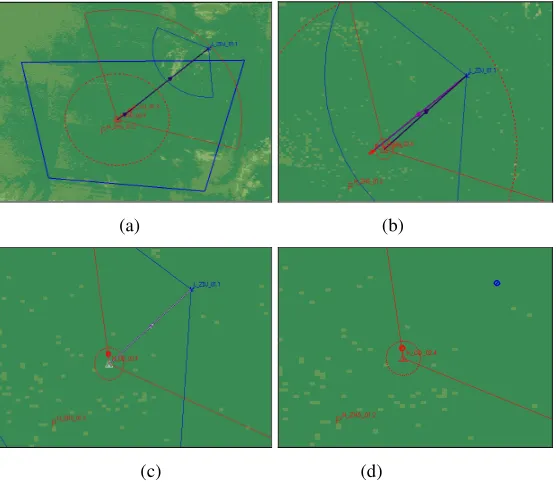
As shown in Figure 7 (a), the aircraft of the blue party has successively entered the detection ranges of fire control radar and AWACS radar of ground air defense unit of the red party and is detected by both radars. The ground air defense unit then transmits preliminary information of threat object to the temporary C2 center through the communication network, i.e. AWACS, informing the threat target is approaching. The AWACS continues to track the target and at meantime informs the ground air defense unit of the incoming situations according to the indication of incoming targets. The fire control radar of ground air defense unit carries on detection and tracking in guiding airspace.
(a) (b)
[image:8.612.175.453.443.684.2](c) (d)
Figure 7. Basic Operational Process of Coordinative Guidance.
AWACS conducts rapid fire distribution and issues the launch instructions and then the ground air defense fire launches missiles. In Figure 7 (c) and (d), the AWACS of the red party and the F22 fighter of the blue party have been shot down successively and the two parties draw.
Summary
In allusion to features like simulation platform of system of equipment’s operating efficiency, the complexity of C2, interaction relationship and so on, the basic simulation model-based networked combinative modeling architecture is put forward. This architecture is high-effectively combinative and extensive, can describe the simulation field of system of equipment’s operating efficiency in detail, which can be the modeling basis for simulation of system of equipment’s operating efficiency. Experiments show that the architecture we propose is fairly effective and useful.
References
[1]Xiaoming Luo, Haoguang Chen, Wei Zhou. The Research of Combat Effectiveness of Weapon Equipment System and Structure Optimization Methods. The proceedings of The Fourth National Youth Conference on Operations Research and Management, 2001.
[2]Rui Wang. The research of Combat Effectiveness of Advanced Aircraft [D]. Northwestern Polytechnical University, China, 2007.
[3]Darilek, R., Perry, W., Bracken, J., Gordon, J., & Nichiporuk, B. Measures of effectiveness for the information-age army (No. RAND/MR-1155-A). RAND Corp Santa Monica CA, 2001.
[4]Perry W, Button R W, Bracken J, et al. Measurements of Effectiveness for the Information-Age Navy: The Effects of Network-Centric Operations on Combat Outcomes[R]. RAND Corp Santa Monica CA, 2002.
[5]Huang J X, Li Q, Jia Q, et al. Research on ABMS-based SoS effectiveness evaluation framework[J]. Systems Engineering and Electronics, 2011, 33(8): 1794-1798.