
2017 International Conference on Computer Science and Application Engineering (CSAE 2017) ISBN: 978-1-60595-505-6
Application of AHP Method and TOPSIS Method in Comprehensive Economic Strength Evaluation of Major Cities in Guizhou Province
Liang Zhou*, Changdi Shi and Liming Luo
Information Engineering College, Capital Normal University, 100048 Beijing, China
ABSTRACT
This paper establishes the comprehensive economic strength evaluation system of major cities in Guizhou province, and puts forward the evaluation model of comprehensive economic strength of major cities in Guizhou province based on the AHP method and the TOPSIS method. The AHP method was used to determine the weight of evaluation indicator. The TOPSIS method is used to calculate the positive and negative ideal solutions, analyses the case, and then the final ranking of the comprehensive economic strength of the major cities in Guizhou province. The result shows that the final ranking, from high to low, of comprehensive economic strength of the major cities in Guizhou province is: Guiyang, Zunyi, Liupanshui, Tongren and Anshun. The evaluation system of the comprehensive economic strength indicator of the major cities in Guizhou province has a certain practicability, which provides an evaluation basis in comprehensive economic strength for the major cities in Guizhou province.
INTRODUCTION
In recent years, with the establishment of large data centers and the promulgation of precision poverty alleviation policies, the national economy and social development of the major cities in Guizhou have made breakthrough progress, but the cities developed unevenly, so it is necessary to explore how to establish a good and scientific comprehensive economic evaluation system. This paper is focused on evaluating the comprehensive economic strength of major cities in Guizhou province effectively.
Selection among alternatives depends on a set of different conflicting criteria that have different optimization directions and different measurement units. The MCDM methods can be used on the national, organizational and project levels. However, most assessment methods are intended only for economic objectives (Sivilevičius et al., 2008). An appropriate mechanism for supporting management practices at an early research on a fuzzy multi-criteria decision making algorithm, which integrated the principles of fusion of fuzzy information, additive ratio assessment method with fuzzy numbers (ARAS-F), fuzzy weighted-product model and analytic hierarchy process (AHP). Karabasevic et al. (2016) introduced an approach for the selection based on the SWARA and ARAS methods under uncertainties (Keršulienė & Turskis 2011).
Turskis and Juodagalvienė (2016) introduced a hybrid MCDM model, which was based on ten different MCDM methods: Game Theory, AHP, and SAW, Multiplicative Exponential Weighting, TOPSIS, and EDAS, ARAS, Full Multiplicative Form, Laplace Rule, and Bayes Rule, is useful to solve complicated problems. Zavadskas et al.
SWARA-ELECTRE III, SWARA, and VIKOR to assess, rank and select the best alternatives. Štreimikienė et al. (2016) paper presented the process of choice such multiple criteria decision-making methods as AHP and ARAS. Stanujkic et al. (2017) proposed using the EDAS method with grey numbers. Zavadskas et al. (2016) overviewed developments of TOPSIS method (Hwang & Yoon, 1981; Yoon, 1980) to solve different complicated problems in recent two decades. There are some new MCDM methods MABAC (Gigović, LJ., 2017) and MAIRCA have been used to assess, rank and select the best alternatives (Pamučar, D., Ćirović,G, 2015; Pamučar, D. et al, 2017).
On the basis of summing up the previous comprehensive economic assessment, this paper used the method of classical AHP and TOPSIS to rank the comprehensive economic strength of major cities in Guizhou province. Firstly, AHP method was used to construct the evaluation indicator system, and calculate the weight of evaluation indicator. Secondly, TOPSIS method was used to calculate the positive and negative ideal solutions, and then the case analysis was carried out to solve the final ranking of the evaluation target, which provided the basis for the self-evaluation of the comprehensive economic strength of the major cities in Guizhou province.
MODEL CONSTRUCTION
Determination of Indicator Weight Based on AHP
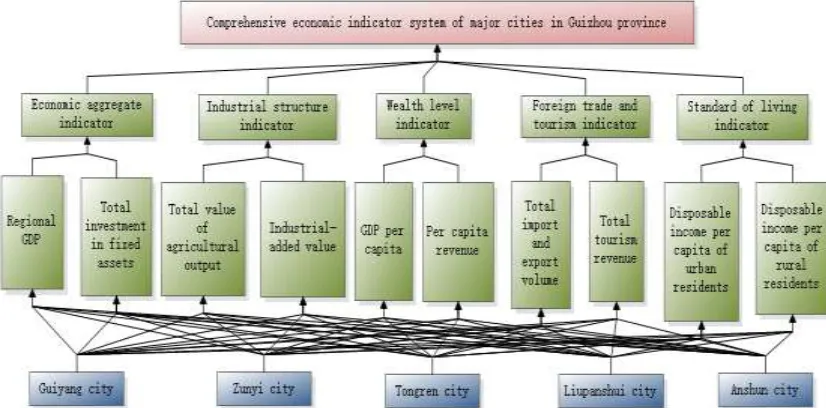
Many factors affect the level of comprehensive economic development of major cities in Guizhou province, such as the geographical locations of the cities, the characteristics of industrial structure and the characteristics of cultural exchange, it is difficult to quantitatively measure the level of economic development of these cities, and thus how to evaluate the economic development level of major cities in Guizhou province scientifically and efficiently is the focus of this paper. According to the basic principles and solving steps of AHP, stratify the comprehensive economic evaluation indicator of major cities in Guizhou province. The target layer is the comprehensive economy of the major cities in Guizhou province. The first level includes five indicators, which include economic aggregate indicator B1, industrial structure indicator B2, wealth level indicator B3, foreign trade and tourism indicator B4, and standard of living indicator B5. The second level includes ten indicators that contain regional GDP C11, total investment in fixed assets C12, total value of agricultural output C21, industrial-added value C22, GDP per capita C31, per capita revenue C32, total import and export volume C41, total tourism revenue C42, disposable income per capita of urban residents C51, and disposable income per capita of rural residents C52. The evaluated objects are Guiyang city D1, Zunyi city D2, Tongren city D3, Liupanshui
city D4, Anshun city D5. Wi represents the combined weight. The indicator system is
Figure 1. Comprehensive economic indicator system of major cities in Guizhou province.
The original data collected by the Guizhou Provincial Bureau of Statistics in 2013 are shown in Figure 2.
Figure 2. Raw data table.
Determining the Weight of Evaluation Indicators
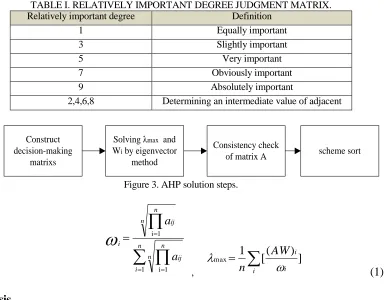
The rationality of the setting economic indicator weight is directly related to the scientific rigor of the evaluation structure. This paper invited the experts in the economic field to discuss the importance of the indicators with the real data collected by the Provincial Bureau of Statistics in 2013. The judgment matrix rule in AHP, which is shown in TABLE I, was used to determine the weight of each indicators. The author
calculated the weight according to the AHP solving steps.
The AHP solving steps are shown in Figure 3. W = [ω1 , ω2, ..., ωn], Wi and λmax were
TABLE I. RELATIVELY IMPORTANT DEGREE JUDGMENT MATRIX.
Relatively important degree Definition
1 Equally important
3 Slightly important
5 Very important
7 Obviously important
9 Absolutely important
2,4,6,8 Determining an intermediate value of adjacent
Construct decision-making
matrixs
Solving λmax and Wi by eigenvector
method
Consistency check
of matrix A scheme sort
Figure 3. AHP solution steps.
n i n n ij n n ij i a a1 i 1
1 i
,
i i i AW n ] ) ( [ 1 max (1) TopsisThis algorithm’s core idea is to detect how well the positive and negative ideal solutions match the evaluated objects. That is, it is the best if the evaluated object is closest to the Positive Ideal Solution and, meanwhile, the farthest away from the Negative Ideal Solution. The solving steps of TOPSIS are represented in Figure 4, where B = (b ij ) m * n , b ij = W i * y ij , and W i is obtained by the AHP method.
Using Vector Specification to Solve Normative Decision Matrices Construct a weighted normative matrix Caculating the positive and negative ideal solution(S+, S-)
The proximity of the scheme to the positive
and negative ideal solutions(D+, D-)
Calculate the degree of proximity of the scheme to the ideal
solution
scheme sort
[image:4.612.96.501.456.509.2]Figure 4. TOPSIS solving steps.
The formula to calculate the positive and negative ideal solutions of the evaluation object are as follows: (2).
}} |
{min , |
{maxb j J1 b j J2
S ij ij
, { in | 1,{max | 2}}
-J j b J j b m
S ij ij
(2)
The formula to calculate the distance between the positive and negative ideal solutions are descripted in (3).
m
j ij i b S
1
2 ) (
D
(i=1,2,...,m),
m
j ij i b S
1
2 ) (
D
CASE STUDY
Solving Indicator Weight
Based on the actual data from the Provincial Bureau of Statistics and the expert team, this paper puts forward a scientific and effective evaluation model for the
evaluation of the economic strength of the major cities in Guizhou province, constructs the two comparison matrices, and uses the AHP software to carry out the consistency test. Some of the results are as follows:
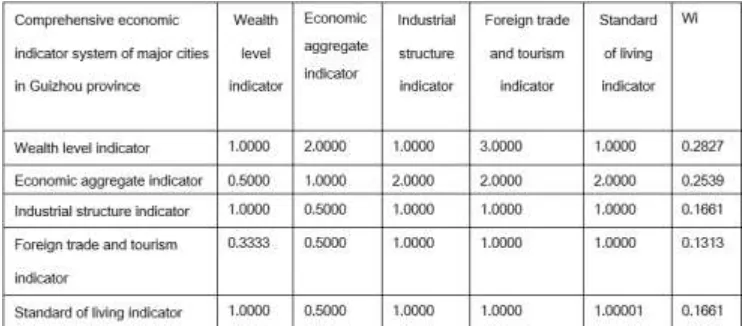
[image:5.612.111.482.219.382.2]The consistency ratio of the comprehensive economic indicator system of the major cities in Guizhou province: 0.0581; the weight of A: 1.0000; λmax: 5.2601, as Figure 5 shows.
[image:5.612.106.490.384.671.2]Figure 5. The relative weight of B1, B2, B3, B4 and B5 to target layer A.
TABLE II. THE RELATIVE WEIGHT OF C11 AND C12 TO THE FIRST INDICATOR B1.
Economic aggregate indictor Regional GDP
Total investment in fixed assets
Wi
Regional GDP 1.0000 1.0000 0.5000
Total investment in fixed assets 1.0000 1.0000 0.5000
TABLE III. THE RELATIVE WEIGHT OF C21 AND C22 TO THE FIRST INDICATOR B2.
Industrial structure indicator
Total value of agricultural output
Industrial-added value
Wi
Total value of agricultural output
1.0000 0.3000 0.2308
Industrial-added value 3.3333 1.0000 0.7692
TABLE IV. THE RELATIVE WEIGHT OF C31 AND C32 TO THE FIRST INDICATOR B3.
Wealth level indicator GDP per capita Per capita revenue
Wi
GDP per capita 1.0000 0.3000 0.2308
Per capita revenue 3.3333 1.0000 0.7692
TABLE V. THE RELATIVE WEIGHT OF C41 AND C42 TO THE FIRST INDICATOR B4.
Foreign trade and tourism indicator
Total import and export volume
Total tourism revenue
Wi
Total import and export volume 1.0000 0.1000 0.0909
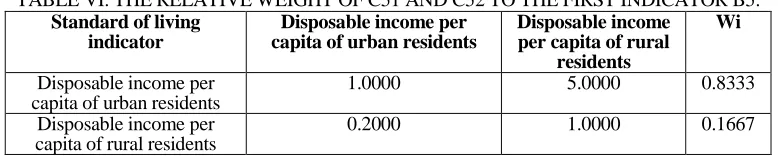
Combined with TABLE II-VI, the secondary indicator relative weight
W *, W * = (0.1269, 0.1269, 0.0383, 0.1277, 0.0652, 0.2175, 0.0119, 0.1193, 0.1384, 0.0277).
TABLE VI. THE RELATIVE WEIGHT OF C51 AND C52 TO THE FIRST INDICATOR B5.
Standard of living indicator
Disposable income per capita of urban residents
Disposable income per capita of rural
residents
Wi
Disposable income per capita of urban residents
1.0000 5.0000 0.8333
Disposable income per capita of rural residents
0.2000 1.0000 0.1667
The final indicators weight of the major cities in Guizhou are shown in TABLE VII.
TABLE VII. FINAL RESULTS
Program Weight
Guiyang City 0.4265
Zunyi City 0.2219
Tongren City 0.0859
Liupanshui City 0.1662
Anshun City 0.0995
The Result of Evaluation Objectives
[image:6.612.103.492.113.191.2]This paper used the C language to implement the TOPSIS method and combined with the weight obtained by AHP method and finally obtained the matrix after the weighted specification, as Figure 6 shows.
Figure 6. Normative decision matrix.
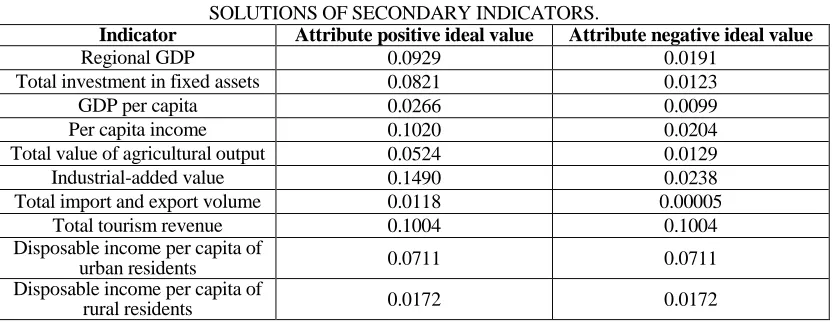
According to the third step of TOPSIS method, the positive and negative ideal solutions of 10 secondary indicators in the evaluation economic strength of major cities of Guizhou are obtained, which are shown in TABLE VIII.
economic strength ranking of the cities in Guizhou province. The ranking, ordered from most developed to least developed, is ranked as follows: Guiyang City, Zunyi City, Liupanshui City, Tongren City and Anshun City. This ranking is generally consistent with the actual level of development of the aforementioned cities.
TABLE VIII. THE POSITIVE AND NEGATIVE IDEAL SOLUTIONS OF SECONDARY INDICATORS.
Indicator Attribute positive ideal value Attribute negative ideal value
Regional GDP 0.0929 0.0191
Total investment in fixed assets 0.0821 0.0123
GDP per capita 0.0266 0.0099
Per capita income 0.1020 0.0204
Total value of agricultural output 0.0524 0.0129
Industrial-added value 0.1490 0.0238
Total import and export volume 0.0118 0.00005
Total tourism revenue 0.1004 0.1004
Disposable income per capita of
urban residents 0.0711 0.0711
Disposable income per capita of
rural residents 0.0172 0.0172
The TOPSIS method was used to obtain the ranking of the comprehensive economic strength of major cities in Guizhou province, which is shown in TABLE IX.
TABLE IX. THE FINAL RANKING OF MAJOR CITIES IN GUIZHOU.
Guiyang city Zunyi city Liupanshui city Tongren city Anshun city
0.8567 0.6493 0.3615 0.1497 0.1281
CONCLUSIONS
This paper combined the AHP method and the TOPSIS method. The AHP method was used to determine the weight of the indicator, and the TOPSIS method was used to calculate the positive and negative ideal solutions and proximities. The comprehensive economic strength ranking of major cities in Guizhou province was obtained. The strength, ordered from high to low, is Guiyang, Zunyi, Liupanshui, Tongren, and followed by Anshun. This ranking is basically in line with the actual level of development of the major cities in Guizhou province. It provides a scientific and practical evaluation model for self-evaluation of the major cities in Guizhou province. The model proposed in this paper can be used in solving the similar economic sorting problems. This article completely solved the research problem, and the research results were consistent with the actual level of development of these cities. Future research: building a more innovative model, and comparing the use of different MCDM method to obtain the results.
REFERENCES
1. Hwang, C. L., and Yoon, K. 1981. “Methods for multiple attribute decision making,” In Multiple attribute decision making, pp. 58-191. Springer Berlin Heidelberg.
3. Saaty, T. L. 1977. “A scaling method for priorities in hierarchical structures,” Journal of mathematical psychology, 15(3):234-281
4. Šaparauskas, J., Kazimieras Zavadskas, E., and Turskis, Z. 2011. “Selection of facade's alternatives of commercial and public buildings based on multiple criteria,” International Journal of Strategic Property Management, 15(2):189-203.
5. Sivilevičius, H., Zavadskas, E. K., and Turskis, Z. 2008. “Quality attributes and complex assessment methodology of the asphalt mixing plant,” Baltic Journal of Road & Bridge Engineering, 3(3). 6. Stanujkic, D., Zavadskas, E. K., Ghorabaee, M. K., and Turskis, Z. 2017. “An extension of the EDAS
method based on the use of interval grey numbers,” Stud. Inf. Control, 26(1): 5-12.
7. Štreimikienė, D., Šliogerienė, J., and Turskis, Z. 2016 “Multi-criteria analysis of electricity generation technologies in Lithuania,” Renewable Energy, 85:148-156.
8. Turskis, Z., and Juodagalvienė, B. 2016. “A novel hybrid multi-criteria decision-making model to assess a stairs shape for dwelling houses,” Journal of Civil Engineering and Management, 22(8):1078-1087.
9. Turskis, Z., Zavadskas, E. K., Antucheviciene, J., and Kosareva, N. 2015. “A hybrid model based on fuzzy AHP and fuzzy WASPAS for construction site selection,” International Journal of Computers Communications & Control, 10(6):113-128.
10. Yoon, K. 1980. “System selection by multiple attribute decision making, Ph.D,” Dissertation, Kansas State University, Manhattan, Kansas.
11. Zavadskas, E. K., Govindan, K., Antucheviciene, J., and Turskis, Z. 2016. “Hybrid multiple criteria decision-making methods: a review of applications for sustainability issues,” Ekonomska istraživanja, 29(1): 857-887.
12. Zavadskas, E. K., Mardani, A., Turskis, Z., Jusoh, A., and Nor, K. M. 2016. “Development of TOPSIS Method to Solve Complicated Decision-Making Problems—An Overview on Developments from 2000 to 2015,” International Journal of Information Technology & Decision Making, 15(03):645-682.
13. Zavadskas, E. K., Turskis, Z., and Kildienė, S. 2014. “State of art surveys of overviews on MCDM/MADM methods,” Technological and economic development of economy, 20(1):165-179. 14. Zavadskas, E. K., Turskis, Z., Vilutienė, T., and Lepkova, N. 2017. “Integrated group fuzzy
multi-criteria model: Case of facilities management strategy selection,” Expert Systems with Applications, 82: 317-331.
15. Zavadskas, E. K., Turskis, Z., Volvačiovas, R., and Kildiene, S. 2013. “Multi-criteria assessment model of technologies,” Studies in Informatics and Control, 22(4): 249-258.
16. Pamučar, D., and Ćirović, G. 2015. “The selection of transport and handling resources in logistics centres using Multi-Attributive Border Approximation area Comparison (MABAC),” Expert Systems with Applications, 2015, 42:3016- 3028.
17. Pamučar, D., Mihajlović, M., Obradović, R., and Atanasković, P. 2017. “Novel approach to group
multi-criteria decision making based on interval rough numbers: Hybrid
DEMATEL-ANP-MAIRCA model,” Expert Systems with Applications, 88:58-80.
![The effects of neem [Azadirachta indica A Juss (meliaceae)] oil on Fusarium oxysporum f sp medicagenis and Fusarium subglutinans and the production of fusaric acid toxin](data:image/gif;base64,R0lGODlhAQABAIAAAP///wAAACH5BAEAAAAALAAAAAABAAEAAAICRAEAOw==)