Munich Personal RePEc Archive
A cointegration and error correction
approach to the determinants of inflation
in India
I, Sahadudheen
Pondicherry University
2012
Online at
https://mpra.ub.uni-muenchen.de/65561/
Determinants of Inflation in India
Sahadudheen I
Lecturer in Economics, Department of Economics,
Calicut University Centre, Kadmat, Lakshadweep, India [email protected]
Abstract
No doubt that the persistent rise in the price levels of commodities and services
adversely affects the economic performance. The goal of each and every Government is to
maintain low and relatively stable levels of inflation. Creeping or mild inflation can be
viewed as having favorable impacts on the economy; on the other hand zero inflation is
harmful to other sectors in the economy. The right level of inflation, is somewhere in the
middle. The study analyzed the major determinants of inflation in India extracting 54 time
series quarterly observations. The study employed Johansen-juselius cointegration
methodology to test for the existence of a long run relationship between the variables. The
cointegrating regression so far considers only the long-run property of the model, and does
not deal with the short-run dynamics explicitly. For this, the error correction from the long
run determinants of inflation is then used as a dynamic model to estimate the short run
determinants of inflation. The study concluded that the GDP and broad money have a
positive effect on the inflation in long run. On the other hand, interest rate and exchange rate
has a negative effect.The income coefficient is 0.37 and showing significant, implying that in
India, a one percent increase in income while others keep constant contributes 0.37%
increase in inflation. Similarly the money coefficient is 0.047 and showing significant,
implying that in India, one percent increase in money supply leads to a 5% increase in price
level.
Keywords: Wholesale price index, GDP, India, unit root, cointegration, Error correction
Introduction
Inflation is an important concept in the history of economic thought and can be
defined as a sustained rise in the general level of prices i.e. a persistent rise in the price levels
of commodities and services, leading to a fall in the currency’s purchasing power. High inflation is bad for the economy and it adversely affects economic performance. Even
moderate levels of inflation can distort investment and consumption decisions. Reducing
unemployment. The problem of inflation used to be confined to national boundaries, and was
caused by domestic money supply and price rises. In this era of globalization, the effect of
economic inflation crosses borders and percolates to both developing and developed nations.
Too much money in circulation, increases production costs, declines in exchange rates,
decreases in the availability of limited resources such as food or oil etc are the basic causes of
inflation. Inflation is a sign that an economy is growing, but excessive economic growth can
be detrimental as it can lead to hyperinflation as experienced, at the other extreme, an
economy with no inflation has essentially stagnated. The right level of economic growth, and
thus the right level of inflation, is somewhere in the middle. Creeping or mild inflation can be
viewed as having favorable impacts on the economy; on the other hand zero inflation is
harmful to other sectors in the economy with falling prices, profits, and employment. In
general, unpredicted running and galloping inflation are regarded has unprecedented effects
on an economy because it distort and disrupt the price mechanism, discourage investment and
saving, adversely effects fixed income group, creditors and ultimately leads to the breakdown
of morals.
Review of Literature
Gary G. Moser (1995) analyzed the dominant factors influencing inflation in Nigeria
by employing the cointegration and Error correction methods for the data ranges from 1960
to 1993. They used real income, broad money, annual rain fall and Naira-US dollar bilateral
exchange rate as their explanatory variables. They found that monetary expansion, driven
mainly by expansionary fiscal policies, explains to a large degree the inflationary process in
Nigeria. Other important factors were the devaluation of the naira and agro climatic
conditions.
Lim and Papi (1997) examined the major determinants of inflation in Turkey for the
ranging 1970 to 1995. The study employed Johansen Co integration technique and on the
basis of the result they concluded that money, wages, prices of exports and prices of imports
have positive influence on domestic price level where as exchange rate exerts inverse effect
on the domestic price level in Turkey.
Ilker Domaç (1998) investigated both the behavior and determinants of inflation in
Albania by applying co-integration and error-correction techniques to the inflation process.
They used Inflation, budget deficit, exchange rate depreciation, money growth and real GDP
as variables in his study. The results of the Granger Causality tests indicated that M1and the
exchange rate has an important predictive content for almost the entire individual items of the
run, inflation is positively related to both money supply and the exchange rate, while it is
negatively related to real income.
Kuijs (1998) investigated the major determinants of price level, output and exchange
rate in Nigeria using Vector Autoregressive (VAR) model. The study suggests that first lag of
prices, 3rd lag of prices, 1st lag of excess money supply and 1st lag of output gap are directly
related to price level where as 2nd lag of prices, 4th lag of exchange rate and output gap are
indirectly linked with price level in Nigeria.
Liu and Adedeji (2000) studied the determinants of inflation in the Islamic Republic
of Iran for data covering the period from 1989 to 1999. By applying Johansen co-integration
test and vector error correction model, they concluded that lag value of money supply,
monetary growth, four years previous expected rate of inflation are positively contributed
towards inflation while two years previous value of exchange premium is negatively
correlated with inflation.
Mosayed and Mohammad (2009) examined the determinants of inflation in Iran for
the data from 1971 to 2006. The study adopted Autoregressive and distributed lag model
(ARDL) and concluded that money supply, exchange rate, gross domestic product, change in
domestic prices and foreign prices, a variable that capture the effect of Iran or Iraq war are
the major determinants of inflation in Iran and all are positively contributing to the domestic
prices in Iran.
Abidemi and Malik (2010) analyzed simultaneous inter relationship between inflation
and its major determinants in Nigeria for the period from 1970 to 2007. The study adopted
Johansen co-integration methodology and error correction model (ECM) and conclude their
study revealing that growth rate of GDP, money supply, Imports, 1st lag of inflation and
interest rate are positively associated with inflation rate, while fiscal deficit and exchange rate
are indirectly associated to inflation.
Armstrong Dlamini and Tsidi Nxumalo (2011) used annual data from 1974 to 2000
and analyzed the determinants of inflation in Swaziland by employing the econometric
technique of cointegration and error correction model (ECM).They used real income,
nominal money supply, nominal interest rate, nominal exchange rates, nominal wages, and
South African consumer prices as explanatory variables and Swaziland consumer price index
as the dependent variable. They found that the impact of the money supply variable on
inflation is insignificant; suggesting that money supply growth in Swaziland does not accord
with normal behavioral expectations towards inflation. Interest rates seem to play no
rate has a significant long-run influence on the level of prices in Swaziland and the foreign
price as have a significant long run influence on the level of prices of Swaziland.
Data, Methodology and Empirical Results
In order to investigate the determinants of inflation in India, the following data are
used. The data used in this study are cumulated from various secondary sources. The variable
such as wholesale price index (WPI), broad money (M3), real gross domestic product
(GDPFC) and prime lending rate are collected from CMIE. The bilateral exchange rate
between dollar and rupee are collected from www.exchangerate.com. The data collected over
a period of 1996Q1 to 2009Q2. The WPI estimated 1993-94 constant prices, whereas GDPFC
is estimated on the basis of 1999-00 constant price and GDP and broad money are seasonally
adjusted.
To investigate the above issue the study uses the 54 quarterly observations from
1996Q1 to 2009Q2. The choice of sample period is due to capture short term dynamics of
inflation. In order to study the various determinants of inflation in India, we considered five
variables, namely WPI, real GDP, prime lending rate, broad money and bilateral exchange
rate. The statistical and time series properties of each and every variable are examined using
the conventional unit root test.
The study employs the econometric technique of cointegration and error correction
model (ECM) in order to estimate a more specific relationship between inflation and its
determinants. The ECM, as a tool of analysis, overcomes the problems of spurious regression
through the use of appropriate differenced variables in order to determine the short-term
adjustments in the model. Cointegration analysis on the other hand provides the potential
information about long term equilibrium relationship of the model.
The relationship between inflation and its key determinants is an important building
block in macro-economic theories and is a crucial component in the conduct of monetary
policy. The proper specification of the model is very important and constitutes primary step
for robust results to obtain. In all the countries the determinants of inflation are almost same,
only the difference is on their magnitude.
There are however, generally three functional forms dominating the literature:
linear-additive, log-linear and linear-no additive. There is general consensus that the log linear
version is the most appropriate functional form. We hypothesize that the fundamental
exchange rate. For estimation purposes, we use the logarithmic transformation of quarterly
data for the period 1996:01–2009:02. we specify the following equation, where all
variables except prime lending rate are expressed in logarithmic forms, is a random error term, and t is a quarterly time index.
Ln Pt=α+ lnYt + Rt+ фln εt + lnXt + t
P= wholesale price index (1993-94 base year prices)
Y= Nominal gross domestic product (1999-00 base year prices)
M= Broad money, R= Prime lending rate, X= rupee- dollar bilateral exchange rate
= error term
The first step of the strategy of our empirical analysis involves determining the order
of integration. Most time series are trended and therefore in most cases are nonstationary. The
problem with non stationary or trended data is that the standard OLS regression procedure
can easily lead to incorrect conclusion. A series of Augmented Dickey-Fuller unit root test is
performed to determine the order of integration of the variables.
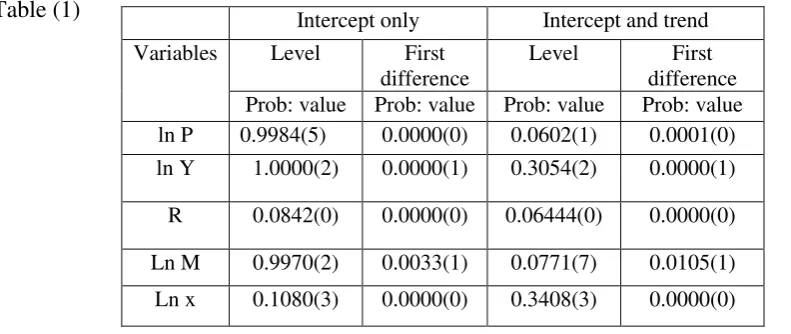
Table shows the ADF test results for both at the level and the first difference on
intercept and intercept and trend.
Table (1)
(Numbers in parenthesis are the number of lags)
The reported result in table reveals that the hypothesis of a unit root can’t be rejected
in all variables in levels. However, the hypothesis of a unit root is rejected in first differences
at 0.05 level of significant which indicates that all variables are integrated of degree one, I(1).
That means all the variables achieve stationarity only after first difference.
Intercept only Intercept and trend
Variables Level First
difference
Level First
difference
Prob: value Prob: value Prob: value Prob: value
ln P 0.9984(5) 0.0000(0) 0.0602(1) 0.0001(0)
ln Y 1.0000(2) 0.0000(1) 0.3054(2) 0.0000(1)
R 0.0842(0) 0.0000(0) 0.06444(0) 0.0000(0)
Ln M 0.9970(2) 0.0033(1) 0.0771(7) 0.0105(1)
[image:6.595.76.472.458.625.2]The estimation of the equation by direct OLS gives the following integration
equation.
P=0.769524+0.031479yt-0.003224Rt+0.307648Mt-0.098304xt
^
(2.937358) (0.662551) (-1.458706) (8.804150) (-2.390108)
(0.0050) (0.5107) (0.1510) (0.000) (0.0207)
Adj R2= 0.994411 F= 2358.394 DW=1.165611
The estimated parameters of equation are in accordance with economic theory. Prime
lending rate and exchange rate have negative parameters while income and broad money has
positive coefficients. All coefficients are statistically significant at 0.05 % level except
income and prime lending rate. Here we have high R2 and t-values, but t is not white noise.
All the variables give the expected result, but the nonstationarity of variable biased the
previous estimation, and the low value of DW can be interpreted as sign of spurious
regression.
The criterion for selecting the lag length consist an important step. There are different
tests that would indicate the optimal number of lags. The study utilizes the SC criterion to
ensure sufficient power of the Johansen procedure.
The next step in our empirical analysis is to test for cointegration. Since the variables
are considered to be I(1), the cointegration method is appropriate to estimate the long run
demand for money. The concept of cointegration is that non-stationary time series are
cointegrated if a linear combination of these variables is stationary. The cointegration
requires the error term in the long-run relation to be stationary. Suppose there are two
variable Yt ad Xt and both Yt and Xt follows I (1) process, Still the linear combination
Ut=Yt - αXt is I (0). If so, both Yt and Xt are said to be cointegrated and a is the cointegrating
parameter. The maximum likelihood approach to test for cointegration is based on the
following system of equations
The number of independent cointegrating vector is equal to the rank of matrix π, If
rank of π = 0; then π is a null matrix and equation turns out to be a VAR model, whereas If
rank of π =1, there is one cointegrating vector and π xt-1 is an error correction term. Johansen
suggests that it can be done by testing the significance of characterizes roots of π.
t i t p
i i t
t x x
x
1
Johansen suggests two test statistics to test the null hypothesis that numbers of
characteristics roots are insignificantly different from unity.
λi = estimated characteristic roots or Eigen values
T = the number of usable observations
λ trace test the null hypothesis
r = 0 against the alternative of r > 0
λmax test the null hypothesis
r = 0 against the alternative of r = 1
The theory asserts that there exists a linear combination of this non-stationary that is
stationary. Solving for the error term, we can rewrite the relation as
t=α- lnYt - Rt -фln εt - lnXt
Since { t} must be stationary, it follows that the linear combination of integrated variables
given by the right hand side of must also be stationary.
Cointegration test result
Unrestricted cointegration Rank test (Trace)
Null hypothesis Eigen Value Trace statistics 5 percent critical value Porb.**
r=0* 0.576467 102.6474 69.81889 0.0000
r≤1*
0.467886 57.97292 47.85613 0.0042
r≤β 0.233837 25.16622 29.79707 0.1556
r≤γ 0.148988 11.31545 15.49471 0.1928
r≤4 0.054722 2.926370 3.841466 0.0871
Unrestricted cointegration Rank test (Maximum Eigenvalue)
Null hypothesis) Eigen Value Max-Eigenvalue 5 percent critical value Porb.**
r=0* 0.576467 44.67449 33.87687 0.0018
r≤1* 0.467886 32.80671 27.58434 0.0097
r≤β 0.233837 13.85076 21.13162 0.3774
r≤γ 0.148988 8.389084 14.26460 0.3405
r≤4 0.054722 2.926370 3.841466 0.0871
(* denotes the rejection of the hypothesis at the 0.05 level. And ** are Mackinnon-Hauge-Michelis (1999) p-values.)
The above table shows that the null hypothesis of no cointegration is rejected at the
conventional level (0.05) and the study conclude that there exists a relationship among the )
ˆ
1 ln( )
1 , (
)
ˆ
1 ( ln )
(
1 max
1
r i n
r i trace
T r
r T r
proposed variables in the long run. Trace test and Eigen value test indicates that there are two
cointegrationg vector.
The normalized cointegration equation is depicted in above table which reveals that
the income and money has a positive effect on inflation. On the other hand, prime lending
rate and exchange rate has a negative. The income coefficient is 0.37 and showing
significant, implying that in India, a one percent increase in income while others keep
constant contributes 0.37% increase in inflation. Similarly the money coefficient is 0.047 and
showing significant, implying that in India, one percent increase in money supply leads to a
5% increase in price level. Interest rate and exchange rate carries expected negative and
significant coefficient.
By specifying the long run determinants of inflation in an error correction model, the
short run as well as the long run effects of all right hand side variables in equation are
estimated in one step, which is a major advantage that error correction modeling has in
comparison to other estimation.
The dynamic relationship includes the lagged value of the residual from the
cointegrating regression ( t-1) in addition to the first difference of variables which appear in
the right hand side of the long run relationship (Y, M, R and X). The inclusion of the
variables from the long run relationship would capture short run dynamics.
The ECM simply defined as
xt t t t t t t mt t t t t t t Rt t t t t t t yt t t t t t t pt t t t t t t X M R Y P x X X M R Y P m M X M R Y P r R X M R Y P y Y X M R Y P p P ) ( ) ( ) ( ) ( ) ( 1 1 1 1 1 1 1 1 1 1 1 1 1 1 1 1 1 1 1 1 1 1 1 1 1
Where, the elements of t s are white noise errors and s are speed of adjustment
parameters and α , , ,ф and are short run parameters. All the variable in the ECε are
stationary, and therefore, the ECM has no problem of spurious regression. Normalized cointegration coefficients
lnP lnY R lnM lnx
1.0000 0.376811
Error correction D(P) D(Y) D(R) D(M) D(X)
Coint Eq1 0.310190 -1.327206 2.406123 -0.041910 -0.322688
Standard error (0.09888) (0.24730) (3.76831) (0.11202) (0.31411)
t statistics [-3.13701] [ 5.36680] [-0.63851] [ 0.37413] [ 1.02731]
The above table shows the speed of adjustment coefficients, which reveals that only
two variables are adjusting. The adjustment coefficient on cointegration equation 1 for the
GDP is negative. The adjustment coefficient for broad money and exchange rate are showing
negative, as it should be, but both adjusting coefficient are showing insignificant. Similarly
adjustment coefficient for prime lending rate is showing positive, as it should be. But the
estimated error correction model enjoys a very low goodness of fit (R2=0.248572, adj R2
=0.0178382). The empirical study is performed by using PC version of Eviews 6.0.
Conclusion
The study used five variables extracting 54 quarterly observations from 1996Q1 to
2009Q2. Since all the variables have unit root at levels the study utilizes Johansen-juselius
cointegration analysis to test for the existence of a long run relationship between the
variables. The cointegrating regression so far considers only the long-run property of the
model, and does not deal with the short-run dynamics explicitly. For this, the error correction
from the long run determinants o0f inflation is then used as a dynamic model to estimate the
short run determinants of inflation. Both the trace test and Eigen value test indicates that there
are two cointegrationg vector. The study concluded that the GDP and broad money have a
positive effect on the inflation in long run. On the other hand, interest rate and exchange rate
has a negative effect. All variables carry expected result. The income coefficient is 0.37 and
showing significant, implying that in India, a one percent increase in income while others
keep constant contributes 0.37% increase in inflation. Similarly the money coefficient is
0.047 and showing significant, implying that in India, one percent increase in money supply
leads to a 5% increase in price level.
References
1. Abidemi, O. I. and εalik, S. A. A. (β010) ‘Analysis of Inflation and its determinant in
Nigeria’, Pakistan Journal of Social Sciences, 7(β), 97-100.
2. Cheng Hoon Lim and δaura Papi(1997) ‘An Econometric Analysis of the
Determinants of Inflation in Turkey’, IεF working paper WP/97/170
4. Dimitorios Asteriou (β010) ‘Applied Econometrics, A εodern Approach Using
Eviews And εicrofit’, Palgrave εacmillan Publication, β006.
5. Gary G. εoser (1995) ‘The εain Determinants of Inflation in Nigeria’ IεF Staff
Papers, Vol. 42, No. 2 (June 1995)
6. Ilker Domaç (1998) ‘The main determinants of inflation in Albania’, World Bank
Policy Research Working Paper No. 1930
7. Juan J. Dolado a, Jesús Gonzalo and Francesc εarmol (1999) ‘Cointegration’,
February, pp 12-19
8. δim, C. H. and Papi, δ. (1997). ‘An Econometric Analysis of the determinants of
Inflation in Turkey’, IεF Working paper no. 170, 1 – 32.
9. δiu, O. and Adedeji, O. S. (β000) ‘Determinants of Inflation in the Islamic Republic
of Iran: A εacroeconomic analysis’, IεF Working paper 1β7, 1 – 28.
10.εosayed, P and εohammad, R. (β009) ‘Sources of Inflation in Iran: An application
of the real approach’, International Journal of Applied Econometrics and Quantitative