NNEMBs at SemEval-2017 Task 4: Neural Twitter Sentiment
Classification: a Simple Ensemble Method with Different Embeddings
Yichun Yin Peking University
Yangqiu Song HKUST
Ming Zhang Peking University
mzhang [email protected]
Abstract
Recently, neural twitter sentiment classi-fication has become one of state-of-the-arts, which requires less feature engineer-ing work compared with traditional meth-ods. In this paper, we propose a simple and effective ensemble method to further boost the performances of neural mod-els. We collect several word embedding sets which are publicly released (often are learned on different corpus) or constructed by running Skip-gram on released large-scale corpus. We make an assumption that different word embeddings cover differ-ent words and encode differdiffer-ent semantic knowledge, thus using them together can improve the generalizations and perfor-mances of neural models. In the SemEval 2017, our method ranks 1st in Accuracy, 5th in AverageR. Meanwhile, the addi-tional comparisons demonstrate the supe-riority of our model over these ones based on only one word embedding set. We re-lease our code1for the method replicabil-ity.
1 Introduction
Twitter sentiment classification has attracted a lot of attention (Dong et al.,2015;Nakov et al.,2016;
Rosenthal et al., 2017), which aims to classify a tweet into three sentiment categories: negative, neutral, and positive. Tweet text has several fea-tures: written by the informal language, hash-tags and emoticons indicate sentiments, and sometimes is sarcasm, which make decisions of tweet senti-ment hard for machines. With releases of anno-tated datasets, more researchers prefer to use the
1https://github.com/zwjyyc/NNEMBs
twitter sentiment classification as one testbed to evaluate their proposed models.
Traditional methods (Mohammad et al., 2013) for twitter sentiment classification use a variety of hand-crafted features including surface-form, se-mantic and sentiment lexicons. The performances of these methods often depend on the quality of feature engineering work, and building a state-of-the-art system is difficult for novices. Moreover, these designed features are presented by the one-hot representation which cannot capture the se-mantic relativeness of different features and pro-poses a problem of feature sparsity. To address this,Tang et al.(2014) induced sentiment-specific low-dimensional, real-valued embedding features for twitter classification, which encode both se-mantics and sentiments of words. In the exper-iments, the embedding features and hand-crafted features obtain similar results, and also they are complementary for each other in the system. With the developments of neural networks in natural language processing, neural sentiment classifica-tion (Severyn and Moschitti, 2015; Deriu et al.,
2016) has attracted a lot of attention recently and become the state-of-the-arts. These methods first learn word embeddings from large-scale twitter corpus, then tune neural networks by the tweets which have distant labels, and finally fine-tune the proposed models by the annotated datasets.
Learning word embeddings using in-domain data is an effective way to boost model perfor-mances (Mikolov et al., 2013; Yin et al., 2016). However, collecting large-scale twitter corpus is often time-consuming. In this paper, we use the different word embedding sets to boost the per-formances of our neural networks, which only in-clude released different word embeddings sets and the word embedding set derived from the released Yelp large-scale datasets by Skip-gram (Mikolov et al., 2013). A simple and effective ensemble
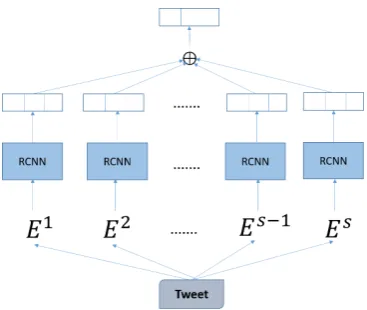
Figure 1: Overview of our method.
method is proposed, which takes different word embedding sets as input to train neural networks and predicts labels of testing tweets by merging all output of neural models. Our ensemble method show its effectiveness in SemEval 2017, though most of used word embedding sets are not learned from twitter corpus, which can be explained that different embedding sets has different vocabular-ies and encode different parts of sentiment knowl-edge. Moreover, we conduct additional experi-ments to analyze our model.
2 Method
In this section, we describe the details of our method, which is illustrated in Figure 1. We feed different word embedding sets into neural net-works and train these neural netnet-works separately. When predicting the labels of tweets in testing set, we sum label probabilities of all neural network to make final decisions.
2.1 Neural Network
We have many choices of neural networks (e.g., LSTM, RNN and GRU) for our method, here we consider RCNN (Lei et al.,2016) in our method. RCNN has non-consecutive convolution and adap-tive gated decay, which aims to capture longer-range, non-consecutive patterns in a weighted manner.
Given a sequence of words which are denoted as {xi}li=1, the corresponding word embeddings {xi}li=1 are derived using the embedding matrix E. Then, RCNN obtains their corresponding hid-den vectors{hi}li=1using the convolution opera-tion and gating mechanism. After obtaining hid-den vectors, RCNN uses a pooling operation to get fixed-sized vector presentation, which is fed
into softmax layer to finish the prediction. Then -gram convolution operation and gating decay are described as follows:
λt=σ(Wλx
t+Uλht−1+bλ), c(1)
t =λtc(1)t−1+ (1−λt)(W1xt),
c(2)t =λtc(2)t−1+ (1−λt)(c(1)t−1+W2xt),
· · ·,
ct(n)=λtct(n−)1+ (1−λt)(ct(−n−11)+Wnxt),
ht= tanh(c(tn)+b),
where Wλ, Uλ, bλ, b and W∗ are learnable
parameters,σ is sigmoid function which rescales the value into (0, 1), is dot product, λt is
gat-ing value determingat-ing how much information of xtand previous patterns is added into the hidden
vector,c(ti)refer to the vector for accumulated pre-vious patterns which are ended withxt include i
consecutive tokens. Whenλt = 0, the
convolu-tion becomes a standardn-gram convolution. We also can build a deep RCNN by adding sev-eral convolution layer on top of hidden vectors derived from the bottom convolution layer. Here we consider the RCNN withdconvolution layers, which outputs{hd
i}li=1. Then, a last pooling oper-ation is conducted on hidden vectors to obtain text representationr. Finally, text representation is fed into a softmax layer. The softmax layer outputs the probability distribution over|Y|categories for the distributed representation, which is defined as:
p(r) =softmax(Wclassk r).
The cross-entropy objective function is used to optimize the RCNN model.
2.2 Prediction
We learn different RCNN models with differ-ent embedding sets as input. Formally, we have s embedding sets which are denoted as {E1,E2,· · ·,Es}, and feed them into s RCNN
Sets
Corpus
Scale Algorithm Dimension Source Vocab
gloveG
General
840B
GloVec
300
R
2.2M
gloveT
27B
GloVec
200
R
1.2M
word2vecGN Google News 100B Word2Vec
300
R
3.0M
word2vecY
Yelp Reviews 0.3B Word2Vec
300
S
0.2M
[image:3.595.89.511.61.155.2]Ensemble
-
-
-
-
-
5.4M
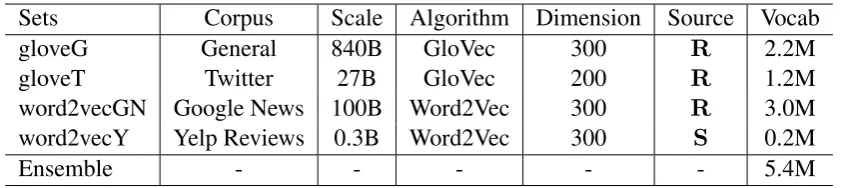
Table 1: Statistics of the embedding sets. Rmeans the embedding set is publicly released andSmeans the embedding set is self-contained. GloVec (Mikolov et al., 2013) and Word2Vec (Pennington et al.,
2014) are most popular embedding algorithms. Scale means the size of tokens in corpus, M and B refer to million and billion respectively. The embedding set word2vecY are trained by Word2Vec with default settings and Yelp reviews are available at https://www.yelp.com/dataset challenge.
Dataset #num #category ratio Previous SemEvals 50032 1.5/4.7/3.8 SemEval 2017 Test 12284 3.2/4.8/2.0
Table 2: Statistics of datasets.
p1 =RCNN1({xi}li=1,E1), p2 =RCNN2({xi}li=1,E2),
. . . ,
ps=RCNNs({xi}li=1,Es), p0 = X
1≤i≤s
pi.
y=argmax1≤i≤|Y|p0i,
whereyis the predicted label.
3 Experiment
3.1 Datasets and Settings
We use 4 embedding sets which are described in Table1. Meanwhile, we crawl and merge all an-notated datasets of previous SemEvals, and split them into training, development, and testing sets with ratio 8:1:1, which are shown in Table 2 to-gether with testing set of SemEval 2017. From the table, we can see that testing set of SemEval 2017 has big differences on the category ratio (nega-tive:neutral:positive), compared with the previous SemEval datasets.
For the model settings, all RCNN models have same configurations but different word embedding sets. We set dimensions of hidden vectors to 250 and depths d to 2. To avoid model over-fitting, we use dropout and regularization as follows: (1) the regularization parameter is set to1e-5; (2) the
dropout rate is set to 0.3, which is applied in the fi-nal text representation. All parameters are learned by Adam optimizer (Kingma and Ba, 2014) with the learning rate 0.001. Note that, all word embed-ding sets are fixed when training. All models are tuned by the development set in Training.
3.2 Results and Analysis
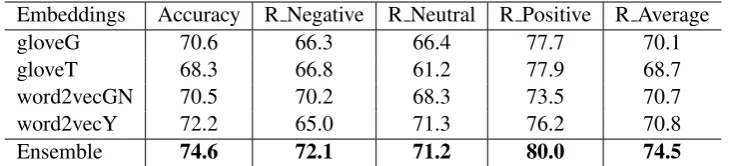
In this section, we first report the results on datasets of previous SemEvals, which are de-scribed in Table 3. Then, we report the perfor-mances of our method on SemEval 2017 in Ta-ble4.
From the Table3, we observe that gloveT per-forms worst though it is trained on in-domain twitter dataset and the word2vecY performs best though it is derived from yelp reviews. As far as we known, Yelp data is constructed by care-fully filtering and is high-quality. Thus, we can include that the quality of corpus is also impor-tant as the size of corpus and domain in twitter sentiment classification. Additionally, we can in-fer that word2vecGN outperforms others in recall of negative category, word2vecY performs best in recall of neutral category, and gloveT is best in re-call of positive category. Different embedding sets propose different characteristics. Additionally, the ensemble method obtains a significant improve-ment of 4%.
Embeddings Accuracy R Negative R Neutral R Positive R Average
gloveG 70.6 66.3 66.4 77.7 70.1
gloveT 68.3 66.8 61.2 77.9 68.7
word2vecGN 70.5 70.2 68.3 73.5 70.7
word2vecY 72.2 65.0 71.3 76.2 70.8
[image:4.595.117.483.62.145.2]Ensemble 74.6 72.1 71.2 80.0 74.5
Table 3: Results on datasets of previous SemEval. R * means recall value.
Embeddings Accuracy R Negative R Neutral R Positive R Average
Best system 65.1 82.9 51.2 70.2 68.1
Median system 61.6 53.1 65.0 67.4 61.8
gloveG 62.9 63.0 61.3 66.7 63.7
gloveT 63.7 70.5 57.4 68.2 65.4
word2vecGN 62.9 68.4 60.0 60.8 63.1
word2vecY 61.6 59.1 63.8 60.5 61.1
[image:4.595.116.486.178.290.2]Our 66.4 69.8 64.0 66.8 66.9
Table 4: Results on SemEval 2017. The median system is the system of rank 19th among 38 teams. worse among these embedding sets, while the
gloveT obtains best performances. Additionally, we can observe that gloveT performs best both in R Negative and R Positive, and word2vecY per-forms best in R Neutral. Compared with the em-bedding baselines, our ensemble method obtains improvements of 2.7% and 1.5% in accuracy and R Average respectively, which demonstrates the effectiveness of the proposed method.
3.3 Error Analysis
In this section, we analyze the incorrect predic-tions of our system in SemEval 2017.
We summarize four kinds of errors in our sys-tem. The first one is that some decisions need do-main knowledge, which our method only can learn from the labeled datasets. The instances are as fol-lows:
Messi’s 100 international goals for Barcelona #fcblive https://t.co/fMkglvusL1 [via @thereis-agenius]. Predicted label: neutral, golden label:
positive
#Trudeau gives your cash to #Terrorist #Hamas-influenced group - #UNRWA - @Can-diceMalcolm https://t.co/5i5o2qwRWl Predicted label:neutral, golden label: negative
Messis 9 goals in CL are more than 20 of the 32 teams in the competition have scored in total, and hes tied with five other sides #fcblivePredicted la-bel:neutral, golden label:positive
The second one is emoticons in tweet, as most of word embedding sets do not include emoticon embeddings and emoticons are always with
senti-Figure 2: Emoticon instances. ments. The instances are described in Figure2
The third one is that sentiments are not consis-tent in sentences. For example, the first half part is positive, while the second half part is negative, in this case, our system would predict ’positive’ or ’negative’, the golden label is neutral.
@jimmyfallon 1. Emily 2. Michel 3. Kirk 4. TJ. Love the quirky ones and Emily coz she’s such a BIATCH! #gilmoregirlstop4. predicted label posi-tive, golden label:neutral
The fourth one is the sarcasm, such as: #Hamas leader: #Trump may be a #Jew https://t.co/jGFZTvj2pF.predicted label positive, golden label:negative
4 Conclusion
References
Jan Deriu, Maurice Gonzenbach, Fatih Uzdilli, Aur´elien Lucchi, Valeria De Luca, and Mar-tin Jaggi. 2016. Swisscheese at semeval-2016 task 4: Sentiment classification using an en-semble of convolutional neural networks with distant supervision. In Proceedings of the 10th International Workshop on Semantic Evalu-ation, SemEval@NAACL-HLT 2016, San Diego,
CA, USA, June 16-17, 2016. pages 1124–1128.
http://aclweb.org/anthology/S/S16/S16-1173.pdf. Li Dong, Furu Wei, Yichun Yin, Ming Zhou, and
Ke Xu. 2015. Splusplus: A feature-rich two-stage classifier for sentiment analysis of tweets. SemEval-2015page 515.
Diederik P. Kingma and Jimmy Ba. 2014. Adam: A method for stochastic optimization. CoRR
abs/1412.6980. http://arxiv.org/abs/1412.6980. Tao Lei, Hrishikesh Joshi, Regina Barzilay, Tommi S.
Jaakkola, Kateryna Tymoshenko, Alessandro Mos-chitti, and Llu´ıs M`arquez. 2016. Semi-supervised question retrieval with gated convolutions. In
NAACL HLT 2016, The 2016 Conference of the North American Chapter of the
Associa-tion for ComputaAssocia-tional Linguistics: Human
Language Technologies, San Diego
Califor-nia, USA, June 12-17, 2016. pages 1279–1289.
http://aclweb.org/anthology/N/N16/N16-1153.pdf. Tomas Mikolov, Ilya Sutskever, Kai Chen, Gregory S.
Corrado, and Jeffrey Dean. 2013. Distributed representations of words and phrases and their com-positionality. In Advances in Neural Information Processing Systems 26: 27th Annual Conference on Neural Information Processing Systems 2013. Proceedings of a meeting held December 5-8,
2013, Lake Tahoe, Nevada, United States.. pages
3111–3119. http://papers.nips.cc/paper/5021- distributed-representations-of-words-and-phrases-and-their-compositionality.
Saif Mohammad, Svetlana Kiritchenko, and Xiaodan Zhu. 2013. Nrc-canada: Building the state-of-the-art in sentiment analysis of tweets. In Proceed-ings of the 7th International Workshop on Semantic Evaluation, SemEval@NAACL-HLT 2013, Atlanta,
Georgia, USA, June 14-15, 2013. pages 321–327.
http://aclweb.org/anthology/S/S13/S13-2053.pdf. Preslav Nakov, Alan Ritter, Sara Rosenthal, Fabrizio
Sebastiani, and Veselin Stoyanov. 2016. Semeval-2016 task 4: Sentiment analysis in twitter. In Pro-ceedings of the 10th International Workshop on Se-mantic Evaluation, SemEval@NAACL-HLT 2016,
San Diego, CA, USA, June 16-17, 2016. pages 1–18.
http://aclweb.org/anthology/S/S16/S16-1001.pdf. Jeffrey Pennington, Richard Socher, and
Christo-pher D. Manning. 2014. Glove: Global vectors for word representation. In Proceedings of the 2014 Conference on Empirical Methods in Natural Lan-guage Processing, EMNLP 2014, October 25-29,
2014, Doha, Qatar, A meeting of SIGDAT, a
Spe-cial Interest Group of the ACL. pages 1532–1543.
http://aclweb.org/anthology/D/D14/D14-1162.pdf. Sara Rosenthal, Noura Farra, and Preslav Nakov. 2017.
SemEval-2017 task 4: Sentiment analysis in Twit-ter. InProceedings of the 11th International
Work-shop on Semantic Evaluation. Association for
Com-putational Linguistics, Vancouver, Canada, SemEval ’17.
Aliaksei Severyn and Alessandro Moschitti. 2015.
UNITN: training deep convolutional neural network for twitter sentiment classification. In Proceed-ings of the 9th International Workshop on Seman-tic Evaluation, SemEval@NAACL-HLT 2015, Den-ver, Colorado, USA, June 4-5, 2015. pages 464–469.
http://aclweb.org/anthology/S/S15/S15-2079.pdf. Duyu Tang, Furu Wei, Nan Yang, Ming Zhou, Ting
Liu, and Bing Qin. 2014. Learning sentiment-specific word embedding for twitter sentiment clas-sification. InProceedings of the 52nd Annual Meet-ing of the Association for Computational LMeet-inguis- Linguis-tics (Volume 1: Long Papers). Association for Com-putational Linguistics, Baltimore, Maryland, pages 1555–1565. http://www.aclweb.org/anthology/P14-1146.
Yichun Yin, Furu Wei, Li Dong, Kaimeng Xu, Ming Zhang, and Ming Zhou. 2016. Unsu-pervised word and dependency path embeddings for aspect term extraction. In Proceedings of the Twenty-Fifth International Joint Conference on Artificial Intelligence, IJCAI 2016, New York,
NY, USA, 9-15 July 2016. pages 2979–2985.