• No results found

CRAYON G1 A Code for the Calculation of the irradiation Behaviour of Fuel Rods EUR 4255

N/A
N/A
Protected

Academic year: 2020

Share "CRAYON G1 A Code for the Calculation of the irradiation Behaviour of Fuel Rods EUR 4255"

Copied!
50
0
0

Loading.... (view fulltext now)

Full text

(1)

m

i«i ι:

EUR 4

î . n n ' f f ' i i l

mmm

JMRw

km.

EUROPEAN ATOMIC ENERGY COMMUNITY — EURATOM

JÌBK?f

A Y

°

N

flu

| S i | | c O D E FOR THE CALCULATION

,__1' 'HE IRRADIATION BEHAVIOUR OF FUEL RODS

•ili!

B

•■•sBi'Ä'i '

H

il»'ÌM

FANTOZZI and Β. HUBER

IfifXLK

I

it.*­:!

m

ivm&

m

rilJM

m

1969

Jtfí

S?iåi

ORGEL Program

Foint Nuclear Research Center

spra Establishment - Italy

(2)

This document was prepared under the sponsorship of the Commission

of the European Communities.

Neither the Commission of the European

nor any person acting on their behalf:

aities, its contractors

Make any warranty or representation, express or implied, with respect

to the accuracy, completeness, or usefulness of the information contained

in this document, or that the use of any information, apparatus, method,

or process disclosed in this document may not infringe privately owned

rights; or

fl!

J i o ä u i u i .

any

liauLULJ W i m lrapCLL l u UIC U»C UI, UI J.UI

WUUägCS

ICSU-lLUlg

from the use of any information, apparatus, method or process disclosed

in this document.

mm

fewiip

;

This report is on sale at the addresses listed on cover page 4

WBsm

at the price of FF 6.

FB 60.-

DM 4.80

Lit. 750

Fl. 4.30«Wj

3

NUtfc

When

ordering, please quote the EUR number and the title,

which

are indicated on the cover

of each

report.

iliiijwilil

lillui

(ffi

Printed by Van Muysewinkel

•fpnyg-

Bru5sels

'

April 196

m m

Ì

liisiP

ÍWm

S iS^SPf>íaffili -S

^1*·

:

ΐί

ι

δ·

m

HU

c l 3

- Γ

• ■i-

* ·.-*«'. ì*r*S3fn ^i Tìrir r Τ

Ιΐτπ It'

L·!

^Β4 ιίί T J A I 3 B I '

V Ì I ' ' M '

1

*JÌ^E^

·**·,

* ì^Jtì·*!·*· - 'sin»n

(3)

EUR 4255 e

CRAYON G 1 — A CODE FOR THE CALCULATION OF THE

IRRADIA-TION BEHAVIOUR OF FUEL RODS, by M. FANTOZZI and B. HUBER

European Atomic Energy Community — EURATOM

ORGEL Program

Joint Nuclear Research Center — Ispra Establishment (Italy)

ORGEL Project

Luxembourg, April 1969 — 44 Pages — 5 Figures — FB 60

The code CRAYON G 1 calculates the evolution of the following

charac-teristics of a cylindrical gas-bonded fuel rod during irradiation: fuel temperature

and swelling, fission gas release and pressure, sheath stress and strain. The

relations utilized in the code are exposed.

For the ORGEL fuel element (SAP-clad uranium carbide), material properties,

being input data for the code, are given.

The constants concerning the irradiation behaviour of uranium carbide have

been adjusted by application of the code to the irradiation experiment NRX-721.

EUR 4255 e

CRAYON G 1 — A CODE FOR THE CALCULATION OF THE

IRRADIA-TION BEHAVIOUR OF FUEL RODS, by M. FANTOZZI and B. HUBER

European Atomic Energy Community — EURATOM

ORGEL Program

Joint Nuclear Research Center — Ispra Establishment (Italy)

ORGEL Project

Luxembourg, April 1969 — 44 Pages — 5 Figures — FB 60

The code CRAYON G 1 calculates the evolution of the following

charac-teristics of a cylindrical gas-bonded fuel rod during irradiation: fuel temperature

and swelling, fission gas release and pressure, sheath stress and strain. The

relations utilized in the code are exposed.

For the ORGEL fuel element (SAP-clad uranium carbide), material properties,

being input data for the code, are given.

(4)
(5)

EUR 4255 e

EUROPEAN ATOMIC ENERGY COMMUNITY — EURATOM

C R A Y O N G l

A CODE FOR THE CALCULATION

OF THE IRRADIATION BEHAVIOUR OF FUEL RODS

by

M. FANTOZZI and B. HUBER

1969

ORGEL Program

Joint Nuclear Research Center

Ispra Establishment - Italy

(6)

ABSTRACT

The code CRAYON G 1 calculates the evolution of the following

charac-teristics of a cylindrical gas-bonded fuel rod during irradiation: fuel temperature

and swelling, fission gas release and pressure, sheath stress and strain. The

relations utilized in the code are exposed.

For the ORGEL fuel element (SAP-clad uranium carbide), material properties,

being input data for the code, are given.

The constants concerning the irradiation behaviour of uranium carbide have

been adjusted by application of the code to the irradiation experiment NRX-721.

KEYWORDS

C-CODES

RADIATION EFFECTS

FUEL RODS

TEMPERATURE

SWELLING

FISSION PRODUCTS

GASES

PRESSURE

STRESSES

STRAIN

(7)

Index

1. Introduction

2. Calculation procedure

4. Sheath stress

X X

X

Acknowledgement

References

Table

Figures

Page

5

7

3« Temperature

3·1« Sheath temperature 3

3.2. Heat transfer in the gap 3

3·3·

Fuel temperature g

12

4.1. Maximum mechanical stress 12

4.2. Average mechanical stress 13

4.3· Thermal stress 14

5« Dimensional variations ]c

5.1. Thermal expansion ]c

5·2. Irradiation swelling of fuel 16

5»3'

Fuel-sheath clearance and sheath deformation I7

6. Bonding gas ,q

6.1. Fission gas release 19

6.2. Conductivity of bonding gas 20

6.3. Pressure of bonding gas 21

7. Properties of fuel and sheath 23

7*1. Relations 23

7.2. Constants for UCand SAP 24

8. Adjustment of constants 26

8.1. The NRX-721 experiment 26

8.2. Application of X-721 data to the code 26

8.3. The adjustment calculation

27

8.4. New data 29

(8)
(9)

5

-CRAYON G 1

A CODE FOR THE CALCULATION OF THE

IRRADIATION BEHAVIOUR OF FUEL RODs(*)

1. Introduction

The code CRAYON Gl calculates the irradiation behavior

of a fuel rod. It gives in the main the evolution of the

follow-ing characteristics durfollow-ing fuel element service:

- fuel and sheath temperatures;

- irradiation swelling of fuel;

- fission gas release and gas pressure;

- sheath stresses and deformations.

The objectives of the code CRAYON are:

- to yield a better insight of what happens in a fuel

element ;

- to predict the failure of fuel elements;

- to clarify the influence of design characteristics and

working conditions in order to contribute to a better

optimization of the reactor.

The code CRAYON was made for application to the fuel

element of the ORGEL reactor* This fuel element consists of UC

rods sheathed with SAP. However, general relations are utilized

to describe physical properties and irradiation behavior; the

material constants to be filled in these relations are input

data. Consequently, the code may be employed also for other

materials than UC and SAP.

(10)

- 6

Generally, the code applies to the following conception

of a fuel rod:

- full cylindrical fuel ;

- gaseous bonding'*^;

- plain or finned, virtually free-standing'

2

) sheath.

The operating conditions of the fuel rod can be changed

step-wise during the calculation procedure, in order to simulate

reactor power variation, fuel element shuffling or fuel degradation.

The following principal idealizations are employed for

temperature calculation:

- temperatures are taken symmetrical with respect to rod

axis ^ J ;

- axial hrat transfer in the rod is neglected;

- steady-state equations are employed·

The utilization of steady-state equations for temperature

calculation means that the code does not apply to very rapid

transients. However, for a 2 cm-diameter UC/SAP rod, the error

in fuel temperature will be less than 10°C if the coolant

temperature transient does not exceed l°C/s. The calculable

transient is the more rapid as the rod is smaller.

A parametrical study by means of the code CRAYON is given

in

¿~2.1 J .

(1) A similar code has been made for liquid metal bonding: Code

CRAYON L 1.

(2) "Virtually free-standing" is to say that sheath is not

collaps-ing under coolant pressure; this does not exclude forced

contact with fuel.

(11)

2. Calculation procedure

The fuel length is divided into n equal sections· The

operation time is divided into a series of "positions" of given

duration. Along each section and during each position, the

operating conditions (input data o¿ , q, T

c

, Pe, Q) are taken

constant.

The duration of each position is divided into small time

increments A t . During each time increment, all values are

taken constant.

The code has been programmed on the 36O-IBM computerò

3« Temperature

Starting from the given coolant temperature, the

calculation proceeds from the outside to the center of the rod.

Except for gap width, the initial cold dimensions (r , r , r )

1 «

J

can be employed for temperature calculation.

(12)

3 . 1 . Sheath temperature

Outer surface temperature;

Τ = Τ +

n

_

a

j

, ( 1 )

1 c 2Tfr

ί

/"γ

ί

Inner surface temperature:

To

=

T,

-

Λ τ

·

Γ ΐ r 2

(2)

2 1 'Π' k r,

+

r-s 1 2

Average sheath temperature:

Τ + Τ

T

3

"

^ T ^

(3)

3.2. Heat transfer in the gap

Radiation heat flux is negligible compared to total heat

flux, even for large temperature differences between fuel and

sheath. For instance, if fuel surface is at 1000°C and sheath

at 450°C, radiation heat flux is about 0.7 W/cm .

The calculation of the code is based on conventional

heat conduction in the bonding gas. In the case of contact

between fuel and sheath, an hypothetical gas layer of uniform

thickness

£

is assumed. This means, theoretically, that heat

transfer by direct solid contact is neglected and that gap

width is considered large compared to the mean free path of gas

molecules. In practice, the assumption of hypothetical gas layer

is to be considered as a mathematical model with the thickness to

be adjusted according to irradiation results.

(13)

-

9-A more sophisticated and physically truer model - as given

in the literature

¿~lj

/~"

z

_7

£$J

Z~\-7 Z~5_7 "

m a

Y

b e

employed

when the constants utilized in these models will be known more

exactly than now.

As the temperature difference between fuel and sheath

in the case of contact is

not very large, its present rather

rough calculation does not degrade the

validity of the final

results of the code.

The temperature Τ at any point of the gap

is given by the

equation:

!

with:

0

é

j

r

έ

3*

where j is the distance from the inner surface of sheath.

r

U t i l i z i n g equation (59) for thermal conductivity k , one

y

obtains from ( 4 ) :

Τ - T . =

-%

— .

■=>

>

q

χ . j

(5)

2

C.

ΤΓ (r +r )

r

1

Λ J

3·3·

Fuel temperature

"From (5) one obtains with j

= j * for the fuel surface

r

temperature Τ :

C +1

C

0

+l

C_+l

T

2

_

T

2

_

2

g

j

. -j*

( 6 )

T

3

T

2

~ C '

«

(rl+r.)

3

l

° '

(14)

10

This equation cannot be resolved independently, since the

gap width j* depends on Τ , because of the thermal expansion of

the fuel.

For calculation of the gap width, see section 5*3*

The distribution of heat generation within the fuel/ 6__/

¿_ 1_J

may be expressed by:

q = q

I (Kr)

(7)

V

V O

o

E l i m i n a t i n g q

by t h e c o n d i t i o n of h e a t b a l a n c e

vo

(

3

"J

= /

2 ^ r q

d r = 2 l f q

-rf-

I . (K r , )

( 8 )

J

v

vo K

1

3

one o b t a i n s :

I

(Kr)

g

K

o

q

v

= r-=Vr .

2rf

r

3

1^ (Kr )

( 9 )

The t e m p e r a t u r e d i s t r i b u t i o n i n t h e f u e l f o l l o w s t h e

F o u r i e r e q u a t i o n :

7

d7

( k

f

r

d7

) =

- %

( 1 0 )

From (9) and (10), one obtains by integration:

J

k

f

dT

-

fcf

*

\

<">

with

I (Kr,) - I (Kr)

"

3

o

- . I (Kr

(15)

- 11

Taking thermal c o n d u c t i v i t y of f u e l independent from

temperature, one obtains the following temperature d i s t r i b u t i o n :

T = T

3

+

k 7 ' 4 H

(13)

The f u e l c e n t e r temperature T, i s :

4 =

Τ

3 ^ · ^ Γ

V

τ, =

(14)

with

*

= 2

Io (Kr ) - 1

Kr, I

(Kr,)

3

1

3

(15)

The medium temperature, averaged on the fuel section, is:

Τ

= Τ

f

3

+

t

t

'h?'ì"

(16)

with

ξ'

Kr,

lo

( K r

3

)

^ _

l

t

(Kr~) " Kr

3

(17)

The equations ( l 4 ) and ( l 6 ) are employed in the code;

f' and fc" are input data which may be obtained from F i g . 1,

knowing e i t h e r F or Kr .

o

3

Generally, the s e l f - s h i e l d i n g c o e f f i c i e n t F i s given

from neutron c a l c u l a t i o n .

F i s defined as the r a t i o of average

o

heat generation d e n s i t y in the fuel t o heat generation d e n s i t y

at t h e fuel surface and i s expressed by:

o

Kr,

I ( K r , )

3

o

3

(16)

­ 12

If the neutron flux depression is small, K may be calculated

with sufficient accuracy from

κ

= ψ ε . <

- 1 ε.)

(»)

(1)

4. Sheath stress

4.1. Maximum mechanical stress

As a criterion for the failure of the end plug weld, the

axial stress <y* at the ends of the rod is calculated.

Since

a

the fins are often removed at the ends of the rod, the calculation

is based on the tube section without fin section.

It is supposed

that there is no forced contact between fuel and end­plug.

P. If r

­ Q

«­a

\

.

\

2.

·

( 2 0 )

' (r. ­r_ )

As a criterion for sheath failure, the tangential stress

(5* between fins is calculated.

Only the difference between

internal gas pressure and external coolant pressure is taken into

account.

If there is forced contact between fuel and sheath,

the plastic deformation of sheath will be considered as an

additional rupture criterion.

Γ

2

­2

«Λ = - — J

(ρ - ρ ) . 10

(21)

t

r ­r

ι

e

(17)

­ 1 3 ­

4.2. Average mechanical stress

These stresses are used in the later calculation to

evaluate the overall elastic deformation of sheath.

For the calculation of axial stress Ç" , it is again

a

supposed that there is no forced contact between fuel and end ­

plug.

No ratcheting effect is taken into account.

The tangential stress G", will only be used in the later

calculation if there is no forced contact between fuel and sheath.

General equations

P

i

Tf

r

2

-

Q

- 2

6" = - i

1

. 10

*

(22)

a

S

/ ­

2

where S

¿_

cm

'_/

i s t h e c r o s s - s e c t i o n of s h e a t h

't ■

ÏÏV

/ " t e

·

de

(23)

with:

^

=

έ2

. (p.­p ) χ 1 0 "

2

(24)

tO

r

6

­ r

2

ι e

where r„ / cm / is the radius of outer profile of sheath, dependent

θ —

on a

ngle θ

£~-7

·

Though this calculation of c* is a rather rough

(18)

14

Equations for rectangular fins:

By application of the given

general equations to fins

of rectangular cross­section,

the following equations are

obtained, which are employed

in the code:

P¿ If r

2

- Q

/

2

2

,

1

(r„ ­ r. + 2 r. .d

1

2

1

e

1 +

e

2

10

­2

■> Tt

(25)

ftl ·

e

i

+

"t *

e

2

e

l

+ e

2

(26)

with:

tl

2

,

»

„ ­2

. (p ­ ρ ) . 10

r„ ­ r„ + α

ι

e

(27)

4.3« Thermal stress

The stress due to the radial temperature gradient is

calculated.

For simplification, the formula for plain sheath

and elastic deformation is employed.

The stress occurs in axial

and tangential direction and is positive (tensile) at the outer

and negative (compressive) at the inner surface of sheath.

th (­)

T

~

­

T

D

\

(19)

­

15­

5» Dimensional variations

5.1. Thermal expansion

Thermal expansion of sheath:

£ = (Τ ­ Τ ) . λ

(

2

9)

s

s

a

s

The thermal expansion of fuel depends on cracking of fuel:

Case A

There are no open cracks in the fuel.

In this case,

local thermal expansion has to be averaged over the fuel

section, in order to get overall expansion:

[

r

3

£ =

^-r

I

\ ^

(T­T ) 21fr dr

(30)

ι

„ * ν

f

a

Jtr,

o

Case Β

Fuel is completely cracked, so that all thermal stresses

in the fuel are relaxed.

In this case, thermal expansion

has to be averaged over the fuel radius:

t

f

= ­i

/

λ , (T­T ) dr

(31)

f

r

3

J

o

f

a

If the expansion coefficient λ. is taken independent of

radius, one sees from equations(30) and (31) that fuel expands

as if being at uniform temperature Τ :

. 6, = λ (τ­τ )

(32)

f

f

f a

with

r

■Λ

ƒ

Τ = - ~ / Τ r dr

(33)

(20)

16

in the case A (T = fuel temperature averaged on fuel section),

and with

O

τ =

- i

T dr

(34)

in the case Β (Τ = fuel temperature averaged on fuel radius) ~ .

In the code, case A is assumed.

Τ is calculated from

equation (l6) which is obtained from equation

(33)

by integration,

5.2. Irradiation swelling of fuel

The swelling behavior of UC is generally described by the

ratio R of diameter increase to burn­up, this ratio depending on

the fuel center temperature and on the nature of UC (porosity,

stoichiometry)

¿~&_J L^J

L

1 0

J

S = R

( T }

. f

(36)

This implies the assumptions that:

­ swelling at constant fuel temperature increases linearly

with burn­up;

­ swelling is independent of fission rate;

­ swelling depends only on fuel center temperature, but not

on the radial temperature profile.

The last assumption is evidently a rather rough

approximation.

If, however, for simplification, only one para­

meter is used to describe temperature dependence of swelling,

the center temperature is likely the most significant parameter.

(l) For uniform heat generation, one would obtain:

T

3 *

T

4

^f

=

o

f 0 r

c a s e

*

Τ + 2 T

4

(21)

- 17

Swelling is assumed to be isotropic, i.e. percentage

diameter and length increases are equal.

The temperature dependence of given swelling data can be

described by a formula of the type:

R

(T

4

) »

C

l

+ C

2

***

(

- T ^

( 3 7 )

where the first term on the right side may be interpreted as to

stand for solid fission product accumulation and the second term

for the action of fission gases«

Equation (36) applies only to constant fuel temperature;

no correlation is known for variable temperature. The assumption

is made here, that equation (36) may be extended to variable fuel

temperature by the formula:

s = /

R, , . dr

(38)

"o

< V

with equation (37), one obtains the formula used in the code:

.

y

t

♦ c,

exp

( - S i )]

t

.

J

S =

Y

\C

A

+

C

0

exp Í - -i )¡ . . Af.

(39)

3'3·

Fuel - Sheath clearance and sheath deformation

It is supposed that no plastic deformation of sheath

occurs in axial direction.

The axial clearance between fuel and

end-plug is then:

(22)

18 ­

Plastic deformation of sheath in tangential direction is

supposed to occur if the deformation imposed by forced contact

with fuel exceeds the elasticity limit (ζ .

In order to decide

if there is contact between fuel and sheath, the radial clearance

is calculated, which would exist without mechanical interaction

of fuel and sheath:

¿o

= j + £

s

r

2

+ A r

m ­

( £

f

+ S )

*

r

3

(41)

with:

Ar

= Δ Γ

+ (Ar ). ,

m

e

ρ j­1

r

i

+ r

2

(St

­Vtfi

E

(42)

(43)

where ( Δ Γ )

.

is the plastic deformation of sheath, occurred

Ρ J­1

during the previous fuel operation.

The following three cases must be distinguished:

.

No c o n t a c t

j

0

-

i>o

j

* =

j

o

Δ

Γ

= ( Δ Γ ) . „

ρ

ρ j - 1

C o n t a c t , but no new

p l a s t i c d e f o r m a t i o n

oi-j - £»¿r - ^

1

2

0

e

J

2

j * =

i

&r

= ( Δ

Γ

) . .

Ρ

Ρ

J - I

C o n t a c t and new

p l a s t i c

d e f o r m a t i o n

Δ Γ

- 3

Γ ΐ + Γ 2

> ^ ο - *

e

2

j * =

Í

~

r „ + r „

T

=

£ . ^

1

2

+ Δ Γ

ρ

2

ο

π

/ ­ \

(23)

­

19­

6. Bonding gas

6.1. Fission gas release

The fission gas production at unit fission energy production

is:

A =

TJr

Z

*s

( 4 7 )

with:

E' = 200 MeV/fission = 3,2 χ I O

­ 1 1

Wsec/fission

E

y

s = 0.254

/"llj

7

one obtains:

A = 3.24 χ ΙΟ"

10

φ™

= 28 a i î S E

W.sec

MWd

The fission gas production in one fuel section is then:

,

J

G = y . A o

- T~

q. Δ*

(48)

η

fa

j

j

The c a l c u l a t i o n of f i s s i o n gas r e l e a s e i s based on Booth's

d i f f u s i o n model / ~ 8 _ 7

12

-7

/T^J*

I f

f i s s i o n production r a t e

and d i f f u s i o n c o e f f i c i e n t are i n v a r i a b l e with time, the f r a c t i o n

of r e l e a s e d t o produced gas i s :

'-*

Ίψ-ί"*

(49)

Generally, fission gas production rate and diffusion

constant are variable with time. As an approximation,equation

(39) wi-11 be employed with a time-averaged diffusion coefficient:

(24)

20

From (39) and ( 4 0 ) , one o b t a i n s :

f = 4

i l · ΣΙ

° ·

Δ ΐ

·

-1« fa

ο α

\ Υ

2 *-= ι

D'. Δι

(51)

j = i

In order t o take i n t o account t h e r a d i a l v a r i a t i o n of

fuel t e m p e r a t u r e , a t h r e e - p o i n t Simpson's r u l e i s a p p l i e d

¿_

12__/:

* ­ *

f ( T ) + 4 f ( T

f

)

+ f ( T

4

)

(52)

The fission gas release from the whole fuel rod is:

η

F

=y

G. f.

f—-,

ι

ι

(53)

ι=χ

6.2. Conductivity of bonding gas

Experimental results show that, within the range of

interest, the thermal conductivity may be considered as independent

of pressure

¿_

l4_/. The conductivity of an inert monoatomic gas

is (see

/_

15_7 Ρ·8):

k

=

g

1 . 9 8 0 1 χ I O "

^ 2

( 2 , 2 ) *

4

fl

fi

/ " c a l / c m s e c

°K_J

(54)

One s e e s from F i g . 2 t h a t , for t h e g a s e s and t e m p e r a t u r e s

of i n t e r e s t , t h e reduced c o l l i s i o n i n t e g r a l can be approximated

by t h e r e l a t i o n :

n

( 2 , 2 ) *

= 1.1575 ( T * ) "

0

'

1 4 7 5

(55)

where ^ " 1 6 7 :

K

B

X* = —- τ

ε*

(25)

with

- 21

Gas

Ar

Xe

Kr

He

ε*/Κ„ =

119.9

10.22

164.7

206.9

o

Utilizing these relations, one obtains from equation (54)

C2

k

= e . . Τ

W/cm °K

(57)

Gas

Ar

Xe

Kr

He

c . χ 10

4.8682

2.7192

1.7068

37·634

c = 0.6475 (independent of the nature of gas)

2

The conductivity of a gas mixture is ¿f~17_7:

k = 0.5 ( E k

fi.

+

­ , Λ

)

(58)

a

i

From equation (57) and ( 5 8 ) , one o b t a i n s :

k

= c . T

C 2

(59)

■ι

= 0

·

5 (

Σ : ° Ι Χ A

+

y//

i—

'

1 C„ .

- )

(60)

l i

It is assumed that the fission gas is 84.5% Xe and 15 «5% Kr

6.3. Pressure of bonding gas

The quantity of bonding gas is:

Η = Η + F

(61)

(26)

­ 2 2 ­

The state of the gases being far from critical point, the

Boyle­Marioette's law can be applied.

For non­uniform temperature,

it is :

p.

f ^

=

3.78.ΙΟ"

3

H

(62)

where dV is a volume element at temperature Τ and the integral

has to be taken over the whole disposable space in the rod.

For the radial gap of one axial section, one obtains with

dV = ì

«

(r

2

+ r ) d j

r

and (from equation (5) by differentiation)

Τ

2

dT = —

.

, ,

q

d j ^

C

l

^

( r

2

+ r

3 )

r

the equation:

— = η '—

( r

2

+ r

3

)

C

l

T

d T

and, integrating from Τ to Τ :

2

3

"dV

I *

2

,

2

C

l

/fp

°2

„,

C

2

N

,,„.

T = ñ ­

( r

2

+ r

3

)

C ¡

( T

3

­

T

2

>

( 6 3 )

gap

The gas plenum at the top of the rod is;

V. = V + j *

ft r

02

(64)

t

ρ

a

2

Its temperature is supposed to be:

Τ + Τ

T

t =

(

2

C

<

6

5 >

(27)

2 3 ­

F u r t h e r m o r e , a chamber beyond t h e rod w i t h t h e volume V

c

and the temperature equal to the coolant temperature at the upper

rod section may be taken into accounts

With these volumes, one obtains from equation (62) the

pressure of the bonding gas:

p. =

3.78.10"

3

. H

( 6 6 )

ι

v. v

n

t

'c

V "

/ dV

T

+ +

(T )

+

¿ —

/ τ "

t

c .

i=l

d

i=n

gap

7« Properties of fuel and sheath

7«1. Relations

Thermal conductivity

The thermal conductivities of fuel and sheath are

considered to be independent of temperature.

Thermal expansion coefficients

It is supposed that the average expansion coefficients

between O °C and T °C are:

T

fuel:

X

f

9

1

+ 9

2

T

T

sheath:

X

s

=

a

!

+ a

2

T

o

The average expansion coefficients between ambient and

operation temperature are then:

X

f

= g

1

+ g

2

(τ* + τ*)

(67)

y = a„ + a

0

(T* + T*)

(68)

(28)

24­

The true expansion coefficient of sheath is:

,

d (g Τ« ♦ g Τ*

2

)

>.

» .

'

■ «ι '

2

«a

T

J

( 6 9 )

S

Mechanical properties of sheath

Young's modulus:

E = b„ ­ b. Τ

(70)

1

2 s

Mechanical resistance:

R* = h + h. Τ + h

0

Τ

2

(71)

1

2 s

3 s

R* is employed for the calculation of the security

coefficient against sheath rupture.

Apparent diffusion coefficient of fission gases in the fuel:

D' = D¿ exp ( ­ | £ )

(72)

7.2. Constants for UC and SAP

The constants given here, being input data, can be changed

without changing the code.

The constants concerning the irradiation behavior of UC

have been adjusted to irradiation data of SAP­clad UC rods (see

section 8 ) .

By that means, the error due to simplified calculation

models and inexact constants is minimized, because the different

(29)

25

Consequently, a set of so adjusted constants is to be

considered as an assembly of which no constant may be changed

independently. If, for instance, the thermal conductivity

would be changed, swelling and diffusion constants would have

to be re-adjusted·

The following list gives the values used for

cast near stoichiometric UC and for SAP

7%'.

Thermal conductivities

k

f

= 0.173 W/cm °C (see s e c t i o n 8)

k = 2 . 0 3 W/cm °C

¿~

19

-7

Thermal expansion c o e f f i c i e n t s :

g

a

= 9.8 . I O

- 6

g

2

= 1.3 . i o "

9

L ^ J

a = 20.38 . 1 0 " a

2

= 9 . I O

- 9

L ^ J

Young's modulus of SAP

¡_

19_7 *

b

t

=

8950 b

2

= 5.925

Mechanical resistance of sheath

The creep rupture resistance is utilized

¿_

19_/

h„ = 5O.I5 h = - O.IO7 h =6.2 . 10~

5

1

2 3

Apparent diffusion coefficient (see section 8)

D' = 0.0045 sec"

o

1

*

(30)

26

Irradiation swelling of UC (see section 8)

C„ = 7 x 10"

7

tU/MVd C. = 1.8 χ 10"

3

tU/MWd C, = 11000 °K

1

2 3

8. Adjustment of constants

There was considerable uncertainty about some constants

concerning the irradiation behavior of UC. These constants were

adjusted by application of the code to the data of the NRX-721

experiment.

8.1. The NRX-721 experiment /~20_7

This experiment was chosen because it was the most

representative one for the conception and the operating conditions

of ORGEL fuel elements.

The NRX-721 rods consist of cast uranium carbide fuel

(l4 mm diameter, I80 mm length), argon bonding and finned SAP

sheath.

In phase I, eight rods were irradiated up to a maximum

burn-up of 8,000 MWd/t. After non-destructive examination, half

of these rods were irradiated in phase II, together with two new

rods containing central thermocouples. This second phase was

terminated after indication of a sheath rupture at a maximum

burn-up of 11,000 MWd/t.

8.2. Application of X-721 data to the code

(31)

2 7

-believed that free uranium metal enhances irradiation swelling,

the rods FMA, FMF and FMR were not considered for the adjustment

calculation.

The variation of irradiation conditions - as coolant

temperature, heat rating, etc. - being small along each rod, the

calculation was done with length-averaged values.

Time-averaged values were employed for each of the

irradiation phases I and II. After each irradiation phase, a

cold phase - with zero-power and 45°C temperature - was included

into the calculation, in order to take into account the fuel/

sheath interaction, due to different thermal expansion, which

may occur between irradiation and examination.

8.3» The adjustment calculation

The criteria for the adjustment of code constants were

that experimental values and calculated values of the following

parameters were as near as possible:

Linear irradiation swelling of fuel (

A D / D ) .

l/3 of

volumetric swelling from post-irradiation data was taken

as reference. This value showed less scatter than

dimensional measurements and was therefore thought to be

more reliable.

Diameter change of sheath.

Fission gas release.

Question was of the following constants:

in-pile thermal conductivity k 5

constants concerning the irradiation swelling: C , C

and C in equation (39);

3

1 *

constants concerning the fission gas release D and Q

in equation (72).

First, a calculation was done with estimated values.

(32)

28

criteria from post­irradiation data, new values were guessed and

tried, and so on, until no further improvement of accordance

seemed possible«

In this manner, only few constants could be modified for

each new trial.

At the beginning, the most uncertain values ­

i.e. C , C, and D ­ were adjusted.

Then it was tried to adjust

also the other constants, but no better accordance was obtained

by the few trials being done.

So, the initially estimated values

were conserved for these constants.

The following values were retained:

k

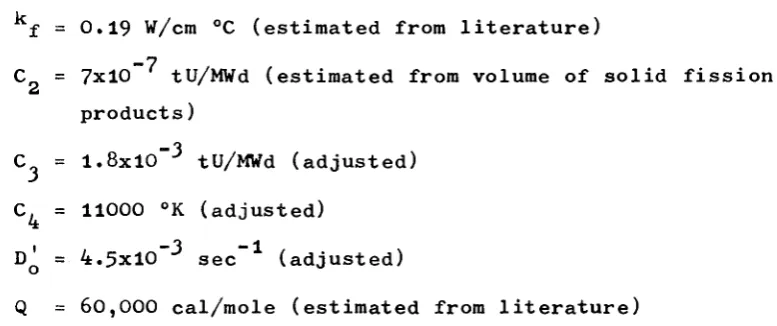
f = 0.19 W/cm °C (estimated from literature)

C = 7x10

tU/MWd (estimated from volume of solid fission

¿a

products)

C = Ι.δχΙΟ

­3

tU/MWd (adjusted)

C, = 11000 °K (adjusted)

D

o

= 4.5xlO

­3

sec"

1

(adjusted)

Q = 60,000 cal/mole (estimated from literature)

The relation for swelling which is obtained with the

retained constants is represented in Fig. 4.

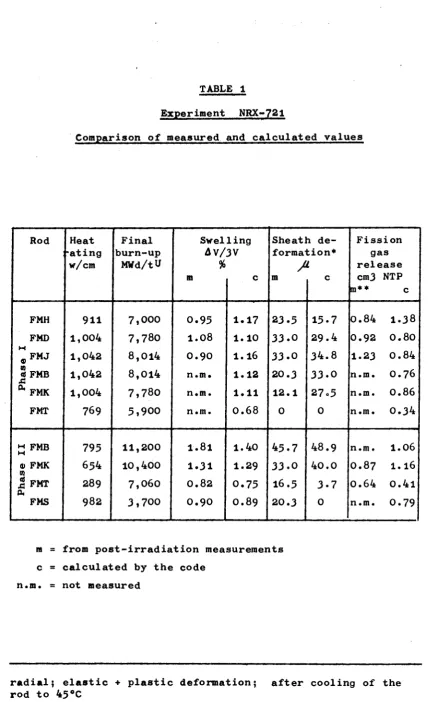
Table 1 gives the measured and the calculated values of

the adjustment criteria (swelling, sheath deformation, fission gas

release).

Fig. 5 gives the measured and the calculated fuel

center temperature of the rod FMS.

It is thought that the following reasons contribute

significantly to the differences:

[image:32.595.135.524.303.466.2]
(33)

29

The calculated plastic sheath deformation at the sheath

rupture of rod FMB is 0.55% (averaged on the sheath circumference)

This value is recommended as sheath rupture criterion.

8.4. New data

At the time when the adjustment was done, some data were

not given and had to be estimated by us. Meanwhile, further

information is available. Several new data differ from the data

utilized in the adjustment calculation. The values for which

this difference seems to be significant are discussed in the

following. It is felt that an adjustment to the new data would

somewhat improve the agreement of code and experience, but would

not change much the adjusted constants.

Flux depression coefficient ξ '

Value utilized in the adjustment calculation: {· = 0.91

New value /~20_J7 : ξ' = Ο.83

From equation (l4), it can be seen that the same results

T, (and, in consequence, same fuel swelling) are obtained with:

ξ' = 0.91 5 k = 0.19 W/cm °C

(values utilized in the adjustment calculation), and with:

έ' = 0.83 5

k f

= 0.173 W/cm °C

It is therefore proposed to utilize the value k =

(34)

30

Heat-rating and burn-up of the lower rods (FMB, FMK, FMT)

The following

table

compares the utilized

data (A) with

the new values (B) from

¿_

20_/.

Rod

FMB

FMK

FMT

Heat­ratin

Phase I

A

1042

1004

769

Β

1024

948

649

g (W/cm

Phas

A

795

654

289

)

3

I I

Β

966

895

612

Total burn­up

(MWd/t)

A

11200

10400

7060

B

m

II8OO

IO85O

736Ο

Fuel­sheath clearance of rod FMS

Value utilized in the adjustment calculation :

t

= 68

V*

New value

: £ = 52 lu

The utilization of the new value would decrease the

calculated fuel center temperature. This may indicate that the

thermal conductivity of the fuel was lower than 0.173 W/cm C.

(35)

31

9. List of symbols

ratio

of

fission

gas

production to fission energy

production /""cm NTP/W sec""7

-1

-7

&

,

a_ constants for X

s

1

b , b constants for E

1

¿>

c

C

o» C_ constants for S

1 3 3

c ., c. constants for k

1 2 g

D' apparent fission gas diffusion coefficient /"sec

J

D

0

constant for D

¿_

sec __/

d height of fins ¿/ cm_7

E Young's modulus of sheath

¿J

kg/mm

J

E' average energy released per fission ¿ W sec/fission_/

e width of fins

£^cmj

e

0

distance between fins /"cm 7

F quantity of released fission gas / cm NTP_/

F self-shielding coefficient / -_/

f fraction of fission gas released

¿_ - J

G quantity of fission gas produced in a section

/"cm

3

NTP_y

g , g

0

constants for A

h , h , h constants for R

1

¿

3

H quantity of bonding gas

¿_<axii

NTP_/

H quantity of initial gas charge

¿_

cm^ NTP_/

I , I Bessel functions of imaginary argument

o 1

j initial radial clearance at ambient temperature

¿_

cm_/

j radial clearance during operation / cm_/

j initial axial clearance at ambient temperature / cm_/

a

(36)

32

j

distance from inner sheath surface in the gap

r

j

criterion for contact between fuel and sheath

o

Β

ν

¿~

cm

-7

criteri

/~cm_7

Κ

Boltzmann's constant / I.38 χ io"

J

W sec/

° K J 7

k

thermal conductivity of fuel

¿_

W/cm °K_/

k

thermal conductivity of bonding gas / W/cm °K /

g

~~

k

t h e r m a l c o n d u c t i v i t y of s h e a t h / W/cm °K /

s

—'

1

fuel length (l) / cm_/

M

molecular weight

¿_

g/mole_/

23

N

Avogadro's number

¿_

6.03 . 10

atoms/mole_/

n

number of axial sections

¿_ -_/

Ρ

pressure of the coolant / kg/cm /

e

P.

pressure of the bonding gas / kg/cm

J

Q

externally applied axial compressive load

/_

kg_/

Q

activation energy for fission gas diffusion

¿_

cal/mole~7

q

linear heat rating

¿_

W/cm_/

q

heat generation density

¿_

W/cm

~J

q

heat generation density at the fuel center /

V/cnr_y

R

gas constant

£~1*

98726 cal/mole °K_7

R

mechanical resistance of sheath

¿_

kg/mm _/

r

distane· from rod axis ¿ c m _ 7

r

outer radius of sheath (l)

¿_

cm_7

r

inner radius of sheath (l) / cm 7

r

fuel radius (l)

¿_ cm J

S

irradiation swelling of fuel

/_

-J

(37)

­ 3 3

Τ

t e m p e r a t u r e /"~

0

K_J7

Τ

o u t e r s u r f a c e s h e a t h t e m p e r a t u r e / ~ ° K _ 7

T„

i n n e r s u r f a c e s h e a t h t e m p e r a t u r e

¿_

°K_7

T-

f u e l s u r f a c e t e m p e r a t u r e

¿_

°K_7

T,

f u e l c e n t e r t e m p e r a t u r e / ~ ° K _ 7

Τ

ambient t e m p e r a t u r e / " ° K 7

a

*— —'

Τ

coolant temperature / °K 7

Τ

average fuel temperature in a section

¿_

°K__7

Τ

average sheath temperature in a section /"~°K_7

Τ

average temperature of gas plenum at the top of

the rod / ~

0

K J 7

T*

reduced temperature /~­_7

T

a

ambient temperature

/_

°C_7

T

f

average fuel temperature in a section

¿_ °C_y

T

s

average sheath temperature in a section

¿_

°C_/

t

time /~sec_7

V

volume disposable to bonding gas

¿_

cm

J

V

volume of gas chamber beyond the rod

¿_

cm

J

c

3

V

g a s volume i n t h e upper e n d - p l u g / c m

/

Ρ

V

g a s volume a t t h e t o p o f t h e rod / c m

J

y

y i e l d of a f i s s i o n g a s p e r f i s s i o n / a t o m s / f i s s i o n

/

s

ck

s h e a t h c o o l a n t h e a t t r a n s f e r

c o e f f i c i e n t

/"W/cm

2

°K_7

p .

a t o m i c f r a c t i o n of a gas on t o t a l bonding gas

¿_

-*_/

c

e q u i v a l e n t r a d i a l c l e a r a n c e a l l o w i n g f o r s u r f a c e

r o u g h n e s s

/_^omJ

Í

o v e r a l l t h e r m a l e x p a n s i o n r a t i o o f f u e l

¿_~J

Í

o v e r a l l t h e r m a l e x p a n s i o n r a t i o of s h e a t h /

- _ /

í

s

(38)

­ 34

^

elasticity limit of sheath material

/_ - J

\

fin efficiency /~~­_7

K

reciprocal of effective neutron diffusion length

­1 "7

' .

a

n

(».a>

Indices :

Ín the fuel / cm _/

1„

average expansion coefficient of fuel from Τ to

f

_

Λ

_

a

T

* y­

0R

­Ij

.

*

A

s

average expansion coefficient of sheath from Τ to

*

ι—

­ 1

—i

a

Τ / °K

A

7

s *—

*

* /—

­1 ­τ

A

real expansion coefficient of sheath at Τ / "Κ

/

s

s —

—'

ι

fin coefficient (surface ratio)/

-_/

γ

Poisson's ratio /

- J

e,

X.

, ^

coefficients concerning the temperature distribution

in the fuel /~­_7

o

low velocity collision diameter / A /

axial sheath stress at the ends of the rod

/^"kg/mm 7

2

β'

tangential sheath stress between fins / k g / m m _ 7

2

C

tangential sheath stress on fins / k g / m m _ 7

sheath

/~kg/mm

2

__7

β'

sheath stress due to radial temperature gradient

d

average axial sheath stress / k g / m m

/

ë

average tangential sheath stress / kg/mm"_/

*f

burn­up (fission energy per ton Uranium) / MWd/t_7

Y

ratio of total fission energy to thermal energy

released in the fuel / ­ _ /

reduced collision integral /

— /

(39)

3 5

-ACKNOWLEDGEMENT

The authors gratefully acknowledge the help of W. Böttcher,

who

(40)

-36

REFERENCES

¿"ij?

S. Giuliani and C. Mustacchi

ι

"Heat Tranefer in a

Fuel Element Gee Gap", EUR 521e, 1964

/~2_7

Cetinkale and Flehendem

"Thermal Conductance of

Metal Surfaces in Contact", Proceedings of the

General Discussion on Heat Transfer, ASME 1951

L$J

P.D. Sanderson:

"Heat Transfer from the Uranium

Fuel to the Magnox Can in a Gas-Cooled Reactor",

6681-ADI

/ 4_7

L.C. Laming:

"Thermal Conductance of Machined

Metal Contacts", International Developments on Heat

Transfer, ASME Conference 1961

£~5J

A.M. Ross and R.L, Stoute:

"Heat Transfer

Coefficient between U0

a

and ZR-2» AECL 1552

/~6_7

J.A.L. Robertson:

" /kdö in Fuel Irradiâtione",

AECL 807, 1959

£lj

Reactor Handbook, Volume IV, Engineering, second

edition, Interscience Publishers, 1964

/"8__7

D.I. Sinizer et al.:

"Irradiation Behaviour of

UC Fuels", NAA-SR-7248, 1962

/"9_7

R

«

D

· Hahn:

"A Study of UC and Cladding Materiale

for High-Temperature Sodium-Cooled Reactors",

NAA-SR-7696, 1963

/~10_7

H

· Pearlman and R.F. Dickerson:

"Carbide Fuel

Fabrication and Performance", A/Conf. 28/P/234»

1964

(41)

-37-/~12_7

A.H. Booth:

"A Method of Calculating Fission Gas

Diffusion from UO Fuel and

its

Application to the

X-2-f Loop Test", AECL 496, 1957,

rep.

I960.

/"l3_7

Cattrel et al.ι

"Fission Product Release

from UO ",

ORNL­2935,

I960.

/

14_7

Lenoir and Coming:

"Thermal

Conductivity

of Gasee:

Measurements

at

High

Pressure",

Chem. Eng. Progr.,

Vol. 47, 1951.

/~*15_7

R , A

· Svehla:

"Estimated Viscosities

and Thermal

Conductivities of

Gases at

High

Temperatures",

NASA-TRR-132,

1962.

/ l6__7

J.O. Hirschfelder et

al·:

"Molecular Theory of

Gases

and

Liquids", Chapman and Hall Ltd., London, 1954.

/"l7_7

V D I

" Wärmeatlas, Da 17, 1963

/ l8_7

B. Huber:

"Carbure d'Uranium ­ Données de projet

pour l'emploi dans un réacteur ORGEL", EURATOM COMMUNICATION

(not available)

/ 19_7

Β

· Huber:

"SAP ­ Données de projet pour l'emploi

dans un réacteur ORGEL", EURATOM Internai Report (not availab

/~20_y

R.D. Mac Donald et al.:

"SÀP­Clad Uranium Carbide

Fuel Elements", AECL­2571, May 1966.

/ 2l_y

J.C. Charrault et al.:

"Comportement des crayons

combustibles de carbure d'uranium gainés de SAP ­

(42)

38

[image:42.595.96.533.72.775.2]

TABLE 1

Experiment NRX-721

Comparison of measured and calculated values

Rod

FMH

FMD

«FMJ

φ

«S FMB

°· FMK

FMT

w FMB

M

Φ FMK

tn

J§ FMT

FMS

Heat

•at

ing

w/cm

911

1,004

1,042

1,042

1,004

769

795

654

289

982

Final

burn­up

MWd/tU

7,000

7,780

8,014

8,014

7,780

5,900

11,200

10,400

7,060

3,700

Swelling

ÙV/3V

%

m

0.95

1.08

0.90

η.m.

η.m.

η «m.

1.81

1.31

0.82

0.90

c

1.17

1.10

1.16

1.12

1.11

0.68

1.40

1.29

0.75

0.89

Sheath de­

formation*

A

m

c

23.5

33.0

33.0

20.3

12.1

0

45­7

33.0

16.5

20.3

15.7

29.4

34.8

33.0

27o5

0

48.9

40.0

3­7

0

Fission

gas

release

cm3

m**

0.84

0.92

1.23

n.m.

n «m ·

n «m.

n .m.

0.87

0.64

n.m.

ΝΤΡ

c

1.38

0.80

0.84

Ο.76

0.86

Ο.34

1.06

L i ó

0.41

Ο.79

m = from post-irradiation measurements

c = calculated by the code

n.m. = not measured

**

radial; elastic + plastic deformation; after cooling of the

rod to 45°C

Figure

Table 1 gives the measured and the calculated values of
Experiment TABLE 1 NRX-721

References

Related documents

Court for the District of Oregon seeking a refund of his income taxes paid, plus interest penalties with respect to the pass-through loss from Cadaja he used to

• building bridges between civil society and public organisations as well as acting as a lobbying body for the Muslim charity sector; • and promoting humanitarian principles

(l) I f an app lication for a protection order i s made in term s of sec tion 2 and the 15 court is sa ti sfied in terms of section 3(2) that a prot ection o rd er

Marie Laure Suites (Self Catering) Self Catering 14 Mr. Richard Naya Mahe Belombre 2516591 [email protected] 61 Metcalfe Villas Self Catering 6 Ms Loulou Metcalfe

Selectman Chase made a motion to appoint the following residents as inspectors and alternate inspectors of Elections with a term of office to expire August 1, 2019 – Richard

Most students of money and banking in the United States would identify open market operations, reserve requirements, and the discount rate as the basic tools of

The fees and spreads for services of the Custodian directly related to the execution of portfolio transactions intiated by CAMI as the Portfolio Advisor are paid by CAMI

Study (first author, year) Targeted intervention Intervention focus Timing (during/ after treatment) Intervention strategy Intervention duration, mean Method of delivery