A Roboethics Framework for the Development and Introduction of Social
Assistive Robots in Elderly Care
Antonio M. M. C. Espingardeiro
Salford Business School
University of Salford, Manchester, UK
TABLE OF CONTENTS
Chapter 1 - Introduction ... 1
Chapter 2 - Literature review ... 9
2.1. Ethics in the digital world ... 9
2.2. Exploratory work in roboethics ... 14
2.2. Roboethics rules and guidance ... 18
2.3. “In-situ” practical workshops with SARs ... 23
2.4. Summary ... 24
Chapter 3 - Human robotics interactions and ethical principles ... 27
3.1. Human robotics interactions ... 27
3.2. Social interactive robotics applications ... 27
3.3. Socially interactive and social assistive robots applications ... 29
3.4. Relevance of social groups and social care ethos ... 30
3.5. Core medical ethical principles in assistive care ... 31
3.6. Core ethical principles and SARs ... 34
3.7. SARs - robots evaluation ... 36
3.8. SARS and HRI benchmarks ... 36
3.8.1. Safety ... 38
3.8.2. Scalability ... 39
3.8.3. Autonomy ... 39
3.8.4. Imitation ... 40
3.8.5. Privacy... 41
3.8.6. HRI task-oriented benchmarks ... 42
Summary of HRI: ... 43
3.8.7. HRI benchmarks, core ethics principles and social care ethos ... 45
3.8.7.1. Imitation ... 46
3.8.7.2. Safety ... 47
3.8.7.3. Autonomy ... 49
3.8.7.4. Social success ... 52
3.8.7.5. Scalability ... 55
3.8.7.6. Understanding of domain ... 57
3.8.7.7. Privacy ... 59
Summary: ... 69
4.1. Research philosophies ... 71
4.2. Research methodology ... 72
4.3. Qualitative data process ... 74
4.3. Qualitative data analysis ... 76
4.4. Care home settings ... 77
4.4. Technology used in the practical workshops ... 80
4.5. Robotic workshops and activities ... 87
Chapter 5 - Research analysis and findings ... 93
5.1. Activities program ... 93
5.2. Research procedures ... 94
5.3. HRI workshops, ethical principles and social care ethos ... 95
Beneficence ... 96
Non-maleficence... 97
Autonomy ... 97
Justice ... 97
5.4. Evaluation structure ... 98
5.5. Qualitative analysis ... 103
5.5.1. Research findings ... 114
Locations A, B, C, D, E ... 114
5.5.1.1. Interview 1 analysis (Table 18): ... 114
Locations A, B, C, D, E ... 116
5.5.1.2. Interview 2 analysis (Table 19): ... 116
Locations A, C, D, E ... 118
5.5.1.3. Interview 3 analysis (Table 20): ... 118
5.5.2. Critical analysis ... 123
5.5.2.1. Safety ... 123
5.5.2.2. Autonomy ... 124
5.5.2.3. Imitation ... 127
5.5.2.4. Understanding of domain ... 129
5.5.2.5. Scalability ... 129
5.5.2.6. Privacy ... 130
5.5.2.7. Social success ... 133
Reencounter ... 140
Chapter 6 - Reframed HRI benchmarks ... 141
6.1. Reframed HRI benchmarks ... 141
6.1.1. HRI benchmarks visual representation ... 141
6.2.2. Supervision scheme ... 144
6.2.3. Safety ... 145
6.2.4. Imitation ... 147
6.2.5. Autonomy ... 150
6.2.6. Social success ... 153
6.2.7. Understanding of domain ... 157
6.2.8. Scalability ... 159
6.2.9. Robotic information system ... 161
6.2.10. Privacy ... 162
6.2.11. Usability testing ... 165
6.2.12. Liability ... 167
6.3. HRI benchmarks diagram ... 169
6.4. HRI benchmarks emerging relationships ... 172
6.4.1. Imitation - safety (1) ... 172
6.4.2. Autonomy - safety (2) ... 173
6.4.3. Autonomy - human supervision scheme (3) ... 173
6.4.4. Imitation - robotic presence (4) ... 174
6.4.5. Human supervision scheme - attachment (5)... 174
6.4.6. Understanding of domain - social success (6) ... 175
6.4.7. Ethnographic studies - scalability (7) ... 175
6.4.8. Usability and testing - safety (8) ... 175
6.4.9. Summary of the proposed HRI benchmarks ... 176
Chapter 7 - Roboethics framework ... 179
7.1. Overview ... 179
7.2. HRI benchmarks analysis ... 179
7.3. HRI benchmarks templates ... 182
7.4. Framework process (steps) ... 185
7.5. Ethical specification ... 185
7.6. Iterative framework process... 185
Chapter 8 - Case studies ... 187
8.1. HRI benchmarks: case studies ... 187
8.2. Humanoid robots (Figures 41, 42) ... 187
8.2.1. Humanoid robots HRI benchmarks relationships ... 204
8.3. Robotic animals (seals and cats) (Figures 45, 46) ... 206
8.3.1. Robotic animals HRI benchmarks relationships... 222
8.3.2. Robotic animals attachment ... 224
8.4. D45 (Figures 49, 50) ... 227
9.4.1. D45 HRI benchmarks relationships ... 247
8.5. Roboethics framework tools developed ... 249
8.6. Robotics prototypes developed ... 251
8.6.1. P37 S65 ... 252
8.6.2. S15 Alpha ... 253
8.7. Summary of case studies ... 255
Chapter 9 - Conclusions and further work ... 256
9.1. Reframing HRI benchmarks ... 256
9.1.1. Safety (3 categories added) ... 257
9.1.2. Autonomy (3 categories added) ... 257
9.1.3. Imitation (5 categories added) ... 258
9.1.4. Social success (6 categories added) ... 258
9.1.5. Understanding of domain (2 categories added) ... 259
9.1.6. Scalability (2 categories added) ... 259
9.1.6. Robotic information system (new benchmark, 1 category) ... 260
9.1.7. Privacy (5 categories added) ... 260
9.1.8. Usability and testing (new benchmark, 3 categories) ... 261
9.1.9. Liability (new benchmark, 1 category)... 261
9.1.10. Human supervision scheme (new benchmark, 2 categories) ... 261
9.1.11. HRI identified relationships ... 262
9.1.12. Roboethics framework ... 262
9.1.13. Reflection on aims and objectives ... 263
9.1.14. Self-critical analysis ... 264
9.1.15. Contribution to knowledge ... 266
9.1.16. Future work ... 266
9.1.17. Summary ... 267
References ... 269
Appendix I - Interviews analysis ... 273
Appendix II - Research impact ... 295
List of figures
Figure 1 - Overall research conceptual map ... 7
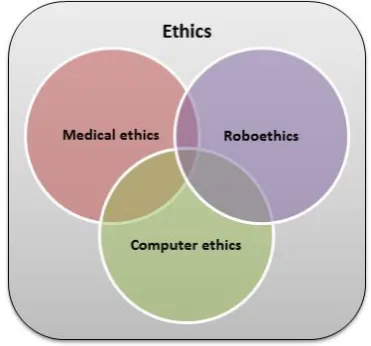
Figure 2 - Roboethics, computer ethics and medical ethics ... 14
Figure 3 - EURON roadmap, robotics applications areas 2006 Veruggio (2006) ... 19
Figure 4 - NAO robotcredit: university of Connecticut CHIP... 28
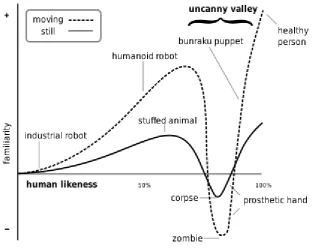
Figure 5 - Uncanny valley theory ... 41
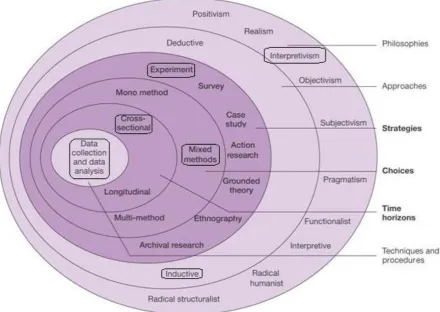
Figure 6 - Onion research model in the context of this research ... 73
Figure 7 - Qualitative data process ... 76
Figure 8 - Qualitative analysis ... 77
Figure 9 - Practical robotic workshops layout ... 78
Figure 10 - RS V2 ... 81
Figure 11 - RS Media ... 81
Figure 12 - Robotic seals ... 82
Figure 13 - ROVIO ... 82
Figure 14 - Automatic vacuum cleaner robot ... 83
Figure 15 - XBox 360 with kinect system ... 83
Figure 16 - Digital tablet ... 84
Figure 17 - D45 mobile robotic platform ... 84
Figure 18 - Robotic cats ... 85
Figure 19 - Robotic mops ... 85
Figure 20 - Robotic crab ... 86
Figure 21 - Human supervision scheme ... 143
Figure 22 - Human supervision scheme set ... 144
Figure 23 - Safety ... 147
Figure 24 - Imitation ... 150
Figure 25 - Autonomy ... 153
Figure 26 - Social success ... 157
Figure 27 - Understanding of domain ... 159
Figure 28 - Scalability ... 161
Figure 29 - Robotic information system ... 162
Figure 30 - Privacy ... 165
Figure 31 - Usability testing ... 167
Figure 32 - Liability ... 169
Figure 33 - HRI benchmarks diagram ... 170
Figure 34 - HRI benchmarks (continuation) ... 171
Figure 35 - HRI benchmarks relationships subscript scheme ... 172
Figure 37 - HRI benchmarks diagram (continuation) ... 181
Figure 38 - Roboethics framework cycle ... 186
Figure 39 - Humanoid robots - HRI benchmarks visual selection ... 188
Figure 40 - Humanoid robots - HRI benchmarks visual selection (continuation) ... 189
Figure 41 - Humanoid robots diagram ... 190
Figure 42 - Humanoid robots diagram (continuation) ... 191
Figure 43 - Robotic animals HRI benchmarks selection ... 207
Figure 44 - Robotic animals - HRI benchmarks selection (continuation) ... 208
Figure 45 - Robotic animals diagram ... 209
Figure 46 - Robotic animals diagram (continuation) ... 210
Figure 47 - D45 HRI benchmarks selection ... 228
Figure 48 - D45 HRI benchmarks selection (continuation) ... 229
Figure 49 - D45 diagram ... 230
Figure 50 - D45 diagram (continuation) ... 231
Figure 51 - Roboethics framework GUI - HRI benchmarks selection 1 ... 249
Figure 52 - Roboethics frameowork GUI - HRI benchmarks selection 2 ... 250
Figure 53 - Roboethics frameork GUI - HRI benchmarks templates completion ... 250
Figure 54 - P37 S65 ... 251
Figure 55 - S15 Alpha ... 253
List of tables Table 1 - HRI proposed benchmarks (Feil-Seifer, Matarid et al. 2007) ... 38
Table 2 - Ethical analysis of the HRI benchmark imitation ... 47
Table 3 - Ethical analysis of the HRI benchmark safety ... 49
Table 4 - Ethical analysis of the HRI benchmark autonomy ... 51
Table 5 - Ethical analysis of the HRI benchmark social success ... 55
Table 6 - Ethical analysis of the HRI benchmark scalability ... 57
Table 7 - Ethical analysis of the HRI benchmark understanding of domain ... 59
Table 8 - Ethical analysis of the HRI benchmark privacy ... 61
Table 9 - HRI benchmarks ethical analysis ... 68
Table 10 - Positivism and interpretivism research methods ... 71
Table 11 - Care home settings ... 79
Table 12 - Robotics technology used in research ... 80
Table 13 - Conducted Workshops and activities ... 88
Table 14 - Robotic workshops/activities calendar ... 91
Table 15 - Interview 1 qualitative analysis ... 106
Table 17 - Interview 3 qualitative analsys ... 113
Table 18 - HRI benchmarks categories and emerging findings ... 116
Table 19 - HRI benchmarks categories and emerging findings ... 118
Dedication
Acronyms
AR(s): Assistive Robots(s).
EC: European Conformity.
EURON: European RoboticsResearch Network.
EUROP: European Robotics Technology Platform.
EEG: Electroencephalography
FCC: Federal Communications Commission
FOV: Field Of View.
GSR: Galvanic Skin Response.
GT: Grounded Theory
GUI: Graphical User Interface
HCI: Human Computer Interaction.
HRI: Human Robotic Interaction.
IT: Information Technology
IS: Information Systems
RAE: Royal Academy of Engineering.
RSG: Relevant Social Groups.
SAR(s): Socially Assistive Robot(s).
SIR(s): Socially Interactive Robot(s).
Abstract:
There is an emerging “aging phenomenon” worldwide. It is likely that we will require the introduction
of assistive technologies that can assist caregivers in the exercise of elderly care. Such technologies
should be designed in ways that promote high levels of human dignity and quality of life through the
aging process. Social Assistive Robots (SARs) demonstrate high potential for complementing elderly
care when it comes to cognitive assistance, entertainment, communication and supervision. However
such close Human Robotics Interactions (HRIs) encompass a rich set of ethical scenarios that need to
be addressed before SARs are introduced into mass markets. To date the HRI benchmarks of “Imitation”, “Safety”, “Autonomy”, “Privacy”, “Scalability”, “Social success” and “Understanding of the domain” are the only guidelines to inform SARs developers when developing robotic prototypes
for human assistance. However such HRI benchmarks are broad and lack of theoretical background to
understand potential ethical issues in elderly care. Further, there is little guidance for either developers
or those involved in the provision of care, regarding the appropriate introduction of SARs.
In this research the current HRI benchmarks are reviewed alongside the core ethical principles of
beneficence, non-maleficence, autonomy and justice, together with a social care ethos. Based on such
interpretation, practical robotics workshops were conducted in five care and extra care institutions
with the direct participation of elderly groups, caregivers and relatives. “In-situ” robotics
demonstrations, informal interviews and observations were conducted, investigating human
behaviours, attitudes, expectations, concerns, and levels of acceptance towards the introduction of
SARs in elderly care settings. Following a thematic analysis of the findings, a roboethics framework
is proposed to support the research and development of SARs. The developed framework highlights
the importance of selection, categorization and completion of relevant HRI benchmarks, HRI
templates, HRI supervision schemes and ethical specifications for SARs applications.
1
CHAPTER 1 - INTRODUCTION
According to the United Nations (UN) human civilization is undergoing significant
demographic changes in both western and non-western cultures. As an example, in 1990 the
number of British citizens over 65 years old represented (16%) of the overall UK population.
From 2012 to 2020 the number of elderly people is expected to reach (20%) (UN 2011). By
the year 2050, UN expects three times more people (worldwide) over 85 than exist today (UN
2011). It is understandable that a significant portion of the future ageing populations will
require extra levels of physical and cognitive assistance throughout their lives. A great deal of
attention and research must be directed to assistive technologies aimed at promoting
ageing-in-place, facilitating living independently and promoting the wellbeing of individuals and
communities. Robotics as a multidisciplinary science starts to demonstrate an immense
potential to be used in social care contexts (Feil-Seifer and Matarić 2009). However in the
robotics community there is still no exact definition to describe “what is a robot” or how we
could classify robots Polk (2005) and Dautenhahn (2013). The word “robot” was introduced
in 1920 by Karel Čapek in the science fiction play Rossum‟s Universal Robots (RUR). In
reality “industrial robotic arms” have been used in manufacturing and production lines since
the 1950s. The efficiency and productivity of industrial robots is translated in modern life
(Veruggio 2006). However, almost a century after we still don‟t have a clear definition to
“what is a robot” and to what extent can we classify devices as robots. In literature we find
different “robotic” definitions. Joseph Engelberger the pioneer of industrial robotics states "I
can't define a robot, but I know one when I see one" (BRNO 2013). The Merriam-Webster
encyclopaedia provides several definitions for what is a robot: "a machine that looks like a
human being and performs various complex acts (as walking or talking) like a human being";
"a device that automatically performs complicated often repetitive tasks", or "a mechanism
guided by automatic controls" (Merriam-webster 2008). In reality robots are usually
classified based on their abilities. In robotics academic teaching Rapp (2011) robotic
classification usually includes the domain of operation, degrees of freedom, control system,
level of autonomy or the goal which robots are designed to. In the domain of assistive
technologies Social Assistive Robots (SARs) result from the intersection of Social Interactive
2 was originally used by Fong, et al. (2003) to describe robots whose main task was some form
of interaction. Such interaction could use social interaction principles typical from human
beings such as speech and gestures. On the other hand the ARs term has been widely referred
in the robotics community to describe robots that assist people with physical limitations or
disabilities (Feil-Seifer and Matarić 2005). Feil-Seifer mentions that SARs philosophy is not
based solely on the interaction itself but mainly on the outcome of the interaction for
providing assistance and achieve measurable progress in terms of convalescence,
rehabilitation, motivation or learning. Despite the degree of sophistication of the terminology
it still doesn‟t translate a fundamental definition and consensus on how to classify robots.
However as SARs philosophy is to provide motivation, supervision, rehabilitation or
convalescence to vulnerable users we could expect scenarios where physical support and
psychological assistance are required. So the physical nature and psychological nature
involved in HRI takes substantial relevance. Due to a high set of possible SARs scenarios in
this thesis we will consider a robot as “an electromechanical device that can be programmed
through software or hardware to execute tasks automatically”. We believe such definition has
enough depth to cover a wide range of situations where robots could complement elderly
care.
However the term “robot” might need to be expanded and possibly categorized according to
its capabilities and primary objectives. In today‟s manufacturing robots, SIRs, ARs,
entertainment robots or any other type of robots such classification takes place independently.
This means robotics classification considers either the robot‟s degrees of freedom, control
system or for example the locomotion method involved. In reality we might have a
combination of robotics characteristics that might take into account both the aesthetics, level
of autonomy and overall robotic objective. Due to the broad range of future robotics
applications we could have robotic information cards to define levels of aesthetics, degrees of
freedom, control systems, locomotion types, autonomy, level of intelligence, types of sensors,
main robotic objective, serial number etc. Such robotics characteristics could also contribute
to define different categories of robots. This means the continuation of ARs, SIRs and SARs
families but probably we will need to categorize them at a higher level (e.g. robot category 1,
robot category 2) to better identify its main objectives and human responsibilities when it
comes to development and usability.
Despite the robotic definition and classification it is likely that robotic assistance with
3 entertainment, cognitive assistance, supervision and communication. Those are capabilities
that could be delivered in the medium/long term by the first generation of SARs. However
the introduction of SARs is likely to raise ethical challenges around independency versus
human contact, privacy and wellbeing of elderly groups. Currently there is a paucity of
studies that involve the use of SARs with vulnerable groups such as the elderly. As an
example existing studies highlight psychological gains with the use of SARs with elderly
groups but also report emerging connections formed between the elderly and robotic animals
Wada and Shibata (2008) and Kidd, et al. (2006). On the same line Wada and Shibata (2008)
report increases in communication and socialization of elderly groups with the use of robotic
seals but also mention emerging connections between certain individuals and the robots.
Beyond such acknowledgement none of these studies analyse the use of SARs from an ethical
point of view. The work of Feil-Seifer and Matarić (2009) calls for attention from the
robotics community to better develop SARs that can provide assistance to vulnerable groups.
They propose a set of HRI benchmarks for informing SARs developments. However such
benchmarks do not include an ethical analysis on its core development. Instead the current
robotics development benchmarks of Kahn, et al. (2006) and Feil-Seifer and Matarić (2009)
are mainly influenced by psychology. Such contributions are important and represent a
starting point however we need more emphasis in the ethics associated to SARs development
and potential use.
Such fact raises the following question: with the emerging demographic challenges how
SARs can be used as an extension of elderly care if they are not ethically analysed? This
represents a critical point to be researched as the outcome of SARs deals with the trade of
between the benefits and potential harms provided to elderly groups. It is likely that we will
have ethical interpretations which can provide important indicators both for users and robotic
manufacturers. However due the sensitivity of elderly care we will need to visit the
foundation principles of ethics. We will have to consider the ethical principles of
“beneficence”, “non-maleficence”, “justice” and “autonomy” Beauchamp and Childress
(2001) to analyse current SARs technologies with the presence of elderly groups. Social care
ethos plays also an important role in listening to people‟s opinions, rights, dignity and choices
in care (Suhonen, et al. 2010). On the same perspective we believe the ethical understanding
of SARs should follow the same assumption. For the moment SARs perception and its
potential benefits for elderly groups has yet to be demonstrated and studied with more
4 Despite the lack of consensus on what defines a robot in this research we are mainly
considering the nature of SARs in care scenarios. SARs can be used in areas of supervision,
entertainment, cognitive assistance and companionship. In general SARs are expected to
move around, resemble different morphologies and communicate and interact (physically or
psychologically) with humans and other systems. Such robotics nature is likely to open new
opportunities unseen in care but also needs careful analysis when bringing robots to
vulnerable groups. As roboethics author Veruggio mentions, “roboethics is an exercise of
ethical reflection related to the particular issues that are generated by the development of
robotic applications and their diffusion in society” (Veruggio, et al. 2011). In SARs it seems
that we need further research that could promote active user participation throughout the
robotics design, development and introduction stages. The use of SARs with vulnerable
groups will represent additional challenges that go beyond the robotics technical nature. To
date there is a lack of practical HRI studies in conjunction with elderly groups that could
translate ethical issues and serve as basis for reflection and guidance for future research and
development of SARs. Also when it comes to social assistance, the scope of previous HRIs
studies is mainly confined to research labs and controlled environments that do not translate
real contexts, challenges and human feedback involved in HRIs. The interaction between
elderly people and robots is likely to open many questions relative to the ethics, validity and
benefit of such interactions. Beyond the fact that SARs are being developed for providing
potential “therapeutic” benefits for users, the crossover between the core ethical principles of
beneficence, non-maleficence, autonomy, justice and social care ethos needs to be further
researched. Social care is already by its nature abundant in ethical scenarios (Suhonen, et al.
2010). We believe that by interpreting and developing further HRI benchmarks according to
the core ethical principles and social care ethos it is possible to shape the development of
SARs and enrich the quality of HRIs that can benefit elderly groups.
When developing SARs for elderly care we could expect additional questions: How SARs
could help in elderly care? What they should look like? What maps good levels of HRI? How
can we supervise and read the outcome of such interactions? How can we address the ethical
issues involved in the development and introduction of SARs in elderly care? Is it possible to
learn and conceive ethical guidelines for developing SARs technologies?. Due the sensitivity
of elderly groups further research will have to improve our understanding on the new field of
roboethics (level 1). We will need to better understand how to connect theoretical
5 possible alternatives. At this point ethics and robotics seem to be separate by different routes.
In reality we will need to build a common language for developers, users and stakeholders
involved in design, development and introduction of SARs. Further qualitative inputs are
needed to create visual representations of HRI benchmarks and try to categorize them
according to relevant areas where SARs could complement elderly care. Such representations
are likely to be completed by the use of ethical specifications which can involve defining
human supervision responsibilities and human contact schemes to be applied. In sum we will
need the development of ethical frameworks and practical tools for understanding some of
the emerging ethical issues arising from the development and introduction of SARs in elderly
care.
The beauty and challenges associated to the use of SARs need contributions from
multidisciplinary teams arising from the fields of electronics, mechanics, computer science,
artificial intelligence, social sciences, ethics, law, psychology, neuroscience, arts and others.
Such exercise could help informing the potential benefits and challenges around the use of
SARs with vulnerable groups. At this stage it seems plausible that the development of ethical
frameworks that take into account the multidisciplinary aspects of HRIs could contribute to
develop better products/services and possibly inform the creation of robotics law.
To help understand some of these questions this research conducts “in-situ” robotics
workshops with the use of SARs and the direct participation of elderly groups, carers,
managers and relatives in care and extra care facilities. We believe that SARs ethical issues
are likely to emerge in real care settings. Such practical robotic workshops are absolutely
crucial to interpret current HRI benchmarks and extend them according to the four ethical
principles of beneficence, non-maleficence, justice, autonomy and social care ethos. At this
point we acknowledge that there is an aging phenomenon worldwide UN (2011) and an
emerging need to develop assistive technologies for expanding the quality of care. However
there are critical considerations involved in the current state of the art of SARs research and
development. After literature review we conclude that there is no articulation between the
ethical considerations and the practical exercise of robotics when assisting elderly groups. In
practical terms there are no roboethics frameworks of reference that can provide guidance
during the development and introduction of SARs. In sum we lack of ethical understanding
and tools that can translate a common language for developers and potential users of SARs
technologies. At this stage we tried to highlight crucial points that need to be carefully
6 To investigate the current state of the art of the ethics involved in developing SARs
for elderly care and identify potential limitations.
To examine how the four core ethical principles of beneficence, non-maleficence,
autonomy, justice allied with social care ethos can be applied to the existing HRI
benchmarks of “safety”, “scalability”, “imitation”, “autonomy”, “privacy”, “social
success” and “understanding of domain” (Feil-Seifer and Matarić 2009).
To conduct practical robotics workshops and perform a qualitative analysis to reframe current HRI benchmarks.
To propose a roboethics framework that includes human supervision schemes, HRI
benchmarks and ethical specifications for the design, development and use of SARs
with elderly groups. Demonstrate the application of the proposed roboethics
framework with practical case studies.
The contribution to knowledge of this thesis is to revise the current HRI benchmarks
according to the four core medical ethical principles allied with social care ethos to propose a
roboethics framework that can inspire the development and introduction of SARs in elderly
care. Such framework involves three steps: analysis and visual representation of HRI
benchmarks, the use of templates to create an ethical specification and finally a revision
process. The roboethics framework represents an iterative process that provides flexible
understanding on some of the SARs emerging ethical issues.
The research is decomposed into 5 main stages (figure 1). Stage 1 reviews the literature on the new curriculum of roboethics. Stages 2 and 3 revise Feil-Seifer and Matarić's (2009)
existing HRI benchmarks according to the core ethical principles of beneficence,
non-maleficence, autonomy, justice and social care ethos. Stage 4 is informed by stages 2 and 3
and it involves practical robotics workshops in care and extra care facilities with elderly
groups, carers and families. Stage 5 analyses qualitatively the practical robotics workshops
and proposes a roboethics framework for assisting the development of SARs for elderly
7 This research follows an interpretivist philosophy to gain understanding of elderly people‟s
attitudes, behaviours and concerns towards the introduction of the SARs in care/extra care
scenarios. Qualitative research methods are applied. The study includes “in-situ” HRI
workshops, informal interviews with elderly groups, caregivers/families and the use of
[image:18.595.74.525.213.476.2]practical case studies.
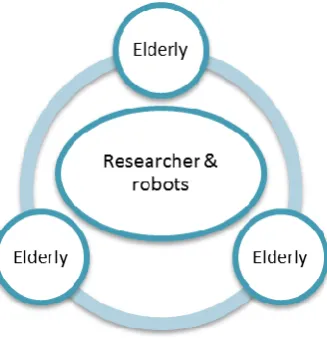
FIGURE 1 - OVERALL RESEARCH CONCEPTUAL MAP
As we saw currently there is a lack of field studies in SARs. Still within the most significant
studies ((Wada and Shibata 2008), (Kidd, et al. 2006), (Tapus, et al. 2009)) there is no
significant analysis, discussion and guidance towards the ethics of delivering SARs to
vulnerable groups such as the elderly. It is an area that needs further attention. This research
adds knowledge and practical applicability to the discipline of roboethics (level 1) by
informing SARs developments and user interaction with elderly groups.
Following the structure of this thesis chapter 2 presents the literature review on the
discipline of roboethics. Chapter 3 introduces SARs technologies and correlates the existing
HRI benchmarks with the core ethical principles of beneficence, non-maleficence, autonomy
and justice aligned with social care ethos. Chapter 4 presents the selected research
methodology and robotic workshops performed during the course of the study. Chapter 5
8 existing HRI benchmarks considering the analysed results with special regard to the core
ethical principles of beneficence, non-maleficence, autonomy, justice and social care ethos.
Chapter 7 presents the proposed roboethics framework, which includes HRI benchmarks
identification, templates, and the framework process. Chapter 8 illustrates the application of
three case studies using the proposed roboethics framework. Chapter 9 describes the
conclusions of this study and suggests further research work.
9
CHAPTER 2 - LITERATURE REVIEW
2.1.ETHICS IN THE DIGITAL WORLD
Information technology (IT) is rapidly expanding to several areas of human life. The
positive impact of information systems (IS) is highly noticeable in areas such as health and
medicine, communications or business (Castells and Cardoso 2005). As IT becomes
omnipresent in human life also the ethical considerations about the use of computer
technology become more challenging. Computer ethics has been a topic of research since
1950s with prominent contributions from (Wiener 1950). Wiener was mainly preoccupied
with the ethical use of computers. Such preoccupations covered aspects related with
automated machines, networks, responsibility, security, artificial intelligence and more.
Today such topics are integral part of discussion in information systems and communication
technologies. In addition, the growth of communications and the Internet originated new
challenges in the field of computer ethics. Some of the most prominent ethical issues in
contemporary computer ethics deal with intellectual property, privacy, control and regulation,
censorship, computer crime and access (Bynum and Rogerson 2003).
However the definition of computer ethics in itself might involve different perspectives.
According to Moor (1985) computer ethics is “the analysis of the nature and social impact of
computer technology and the corresponding formulation and justification of policies for the
ethical use of such technology”. According to Johnson and Snapper (1985) computers didn‟t
constitute a whole new ethical paradigm, but rather gave a “new twist” to already familiar
issues such as ownership, power, privacy and responsibility. Because of the exponential
growth of information systems and communication technologies authors such as
Gorniak-Kocikowska (1996) even predict that computer ethics will possibly achieve the standard of
global ethics. Kocikowska mentions “in the future, the rules of computer ethics should be
respected by the majority (or all) of the human inhabitants of the Earth... In other words,
computer ethics will become universal; it will be a global ethic”.
For now we understand and feel the current and emerging importance of computer ethics in
modern life however in this thesis we will consider computer ethics as an area of applied
10 involves guidance on how humans choose to conduct themselves through the use of
computing programs and resources online or offline. Typically computer ethics deals with
issues such as privacy rights and respect for intellectual property which are transversal to
developers and users.
On another plain medical ethics is an area that studies how physicians conduct their actions
in the exercise of health care. Every situation presents different questions and ethical issues in
medicine should be approached carefully (Gillon 1994). Beauchamp and Childress (2001)
proposed a medical ethics framework that involves the interpretation of the four core ethical
principles of beneficence, non-maleficence, justice and autonomy. In health care beneficence
guides health care workers towards the benefit of patients. Non-maleficence states that the
physician actions should not harm individuals. Autonomy deals with the respect for patients
decisions about their own care. Finally justice deals with difficult questions associated with
access or rationalization of care (Gillon 1994). However how physicians will apply those
same ethical principles remains a big challenge. In practical terms beneficence is not
separable from non-maleficence. As an example, working towards the best interest of a
patient might involve administrating a short/medium term painful treatment. On the same
spectrum respecting patients‟ autonomy might imply stopping treatments or procedures that
are considered by the medical community as beneficial for such individuals. In justice
medical decisions usually take the notion of fairness, however they could be influenced by
risk factors such as epidemic situations or even governmental considerations towards costs in
health care. As Gillon (1994) mentions although such framework doesn‟t provide a set of
ordered rules for every single situation, the four core principles can help doctors and other
health care professionals to make moral judgements and decide the course of actions.
In the domain of information and communication technologies it is important to
acknowledge that we are relying more and more on computing decisions (Castells and
Cardoso 2005). Samuel, et al. (2010) report similarities between medical ethics and computer
ethics. Medical devices and health care information systems are currently based on software.
As Anderson and Goodman (2002) mentions software in health care could make life and
death decisions. The operating system flaw of the Therao-25 medical accelerator is reported
as one of the examples that originated losses of lives. Beyond such fact, ethical challenges in
modern health care deal with scenarios related with safety and confidentiality. Questions
around patients information as well as health professionals information comes to debate
11 information relative to patients participating in antiretroviral research programs versus their
privacy and testimonials to other patients. Another example deals with doctors‟ access to
information systems where patients‟ complaints are made towards health professionals and
how such access impacts on care decisions. On the first example the patients‟ privacy has to
be taken into account but on the other hand such behaviour brings inefficiency to the process
of informing patients with typical disorders. The same dilemma arises with health
professionals‟ access to patients‟ complaints databases. Does such behaviour improve health
care or it prejudices the health care decisions? Ethics deals with deriving knowledge and
guidance towards decisions that involve moral judgements. Thereby the interpretation of the
ethical principles of beneficence, non-maleficence, autonomy and justice involve
understanding, selecting and deciding the outcome of actions towards information systems in
health care. However as in medical ethics such interpretation varies and could in same cases
translate advantages and disadvantages for the stakeholders involved (Gillon 1994). The
common aspects of medical ethics and computer ethics point to a classification where
computer ethics involves a certain understanding of medical ethics (Samuel, et al. 2010). It is
important that software developments associated to health care follow a system of
verifiability and ethical discussion before entering in activity. Thereby for the scope of this
thesis we will consider that computer ethics relates to medical ethics in terms of the resulting
interpretation of the core ethical principles (figure 2).
Roboethics is defined by its author Veruggio, et al. (2011) as “an exercise of ethical
reflection related to the particular issues that are generated by the development of robotic
applications and their diffusion in society”. Roboethics updates views on concepts such as the
dignity and integrity of people, their fundamental rights and the social, legal and
psychological elements involved in the development of robotics technologies (Veruggio, et
al. 2011). As we saw SARs philosophy is to provide assistance through forms of
rehabilitation, motivation, convalescence or coaching of vulnerable groups. Due to
demographics challenges we will probably need to develop assistive technologies to extend
our current levels of care. Scenarios associated to elderly groups‟ cognitive assistance,
supervision, entertainment or companionship constitute areas where SARs could be possibly
applied. The universe of SARs is likely to be vast including robots from different types of
aesthetics, ergonomics, autonomy or locomotion. Robots are likely to move and resemble
different physical configurations in close proximity of elderly groups. In such exercises
12 commands the hardware behaviour involved in SARs. Such feature could be critical when it
comes to decision making that could influence the robot‟s interaction with users or the
environment. As Anderson and Goodman (2002) mentions “software could make critical
decisions in health care”. Such fact constitutes in itself a fundamental challenge in computer
ethics. Similarly the notion of human safety associated to robotics decision making is of
primary importance. Situations where the SARs levels of displayed autonomy could be
compromised by software bugs, unpredicted situations or hardware failures (e.g. sensors)
could influence negatively the outcome of care actions. So in the domain of safety roboethics
already shares important questions with computer ethics when it comes to controlling
software in care situations. Other examples deal also with challenges associated to the
privacy of HRIs. As we saw computer ethics presents examples of critical scenarios where
healthcare information brings issues around privacy both for patients and health professionals
(Anderson and Goodman 2002). Questions around patients‟ sensitive information or the
nature of access to digital care complaints are in debate but not separable from a medical
ethics perspective. In roboethics because SARs are likely to provide cognitive assistance and
supervision to groups such as the elderly similar questions arise. Cognitive assistance
involves programming SARs databases with a set of medication reminders, personal task lists
and other elements that contribute for the welfare of individuals. However the access to the
elderly personal and sensitive information for robot programming is not currently discussed
or represented by codes of conduct. Who can access such information (e.g. caregivers, robot
operators) and what are the elderly users‟ safeguards? Such questions involve particular
interpretations of the core ethical principles of beneficence, non-maleficence, justice and
autonomy.
Additionally roboethics is likely to raise more and different ethical challenges. The synthetic
aspect of robots involves aesthetics and behavioural considerations (Breazeal 2002). Until
this point humans having been dealing primarily with fixed terminals (computers) running
software. As robots‟ embodiment takes place it is likely that robots could translate different
levels of persuasiveness and ethical considerations. As Kidd (2008) reports there seems to be
a higher level of persuasiveness arising from HRIs relatively to traditional software running
on computers. Kidd (2008) mentions that participants were much more motivated by a
weighting loss robotic coach than a classical software program. Results proved that globally
people did consider more accurately the indications provided by a robot in order to control
13 to the research teams. Following the same line Wada, et al. (2008) also reports psychological
gains when using robotic seals in care homes in Japan. Such robots were used as relaxing and
comforting platforms to improve the communication and socialization among elderly users.
Wada also reports connections formed by certain elderly individuals and robotic seals (Wada,
et al. 2008). To a certain extent we should be aware that the aesthetics and behavioural nature
of robots could originate new levels of persuasiveness between humans and robots. SARs
nature is based on the outcome of HRI which could originate advantages and ethical
challenges for vulnerable groups.
For now it is noticeable that at this stage many of the computer ethics challenges around
safety and privacy are inherited by robotics technologies (figure 2). The sensitivity of HRIs for example in assistive care brings up the core ethical principles of beneficence,
non-maleficence, autonomy and justice to discussion. Robotics by its power and persuasiveness
opens new opportunities and challenges for human life. It is likely that roboethics will
represent an extension and not disruption with the information technology era. The
intersection between computer ethics (figure 2), medical ethics and roboethics is crucial to understand many of the ethical challenges associated to SARs development and use. As we
saw in health care the three areas are confronted with the application of the core ethical
principles of beneficence, non-maleficence, autonomy and justice. Such assumption should
continue to inspire roboethics on its foundation and exercise. Thereby the contribution of this
thesis arises from such intersection to possibly inform future developments and practical use
of SARs in elderly care.
It is important to remember that beneficence will mean that robotic systems should be
developed and used in ways that benefit human beings. Non-maleficence reinforces the
notion of not harming robotic users. Such principle gains extreme importance in terms of user
safety when considering for example autonomous and semi-autonomous robotic systems to
be deployed in care scenarios. The ethical principle of autonomy deals with the right of users
to decide the course of actions in HRI scenarios. Finally justice is related to costs,
14
FIGURE 2 - ROBOETHICS, COMPUTER ETHICS AND MEDICAL ETHICS
2.2.EXPLORATORY WORK IN ROBOETHICS
In 1920 the Czech writer Karel Čapek introduced the word robot through his famous play
entitled “Rossum‟s Universal Robots”. In the following 93 years such vision inspired many
science fiction writers and public to preconceive potential robotics and automation scenarios.
Despite such “media” success however there is still no consensus in the scientific community when it comes to define “what a robot is” and which machines can be classified as robots. In reality the set of opportunities that such programmable robotic devices start to demonstrate for human life can be viewed as both fascinating and dangerous at the same time. Machines
with various forms and dimensions are being equipped with sensors and computerized with
AI algorithms for a wide range of purposes (Veruggio, et al. 2011). According to some of the
world leading experts in robotics ((Breazeal 2002), (Brooks, et al. 2000)) it is likely that
robots will be endowed with the ability to learn and process human profiles, tastes, habits,
which will inevitably lead to privacy, safety and individual freedom choices. It is likely that
in the near future humans will coexist with the next generation of automated machines
(robots) employed alongside domestic workers, nurses and caregivers at home, hospitals and
extra care facilities. For instance, in aging societies there is an urgent motivation for safe,
(semi)autonomous and adaptable personal robots, also called SARs. However it is also likely
that such distribution of robots will raise many completely new ethical, legal, and societal
challenges.
AI is becoming more advanced and targeted to be used in a vast array of applications
15 Sharkey and Sharkey (2011) have continuously warned the scientific robotics community of
other types of dangers that go beyond physical safety. As robotics technology advances
“roboethics” constitutes an area of primary importance to be studied and further developed.
According to Sharkey and Sharkey (2010), robots can cause psychological problems,
especially in vulnerable populations such as children, elderly people and hospital patients.
Also issues regarding the attribution of civil and criminal liability should an autonomous
robot produce damages are also arising in many debates. For instance, if we consider the civil
and criminal liability of machines causing damage (physical, psychological or both) to
humans or the environment, where does the responsibility lies? To robotic developers,
insurers or final users? Which standards can inform law practitioners or courts?. There are
also critical areas surrounding the humanitarian and international laws in the cases of brutal
force used by military robotics. Such ideas have been subject to discussion since the “dawn”
of robotics particularly in the works of Wiener (1950) or in the science fiction stories of
Asimov (1941) where “the three laws of robotics” were introduced.
Three Laws of Asimov
1. A robot may not injure a human being or, through inaction, allow a human being to
come to harm.
2. A robot must obey the orders given to it by human beings, except where such orders
would conflict with the first law.
3. A robot must protect its own existence as long as such protection does not conflict
with the first or second laws.
The robotics laws were derived from a top-down approach where ethical theories such as
utilitarianism and deontology were applied for evaluating the morality of a specific course of
action (Wallach 2008). However according to Singer (2009) Asimov‟s laws were conceived
purely for science fiction purposes. The laws seem to imply that robots have similar cognitive
capabilities and behaviours as human beings. Such laws are far from being implemented into
present day robotics. The current state of the art in AI is very limited Singer (2009) and such
laws would imply a deeper knowledge about human conscience and ultimately its
implementation on a machine.
It is only in the last few years that the debate has been progressively organized within the
16 field of applied ethics (Veruggio, et al. 2011). Roboethics is an exercise of “ethical reflection
related to the particular issues that are generated by the development of robotic applications
and their diffusion in society” (Veruggio, et al. 2011:21). Because the complexity and
sensitivity of the subject is enormous it is important to clarify the terminology between ethics
and robotics before going further. For doing so I have analysed the perspectives of Veruggio,
et al. (2011). In the article entitled “Roboethics: Ethics Applied to Robotics” Veruggio, et al.
(2011) state that at least three levels of roboethics were already identified:
Roboethics levels (Veruggio)
Roboethics (Level 1) Robot Ethics (Level 2) Robot‟s Ethics (Level 3)
The first level is denominated “Roboethics” and is represented by the “adopted ethical
theories, developed principally by the branch of philosophy called morality, which studies
human conduct, moral assessments, and the concepts of good and evil, right and wrong,
justice and injustice” (Veruggio, et al. 2011:21). Such level represents an ethical reflection directly related to the particular issues generated by the “development of robotic applications
and their diffusion in society. They add that level 1 “updates the various views on concepts
such as dignity and integrity of a person, the fundamental rights of individuals and the social,
psychological and legal aspects involved in the research and development of robotics and its
diffusion in society ” (Veruggio, et al. 2011:21).
A second level presented by Veruggio is currently referred to as “Robot Ethics” or machine
ethics. This level represents the code of conduct that engineers and roboticists should
implement in the AI algorithms of their robotic creations. It is seen as a sort of “artificial
ethics able to guarantee that autonomous robots will exhibit ethically acceptable behaviour in
all situations in which they interact with human beings or when their actions may have an
impact on human society” (Veruggio, et al. 2011:21). Finally Veruggio presents a third level
defined as “Robot‟s Ethics”, because it is “the ethics born from the subjective morality of a
hypothetical robot that is equipped with a conscience and freedom to choose its own actions
17 2011:21). This would be a scenario where robots could be deemed as moral agents involving
their responsibilities or even rights.
In a certain way roboethics tries to provide answers to the scientific progress of robotics and
related technical fields. Due to the high number of potential robotic applications the concepts
of human dignity, integrity and the fundamental rights of the individuals, as well as the
social, psychological and legal aspects become intertwined. By their nature these are
elements likely to change from individual to individual or from culture to culture which
makes them challenging to analyse.
What is ethically acceptable or not is a direct product of the aforementioned level 1 of
roboethics (Veruggio, et al. (2011). This researcher‟s perspective is that any result from robot
ethics level 2 must be strongly informed by level 1.
When it comes to robot‟s ethics level 3 it is still a purely speculative scenario as Veruggio
states that “robots are in fact “machines”, tools that are unaware of the choices made by their
human creators, which therefore we bear the moral responsibility for their actions”
(Veruggio, et al. 2011:21).
Such categorization isn‟t targeted specifically to SARs. Instead it tries to cover a wider
spectrum of robotics applications where we have three different natures of research involved.
The first one is directly related to the broad curriculum of ethics as well as considering the
social impacts, advantages, disadvantages of robotics technologies. Areas such as humanities,
social sciences, arts and law could well be located in this level. The second area tries to map
technical solutions for practical implementations in robotics systems. I consider this to be a
natural field for science, engineering, maths and technology. Lastly the third level appeals to
robot‟s conscience and ethical reflections on their actions towards human life. Currently this
is still part of science fiction and thereby it is difficult to imagine the possible areas of human
knowledge that could contribute for such research. To date all three levels of roboethics are
not translating any guidance for prospective robot developers and their users. Nevertheless
the levels can help us localising some of the emerging ethical questions about robotics and
maybe addressing multidisciplinary teams to study and follow the evolution of robotics
science.
In the perspective of this research more clarity is needed in the area of roboethics (level - 1).
We have to understand and establish new paradigms and ethical frameworks to equip
roboticists, engineers, computer scientists, philosophers, sociologists, lawyers and ultimately
18 robotics in society. Thereby some valid questions that society might ask include: why do we
want robots (motivation)?; where they should be applied (areas of human life); what do we
want them exactly to do?; what should they look like?; are they threatening? if yes, what can
be done to mitigate this?. Such questions have to actively involve prospective user‟s feedback
on how machines should be designed, what kinds of usability, privacy and accessibility levels
are required, what HRIs scenarios should be presented, and finally what are the relevant
levels of autonomy and uncertainty for human intervention, safety or welfare.
2.2.ROBOETHICS RULES AND GUIDANCE
In 2006 the EURON “EUropean RObotics research Network” workshop on roboethics took place in Genova (Italy) (Veruggio 2006). This was the first key conference where scientists
from humanities and science were involved to debate contributions to the foundations of the
human ethics applied to robotics. One of the findings of this meeting was the confirmation
that the perception of robots and the definition of good and bad differ according to ages,
cultures, religious beliefs, moral values, professional duties, social obligations and
prohibitions. The EURON roadmap (figure 3) (Veruggio 2006) covers an assessment of the potential ethical issues in the design, development and use of robots and intelligent machines.
It investigates potential ethical issues around the following robotics applications: advanced
production systems, network robotics, outdoor robotics, military robotics, edutainment,
adaptive robot servants in intelligent homes and health care and life quality. The EURON
roadmap draws a broad perspective on the potential use of robotics and automation
technologies by mapping its advantages and disadvantages, however the EURON roadmap is
not sustained by academic studies on HRI and globally it doesn‟t seem to reflect practical
guidelines for prospective SARs developers and users. Nevertheless the EURON roadmap
marks a wake up stage for the robotics scientific community relatively to the importance of
19
FIGURE 3 - EURON ROADMAP, ROBOTICS APPLICATIONS AREAS 2006 VERUGGIO (2006)
However in the literature we also find controversial perspectives and studies that do not
reflect exactly the visions of the EURON group. In 2006 a research was commissioned and
recently updated in 2011 by the UK Office of Science and Innovation's Horizon Scanning
Centre entitled “A.I. Law: Ethical and Legal Dimensions of Artificial Intelligence”. The
article depicts a future science fiction scenario where robot calls may be made for human
rights to be extended to robots (TheSgimaScan2.0 2011). At the end of 2007 the South Korean government announced the development of a robot ethics charter which to date has
not been made public. However the media reported that the “robot ethics” charter will
address questions such as “robot abuse of humans and human abuse of robots”. Some of the
sensitive areas will cover human addiction to robots, human abuse of robots and prohibiting
robots from ever hurting humans (Terry 2007). Taking a different perspective, Kim, et al.
(2009) revealed a study where 230 participants (students) from the University of Hawaii
(USA) completed a questionnaire which determined their concern relative to communication
constraints in situations involving humans and robots. The results showed that people were
more concerned with avoiding hurting the human‟s feelings as well as avoiding the
inconveniencing of other humans and less concerned with avoiding hurting the robot‟s
feelings or avoiding the inconveniencing of a robot partner.
In 2010 the UK EPSRC council gathered a team of experts from the world of technology,
industry, arts, law and social sciences to discuss emerging robotics applications and their
future potential for society. The outcome of this initiative was a document with five rules
20 Five rules of EPSRC
1. Robots are multi-use tools. Robots should not be designed solely or primarily to kill
or harm humans, except in the interests of national security.
2. Humans, not robots, are responsible agents. Robots should be designed & operated as
far as is practicable to comply with existing laws & fundamental rights & freedoms,
including privacy.
3. Robots are products. They should be designed using processes which assure their
safety and security.
4. Robots are manufactured artefacts. They should not be designed in a deceptive way to
exploit vulnerable users; instead their machine nature should be transparent.
5. The person with legal responsibility for a robot should be attributed.
The EPSRC rules represent an effort to reinforce both the role of human beings and robots
in a future society. However the rules do not reflect a specific type of robotics application
that they could be applied to. The rules seem to be targeted to future designers and regulators
of robotics technologies but no academic reviews or references have been presented along
them. The five rules seem to be generated in a “common sense” fashion and it is
understandable that they try to inform both specialists and non-specialists audiences. In an
ethical perspective the rules seem to be generated from a top-down approach underpinned by
the ethical theories of deontology and utilitarianism (EPSRC 2010). Unfortunately the five
rules are far from translating any real practical guidelines when it comes to the development
of SARs with vulnerable groups.
In terms of benefits and harm, non-discrimination and privacy the works and interventions
of ((Sharkey and Sharkey 2010), (Whitby 2010)) highlight the importance of understanding
human ethics when deploying robots into society. Sharkey and Sharkey (2010) highlights that
there are potential risks associated with the use of robot carers with elderly people when it
comes to the reduction of human contact, increase in the feelings of objectification, losses of
control, privacy or personal liberty. Whitby (2010) reinforces the idea of developing urgent
guidelines and legal regulations for the development of robots. Both authors warn the
scientific community about the lack of guidance when developing machines for taking care of
21 In terms of cultural diversity and pluralism the roboethics EURON Veruggio (2006)
roadmap and Kitano (2007) emphasize the need for having general principles or adaptation
mechanisms for the wider acceptability of robotics within different cultures and beliefs.
Relative to autonomy and individual responsibility, the works of Weng (2009) and Arkin
(2008) appeal to a significant change in the way autonomous systems take responsibility in
actions. Weng (2009) states that robots should be considered as “third existence entities” that
will resemble living things in appearance and behaviour, but it will not be self-aware. Arkin
(2008) proposes a “responsibility advisor” in warfare applications which can be translated as
a mechanism for advising human operators in terms of final responsibility for their actions. In
2009 a document has been released by the UK Royal Academy of Engineering (RAE)
entitled “Autonomous Systems, Social, Legal and Ethical issues” (RAE 2009) which
highlights the benefits, liability and ethical problems arising from the use of autonomous
systems in personal robotics and the transport sector. The document suggests if future robots
are able to extend human care, society has to seriously question the cost of such technology,
the balance between the isolation and independency of vulnerable groups as well as usability
and privacy issues.
On the transport sector the report mentions that the use of autonomous systems could bring
an immense set of advantages towards traffic management and increased levels of human
safety. However currently there is no suitable legal framework to address issues such as
insurance and drivers‟ responsibility with self-driving vehicles. On other landscape we have
seen tremendous progress in terms of autonomous driving vehicles over the last ten years.
The Google self-driving car, or more recently the UK robot car are direct applications of such
autonomous driving technology that could become a reality in the near future. However we
are still lacking of academic contributions targeted to our social and legal spectrum that could
accompany the reality of such progress. Such delay could result in lack of preparation and
policy making when the first autonomous driving vehicles are introduced into the market. In
the case of SARs we must be attentive to the current rate of progress. At the same time we
have to start equipping ourselves with ethical frameworks that could inform our legal systems
when such technologies are prepared to extend the levels of human care with vulnerable
groups such as the elderly.
The late 2009 report entitled “Introduction to Ethical, Legal and Societal Issues of Robotics”
has been issued by the European Robotics Technology Platform group (EUROP). The
22 weighting the introduction of new robotics technology in production processes (EUROP
2009). Mainly the report tries to analyse case studies where the urgency, novelty and social
persuasiveness of robotics technology could raise ethical issues around human workers and
robot workers. By doing so it raises societal concerns towards ethical studies that could be
further conducted in robotics applications.
In 2009 the authors Feil-Seifer and Matarić (2009) extended the original HRI benchmarks of
Kahn, et al. (2006). The contribution was specially focused on potential guidelines for the
development of SARs. It presents seven HRI benchmarks entitled: safety, scalability,
imitation, autonomy, privacy, social success and understanding of domain. So far this
contribution constitutes the most relevant work to extend current knowledge on HRI
benchmarks with special regard to emerging SARs ethical issues with vulnerable groups. The
work not only identifies ethical issues in SARs but it mainly tries to move us towards a set of
potential guidelines for research and development of SARs. However the HRI benchmarks
don‟t seem to consider on its basis the four core ethical principles of beneficence,
non-maleficence, justice, autonomy nor social care ethos considerations which this research
believes are of primary importance to be explored in the context of SARs for elderly care.
The research presented in this thesis extends Feil-Seifer‟s HRI benchmarks through the
application of the previous core ethical principles and investigating elderly peoples‟ attitudes
and choices towards SARs. We will discuss these in detail in chapter three.
All the presented works seem to be very generic both in terms of robotics applications and
eventual guidelines for the design and development of SARs. As our ageing society progress
we have to expand our own levels of care through diverse technological platforms that could
include SARs. Robots that can provide supervision, cognitive assistance, entertainment and
companionship could well result in increased benefits for elderly individuals and help
reorganizing the quality and networks of care. However at this point, it seems we need further
research involving SARs and the direct participation of elderly groups. Robots are still part of
our fictional dreams and the lack of understanding, knowledge and experience when humans
interact with SARs has to be iteratively researched through the coming years. The start-up
participation of elderly groups in this research can reveal important cues on how people
perceive the first generation of SARs. Such crossing will help us understanding the ethics of
HRIs and inevitably guide us through the design and development of SARs.