© 2017, IRJET | Impact Factor value: 5.181 | ISO 9001:2008 Certified Journal | Page 372
Campus Cloud – A Management Information System on Cloud
Niraj Khot
1, Ketan Mudur
2, Omkar Thorat
3, Yogesh Doulatramani
41,2,3
Student in Dept. of IT Engineering, Vidyalankar Institute of Technology, Maharashtra, India
4
Assistant Professor, Dept. of IT Engineering, Vidyalankar Institute of Technology, Maharastra, India
---***---Abstract -
In the present-day world of technology, computers are affecting our lives in more ways than we are aware of– computerized management, maintaining information digitally, real time update of records, automated report generation, the list is endless.This paper aims to propose a community cloud service setup that will provide academic as well as non-academic institutes with a selection of services. All institutions involved will have a presence on a central platform to be used for publicity and customer interaction purposes where they can advertise themselves and be discovered by clients looking for their specific services. They will also be provided with a customized website as well as an android application. Finally, all institutions involved will be provided with a cloud based institute management system that is accessible from anywhere and to anyone with the proper access permissions.Key Words
:
campus, cloud, institute, management,
networking.
1.INTRODUCTION
Institute Management systems currently available in the market are extremely highly priced, as well as dependent on the institutes for maintenance of client-server or mainframe systems that are required to run them.
They also do not provide services such as effective remote access via cloud, a web presence, customer interaction modules and so on, all in one package. Institutes today have to pay separately for web presence and management system to different proprietors.
Campus Cloud aims to provide a community cloud service which will act as a central platform for institutes, both academic and non-academic, for publicity as well as management purposes which would substantially reduce human workload and resource utilization of the institutes in turn.
The institutes once onboard with Campus Cloud would be given a web presence and a management system which shall be managed completely by Campus Cloud's developers along
with a customized website and an Android application completely dedicated to the institute- all for a minimal cost. The institutes on board will get all the features that are required to run an institute such as maintaining student data, academic reports, a payment module, notifying parents about student's performance, notifying students about the academic work that needs to be fulfilled, etc. to name a few along with web presence and a customized website. All the data of the institute will be stored remotely on a cloud, to be made accessible on demand. This will help the system in case of hardware failure, power failure, etc. From students and parents perspective, Campus Cloud will act as a search engine to find institutes in their locality and of their interest without having to compromise on their time by physically visiting the institute to just get the basic details.
2.SYSTEM DESIGN
This deals with data flow diagram, detailed flow graph, requirement analysis, and the design process of the front and back end design of the Management Information System.
A. Data Flow Diagram
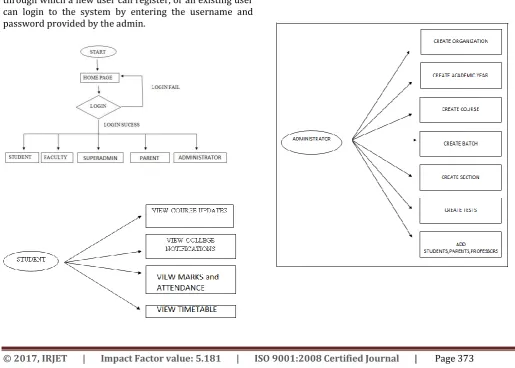
A Data Flow Diagram (DFD) is a graphical representation of the “flow” of Management Information System. A data flow diagram can also be used for the visualization of Data Processing. DFD shows the interaction between the system and outside entities.
© 2017, IRJET | Impact Factor value: 5.181 | ISO 9001:2008 Certified Journal | Page 373
Fig. 1: Data Flow Diagram
This paper mainly focuses on managing the information about the students, faculty, information, exam section, related information of the college which is maintained by the college administration through various levels of controlling. The function of the individual entities will be explained in detail in the flow graph.
B. Detailed Flow Diagram
© 2017, IRJET | Impact Factor value: 5.181 | ISO 9001:2008 Certified Journal | Page 374
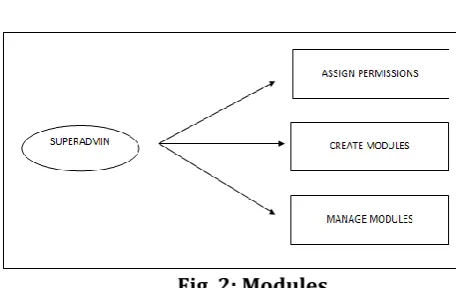
Fig. 2: Modules
Student
Students can access information about courses, faculty, test scores, attendance, timetable and notifications from the faculty. The course details include information regarding branch they are studying, the academic curriculum of the college, year -wise subject offered by the branch, test score details include internal marks of the subjects, he can also ask any queries to the staff regarding the subjects.
Faculty
The staff can update the information regarding students’ attendance, internal marks of the students and any information regarding the subjects they handle. They can also view student details for better understanding student performance and improving the efficiency of students. They can also send notifications to students regarding the upcoming assignments or tasks that need to be completed.
Administrator
The administrator is responsible for entering the details of new students; promoting students from one class to another, from one semester to another, and from one year to another; managing student accounts like any changes regarding to the name, address, etc. The administrator also manages the faculty accounts, like entering a new faculty and assigning the faculty to the subjects. The administrator will check all the updates i.e. student updates, faculty updates, exam updates etc. The administrator has the highest level of power in the respective organization.
Superadmin
The superadmin is responsible for assigning permissions to the organisation's administrator like creating academic year, courses, branches, adding students, etc. The superadmin has the highest level of power in the Campus Cloud system.
Parents
Parents can access the information related to their child, like test scores and attendance. Parents can also schedule an
appointment with the faculty regarding the progress of their child.
3. TECHNOLOGY
A. Spring Framework
The Java Spring Framework is an application framework and a container designed for providing Inversion of Control, based on the Java programming platform. The framework's core features such as IoC, AOP, etc. can be used by any Java application using the framework. The Spring Framework also provides extensions for building dynamic web applications on top of the Java EE platform. The framework does not require adherence to any specific model of programming. It has become a popular option in the Java development community as an alternative to or even as an addition to the Enterprise JavaBeans (EJB) model.
Inversion of Control
The central feature of the Spring Framework is its Inversion of Control (IoC) container, which provides an established and well defined method for configuration and management of Java objects using reflection. The container has a lot of functions such as the management ofthe lifecycles of specific objects: creation of objects, calling of initialization methods, and configuring the objects as required, performing dependency injection, and so on.
Aspect-oriented programming framework
The Spring Framework comes with its own Aspect-oriented programming (AOP) framework that provides cross-cutting functionalities by modularizing them into aspects. The intention for creating a separate AOP framework entirely for Spring came from the desire that it would provide basic AOP features while minimizing the complexity of the framework’s design, implementation, or configuration. The Spring AOP framework is based on a proxy pattern and is configured at run time. This eliminates a step during compilation and reduces load time as well as pre-processing.
Model–view–controller framework
© 2017, IRJET | Impact Factor value: 5.181 | ISO 9001:2008 Certified Journal | Page 375 framework. The framework has well defined strategic
interfaces for all of the responsibilities that are required to be handled by a modern request-based framework.
The Spring Framework has been used for the development of the core institute management system, as well as the support for the web application that serves as the front end user interface for the system.
B. Hibernate Framework
Hibernate ORM (Hibernate in short) is a tool developed for object-relational mapping for the Java programming language. It provides a framework for the mapping of a model in an object oriented domain to entities in a relational database. Hibernate solves many problems that occur in usual object-relational mapping by replacing the standard method of direct, persistent database access to database for read/write operations with high-level functions for handling the object.
The primary feature of Hibernate is the mapping of Java classes in an application to corresponding tables in a database, as well as the mapping of data types used by Java to data types used by SQL. It also provides facilities for data querying and retrieval. It is entirely responsible for the generation of SQL calls and completely removes the requirement for a developer to perform manual handling and the conversion of the result set into an object.
Hibernate also has a provision for an SQL inspired query language called the Hibernate Query Language (HQL). It allows SQL-like queries to be created for managing Hibernate's data objects. It provides Criteria Queries as an object-oriented alternative to HQL.
Hibernate has been used in conjunction with the Spring Framework for handling database integration and persistence.
C. Amazon Web Services EC2
Amazon Web Services (AWS) offers a suite of cloud computing services that make up an on-demand computing platform. The Amazon Elastic Compute Cloud (EC2) allows its users to rent virtualized hardware on a monthly basis on which they can run their own computing software and applications.
EC2 encourages scalability in the deployment of applications by providing a web service through which a user can create and boot up an Amazon Machine Image (AMI) to be used to
configure an ‘instance’, a virtual machine that runs on Amazon’s servers, which can run any of a few specific operating systems as well as any software desired.
A user can create, launch, and terminate server-instances as needed, paying by the hour for active servers – hence the term "elastic". The free tier of EC2 provides 1GB ROM and 8GB of Storage as well as 5GB of S3 Data Storage.
The Campus Cloud system has been deployed on an instance in the free tier of EC2, allowing for sufficient capabilities for demonstration of the system.
D. Maven
Maven is a build automation tool developed for and primarily used by Java projects. Maven addresses two parts of software development: first, it describes how software is built, and second, it describes its dependencies.
Maven dynamically downloads Java libraries and Maven plug-ins from one or more repositories such as the Maven 2 Central Repository, and stores them in a local cache, to be used by the application as required. The dependencies can be dynamically updated as required, simplifying the build process and reducing work required by the developers. Maven has been used for resolution of dependencies for Spring, Hibernate, and other libraries required by the Campus Cloud system.
E. Android Studio
Android Studio is the official integrated development environment (IDE) released by Google for the Android platform.
It provides build support based on Gradle, Android-specific refactoring and quick fixes, tools to catch performance, usability, version compatibility and other problems by Lint, some template-based wizards to create common Android designs and components, a rich layout editor that allows users to drag-and-drop UI components, an option to preview layouts in multiple screen configurations, support for building applications for Android Wear, built-in support for the Google Cloud Platform, integration with Google Cloud Messaging and App Engine, and an Android Virtual Device that is used to run and debug apps.
© 2017, IRJET | Impact Factor value: 5.181 | ISO 9001:2008 Certified Journal | Page 376 F. JSTL
The Java Server Pages Standard Tag Library (JSTL) is a component of the Java EE Web application development platform. It extends the JSP specification by adding a library of JSP tags for a variety of common tasks, such as XML data processing, conditional execution, database access and loops. JSTL provides an effective way to insert programming logic into a JSP page without embedding Java code in the page. The use of a standardised tag set, rather than constant use of snippets of Java code, leads to more manageable code and enables differentiation between the development of the application code and user interface.
JSTL has been used for the creation of web pages required for the dynamic web application serving as the front end for the Campus Cloud system.
G. AJAX
Asynchronous JavaScript and XML (AJAX) is a set of web development techniques using several technologies on the client side for the creation of asynchronous web applications.
With Ajax, web applications can send data to and retrieve from a server asynchronously (in the background) without interfering with the display and behavior of the existing page. By decoupling the data interchange layer from the presentation layer, Ajax allows for dynamic change in the content of a webpage without the need to reload the entire page.
AJAX has been used for the development of web pages required for the dynamic web application serving as the front end for the Campus Cloud system.
H.
Bootstrap
Bootstrap is a free and open-source front-end web framework for designing websites and web applications. It contains HTML- and CSS-based design templates for typography, forms, buttons, navigation and other interface components, as well as optional extensions for JQuery and JavaScript. Unlike many web frameworks, it is purely focused on front-end development only.
Bootstrap has been used for the designing of web pages required for the dynamic web application serving as the front end for the Campus Cloud system.
4.
FUNCTIONAL
AND
NON
FUNCTIONAL
REQUIREMENTS
A. Hardware Requirements
Server Side
Nil
Client Side
Computer Terminal with Internet access for using Web Application
Android Smartphone with Android 4.0 and above with Internet Access
B. Software Requirements
Server Side
Virtualized Server Machine running on AWS EC2 tier
Java 8 EE
Apache Tomcat Server version 8.0 Spring Framework 4.0
Hibernate ORM Apache Maven
Client Side
Web Browser for Web Application Campus Cloud Application
5. RESULT
© 2017, IRJET | Impact Factor value: 5.181 | ISO 9001:2008 Certified Journal | Page 377
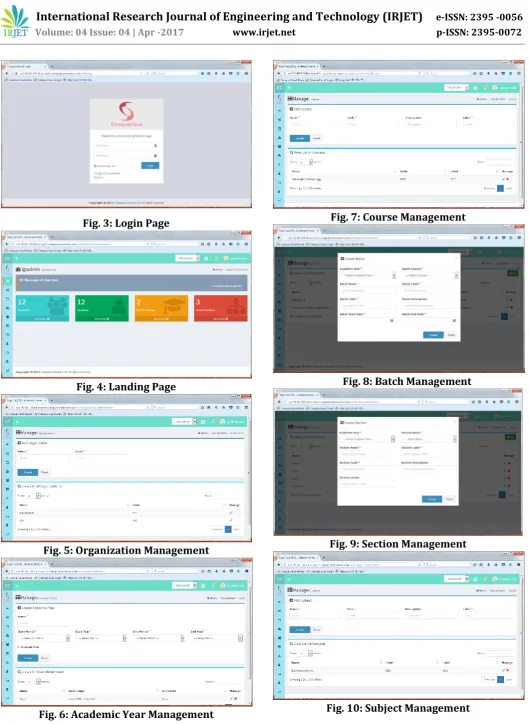
Fig. 3: Login Page
Fig. 4: Landing Page
[image:6.595.35.565.39.764.2]Fig. 5: Organization Management
Fig. 6: Academic Year Management
Fig. 7: Course Management
Fig. 8: Batch Management
Fig. 9: Section Management
© 2017, IRJET | Impact Factor value: 5.181 | ISO 9001:2008 Certified Journal | Page 378
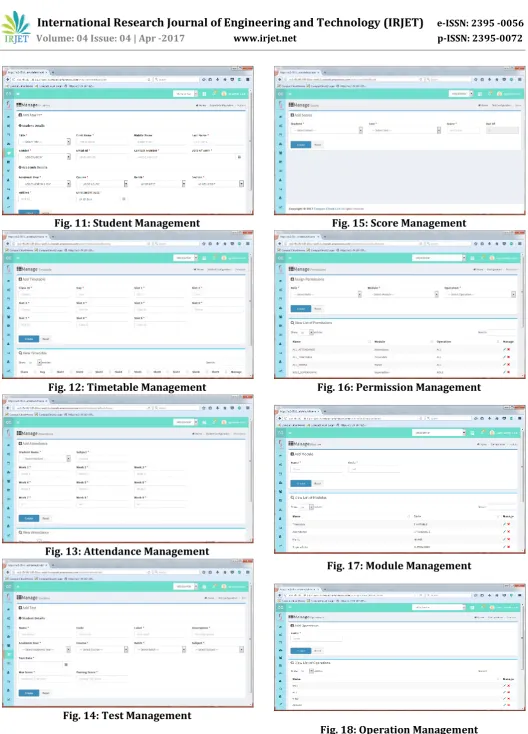
Fig. 11: Student Management
Fig. 12: Timetable Management
[image:7.595.34.563.33.768.2]Fig. 13: Attendance Management
Fig. 14: Test Management
Fig. 15: Score Management
Fig. 16: Permission Management
Fig. 17: Module Management
© 2017, IRJET | Impact Factor value: 5.181 | ISO 9001:2008 Certified Journal | Page 379
Fig. 19: Android Start
Fig. 20: Android Login
[image:8.595.72.528.63.735.2]Fig. 21: Android Home
© 2017, IRJET | Impact Factor value: 5.181 | ISO 9001:2008 Certified Journal | Page 380
Fig. 23: Networking Portal Search
Fig. 24: Networking Portal Compare
6. CONCLUSION
This paper has identified several issues with systems intended for institute management and other similar systems that have been implemented in the real world. It is apparent that while successful implementation of such systems makes for consistently improved performance, institutions face several obstacles while doing so, such as revenue issues, technological issues, implementation complexity, lack of technical knowledge, and so on. Campus Cloud mostly focuses on educational institutes and thus there would be no need for the institute to substantially change its system/method of working and thus the risk would be minimal. The optimal level of integration would be defined as per the requirements of a given organization, with the modular and on-demand nature of the Campus Cloud service, providing the best possible advantages to end users.
REFERENCES
[1] Shrikant Patnaik, Khushboo Kumari Singh, Rashmi Ranjan and Niki Kumari, “College Management System”, International Research Journal of Engineering and Technology (IRJET), vol: 03 Issue: 05, May. 2016. [2] Lalit Mohan Joshi, "A Research Paper on College
Management System", International Journal of
Computer Applications, Vol. 122 - No. 11, July 2015. [3] Rajesh Shah, Makhan Kumbhkar “Cloud Based College
Management Information System for Autonomous Institute”, International Journal of Advanced Research in Computer Science and Software Engineering, Volume 5, Issue 5, May 2015
[4] Vishwakarma R Ganesh, "Android College Management System", International Journal of Advanced Research in Computer Engineering & Technology (IJARCET) Volume 5, Issue 4, April 2016.
[5] S. R. Bramhaoudar, Geeta R. B., S. G. Totad: ”Web Based Student Information Management System”, International Journal of Advanced Research in Computer and Communication Engineering, Vol. 2, Issue 6, June 2013
[6] Pernille Kraemmerand, Charles Moller, Harry Boer: “ERP implementation: an integrated process of radical change and continous learning”, Production planning and control, Vol. 14, No. 4, pp 338-348,2003.
[7] Elisabeth J. Umble, Michael Umble, “Avoiding ERP implementation Failure”, Industrial Management, 2002. [8] Theodore Grossman, James Walsh: “Avoiding the pitfalls
of ERP system implementation”, Information systems management, 2004