lean maturity model
Mollasalehi, S, Aboumoemen, AA, Rathnayake, A, Fleming, AJ and Underwood, J
10.24928/2018/0507
Title Development of an integrated BIM and lean maturity model
Authors Mollasalehi, S, Aboumoemen, AA, Rathnayake, A, Fleming, AJ and Underwood, J
Type Conference or Workshop Item
URL This version is available at: http://usir.salford.ac.uk/id/eprint/50766/
Published Date 2018
USIR is a digital collection of the research output of the University of Salford. Where copyright permits, full text material held in the repository is made freely available online and can be read, downloaded and copied for noncommercial private study or research purposes. Please check the manuscript for any further copyright restrictions.
DEVELOPMENT OF AN INTEGRATED BIM
AND LEAN MATURITY MODEL
Sajedeh Mollasalehi 1, Ahmed Adel Aboumoemen2, Anushka Rathnayake3, Andrew
Fleming4, Jason Underwood5
ABSTRACT
The level of Building Information Modelling (BIM) and Lean adoption has been rapidly increased. The benefits of integrating these two approaches have also been identified. However, to achieve the maximum benefits of the interaction of these two approaches, there needs to be assessment tools to analyse their performances collectively. Because understanding and analysing the performances of these approaches would provide value to the entire project in terms of lessons learned, more value generation, and continuous improvements. Therefore, this paper aims to propose an integrated BIM and Lean Maturity Model based on reviewing the literature around current maturity models.
This paper proposes an Integrated BIM and Lean Maturity Model named “IDEAL” which could serve as a basis in terms of assessing the performances of the projects implementing BIM and Lean together.
KEYWORDS
Maturity Models, Maturity Assessments, Lean Construction, Building Information Modelling (BIM)
1.1 INTRODUCTION
In recent years, the application of new innovative and technological approaches has been increased to improve overall project productivity and performances within the construction industry. The most beneficial approaches can be considered to be BIM and Lean Construction which provide benefits to the construction industry. Because of the increased adoption of BIM and Lean approaches, there is a need of having proper assessment tools or models to analyse the performances of these approaches.
1 PhD Candidate, University of Salford, UK, [email protected] 2 PhD Candidate, University of Salford, UK, [email protected] 3 PhD Candidate, University of Salford, UK, [email protected]
4 Senior Lecturer, School of the Built Environment, University of Salford, UK, [email protected]
There are different assessment tools and maturity models available for assessing the performances of BIM and Lean individually. However, due to the increased adoption of these two approaches together, there is a need of having an integrated maturity model or assessment tool to analyse the performance of both BIM and Lean together. Providing an integrated BIM and Lean maturity model would enhance analysing the performances of these two collectively together so that subsequently it would enable realising the benefits of both approaches.
2.1MATURITYASSESSMENTS
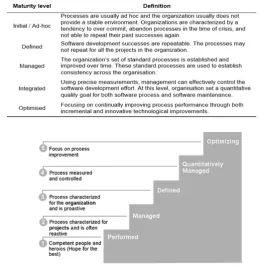
[image:3.612.174.434.436.705.2]Over the recent years, an interest over maturity models have increased in such way that maintaining a maturity model supports organisations in becoming more mature (Khoshgoftar and Osman, 2009). Andersen and Jessen (2003) definition of maturity is the quality or state of being mature. Jugdev and Thomas (2002) pointed out that the main advantages of a maturity model is that it allows to recognize strengths, weaknesses, and benchmarking information for projects and organisations. However, maturity models also possesses a set of limitations, from a theoretical perspective in specific (Dakhil and Alshawi, 2014; Jugdev and Thomas, 2002). Existing literature shows that a set of maturity models have been used to assess organisations (Khoshgoftar and Osman, 2009). The Software Engineering Institute (SEI) developed the CMM, which is based on a software development process (SEI, 1993). Six models have been created from this development, but lately it has been integrated into a holistic maturity model that has been named by the CMMI. This Model includes 5 levels of maturities which are explained in Table 1 (SEI. 1993).
Figure 1- Capability Maturity Model Integration (CMMI) (Chrissis et al., 2003)
There is a need of having an integrated maturity model or assessment tool to analyse the performance of both BIM and Lean approaches together. Since most of the existing maturity models in relation to BIM and Lean have adopted the Capability Maturity Model Integration (CMMI) approach, therefore, CMMI should also be adopted when introducing the integrated BIM and Lean maturity model (Chrissis et al., 2003). Based on the CMM levels, an evolution of a maturity model was developed which includes 5 levels as explained in Figure 1 (Chrissis et al., 2003). By reviewing literature, the authors have selected only a few BIM and Lean maturity models which are most relevant to the context of this study.
2.2BIMMATURITIES
According to Eastman et al. (2011, p.16) “BIM is a fundamentally different way of creating, using, and sharing building information lifecycle data”. BIM provides many benefits to the whole projects lifecycle as “BIM facilitates a more integrated design and construction process” and thus this “results in better quality buildings at lower cost and reduced project duration” (Eastman et al., 2011).
Even though, BIM provides many benefits, to gain the true benefits of its adoption, individuals along with organizations should have the right knowledge to first use it and then to assess their performance of its usage (Smits et al., 2016). Additionally, due to different size and/or project types of companies, the BIM implementation level in organisations vary from one to another. Therefore, organisations need to consider the importance of adopting BIM maturity models and assessments based on the current available BIM maturity assessments (Chen et al., 2014; Succar, 2009).
There are many different BIM Maturities. Nevertheless, Most of the current BIM maturities follow the CMMI, since it is more relevant and related to the background of BIM than rest of the maturity types (Aboumoemen & Underwood, 2017, Dakhil & Alshawi, 2014). Bilal Succar (2010) defines BIM maturity as a state of the quality, repeatability and degree of excellence of a BIM model within a BIM capability. Succar developed a ranking system, namely Building Information Modelling Maturity (BIMM) that incorporates the essential parts for delivering BIM applications through an operational process. Several models have been developed by Industry practitioners and academics to assess construction industry’s BIM performance and implementations (Giel and Issa, 2013; Nepal et al., 2014; Succar, 2010). BIM maturities are developed to measure efficiency of BIM competencies and capabilities across a set of construction industries (Aboumoemen & Underwood, 2017).
2.3.1 Bilal Succar BIM Maturity Matrix Index
[image:5.612.127.506.169.282.2]The BIM Maturity Matrix Index- (BIMMI) has been developed by Succar (2009) that is driven from the CMM. BIM framework components are combined on an information tool through performance improvement measurements, which justifies reason for development of the BIMMI. BIM Maturity levels can be demonstrated from Figure 2 below.
Figure 2 - The Five Maturity Levels (Succar, 2009)
2.3.2 The U.S National Institute of Building Sciences BIM Model (NIBS)
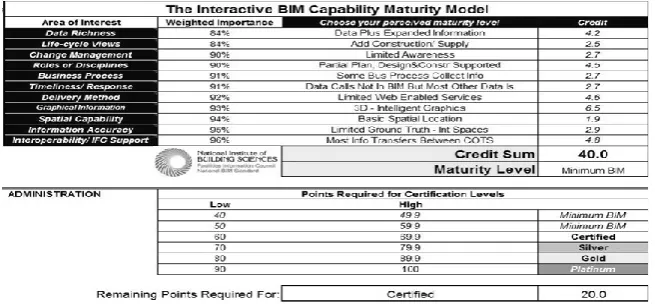
[image:5.612.143.471.487.639.2]The U.S National Institute of Building Sciences (NIBS) developed the interactive BIM standard Capability Maturity Model (CMM), which incorporates areas of a BIM model such as Data richness, and the information related to its area of interest. A weighting importance is provided to each area of interest to distinguish them, which are classified consequently. A description of the maturity level is given to understand what they mean so the users expected to complete the assessment are to select the necessary levels, and then a score is given to each interest area that adds up to deliver the total sum of the maturity level. A certification level is demonstrated and points required to be achieved is displayed which allows organisations to see which maturity levels they fall under, where if it did not reach the minimum level, then how many points are required to reach the required level (NIBS. 2007) as shown in Figure 3.
3.1
LEAN
MATURITY
In the past 20 years, the construction industry has recognised the importance of adopting new approaches and principles to reduce waste and thus improve overall project productivity and performances (Egan, 1998; Latham 1994). Lean construction is recognised as one of the key approaches to improve the construction productivity by reducing waste (Egan, 1998; Mollasalehi et al., 2016). It was stated by Lehman & Reiser (2004) “lean construction is a project delivery system based on Lean Production Management process, which is aimed at improving value by satisfying customer needs and improving performance”. However, to understand the potential benefits of Lean and to achieve its true value, organisations need to measure and assess their lean implementation performances. This could be done through Lean maturity assessments and models. In recent years there is an increased level of interest in lean maturity models (Becker, et al., 2010). Lean Maturity models aim to manage the major revolution changes by defining directions, prioritising improvement opportunities, and guide cultural changes (Nesensohn, et al., 2014). Based on the review of Lean maturity assessments by Urban (2015), there are different types of Lean maturity assessments which adopt different approaches to assessing Lean maturity. These studies include: Lean Enterprise Self-Assessment Tool (LESAT) by Nightingale & Mize (2002), Lean Production check-list by Sánchez & Pérez (2001), Lean Construction Maturity Model (LCMM) by Nesensohn et al. (2014), Lean Manufacturing Performance Evaluation Audit by Donovan (2015), and Lean Index by Ray et al. (2006). Based on the above mentioned studies, two Lean Maturity assessments have been chosen in this paper which are most relevant in this context.
3.1.1 Lean Enterprise Self-Assessment Tool (LESAT)
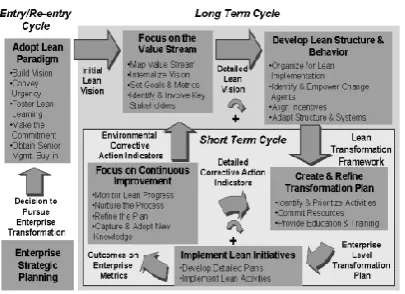
[image:6.612.206.409.532.679.2]Massachusetts Institute of Technology (MIT) assessment tool is one of the broadest system in business level invented by “Lean Aerospace Initiative” (Nightingale & Mize, 2002). As a supporter for MIT assessment tool, Enterprise Level Roadmap as shown in Figure 4, was developed to complete overall process of lean implementation. Entry/Re-entry cycle, Long Term cycle, and Short Term cycle are the main activities in the transition road map which support lean transformation.
To complete the model, LESAT was proposed by LAI to support the model. There were five maturity statements in the LESAT Maturity, ranging from least capable (Level 1) to world-class (Level 5) (Nightingale & Mize, 2002). Main characteristics of each level has been described in Table 2 below.
Table 2 - LESAT defined (Nightingale & Mize, 2002)
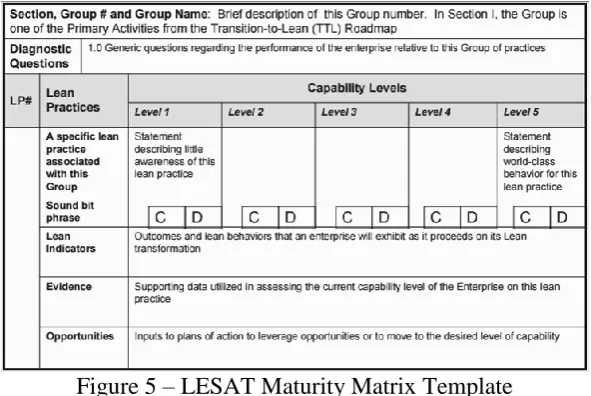
Although there are several models available for lean management, the completed model is developed by Lean Aerospace Initiative (LAI) which clearly defines principal activities and leading tasks as well as helpful enablers and instruments. The analysis of Hallam (2003) indicated that, thirty-one UK and USA industries have implemented LESAT. LESAT helps them to determine the current status of lean through an assessment process. However, like most of other available lean models, LAI’s assessment relies on internal and external relations and strategic issues from the enterprise perspectives. A template of LESAT Maturity matrix is shown in Figure 5.
Figure 5 – LESAT Maturity Matrix Template
3.1.2 Lean Construction Maturity Model
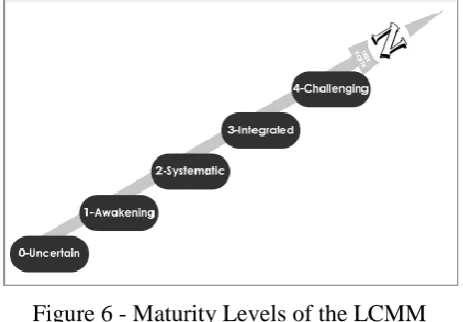
[image:7.612.167.463.441.639.2]60 defined Behaviours, Goals & Practices with 75 Ideal Statements to measure the maturity within organisations, which would provide essential support and guidance to the lean adoption in organisations (Nesensohn et al., 2014). Five maturity levels that are shown in Figure 6 measure the deviation between the Ideal Statement and the current state of the assessed organisation (Nesensohn et al., 2014). Each maturity level is defined in Table --- which are used to assess the project.
[image:8.612.169.449.379.488.2]Figure 6 - Maturity Levels of the LCMM
Table 3 - Definition of the Maturity Levels
3.1ANINTEGRATEDBIMANDLEANMATURITYMODEL(IDEAL)
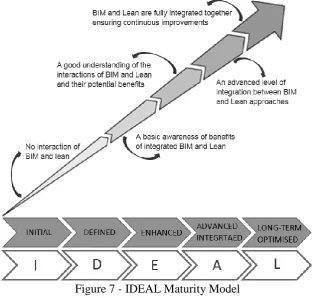
but it also considers the maturity level of these approaches collectively together. Firstly, by reviewing BIM and Lean maturity models separately, the authors extracted the main features and beneficial aspects of each model. Then, based on the findings from reviewing the maturity models and also the interaction between BIM and Lean approaches, the IDEAL model was developed. Each level in the IDEAL maturity model is described and defined in detail in relation to Figure 5 which can be demonstrated from Table 4. This IDEAL maturity model would enhance analysis of the projects’ performances where BIM and Lean approaches are implemented together. Therefore, the performance of these two approaches would be analysed and assessed to better realisation of their benefits.
CONCLUSION
It has been recognised that there is a need for an integrated BIM and Lean maturity model to assess the performances of projects that implement both BIM and Lean together. As the aim of this paper was to propose an integrated BIM and Lean maturity model, a review of the existing maturity models and assessments were conducted for BIM and Lean individually. Thus, this paper adopted some of the initial concepts of the current BIM and Lean maturity levels and then through looking at the interaction of the BIM and Lean, an integrated BIM and Lean maturity model was proposed.
This paper proposes a maturity model named “IDEAL” which aims to assess and analyse the performances of the projects that are implementing BIM and Lean together. This IDEAL model comprises of five main levels which are in line with the level of integration of BIM and Lean. Therefore, the performance of these two approaches could be analysed and assessed through this proposed model to better realisation of their benefits.
This paper proposes this model, but the next stage of this study is to then validate this proposed model in a real-life construction project. So, the authors of this paper would recommend the use of the IDEAL maturity model in construction projects to both validate the model and assess their performances in relation to the adoption of integrated BIM and Lean. Also, it is recommended to examine and investigate the usage of the IDEAL model amongst the projects to better identify its benefits.
REFERENCES
Aboumoemen, A. & Underwood, J. (2017). A Level 2 BIM Maturity-KPI Assessment: Literature Review. 13th International Postgraduate Research Conference (IPGRC 2017), 14-15 September 2017, Salford, UK.
Andersen, E. S., & Jessen, S. A. (2003). Project maturity in organisations. International Journal of Project Management, 21(6), 457–461. doi: 10.1016/S0263-7863(02)00088-1
Azhar, S. (2011). Building information modeling (BIM): Trends, benefits, risks, and challenges for the AEC industry. Leadership and management in engineering, 11(3), 241-252. doi: 10.1061/(ASCE)LM.1943-5630.0000127
Becker, J., Niehaves, B., Pöppelbuß, J. & Alexander, S., 2010. Maturity Models in IS ResearcH. Pretoria., s.n.
Chen, Y., Dib, H., & F. Cox, R. (2014). A measurement model of building information
modelling maturity. Construction Innovation, 14(2), 186-209.
Chrissis, M. B., Konrad, M., & Shrum, S. (2003). CMMI guidelines for process integration and product improvement: Longman Publishing Co., Inc.
Dakhil, A., & Alshawi, M. (2014). BIM Benefits-Maturity Relationship from Client Perspective. Information and Knowledge Management, 4(9), 8–16.
Egan, J. (1998). Rethinking Construction. Construction Task Force Report for Department of the Environment, Transport and the Regions. DETR, London.
Giel, B., & Issa, R. R. (2013). Synthesis of existing BIM maturity toolsets to evaluate building owners. Computing in Civil Engineering, 451–458. doi: 10.1061/9780784413029.057
Hallam, C. R. A., 2003. Lean enterprise self-assessment as a leading indicator for accelerating transformation in the aerospace industry. MIT, USA.
Jugdev, K., & Thomas, J. (2002). Project management maturity models: The silver bullets of competitive advantage. Project Management Institute, Project Management Journal, 33(4), 4–14.
Khoshgoftar, M., & Osman, O. (2009). Comparison of Maturity Models School of Housing, Building and Planning. Computer Science and Information Technology. 2nd IEEE International Conference, 297–301. doi:10.1109/ICCSIT.2009.5234402
Latham, S. M. (1994). Constructing the team.
Lehman, T., & Reiser, P. (2004). Maximizing Value & Minimizing Waste–Value Engineering & Lean Construction. In Proceedings of SAVE International Conference, USA.
LESAT, 2001. Lean Enterprise Self-Assessment Tool - Facilitator’s Guide. Lean Aerospace Initiative - Massachusetts Institute of Technology.
Mollasalehi, S., Fleming, A., Talebi, A., & Underwood, J. (2016). Development of an Experimental Waste Framework Based on BIM/Lean Concept in Construction Design. In Proceedings of the 24th IGLC. Boston, USA.
Nepal, M. P., Jupp, J. R., & Aibinu, A. A. (2014). Evaluations of BIM: frameworks and perspectives. Computing in Civil and Building Engineering (2014), 769-776. doi: 10.1061/9780784413616.096
Nesensohn, C., Bryde, D., Ochieng, E. & Fearon, D., 2014. Maturity and Maturity Models in Lean Construction. Australasian Journal of Construction, 14(1), p 45-59. NIBS. (2007). United States National BIM Standards Version 1 – Part 1: Overview,
principles and Methodologies. Washington, DC.
Nightingale, D. J., & Mize, J. H. (2002). Development of a lean enterprise transformation maturity model. Information Knowledge Systems Management, 3(1), 15-30.
Sacks, R., Koskela, L., Dave, B. A., and Owen, R. (2010). Interaction of lean and building information modeling in construction. Journal of construction engineering and management 136(9), 968-980.
SEI. (1993) Key Practices of the Capability Maturity Model, Version 1.1, Software Engineering Institute.
Succar, B. (2009). Building information modelling framework: a research and delivery foundation for industry stakeholders. Automation in Construction, 18(3), 357–375. doi:10.1016/j.autcon.2008.10.003
Succar, B. (2013). BIM: conceptual constructs and performance improvement tools. School of Architecture and Built Environment Faculty of Engineering and Built Environment University of Newcastle.
Smits, W., Buiten, V. M., & Hartmann, T. (2016). Yield-to-BIM: impacts of BIM maturity on project performance. Building Research & Information, 1-11. doi: 10.1080/09613218.2016.1190579