Functional constraint and small insertions and deletions in the
ENCODE regions of the human genome
Taane G Clark
¤
*
, Toby Andrew
¤
*
, Gregory M Cooper
†
, Elliott H Margulies
‡
,
James C Mullikin
‡
and David J Balding
*
Addresses: *Department of Epidemiology and Public Health, Imperial College, Norfolk Place, London, W2 1PG, UK. †Department of Genetics,
Stanford University, Stanford, California 94305, USA. ‡National Human Genome Research Institute, National Institutes of Health, 9000
Rockville Pike, Bethesda, Maryland 20892, USA.
¤ These authors contributed equally to this work.
Correspondence: Taane G Clark. Email: [email protected]
© 2007 Clark et al; licensee BioMed Central Ltd.
This is an open access article distributed under the terms of the Creative Commons Attribution License (http://creativecommons.org/licenses/by/2.0), which permits unrestricted use, distribution, and reproduction in any medium, provided the original work is properly cited.
Indels in the human genome
<p>Indel rates were observed to be reduced approximately twenty-fold in exonic ENCODE regions, five-fold in sequence that exhibits high evolutionary constraint in mammals and up to two-fold in some classes of regulatory elements.</p>
Abstract
Background: We describe the distribution of indels in the 44 Encyclopedia of DNA Elements (ENCODE) regions (about 1% of the human genome) and evaluate the potential contributions of small insertion and deletion polymorphisms (indels) to human genetic variation. We relate indels to known genomic annotation features and measures of evolutionary constraint.
Results: Indel rates are observed to be reduced approximately 20-fold to 60-fold in exonic regions, 5-fold to 10-fold in sequence that exhibits high evolutionary constraint in mammals, and up to 2-fold in some classes of regulatory elements (for instance, formaldehyde assisted isolation of regulatory elements [FAIRE] and hypersensitive sites). In addition, some noncoding transcription and other chromatin mediated regulatory sites also have reduced indel rates. Overall indel rates for these data are estimated to be smaller than single nucleotide polymorphism (SNP) rates by a factor of approximately 2, with both rates measured as base pairs per 100 kilobases to facilitate comparison.
Conclusion: Indel rates exhibit a broadly similar distribution across genomic features compared with SNP density rates, with a reduction in rates in coding transcription and evolutionarily constrained sequence. However, unlike indels, SNP rates do not appear to be reduced in some noncoding functional sequences, such as pseudo-exons, and FAIRE and hypersensitive sites. We conclude that indel rates are greatly reduced in transcribed and evolutionarily constrained DNA, and discuss why indel (but not SNP) rates appear to be constrained at some regulatory sites.
Background
Insertion-deletion polymorphisms (indels) have to date received less attention in the study of sequence variation than
have single nucleotide polymorphisms (SNPs), despite their frequency (estimated at approximately 16% to 25% of all sequence polymorphism events) and their potential
Published: 4 September 2007
Genome Biology 2007, 8:R180 (doi:10.1186/gb-2007-8-9-r180)
Received: 15 November 2006 Revised: 4 September 2007 Accepted: 4 September 2007 The electronic version of this article is the complete one and can be
functional importance [1]. 5' Untranslated regions (UTRs) and gene coding regions have previously been observed to have lower indel rates compared with other regions, suggest-ing that the constraint may have arisen because of negative selection [2]. In general, indels that give rise to frame shifts in coding sequence are more disruptive than non frame-shifts and single point mutations, because of third base degeneracy [3]. As a result, coding sequence indels tend to have lengths that are multiples of three, whereas regulatory sequences tend to have more frequent indels that occur in distinct blocks [4]. The majority of indels are di-allelic and small, with allele length differences of relatively few (one to four) nucleotides [2,5,6]. Given their frequency, small indels could play an important role in contributing to phenotypic differences in humans, including susceptibility to diseases. It is therefore of interest to characterize indel distribution across the human genome, and to integrate indels into SNP marker maps in order to aid in the identification of natural genetic variation.
Recent theoretical work has considered the distribution of indels under neutrality and exploited the evolutionary imprint of sequence indels in order to pinpoint functional DNA regions that are subject to purifying selection [7]. Snir and Pachter [8] used Encyclopedia of DNA Elements (ENCODE) data and multiple primate sequences to study indel events between species. This work suggests that indel rates genome wide are not uniform and that indel events are not neutral; in particular, the work has identified indel hotspots in the human genome. A minority of insertions and deletions may also have plausibly played a major role in spe-ciation events, including human-chimpanzee phenotypic dif-ferences [9,10]. An investigation of 2,000 human di-allelic indels found that the majority were monomorphic in chim-panzees and gorillas, indicating that most indels have arisen after the most recent common primate ancestor [6] and are lineage specific [5].
We used the small insertion and deletion ENCODE data [11] to address four questions. First, do the 14 manually selected regions have lower insertion and deletion rates compared with the 30 randomly selected regions? This might be expected to be the case if the selection process [12] for the manually selected ENCODE regions of interest were biased toward regions with greater density of genes or genes of evo-lutionary importance, with greater functional and evolution-ary constraints. Second, do indel rates vevolution-ary by genomic annotation feature (in turn reflecting varying levels of func-tional constraint)? Indels that arise in coding sequence are more likely to be deleterious and therefore subject to purify-ing selection. As a result, DNA sequences that encode pro-teins might be expected to have some of the lowest genomic indel rates, followed by a wide variety of functional features that are believed to regulate gene expression via an increasing number of previously unrecognized mechanisms [13-17].
Third, are indel rates negatively correlated with measures of evolutionary constraint? We expect indel rates to be nega-tively associated with evolutionary constraint scores (see Materials and methods, below) where DNA sequences are subject to purifying selection. To address this question, we also correlated indel rates with ancestral repeat (AR) sequence. AR sequences are mobile elements that inserted before the common ancestor of most mammals and have sub-sequently become inactive [18]. ARs are considered to be pre-dominantly neutral sequences (not subject to purifying selection) and hence we would anticipate indels to accumu-late in AR sequence regions with relatively little or no con-straint. Based on the assumption that new indels have arisen in AR regions in the past at the same rate as elsewhere in the genome, observed indel rates might be expected to be posi-tively correlated with AR sequence rates.
The fourth question we consider is how do ENCODE indel rates compare with SNP rates across genomic features and evolutionary constrained sequence?
Here we describe the distribution of small indels (ranging from 1 to 20 base pairs [bp]) in the manually and randomly selected ENCODE regions, their distribution in relation to genomic annotation features, and their relationship with measures of evolutionary constraint.
Results
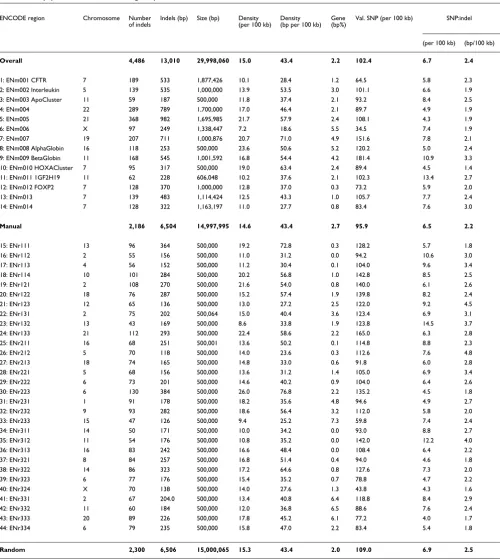
All identified small indels (n = 4486) in the ENCODE regions were mapped onto physical coordinates for ENCODE func-tional features. The average indel length of identified small indels is 2.8 bp, ranging from 1 to 20 bp. The overall density is on average 15 indels per 100 kilobases (kb; 99% confidence interval [CI] 13.4 to 16.7) or, in terms of total indel length, 43.4 bp per 100 kb (99% CI 38.3 to 49.1). All results in Tables 1 to 3 are presented in two ways: as numbers of indel events (indels per 100 kb) and total indel length (indel bp per 100 kb). In the interests of brevity, indel rates are referred to in the text to as indel bp per 100 kb unless stated otherwise. This also facilitates comparison with SNP rates.
There are no substantial differences in indel or gene density between manually and randomly selected regions (Table 1). The indel rates in manual regions are similarly variable (sdnum/100 kb = 5.0 number of indels per 100 kb; sdbp/100 kb = 14.7 indel bp per 100 kb, where sdnum/100 kb and sdbp/100 kb refer to the standard deviation for number of indels and indel bp per 100 kb, respectively) to those in random regions (sdnum/
100 kb = 4.0; sdbp/100 kb = 14.0), with no significant differences
in the summary data (F[13,29] = 1.52, P = 0.34).
Table 1
Indel density (for all 44 ENCODE regions)
ENCODE region Chromosome Number
of indels
Indels (bp) Size (bp) Density (per 100 kb)
Density (bp per 100 kb)
Gene (bp%)
Val. SNP (per 100 kb) SNP:indel
(per 100 kb) (bp/100 kb)
Overall 4,486 13,010 29,998,060 15.0 43.4 2.2 102.4 6.7 2.4
1: ENm001 CFTR 7 189 533 1,877,426 10.1 28.4 1.2 64.5 5.8 2.3
2: ENm002 Interleukin 5 139 535 1,000,000 13.9 53.5 3.0 101.1 6.6 1.9
3: ENm003 ApoCluster 11 59 187 500,000 11.8 37.4 2.1 93.2 8.4 2.5
4: ENm004 22 289 789 1,700,000 17.0 46.4 2.1 89.7 4.9 1.9
5: ENm005 21 368 982 1,695,985 21.7 57.9 2.4 108.1 4.3 1.9
6: ENm006 X 97 249 1,338,447 7.2 18.6 5.5 34.5 7.4 1.9
7: ENm007 19 207 711 1,000,876 20.7 71.0 4.9 151.6 7.8 2.1
8: ENm008 AlphaGlobin 16 118 253 500,000 23.6 50.6 5.2 120.2 5.0 2.4
9: ENm009 BetaGlobin 11 168 545 1,001,592 16.8 54.4 4.2 181.4 10.9 3.3
10: ENm010 HOXACluster 7 95 317 500,000 19.0 63.4 2.4 89.4 4.5 1.4
11: ENm011 1GF2H19 11 62 228 606,048 10.2 37.6 2.1 102.3 13.4 2.7
12: ENm012 FOXP2 7 128 370 1,000,000 12.8 37.0 0.3 73.2 5.9 2.0
13: ENm013 7 139 483 1,114,424 12.5 43.3 1.0 105.7 7.7 2.4
14: ENm014 7 128 322 1,163,197 11.0 27.7 0.8 83.4 7.6 3.0
Manual 2,186 6,504 14,997,995 14.6 43.4 2.7 95.9 6.5 2.2
15: ENr111 13 96 364 500,000 19.2 72.8 0.3 128.2 5.7 1.8
16: ENr112 2 55 156 500,000 11.0 31.2 0.0 94.2 10.6 3.0
17: ENr113 4 56 152 500,000 11.2 30.4 0.1 104.0 9.6 3.4
18: ENr114 10 101 284 500,000 20.2 56.8 1.0 142.8 8.5 2.5
19: ENr121 2 108 270 500,000 21.6 54.0 0.8 140.0 6.1 2.6
20: ENr122 18 76 287 500,000 15.2 57.4 1.9 139.8 8.2 2.4
21: ENr123 12 65 136 500,000 13.0 27.2 2.5 122.0 9.2 4.5
22: ENr131 2 75 202 500,064 15.0 40.4 3.6 123.4 6.9 3.1
23: ENr132 13 43 169 500,000 8.6 33.8 1.9 123.8 14.5 3.7
24: ENr133 21 112 293 500,000 22.4 58.6 2.2 165.0 6.3 2.8
25: ENr211 16 68 251 500,001 13.6 50.2 0.1 114.8 8.8 2.3
26: ENr212 5 70 118 500,000 14.0 23.6 0.3 112.6 7.6 4.8
27: ENr213 18 74 165 500,000 14.8 33.0 0.6 91.8 6.0 2.8
28: ENr221 5 68 156 500,000 13.6 31.2 1.4 105.0 6.9 3.4
29: ENr222 6 73 201 500,000 14.6 40.2 0.9 104.0 6.4 2.6
30: ENr223 6 130 384 500,000 26.0 76.8 2.2 135.2 4.5 1.8
31: ENr231 1 91 178 500,000 18.2 35.6 4.8 94.6 4.9 2.7
32: ENr232 9 93 282 500,000 18.6 56.4 3.2 112.0 5.8 2.0
33: ENr233 15 47 126 500,000 9.4 25.2 7.3 59.8 7.4 2.4
34: ENr311 14 50 171 500,000 10.0 34.2 0.0 93.0 8.8 2.7
35: ENr312 11 54 176 500,000 10.8 35.2 0.0 142.0 12.2 4.0
36: ENr313 16 83 242 500,000 16.6 48.4 0.0 108.4 6.4 2.2
37: ENr321 8 84 257 500,000 16.8 51.4 0.4 94.0 4.6 1.8
38: ENr322 14 86 323 500,000 17.2 64.6 0.8 127.6 7.3 2.0
39: ENr323 6 77 176 500,000 15.4 35.2 0.7 78.8 4.7 2.2
40: ENr324 X 70 138 500,000 14.0 27.6 1.3 43.8 4.3 1.6
41: ENr331 2 67 204.0 500,000 13.4 40.8 6.4 118.8 8.4 2.9
42: ENr332 11 60 184 500,000 12.0 36.8 6.5 88.6 7.6 2.4
43: ENr333 20 89 226 500,000 17.8 45.2 6.1 77.2 4.0 1.7
44: ENr334 6 79 235 500,000 15.8 47.0 2.2 83.4 5.4 1.8
Random 2,300 6,506 15,000,065 15.3 43.4 2.0 109.0 6.9 2.5
Manual (regions 1-14; each approx. 500 kb-2 MB) and random (regions 15-44 each approx. 500 kb) selected ENCODE regions are defined [12] as: Manual: genomic regions with well studied genes and availability of comparative sequence
Random: selected randomly across the genome, stratified by gene density and non-exonic conservation
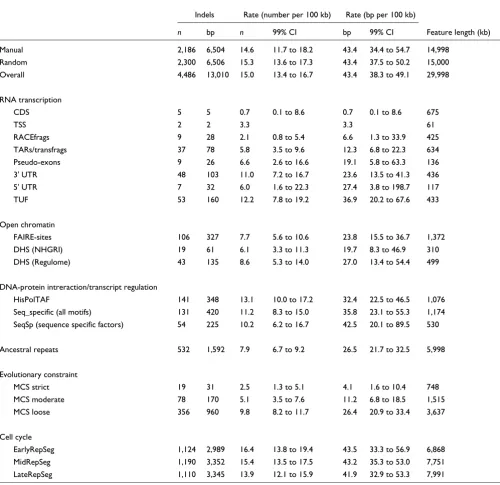
exhibit a significant reduction in indel rates, as assessed by identifying open reading frames (coding sequence [CDS] mean indel rate: 0.7 bp per 100 kb), transcription start sites (TSSs; 3.3 bp per 100 kb), rapid amplification of cDNA ends fragments (RACEfrags; 6.6 bp per 100 kb), and transcribed fragments (12.3 bp per 100 kb). Pseudo-exons (19.1 bp per 100 kb), 3' UTRs (23.6 bp per 100 kb), 5' UTRs (27.4 bp per 100 kb), and transcripts of unknown function (36.9 bp per 100 kb) all exhibit a reduction in indel rates compared with
the overall mean for all ENCODE sequence, but these findings are not statistically significant.
[image:4.612.58.558.117.602.2]Potential regulatory elements, assessed by measuring open chromatin sites, also reveal sequences with constrained indel rates (Table 2). Formaldehyde assisted isolation of regulatory elements (FAIRE) sites (23.8 bp per 100 kb) and DNAse hypersensitive sites (DHS; [NHGRI group] 19.7 bp per 100 kb and [Regulome group] 27.0 bp per 100 kb) both exhibit
Table 2
Indel density for annotation features (across all 44 ENCODE regions)
Indels Rate (number per 100 kb) Rate (bp per 100 kb)
n bp n 99% CI bp 99% CI Feature length (kb)
Manual 2,186 6,504 14.6 11.7 to 18.2 43.4 34.4 to 54.7 14,998
Random 2,300 6,506 15.3 13.6 to 17.3 43.4 37.5 to 50.2 15,000
Overall 4,486 13,010 15.0 13.4 to 16.7 43.4 38.3 to 49.1 29,998
RNA transcription
CDS 5 5 0.7 0.1 to 8.6 0.7 0.1 to 8.6 675
TSS 2 2 3.3 3.3 61
RACEfrags 9 28 2.1 0.8 to 5.4 6.6 1.3 to 33.9 425
TARs/transfrags 37 78 5.8 3.5 to 9.6 12.3 6.8 to 22.3 634
Pseudo-exons 9 26 6.6 2.6 to 16.6 19.1 5.8 to 63.3 136
3' UTR 48 103 11.0 7.2 to 16.7 23.6 13.5 to 41.3 436
5' UTR 7 32 6.0 1.6 to 22.3 27.4 3.8 to 198.7 117
TUF 53 160 12.2 7.8 to 19.2 36.9 20.2 to 67.6 433
Open chromatin
FAIRE-sites 106 327 7.7 5.6 to 10.6 23.8 15.5 to 36.7 1,372
DHS (NHGRI) 19 61 6.1 3.3 to 11.3 19.7 8.3 to 46.9 310
DHS (Regulome) 43 135 8.6 5.3 to 14.0 27.0 13.4 to 54.4 499
DNA-protein intreraction/transcript regulation
HisPolTAF 141 348 13.1 10.0 to 17.2 32.4 22.5 to 46.5 1,076
Seq_specific (all motifs) 131 420 11.2 8.3 to 15.0 35.8 23.1 to 55.3 1,174
SeqSp (sequence specific factors) 54 225 10.2 6.2 to 16.7 42.5 20.1 to 89.5 530
Ancestral repeats 532 1,592 7.9 6.7 to 9.2 26.5 21.7 to 32.5 5,998
Evolutionary constraint
MCS strict 19 31 2.5 1.3 to 5.1 4.1 1.6 to 10.4 748
MCS moderate 78 170 5.1 3.5 to 7.6 11.2 6.8 to 18.5 1,515
MCS loose 356 960 9.8 8.2 to 11.7 26.4 20.9 to 33.4 3,637
Cell cycle
EarlyRepSeg 1,124 2,989 16.4 13.8 to 19.4 43.5 33.3 to 56.9 6,868
MidRepSeg 1,190 3,352 15.4 13.5 to 17.5 43.2 35.3 to 53.0 7,751
LateRepSeg 1,110 3,345 13.9 12.1 to 15.9 41.9 32.9 to 53.3 7,991
reduced indel rates. DHS are short regions of DNA that are relatively easily cleaved by DNAse I.
Acetylated histones are usually associated with transcription-ally active chromatin and deacetylated histones with inactive chromatin. Hence, histone modified regions often signify reg-ulatory sites. Selected histone modifications and binding sites for RNA polymerase II and the general transcription factor TAF250 were assayed for the ENCODE regions (see ENCODE
Project Consortium [19] and Table 4 for details). These sites show modestly reduced indel rates (HisPolTAF: 32.4 bp per 100 kb), along with sites occupied by sequence specific bind-ing proteins (all motifs: 35.8 bp per 100 kb), but neither find-ing is statistically significant.
[image:5.612.57.555.116.601.2]Multi-species constrained sequence (MCS moderate; 11.2 bp per 100 kb) show greatly reduced indel rates (Table 2), similar to rates in coding regions. AR regions (26.5 bp per 100 kb)
Table 3
Comparison of indel and SNP density by ENCODE experimental features
Indels Validated SNPs
bp/100 kb 99% CI bp bp/100 kb
Manual 43.4 34.4 to 54.7 14,390 95.9
Random 43.4 37.5 to 50.2 16,343 109.0
Overall 43.4 38.3 to 49.1 30,733 102.4
RNA transcription
CDS 0.7 0.1 to 8.6 421 62.4
TSS 3.3 42 68.7
RACEfrags 6.6 1.3 to 33.9 278 65.4
TARs/transfrags 12.3 6.8 to 22.3 591 93.1
Pseudo-exons 19.1 5.8 to 63.3 132 96.9
3' UTR 23.6 13.5 to 41.3 370 84.8
3' UTR 27.4 3.8 to 198.7 97 83.2
TUF 36.9 20.2 to 67.6 423 97.6
Open chromatin
FAIRE-sites 23.8 15.5 to 36.7 1,232 89.8
DHS (NHGRI) 19.7 8.3 to 46.9 297 95.9
DHS (Regulome) 27.0 13.4 to 54.4 450 90.1
DNA-protein interaction/transcript regulation
HisPolTAF 32.4 22.5 to 46.5 850 79.0
Seq_specific (all motifs) 35.8 23.1 to 55.3 1,098 93.5
SeqSp (sequence specific factors) 42.5 20.1 to 89.5 421 79.4
Ancestral repeats 26.5 21.7 to 32.5 5,749 95.9
Evolutionary constraint
MCS strict 4.1 1.6 to 10.4 229 30.6
MCS moderate 11.2 6.8 to 18.5 667 44.0
MCS loose 26.4 20.9 to 33.4 2,052 56.4
Cell cycle
EarlyRepSeg 43.5 33.3 to 56.9 6,165 89.8
MidRepSeg 43.2 35.3 to 53.0 7,418 95.7
LateRepSeg 41.9 32.9 to 53.3 8,896 111.3
Table 4
Experimental feature definitions
Feature Term Definition
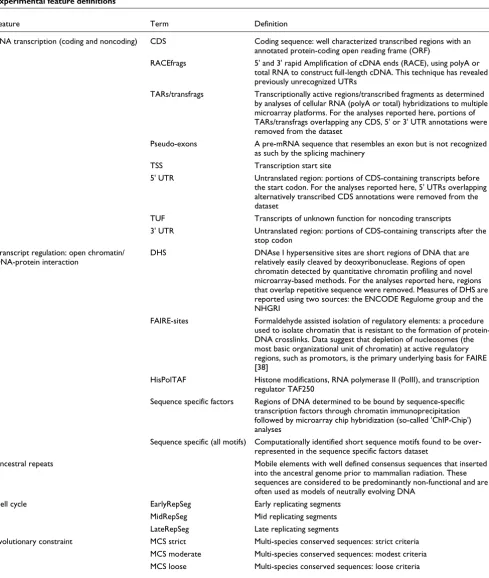
RNA transcription (coding and noncoding) CDS Coding sequence: well characterized transcribed regions with an annotated protein-coding open reading frame (ORF)
RACEfrags 5' and 3' rapid Amplification of cDNA ends (RACE), using polyA or total RNA to construct full-length cDNA. This technique has revealed previously unrecognized UTRs
TARs/transfrags Transcriptionally active regions/transcribed fragments as determined by analyses of cellular RNA (polyA or total) hybridizations to multiple microarray platforms. For the analyses reported here, portions of TARs/transfrags overlapping any CDS, 5' or 3' UTR annotations were removed from the dataset
Pseudo-exons A pre-mRNA sequence that resembles an exon but is not recognized as such by the splicing machinery
TSS Transcription start site
5' UTR Untranslated region: portions of CDS-containing transcripts before the start codon. For the analyses reported here, 5' UTRs overlapping alternatively transcribed CDS annotations were removed from the dataset
TUF Transcripts of unknown function for noncoding transcripts
3' UTR Untranslated region: portions of CDS-containing transcripts after the stop codon
Transcript regulation: open chromatin/ DNA-protein interaction
DHS DNAse I hypersensitive sites are short regions of DNA that are relatively easily cleaved by deoxyribonuclease. Regions of open chromatin detected by quantitative chromatin profiling and novel microarray-based methods. For the analyses reported here, regions that overlap repetitive sequence were removed. Measures of DHS are reported using two sources: the ENCODE Regulome group and the NHGRI
FAIRE-sites Formaldehyde assisted isolation of regulatory elements: a procedure used to isolate chromatin that is resistant to the formation of protein-DNA crosslinks. Data suggest that depletion of nucleosomes (the most basic organizational unit of chromatin) at active regulatory regions, such as promotors, is the primary underlying basis for FAIRE [38]
HisPolTAF Histone modifications, RNA polymerase II (PolII), and transcription regulator TAF250
Sequence specific factors Regions of DNA determined to be bound by sequence-specific transcription factors through chromatin immunoprecipitation followed by microarray chip hybridization (so-called 'ChIP-Chip') analyses
Sequence specific (all motifs) Computationally identified short sequence motifs found to be over-represented in the sequence specific factors dataset
Ancestral repeats Mobile elements with well defined consensus sequences that inserted into the ancestral genome prior to mammalian radiation. These sequences are considered to be predominantly non-functional and are often used as models of neutrally evolving DNA
Cell cycle EarlyRepSeg Early replicating segments
MidRepSeg Mid replicating segments LateRepSeg Late replicating segments
Evolutionary constraint MCS strict Multi-species conserved sequences: strict criteria
Indel rate versus MCS modest for human and 13 mammals Figure 1
Indel rate versus MCS modest for human and 13 mammals. Indel rate and multi-species constrained sequences (MCS modest) are both expressed as base pairs (bp) per 100 kilobases (kb). The solid line represents the fit from a cubic smoothing spline, whereas the dashed line is the fit from a robust linear regression.
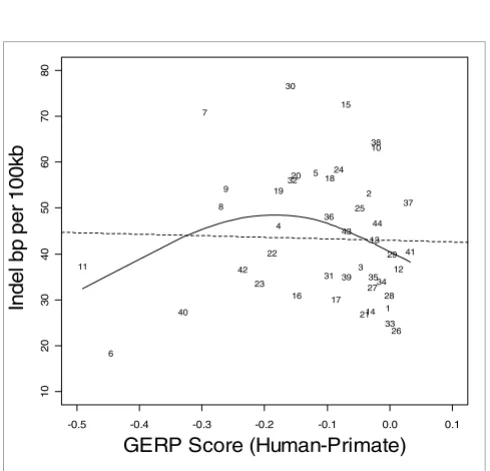
Indel rate versus GERP score comparing human and primates Figure 2
Indel rate versus GERP score comparing human and primates. Indel rate is expressed as base pairs (bp) per 100 kilobases (kb). The solid line represents the fit from a cubic smoothing spline, whereas the dashed line is the fit from a robust linear regression. GERP, genomic evolutionary rate profiling.
2000 4000 6000 8000 10000 12000 14000 10 20 30 40 50 60 70 80
MCS (moderate) bp per 100kb
In del bp per 100 kb 1 2 3 4 5 6 7 8 9 10 11 12 13 14 15 16 17 18 19 20 21 22 23 24 25 26 27 28 29 30 31 32 33 34 35 36 37 38 39 40 41 42 43 44
-0.5 -0.4 -0.3 -0.2 -0.1 0.0 0.1
10 2 0 30 40 50 60 70 80
GERP Score (Human-Primate)
Indel b p p er 10 0kb 1 2 3 4 5 6 7 8 9 10 11 12 13 14 15 16 17 18 19 20 21 22 23 24 25 26 27 28 29 30 31 32 33 34 35 36 37 38 39 40 41 42 43 44
[image:7.612.54.301.86.296.2]Indel rate versus all AR sequence rate Figure 3
Indel rate versus all AR sequence rate. Indel rate and ancestral repeat (AR) sequence rate are both expressed as base pairs (bp) per 100 kilobases (kb). The solid line represents the fit from a cubic smoothing spline, whereas the dashed line is the fit from a robust linear regression. Note that the same relationship is observed for indel rate versus long AR bp per 100 kb.
AR sequence rate versus MCS modest Figure 4
AR sequence rate versus MCS modest. Ancestral repeat (AR) sequence rate and multi-species conserved sequences (MCS modest) are both expressed as base pairs (bp) per 100 kilobases (kb). The solid line represents the fit from a cubic smoothing spline, whereas the dashed line is the fit from a robust linear regression.
10000 15000 20000 25000
1 0 20 30 4 0 50 6 0 7 0 80
AR bp per 100kb
In d e l bp p er 10 0k b 1 2 3 4 5 6 7 8 9 10 11 12 13 14 15 1617 18 19 20 21 22 23 24 25 26 27 28 29 30 31 32 33 34 35 36 37 38 39 40 41 42 43 44
2000 4000 6000 8000 10000 12000 14000
1 0 00 0 1 5 0 0 0 2 0 00 0 2 5 0 00
MCS (modest) bp per 100kb
[image:7.612.53.298.385.621.2] [image:7.612.310.555.395.660.2]also showed unexpectedly reduced indel rates. Cell cycle rep-licating segments (MidRepSeg: 43.2 bp per 100 kb) show no relationship with indel rates.
Figures 1 to 3 show the relationship between indel base pairs per 100 kb and measures of mammalian evolutionary con-straint, human-primate evolutionary concon-straint, and AR rates, with each data point representing a summary score for each ENCODE region. The Pearson correlation coefficients relating to Figures 1 to 3 are statistically insignificant when all of the ENCODE region summary data points are considered. However, when outlying data points are identified and excluded using standard regression diagnostics, the correla-tions are of marginal statistical significance. Indel rates are (nonsignificantly) inversely correlated with mammalian MCS score (Figure 1; r = -0.25, P = 0.11 with outlier ENCODE region 10 excluded), and negatively associated with the pri-mate genomic evolutionary rate profiling (GERP) score and GERP squared using multiple regression (Figure 2; multiple correlation coefficient: R = 0.32, P = 0.04). Indel rates are also observed to be marginally and negatively correlated with AR rates and AR squared (Figure 3; multiple correlation coef-ficient: R = -0.30, P = 0.06 with regions 8 and 15 identified as outliers).
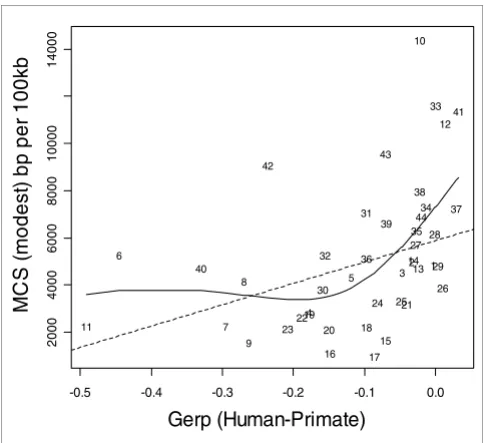
AR rates (bp per 100 kb) are strongly inversely correlated with MCS (Figure 4; r = -0.46, P < 0.002), but exhibit no rela-tion with either human-primate or human-mammal GERP scores (plots not shown; GERP primate: r = 0.02, P = 0.91; GERP mammal: r = -0.03, P = 0.8). MCS and GERP
con-straint scores are positively correlated with one another in a curvilinear relationship (Figure 5; r = 0.42, P = 0.005), with the homeobox gene family HOXA cluster, ENCODE region 10, identified as a highly conserved outlier region on the MCS but not an outlier on either of the GERP scores.
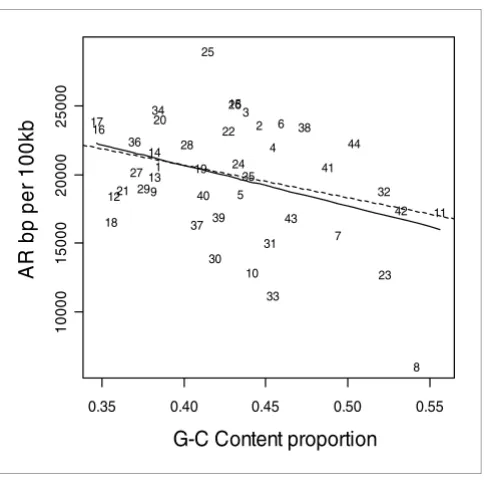
AR rates also exhibit a strong negative correlation with local GC content (Figure 6; r = -0.55, P = 0.001). Indel rates show an overall positive correlation with GC content for the ENCODE regions (Figure 7), which illustrates that indel rates may be confounded by local GC content. In order to check the effect of GC content on indel rates, we recalculated the results presented in Table 2 including GC content as a confounder. For example, although indel events per 100 kb in AR sequence is observed to be about 7.9 (99% CI 6.7 to 9.2; see Table 2), the mean rates are about 4.7 (99% CI 3.5 to 6.4) and about 10.4 (99% CI 8.6 to 12.4) for AR sequence with GC con-tent above 50% and GC concon-tent below 50%, respectively. However, the mean indel rates presented in Table 2 are not significantly altered when adjusted for local GC content at each annotational feature (data not presented).
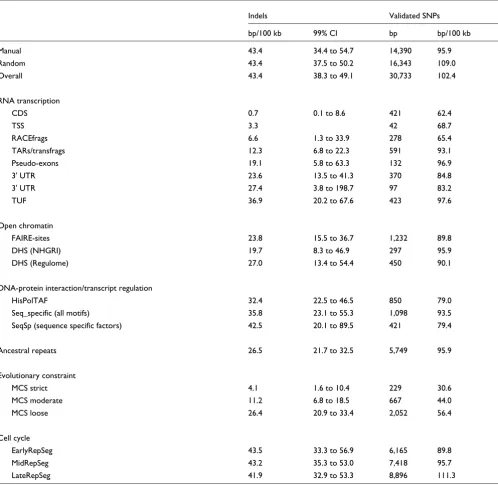
Table 3 compares the distribution of indel and validated SNP rates by experimental feature. In general, indel rates are lower than SNP rates, with a ratio of validated SNPs to indel event rates of 6.7 (102.4/15), or 2.4 (102.4/43.4) for validated SNPs:indel bp. The pattern of indel rates across genomic
[image:8.612.57.300.85.307.2]fea-MCS modest versus GERP human-primate score Figure 5
MCS modest versus GERP human-primate score. Multi-species conserved sequences (MCS modest) is expressed as base pairs (bp) per 100 kilobases (kb). The solid line represents the fit from a cubic smoothing spline, whereas the dashed line is the fit from a robust linear regression. GERP, genomic evolutionary rate profiling.
-0.5 -0.4 -0.3 -0.2 -0.1 0.0
2000 4000 6000 8 000 10000 14 000
Gerp (Human-Primate)
M
C
S
(
m
odes
t)
bp per
100k
b
1 2 3 4 5 6 7 8 9 10 11 12 13 14 15 16 17 18 19 20 21 22 23 24 25 26 27 28 29 30 31 32 33 34 35 36 37 38 39 40 41 42 43 44AR sequence rate versus GC content Figure 6
AR sequence rate versus GC content. Ancestral repeat (AR) sequence rate is expressed as base pairs (bp) per 100 kilobases (kb). The reduced local GC content observed in AR sequence reflects the process of deamination of methylated CpG to TpG dinucleotides in vertebrate sequence over long evolutionary periods of time [3]. The solid line represents the fit from a cubic smoothing spline, whereas the dashed line is the fit from a robust linear regression.
0.35 0.40 0.45 0.50 0.55
10 20 30 40 50 60 70 80
G-C Content proportion
Ind
e
l bp per
tures is broadly similar to SNP density. For example, as a per-centage of their respective overall means, the indel rates for MCS evolutionary constraints of strict, moderate, and loose are 10%, 26% and 61%, compared with 29%, 43% and 55% for SNP rates. Similarly, the indel and SNP rates are reduced for many transcribed sequences (CDS, TSS, and RACEfrags).
For some features, however, the pattern of constraint for indel and SNP rates differ quite markedly (Table 3). Although indel rates are constrained in chromatin mediated transcrip-tion regulatory sites (FAIRE: 23.8 bp per 100 kb; DHS: 19.7 to 27.0 bp per 100 kb), SNP rates are not constrained for these features (FAIRE: 90 SNPs per 100 kb; DHS: 90 to 96 SNPs per 100 kb) as compared with the overall mean (102.4 SNPs per 100 kb).
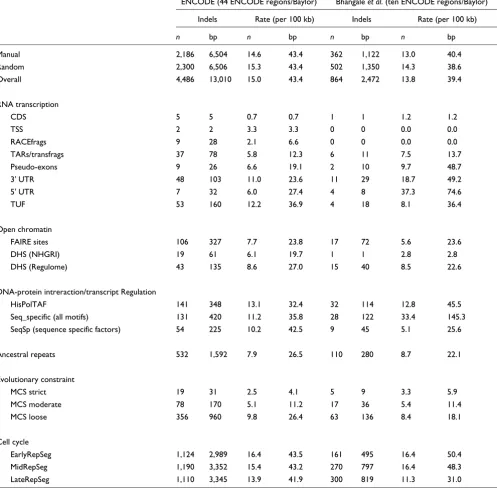
Table 5 compares indel rates by functional annotation for these data and the data presented by Bhangale and coworkers [20]. The overall indel rates are very similar for indel events (15 per 100 kb versus 13.8 per 100 kb for the data presented by Bhangale and coworkers [20]) and indel bp (43.4 bp per 100 kb versus 39.4 bp per 100 kb). The indel rates presented by Bhangale and coworkers [20] are also greatly reduced for coding DNA but not pseudo-exons or UTR sequence. Open chromatin indel rates are reduced in both datasets.
Discussion
This work represents the first systematic description of small insertion/deletion human polymorphism data in relation to
functional and evolutionary annotation, which complements larger scale structural variation data across the genome [2,21-24]. In order to understand the potential contribution made by indels to human genetic variation, we contrasted small indel rate variation by type of ENCODE region (manual or random selection), indel rates by functional annotation features, and indel rates by evolutionary constraint scores and neutral (AR) sequence; finally, we compared indel and SNP rates and their relative pattern of distribution across genomic features.
Overall, indel rates do not vary significantly between manual and randomly selected regions, suggesting that the ENCODE selection criteria for manual regions (the presence of well studied genes and availability of substantial comparative sequence) do not preclude similar genomic profiles for man-ual and random regions, with stratified randomly selected regions designed to be representative of a broad range of the genome [11].
Small indels are common and constitute approximately 15 insertions/deletions every 100 kb or, in terms of sequence length, 43 bp per 100 kb of the genome. The number of vali-dated common SNPs is observed to be about seven times the number of small indels (indels per 100 kb) or twice the observed indel bp rate (bp per 100 kb). Indel rates are greatly reduced in regions associated with known functionality (largely coding DNA) and under evolutionary constraint. Compared with the overall mean, indel event rates are reduced by factors of about 20 for exon coding regions, about 5 for strict MCS sequence, and about 2 for measures of chro-matin mediated regulatory sites. These observations are consistent with estimates from other studies [1,2,8]. The cor-responding reduction in indel rates for these data compared with bulk DNA and when measured as indel bp per 100 kb rather than indel events, about 60 (CDS), about 10 (strict MCS), and about 2 (FAIRE and DHS).
Approximately 5% of the ENCODE sequence is estimated to be subject to moderate evolutionary constraint across mam-malian species (Table 2), but only a minority of these con-strained sequences are estimated to overlap with known protein coding exons and their associated UTRs (about 40%). The majority either overlap with known noncoding functional features (20%) or are suspected to be associated with previ-ously unrecognized (40%) noncoding transcription [25].
As expected, coding (CDS, TSS, and RACEfrags) and con-strained sequence (MCS) show the most concon-strained indel rates, followed by noncoding transcripts (transcriptionally active regions/transcribed fragments) and regulatory fea-tures (FAIRE sites, DHS, and HisPolTaf). To the extent that indels arise in functional sequence, in general indels appear to be subject to purifying selection, with indel rates negatively correlated with past evolutionary constraint across mammal
[image:9.612.55.297.83.326.2]Indel rates versus GC content Figure 7
Indel rates versus GC content. Indel rate is expressed as base pairs (bp) per 100 kilobases (kb). The solid line represents the fit from a cubic smoothing spline, whereas the dashed line is the fit from a robust linear regression.
0.35 0.40 0.45 0.50 0.55
10000
15000
20000
25000
G-C Content proportion
A
R
bp per
100k
b
1
2 3
4
5 6
7
8 9
10
11 12
13 14
15 16
17
18
19 20
21
22
23 24
25
26
27 28
29
30 31
32
33 34
35 36
37
38
39 40
41
42 43
and primate sequences (MCS human-mammal and GERP human-primate scores; Figures 1 and 2).
An apparent exception to the negative relationship between indel rates and constraint score is the HOXA cluster
[image:10.612.61.558.130.618.2](ENCODE region 10), which runs counter to this trend. This region simultaneously exhibits the highest evolutionary con-straint in the comparison of mammalian sequence (MCS) and the third highest indel rate for all the ENCODE regions (Fig-ure 1). However, the HOXA cluster is in the centre of the
Table 5
Comparison of ENCODE and Bhangale et al. (ten ENCODE regions) indel data
ENCODE (44 ENCODE regions/Baylor) Bhangale et al. (ten ENCODE regions/Baylor)
Indels Rate (per 100 kb) Indels Rate (per 100 kb)
n bp n bp n bp n bp
Manual 2,186 6,504 14.6 43.4 362 1,122 13.0 40.4
Random 2,300 6,506 15.3 43.4 502 1,350 14.3 38.6
Overall 4,486 13,010 15.0 43.4 864 2,472 13.8 39.4
RNA transcription
CDS 5 5 0.7 0.7 1 1 1.2 1.2
TSS 2 2 3.3 3.3 0 0 0.0 0.0
RACEfrags 9 28 2.1 6.6 0 0 0.0 0.0
TARs/transfrags 37 78 5.8 12.3 6 11 7.5 13.7
Pseudo-exons 9 26 6.6 19.1 2 10 9.7 48.7
3' UTR 48 103 11.0 23.6 11 29 18.7 49.2
5' UTR 7 32 6.0 27.4 4 8 37.3 74.6
TUF 53 160 12.2 36.9 4 18 8.1 36.4
Open chromatin
FAIRE sites 106 327 7.7 23.8 17 72 5.6 23.6
DHS (NHGRI) 19 61 6.1 19.7 1 1 2.8 2.8
DHS (Regulome) 43 135 8.6 27.0 15 40 8.5 22.6
DNA-protein intreraction/transcript Regulation
HisPolTAF 141 348 13.1 32.4 32 114 12.8 45.5
Seq_specific (all motifs) 131 420 11.2 35.8 28 122 33.4 145.3
SeqSp (sequence specific factors) 54 225 10.2 42.5 9 45 5.1 25.6
Ancestral repeats 532 1,592 7.9 26.5 110 280 8.7 22.1
Evolutionary constraint
MCS strict 19 31 2.5 4.1 5 9 3.3 5.9
MCS moderate 78 170 5.1 11.2 17 36 5.4 11.4
MCS loose 356 960 9.8 26.4 63 136 8.4 18.1
Cell cycle
EarlyRepSeg 1,124 2,989 16.4 43.5 161 495 16.4 50.4
MidRepSeg 1,190 3,352 15.4 43.2 270 797 16.4 48.3
LateRepSeg 1,110 3,345 13.9 41.9 300 819 11.3 31.0
region and is surrounded by gene deserts with limited evi-dence of evolutionary constraint. Hence, the explanation for this potentially counterintuitive observation is probably that the indel polymorphisms are largely confined to the gene deserts, whereas the constrained sequence is confined to the central portion of the HOXA cluster.
AR sequence rates are negatively correlated with mammalian sequence constraint (MCS; Figure 5), which is expected because AR sequence is neutral and not subject to natural selection. However, AR is not associated with GERP human-primate and GERP human-mammal scores (data not shown), because AR sequence was defined and identified in relation to broad mammalian sequence comparisons and not specifically primate sequence.
Multi-species constrained scores for mammals (MCS modest) and GERP for human-primate comparisons are strongly neg-atively correlated (Figure 6). The nonlinear relationship also reflects the fact that relatively recent (human-primate) sequence constraint comparisons fail to discriminate between the shared, more highly conserved sequences, which are only observed using broader phylogenetic comparisons.
Indel and SNP rates do not vary by the timing of DNA sequence replication during S-phase (the synthesis of DNA in preparation for mitosis) when classified as early, mid, and late S-phase replication timing [19].
Based upon two assumptions, we anticipated AR sequence rates to be positively correlated with indel rates across the ENCODE regions. What we in fact observe is a negative cor-relation between AR and indel rates (Figure 3). This unex-pected result initially suggests that one or both of the assumptions may be false. The first assumption is that AR sequence is effectively functionless (and therefore neutral sequence), and the second is that indel mutations arise at the same rate in AR sequence as elsewhere in the genome. Although there is evidence that interspersed repeats in mam-malian genomes may acquire functional roles as both protein-coding and transcriptional regulatory regions, only about 5% of the total amount of nonexonic constrained sequence (GERP) in the ENCODE regions is estimated to overlap with AR sequence [26]. This indicates that most AR sequence is still likely to be neutral and, for the most part, is unlikely to be subject to selection. By contrast, a lack of uniform indel muta-tion rates across the genome is more plausible [8]. Just as nucleotide point mutation rates [27] and segmental duplica-tions [28] vary widely across the genome, it has been shown that the rate (and perhaps mechanism) of indel generation also varies widely across the genome [8].
Alternatively, the observed reduction in AR indel rates could in part arise from confounding caused by local GC content or experimental ascertainment bias. We observed AR rates to be negatively correlated with GC content (Figure 6; r = -0.55, P
= 0.001) and ENCODE indel rates to be positively correlated with GC content (Figure 7). The overall indel event rate when adjusted for mean centered GC content remains unaltered, at 15 events per 100 kb (99% CI 13.4 to 16.7), whereas AR indel rates are about 4.7 events (99% CI 3.5 to 6.4) and about 10.4 events (99% CI 8.6 - 12.4) for sequence with GC content above 50% and GC content below 50%, respectively. However, although indel rates are associated with local GC content, the latter only partly accounts for reduced AR indel rates, because the indel rate for AR with reduced GC content (10.4 per 100 kb for sequence with <50% GC content) is still lower than indel rates for bulk DNA (15 per 100 kb).
One final possibility for the observed indel rate reduction for these data in AR regions, could also be an artefact of the data generation process. Ascertainment bias could arise against AR sequence with common indels because of the nature of identifying ancestral repeats common to mammalian species. Indels arising in AR sequence would reduce the alignment score used to identify ancestral repeats, so that true AR con-taining indels would be less likely to be identified as AR. The problem could be exacerbated if indel rates are elevated in regions that have also experienced increased rates of indel changes throughout mammalian evolution (which is likely to be the case because lineage-specific rates of indel divergence between mammals are strongly correlated with genomic region). Both of these mechanisms would give rise to experi-mental artefact and apparent reduction in AR indel rates.
Some of the annotation features that show significantly reduced indel rates in this analysis also show reduced levels of nucleotide substitutions (for example, CDS, TSS, RACEfrags, and MCS), indicating that selective constraint is acting to both reduce SNP as well as indel density. However, other cat-egories such as noncoding transcription sites (transcription-ally active regions/transcribed fragments, pseudo-exons) and chromatin regulatory elements, as assessed by DHS (acti-vated cis-regulatory elements in mammalian genomes) and FAIRE sites, appear to show reduced indel rates, but not reduced SNP density. This observation is consistent with experimental data that show DNA regulation of nucleosome stability to be diffuse, cumulative across base pairs, and apparently on the scale of a single nucleosome, at about 200 bp [14]. In this context, indels may have important implica-tions for understanding genome function and variation, because chromatin composition plays a central role in regu-lating all DNA templated processes, including transcription, recombination, repair, and replication.
statistical approach to investigating the distribution of indels in relation to annotation features, in order to account for inherent uncertainty, both in terms of biology and experi-mental measurement error. We also used independent data from Bhangale and coworkers [20] to compare indel rates by functional annotation and evolutionary constraint. Table 5 shows similar overall rates and reduction in indel rates for coding sequence (CDS, TSS, and RACEfrags), but not for pseudo-exons or UTRs. The data from Bhangale and cowork-ers also show reduced rates for open chromatin features (FAIRE and hypersensitive sites).
The second potential limitation is that, for most of our analy-ses, we have used summary measures for each ENCODE region, and it is likely that some effects of interest in small sequences will therefore be overlooked. Nevertheless, rela-tively crude summary measures by region and annotation fea-ture still reveal clear trends between indel rates and indirect (experimental and computational) measures of functional and evolutionary constraint. We assessed the robustness of our results to various potential biases by conducting several sensitivity analyses. For instance, some of the encode regions (ENm010, ENm013, ENm014, ENr112, ENr113, ENr123, ENr131, ENr213, ENr232, and ENr321) were genotyped more intensively than others, but we found no evidence that these regions yielded substantially different results in our analyses. Indels are predominantly (58%) 1 bp in length, and we repeated analyses with only those indels with lengths in excess of 1 bp, and found that the trends in our analysis do not substantially alter (data not shown). We also repeated the analyses for insertions and deletions separately and reached the same conclusions.
Conclusion
Small indels that arise in functional sequence are likely to be subject to negative selection, as shown by the reduced indel rates in transcribed DNA, evolutionarily constrained sequence, and - to a lesser extent - regulatory elements. Although reduced indel and SNP rates are both clearly related to coding sequence constraints, constrained indel rates in regulatory regions may reflect that indels are more likely than SNPs to moderate the structural function of regulatory ele-ments. Indels may play a more important role than SNPs in contributing to natural genetic variation at regulatory sites, and hence they could be an important source of variation in gene expression levels.
Materials and methods
The ENCODE project aims to identify and catalog all func-tional elements, including coding sequences of genes and noncoding DNA, in the human genome. A pilot study phase considered 44 discrete regions that encompass 30 mega-bases, or about 1% of the human genome, with 14 of these regions (about 15 megabases) selected manually and the
remainder randomly [11]. Small indels in the ENCODE regions were called from shotgun re-sequencing reads and traces of the SNP discovery efforts from both the SNP consor-tium and the HapMap (see the report from the ENCODE Project Consortium [19] for details of discovery and valida-tion procedures). The shotgun technology used identified indels with a maximum length of 20 bp. Whole genome sequence data were generated totalling onefold coverage of the human genome from DNA derived from a pool of cell lines from eight unrelated adult African Americans (four male and four female) enrolled in Houston, Texas, USA [31]. The SSA-HADIP software package, a modification of SSAHASNP [32], was used to align these reads to build 35 of the human refer-ence sequrefer-ence, generating polymorphism calls, while keeping track of the total bases aligned for each read. In brief, the neighbourhood quality standard base alignment method was adapted to identify indels by requiring the inserted/deleted bases and the flanking five bases on either side of the indel to exceed a minimum Phred quality score of 22. If these minima were not met, then the indel was not reported.
For this study, indels and SNPs were called using the eight Baylor samples in order to facilitate comparison. Only vali-dated SNPs (those with heterozygosity scores) were used.
As part of the HapMap project [33], ten ENCODE regions had in-depth SNP discovery by polymerase chain reaction re-sequencing on 48 individuals in four populations; this dataset represents the deepest multi-megabase resequencing data currently available and is about three times as dense as phases I and II of the HapMap project. Experimental data, sequence conservation, and feature definitions were obtained from the three experimental groups of the ENCODE Consor-tium and the multiple sequence analysis group [19]. All data used in our work are available at the ENCODE project at Uni-versity of California, Santa Cruz [34] and are available from the corresponding author. The full set of ENCODE indels can be downloaded directly [35].
confidence intervals were generated using aggregate sum-mary measures across ENCODE regions, rather than raw data. The SNP densities correspond to a measure of heterozy-gosity (1 SNP per 100 kb, corresponds to a heterozyheterozy-gosity of 1 × 10⁻⁵).
Comparative sequence analysis has become a key bioinfor-matics tool for identifying noncoding functional DNA [37]. We use two derived scores that attempt to measure the rela-tive evolutionary constraint of DNA sequences: the lengths of MCSs determined from the multiple sequence alignments comparing human with 13 species of mammal [25], and rejected substitution or GERP scores from comparisons between humans and primates [26].
Evolutionarily constrained sequences were identified using three independent sequence conservation constraint pro-grams (binCons, phastCons, and GERP) for three different multiple sequence alignments generated using TBA, MLA-GAN, and MAVID for 14 mammalian species [25]. Each align-ment used human sequence as the reference. Three levels of MCS were defined: strict, in which sequences are constrained in all alignment/conservation combinations; moderate, in which sequences are constrained in at least two of three align-ments, and from two of three conservation programs; and loose, in which sequences are constrained in at least one alignment/conservation combination. We found results did not alter qualitatively between use of the three scores and we present results using moderate MCS in this report. Note that we refer to 'constrained' rather than 'conserved' sequence because conservation per se does not imply function, whereas constraint does. GERP identifies regions at high resolution that exhibit nucleotide substitution deficits, and measures these deficits as 'rejected substitutions'. Rejected substitu-tions reflect the intensity of past purifying selection and are used to rank and characterize constrained elements. GERP scores are positive in constrained regions and negative in neutral DNA [26], and MCS scores are high in constrained regions and low in neutral DNA [25].
To illustrate potential relationships between indel rates and constraint scores, summary data for the 44 ENCODE regions were plotted using cubic smoothing splines and robust linear regression using an M estimator [36]. The latter approach is robust to potential outliers but conservative. Potential out-liers were also identified using standard regression leverage-residual diagnostics [36], and we assessed the sensitivity of results to outlier removal using Pearson product moment correlation coefficients (r) and adjusted linear R2 statistics
(multiple correlation coefficient R).
Abbreviations
AR, ancestral repeat; bp, base pairs; CDS, coding sequence; CI, confidence interval; DHS, DNAse hypersensitive sites; ENCODE, Encyclopedia of DNA Elements; FAIRE,
Formal-dehyde assisted isolation of regulatory elements; GERP, genomic evolutionary rate profiling; HOXA, HOXA cluster (homeobox gene family); kb, kilobases; MCS, multi-species constrained sequence; RACEfrag, rapid amplification of cDNA ends fragment; SNP, single nucleotide polymorphism; TSS, transcription start site; UTR, untranslated region.
Authors' contributions
TC and TA analysed the indel data and wrote the manuscript. GC generated the evolutionary constraint scores and JM gen-erated the shotgun indel data. EM, GC, JM and DB provided detailed advice and commented on the text. All authors read and approved the final version of the manuscript.
Acknowledgements
We wish to thank all those within the ENCODE Consortium who have assisted directly and indirectly with this work, and Tushar Bhangale for providing data. TC was supported by the Medical Research Council (UK). TA is supported by the Department of Health.
References
1. Mills RE, Luttig CT, Larkins CE, Beauchamp A, Tsui C, Pittard WS, Devine SE: An initial map of insertion and deletion (INDEL) variation in the human genome. Genome Res 2006, 16:1182-1190.
2. Bhangale TR, Rieder MJ, Livingston RJ, Nickerson DA: Comprehen-sive identification and characterization of diallelic insertion-deletion polymorphisms in 330 human candidate genes. Hum Mol Genet 2005, 14:59-69.
3. Strachan T, Read AP: Human Molecular Genetics Garland Science/Tay-lor & Francis Group; 2006.
4. Wasserman WW, Sandelin A: Applied bioinformatics for the identification of regulatory elements. Nat Rev Genet 2004, 5:276-287.
5. Initial sequence of the chimpanzee genome and comparison with the human genome. Nature 2005, 437:69-87.
6. Weber JL, David D, Heil J, Fan Y, Zhao C, Marth G: Human diallelic insertion/deletion polymorphisms. Am J Hum Genet 2002, 71:854-862.
7. Lunter G, Ponting CP, Hein J: Genome-wide identification of human functional DNA using a neutral indel model. PLoS Comput Biol 2006, 2:e5.
8. Snir S, Pachter L: Phylogenetic Profiling of Insertions and Dele-tions in Vertebrate Genomes. In Research in Computational Molec-ular Biology Berlin, Heidelberg: Springer; 2006:265-280.
9. Kuroki Y, Toyoda A, Noguchi H, Taylor TD, Itoh T, Kim DS, Kim DW, Choi SH, Kim IC, Choi HH, et al.: Comparative analysis of chimpanzee and human Y chromosomes unveils complex evolutionary pathway. Nat Genet 2006, 38:158-167.
10. Li WH, Saunders MA: News and views: the chimpanzee and us. Nature 2005, 437:50-51.
11. ENCODE Project Consortium: The ENCODE (ENCyclopedia Of DNA Elements) Project. Science 2004, 306:636-640. 12. ENCODE project target selection process and target
regions [http://genome.gov/10506161]
13. Eddy SR: Non-coding RNA genes and the modern RNA world. Nat Rev Genet 2001, 2:919-929.
14. Giresi PG, Gupta M, Lieb JD: Regulation of nucleosome stability as a mediator of chromatin function. Curr Opin Genet Dev 2006, 16:171-176.
15. Kellis M, Patterson N, Endrizzi M, Birren B, Lander ES: Sequencing and comparison of yeast species to identify genes and regu-latory elements. Nature 2003, 423:241-254.
16. Maquat LE: Nonsense-mediated mRNA decay: splicing, trans-lation and mRNP dynamics. Nat Rev Mol Cell Biol 2004, 5:89-99. 17. Pagani F, Baralle FE: Genomic variants in exons and introns:
18. Waterston RH, Lindblad-Toh K, Birney E, Rogers J, Abril JF, Agarwal P, Agarwala R, Ainscough R, Alexandersson M, An P, et al.: Initial sequencing and comparative analysis of the mouse genome. Nature 2002, 420:520-562.
19. Identification and analysis of functional elements in 1% of the human genome by the ENCODE pilot project. Nature 2007, 447:799-816.
20. Bhangale TR, Stephens M, Nickerson DA: Automating resequenc-ing-based detection of insertion-deletion polymorphisms. Nat Genet 2006, 38:1457-1462.
21. Conrad DF, Andrews TD, Carter NP, Hurles ME, Pritchard JK: A high-resolution survey of deletion polymorphism in the human genome. Nat Genet 2006, 38:75-81.
22. Locke DP, Sharp AJ, McCarroll SA, McGrath SD, Newman TL, Cheng Z, Schwartz S, Albertson DG, Pinkel D, Altshuler DM, et al.: Linkage disequilibrium and heritability of copy-number polymor-phisms within duplicated regions of the human genome. Am J Hum Genet 2006, 79:275-290.
23. Redon R, Ishikawa S, Fitch KR, Feuk L, Perry GH, Andrews TD, Fie-gler H, Shapero MH, Carson AR, Chen W, et al.: Global variation in copy number in the human genome. Nature 2006, 444:444-454.
24. Wong KK, deLeeuw RJ, Dosanjh NS, Kimm LR, Cheng Z, Horsman DE, MacAulay C, Ng RT, Brown CJ, Eichler EE, et al.: A comprehen-sive analysis of common copy-number variations in the human genome. Am J Hum Genet 2007, 80:91-104.
25. Margulies EH, Cooper GM, Asimenos G, Thomas DJ, Dewey CN, Siepel A, Birney E, Keefe D, Schwartz AS, Hou M, et al.: Analyses of deep mammalian sequence alignments and constraint pre-dictions for 1% of the human genome. Genome Res 2007, 17:760-774.
26. Cooper GM, Stone EA, Asimenos G, Green ED, Batzoglou S, Sidow A: Distribution and intensity of constraint in mammalian genomic sequence. Genome Res 2005, 15:901-913.
27. Ellegren H, Smith NG, Webster MT: Mutation rate variation in the mammalian genome. Curr Opin Genet Dev 2003, 13:562-568. 28. Bailey JA, Eichler EE: Primate segmental duplications: crucibles of evolution, diversity and disease. Nat Rev Genet 2006, 7:552-564.
29. Guigo R, Flicek P, Abril JF, Reymond A, Lagarde J, Denoeud F, Anton-arakis S, Ashburner M, Bajic VB, Birney E, et al.: EGASP: the human ENCODE Genome Annotation Assessment Project. Genome Biol 2006, 7(Suppl 1):S2-S31.
30. Reese MG, Guigo R: EGASP: introduction. Genome Biol 2006:S1-S3.
31. A haplotype map of the human genome. Nature 2005, 437:1299-1320.
32. Ning Z, Cox AJ, Mullikin JC: SSAHA: a fast search method for large DNA databases. Genome Res 2001, 11:1725-1729. 33. The International HapMap Project [http://www.hapmap.org/] 34. The ENCODE project at UCSC
[http://genome.ucsc.edu/cgi-bin/hgTables]
35. The ENCODE project at UCSC [http://hgdown load.cse.ucsc.edu/goldenPath/hg17/encode/database/encodeIn dels.txt.gz]
36. Venables WN, Ripley BD: Modern Applied Statistics with S New York: Springer; 2002.
37. Hardison RC: Conserved noncoding sequences are reliable guides to regulatory elements. Trends Genet 2000, 16:369-372. 38. Giresi PG, Kim J, McDaniell RM, Iyer VR, Lieb JD: FAIRE