The SeqFEATURE library of 3D functional site models: comparison
to existing methods and applications to protein function annotation
Shirley Wu
*
, Mike P Liang
†
and Russ B Altman
*‡§
Addresses: *Program in Biomedical Informatics, Stanford University, Stanford, CA, 94305 USA. †Google, Inc., Amphitheatre Pkwy, Mountain View, CA, 94043 USA. ‡Department of Genetics, Stanford University, Stanford, CA, 94305 USA. §Department of Bioengineering, Stanford University, Stanford, CA, 94305 USA.
Correspondence: Russ B Altman. Email: [email protected]
© 2008 Wu et al.; licensee BioMed Central Ltd.
This is an open access article distributed under the terms of the Creative Commons Attribution License (http://creativecommons.org/licenses/by/2.0), which permits unrestricted use, distribution, and reproduction in any medium, provided the original work is properly cited.
SeqFEATURE: protein function annotation tool
<p>SeqFEATURE, a tool for protein function annotation, models protein functions described by sequence motifs using a structural repre-sentation. The tool shows significantly improved performance over other methods when sequence and structural similarity are low. </p>
Abstract
Structural genomics efforts have led to increasing numbers of novel, uncharacterized protein structures with low sequence identity to known proteins, resulting in a growing need for structure-based function recognition tools. Our method, SeqFEATURE, robustly models protein functions described by sequence motifs using a structural representation. We built a library of models that shows good performance compared to other methods. In particular, SeqFEATURE demonstrates significant improvement over other methods when sequence and structural similarity are low.
Background
With the complete genomes sequenced for an increasing number of organisms, emphasis is shifting from identifying genes and gene products to understanding protein function and the interactions between biological entities on a systems level. Molecular-level descriptions of cellular physiology are critical for elucidating biological processes and manipulating them for medical or industrial purposes, such as bioremedia-tion or drug design. In particular, the three-dimensional structures of proteinsprovide clues about their functions and how function may be manipulated by mutation or with small molecule chemicals. With protein structure determination becoming more efficient, the number of available structures is growing rapidly. The emergence of structural genomics [1], which aims to solve a representative set of proteins covering the entire space of naturally occurring structural folds, has spurred this growth, and depositions in the Protein Data Bank (PDB) [2] from structural genomics projects accounted for 16% of new structures in 2006, almost double the percent-age in 2003 [3]. Structural genomics data and targets from
almost all structural genomics centers are stored centrally in TargetDB [4], a database accessible from the PDB.
Because a major goal of structural genomics is to sample the entire protein structure space, many of the structural genom-ics centers target proteins with novel folds and low sequence identity to known proteins. The number of structures released per year by structural genomics has grown to almost 1,400 in 2007, with about 50% of these having less than 30% sequence identity to the rest of the PDB [3]. The consequence of this growth is that many of the new structures being depos-ited into the PDB lack functional annotation. Learning the functions of these new proteins will enable us to take best advantage of structural genomics efforts, but using conven-tional experimental methods can be tremendously time-con-suming and expensive without testable hypotheses. As the field of structural genomics matures, the bottleneck from structure determination to functional annotation will become more pronounced. Automated function prediction programs would greatly alleviate this problem by providing clues and focusing investigation.
Published: 16 January 2008
Genome Biology 2008, 9:R8 (doi:10.1186/gb-2008-9-1-r8)
Received: 1 August 2007 Revised: 21 November 2007 Accepted: 16 January 2008 The electronic version of this article is the complete one and can be
Many function prediction programs exist, ranging from those that describe general physicochemical properties of proteins to those that characterize functional domains or predict spe-cific enzymatic activity. The majority of predictors use pri-mary sequence, and the simplest method is to use a sequence alignment algorithm such as BLAST [5], since high sequence similarity is almost always indicative of evolutionary - and, often times, functional - conservation. Wilson et al. [6] showed that precise function can be transferred reliably above 40% and broad functional class above 25% sequence identity. In addition, many tools take advantage of curated databases, such as the manually inspected profile-Hidden Markov Models (HMMs) contained in the Pfam database of protein families [7], and PROSITE, which consists of manu-ally built sequence patterns and profiles [8].
Both Pfam and PROSITE are contained within InterPro [9,10], a comprehensive, integrated resource for protein sequence information that provides many databases and tools for protein function and domain recognition. Among the tools offered are other HMM-based methods [11] such as HMMTigr, built on the TIGRFAMs database [12], and HMMPanther, built on the PANTHER database [13], both of which focus on function-based classification. Superfamily [14], another HMM-based tool hosted on InterPro, classifies sequences using manually curated models built from the Structural Classification of Proteins (SCOP) [15]. As a com-plement to Superfamily, Gene3D [16] is a semi-manually curated set of models built using the CATH protein structure classification [17].
Sequence-based tools often provide useful information about function, but they may be less well suited to cases where sequence identity is low. Under these circumstances, struc-ture-based tools may detect functional signals that sequence-based methods are unable to capture due to sequence diver-gence. Since a protein's structure and function are inexorably linked, structure-based tools can abstract out those elements that are necessary for defining a particular function inde-pendent of the linear sequence, lending a degree of sensitivity and specificity that may improve over sequence-based tools. The abstractions can range in scale from entire secondary structure elements to residue or atom-based features. Func-tion annotaFunc-tion based on structure is usually limited to recog-nition of either general folds or low-level molecular functions such as binding sites and active sites; it is unlikely routinely to predict the overall biological pathways and processes in which a protein participates. However, a complete under-standing of structural environments and binding and active site properties provides a pyramid of evidence for the func-tional roles of a protein.
A number of structure-based function prediction methods have been developed to take advantage of the surge of new protein structures. Some of these rely on expert knowledge for defining the features useful for classifying a particular
functional site, while others learn the important features through supervised machine learning approaches. An exam-ple of the former is Fuzzy Functional Forms [18], which are three-dimensional descriptions of functional sites based on conserved geometry, protein conformation, and residue iden-tity. The descriptions are built by hand using information from solved crystal structures and published literature, and were able to help identify functional sites in structures whose sequence similarity to known proteins was low enough to render sequence-based tools ineffective [19].
Constructing models manually is time-consuming, however, and several more tractable methods have since been devel-oped. ProKnow [20] uses features extracted from sequence or structure via established tools such PSI-BLAST [21], DALI [22], PROSITE, and the Database of Interacting Proteins (DIP) [23] to map proteins to functional terms in the Gene Ontology (GO) [24]. An alternative method by Polacco and Babbitt [25], called Genetic Algorithm Search for Patterns in Structures, or GASPS, constructs short three-dimensional motifs of functional sites consisting of conserved residues through an iterative mutation and selection process. Second-ary Structure Matching (SSM) uses a graph-based represen-tation of secondary structure to find similar structural matches to a query structure from the PDB [26]. Laskwoski et al. [27] presented the idea of 3D templates, which are spatial arrangements of three residues representative of functional sites or ligand-binding sites. These can be built from known examples and matched to the query, or the query structure itself can be broken into 'reverse' templates and matched against the PDB.
Perhaps the most ambitious solution to the problem of auto-mated function prediction is ProFunc [28]. Combining about a dozen different sequence and structure-based methods, including database pattern searches, SSM, and 3D templates, ProFunc offers an impressively complete arsenal of methods for function prediction in one convenient, web-based tool. A recent study tested ProFunc's usefulness in predicting func-tion for structural genomics targets and found that SSM and 3D templates were most effective [29]. To determine correct-ness of their predictions, they compared GO terms between the query and potential hit.
enzyme classification, but it does not describe non-enzymatic functions or take into account sequence conservation or mechanism, which can indicate an evolutionary relationship [31]. The GO database is comprehensive and its terms are extremely popular for biological annotation, but it is difficult to compare terms when function predictions are made at dif-ferent levels of the GO hierarchy.
The outputs of function prediction methods are also difficult to compare; for example, SSM returns an entire structure or portion of a structure that matched the query, while 3D tem-plates returns either a precise prediction of function at a three-dimensional location in the query, or a protein contain-ing similar residue geometry to the query, dependcontain-ing on the type of template chosen. The ambiguity behind the concept of 'function' and even its location in a structure with the con-comitant diversity of frameworks and outputs make it very challenging to compare the performance of different meth-ods. By restricting a comparison to a subset of functions that is relatively well defined, however, such as enzymatic func-tions, one can gain an impression of how each method performs.
Here, we present and apply SeqFEATURE, an automated method for protein function annotation from structure that is an extension of FEATURE, a more general framework pub-lished previously [32]. FEATURE models the local three-dimensional microenvironment surrounding functional sites and is, therefore, mostly independent of sequence or struc-ture homology. Although FEATURE performs well [33], the need for manually curated sets of positive training examples may limit its utility. SeqFEATURE addresses this limitation by automatically extracting training sets from the PDB using sequence motifs as seeds [34]. The FEATURE framework models three-dimensional motifs using physical and chemi-cal properties, and thus attempts to generalize the one-dimensional motif by recognizing similar three-one-dimensional environments that do not share significant one-dimensional similarity. We have used SeqFEATURE to build a library of functional site models from PROSITE motifs and evaluated its performance through cross-validation. Importantly, we also compared SeqFEATURE to PROSITE, Pfam, HMMPan-ther, Gene3D, SSM and 3D templates, and further examined each method's performance in low sequence identity and low structural similarity situations.
As a first step in aiding structural genomics and function pre-diction efforts, we have applied SeqFEATURE in a compre-hensive scan of the entire PDB and focused our analysis on structures from the TargetDB repository of structural genom-ics targets. We report several interesting case studies from this analysis and compare SeqFEATURE's predictions to those of other methods. All data from the scan and all of the functional site models created to date are available for down-load [35]. Additionally, one can scan any structure in PDB format with the full library of SeqFEATURE models.
Results
We built a library of 3D functional site models using the FEA-TURE algorithm applied to training sets extracted automati-cally through sequence motifs found in the PDB. The library was evaluated using cross-validation and compared to exist-ing sequence and structure-based function prediction meth-ods. We also investigated potential functions for structures with unknown function.
SeqFEATURE model library
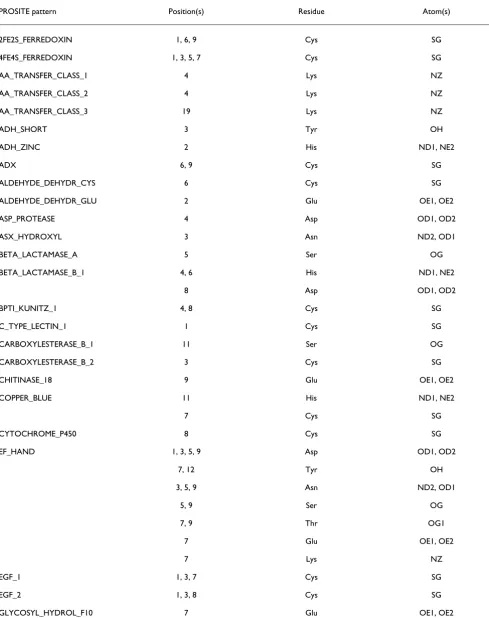
The SeqFEATURE library consists of 136 models derived from 53 PROSITE patterns (Table 1). Of these models, 105 (77%) have an AUC greater than 0.8, and 64 (47%) have an area under the curve (AUC) greater than 0.95 (Figure 1a). Sensitivity at the default 99% specificity cutoff is slightly more variable, but 82% of the models have sensitivity greater than 0.5 and 59% have sensitivity greater than 0.75 (Figure 1b).
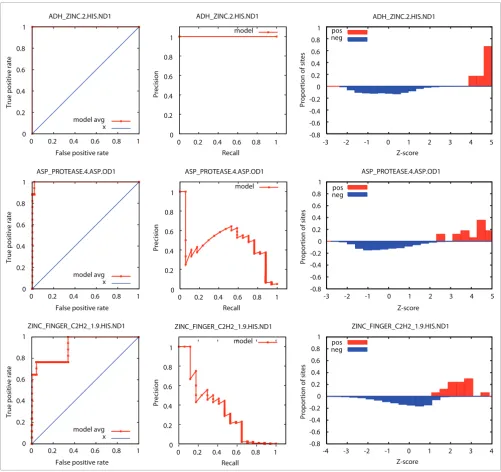
Receiver operating characteristic (ROC) curves from cross-validation and Z-score distributions of the final models can be used together to evaluate the ability of the model to distin-guish true sites from the background. We evaluate the sepa-ration between the positive and negative sites by plotting the distributions of Z-scores for the positive and negative training examples. Plots of positive predictive value (PPV) versus sen-sitivity give the proportion of total hits to the models that are true positives as a function of sensitivity. Representative examples of ROC curves, PPV versus sensitivity curves, and Z-score distributions for a range of model performances are shown in Figure 2.
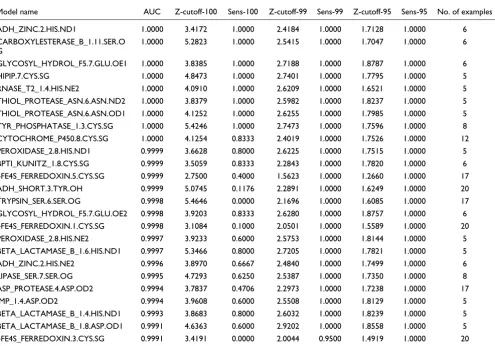
Table 2 lists the top 25 performing SeqFEATURE models ranked by AUC. The sensitivity of these models is, in general, very high, especially at the default 99% specificity Z-score cut-offs. Even at 100% specificity over half of the models have greater than 0.75 sensitivity. This list also contains a wide range of PROSITE patterns, indicating that the method per-forms very well for many different types of functional sites.
Methods comparison
Cross-validation is not necessarily representative of how a model will perform on independent test data. In order to get a more realistic estimate of the library's performance, we con-structed a specialized test set from the PROSITE records for each pattern, which contain manually curated annotations of true positives, false positives, and false negatives. The test sets consisted, therefore, of structures that the associated PROSITE pattern is known to detect correctly, falsely predict, and altogether miss.
Table 1
SeqFEATURE models built from PROSITE motifs
PROSITE pattern Position(s) Residue Atom(s)
2FE2S_FERREDOXIN 1, 6, 9 Cys SG
4FE4S_FERREDOXIN 1, 3, 5, 7 Cys SG
AA_TRANSFER_CLASS_1 4 Lys NZ
AA_TRANSFER_CLASS_2 4 Lys NZ
AA_TRANSFER_CLASS_3 19 Lys NZ
ADH_SHORT 3 Tyr OH
ADH_ZINC 2 His ND1, NE2
ADX 6, 9 Cys SG
ALDEHYDE_DEHYDR_CYS 6 Cys SG
ALDEHYDE_DEHYDR_GLU 2 Glu OE1, OE2
ASP_PROTEASE 4 Asp OD1, OD2
ASX_HYDROXYL 3 Asn ND2, OD1
BETA_LACTAMASE_A 5 Ser OG
BETA_LACTAMASE_B_1 4, 6 His ND1, NE2
8 Asp OD1, OD2
BPTI_KUNITZ_1 4, 8 Cys SG
C_TYPE_LECTIN_1 1 Cys SG
CARBOXYLESTERASE_B_1 11 Ser OG
CARBOXYLESTERASE_B_2 3 Cys SG
CHITINASE_18 9 Glu OE1, OE2
COPPER_BLUE 11 His ND1, NE2
7 Cys SG
CYTOCHROME_P450 8 Cys SG
EF_HAND 1, 3, 5, 9 Asp OD1, OD2
7, 12 Tyr OH
3, 5, 9 Asn ND2, OD1
5, 9 Ser OG
7, 9 Thr OG1
7 Glu OE1, OE2
7 Lys NZ
EGF_1 1, 3, 7 Cys SG
EGF_2 1, 3, 8 Cys SG
GLYCOSYL_HYDROL_F5 7 Glu OE1, OE2
HIPIP 1, 7 Cys SG
HMA_1 5, 8 Cys SG
IG_MHC 3 Cys SG
IMP_1 4 Asp OD1, OD2
KAZAL 1, 3, 7, 9 Cys SG
LIPASE_SER 7 Ser OG
LIPOYL 9 Lys NZ
PA2_HIS 4 His ND1, NE2
PEROXIDASE_1 8 His ND1, NE2
PEROXIDASE_2 8 His ND1, NE2
PHOSPHOPANTETHEINE 6 Ser OG
PROTEIN_KINASE_ST 5 Asp OD1, OD2
PTS_HPR_SER 5 Ser OG
RNASE_T2_1 4 His ND1, NE2
SHIGA_RICIN 5 Glu OE1, OE2
8 Arg NE, NH1, NH2
SMALL_CYTOKINES_CC 1, 2, 11, 17 Cys SG
SNAKE_TOXIN 2, 4, 7, 8 Cys SG
SUBTILASE_ASP 5 Asp OD1, OD2
THIOL_PROTEASE_ASN 6 Asn ND2, OD1
THIOL_PROTEASE_HIS 3 His ND1, NE2
THIOREDOXIN 8, 11 Cys SG
TRYPSIN_HIS 5 His ND1, NE2
TRYPSIN_SER 6 Ser OG
TYR_PHOSPHATASE_1 3 Cys SG
UBIQUITIN_CONJUGAT_1 10 Cys SG
ZINC_FINGER_C2H2_1 1, 3 Cys SG
7, 9 His ND1, NE2
ZINC_PROTEASE 3, 7 His ND1, NE2
4 Glu OE1, OE2
[image:5.612.57.540.108.680.2]Some PROSITE patterns have multiple functional residues, and so more than one model was built for these patterns (for example, multiple EF_HAND models are built). Many hits will score high on all models, but distantly related sites may hit only a subset. SeqFEATURE models are named by concatenating the PROSITE-PATTERN, POSITION, RESIDUE and ATOM for unambiguous identification.
Table 1 (Continued)
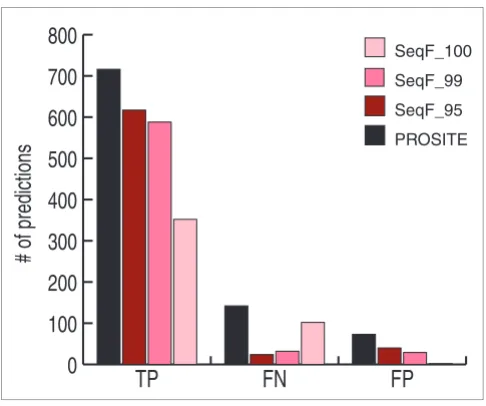
PROSITE pattern. Figure 4 shows overall numbers of predic-tions in each category. Since the test sets were derived from PROSITE, the PROSITE values represent the maximum that could possibly be obtained for each type of prediction. While SeqFEATURE does not predict all true positives correctly, it predicts 82% of true positives correctly at the default 99% specificity cutoff. At the same cutoff, SeqFEATURE also predicts about 78% fewer false negatives than PROSITE, and about 60% fewer false positives.
When we compared performance between SeqFEATURE, Pfam, HMMPanther, and Gene3D (restricting the compari-son to the high confidence assigned patterns for each sequence-based method as described in Materials and meth-ods), we found Gene3D to be the best performing method by far, with sensitivity just over 98%, specificity at 85.4%, and PPV at 99% (Table 3). Pfam was the second most sensitive method at 93.7%; since it predicted all negative examples (PROSITE false positives) correctly, Pfam had a PPV of 100%. HMMPanther scored slightly below Pfam on its limited test set with a sensitivity of 91.9%; there were not enough exam-ples to evaluate specificity. SeqFEATURE had a sensitivity of 86.2% at our most lenient cutoff, and specificity and PPV comparable to Pfam and Gene3D at our more stringent cut-offs. Interestingly, all of the sequence-based methods show a marked decrease in sensitivity when evaluated only on posi-tive examples that did not contain the PROSITE motif (that is, PROSITE false negatives). SeqFEATURE, on the other hand, is not as significantly affected by whether the test proteins contain the canonical sequence motifs.
On the randomized sample test set (see Materials and meth-ods), we were able to compare SeqFEATURE to 3D templates and SSM (Table 4). Here, SeqFEATURE's best sensitivity increased to 93%, though its best specificity dropped to 93%. PPV decreased slightly to 94% at the most stringent cutoff. 3D templates performed most well out of the structure-based methods, with 90% sensitivity, 100% specificity, and a PPV of 100%. SSM performed similarly to SeqFEATURE.
[image:6.612.58.554.86.295.2]Importantly, however, since the goal of many function predic-tion methods, including SeqFEATURE, is to aid in annotapredic-tion of solved structural genomics targets, we also compared SeqFEATURE to the sequence-based methods using low sequence identity test sets to mimic the situation in which a newly solved structure has low sequence identity to proteins of known function. Table 3 shows the sensitivities of PROSITE, Gene3D, Pfam, HMMPanther and SeqFEATURE at 95% and 99% specificity cutoffs for test sets filtered at 25%, 30%, and 35% sequence identity to the training set. The sequence-based methods perform less well, particularly on sequences filtered at 30% and 25% identity. In contrast, SeqFEATURE achieves a sensitivity of 92.3% at the most lenient cutoff and 84.6% at the moderate cutoff for sequences with <25% sequence identity to the training sets. As shown in Figure 5, the sensitivity of sequence-based methods decreases directly in proportion to sequence identity, whereas the sen-sitivity of SeqFEATURE at all three cutoffs shows no down-ward trend. The observation that SeqFEATURE's performance remains robust reflects the fact that SeqFEA-TURE's true positive predictions are concentrated at lower Distribution of AUC and sensitivity for all SeqFEATURE models listed in Table 2
Figure 1
Distribution of AUC and sensitivity for all SeqFEATURE models listed in Table 2. (a) Distribution of model AUC. Most models have AUC greater than 0.8, with 47% having AUC >0.95 and a few poor performers less than 0.5. (b) Distribution of model sensitivity. We plot the sensitivity of each model at the default score cutoff of 99% specificity based on training data. Most models have a sensitivity greater than 0.6-0.7 at this cutoff, and many have a sensitivity greater than 0.8.
# of models
30
25
20
15
10
5
0
< 0.5 0.5-0.6
0.6-0.7
0.7-0.8
0.8-0.9
0.95-0.99
0.99-1.00
1.00
0.9-0.95
AUC range
(a)
# of models
30
25
20
15
10
5
0
0.0-0.1
0.1-0.2
0.2-0.3
0.3-0.4
0.4-0.5
0.6-0.7
0.7-0.8
0.8-0.9
0.5-0.6
Sensitivity range
(b)
35 40
0.9-1.0
sequence identities, suggesting that SeqFEATURE may be especially valuable in this scenario.
To determine whether the degree of structural similarity affects how well different methods predict function, we also constructed a low structural similarity test set using Dali pairwise matching between members of the low sequence identity test set and the corresponding positive training sets.
Although relatively small (15 examples), the low structural similarity test set allows us to approximate the situation of function prediction on novel folds. As illustrated in Table 4, SeqFEATURE performs better at the 95% and 99% specificity cutoffs than the other structure-based methods; its low struc-tural similarity (LS)-sensitivity is 53% and 47%, respectively, while the LS-sensitivity values for SSM and 3D templates are both less than 30%.
[image:7.612.54.555.85.557.2]Example ROC curves, precision-recall curves, and Z-score distributions for SeqFEATURE models Figure 2
Example ROC curves, precision-recall curves, and Z-score distributions for SeqFEATURE models. A sample of performance plots for
ADH_ZINC.2.HIS.ND1 (top), ASP_PROTEASE.4.ASP.OD1 (middle), and ZINC_FINGER_C2H2_1.9.HIS.ND1 (bottom) are shown, representing a model with excellent performance, good performance, and somewhat satisfactory performance, respectively. The leftmost plot in each row gives the ROC curve in red and random performance in blue, the middle plot shows the precision versus recall (sensitivity) curve, and the rightmost plot shows the distribution of scores for positive sites (red) and negative sites (blue) from training. Because there are many more negative sites than positive sites, the score distributions on the right are normalized to Z-scores.
0 0.2 0.4 0.6 0.8 1
0 0.2 0.4 0.6 0.8 1
Precision
Recall ADH_ZINC.2.HIS.ND1
model
0 0.2 0.4 0.6 0.8 1
0 0.2 0.4 0.6 0.8 1
True positive rate
False positive rate ADH_ZINC.2.HIS.ND1
model avg x
-0.8 -0.6 -0.4 -0.2 0 0.2 0.4 0.6 0.8 1
-3 -2 -1 0 1 2 3 4 5
Proportion of sites
Z-score ADH_ZINC.2.HIS.ND1
pos neg
0 0.2 0.4 0.6 0.8 1
0 0.2 0.4 0.6 0.8 1
True positive rate
False positive rate ASP_PROTEASE.4.ASP.OD1
model avg x
0 0.2 0.4 0.6 0.8 1
0 0.2 0.4 0.6 0.8 1
Precision
Recall ASP_PROTEASE.4.ASP.OD1
model
-0.8 -0.6 -0.4 -0.2 0 0.2 0.4 0.6 0.8 1
-3 -2 -1 0 1 2 3 4 5
Proportion of sites
Z-score ASP_PROTEASE.4.ASP.OD1
pos neg
0 0.2 0.4 0.6 0.8 1
0 0.2 0.4 0.6 0.8 1
Precision
Recall ZINC_FINGER_C2H2_1.9.HIS.ND1
model
0 0.2 0.4 0.6 0.8 1
0 0.2 0.4 0.6 0.8 1
True positive rate
False positive rate ZINC_FINGER_C2H2_1.9.HIS.ND1
model avg x
-0.8 -0.6 -0.4 -0.2 0 0.2 0.4 0.6 0.8 1
-4 -3 -2 -1 0 1 2 3 4
Proportion of sites
Z-score ZINC_FINGER_C2H2_1.9.HIS.ND1
Predictions of function for structural genomics targets
As of November 2007, TargetDB contained about 5,250 tar-gets with structures released in the PDB; of these, about 1,500 were labeled only with 'structural genomics', 'unknown func-tion', or 'hypothetical protein' in the PDB file header. Using the criteria of model AUC > 0.8, maximum score of that model's negative training set, and minimum score of that model's positive training set, we found 35 potential functional sites. We added one more predicted functional site that did not quite satisfy the criteria but had several such hits for mul-tiple models for the same function, resulting in a total of 36 high-confidence predictions. We compare our predictions to those of PROSITE, Pfam, Gene3D, HMMPanther, SSM and 3D templates for the same structures.
In examining these structures, we found that some of them, though labeled as 'unknown function', actually had some functional annotation and, thus, we could determine the plausibility of our prediction. For example, PDB structure 1XRI is described as a putative phosphatase, and had a high
scoring hit for the TYR_PHOSPHATASE_1.3.CYS.SG model. All of the other methods also detected phosphatase activity. Another example is 2E72, described as a zinc-finger contain-ing protein, which hit our ZINC_FINGER_C2H2_1.1.CYS.SG model and for which Pfam, Gene3D, HMMPanther, SSM, and 3D templates all predicted zinc finger motifs.
More interesting, however, are predictions for structures that fail to garner any predictions from PROSITE, Pfam, Gene3D, or HMMPanther. Table 5 presents three of our most intrigu-ing cases. In all of these cases, only SeqFEATURE gives a high-confidence prediction, though 3D templates and SSM sometimes offer matches to putative functions or have low-confidence predictions. In contrast, the SeqFEATURE pre-dictions have relatively high Z-scores compared to the train-ing set distributions.
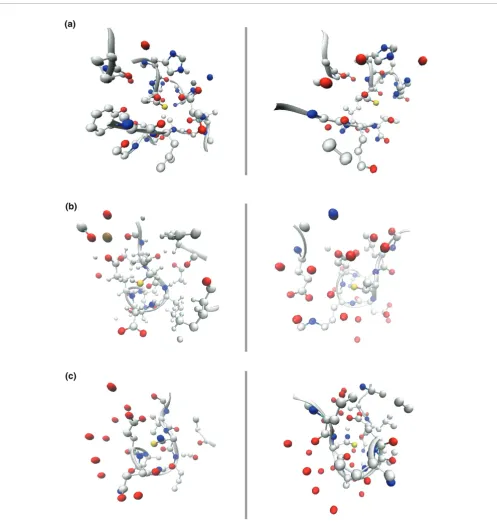
The local environment surrounding high-confidence pre-dicted sites in three TargetDB structures are shown in Figure 6 alongside positive training set examples of the
correspond-Table 2
Top 25 performing SeqFEATURE models
Model name AUC Z-cutoff-100 Sens-100 Z-cutoff-99 Sens-99 Z-cutoff-95 Sens-95 No. of examples
ADH_ZINC.2.HIS.ND1 1.0000 3.4172 1.0000 2.4184 1.0000 1.7128 1.0000 6
CARBOXYLESTERASE_B_1.11.SER.O G
1.0000 5.2823 1.0000 2.5415 1.0000 1.7047 1.0000 6
GLYCOSYL_HYDROL_F5.7.GLU.OE1 1.0000 3.8385 1.0000 2.7188 1.0000 1.8787 1.0000 6
HIPIP.7.CYS.SG 1.0000 4.8473 1.0000 2.7401 1.0000 1.7795 1.0000 5
RNASE_T2_1.4.HIS.NE2 1.0000 4.0910 1.0000 2.6209 1.0000 1.6521 1.0000 5
THIOL_PROTEASE_ASN.6.ASN.ND2 1.0000 3.8379 1.0000 2.5982 1.0000 1.8237 1.0000 5
THIOL_PROTEASE_ASN.6.ASN.OD1 1.0000 4.1252 1.0000 2.6255 1.0000 1.7985 1.0000 5
TYR_PHOSPHATASE_1.3.CYS.SG 1.0000 5.4246 1.0000 2.7473 1.0000 1.7596 1.0000 8
CYTOCHROME_P450.8.CYS.SG 1.0000 4.1254 0.8333 2.4019 1.0000 1.7526 1.0000 12
PEROXIDASE_2.8.HIS.ND1 0.9999 3.6628 0.8000 2.6225 1.0000 1.7515 1.0000 5
BPTI_KUNITZ_1.8.CYS.SG 0.9999 3.5059 0.8333 2.2843 1.0000 1.7820 1.0000 6
4FE4S_FERREDOXIN.5.CYS.SG 0.9999 2.7500 0.4000 1.5623 1.0000 1.2660 1.0000 17
ADH_SHORT.3.TYR.OH 0.9999 5.0745 0.1176 2.2891 1.0000 1.6249 1.0000 20
TRYPSIN_SER.6.SER.OG 0.9998 5.4646 0.0000 2.1696 1.0000 1.6085 1.0000 17
GLYCOSYL_HYDROL_F5.7.GLU.OE2 0.9998 3.9203 0.8333 2.6280 1.0000 1.8757 1.0000 6
4FE4S_FERREDOXIN.1.CYS.SG 0.9998 3.1084 0.1000 2.0501 1.0000 1.5589 1.0000 20
PEROXIDASE_2.8.HIS.NE2 0.9997 3.9233 0.6000 2.5753 1.0000 1.8144 1.0000 5
BETA_LACTAMASE_B_1.6.HIS.ND1 0.9997 5.3466 0.8000 2.7205 1.0000 1.7821 1.0000 5
ADH_ZINC.2.HIS.NE2 0.9996 3.8970 0.6667 2.4840 1.0000 1.7499 1.0000 6
LIPASE_SER.7.SER.OG 0.9995 4.7293 0.6250 2.5387 1.0000 1.7350 1.0000 8
ASP_PROTEASE.4.ASP.OD2 0.9994 3.7837 0.4706 2.2973 1.0000 1.7238 1.0000 17
IMP_1.4.ASP.OD2 0.9994 3.9608 0.6000 2.5508 1.0000 1.8129 1.0000 5
BETA_LACTAMASE_B_1.4.HIS.ND1 0.9993 3.8683 0.8000 2.6032 1.0000 1.8239 1.0000 5
BETA_LACTAMASE_B_1.8.ASP.OD1 0.9991 4.6363 0.6000 2.9202 1.0000 1.8558 1.0000 5
4FE4S_FERREDOXIN.3.CYS.SG 0.9991 3.4191 0.0000 2.0044 0.9500 1.4919 1.0000 20
[image:8.612.58.553.120.466.2]ing SeqFEATURE model. Figure 6a shows 2EJQ, a conserved hypothetical protein from Thermo thermophilus to the right of 1KAP, a zinc metalloprotease from Pseudomonas aerugi-nosa. SeqFEATURE predicts an environment similar to that of a zinc protease, and, indeed, the two environments share
[image:9.612.56.555.86.607.2]the presence of two histidine residues and a number of nega-tive charges in the vicinity of the site, as well as some common secondary structures. The other two cases are both predic-tions of calcium binding. 2OGF, an uncharacterized structure from Methanococcus janaschii, is compared to 1FI6, the cal-Performance on PROSITE true positives, false positives, and false negative test sites
Figure 3
Performance on PROSITE true positives, false positives, and false negative test sites. We show the (a) true positive (TP), (b) false negative (FN), and (c) false positive (FP) prediction rates for SeqFEATURE (at 95%, 99%, and 100% specificity) and PROSITE on test sites derived from the corresponding PROSITE patterns. The PROSITE values represent the maximum possible for each category. Not all patterns had a false negative or false positive test set. Most of SeqFEATURE's incorrect predictions at 95% and 99% specificity cutoffs arise from poor performance on a small subset of the patterns.
SeqF_100 SeqF_99 SeqF_95 0 10 20 30 40 50 60 70 80 PROSITE 2FE2S_FERREDO XIN 4FE4S_FERREDO XIN AA_TRANSFER_CLASS_1 AA_TRANSFER_CLASS_3 ADH_SHOR T ADH_ZINC ADX ASP_PR O TEASE ASX_HYDR O XYL BET A_LA CT AMASE_A BET A_LA CT AMASE_B_1 BPTI_KUNITZ CARBO XYLESTERASE_B_1 CARBO XYLESTERASE_B_2 CHITINASE_18 COPPER_BLUE CYT OCHR O ME_P450 C_TYPE_LECTIN EF_HAND EGF_1 EGF_2 GL YCOSYL_HYDR OL_F5 GL YCOSYL_HYDR OL_F10 HIPIP HMA_1 IG_MHC IMP_1 KAZAL LIP ASE_SER PER O XID A SE_2 PR O TEIN_KINASE_ST SHIGA_RICIN SMALL_CYT O KINES_CC SNAKE_T O XIN SUBTILASE_ASP THIOL_PR O TEASE_ASN THIOREDO XIN TR YPSIN_SER TYR_PHOSPHA T ASE_1 UBIQ UITIN_CONJUGA T ZINC_FINGER_C2H2_1 ZINC_PR O T EASE # of TP predictions 0 2 4 6 8 10 12
# of FN predictions
0 2 4 6 8 10 12
# of FP predictions
(a)
(b)
(c)
2FE2S_FERREDO XIN 4FE4S_FERREDO XIN AA_TRANSFER_CLASS_1 AA_TRANSFER_CLASS_3 ADH_SHOR T ADH_ZINC ASP_PR O TEASE ASX_HYDR O XYL BET A_LA CT AMASE_A BET A_LA CT AMASE_B_1 BPTI_KUNITZ CARBO XYLESTERASE_B_1 CARBO XYLESTERASE_B_2 CHITINASE_18 COPPER_BLUE CYT OCHR O ME_P450 C_TYPE_LECTIN EF_HAND EGF_1 EGF_2 GL YCOSYL_HYDR OL_F5 GL YCOSYL_HYDROL_F10 HMA_1 IG_MHC IMP_1 KAZAL LIP ASE_SER PER O XID A SE_2 PR O TEIN_KINASE_ST SHIGA_RICIN SMALL_CYT O KINES_CC SNAKE_T O XIN SUBTILASE_ASP THIOL_PR O TEASE_ASN THIOREDO XIN TR YPSIN_SER TYR_PHOSPHA T ASE_1 UBIQ UITIN_CONJUGA T ZINC_FINGER_C2H2_1 ZINC_PR O T EASE ADX HIPIP 2FE2S_FERREDO XIN 4FE4S_FERREDO XIN AA_TRANSFER_CLASS_1 AA_TRANSFER_CLASS_3 ADH_SHOR T ADH_ZINC ASP_PR O TEASE ASX_HYDR O XYL BET A_LA CT AMASE_A BET A_LA CT AMASE_B_1 BPTI_KUNITZ CARBO XYLESTERASE_B_1 CARBO XYLESTERASE_B_2 CHITINASE_18 COPPER_BLUE CYT OCHR OME_P450 C_TYPE_LECTIN EF_HAND EGF_1 EGF_2 GL YCOSYL_HYDR OL_F5 GL YCOSYL_HYDR
cium-binding domain of a protein involved in Ras signal transduction; 2OX6, an uncharacterized gene product from Shewanella oneidensis, is compared to 1K8U, a calcium
reg-ulatory protein. Both positive examples show an abundance of negative charges about five to seven angstroms from the motif residue. The predicted sites show comparable distribu-tions of negative charges and contain loop structures similar to the positive examples. These three, in addition to SeqFEATURE's significant predictions for other TargetDB structures with unknown function, are especially interesting and warrant further study. All significant predictions for Tar-getDB structures are publicly available [36].
Protein Data Bank scan
We additionally scanned every structure in the PDB - about 100 million potential sites - with every SeqFEATURE model. When we consider only those scores that came from models with an AUC of at least 0.95, and were greater than the 99% specificity cutoff defined for that model, 440,460 scores fit these criteria, or about 0.5% of the total number of scores generated. Filtering out redundant scores from proteins with multiple chains results in 298,870 predictions in 29,668 structures. The raw data from the scan are available for down-load [36]; further analysis of these predictions is beyond the scope of this paper. To access the full library scan for one structure, the user may query by PDB ID; alternatively, one can access all results by querying for a specific SeqFEATURE model.
Discussion
SeqFEATURE extends earlier work on characterizing func-tional sites in protein structures by automating training set selection. We have used it to build a library of three-dimen-sional functional site models, 77% of which have an AUC greater than 0.8. When tested on untrained but known true positives, false positives, and false negatives from their corre-Summary performance on PROSITE true positives (TP), false positives
[image:10.612.54.297.84.287.2](FP), and false negative (FN) test sites Figure 4
Summary performance on PROSITE true positives (TP), false positives (FP), and false negative (FN) test sites. We summarize total numbers of predicted true positives, false negatives, and false positives for PROSITE and SeqFEATURE at 100%, 99%, and 95% specificity cutoffs. SeqFEATURE (at the default 99% specificity cutoff) misses about 18% of the PROSITE true positives on average, but it also predicts 60% fewer false positives and 78% fewer false negatives than PROSITE. The three different specificity cutoffs also show tradeoffs in the numbers of true positives and false predictions made by SeqFEATURE, demonstrating that one can adjust the cutoff to fit desired performance. For example, one can attain a very high positive predictive value by using SeqFEATURE's 100% specificity cutoffs - although sensitivity decreases to about 50%, almost no false positive predictions are made.
0
100
200
300
400
500
600
700
800
SeqF_100
SeqF_99
SeqF_95
PROSITE
FP
FN
TP
# of predictions
Table 3
Comparison of SeqFEATURE (at three specificity-based score cutoffs) to Gene3D, Pfam, and HMMPanther (Panther)
Gene3D Pfam Panther SeqF_95 SeqF_99 SeqF_100
True positive sensitivity 0.998 0.937 0.919 0.862 0.821 0.492
False negative sensitivity 0.907 0.704 0.532 0.831 0.775 0.282
Overall (TP + FN) sensitivity 0.983 0.898 0.831 0.857 0.814 0.457
(False positive) specificity 0.854 1.000 - 0.452 0.603 0.973
Positive predictive value 0.990 1.000 - 0.948 0.960 0.995
Sensitivity at <35% seq-ID 0.925 0.761 0.639 0.769 0.699 0.316
Sensitivity at <30% seq-ID 0.869 0.738 0.618 0.869 0.783 0.400
Sensitivity at <25% seq-ID 0.600 0.467 0.250 0.933 0.786 0.429
[image:10.612.58.554.531.657.2]sponding PROSITE patterns, many models correctly classi-fied all of the true positives and some of the false negatives, and had fewer false positive predictions than the pattern. Even when a model failed to recapitulate every PROSITE true positive, it often correctly predicted proteins that the PROSITE pattern missed.
Furthermore, we show that although SeqFEATURE demon-strates slightly lesser performance than the sequence-based methods overall, it exhibits useful performance trends as sequence identity to proteins of known function decreases. SeqFEATURE, and perhaps structure-based methods in gen-eral, should be most valuable in these scenarios, since they sense three-dimensional atomic environments rather than the sequences that fold to create those environments. We observe that this advantage is strongest when the sequence identity is less than 30%, which is well-documented as the 'twilight zone' of sequence analysis [37].
When we further investigate this region of low identity, we see that SSM and 3D templates do not perform as well as SeqFEATURE on the low structural similarity test set. SSM is essentially a fold-matching algorithm, and at low structural similarities the folds of the test structures likely differed sig-nificantly from those folds most representative of proteins with the function in question. Theoretically, the 3D template method is more similar to SeqFEATURE, but in reality it per-formed similarly to SSM. It is possible that the residue triads
that 3D templates detect were dependent on exact conserva-tion of sequence features. In contrast, SeqFEATURE was less affected by the reduction in structural similarity because it depends less on specific sequences or arrangements of resi-dues, and instead incorporates abstract physical and chemi-cal properties in a lochemi-cally defined region.
Determining how different methods compare in predicting function is a challenging task, and so neither our procedure for comparing methods nor the interpretation of the compar-ison's results is straightforward. Function itself is broadly defined and does not lend itself easily to straightforward or computable classification schemes. Many classifications are applicable only to specific types of functions and can differ in the scope of their descriptions, ranging from whole domain labels on sequence (for example, Pfam) to exact locations in structures (for example, SeqFEATURE or 3D templates). Responding to this diversity in description and classification, we made several choices in our comparison of sequence and structure-based methods, each of which carries a certain amount of bias.
[image:11.612.54.552.116.193.2]In comparing Pfam, HMMPanther, and Gene3D to other methods, for example, we restricted the evaluation to those functions (PROSITE patterns, specifically) whose SeqFEA-TURE positive training sets mapped unambiguously to the corresponding database assignment. This may have artifi-cially boosted performance of the sequence-based methods,
Table 4
Comparison of SeqFEATURE (at three specificity-based score cutoffs) to 3D templates and SSM
3D templates SSM SeqF_95 SeqF_99 SeqF_100
Sensitivity 0.897 0.724 0.931 0.862 0.552
Specificity 1.000 0.933 0.600 0.667 0.933
PPV 1.000 0.955 0.818 0.833 0.941
LSS-sensitivity 0.200 0.267 0.533 0.467 0.133
We calculated the sensitivity, specificity, and PPV for SeqFEATURE, 3D templates, and SSM using a random subset of 29 positive and 15 negative structures. Additionally, we calculated sensitivity for each method on a low structural similarity subset ('LSS-sensitivity') of the positive test set. Bold values indicate the top two performing methods for that row. SeqFEATURE performs relatively less well overall, but when structural similarity is reduced, SeqFEATURE again is the best performing method.
Table 5
Predicted function for three structures from TargetDB
PDB ID SeqFEATURE model AUC Site Z-score Cutoff Other predictions
2EJQ ZINC_PROTEASE.4.GLU.OE1 0.892 GLU96:A 4.574 -0.074 3D templates: probable anthrax toxin lethal factor
2OGF EF_HAND.9.THR.OG1 0.920 THR17:D 4.675 3.370 SSM: aminopeptidase (Z-score = 2.7)
2OX6 EF_HAND.9.ASN.OD1 0.863 ASN8:B 4.102 2.498 3D templates: probable Zn enzyme
[image:11.612.53.561.622.685.2]since we, in effect, considered only patterns with very high 'sensitivity' for each method to begin with based on our train-ing sets. Interesttrain-ingly, we also investigated HMMTIGR and Superfamily as other methods to include in the comparison, but these tools made very few predictions over the entire set of training and test structures, so we excluded them from the study.
Our choice of gold standard test sites from PROSITE may also be controversial because the test set is limited to those func-tional patterns that have been manually characterized and are thus subject to human judgment as well as human preference. In addition, due to the small number of test sites for most pat-terns, the results may be dominated by a few patterns with many test sites. Perhaps most obvious is the high probability that the negative test sites, by virtue of being defined as false positives with respect to the PROSITE pattern, are 'difficult cases'. This means that SeqFEATURE may be predisposed to low specificity, and specificity for all methods overall may suf-fer because the negative examples tend to be highly similar to the positive examples on at least the local sequence level.
The different types of input used to train each method also have some implications, an important one being that sequence-based methods currently have much more data available to them than structure-based ones. Although this means that the best sequence-based methods currently outperform structure-based methods on our unfiltered PROSITE-based test sets, it does not diminish the need for or value of structure-based methods. Such methods are useful precisely when sequence identity to known proteins is low, as shown in our results on low sequence identity test sets and our analyses on interesting TargetDB predictions.
The two structure-based methods compared here contain an analogous advantage, however, in that they match the query against the entire repository of known protein structures. Thus, if the query has very similar structures (for example, the same protein from different species) in the PDB, SSM and 3D template searches will very likely result in a high confi-dence hit to these structures. In cases where the query struc-ture is completely novel, however, SSM and 3D templates are expected to do less well, as suggested by their performance on the low structural similarity test set. SeqFEATURE, on the other hand, because it does not rely on exactly conserved geometries or structural motifs, continues to show robust performance even when the structure does not share signifi-cant similarity to known proteins.
Another potential bias may come from limiting the structure-based comparisons to those patterns associated with EC numbers. In order to determine the correctness of predictions from SSM and 3D templates, we required a precise functional classification system. SCOP is a potential alternative evalua-tion method, but SCOP is a structural classificaevalua-tion that does not always map directly to function, so we chose to use EC numbers. This, of course, means that the results of the com-parisons may not be representative of how each method per-forms on non-enzymatic functions. The use of EC numbers is also affected by how accurately and completely the PDB is annotated and by the granularity of function assigned. Sev-eral of the test structures on which 3D templates and SSM performed poorly had matches to proteins annotated with only slightly different EC numbers. Thus, 3D templates and SSM should still be considered valuable tools for gaining insight into the potential function of an uncharacterized protein.
Although the set of patterns and the resulting test sets used here are by no means fully representative or without bias, they enabled us to map our SeqFEATURE models directly to test sets, a non-trivial endeavor given the inconsistency and variety of existing function classifications. It also allowed us to look specifically at where SeqFEATURE improves on or fares worse than the sequence patterns that generated the models. We often chose test sets with biases against our method in order to assess its operating characteristics accu-rately; for example, our use of one-dimensional sequence Sensitivity trends of SeqFEATURE, Gene3D, Pfam, and HMMPanther at
[image:12.612.55.295.83.363.2]low sequence identities Figure 5
Sensitivity trends of SeqFEATURE, Gene3D, Pfam, and HMMPanther at low sequence identities. We compared the sensitivity of SeqFEATURE at three specificity cutoffs against the sensitivity of Gene3D, Pfam, and HMMPanther on test sets filtered for low sequence identity. We evaluated each method on the subset of the original test set that had less than the specified sequence identity to the training sets. As sequence identity decreases, the sequence-based methods show a clear trend towards lower sensitivity. In contrast, SeqFEATURE at all three cutoffs shows no such downward trend, indicating robust detection of function even when sequence identity is very low.
0.0 0.2 0.4 0.6 0.8 1.0
SeqF_100 SeqF_99 SeqF_95 HMMPanther Pfam Gene3D
< 25% < 27% < 29% < 31% < 33% < 35%
Sensitivity
Local environments SqFEATURE predictions for three TargetDB structures with unknown function Figure 6
Local environments of SeqFEATURE predictions for three TargetDB structures with unknown function. Three predicted functional sites from TargetDB structures are shown compared to known examples of the predicted function. The predicted and known sites are shown in yellow, positively charge atoms (nitrogens) are shown in blue, and negatively charged atoms (oxygens) are shown in red. Carbons and secondary structure are shown in grey. All atoms within 7.5 angstroms of the site are shown. (a) The active site of a known zinc protease (1KAP) is shown to the left of a zinc protease site in 2EJQ predicted by SeqFEATURE. Note the presence of two histidine residues (one can be seen clearly above each site) and a number of negative charges distributed throughout both local environments. Note also the similarity in secondary structure. (b) The local structure of 1FI6 (left), which contains a known EF hand calcium-binding motif, is compared to SeqFEATURE's predicted calcium-binding site in 2OGF. Note the similar distribution of negative charges and closely matching loop structures. The calcium is visible as a brown sphere in 1FI6, surrounded by oxygen atoms. (c) 1K8U is another known EF hand containing protein, shown to the left of the uncharacterized protein structure 2OX6, for which SeqFEATURE predicts calcium-binding. These figures were created using VMD [43].
(a)
(b)
patterns as the gold standard provides a strong advantage to sequence-based methods. Restricting the comparison to pat-terns that mapped coherently to Pfam, Gene3D, and HMMPanther families may also predispose those methods to good performance. SeqFEATURE exhibited good perform-ance despite these biases.
Because SeqFEATURE also focuses on the local microenvi-ronment around functional sites, it can detect function at
[image:14.612.57.554.87.520.2]finer detail than fold-matching algorithms such as SSM. Because it considers both atom-based and physichochemical properties in addition to residue-based ones, it is also capable of generalizing function away from sequence and may be able to detect functional similarities that have converged from dif-ferent ancestors or that use slightly difdif-ferent residues and a different overall fold to accomplish similar activities. This capability is demonstrated by the fact that SeqFEATURE detects many of the positive examples that the PROSITE pat-Overview of the SeqFEATURE pipeline
Figure 7
Overview of the SeqFEATURE pipeline. SeqFEATURE forms training sets by (a) extracting sequence (one-dimensional) motifs from PROSITE and (b) identifying the annotated functional amino acids. We extract examples of the one-dimensional motif with known three-dimensional structure in the PDB and center FEATURE training sites on each functional atom of each functional amino acid annotated in the PROSITE pattern. We choose negative sites matched for atom density randomly from the PDB that do not contain the function. (c) FEATURE then creates a model of the sites by summarizing the biochemical and biophysical features found in concentric shells around the functional atom center. (d) The resulting three-dimensional fingerprint specifies the properties that are in relative abundance or paucity in the site, representing the model. (e) A protein of interest is converted into features and scored with the model using a naïve Bayes scoring function, and predictions are made using score cutoffs, which can be based on desired performance statistics. The scores are calibrated into Z-scores using the training set used to derive each model.
EF_HAND, THIOREDOXIN . . .
1D Motif Database
Motif functional sites
EF_HAND.1.ASP.OD1 EF_HAND.5.SER.OG ...
THIOREDOXIN.8.CYS.SG ...
Structural examples of functional site Background sites of same atom type
and atom density Negative training set
Positive training set
Statistical model of functional site (”fingerprint”)
Sites of interest in protein structure
Score cutoff based on training data
Scores for query sites (predictions) 1 1 0 2 1 2 0 0 ...
1 1 0 2 1 2 0 0 ... 0 0 1 1 0 1 2 0 ... 0 0 1 1 0 1 2 0 ... 1 0 0 1 0 0 1 1 ... 1 0 0 1 0 0 1 1 ... 2 1 0 0 1 0 1 0 ... 2 1 0 0 1 0 1 0 ...
Featurization of local physicochemical environment using radial shells
FEATURE
1 0 0 0 0 1 1 0 ... 1 0 0 0 0 1 1 0 ... 0 2 1 0 0 0 0 2 ... 0 2 1 0 0 0 0 2 ...
Scoring function
PDB
1 1 0 2 1 2 0 0 ... 1 1 0 2 1 2 0 0 ... 0 0 1 1 0 1 2 0 ... 0 0 1 1 0 1 2 0 ... 1 0 0 1 0 0 1 1 ... 1 0 0 1 0 0 1 1 ... 2 1 0 0 1 0 1 0 ... 2 1 0 0 1 0 1 0 ... 1 0 0 0 0 1 1 0 ... 1 0 0 0 0 1 1 0 ... 0 2 1 0 0 0 0 2 ... 0 2 1 0 0 0 0 2 ...
Calculation of feature vectors
Training set selection
Model training
Site scanning
(a)
(b)
(c)
(d)
(e)
. . .
Shell 0 1 2 3 4 5 ATOM-TYPE-IS-C
tern misses. The ability to abstract the properties relevant to function independent of sequence or structural homology is one of SeqFEATURE's biggest strengths.
Another one of SeqFEATURE's advantages is that score cut-offs can be adjusted to reflect the user's desired performance criteria, for example, estimated specificity, sensitivity, or pos-itive predictive value. The ratio of true pospos-itives to false posi-tives and false negaposi-tives is traded off depending on where the score cutoff is set. There are several additional filters one can use to boost the confidence of positive predictions. True hits often manifest themselves as a cluster of high-scoring positive predictions for the same or related functional site models.
Single, isolated hits in a protein, although potentially inter-esting, may not have the exact function represented by the model.
[image:15.612.55.551.116.535.2]The functional 'fingerprint' of each model (as shown in Figure 7d) also allows detailed understanding of the physicochemi-cal environment representative of that type of functional site, and detailed inspection of potential positives may boost con-fidence of positive predictions or help explain the existence of any false positives. Even if the SeqFEATURE prediction is not entirely accurate, the fact that it is based on a representation of the local physical and chemical environment means that we can still make interesting observations about what properties
Table 6
Physicochemical properties used by the FEATURE algorithm
Atom-based Molecule-based Residue-based Secondary structure-based
ATOM-TYPE-IS-C PARTIAL-CHARGE RESIDUE_NAME_IS_ALA SECONDARY_STRUCTURE1_IS_3HELIX
ATOM-TYPE-IS-CT HYDROXYL RESIDUE_NAME_IS_ARG SECONDARY_STRUCTURE1_IS_4HELIX
ATOM-TYPE-IS-Ca AMIDE RESIDUE_NAME_IS_ASN SECONDARY_STRUCTURE1_IS_5HELIX
ATOM-TYPE-IS-N AMINE RESIDUE_NAME_IS_ASP SECONDARY_STRUCTURE1_IS_BRIDGE
ATOM-TYPE-IS-N2 CARBONYL RESIDUE_NAME_IS_CYS SECONDARY_STRUCTURE1_IS_STRAND
ATOM-TYPE-IS-N3 RING-SYSTEM RESIDUE_NAME_IS_GLN SECONDARY_STRUCTURE1_IS_TURN
ATOM-TYPE-IS-Na PEPTIDE RESIDUE_NAME_IS_GLU SECONDARY_STRUCTURE1_IS_BEND
ATOM-TYPE-IS-O VDW-VOLUME RESIDUE_NAME_IS_GLY SECONDARY_STRUCTURE1_IS_COIL
ATOM-TYPE-IS-O2 CHARGE RESIDUE_NAME_IS_HIS SECONDARY_STRUCTURE1_IS_HET
ATOM-TYPE-IS-OH NEG-CHARGE RESIDUE_NAME_IS_ILE SECONDARY_STRUCTURE1_IS_UNKNOWN
ATOM-TYPE-IS-S POS-CHARGE RESIDUE_NAME_IS_LEU SECONDARY_STRUCTURE1_IS_HELIX
ATOM-TYPE-IS-SH CHARGE-WITH-HIS RESIDUE_NAME_IS_LYS SECONDARY_STRUCTURE1_IS_BETA
ATOM-TYPE-IS-OTHER HYDROPHOBICITY RESIDUE_NAME_IS_MET SECONDARY_STRUCTURE1_IS_COIL
ATOM-NAME-IS-ANY MOBILITY RESIDUE_NAME_IS_PHE SECONDARY_STRUCTURE1_IS_HET
ATOM-NAME-IS-C SOLVENT-ACCESSIBILITY RESIDUE_NAME_IS_PRO SECONDARY_STRUCTURE1_IS_UNKNOWN
ATOM-NAME-IS-N RESIDUE_NAME_IS_SER
ATOM-NAME-IS-O RESIDUE_NAME_IS_THR
ATOM-NAME-IS-S RESIDUE_NAME_IS_TRP
ATOM-NAME-IS-OTHER RESIDUE_NAME_IS_TYR
RESIDUE_NAME_IS_VAL
RESIDUE_NAME_IS_HOH
RESIDUE_NAME_IS_OTHER CLASS1_IS_HYDROPHOBIC
CLASS1_IS_CHARGED
CLASS1_IS_POLAR CLASS1_IS_UNKNOWN
CLASS2_IS_NONPOLAR
CLASS2_IS_POLAR CLASS2_IS_BASIC
CLASS2_IS_ACIDIC
CLASS2_IS_UNKNOWN
helped the site score highly, and which additional properties may be necessary for the site truly to contain the predicted function.
Most importantly, since SeqFEATURE is not dependent on sequence or overall structural fold, it can be used when either the sequence or the structure is novel. This became evident when we compared the performance of the different methods at low sequence identities and low structural similarities, and found that SeqFEATURE shows a trend to being more sensi-tive than sequence-based methods at low sequence identities and more sensitive than other structure-based ones at low structural similarities. As shown with the three TargetDB examples, SeqFEATURE is able to predict function where other methods are not. Further inspection of the putative sites reveals compelling evidence for SeqFEATURE's predictions. The ability to provide useful predictions on novel structures will become more and more important as struc-tural genomics matures, and SeqFEATURE demonstrates robust performance in this area.
Conclusion
Advances in protein structure determination have led to an increase in unannotated structures, many with low sequence identity to known proteins. Our method, SeqFEATURE, uses functional sequence motifs to seed training sets from which three-dimensional models of the function are built. We used SeqFEATURE to construct a large library of three-dimen-sional functional site models from PROSITE motifs and scanned uncharacterized structural genomics targets from TargetDB for function. SeqFEATURE's descriptive and intui-tive models show comparable performance to existing sequence- and structure-based methods. Importantly, SeqFEATURE models retain robust performance when sequence identity and structural similarity are reduced. Methods such as SeqFEATURE that do not rely on strict sequence or structure conservation will be valuable tools for annotating novel protein structures.
Materials and methods
SeqFEATURE (Figure 7) is a method for automatically select-ing trainselect-ing sets and buildselect-ing structural models within the FEATURE framework, a system for modeling functional sites in protein structures that has been published previously [32]. Here, we summarize the FEATURE algorithm and present SeqFEATURE in more detail.
The FEATURE algorithm
FEATURE builds statistical three-dimensional models of the local environment around a functional site given training sets of positive and negative examples. These models can then be used to evaluate test sites and predict whether they have par-ticular functions. FEATURE calculates a number of physico-chemical properties (Table 6) at varying radial distances from
the site center and creates a feature vector containing the val-ues of each property in each radial volume (Figure 7c). Both atomic and residue level properties are examined, allowing the functional site to be described at multiple levels. The structural model is constructed by comparing the statistical distribution of properties between positive and negative sites.
In a model for a particular functional site, properties are described as either significantly more present, more absent, or having no significant difference in the positive sites com-pared to negative sites using the Wilcoxan rank sum test [32]. The significant properties can be visually displayed as a color-coded matrix unique to that model, which we call its finger-print (Figure 7d).
Using a naïve Bayes scoring function, FEATURE can then evaluate the likelihood that a query site contains the function described by a particular model. A feature vector is created for the query site in the same way as for the training sites, and a likelihood score is calculated assuming independence of each individual feature υi:
A score cutoff for classifying a query site can be chosen for each model according to the user's desired performance crite-ria (Figure 7e).
SeqFEATURE
Training set selection
SeqFEATURE adds to the FEATURE framework by using one-dimensional sequence motifs as seeds for generating training sets of structural examples (Figure 7a). This method was first introduced by Liang et al. [34] in a single application to calcium binding by EF-hand motifs, and is extended and applied here into a full library of functional site models. To build the library of models, we extracted structural examples of PROSITE functional site patterns from the ASTRAL40 compendium [38], which is a nonredundant subset of protein domains in the PDB. We required training sets to have a min-imum of five structural examples.
PROSITE patterns are regular expressions that specify the amino acids permitted at each position of the motif. We defined functional site centers to be the functional atom(s) of annotated functional residues in each pattern, for example, the gamma oxygen of serine, or SER.OG. For patterns with multiple functional residues or multiple functional atoms, we built multiple models for the same PROSITE pattern. For example, the PROSITE pattern EGF_1 has functional cysteine residues at positions 1, 3, and 7, so there are three models centered at three atoms in this pattern -EGF_1.1.CYS.SG, EGF_1.3.CYS.SG, and EGF_1.7.CYS.SG. Models derived from PROSITE are always named using a four-part naming scheme specifying the motif, the position in
Score= ⎡ ⎣⎢
⎤ ⎦⎥
∑
log ( | ) ( ) P site i P sitei
the motif, the residue at that position, and the atom within that residue upon which the model is centered. See Table 1 for a complete list of SeqFEATURE models.
Positive training sets consist of PDB coordinates of functional atoms as described above, extracted from structures contain-ing that particular pattern. We selected negative traincontain-ing sets randomly from identical residues in the rest of the PDB whose atom compositions and densities are similar to the positive sites. In order to define the background distribution of the functional site environments, we used a thousand times as many negative sites as positive sites for each model, when possible, but never less than 4,000.
Model cross-validation and evaluation
We internally evaluated each model using five-fold cross val-idation by partitioning the positive and negative training sets randomly into five blocks. For each run, we used four blocks to build the model and tested performance on the remaining block. To compare results across runs, we transformed the scores into Z-scores by standardizing to the mean and stand-ard deviation of the negative score distribution.
To measure performance, we employ ROC curves, which plot the true positive rate (sensitivity, or the ratio of true positive predictions to all true positives) against the false positive rate (1-specificity, or the ratio of false positive predictions to all true positives) at varying Z-score cutoffs. We also use PPV versus sensitivity to gauge the performance of a model. Sensi-tivity, specificity, and PPV are calculated as follows:
The AUC estimates the probability that a random positive site will be scored higher than a random negative site, and pro-vides a summary measure of the performance of the model. The final models used all of the training examples, and include score cutoffs calculated for 95%, 99%, and 100% spe-cificity based on cross validation data.
Comparison to other function prediction methods
The manually curated PROSITE record for each pattern con-tains known true positives, false positives, and false negatives predicted by that pattern, listed using Swiss-Prot identifiers. We treated each Swiss-Prot ID as a unique protein. Taking existing mappings between Swiss-Prot and the PDB, we also converted each list into a list of corresponding PDB structures to use as input to SeqFEATURE and other structure-based prediction methods. Thus, our positive test set consisted of
Swiss-Prot IDs and PDB structures for proteins annotated as true positives and false negatives in PROSITE, and our nega-tive test set consisted of Swiss-Prot IDs and PDB structures for proteins annotated as false positives. We removed all pos-itive training set structures from the test sets and filtered the test structures to ensure that they contained the functional regions described by the appropriate PROSITE pattern.
Using these test sets, we compared performance among PROSITE, Pfam, Gene3D, HMMPanther, SSM, 3D templates (reverse template type), and SeqFEATURE. In order to ensure consistency across the comparisons, we restricted the analysis to patterns that had at least one model with an AUC >0.75 and that also mapped unambiguously to the pattern database or tool being compared. For example, to determine the Pfam assignment for a particular pattern, we looked up the set of Pfam assignments for each structure in the training set using Pfam's publicly available mappings. Unambiguous assignments were those for which either 100% of the training set mapped to the same Pfam family, or for which the Pfam family clearly matched the PROSITE pattern (for example, PROSITE pattern GLYCOSYL_HYDROL_F10 and Pfam fam-ily 'Glyco_hydro_10'). Forty-two PROSITE motifs had both an AUC >0.75 and a positive test set independent of the train-ing set (TRYPSIN_HIS was excluded due to it betrain-ing nearly identical to TRYPSIN_SER), and, of these, 31 mapped unam-biguously to Pfam, 12 to Panther, and 29 to Gene3D.
Because structure-based methods such as 3D templates and SSM are more computationally expensive to run than SeqFEATURE and the sequence-based methods, we split the comparison into two parts. The first part compared PROSITE, Pfam, HMMPanther, Gene3D, and SeqFEATURE, and covered the unambiguous portions of the test sets in their entirety. PROSITE's predictions came directly from its anno-tations. For the other sequence-based methods, we analyzed the test set proteins using each tool and marked a protein as a positive prediction if at least one of its mapped predictions matched the unambiguous assignment for the pattern being tested. HMMPanther and Gene3D were run from the Inter-Pro servers using the stand-alone downloadable Perl client [39]. Pfam's predictions were taken directly from their pub-licly available mapping file. For SeqFEATURE, we classified a protein as positive if at least one of its mapped PDB structures scored above the specified cutoff for at least one model derived from that pattern. Since SeqFEATURE cutoffs are variable, we tested performance at 95%, 99%, and 100% spe-cificity cutoffs.
To compare SSM, 3D templates, and SeqFEATURE, we lim-ited our test sites to those derived from PROSITE patterns that mapped to EC numbers. Since 3D templates (reverse template type) and SSM both return protein structures rather than a named function as output, we used EC numbers to evaluate predictions made by SSM and 3D templates. We determined the set of EC numbers corresponding to each pat-Sensitivity # of true positive predictions
total # of true
= ppositives
Specificity # of true negative predictions total # of true
= nnegatives
Positive predictive value # of true positive predictions to
tern's training set and randomly sampled 29 positive sites and 15 negative sites from the EC-compatible subset of test sites. We then took the top prediction below 95% sequence identity to the query for each test site from SSM and 3D templates that had an EC number, and considered it a positive prediction if the EC number matched any of the EC numbers assigned to the relevant PROSITE pattern. We determined SeqFEATURE predictions by evaluating whether each structure scored above the 95%, 99%, and 100% cutoffs for at least one model derived from the appropriate pattern.
Importantly, we compared the sequence-based methods to SeqFEATURE using low sequence identity test sets. We com-puted all pairwise sequence alignments between structures in the positive test set and the training set for each pattern using Jaligner, a freely available Smith-Waterman alignment soft-ware package [40], and constructed a new test set consisting of those test structures that had less than 35% sequence iden-tity to structures in their corresponding training set. This comprised the low sequence identity positive test set, which we analyzed according to sequence identity thresholds differ-ing by 2% (<35%, <33%, and so on, down to <25%). We looked up the predictions from the sequence-based methods for the low sequence identity test set at each of these thresholds.
From the low sequence identity test set, we conducted pair-wise structural similarity searches between each structure and the structures in the corresponding training sets using DALI, a publicly available tool for calculating structural similarity [41]. We discarded any structure that matched a training set structure with a Dali Z-score greater than 10.0. The remaining structures all had no significant matches, or only low-confidence matches, to their positive training sets. We looked up the predictions from 3D templates, SSM, and SeqFEATURE (at the three different cutoffs) for the low structural similarity test set.
Protein Data Bank scan
Any PDB structure can be scanned with any SeqFEATURE model to generate a list of predictions. The March 2006 ver-sion of the PDB contains about 35,600 structures, about 95% of which are proteins. We extracted lists of each of the rele-vant potential functional atoms from each protein structure (ARG.NE, ASP.OD1, ASP.OD2, CYS.SG, and so on), including all chains. This resulted in 90,919,770 potential sites. We then scored all of these sites with the corresponding models that were built on that particular type of functional atom. The entire scan (extracting and scoring) took about one day to complete on fourteen parallel processors. To analyze the scan data, we filtered out redundant scores from proteins with multiple, identical chains.
TargetDB prediction analysis
We focused our scan analysis on structures listed in Tar-getDB, the database for targets from structural genomics
centers [4]. Using the headers of released PDB files, we fil-tered for those that lacked functional annotation; for exam-ple, 'STRUCTURAL GENOMICS,' 'UNKNOWN FUNCTION', 'HYPOTHETICAL PROTEIN', and so on. We scanned these structures with the entire library of SeqFEATURE models and manually examined the predictions for those hits that satisfied the following two conditions: the prediction was for a model that has an AUC >0.85; and the hit scored above the 100% specificity cutoff or well within the positive Z-score dis-tribution for that model. We then compared each prediction to the results of PROSITE, Pfam, HMMPanther, Gene3D, SSM, and 3D template searches on those structures, and pri-oritized cases where the sequence-based methods produced no significant predictions.
WebFEATURE function prediction server
All of the models may be used to scan any protein structure on WebFEATURE, our web-accessible function prediction server [35]. Results from the PDB scan are also available for download. Source code for FEATURE is available from SimTK [42].
Abbreviations
AUC, area under the curve; EC, Enzyme Commission; GO, Gene Ontology; HMM, Hidden Markov Model; PDB, Protein Data Bank; PPV, positive predictive value; ROC, receiver operating characteristic; SCOP, Structural Classification of Proteins; SSM, Secondary Structure Matching.
Authors' contributions
SW performed the model training, performance evaluation, PDB analysis, case study analysis, and wrote the manuscript. MPL conceived and preliminarily carried out model training and performance evaluation. RBA conceived and directed the study and helped write the manuscript.
Acknowledgements
This work was funded by the following grants: NIHLM0703 and NIHLM05652. The authors would like to thank Dr Jessica Ebert for helpful comments on the manuscript.
References
1. Brenner SE: A tour of structural genomics. Nat Rev Genet 2001, 2:801-809.
2. Berman HM, Henrick K, Haruki N: Announcing the worldwide Protein Data Bank. Nat Struct Biol 2003, 10:980.
3. TargetDB Statistics Summary Report [http://targetdb.pdb.org/ statistics/TargetStatistics.html]
4. Chen L, Oughtred R, Berman HM, Westbrook J: TargetDB: a tar-get registration database for structural genomics projects. Bioinformatics 2004, 20:2860-2862.
5. Altschul S, Gish W, Miller W, Myers E, Lipman D: Basic Local Alignment Search Tool. J Mol Biol 1990, 215:403-410.