International Journal of Emerging Technology and Advanced Engineering
Website: www.ijetae.com (ISSN 2250-2459, ISO 9001:2008 Certified Journal, Volume 7, Issue 11, November 2017)
358
Computational Study on Heat Transfer of MHD Dusty Fluid
Flow under Variable Viscosity and Variable Pressure down an
Inclined Irregular Porous Channel
G Kalpana
1, K R Madhura
21Department of Mathematics, Sri Krishna Institute of Technology, Bangalore, India-560090
Research Scholar: East West Institute of Technology, VTU, Karnataka, India
2Post Graduate Department of Mathematics, The National College, Jayanagar, Bangalore,
Trans - Disciplinary Research Centre, National Degree College, Basavanagudi and The Florida International University, USA
Abstract— The present exploration deliberates the characteristics of heat transfer, variable viscosity and variable pressure of laminar dusty fluid flow in an inclined irregular channel. Mathematical model is considered for an unsteady, incompressible, electrically conducting visco elastic fluid flow through porous medium. It is taken that fluid flow stratifies perpendicular to the channel which results into variation of fluid density and viscosity normal to the flow and the variation of pressure is along the axes. The governing system of momentum and energy equations subjected to convective and non convective boundary conditions and investigated numerically using finite difference and Crank Nicolson iterative techniques. Results revealed that the velocities of dusty fluid and temperature are remarkably higher in non convective boundary than convective boundary. Variations of interesting influential parameters on temperature and velocity profiles are explored graphically to interpret the physical aspects of the model. For the interest of engineers, skin friction and heat transfer coefficients at the boundaries are tabulated for various flow governing pertinent parameters.
Keywords— Dusty fluid, Variable viscosity and variable pressure, Heat transfer, Inclined irregular channel.
Mathematics Subject Classifications(2010)— 76T10, 76T15.
I. INTRODUCTION
The ever enhancement of realistic applications in dusty fluid flow leads to a considerable interest in various field of studies includes movement of inert solid particles in the atmosphere, suspended particles in seas, waste water treatment, corrosive particles in engine oil flow, blood flow in the arteries, etc. Several analysts have contributed on dusty fluid flows which intensified to explore further to look deep into thermal effect on such flows. Heat transfer is an energy interaction between hot and cold bodies or vibrational kinetic energy of molecules.
Numerous engineering problems are depending on either inhibiting (as in loft insulator) or enhancing (as in heat exchangers) heat transfer. For instance, heat exchanger is a device that allows to passes heat from one fluid to another without having to mix together or come into direct contact. Its essential principle is to transfers the heat without transferring the fluid that carries the heat. Thus, it is imperative to contemplate the detailed characteristics of heat transfer methods which leads a hand in automotive engineering, thermal management of electronic devices, climate control, material processing, power station engineering, etc. Investigations on heat transfer assist to increase the efficiency of many domiciliary appliances like the electric or gas range, the heating and air conditioning system, the refrigerator and freezer, the water heater, the iron, computer, television, etc. It plays crucial role in the design of car radiators, solar collectors, various components of power plant, space craft, etc.
International Journal of Emerging Technology and Advanced Engineering
Website: www.ijetae.com (ISSN 2250-2459, ISO 9001:2008 Certified Journal, Volume 7, Issue 11, November 2017)
359 Numerical investigation is carried out on boundary layer flow and heat transfer of a dusty fluid over a stretching sheet under different conditions by [6-9] and they have illustrated the rate of heat transfer at the surface. Hazen et al. [10] have formulated unsteady MHD dusty fluid flow through porous medium between the parallel plates and they have reported heat transfer and ion slip effect, when the transverse magnetic field is applied externally under exponentially decaying pressure gradient. Anand et al. [11] have looked into the flow features and heat transfer characteristics of unsteady dusty flow of an exponential stretching sheet and they have recognized modification in flow patterns due to heat source and magnetic field.
In recent years, the influence of heat transfer on visco-elastic dusty fluid flows is one of the thrust areas due to its prerequisite in extrusion of plastic in the manufacture of rayon and nylon, purification of crude oil, pulp oil, paper industry, textile industry, in different geophysical cases, etc. Few researchers [12,13] have explained the effect of chemical reaction and thermal diffusion on the unsteady dusty flow of an incompressible, visco-elastic fluid flow. The above phenomenon has become more potential and desideratum in few practical situations when the effect of viscosity and its variation is accompanied. In lubrication based machinery, for better functioning of the system, it is required to check out the effectuality of the model under different oils and different operating conditions and the impact of varying oil viscosity with temperature has to be identified. Superior lubricating oils must ensure the reduction in wear and friction at the contact surface and avoids defects in mechanism.
Analysing flows through different geometry is gaining more attention as it plays a vital role in the characteristics of the fluid flows. In particular, many dissections are accomplished in laboratory on an inclined channel since this geometry is very close to practical situations encountered in industry or environment. Solar collector is one of the commonly used appliances having inclined geometry which has enormous applications in heat transfer technology. Solar energy collection has been the leading attention of abundant researchers for the past two centuries as it can trim down the cost of domestic water heating up to $70\%$. On rare occasions, a channel has been used as a rheometer, as in the investigation of the rheological properties of polymeric liquids and granular materials. Geetanjali et al. [14] have analytically examined the unsteady dusty visco-elastic liquid in an inclined channel bounded by two parallel plates.
By treating the product of Prandtl and Eckert number as the perturbation parameter, the regular perturbation approach is given for two phase magneto hydrodynamic convective flow of electrically conducting fluid in an inclined channel by Malashetty et al. [15]. Hazarika and Santana [16] have investigated the effects of variable viscosity and thermal conductivity on the flow of dusty fluid past a continuously moving plate. The combined effects of variable viscosity and variable thermal conductivity on free convection flow of dusty fluid along a vertical porous plate embedded in a porous medium with magnetic field and heat generation has numerically solved by Hazarika and Jadav [17]. [18,19] attained the outcomes of unsteady dusty viscoelastic fluid flow with convective boundary condition in an irregular channel. Rathod and Sridhar [20] have discussed the interaction of peristalsis for the flow of a couple stress fluid in a two dimensional inclined channel. Heat transfer between two isothermal non-conducting inclined parallel plates of an electrically conducting Poiseuille flow in the presence of transverse magnetic field with viscous and ohmic dissipation has analyzed by Muhim [21].
International Journal of Emerging Technology and Advanced Engineering
Website: www.ijetae.com (ISSN 2250-2459, ISO 9001:2008 Certified Journal, Volume 7, Issue 11, November 2017)
360 Thermal radiation, magnetic field and buoyancy force effects on oscillatory dusty fluid flow through a vertical channel filled with a saturated porous medium have contended by Prakash [23]. Few noteworthy theoretical manifestations on the effect of dusty fluid through porous medium in different geometries are available in [25-28].
In stratified flows, the density of the fluid varies from one point to another. For instance, a kind of stratification occurs when warm water lies above cold water or fresh water above saltwater. This phenomenon is commonly observed in the ocean and the atmosphere. As the density varies continuously in the ocean and the atmosphere, therefore, it leads to continuous stratification which in turn affect the motion of the water and air. Chakraborty [29] and Chakraborty and Nripen [30] have studied two dimensional laminar stratified incompressible MHD flow of Rivlin-Ericksen viscoelastic fluid in porous medium down a horizontally inclined parallel plate channel in presence of uniform transverse magnetic field when subjected to variable viscosity and pressure. Madhura et al. [31] have obtained the novel solution to the heat and mass transfer effect on nanofluid by considering different pressure gradients..
Considering the multiple purposes into account, this article pioneers the effect of thermal diffusion on visco elastic dusty stratified fluid flow through inclined porous irregular channel. To achieve more accurate prediction for the flow, varying viscosity and varying pressure gradient are taken into consideration. Various physical parameters alleviate to get explore on the behaviour of the flow subjected to variable pressure and viscosity under the influence of convective and non convective boundary conditions.
II. MATHEMATICAL MODEL OF THE PROBLEM
The article deals with unsteady, laminar flow of an electrically conducting visco-elastic dusty fluid through an infinitely long irregular channel in porous medium. The
irregular channel of uniform thickness is inclined at an
angle . The -axis is taken along the direction of the flow and the uniform magnetic field of strength is applied normal to it as shown in fig. 1. The assumptions made for the study are as follows:
The dust particles are distributed uniformly throughout the fluid.
The dust particles are solid spheres in shape, identical and symmetrical in size and elastic and electrically non conducting in nature.
The number density of dust particles is constant.
[image:3.612.327.562.523.668.2] Hall effect, polarization effect, buoyancy force, induced magnetic field and heat radiation are neglected.
Fig. 1 Geometry of the flow
Here the fluid gets stratified along -axis, due to temperature variation within the fluid medium. Hence, variation in fluid density and viscosity occurs along the
height of the channel which is given by ( )
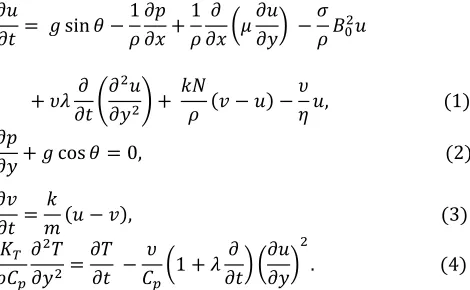
( ) where and are the coefficient of density and viscosity along irregular wall. The flow is due to the pressure difference, defined as where is function of only and is the inclination of the channel. Taking into consideration of these assumptions, the governing equations in cartesian coordinate system based on Prandtl boundary layer theory are as follows:
(
)
( )
( ) (
)
International Journal of Emerging Technology and Advanced Engineering
Website: www.ijetae.com (ISSN 2250-2459, ISO 9001:2008 Certified Journal, Volume 7, Issue 11, November 2017)
361
√
The non-dimensional equations of (1), (2), (3) and (4), after dropping * are given as,
(
) ( )
( ) (
)
Where - velocity of the fluid phase, - velocity of the
dust phase, - heat transfer coefficient, – time, - density of the fluid, h - width of the channel, p - pressure of the fluid, - positive real
constants, - coefficient of thermal conductivity of the fluid, - co-ordinate axis along the channel, - co-ordinate axis normal to the channel, - acceleration due to gravity, - temperature of the fluid, – stokes resistnace coefficient, - wall temperature, - local temperature,
- visco elastic parameter, – constant, - number density of the dust particles, - specific heat at constant pressure, – electrical conductivity, – magnetic field, - permeability of the porous medium, – stratification decay parameter, - mass per unit volume of the dust particles, - amplitude parameter, - kinematic viscosity,
- wave number, - viscosity of the fluid = , Reynolds number:
, visco-elastic parameter:
, relaxation time parameter
,
Hartmann number √ , Prandtl number:
, Eckert number
, Biot number
, mass concentration of dust particle and
.
The prescribed dusty fluid flow is evaluated for following two cases.
Case 1:
The convective boundary condition of irregular wall
at is
[
]. Similarly, for flat wall at the
temperature of is
[
]. Flat wall is maintained at higher temperature than wavy wall i.e. The appropriate initial and boundary conditions of velocity components and temperature are given by
i. When ,
for ( )
ii. When
[ ] for
and
[ ] for
When the above conditions are non dimensionalised, it transformed to the following form,
i. When , for
ii. When
for
and
for
where .
In the present scenario, numerical approach to the mathematical model is more preferable than analytical approach, due to technological advancement and user friendly software innovation which overcomes the difficulties of time consumption, solving technique, etc. The prescribed flow is analyzed by finite difference scheme to illustrate velocities of fluid and dust and Crank Nicolson method to determine temperature. The approximations of coupled equations of fluid velocity (5), dust velocity (6) and temperature (7) are given by
( )
International Journal of Emerging Technology and Advanced Engineering
Website: www.ijetae.com (ISSN 2250-2459, ISO 9001:2008 Certified Journal, Volume 7, Issue 11, November 2017)
362
The numerical approximation of corresponding initial and boundary conditions are as follows:
i. When , ii. When
and
Where
Case 2:
Consider the non convective boundary condition of irregular wall at is and for flat wall at is . Temperature of flat wall has maintained higher than irregular wall i.e. . Therefore, its respective initial and boundary conditions of velocity profiles and temperature are as follows:
i. When , for ( )
ii. When for
and for
The corresponding non dimensionlised form of above initial and boundary conditions are
i. When , for
ii. When for
and for
The governing equations of dusty fluid flow through inclined channel are given by the equations (5) to (7) and the corresponding numerical computations are given by equations (8) to (10). The finite difference and Crank nicolson estimation of non convective initial and boundary conditions are as follows:
i. When ,
ii. When and
Where
.
Here refers to with step size , refers to time with its mesh and . Hence, from the equations (8) to (10), one can get velocities of fluid and dusty flow and temperature respectively for cases 1 and 2. To understand the behavior of the flow, numerical computations are examined for different values of the physical parameters that describe the flow characteristics and the results are exhibited graphically. The values of parameters are taken as follows:
International Journal of Emerging Technology and Advanced Engineering
Website: www.ijetae.com (ISSN 2250-2459, ISO 9001:2008 Certified Journal, Volume 7, Issue 11, November 2017)
363 accuracy of the convergence and stability of numerical techniques, the outcomes have computed with smaller values i.e., , etc, and no considerable changes were observed in each cases. The above computations are carried out using a strong mathematical software mathlab.
Skin friction ( )
The friction between a moving fluid and the channel i.e., wall shear stress can be analyzed with the help of skin friction. Coefficient of skin friction is given by where (
) is the shearing stress. On using the
non dimensional number, the skin friction coefficient
reduced to ( )
. Since, Reynolds number is
measure of dominance of inertial forces over the viscous forces, it act as a important parameter at different scales of the flow measurement studies. Reynolds number assists as a tool to either amplify or reduce the effect of skin friction, to fit the corresponding value of interest.
Nusselt number ( )
The comparison of heat transfer rate between the conduction and convection of fluid can be analyzed by Nusselt number . The non dimensional heat transfer
coefficient
where ( ) is
heat flux at the wall. When non dimensional variables are used, Nusselt number takes the form
(
)
The fluid flow is characterized as laminar when Nusselt number is closer to 1 and turbulent when it is in the range of 100-1000.
III. RESULTS AND DISCUSSIONS
Numerical solutions for velocities of fluid and dust phases and temperature for various physical parameters are studied when a flow is subjected to variable viscosity and pressure. The influence of convective and non convective boundaries are probed on velocities and temperature and presented graphically from fig. 2 to 19.
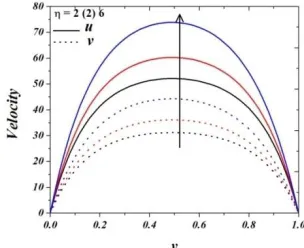
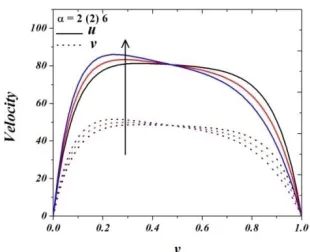
[image:6.612.361.513.517.641.2]It is contemplated that changes in the nature of the fluid flow against the variation in physical aspects are same in both the cases. Variation of fluid and dust velocities for disparate values of permeability of porous medium, Reynolds number, Hartmann number and stratification decay parameter are depicted in fig. 2 to 9. As enhancement in porosity parameter lowers the drag force, i.e., opposition force to the direction of the flow reduces, which leads to higher velocities of fluid and dust particles as in fig. 2 & 3. It is evident from fig. 4 & 5, velocities of fluid and dust raises with Reynolds number, since it is directly proportional to inertial force. Effect of Hartmann number on velocity profiles are obtained as one can expect, i.e., velocities of fluid and dust phases reduces for higher values of Hartmann number, shown in fig. 6 & 7. This behaviour is quiet natural since magnetic field is applied normal to the flow, which slows down the movement of the fluid and dust in the channel. Hence damping effect on the flow velocities is witnessed while Hartmann number accretes. Fig. 8 & 9 clearly indicates that the velocities getting strengthened when stratification decay parameter gets incremented on account of contraction in the barriers between the fluids. One can noticed that as relaxation time of the dust particles decreases then the velocity of both fluid and dust become same. Also it is observed that dust particles attain the steady state slower than the fluid particles. The wavy wall impacts on the velocity profiles of all physical parameters are observed and it is noticed that decrease in the magnitude of velocity profiles near to the wavy wall is proportional to the amplitude of the wavy wall. The fluid and dust velocities depend on frequency parameter and length of the wavy wall.
International Journal of Emerging Technology and Advanced Engineering
Website: www.ijetae.com (ISSN 2250-2459, ISO 9001:2008 Certified Journal, Volume 7, Issue 11, November 2017)
[image:7.612.368.520.149.273.2]364 Fig. 3 Variation of fluid and dust velocity with permeability of
[image:7.612.93.244.150.274.2]porous medium (Case-2)
Fig. 4 Variation of fluid and dust velocity with Reynolds number (Case-1)
[image:7.612.90.243.320.446.2]Fig. 5 Variation of fluid and dust velocity with Reynolds number (Case-2)
Fig. 6 Variation of fluid and dust velocity with Hartmann number (Case-1)
Fig. 7 Variation of fluid and dust velocity with Hartmann number (Case-2)
[image:7.612.372.519.321.445.2] [image:7.612.365.520.490.616.2] [image:7.612.89.243.493.619.2]International Journal of Emerging Technology and Advanced Engineering
Website: www.ijetae.com (ISSN 2250-2459, ISO 9001:2008 Certified Journal, Volume 7, Issue 11, November 2017)
[image:8.612.87.239.149.273.2]365 Fig. 9 Variation of fluid and dust velocity with stratification decay
parameter (Case-2)
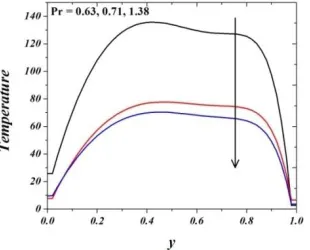
With the assist of fig. 10 to 19, the reflections of temperature while varying Hartmann number, Biot number, Eckert number, Reynolds number and Prandtl number have been interpreted. Fig. 10 & 11 specified that temperature varies proportionally with Hartmann number. Stronger the magnetic field, increases temperature due to viscous heating resulted from large shear stresses.
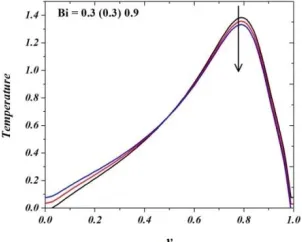
Physically, flow tends to get heated as magnetic field is applied and reduces the heat transfer from the wall. Biot number acts as a key to examine heat transfer. Resistance of heat transfer at the wall of the channel is low at high Biot number, as a result temperature falls which is shown in fig. 12 & 13. Flow is evaluated for and , being heat conduction inside the system is comparatively faster than the heat convection away from its surface when . Accordingly increase in Biot number results with cooling of the model which is influential while designing any model. In fig. 14 & 15, high temperature is noticed for greater values of Eckert number, as subsequently heat dissipation potential decreases. As a repercussion of dissipation due to viscosity and elastic deformation, higher Eckert number allows energy to be stored in the region. Same trend is observed with increase in Reynolds numbers, which is shown in fig. 16 & 17. As Reynolds number is ratio of inertial force to viscous force, inertial force dominates viscous force at higher values hence velocity increases. Fig. 18 & 19 reveals that enhancement in Prandtl number for the values (oxygen), (air) and (gaseous ammonia) results in significant decline in temperature. Physically this can be interrupted as, when Prandtl number increases, thermal boundary layer thickness reduces. Also Prandtl number controls thermal boundary layer in heat transfer situations and when it is less, heat diffuses faster when compared to velocity.
[image:8.612.371.520.195.321.2]Here the analysis is carried out for air, since Prandtl number is fixed to throughout the study. Thus to increase the cooling rate of conduction fluid, one can prefer the fluids with larger Prandtl number.
Fig. 10 Variation of temperature with Hartmann number (Case-1)
Fig. 11 Variation of temperature with Hartmann number (Case-2)
[image:8.612.359.513.358.483.2] [image:8.612.369.520.522.643.2]International Journal of Emerging Technology and Advanced Engineering
Website: www.ijetae.com (ISSN 2250-2459, ISO 9001:2008 Certified Journal, Volume 7, Issue 11, November 2017)
366 Fig. 13 Variation of temperature with Biot number (Case-2)
Fig. 14 Variation of temperature with Eckert number (Case-1)
Fig. 15 Variation of temperature with Eckert number (Case-2)
Fig. 16 Variation of temperature with Reynolds number (Case-1)
Fig. 17 Variation of temperature with Reynolds number (Case-2)
International Journal of Emerging Technology and Advanced Engineering
Website: www.ijetae.com (ISSN 2250-2459, ISO 9001:2008 Certified Journal, Volume 7, Issue 11, November 2017)
[image:10.612.92.247.151.276.2]367 Fig. 19 Variation of temperature with Prandtl number (Case-2)
For the interest of engineering, the skin friction and heat transfer coefficients are calculated for different physical pertinent. The effects of Hartmann number, Reynolds number and porosity parameters on the skin friction coefficient are tabulated in table I. It is cleared that coefficient of skin friction enlarges for high Hartmann number, Reynolds number and permeability of porous medium irrespective of stratified decay parameter. Also, when the stratified decay parameter increases, there is a consequent shrink in friction has noticed. Table II reveals the heat transfer effect for Reynolds number, Eckert number, Hartmann number, Biot number and Prandtl number. Nusselt number drops with the visco elastic parameter for these dimensionless physical parameters except Reynolds number. From the tabulated values of skin friction and heat transfer coefficient, one can conclude that the flow is laminar.
IV. CONCLUSIONS
With the interest of frequent usability in multifarious engineering field, theoretical analysis is carried out for MHD dusty fluid flow through inclined porous irregular channel. The following summarization is made for the influence of the study under different physical parameters,
Velocities and temperature are parabolic in nature. Velocities are lesser at the wavy than the non-wavy
boundary.
Dust velocity is lesser than fluid since dust particles restrict the flow.
Temperature near wavy wall is least and maximum near the flat wall.
Fluid and dust velocities and temperature are elevated for non convective flow.
Skin friction coefficient decreases for various physical parameters as the stratification decay parameter increases.
Shearing stress is reasonably high for non convective flow than convective flow.
Heat transfer coefficient raises for different physical parameters when visco elastic parameter increases. Heat flux is relatively higher for non convective
flow than convective flow.
REFERENCES
[1] Saffman, P.G. On the stability of laminar flow of a dusty gas. J. Fluid Mech. 13(1), 120-129, 1962.
[2] Chamber, P.L., Young, J.D. On diffusion of a chemically reactive species in a laminar boundary layer flow. Phys. Fluids. 1(1), 148-154, 1958.
[3] Michael, D.H., Norey, P.W. The laminar flow of a dusty gas
between rotating cylinders. Q. J. Mech. Appl. Math. 21(3), 375-388, 1968.
[4] Gireesha, B.J., Pavithra, G.M., Bagewadi, C.S. Boundary layer flow
and heat transfer of a dusty fluid over an exponentially stretching sheet. Br. J. Math. Comp. science. 2(4), 187-197 (2012)
[5] Mohan Krishna, P., Sugunamma, V., Sandeep, N. Magnetic field and
chemical reaction effects on convective flow of dusty viscoous fluid. Commun. Appl. Sci. 1(1), 161-187 (2013)
[6] Runu Sahu, Mishra, S.K.: Boundary layer flow and heat transfer of a
dusty fluid over a vertical permeable stretching surface. Int. J. Pure Appl. Res. Eng. Technol. 4(1), 360-370 (2015)
[7] \bibitem{MishraRauta} Mishra, S.K., Rauta, A.K. Boundary layer
flow and heat transfer of an unsteady dusty fluid over a stretching sheet. Int. J. Sci. Eng. Res. {\bf 6}(1), 182-189 (2015)
[8] Aswin Kumar Rauta, Saroj Kumar Mishra: The effect of radiation
on boundary layer flow and heat transfer of an unsteady dusty fluid over a stretching sheet with electrification of particles. Int. J. Eng. Techno. Res. 3(1), 244-253, 2015.
[9] Prasannakumara, B.C., Gireesha, B.J., Manjunatha, P.T. Melting
phenomenon in MHD stagnation point flow of dusty fluid over a stretching sheet in the presence of thermal radiation and non-uniform heat source/sink. Int. J. Comput. Methods Eng. Sci. Mech. 16, 265-274, 2015.
[10] Hazem Ali Attia, Abbas, W., Salama, M.D., Abdeen, A.M. Transient
couette flow of a dusty fluid between parallel plates with the ion slip effect and heat transfer under exponential decaying pressure gradient. Int. J. Innovative Res. Sci. Eng. Techno. 8(4), 6815-6822, 2015.
[11] Anand, V.W.J., Ganesh. S., Mohamed Ismail, A., Kirubhashankar,
C.K. Unsteady MHD dusty fluid flow of and exponential stretching sheet with heat source through porous medium. Appl. Math. Sci. 9(42), 2083-2090, 2015.
International Journal of Emerging Technology and Advanced Engineering
Website: www.ijetae.com (ISSN 2250-2459, ISO 9001:2008 Certified Journal, Volume 7, Issue 11, November 2017)
368
[13] Om Prakash, Devendra Kumar, Dwivedi, Y.K. Effects of thermal
difffusion and chemical reaction on MHD flow of dusty visco-elastic (Walter's liquid model-B) fluid. J. Electromagn. Anal. Appl. 2(10), 581-587, 2010.
[14] Geentanjali alle, Aashis S. Roy, Sangshetty kalyane, Ravi M. Sonth:
Unsteady flow of a dusty visco-elastic fluid through a inclined channel. Adv. Pure Math. 1(4), 187-192, 2011.
[15] y} Malashetty, M.S., Umavathi, J.C., Prathap Kumar, J.: Convective
magnetohydrodynamic two fluid flow and heat transfer in an inclined channel. Heat Mass Transfer. 37(2-3), 259-264, 2001. [16] Hazarika, G.C., Santana hazarika, Effects of variable viscosity and
thermal conductivity on the flow of dusty fluid over a continuously moving plate. Int. J. Comput. Appl. 122(4), 46-51, 2015.
[17] Gopal chandra hazarika, Jadav konch, Effects of variable viscosity and thermal conductivity on magnetohydrodynamic free convection dusty fluid along a vertical porous plate with heat generation. Turk. J. Phys. 40(1), 52-68, 2016.
[18] Sivaraj, R., Rushi kumar, B: Unsteady MHD dusty viscoelastic fluid
couette flow in an irregular channel with varying mass diffusion. Int. J. Heat Mass Transfer. 55(11-12), 3076-3089, 2012.
[19] Sivaraj, R., Rushi kumar, B. Chemically reacting dusty viscoelastic fluid flow in an irregular channel with convective boundary. Ain Shams Eng. J. 4(1), 93-10, 2013.
[20] Rathod, V.P., Sridhar, N.G. Peristaltic flow of a couple stress fluids
in an inclined channel. Int. J. Allied Pract. Res. Rev. 2(7), 27-38, 2015.
[21] Muhim Chutia, Numerical study of steady MHD plane Poiseuille
flow and heat transfer in an inclined channel. Int. J. Adv. Res. Sci. Eng. Techno. 3(10), 2773-2781, 2016.
[22] Hamdan M.H., Barron R.M.: A dusty gas flow model in porous
media. J. Comp. Appl. Math. 30, 21-37, 1990.
[23] Hazem Ali Attia, Abbas, W., Abdeen, M.A.M., Emam, M.S. Effect
of porosity on the flow of a dusty fluid between parallel plates with heat transfer and uniform suction and injection. Eur. J. Environ. Civ. Eng. 18(2), 241-251, 2014.
[24] Om prakash, Makinde, O.D., Devendra kumar, Dwivedi, Y.K.: Heat
transfer to MHD oscillatory dusty fluid flow in a channel filled with a porous medium. Sadhana. 40(4),1273-1282, 2015.
[25] Madhura, K.R., Gireesha, B.J., Bagewadi, C.S. Exact solutions of
unsteady dusty fluid flow through porous media in an open rectangular channel. Adv. Theor. Appl. Mech. 2(1), 1-17, 2009.
[26] Madhura, K.R., Gireesha, B.J., Bagewadi, C.S. Flow of an unsteady
dusty fluid flow through porous media in a channel of triangular cross-section. Int. Rev. Phys. 4(6), 315-325, 2010.
[27] Gireesha, B.J., Madhura, K.R., Bagewadi, C.S. Flow of an unsteady
dusty fluid flow through porous media in an uniform pipe with sector of a circle as cross-section. Int. J. Pure Appl. Math. 76(1), 29-47, 2012.
[28] Madhura, K.R., Swetha, D.S. Flow of an unsteady dusty fluid flow through hexagonal channel in presence of porous medium. Int. J. Appl. Math. Stat. 52(8), 29-47, 2014.
[29] Shyamanta Chakraborty, MHD flow and heat transfer of a dusty
viscoelastic stratified fluid down an inclined channel in porous medium under variable viscosity. Theor. Appl. Mech. 26, 1-14, 2001.
[30] Chakraborty, S., Nripen medhi, MHD flow and heat transfer of a
dusty visco-elastic liquid down an inclined channel in porous medium under variable viscosity and pressure. Proc. ICFM (Int. Conf. Front. Math.). 177-183, 2015.
[31] Madhura, K.R., Babitha, Iyengar, S.S. Impact of heat and mass
International Journal of Emerging Technology and Advanced Engineering
Website: www.ijetae.com (ISSN 2250-2459, ISO 9001:2008 Certified Journal, Volume 7, Issue 11, November 2017)
369
TABLEI
SKIN FRICTION COEFFICIENT FOR DIFFERENT PHYSICAL PARAMETERS
Parameters
Case 1 Case 2 Case 1 Case 2 Case 1 Case 2
0.5 15.38713809 12.44109557 9.332771015 7.545905903 5.660611761 4.576823285
1 21.39312564 18.28245073 12.97558661 11.0888669 7.870091107 6.725737759
1.5 24.49524133 18.9553975 14.85711488 11.49702975 9.01129569 6.973301038
0.05 -16.86664835 18.75757364 -10.23013935 -11.37704352 -6.204893169 -6.9005257
0.1 -6.855358969 -8.288413659 -4.157985398 -5.027177005 -2.521945626 -3.049136985
0.15 -0.552840505 -0.578686141 -0.335314716 -0.350990887 -0.203378656 -0.212886734
2 3134.056033 901.0445634 1900.901073 546.5111535 1152.954782 331.4757704
4 3499.242339 956.5633761 2122.397764 580.1850156 1287.299316 351.9000003
6 3864.428647 1039.640396 2343.894457 630.573775 1421.643851 382.4623277
TABLEIII
HEAT TRANSFER COEFFICIENT FOR DIFFERENT PHYSICAL PARAMETERS
Parameters
Case 1 Case 2 Case 1 Case 2 Case 1 Case 2
0.1 0.078861774 -2.602742598 0.157723548 -5.205485196 0.236585321 -7.808227795
0.2 0.185912146 -2.092206451 0.371824292 -4.184412902 0.557736439 -6.276619353
0.3 0.597615316 -1.609762442 1.195230631 -3.219524884 1.792845947 -4.829287327
2 0.088245632 0.448958871 0.176491265 0.897917742 0.264736897 1.346876613
4 -1.209985476 0.011144787 -2.419970951 0.022289573 -3.629956427 0.03343436
6 -2.178027699 -0.377310122 -4.356055398 -0.754620244 -6.534083097 -1.131930365
5 -1.314765778 -2.420230222 -2.629531556 -4.840460444 -3.944297333 -7.260690667
10 -1.553462222 -2.645776889 -3.106924444 -5.291553778 -4.660386667 -7.937330667
15 -2.043630222 -3.800065778 -4.087260444 -7.600131556 -6.130890667 -11.40019733
0.3 -0.189232757 -1.333571134 -0.378465514 -2.667142268 -0.567698271 -4.000713401
0.6 -0.545467365 -3.841864273 -1.090934731 -7.683728546 -1.636402096 -11.52559282
0.9 -1.737770493 -3.917332562 -3.475540987 -7.834665124 -5.21331148 -11.75199769
0.63 2.389232757 1.444171131 0.478456614 -2.00964434578 -3.765619876 -4.845308641
0.71 0.231467365 0.045762273 -0.167478431 -3.897585469 -5.984056271 -7.842895412