Omani banking sector
Alhousary, T, Underwood, J and Xanthidis, D
Title
ICT developments and utilization in the Omani banking sector
Authors
Alhousary, T, Underwood, J and Xanthidis, D
Type
Article
URL
This version is available at: http://usir.salford.ac.uk/id/eprint/48501/
Published Date
2017
USIR is a digital collection of the research output of the University of Salford. Where copyright
permits, full text material held in the repository is made freely available online and can be read,
downloaded and copied for noncommercial private study or research purposes. Please check the
manuscript for any further copyright restrictions.
ICT developments and utilization in the Omani banking sector
TAREQ ALHOUSARY
College of Commerce & Business Administration, Management Information Systems
Dhofar University
Salalah
OMAN
[email protected]
JASON UNDERWOOD
School of the Built Environment
The University of Salford Manchester
UK
[email protected]
DIMITRIOS XANTHIDIS
Faculty of Business, Management Information Systems,
Sohar University
Sohar
OMAN
[email protected]
Abstract:
While adopting information and communication technologies (ICT) has become inevitable,
the next-level challenge to organizations is how well they are utilizing this technology asset. Almost
two decades earlier, which is not a noticeable span of time of the human history, the research focus
was on how beneficial adopting technology by organizations was. Nowadays, the focus of the research
is shifted primarily to how well the technology should be managed and tuned to achieve the business
strategic goals and attain its competitive advantage or secure survival at minimum. This study takes
the commercial banking sector in Oman as a sample of a highly ICT-infused sector in the service
industry. Its aims to assess the efficiency and effectiveness of managing the information systems run
by a sector closely linked to its performance. The performance is the determinant of the
competitiveness/surviving level of any organization; banks are no exception. The research
methodology comprises of a self-administered questionnaire and an interview. The study was
conducted over 6 months. The exploratory nature of this research and the relevant type of data
collected (categorical and ordinal) has led to use the descriptive statistics including central-tendency
measures. The interviews have triangulated and confirmed the quantitative data collected. The study
finds that the selected sector has adopted latest ICT infrastructure in conducting both back-office and
front-office business which are adopted by common competitors worldwide. However, the study finds
that while the IT infrastructure follows the latest technologies in the field, there is still room to
optimize the utilization of this infrastructure by improving its administrative as well as technical
management of it.
1 Introduction
ICT developments explain and justify their rapid adoption by various types of organizations to improve their competitive advantage [1]. The current trend of teamwork in an organization, or even between several ones, is characterized by the heavy ICT mediation which is considered the “bread and butter” of virtual team (VT) work [2]. Education, health, defence, manufacturing, and banking are just some of the sectors that follow this paradigm. The banking industry, in particular, is among those who have been deeply affected by the impact of ICT altering not just the way work is conducted but introducing innovative services to their customers as well. The banking sector across the globe has embraced and used ICT as part of its business strategy for expansion, revenue generation, extension of customer base and creating competitive advantage against the other organizations in the sector [3]. It remains, however, a challenge in Oman to explore optimum ways to use the ICT by the banks to achieve the organization’s strategic objectives.
2 Background
2.1 A glance at the Omani commercial
banking sector (OCBS)
Omani government’s aim towards a stronger economy has led to a serious increase of the importance of investing in ICT infrastructure. Construction, telecommunications, transportation (especially airports), in addition to the financial industries all have been supported and nurtured by the Omani government to support the renaissance sought by the country. The banking sector, like the case of the other sectors, is benefiting from the strong economic performance, the economy liberalization, the diversification, the major infrastructure developments, the accelerated privatization orientation, the in-flow of foreign direct investments (FDI), and the favourable demographics with strong population growth and high percentage of youth. These are the driving forces for the growth of banks as well [4]. The FDI policy in Oman has led to increased investments. In the Business Environment Outlook, Shachmurove [5] explained that this policy has offered a set of incentives that made it attractive to foreign investors to activate free capital movement which allows foreign money to move in and out of Oman with no restrictions. Amongst these incentives are the 5-year
[image:3.595.308.546.212.577.2]tax free policy (potentially) renewable for another equal period, low-interest loans from the Oman Development Bank (limited) and the Ministry of Commerce and Industry, subsidized plant facilities and utilities at industrial sites, and, lastly, exemptions from custom duties on equipment and raw material during the early ten years of the investment.
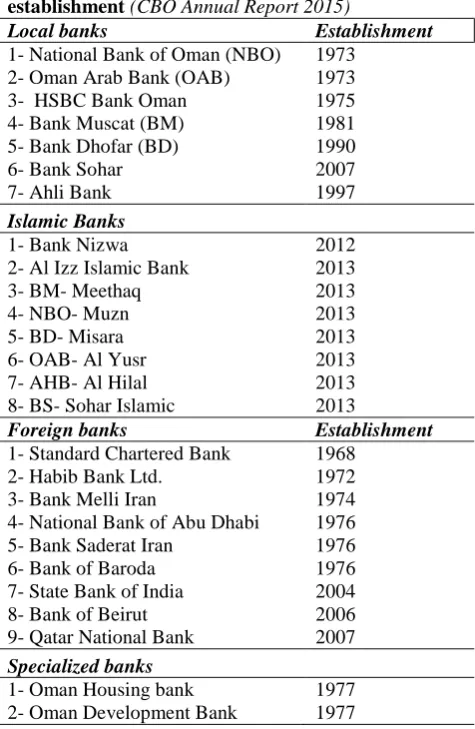
Table 1: The Omani banking sector - History of establishment (CBO Annual Report 2015)
Local banks Establishment
1- National Bank of Oman (NBO) 1973 2- Oman Arab Bank (OAB) 1973
3- HSBC Bank Oman 1975
4- Bank Muscat (BM) 1981
5- Bank Dhofar (BD) 1990
6- Bank Sohar 2007
7- Ahli Bank 1997
Islamic Banks
1- Bank Nizwa 2012
2- Al Izz Islamic Bank 2013
3- BM- Meethaq 2013
4- NBO- Muzn 2013
5- BD- Misara 2013
6- OAB- Al Yusr 2013
7- AHB- Al Hilal 2013
8- BS- Sohar Islamic 2013
Foreign banks Establishment
1- Standard Chartered Bank 1968
2- Habib Bank Ltd. 1972
3- Bank Melli Iran 1974
4- National Bank of Abu Dhabi 1976
5- Bank Saderat Iran 1976
6- Bank of Baroda 1976
7- State Bank of India 2004
8- Bank of Beirut 2006
9- Qatar National Bank 2007
Specialized banks
1- Oman Housing bank 1977
2- Oman Development Bank 1977
2.2 The ICT enabling role
Recent ICT rapid developments are considered an enabling factor for the increased adoption of the virtual mode of work [7]. In fact, without the ICT revolution it would be impossible to imagine the emergence of any form of time-efficient dispersed locations organization collaboration [8]. The maturity level of the information and communication technology (ICT) advents facilitates the flexibility in terms of time and cost to back up and support the business networks [1, 9-12]. While banking sector, in general, is the veins and arteries of any economy, the ICT has become the heart of this sector [13].
For organizations, the advent of ICT has made it challenging to adopt in the new competitive economy [14]. The direct particular serious implication is that the rapidly growing ICT capabilities and enhancements lead to drastic falling of the costs of the organizations [15]. This is because of the increased inter-organizational alliances and the maturity of ICT that enable reliable computer-mediated communication [16]. In the banking sector, the selection of the appropriate technology towards virtual team work is of critical importance.
2.3 Utilizing ICT infrastructure
The ICT infrastructure is described in the advancement centre for information systems (CCTA) as “the hardware, software and computer related telecommunications that support the ongoing provision of the organization’s ICT services”. It is associated with the people involved in the planning, management, implementation and operation of the IT in addition to the policies and regulatory procedures [17]. Kern et al. [18] refer in more details to the ICT infrastructure as it comprises the network, data centre facilities, server rooms, connection media, desktop, databases (RDBMS), operating systems (OS), integration, applications support, processes, metrics, service level agreements, systems management tools, all computer-related hardware, special purpose software applications such as the financial applications, e-mail systems office tools, and people. Kern et al. [18] stress that the human factor is the most valuable and critical one among the IT infrastructure factors that can affect its exploitation. From the IS perspective, Turban et al. [19], using an organizational term ‘information infrastructure’ instead of the technology-oriented one, refer that an
organization’s information infrastructure “consists of the physical facilities, services, and management that support all computing resources in an organization”.
The above describe ‘what the information infrastructure is’. Hence, it includes five major components that are: computer hardware, general-purpose software, networks and communication facilities (intranet & Internet), databases, and information management personnel. These definitions highlight the variables that should be traced in the target sector of this study that can be put as follows: availability of computers (per person), the availability of network access (through intranet and Internet), the availability of the technical support staff and the availability of the policies and procedural documents that regulate the use of the ICT hardware and software. It is important to mention here that the technical issues concerning the ICT infrastructure such as the network architecture and standards used are beyond the scope of this research.
3 Research methodology and data
collection
Three research questions constitute the core of this study which is of the exploratory nature:
1. What is the availability status quo of the IT infrastructure in the OCBS?
2. What is the status quo of the utilization of the IT infrastructure in the OCBS?
3. How can the utilization of the available IT infrastructure be further advanced?
Objectivism is adopted as the philosophical stand of this study with limited use of subjectivism in some areas. For this, two data collection mechanisms were used, i.e. the self-administered questionnaire and the interview. The variables identified for this study were developed from [20] and based on the purpose of this study [21]. The questionnaire was validated also by having the opinion of a panel of 4 experts. It was validated next by using a pilot study [21] where it was distributed to 21 respondents from two different banks of the five contributed in this study. The respondents of the pilot study gave a valuable feedback and led to a few but important modifications. Reliability of the scale was measured using the Cronbach’s Coefficient Alpha. The value of the test was (.745)
which indicates accepted level of reliability of a scale [22].
of computer systems to each employee/have access to computer device, the availability of network and the Internet access and the availability of work computer applications. Second, the demand side that is how comfortable employees are working on computers, and the level of work dependency on computer and network applications, the type of network applications, and the type of communication media used for work purposes. Third, the facilitating side which relates to the availability and reliability of the technical assistance to reduce the system failures as well as the speed of responding to a system failure system in case it is down.
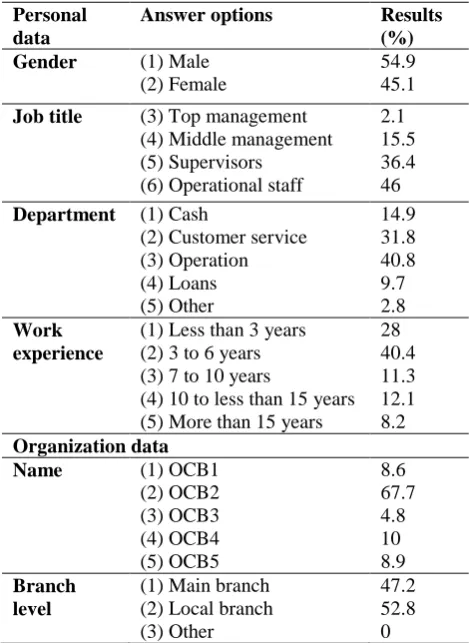
Table 2: Personal and organizationalcharacteristics
Personal data
Answer options Results
(%)
Gender (1) Male
(2) Female
54.9 45.1
Job title (3) Top management (4) Middle management (5) Supervisors
(6) Operational staff
2.1 15.5 36.4 46
Department (1) Cash
(2) Customer service (3) Operation (4) Loans (5) Other
14.9 31.8 40.8 9.7 2.8
Work experience
(1) Less than 3 years (2) 3 to 6 years (3) 7 to 10 years
(4) 10 to less than 15 years (5) More than 15 years
28 40.4 11.3 12.1 8.2
Organization data
Name (1) OCB1
(2) OCB2 (3) OCB3 (4) OCB4 (5) OCB5
8.6 67.7 4.8 10 8.9
Branch level
(1) Main branch (2) Local branch (3) Other
47.2 52.8 0
More than a thousand copies of the questionnaire were distributed using traditional method by hand submission (300 hardcopies) directly to the participating banks and more than 700 copies were distributed through emails with the help of banks’ representatives for this purpose. Three hundred and seventy-three (373) copies were returned with two hundred and ninety-one (291) of them decided to be good for further for analysis. This means a response rate of 37.3% of the total distributed copies and
29.1% for the eligible copies for analysis. It is, also, be worth mentioning that only 7% of the total received copies were through email.
The data gathered was analyzed by SPSS version 16. Table 2 details the personal and organizational attributes of the sample. Male and female percentiles show the inclusion and empowerment of women labor in the Sultanate especially in the service sector. Job title reflects the administrative levels in the OCBS and shows its hierarchical structure adopted in the banking sector. The “Department” question shows the distribution of the various functions in the sample with the majority falling into the operation and customer service given the nature of the service. The majority of the respondents have work experience spanning between 3 to 6 years. As for the organization demographic data, the contribution of the five participating banks in the study varied ranging from 4.7% to 67.7%. The variation is noted and justified as to be corresponding to the variation of each bank market share in the Omani banking services market. However, matching between the two, i.e. bank marketing share and its percentage in the sample, is done as best as possible.
4 Findings
just a precautionary measure to reduce risk level”.
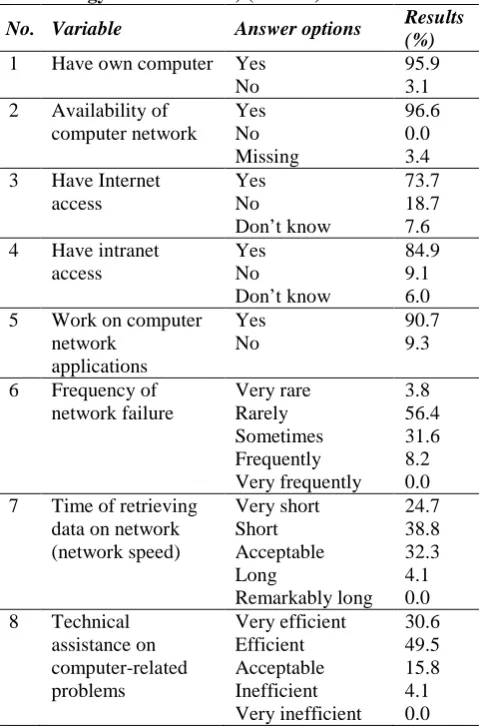
[image:6.595.52.292.181.545.2]Network response time seems to be satisfactory for almost all respondents except 4.1% who reported long waiting time before application response takes place.
Table 3. ICTI (Information Communication Technology Infrastructure) (N= 291)
No. Variable Answer options Results
(%)
1 Have own computer Yes No
95.9 3.1 2 Availability of
computer network Yes No Missing 96.6 0.0 3.4 3 Have Internet
access Yes No Don’t know 73.7 18.7 7.6 4 Have intranet
access Yes No Don’t know 84.9 9.1 6.0 5 Work on computer
network applications Yes No 90.7 9.3
6 Frequency of network failure Very rare Rarely Sometimes Frequently Very frequently 3.8 56.4 31.6 8.2 0.0 7 Time of retrieving
data on network (network speed) Very short Short Acceptable Long Remarkably long 24.7 38.8 32.3 4.1 0.0 8 Technical
assistance on computer-related problems Very efficient Efficient Acceptable Inefficient Very inefficient 30.6 49.5 15.8 4.1 0.0
As to the human involvement in managing and maintaining the hardware of the ITI, the resulting percentage values of the positive answers (5 and 4 in the Likert scale) are 60.2% for network failure, 63.5% for network speed and 80.1% for technical assistance to computer-related problems. Both network failure and network speed results provide modest levels of ITI infrastructure in terms of network speed and reliability. This might suggest that employees hardly feel network related problems; furthermore, they feel the speed of retrieving data through these networks is close to the average which indicates room for improvement. As for the technical assistance, 80.1% indicate reliable
ITI technical staff support to handle various issues and problems. These details are shown in Table 3.
4.1 ITI of the Omani commercial banking
sector (OCBS)
ITI (Information Technology Infrastructure) refers to the computer-related aspect and the professional people in charge of planning, implementing, and maintaining ITI to support the various operations of the organization [17, 18]. It is concerned with three issues, i.e. the availability, the compatibility, and the competency of the ITI resource [23]. In other words, it focuses in addressing issues related to the hardware (e.g. computers, servers, connectivity, etc.), software (e.g. network applications) as well as the supporting qualified technical staff. The summarized findings are detailed in Table 4.
[image:6.595.310.554.498.620.2]The values suggest a general positive stance in every issue inquired. Both mode and median values being equal to 4 and given a minimum of 2 and a maximum of 5 indicates that no extreme negative answers exist among the sample. The standard deviation ranges from .699 to .844 suggesting good variation in the range of answers. The last row in Table 4 shows the combined values of the central tendency of these indicators which indicate the overall positive level of the ITI of the sector in terms of the network failure, network speed and level of technical assistance.
Table 4: Central tendency values of ITI scale ordinal items (N=291)
Item Mode Median Std.
deviation min. max.
Frequency of
network failure 4 4 0.699 2 5
Network speed 4 4 0.844 2 5
Level of technical assistance
4 4 0.792 2 5
Combined
values 4 4 0.646 2 5
4.2 ICT utilization in the sector
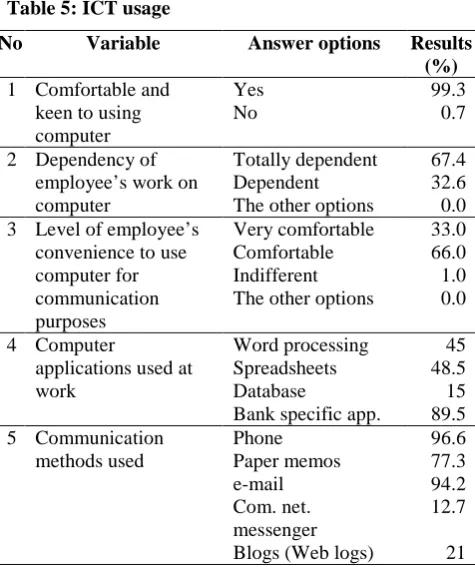
and presentation applications (15%) are all used but not equally. Cramer’s V test point towards low correlation between the use of these tools and the various levels of employees (.177, sig .28; .176, sig .29).
Table 5: ICT usage
No Variable Answer options Results
(%)
1
Comfortable and keen to using computer Yes No 99.3 0.7 2 Dependency of employee’s work on computer
Totally dependent Dependent The other options
67.4 32.6 0.0 3
Level of employee’s convenience to use computer for communication purposes Very comfortable Comfortable Indifferent The other options
33.0 66.0 1.0 0.0 4 Computer
applications used at work
Word processing Spreadsheets Database
Bank specific app.
45 48.5 15 89.5 5 Communication methods used Phone Paper memos e-mail Com. net. messenger Blogs (Web logs)
96.6 77.3 94.2 12.7
21
Additionally, there are three major bank-specific applications reported applications, namely ECC, AS400 and T24. Cramer’s V test (.663, sig. 000) reveals high correlation between the use of these applications and the job level. Cross tabulation further suggests this correlation (100%) for the top and middle management but gradually decreasing towards the first-level management (supervisors) and the non-managerial staff (clerks).
With regards to the communication methods used, the results show high reliance on phone with 96.6% and email with 94.2% and less on paper memos 77.3% followed by Weblogs 21% and last network messenger 12.7%. Interviewees provided almost similar justification on relying on phone calls and emails for communications. As they mentioned, they need to use phone calls, especially for urgent matters, and email for less urgent issues where documentation is important whether for disclaiming purposes or for providing reference for future need.
The values of the central tendency (i.e. standard deviation, skewness) of employee’s answers (table 6) are used to explain the dependency on computers
[image:7.595.314.547.375.538.2]and the level of convenience. The values of both these indicators suggest positive readiness on all issues addressed in the study. The standard deviation value is .47 which means that the dispersion of the values around the average value is low. This is clear however by the minimum and maximum values which are 4 and 5, respectively meaning that all respondents are either dependent or completely dependent on computers in their work which explains the tight positive range of options all respondents fall in. The skewness of -.739 suggests the overall tendency of the result to this indicator to the positive options. As to the convenience in using computers, the standard deviation value is .531 means that the dispersion of the values around the average value still considerably low even though the minimum and maximum values span wider from 2 to 5 which mean all options were selected except the extreme negative option. The skewness of .163 suggests an overall slight tendency of the result to this indicator to the positive options.
Table 6: Central tendency of the ICT infrastructure & usage scale ordinal items
Item N Std.
deviation
Skewness min max
Level of work dependency on computer
290 .470 -.739 4 5
Convenience in using computers
291 .531 -.163 2 5
Frequency of network failure
291 .699 -.6 2 5
Network speed 283 .844 -.109 2 5 Level of technical
assistance
291 .792 -.621 2 5
Combined values 291 .646 -.429 2 5
5 Conclusions
especially with the existence of ten foreign banks that have considerably longer experience in the field. This is also put clearly by all respondents where one of them put it this way: “Our bank relies highly on its IT resource and its utilization. For this, the bank has shifted recently to one of the recent IT bank application. The management is also provides IT training a few times a year to make sure that its employees are competent and doing their jobs at reliable level since most of the bank’s jobs and tasks rely largely on IT”
This finding fulfils answering the second research question that is concerned with how ICT is utilised in the target sector in order to establish how far it is likely to be ready in accepting VT mode of work that relies largely on the use of ICT. Therefore, in answering the question ‘the level of ICT utilization in the commercial banking sector is advanced enough in using its ICT resource in a way that supports adopting VT among the other traditional work mechanisms.
References:
[1] Hertel G, Geister S, Konradt U, Managing virtual teams: A review of current empirical research. Human resource management review, 2005, 15(1), pp. 69-95.
[2] Walvoord AA, Redden ER, Elliott LR, Coovert MD, Empowering followers in virtual teams: Guiding principles from theory and practice,
Computers in Human Behavior, 2008, 24(5), pp. 1884-1906.
[3] Kevin BO, Benard MC, Ronald MO, Impact and Challenges of Information Communication Technology Adoption in the Tanzanian Banking Sector, International Journal of Academic Research in Business and Social Sciences, ISSN: 2222-6990, 2013, 3(2), pp. 323.
[4] El-Quqa OM, Hasan F, Marfatia MJ, Gouda A,
Oman banking sector report, Kuwait: Global Investment House KSCC, 2007.
[5] Shachmurove Y, Entrepreneurship in Oman,
Penn Institute for Economic Research, 2009. [6] Central Bank of Oman (CBO), Annual Report,
2015,
www.cbo-oman.org/annual/Annual_Report_2015.pdf. [7] Hossain L, Wigand R, ICT enabled virtual
collaboration through trust, Journal of Computer-Mediated Commmunication, 2004, 10(1), 00.
[8] Ale Ebrahim N, Ahmed S, Taha Z, Virtual teams: A literature review, 2009, 3(3), pp. 2653-2669,
https://hal.archives-ouvertes.fr/file/index/docid/593357/filename/N ader-AJBAS_3_3_2653-2669-2009.pdf.
[9] Hope J, Hope T, Competing in the third wave: the ten key management issues of the information age, Harvard Business Press, 1997. [10] Rezgui Y, Role-based service-oriented implementation of a virtual enterprise: A case study in the construction sector, Computers in Industry, 2007, 58(1), pp. 74-86.
[11] Schiller SZ, Mandviwalla M, Virtual team research: An analysis of theory use and a framework for theory appropriation, Small group research. 2007, 38(1), pp. 12-59.
[12] Vosloo S, Van Belle J, E-government and the E-readiness of Non-Profit Organisations in the Western Cape, The 2nd Annual Conference of the Community Informatics Research Network (CIRN), South Africa 2005, pp. 24-26.
[13] Aliyu AA, HJ Tasmin RB, The Impact of Information and Communication Technology of Bank's Performance and Customer Service Delivery in the Banking Industry, International Journal of Latest Trends in Finance & Economic Sciences, E-ISSN: 2047-0916, 2012, 2(1), pp. 80-90.
[14] Arnison L, Miller P, Virtual teams: a virtue for the conventional team, Journal of Workplace Learning, 2002, 14(4), pp. 166-173.
[15] Brodt TL, Verburg RM, Managing mobile work—insights from European practice. New Technology, Work and Employment, 2007, 22(1), pp. 52-65.
[16] Kayworth TR, Leidner DE, Leadership effectiveness in global virtual teams. Journal of management information systems, 2002, 18(3), pp. 7-40.
[17] CCTA T. G, An introduction to IT infrastructure planning, London: Crown, 1994. [18] Kern H, Galup SD, Nemiro G, IT organization:
building a worldclass infrastructure, Prentice Hall PTR, 2000.
[19] Turban E, King D, Lee J, Viehland D,
Electronic commerce: A managerial perspective 2002, Prentice Hall: ISBN 0. 13.975285 (2002): 4, 2002.
[20] Ismail Al-Alawi A, Yousif Al-Marzooqi N, Fraidoon Mohammed Y, Organizational culture and knowledge sharing: critical success factors. Journal of knowledge management, 2007, 11(2), pp. 22-42.
[22] Pallant J, SPSS Survival Manual: A Step by Step Guide to Data Analysis Using SPSS, 4th Edition ed: McGraw Hill, 2010.
[23] Pauleen DJ, An inductively derived model of leader-initiated relationship building with virtual team members, Journal of Management Information Systems, 2003, 20(3), pp. 227-256. [24] Henderson R, Deane F, Barrelle K, Mahar D,
Computer anxiety: correlates, norms and problem definition in health care and banking employees using the computer attitude scale, Interacting with computers, 1995, 7(2), pp. 181-193.
[25] Renkema TJ, The IT value quest: how to capture the business value of IT-based infrastructure, John Wiley & Sons, Inc., 2000. [26] Renken J, Developing an IS/ICT management