i
THE CONTRIBUTIONS OF KNOWLEDGE MAPPING
IN FACILITIES PERFORMANCE EVALUATION
PRACTICE IN MALAYSIA
Mohd Fadzil MAT YASIN
ii
THE CONTRIBUTIONS OF KNOWLEDGE MAPPING
IN FACILITIES PERFORMANCE EVALUATION
PRACTICE IN MALAYSIA
Mohd Fadzil MAT YASIN
School of the Built Environment,
College of Science and Technology,
University of Salford, Salford, UK
i
TABLE OF CONTENTS
TABLE OF CONTENTS ... I LIST OF FIGURES ... IX LIST OF TABLES ... XI ACKNOWLEDGEMENT ... XVII LIST OF PUBLICATIONS ... XVIII DECLARATION ... XIX ABBREVIATIONS ... XX ABSTRACT ... XXI
CHAPTER 1. INTRODUCTION ... 1
1.1INTRODUCTION ... 1
1.2BACKGROUND AND REVIEW OF RESEARCH NEEDS IN THE AREA ... 1
1.3FACILITIES MANAGEMENT POSITION IN THE MALAYSIAN SERVICE INDUSTRY ... 4
1.4RESEARCH QUESTIONS ... 7
1.5RESEARCH AIMS AND OBJECTIVES ... 8
1.5.1 Research Aim ... 8
1.5.2 Research Objectives ... 8
1.6SIGNIFICANCE/BENEFITS OF THE STUDY ... 9
1.7STRUCTURE OF THE THESIS ... 10
1.8SUMMARY AND LINK ... 13
CHAPTER 2. A REVIEW OF LITERATURE ON KNOWLEDGE MAPPING AND FACILITIES PERFORMANCE EVALUATION ... 14
2.1INTRODUCTION ... 14
2.2AN OVERVIEW OF FACILITIES MANAGEMENT PRACTICE ... 15
2.2.1 Introduction ... 15
2.2.2 Characteristics of Facilities Management Organisations ... 16
2.2.3 Knowledge Management in Facilities Management Organisations ... 20
2.2.4 Core competencies in facilities management ... 26
ii
2.2.6 Process of Managing Facilities ... 29
2.3FACILITIES PERFORMANCE EVALUATION PROCESSES... 33
2.3.1 Purpose and benefits of evaluation ... 37
2.3.2 Building and facilities-related evaluation techniques ... 39
2.3.3 Information technology in Facilities Management ... 41
2.4KNOWLEDGE MAPPING IMPLEMENTATION ... 43
2.4.1 Definition of Knowledge Mapping ... 44
2.4.2 Character of Knowledge Mapping ... 45
2.4.3 Process of Knowledge Mapping ... 47
2.4.4 Identification of Organisational Knowledge ... 50
2.4.5 Knowledge Repository... 53
2.4.6 Identifying the gaps and creating the links ... 53
2.4.7 Types, Tools and Techniques of Knowledge Mapping ... 54
2.4.8 Potential Benefits of Knowledge Mapping ... 60
2.4.9 Conceptualisation of Knowledge Mapping Within Facilities Performance Evaluation ... 63
2.4.10 Selecting the Appropriate components in Knowledge Mapping ... 64
2.4.11 Barriers and challenges for knowledge mapping ... 66
2.5THE CONCEPTUAL FRAMEWORK ... 67
2.6SUMMARY AND LINK ... 71
CHAPTER 3. A RESEARCH METHODOLOGY ... 72
3.1INTRODUCTION ... 72
3.2METHODOLOGY:ANESTED RESEARCH APPROACH ... 72
3.3RESEARCH PHILOSOPHY ... 73
3.3.1 Ontological Consideration ... 74
3.3.2 Epistemological Consideration ... 74
iii
3.4RESEARCH APPROACH:THE SURVEY METHODS ... 76
3.5IDENTIFICATION OF THE POPULATION SAMPLE AND SELECTION OF SAMPLE FRAME ... 77
3.6DATA COLLECTION METHODS... 78
3.6.1 Literature review and synthesis ... 78
3.6.2 Interviews ... 79
3.6.3 Questionnaire method: The Design and The Content ... 82
3.6.4 Questionnaire method: The Administration Survey ... 84
3.6.5 Questionnaire method: Reasons for choosing the E-mail Survey Approach ... 89
3.7DATA ANALYSIS METHOD ... 91
3.7.1 Qualitative Data Analysis ... 91
3.7.2 Quantitative Data Analysis ... 91
3.8RELIABILITY AND VALIDITY ISSUES ... 91
3.8.1 Reliability analysis... 91
3.8.2 Validity of the research ... 92
3.9SUMMARY AND LINK ... 93
CHAPTER 4. PRACTICE OF FACILITIES PERFORMANCE EVALUATION ... 94
4.1INTRODUCTION ... 94
4.2TRENDS AND DIRECTION OF FACILITIES PERFORMANCE EVALUATION PRACTICE ... 95
4.3PURPOSE OF FACILITIES PERFORMANCE EVALUATION ... 96
4.4EXTENT OF PRACTICE OF FACILITIES PERFORMANCE EVALUATION ... 99
4.4.1 Extent of facilities performance evaluation (FPE) practice based on facilities management service provision ... 103
4.4.2 Extent of facilities performance evaluation (FPE) practice based on facilities management organisational size ... 105
4.5ANALYSIS OF THE ISSUES AND CHALLENGES IN CONDUCTING FPE ... 108
iv
4.5.2 Challenges associated with obtaining the information and data of the building
facilities... 116
4.5.3 Challenges associated with insufficient number of staff ... 117
4.5.4 Challenges associated with lack of awareness ... 118
4.6 THE CRITICAL SUCCESS FACTORS IN CONDUCTING FACILITIES PERFORMANCE EVALUATION ... 119
4.6.1 The Critical Success Factors (CSFs) ... 119
4.6.2 The critical success factors according to FM service provision ... 121
4.6.3 Critical success factors according to organisational size ... 123
4.6.4 Criticality related to evaluators’ knowledge for successful facilities performance evaluation ... 125
4.6.5 Criticality related to the quality of reports/outputs in determining facilities performance evaluation success ... 127
4.6.6 Criticality related to accessibility to the data and information of the facilities 128 4.6.7 Accessibility to the Space ... 129
4.7SUMMARY AND LINK ... 129
CHAPTER 5. ROLE OF KNOWLEDGE MAPPING IN MANAGING FACILITIES 133 5.1INTRODUCTION ... 133
5.2THE ROLE OF KNOWLEDGE MAPPING IN FACILITIES MANAGEMENT ORGANISATIONS IN MALAYSIA ... 133
5.2.1 The role of knowledge mapping vs. FM service provision... 140
5.2.2 The role of knowledge mapping according to organisational size ... 143
5.2.3 Role in improving knowledge asset inventory: Building and facilities information ... 145
5.2.4 Role in improving knowledge asset inventory: People and information ... 146
5.2.5 Role in avoiding duplication of tasks ... 148
5.2.6 Role in identifying knowledge gaps ... 149
v
5.3FACTORS INFLUENCING THE INCREASING ROLE OF KNOWLEDGE MAPPING IN FM ... 152
5.3.1 Influence of Information and Communication Technology (ICT) ... 159
5.3.2 Influence of User Demand for Better Quality Facilities Management ... 163
5.3.3 Influence of Knowledge Management Awareness in Facilities Management . 165 5.3.4 Influence of Competitiveness among Facilities Management Providers ... 166
5.4SUMMARY AND LINK ... 167
CHAPTER 6. THE ROLE OF KNOWLEDGE MAPPING IN FACILITIES PERFORMANCE EVALUATION (FPE) ... 169
6.1INTRODUCTION ... 169
6.2KNOWLEDGE MAPPING AS AN APPROACH IN IMPROVING EFFECTIVENESS AND EFFICIENCY IN FACILITIES PERFORMANCE EVALUATION... 170
6.3ROLE OF KNOWLEDGE MAPPING IN FACILITIES PERFORMANCE EVALUATION PROCESS171 6.3.1 Role of knowledge mapping in identifying knowledge gaps for facilities performance evaluation ... 180
6.3.2 Role of knowledge mapping in simplifying the process for facilities performance evaluation ... 182
6.3.3 Role in avoiding duplication of tasks ... 183
6.3.4 Role in linking the right people to the task ... 184
6.3.5 Role in providing building facilities database ... 185
6.4SUMMARY AND LINK ... 186
CHAPTER 7. CHALLENGES ASSOCIATED WITH IMPLEMENTING KNOWLEDGE MAPPING IN FACILITIES PERFORMANCE EVALUATION ... 189
7.1INTRODUCTION ... 189
7.2 COMMON ISSUES AND CHALLENGES IN IMPLEMENTING KNOWLEDGE MAPPING IN FACILITIES MANAGEMENT ORGANISATIONS ... 189
7.3 THE ISSUES AND CHALLENGES FOR FACILITIES MANAGEMENT ORGANISATION IN IMPLEMENTING KNOWLEDGE MAPPING INITIATIVES... 191
7.3.1 Challenges According to the Size of Facilities Management Organisations ... 194
vi
7.3.3 Challenge associated with Attitudes and Cultures in The Organisation ... 197
7.3.4 Challenge associated with training for implementation ... 202
7.3.5 Challenge associated with understanding knowledge flow ... 204
7.3.6 Challenge associated with data and information accuracy in the organisation 206 7.3.7 Challenge associated with financial constrain ... 207
7.4SUMMARY AND LINK ... 208
CHAPTER 8. EXPLOITATION OF KNOWLEDGE MAPPING BENEFITS IN FACILITIES PERFORMANCE EVALUATION ... 211
8.1INTRODUCTION ... 211
8.2THE EXPLOITATION OF KNOWLEDGE MAPPING BENEFITS ... 212
8.2.1 Exploration vs. Exploitation ... 212
8.2.2 Exploitation of knowledge mapping in facilities performance evaluation ... 213
8.3THE PROCESSES IN EXPLOITING KNOWLEDGE MAPPING BENEFITS ... 215
8.3.1 Exploitation of knowledge mapping benefits based on the facilities management provision ... 219
8.3.2 Exploitation of knowledge mapping benefits based on the sizes of facilities management organisation ... 220
8.3.3 ICT in exploitation of knowledge mapping benefits ... 223
8.3.4 Documentation of business process ... 226
8.3.5 Continuously identify organisational knowledge ... 226
8.3.6 Evaluate knowledge mapping outcomes ... 227
8.3.7 Review the Facilities Performance Evaluation process ... 228
8.4THE CRITICAL SUCCESS FACTORS FOR EXPLOITING KNOWLEDGE MAPPING BENEFITS .. 229
8.4.1 The critical success factors (CSFs) according to size of organisation ... 232
8.4.2 The critical success factors (CSFs) according to facilities management service provision ... 233
vii
8.4.3 Understanding knowledge flow in the process of facilities performance
evaluation (KCSF1) ... 236
8.4.4 Ability to capture new knowledge (KCSF2) ... 237
8.4.5 Top management support for knowledge mapping exploitation (KCSF3) ... 238
8.4.6 Knowledge and Skill of the staff involve in the knowledge mapping (KCSF4) ... 239
8.4.7 Organisational culture (KCSF5) ... 240
8.4.8 Identification of the needs for knowledge mapping (KCSF6) ... 240
8.4.9 Availability and accessibility to information and communication technology (ICT) (KCSF7) ... 241
8.4.10 Individual willingness to share knowledge (KCSF8) ... 242
8.4.11 Flexibility of the knowledge mapping techniques (KCSF9) ... 243
8.5 PROPOSED EXPLOITATION FOR KNOWLEDGE MAPPING BENEFITS IN FACILITIES PERFORMANCE EVALUATION ... 243
8.6GUIDANCE FOR IMPROVING AWARENESS AND EXPLOITATION OF KNOWLEDGE MAPPING IN FACILITIES PERFORMANCE EVALUATION... 251
8.6.1 Content and Design of the Guidance Documents ... 252
8.6.2 Implementation of the guidance ... 254
8.6.3 Scope of the guidance ... 254
8.6.4 Proposed Guidance Documents ... 255
8.6.5 Validation of the guidance ... 257
8.7SUMMARY AND LINK ... 259
CHAPTER 9. CONCLUSIONS AND RECOMMENDATIONS ... 261
9.1INTRODUCTION ... 261
9.2THE RESEARCH PROCESS ... 261
9.3LIMITATION AND SELF-CRITICAL ANALYSIS... 263
9.4CONCLUSION OF THE STUDY ... 264
viii
9.4.2 Role of knowledge mapping in facilities management organisation ... 266
9.4.3 Role and implication of knowledge mapping in FPE ... 268
9.4.4 Challenges associated with implementation of knowledge mapping ... 269
9.4.5 Exploitation of knowledge mapping benefits... 270
9.5RECOMMENDATION AND FUTURE WORK ... 271
9.5.1 Recommendations for practitioners ... 272
9.5.2 Recommendations for academia... 273
ix
LIST OF FIGURES
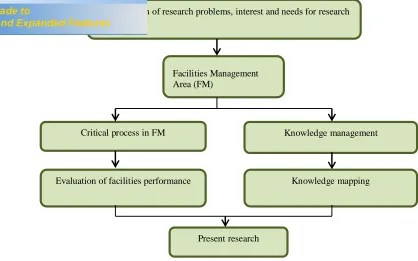
Figure 1.1: Identification of research needs in facilities management (FM) area ... 2
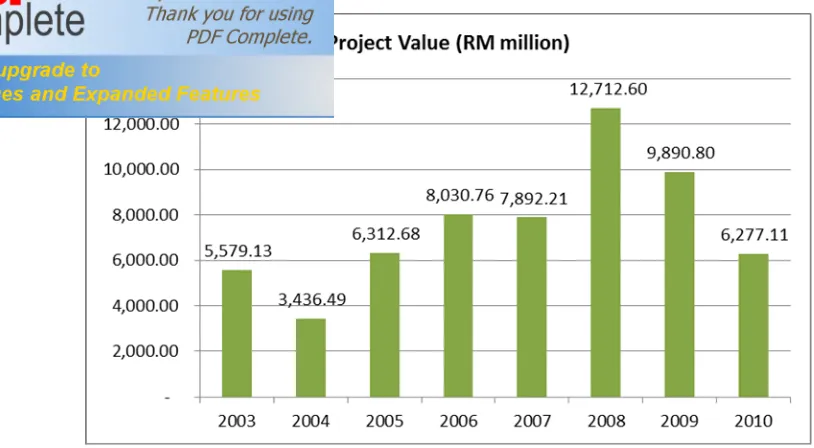
Figure 1.2: Facilities management contract awarded to independent contractors in Malaysia between Year 2003 to Year 2010 (extracted from CIDB annual report statistics) ... 5
Figure 1.3: Service sector expected annual growth rate (%) in 10th Malaysian Plan for 2011 to 2015 ... 6
Figure 1.4: Share of Service sector in Malaysia to GDP in 2015 ... 6
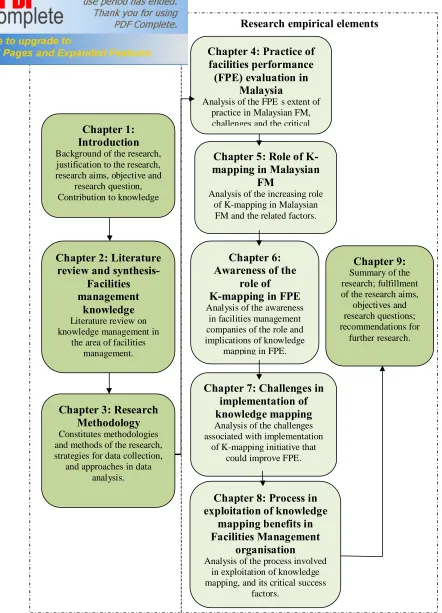
Figure 1.5: Flow of research based on thesis chapters’ arrangement ... 12
Figure 2.1: The service process matrix (adopted from Schmenner,1986, as cited in Fitzsimmons and Fitzsimmons, 1998) ... 17
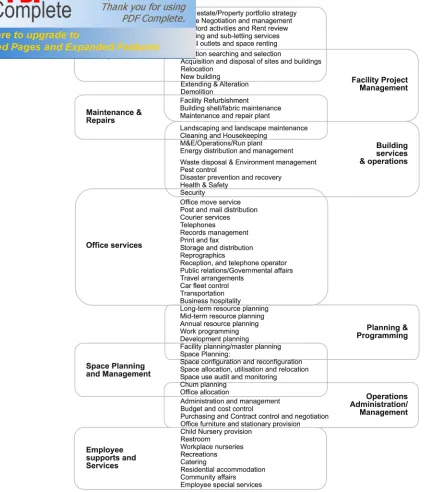
Figure 2.2: Cluster of facilities management support service (source Chotipanich, 2004) ... 19
Figure 2.3: Information flows for physical resources (McLennan, 2000)... 21
Figure 2.4: Facilities Management Practice and Knowledge Capture (Then 2005) ... 23
Figure 2.5: AEC/FM information system supported by IFCs and FMCMs. (source: Yu et. al., 2000) ... 26
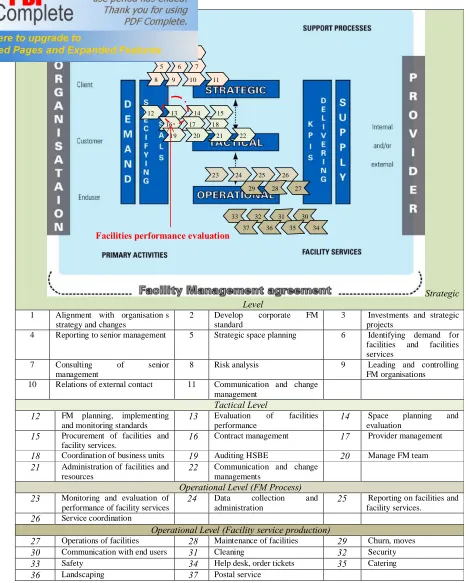
Figure 2.6: Relationship of FM processes to the Facilities Management Model: Position of facilities performance evaluation at the tactical level (Source: BSI, 2007) ... 30
Figure 2.7: Evaluating facilities performance process model (adopted from Preiser et. al , 1991 and Barrett and Baldry, 2003). ... 36
Figure 2.8: Facilities management decision system (adopted from Rondeau et al., 2006) .... 43
Figure 2.9: Hierarchy of knowledge (adopted from Bollinger and Smith, 2001: Model of learning progression) ... 52
Figure 2.10: Knowledge Transition (adopted from Bollinger and Smith, 2001) ... 53
Figure 2.11: Mapping techniques for the map context (source: Folkes, 2004) ... 57
Figure 2.12: Category of knowledge mapping benefits ... 61
Figure 2.13: Knowledge mapping concept model ... 65
Figure 2.14: Scope and focus areas of the study... 69
Figure 3.1: A nested research methodology (adopted from: Kagioglou et.al., 1998) ... 73
Figure 3.2: Research on three dimensions (source: Sexton & Barrett, 2003) ... 74
Figure 4.1: Level of interaction between levels in facilities performance evaluation and skills and knowledge intensiveness ... 98
Figure 4.2: Measurement of FPE practice ... 99
x
Figure 8.1: Exploitation of knowledge mapping benefits process (Adopted from March and
Barrett, 2010) ... 245
xi
LIST OF TABLES
Table 2.1: Challenges for professional service (adopted from Schmenner, 1986, as cited in
Fitzsimmons and Fitzsimmons, 1998) ... 17
Table 2.1: Challenges or key concerns related to knowledge management in the organisation
(adopted from Alavi and Leidner, 1999) ... 22
Table 2.2 : Six basic steps in knowledge mapping (adopted from Vestal, 2000) ... 48
Table 2.3 : Six basic steps in knowledge mapping ... 49
Table 2.4 : Knowledge map classification (adapted from Eppler, 2008 and Wexler, 2001) .. 59
Table 2.5: Classifying micro-conceptual frameworks (adopted from Shields and Tajalli.
2006) ... 68
Table 2.6: Relationship between research aims, objectives and working hypotheses ... 70
Table 3.1: Relevant situations for different research methods. (source; COSMOS as cited in
Yin, 2009) ... 77
Table 3.2: Literature search coverage ... 79
Table 3.3 : Cross tabulation of interview respondents based on their organisations’ size and
their FM service provisions ... 81
Table 3.4 : Response rate of the questionnaire survey ... 85
Table 3.5 : Categorisation of enterprise based on Malaysian SME Corporation definition .. 86
Table 3.6 : Cross tabulation of respondents based on their organisations’ sizes and their FM
service provisions ... 87
Table 3.7 : Respondents job titles in two FM service provisions: outsource and in-house. ... 88
Table 3.8: Respondents’ experience according to FM service provision ... 89
Table 3.9 : Internet usage and population growth in Malaysia, Source – Internet World Stats
(2011) ... 90
Table 4.1: Extent of practice of FPE in Malaysia ... 100
Table 4.2: Extent of practice of FPE according to FM service provision ... 103
Table 4.3: Mann-Whitney U test statistic extent of practice in conducting facilities
performance evaluation according to the facilities management service provision ... 105
Table 4.4: Extent of practice in conducting FPE according to organisational size ... 106
Table 4.5: Kruskal-Wallis test statistic for basis in conducting FPE according to the
organisational size ... 107
xii
Table 4.7: Challenges and issues in conducting facilities performance evaluation highlighted
by interview respondent. ... 110
Table 4.8: Challenges in conducting FPE according to FM service provision ... 111
Table 4.9: Mann-Whitney U test statistic challenge in conducting facilities performance evaluation according to the facilities management service provision ... 113
Table 4.10: Challenges in conducting FPE according to organisational size ... 113
Table 4.11: Kruskal-Wallis test statistic challenge in conducting facilities performance evaluation according to the organisational size ... 114
Table 4.12: Respondents’ length of experience in the facilities management area ... 116
Table 4.13: Level of challenge for lack of staff ... 118
Table 4.14: Level of challenge for lack of awareness ... 118
Table 4.15: Overall critical success factors in conducting FPE ... 120
Table 4.16: The Critical Success Factors (CSFs) in conducting facilities performance evaluation highlighted by interview respondent. ... 121
Table 4.17: Critical success factors in conducting FPE according to FM service provision ... 122
Table 4.18: Mann-Whitney U test statistic for critical success factors of practice in conducting facilities performance evaluation according to the facilities management service provision ... 122
Table 4.19: Critical success factors in conducting FPE according to organisational size .. 124
Table 4.20: Kruskal-Wallis test statistic for critical success factors (CSFs) in conducting FPE according to the organisational size ... 124
Table 4.21: Level of criticality with relation to knowledge and skill of the evaluators ... 125
Table 4.22: Level of criticality with relation to the quality of the report/outputs ... 127
Table 4.23: Level of criticality with relation accessibility to the data and information of the facilities ... 128
Table 4.24: The dimensions of FPE practice in FM organisations ... 130
Table 5.1: Role of knowledge mapping in facilities management organisations ... 135
Table 5.2: Role of knowledge mapping in facilities management organisations highlighted by interview respondents ... 138
xiii
Table 5.4: Mann-Whitney U Test for differences between FM service provision (i.e.
out-sourced and in-house) in gaining knowledge mapping benefits in FPE... 141
Table 5.5: Role of knowledge mapping in FM organisations according to organisational size ... 143
Table 5.6: Kruskal-Wallis test statistic of the role of knowledge mapping in FM organisations
according to organisational size ... 144
Table 5.7: Level of importance of knowledge mapping in improving knowledge asset
inventory by providing a comprehensive database of the building and facilities information in facilities management ... 145
Table 5.8: Level of importance of knowledge mapping in improving knowledge asset
inventory by providing directories of people and information in facilities management ... 147
Table 5.9: Level of importance of knowledge mapping in avoiding duplication of tasks in
facilities management ... 148
Table 5.10: Level of importance of knowledge mapping in identifying the knowledge needs
(knowledge gap) in facilities management. ... 149
Table 5.11: Level of importance of knowledge mapping in improving overall processes
workflow involved in managing facilities.... 151
Table 5.12: Influential factors in the rise of knowledge mapping role in Malaysian FM ... 153
Table 5.13: Influential factors in the rise of knowledge mapping role in Malaysia according
to FM service provision ... 155
Table 5.14: Mann-Whitney U test statistic for Influential factor in the rise of knowledge
mapping role in Malaysia according to FM service provision ... 157
Table 5.15: Influential factors in the rise of knowledge mapping role in Malaysia according
to size of organisation ... 158
Table 5.16: Kruskal-Wallis test statistic for Influential factor in the rise of knowledge
mapping role according to the organisational size ... 159
Table 5.17: Influence of ICT development to the rise of knowledge mapping roles in facilities
management ... 161
Table 5.18: Knowledge mapping perspectives and the role of information technology
(adopted from Alavi and Leidner, 2001) ... 162
Table 5.19: Influence of user demand for better quality FM on the rise of knowledge mapping
xiv
Table 5.20: Influence of increase of awareness towards knowledge mapping to the rise of
knowledge mapping role in facilities management... 165
Table 5.21: Influence of business competitiveness to the rise of knowledge mapping role in facilities management ... 166
Table 6.1 : Comparison between “efficiency” and “effectiveness” ... 170
Table 6.2: Role of knowledge mapping in facilities performance evaluation process ... 172
Table 6.3: Role of knowledge mapping in facilities performance evaluation process highlighted by interview respondent. ... 173
Table 6.4: Potential benefits of knowledge mapping in FPE perceived by facilities managers in Malaysia according to their organisation service provision. ... 175
Table 6.5: Mann-Whitney U Test for difference between FM service provision (i.e. out-sourced and in-house) in gaining knowledge mapping benefits in FPE... 176
Table 6.6: Potential benefits of knowledge mapping in FPE perceived by facilities managers in Malaysia according to their organisations’ size. ... 177
Table 6.7: Kruskal-Wallis statistical test on potential benefits of knowledge mapping in FPE according to the organisational size ... 179
Table 6.8: Level of benefits of identification of knowledge gap ... 180
Table 6.9: Level of benefits of simplifying the process... 182
Table 6.10: Level of benefits of avoiding duplication of tasks... 183
Table 6.11: Level of benefits of linking the right people to the task ... 184
Table 6.12: Level of benefits of having a building facilities database ... 185
Table 6.13: Level of benefits of having a building facilities database ... 188
Table 7.1: Challenges in implementation of knowledge mapping ... 191
Table 7.2: Most challenging factors perceived by the survey respondents. ... 192
Table 7.3: Challenges and issues in implementing knowledge mapping for facilities performance evaluation highlighted by interview respondents. ... 193
Table 7.4: Challenges in implementation of knowledge mapping according to organisational size... 195
Table 7.5: Kruskal-Wallis test for significant differences on challenges in implementation of knowledge mapping according to the organisational size ... 195
xv
Table 7.7: Mann-Whitney U test statistic for significance differences on challenges in
implementation of knowledge mapping according to the facilities management service
provision ... 197
Table 7.8: Level of challenge for attitude and culture in implementing knowledge mapping initiative in facilities performance evaluation ... 198
Table 7.9: Level of challenge of lack of training in implementing knowledge mapping initiative in facilities performance evaluation ... 202
Table 7.10: Level of challenge of understanding knowledge flow in implementing knowledge mapping initiative in facilities performance evaluation ... 204
Table 7.11: Level of challenge with regards to the accuracy of data and information of facilities ... 206
Table 7.12: Level of challenge with regards to the financial constrain that prevent knowledge mapping initiative to take place in FPE ... 207
Table 8.1 : Process in exploitation of knowledge mapping benefits in FPE ... 216
Table 8.2: The process in-place for exploitation of knowledge mapping benefits in facilities performance evaluation highlighted by interview respondent. ... 217
Table 8.3 : Process in exploitation of knowledge mapping benefits in FPE according to FM service provision ... 219
Table 8.4: Mann-Whitney U Test for difference between FM service provision i.e. out-source and in-house. ... 220
Table 8.5: Process in exploitation of knowledge mapping benefits in FPE according to sizes of FM organisation ... 221
Table 8.6: Kruskal-Wallis test for significance differences on processes in exploiting of knowledge mapping benefits according to the organisational size ... 222
Table 8.7: ICT readiness for knowledge mapping exploitation ... 223
Table 8.8: Process related to documentation of business process ... 226
Table 8.9: Identification of organisational knowledge ... 227
Table 8.10: Process related to evaluating knowledge mapping outcomes in FPE ... 228
Table 8.11: Process related to reviewing FPE process ... 228
Table 8.12: Overall critical success factors in exploitation of knowledge mapping benefits in facilities performance evaluation ... 230
xvi
Table 8.14: Critical success factors in conducting FPE according to organisational size .. 232
Table 8.15: Kruskal-Wallis test for significance differences on exploitation of knowledge
mapping benefits in FPE according to sizes of organisation ... 233
Table 8.16: Critical success factors in conducting FPE according to FM service provision ... 234
Table 8.17: Mann-Whitney U Test for difference between FM service provision i.e.
out-source and in-house. ... 235
Table 8.18: Knowledge map quality criteria ... 249
xvii
ACKNOWLEDGEMENT
From the formative stages of this thesis, to the final draft, I owe an immense debt of gratitude to my supervisor, Professor Charles Egbu. His sound advice and careful guidance were indubitable. Firstly, I am indebted to Universiti Teknologi MARA Malaysia (UiTM) and the Malaysian Civil Service Department (JPA), for sponsoring my doctoral study at the University of Salford, Manchester.
My love and thanks to my wife Khuriza Shuib who endured with sincere love and patience all the hardship taking care of our family during those challenging time while doing this research. To my lovely children Danial, Aleya, Balqis, Danish and Darwish who gave me the strength and inspiration in completing this research, thank you. To other family members, especially my brothers, sisters and in-laws, thank you for all the prayers.
I would also like to extend my sincere thanks to all members of the School of The Built Environment, Salford University especially members of post graduate office, academic members and all fellow researchers who have always given courage to me. You all have made my time here full of enjoyment and absolutely exceptional. I would be remiss without mentioning Ms Maggie Hardman, whose extreme generosity will be remembered always.
Special thanks to those who participated as a respondent and agreed to be interviewed and replied the questionnaires, for, without your time and cooperation, this project would not have been possible.
xviii
LIST OF PUBLICATIONS
The following publications by the author of this Thesis have derived wholly or in part from this Thesis during its preparation:
1- Yasin, F and Egbu, C (2011) Critical steps to knowledge mapping in facilities management organisation. In: Egbu, C and Lou, E C W (Eds.), Proceedings 27th Annual ARCOM Conference, 5-7 September 2011, Bristol, UK. Association of Researchers in Construction Management, 603–12, ISBN: 978-0-9552390-5-2.
2- Yasin, F and Egbu, C (2010) Exploitation of knowledge mapping benefits in the facilities performance evaluation process: a conceptual framework. In: Egbu, C (Ed.), Proceedings 26th Annual ARCOM Conference, 6-8 September 2010, Leeds, UK. Association of Researchers in Construction Management, Vol. 2, 799–808. ISBN: 978-0- 9552390-4-5.
3- Yasin, M.F. and Egbu, C. (2010) “Harnessing Knowledge Management in the process of performance evaluation of facilities in Malaysia: A Critical Success Factors”, W070 CIB World Building Congress 2010.
4- Mat Yasin, M.F and Egbu, C.O. (2009), Evaluating Building Performance Of Public Office Buildings Proceeding International Built Human Environment Research Week, 9th International Post Graduate Research Conference, 29-30 January, Salford Quays, Greater Manchester, UK, pp 309-319.
xix
DECLARATION
xx
ABBREVIATIONS
AEC : Architecture, Engineering Construction APQC : American Productivity and Quality Center BIFM : British Institute of Facilities Management BSI : British Standard Institution
FM : Facilities Management
FMC : Facilities Management Classes FPE : Facilities Performance Evaluation
CIDC : Computer Integrated Design and Construction CIDB : Construction Industry Development Board CIFM : Computer Integrated Facilities Management IFMA : International Facilities Management Association ICT : Information and Communication Technology IT : Information Technology
KM : Knowledge Management
NAFAM : National Asset and Facility Management SLA : Service Level Agreement
SME : Small and Medium Enterprise
xxi
ABSTRACT
xxii
1
CHAPTER 1.
INTRODUCTION
1.1Introduction
This chapter introduces the overall focus of the present research. The chapter is organised as follows:
(1) Background and review of research needs in the area. (2) Research aims and objectives.
(3) Limitation of the research.
(4) A synopsis and the proposed thesis outline. (5) Chapter Summary with link to Chapter 2.
1.2Background and review of research needs in the area
A research problem is an issue or concern that needs to be addressed (Cresswell, 2009). The intent of a research problem is to provide a rationale or need for studying a particular issue or problem. This research problem can be derived from personal experience, job-related problem, research agenda or scholarly problem (Cresswell, 2009). Subsequently, this section discusses the research agenda and scholarly problem in the literatures that leads to the present research:
(1) The issues that show the significance of facilities performance evaluation role in facilities management;
(2) The issues that show the need for knowledge management in facilities management organisations;
(3) The importance of knowledge mapping in knowledge management area; and (4) The significance of knowledge mapping approaches in facilities performance
2
Figure 1.1: Identification of research needs in facilities management (FM) area
Apropos facilities management side, the importance of evaluating facilities performance has been emphasized by many authors (e.g Barret; 1992, Tranfield and Akhlaghi;1995, Alexander;1996, Fleming; 2005, Brackertz;2006, Fianchini;2007, Pati et. al.;2008, Abdulrahman et. al.;2008, Pitt and Tucker;2009). These authors emphasised the importance of facilities performance evaluation based on the following circumstances:
1) The facilities performance evaluations provide information to the facilities management organisations on the current state of the physical condition and overall performance of the building and facilities;
2) The evaluation exercise gathers the building occupants’ and facilities users’ feedback on the satisfaction and their perspectives on building environments and overall facilities management services;
3) It enables the effective planning for future improvement, changes, and scheduling works while referring to the data and information gained through the evaluation;
Identification of research problems, interest and needs for research
Facilities Management Area (FM)
Critical process in FM Knowledge management
Evaluation of facilities performance Knowledge mapping
3
4) It provides significant information, in providing options for problem solving and decision making; and
5) In general, the evaluation could lead to cost saving and improvement of the overall service of facilities management.
The importance of facilities performance is also highlighted by Alexander (1996) who refers to the evaluation role as one of “three essential issues” for the effective implementation of a facilities strategy. This emphasised the importance of measuring facility performance in managing facilities and proved that the exercise could lead to improvement of the effectiveness and efficiency of facilities management organisation.
Hence, implementation of knowledge mapping could lead to improvement and added value to facilities performance evaluation, simultaneously to facilities management organisations in general. It is commonly accepted that facilities performance evaluation involves a group of multidisciplinary evaluators with different skills and knowledge (Then, 2005; McDougall et. al., 2002). The knowledge of facilities performance evaluation statically remains within an individual’s tacit and explicit barrier. Thus, it retards the innovation process within facilities management organisations and is expected to be generated from the evaluation process. A dynamic knowledge sharing and exchange within the internal staffing can occur through knowledge mapping.
A facilities management organisation is identified as a service-based organisation (Fitzsimmons, 1998, Atkin and Brooks, 2009, Barrett and Baldry, 2003). As a knowledge-based organisation, a facilities management organisation critically needs knowledge management benefits to be exploited. Thus, Nutt (1999) regarded knowledge management in facilities management field to be at a primitive stage of development and its terrain is largely unexplored. Facilities management-associated firms have limited understanding and less experience on how to identify what knowledge is important, capture it and promote its use throughout their own organisations and their project teams (Amaratunga, 2008).
4
Awareness towards the importance of knowledge mapping is another problem that needs to be addressed. Facilities management organisations focus on the service they provide. In such cultures, people are naturally inclined to emphasise issues that are tangible, visible to be measured and are likely to resist process improvement activities that do not contribute to short term tangible results (Hinks and Mcnay, 1999) and provide returns on investment (Then, 2005) to the organisation. Consequently, as a process-related work, knowledge mapping has not been viewed as a high priority in the organisation. Immediate research area in knowledge mapping by Yun (2008) elicits the human resource, process and technological aspects in the context of knowledge mapping approach within construction project organisations suggested that further research is necessary to consolidate the theory of knowledge mapping approach within other areas.
As hypothesised in recent research and the above discussions, the present research would like to consolidate the theory of knowledge mapping in the facilities management spectrum. On the same premise, it has clearly emerged that there is a need for the knowledge mapping role in facilities management organisations to be identified. There is also a need to identify the related key factors, challenges and the processes in exploitation of knowledge mapping benefits which occur in facilities management organisations, notably in the facilities performance evaluation.
1.3Facilities Management position in the Malaysian service industry
5
Figure 1.2: Facilities management contract awarded to independent contractors in Malaysia between Year 2003 to Year 2010 (extracted from CIDB annual report statistics)
6
Figure 1.3: Service sector expected annual growth rate (%) in 10th Malaysian Plan for 2011 to 2015
Figure 1.4: Share of Service sector in Malaysia to GDP in 2015
7
1.4Research Questions
The previous section discussed brief ideas of the research scope and highlights that:
1) Facilities management is one of the components in the Malaysian service sector and plays an important role in the Malaysian economy;
2) Facilities management is a knowledge-based professional practice that provides consultation and management services to the customers; and
3) Facilities Performance Evaluation (FPE) is a vital process in facilities management and any improvement on the FPE practice can improve facilities management significantly.
The working hypotheses provide a direction for the research at an early stage and posed the following research questions:
(1) How the facilities performance evaluation is being practiced in facilities management organisations in Malaysia and what factors constitute the challenge/s and critical for successful facilities performance evaluation?
(2) What are the roles that knowledge mapping play in facilities management organisations especially in facilities performance evaluation and are the facilities management organisations really aware of those roles?
(3) What constitutes the challenges in implementing knowledge mapping in facilities management organisations especially in facilities performance evaluation? AND
8
To satisfy the above research questions, a set of aims and objectives have been formulated for the present research in the next section.
1.5Research Aims and Objectives
1.5.1Research Aim
The aims of this research are:
v To establish the critical success factors for effective exploitation of knowledge mapping in performance evaluation of facilities; and
v To develop an appropriate guidance for improving awareness and exploitation of knowledge mapping in performance evaluation of facilities in Malaysia.
1.5.2Research Objectives
In order to achieve the above aims, the following objectives have been formulated:
(1) To investigate the extent to which performance evaluation of facilities is practiced in Malaysia, and document both challenges that confront facilities managers in this regard and the critical success factors in effective performance evaluation of facilities;
(2) To explore the increasing role of knowledge mapping in the management of facilities in Malaysia and document factors that have given impetus to this; (3) To investigate the extent to which facilities management organisations are
aware of the role and implications of knowledge mapping in performance evaluation of facilities;
9
(5) To identify processes, if any, that are in place in facilities management organisations, to exploit the benefits of knowledge mapping in performance evaluation of facilities, document critical success factors for effective exploitation of knowledge mapping and proffer guidance for improvements in this regard.
1.6Significance/Benefits of the Study
This study will benefit fellow researchers, facilities management managers and personnel, and facilities management clients in the ways as listed below:
(1) Fellow researchers in facilities management will benefit from this study which is expected to spark new interest in the mapping of broad facilities management knowledge;
(2) Facilities management practitioners can be expected to be more aware of the importance of measuring facilities performance to fulfil structural, economical and functionalities of the facilities;
(3) Facilities management organisations can become more knowledgeable about facilities performance evaluation processes, and may become more familiar with users’ and client’s needs;
(4) Facilities management organisations will be able to identify relevant skills and knowledge better, together with a more appropriate mix of multi-disciplinary skills in conducting facilities performance evaluations;
(5) For Malaysia’s facilities management practitioners, create awareness to incorporate knowledge mapping in the facilities management process in general and specifically in facilities performance evaluation; and
(6) Identification of key success factors in both conducting facilities performance evaluation to the facilities and harnessing knowledge mapping approach in the facilities performance evaluation might assist in providing a “guided route” for implementation.
10
management in facilities management discipline. The uniqueness of the research is its narrowing down on the broad scope of knowledge management to one of its tools and process of knowledge mapping in facilities performance evaluation.
1.7Structure of the Thesis
The proposed thesis will consist of nine (9) chapters in full. Outlines of the overall thesis will be as follows:
Chapter 1 discusses the background of the research. The need for research in the area, posing a research question, formulation of research aims and objectives are highlighted in the chapter. Structure and flow of the thesis are as illustrated in Figure 2.
Chapter 2 discusses the literature review apropos knowledge management in the area of facilities management from the perspective of facilities performance evaluation practices and within the knowledge management implementation environment. It mainly deliberates the characters of facilities management organisation in worldwide view and local perspective (Malaysia). This chapter endeavours to underpin the analysis in Chapter 3 to Chapter 9 in the present research.
Chapter 3 outlines the research methodology and research methods adopted in the present research. Ontology, epistemology and axiology positions of the present research are also highlighted. Approaches in undertaking surveys and modes of data analysis used for the present research are also discussed in this chapter.
11
Chapter 5 presents analysis findings from the questionnaire survey and interview data on the role of knowledge mapping in facilities management organisations in Malaysia. The factors that give influence to the progress of knowledge mapping role in the management of facilities in Malaysia are also analysed in this chapter. Overall, Chapter 5 addresses Objective 2 of the research study.
Chapter 6 presents analysis findings from the questionnaire survey and interview data on the awareness of the facilities management organisations of the roles and implications of knowledge mapping in performance evaluation of facilities. Overall, Chapter 6 addresses Objective 3 of the research study.
Chapter 7 presents the findings from the questionnaire survey and interview data analysis on the challenges associated with implementation of knowledge mapping initiatives that could improve performance evaluation of facilities. Overall, Chapter 7 addresses Objective 4 of the research study.
Chapter 8 presents findings from the questionnaire survey analysis and interview data analysis on the processes that takes place in the exploitation of knowledge mapping benefits in the facilities performance evaluation. The critical success factors for effective exploitation of knowledge mapping are also analysed. The proposed guidance for exploitation of knowledge mapping in facilities performance evaluation is addressed in this chapter. Overall, Chapter 8 addresses Objective 5 of the research study.
Chapter 9, finally, summarises the research process and provide key findings from the analysis throughout the study. Furthermore, the limitations and contributions of the study are discussed; and suggestions made for several directions of future research.
12
[image:36.612.74.516.41.654.2]Introduction, Literature review and Methodology
Figure 1.5: Flow of research based on thesis chapters’ arrangement
Research empirical elements
Chapter 4: Practice of facilities performance (FPE) evaluation in
Malaysia
Analysis of the FPE’s extent of practice in Malaysian FM, challenges and the critical
Chapter 5: Role of K-mapping in Malaysian
FM
Analysis of the increasing role of K-mapping in Malaysian FM and the related factors.
Chapter 6: Awareness of the
role of K-mapping in FPE
Analysis of the awareness in facilities management companies of the role and implications of knowledge
mapping in FPE.
Chapter 7: Challenges in implementation of knowledge mapping
Analysis of the challenges associated with implementation
of K-mapping initiative that could improve FPE.
Chapter 8: Process in exploitation of knowledge
mapping benefits in Facilities Management
organisation
Analysis of the process involved in exploitation of knowledge mapping, and its critical success
factors.
Chapter 9:
Summary of the research; fulfillment of the research aims,
objectives and research questions; recommendations for further research. Chapter 1: Introduction
Background of the research, justification to the research, research aims, objective and
research question, Contribution to knowledge
Chapter 2: Literature review and
synthesis-Facilities management
knowledge
Literature review on knowledge management in
the area of facilities management.
Chapter 3: Research Methodology
Constitutes methodologies and methods of the research, strategies for data collection,
13
1.8Summary and link
This chapter has outlined the research background and the focus of the study. It provides evidence that facilities performance has a significant role in the management of facilities as a whole. This also indicates that effective facilities management service can be achieved by harnessing elements of knowledge management. To implement knowledge management in the organisation, there should be elements of tacit and explicit knowledge in the organisation. This is where the need for knowledge mapping exists in facilities management organisation as a whole and specifically in facilities performance evaluation process.
14
CHAPTER 2.
A
REVIEW
OF
LITERATURE
ON
KNOWLEDGE MAPPING AND FACILITIES
PERFORMANCE EVALUATION
2.1Introduction
This chapter introduces the overall focus of the present research. The chapter is organised as follows:
(1) Overview of facilities management practice: the literature discusses on the definitions, characteristics, local context in Malaysian practice and direction of research in the facilities management area;
(2) Literature review on facilities performance evaluation: the literature discusses on the position of facilities performance evaluation in facilities management practice. The literature also discusses the scope and various perspectives of evaluation in the management of facilities;
(3) Overview of knowledge mapping: the literature discusses and reviews on the definitions, the characteristics, the processes involved, tools and techniques as well as the potential benefits that could be explored;
(4) Formulation of the conceptual framework of the present research based on the literature; and
(5) A synopsis and the proposed thesis outline.
15
2.2An overview of Facilities Management Practice
2.2.1Introduction
Facilities management is viewed differently according to different geographical locations, interests and schools of thought. Hence, it is difficult to have a standard definition for “facilities management” that is commonly accepted or agreed (CFM, 1996; Price, 2001; Grimshaw, 1999; Lord, et al., 2002). Geographically, the American-based International Facility Management Association (IFMA) defined facilities management as a “profession that encompasses multiple disciplines to ensure functionality of the work environment by integrating people, place, processes and technology”.
The British Institute of Facilities Management (BIFM) however defines facilities management as “the integration of multi-disciplinary activities within the built environment and the management of their impact upon people and the workplace”. Both the IFMA and the BIFM have worldwide memberships who practice facilities management in different countries. Another definition of facilities management made by the Australian based Facilities Management Association (FMA) defined FM as “a business practice that optimises people, processes, assets and the work environments to support the delivery of an organisation’s business objectives”.
Individual authors, however, have proposed different definitions based on their interests, observation and schools of thought. Early definitions (Becker, 1995; Cotts and Lee, 1992) suggest that FM is only concerned with the ‘hardware’ such as buildings, furniture and equipment at the workplace. Later definitions, however, included services and performance towards organisational improvement, such as people, process, environment, health and safety as the responsibilities of FM (Connors, 2003).
16
From the practical perspective, FM is identified as one of the fastest growing professions in the UK and Europe (Harris, 2003). It is increasingly gaining recognition from many organisations but its status as a profession or a market is still being debated (Green and Price, 2000). The traditionally defined practice of facility design and management as the co-ordination of the physical workplace with the people and work of an organisation has expanded so that it now interfaces with just about every element of the business; from human resources to information systems and accounting (Teicholz, 2001). Challenges facing facilities managers in the future are those of finding new ways of leading, of cultivating environments for performing, and of finding new conversations with clients, customers and staff (Price and Akhlaghi, 1999).
2.2.2Characteristics of Facilities Management Organisations
The previous section highlights the current practice and development of facilities management as a profession. Facilities management organisations are emerging with the development and expansion of the built environment industry as a whole.
Facilities management can be identified as a service-based organisation which provides skill, labour and consultation to the clients. Schmenner (1986) as cited in Fitzsimmons and Fitzsimmons (1998) proposed the service process matrix in Figure
2.1 where the services are classified across two dimensions that significantly affect the character of the service delivery process. The facilities management organisation falls in the professional category which provides highly trained specialists to deal with facilities management matters for the clients. The distinctions of the service organisations are in the following forms:
1) The customer (client) as a participant in the service process; 2) Simultaneous production and consumption of services; 3) Time perishable capacity;
4) Site selection dictated by location of customers; 5) Labour intensity;
17 7) Difficulties in measuring output.
Service factory: § Airlines
§ Trucking
§ Hotels
§ Resorts and recreations
Service shop: § Hospitals
§ Auto repair
§ Other repair services
Mass factory: § Retailing
§ Wholesaling
§ Schools
§ Retail aspects of commercial banking
Professional service: § Doctors
§ Lawyers
§ Accountants
§ Architect
§ Facilities management
Figure 2.1: The service process matrix (adopted from Schmenner,1986, as cited in
Fitzsimmons and Fitzsimmons, 1998)
[image:41.612.206.495.105.318.2]Schmenner (1986) also identified challenges in the professional-based organisational environments as shown in Table 2.1:
Table 2.1: Challenges for professional service (adopted from Schmenner, 1986, as
cited in Fitzsimmons and Fitzsimmons, 1998)
Challenges apropos high
interaction/ high customisation Challenges apropos high level intensity
§ Fighting increasing cost.
§ Maintaining quality
§ Reacting to customer intervention in process
§ Managing advancement of people delivering service
§ Managing flat hierarchy with loose subordinate-superior relationships
§ Gaining employee loyalty
§ Hiring
§ Training
§ Methods development and control
§ Employees’ welfare
§ Scheduling workforces
§ Control of far-flung geographical locations
§ Start-up of new units
§ Managing growth
Degree of interaction and customisation
Degree of labour intensity High
Low
18
19
Figure 2.2: Cluster of facilities management support service (source Chotipanich,
[image:43.612.66.495.47.539.2]20
However, support services strategy is a neglected area of concern in many organisations (Bennett, as cited in Nutt, 2002). And yet, it is critical that FM strategy and organisational strategy merge (Barrett and Baldry, 2003). A lack of strategic integration between FM and the core organisation could result in contradictory objectives and goals (Barrett, 2003). FM objectives must be seen to be in tandem with the strategic direction of the organisation and be in support of its business.
It is important for the FM department to play its role in enhancing the performance of the organisation. In order to convince the organisation’s top management of the FM department’s strength and priority, the staff in question should provide evidence in support of the service performance by measuring its activity.
2.2.3Knowledge Management in Facilities Management Organisations
According to (Nutt 2000), the FM knowledge trail starts from a position that relies largely on borrowed management concept on one hand, and on imported technical expertise from other professional fields of activity on the other. The knowledge in facilities management has three main sources i.e. knowledge of property and construction, FM knowledge and knowledge of facilities design and use (Nutt 1999a) while Kincaid (1994) cited that FM emerged with the integration of three main strands of activities: property management, property operations and maintenance & office administration.
Nutt (2000) characterises FM as “information-saturated” ”data-rich” but “knowledge-poor” and Sink (1991) suggests that performance measurement is “a mystery….complex, frustrating, difficult, challenging, important, abused and misused” function, the existence of KM in FM organisations becomes more essential.
21
The McLennan information flow was obviously dedicated to the post occupancy evaluation that focused on building design improvement purpose and neglecting the importance of the evaluation for the existing building maintenance or facilities management theme. However, he stressed the importance of understanding the information flow in facilities management organisations that should have the feedback loop to enable the knowledge gain to be quickly dispersed to provide the opportunity for the organisation to exploit the knowledge through operating buildings as shown in
Figure 2.4.
Knowledge Management (KM), like many other approaches in the built environment, is adapted from other fields of management i.e. business management and manufacturing. KM is of strategic concern for many organisations in today’s business environment; hence, there has been a growing interest in KM within FM recently.
The London Times (Hoare, 1999 cited in Pathirage, et al, (2008a, 2008b and 2008c) calls KM the “fifth discipline” after business strategy, accounting, marketing, and human resources and called upon British companies to harness it to improve their performance and profitability. Throughout the years, the researcher and academia has deliberately discussed the potential, challenge and critical success factors for knowledge management implementation in various types and categories of organisation. The context of discussion of the literature in this regards is as summarised in enclosed
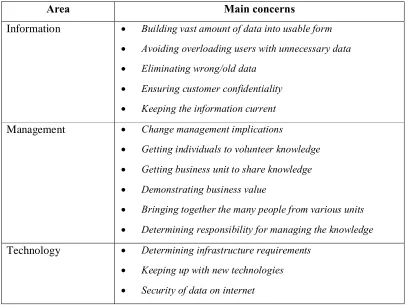
APPENDIX A. The challenges for organisation in harnessing KM in organisation are originated from three continuum i.e. information, management and technology as shown in Table 2.2(Alavi and Leidner, 1999).
Figure 2.3: Information flows for physical resources (McLennan, 2000) Briefs:
-business -operational -design Business
case Post occupancy evaluation
Build Design
22
[image:46.612.131.539.252.558.2]Yet, KM has been little studied in the context of FM despite a theoretical proposition that it is one future (Nutt, 2000) of the discipline or perhaps the future (Price and Akhlaghi, 1999) of the discipline. Indeed, the management of physical space may be the most under-utilised tool in contemporary knowledge management (Ward and Holtham, 2000) and a knowledge perspective may supply the conceptual framework with which occupier of property (facilities users) can understand and measure the business benefits they derive from occupation (Haynes et al., 2000).
Table 2.2: Challenges or key concerns related to knowledge management in the organisation (adopted from Alavi and Leidner, 1999)
Area Main concerns
Information · Building vast amount of data into usable form · Avoiding overloading users with unnecessary data · Eliminating wrong/old data
· Ensuring customer confidentiality · Keeping the information current
Management · Change management implications
· Getting individuals to volunteer knowledge · Getting business unit to share knowledge · Demonstrating business value
· Bringing together the many people from various units · Determining responsibility for managing the knowledge
Technology · Determining infrastructure requirements · Keeping up with new technologies · Security of data on internet
23
(1) it sets out from an ever widening and ill-defined sphere of activity; (2) it still needs greater internal coherence for many working in the field;
(3) it lacks external coherence to many corporate and business organisations, and to educate public at large;
(4) it has too few secure methods of its own to underpin good practice;
(5) it has already begun to make its own distinctive contribution within the management field; and
(6) it is insufficiently supported by an adequate knowledge base.
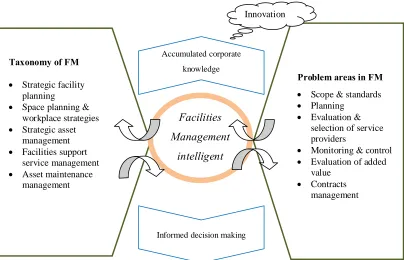
Then (2005) proposes a model for capturing knowledge from FM practice by linking between the identified problem areas in FM practice and taxonomy covering FM knowledge areas or functions as illustrated in Figure 2.4. It was further predicted that the outcomes from practice analysis will form the basis of key corporate learning and innovation.
Nutt and McLennan (2000) stress the two KM knowledge perspectives that need to be considered within FM are those of the corporate organisation and those of the individual employee. New strategic knowledge for FM could become a principal component of corporate knowledge value, as information begins to define market share for products and services around the world; with ICT providing the means for real time management globally.
Innovation
Facilities Management
intelligent
Problem areas in FM
· Scope & standards
· Planning
· Evaluation & selection of service providers
· Monitoring & control
· Evaluation of added
value
· Contracts
management Accumulated corporate
knowledge
Taxonomy of FM
· Strategic facility planning
· Space planning & workplace strategies · Strategic asset
management · Facilities support
service management
· Asset maintenance
management
[image:47.612.130.534.471.731.2]Informed decision making
24
To maintain both tacit and explicit knowledge within the organisation, the sub-processes of KM such as knowledge identification, capture, storage, mapping, dissemination and creation should be harnessed. Eley (2001) urges the facilities manager to maintain good knowledge of what is possible to survive the future. This could be obtained if facilities managers really understand its “professional core” and client expectations and needs. Then (2004) reviews the scope and competencies in three national institutions of facilities or facilities management in North America, Britain and Australia as follows:
(1) Strategic Facilities management (governance and organisational capability) (2) Facility Planning (identification of business needs and response)
(3) Facility Creation/Acquisition (4) Facility Operation
(5) Facility Maintenance
(6) Facility Replacement and Disposal (7) Facility Management Tools (8) Facility Management Systems (9) Business Management
(10) Legislation, Codes, Regulations and Standards
For an effective KM exchange, both antecedents that govern knowledge (culture and technology) must be fully harnessed. An organisation must attract employees who can stimulate innovative behaviour or re-tool its employees in order to acquire the techniques and the principles of creativity. Therefore, FM organisations should always seek employees who think critically, plan strategically and adapt quickly to change (Oxer, 1998 as cited by Kululanga and McCaffer). Similarly, cultural and technological support services must be interwoven into their organisational processes.
25 1) Attitude among workers;
2) Technology used in organisations; 3) Systematic working methods; 4) Support from top management; 5) Knowledge culture in organisations; 6) Thoughtful;
7) Knowledge Creation;
8) Repository system in organisations; and 9) Innovation
FM cannot benefit effectively from KM without the existence of the two constructs of knowledge management. The two constructs act as a whole for effective KM. Thus, FM should intentionally and systematically cultivate knowledge and ensure a successful utilisation from the enabled cognitive capacity of their employees besides integrating the working environment with the services that support KM.
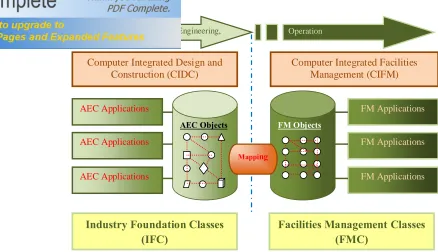
In cultivating the information and knowledge effectively, like other knowledge-based organisations, information technology is broadly exploited by facilities management firms in most of their operations (Barrett and Baldry, 2003). As an example, Yu et al. (2000) contend that in architecture, engineering and construction (AEC) activities, information is created by numerous computer applications throughout the entire life cycle of the project. The association of the information system between design and construction stage and operations stage in the management of facilities is shown in
26
Figure 2.5: AEC/FM information system supported by IFCs and FMCMs. (source: Yu et. al., 2000)
Vischer (2001) suggests that an important reason to conduct a FPE is to develop knowledge about the design and construction decisions such as cost, occupant satisfaction, and physical building performance aspects. Therefore, in order to put into proper perspective the constructs for knowledge management specifically in knowledge mapping, Section 2.4 discusses the methodologies of acquiring, creating, sharing, storing and utilising intellectual assets.
2.2.4Core competencies in facilities management
The competence in facilities management emerged from the “fore parents” industries which draw on the body of knowledge that spans science, engineering, the humanities and social sciences. Despite many competencies required for managing facilities, Atkin and Brooks (2009) suggest that the core competence in facilities management is based on the knowledge in architecture, engineering, construction, technology, management, law and economics which covers:
AEC Objects FM Objects AEC Applications
AEC Applications
AEC Applications
Mapping
FM Applications
FM Applications
FM Applications Computer Integrated Design and
Construction (CIDC)
Computer Integrated Facilities Management (CIFM)
Design, Engineering, Operation
Industry Foundation Classes (IFC)